Translated from the French. Read the original.

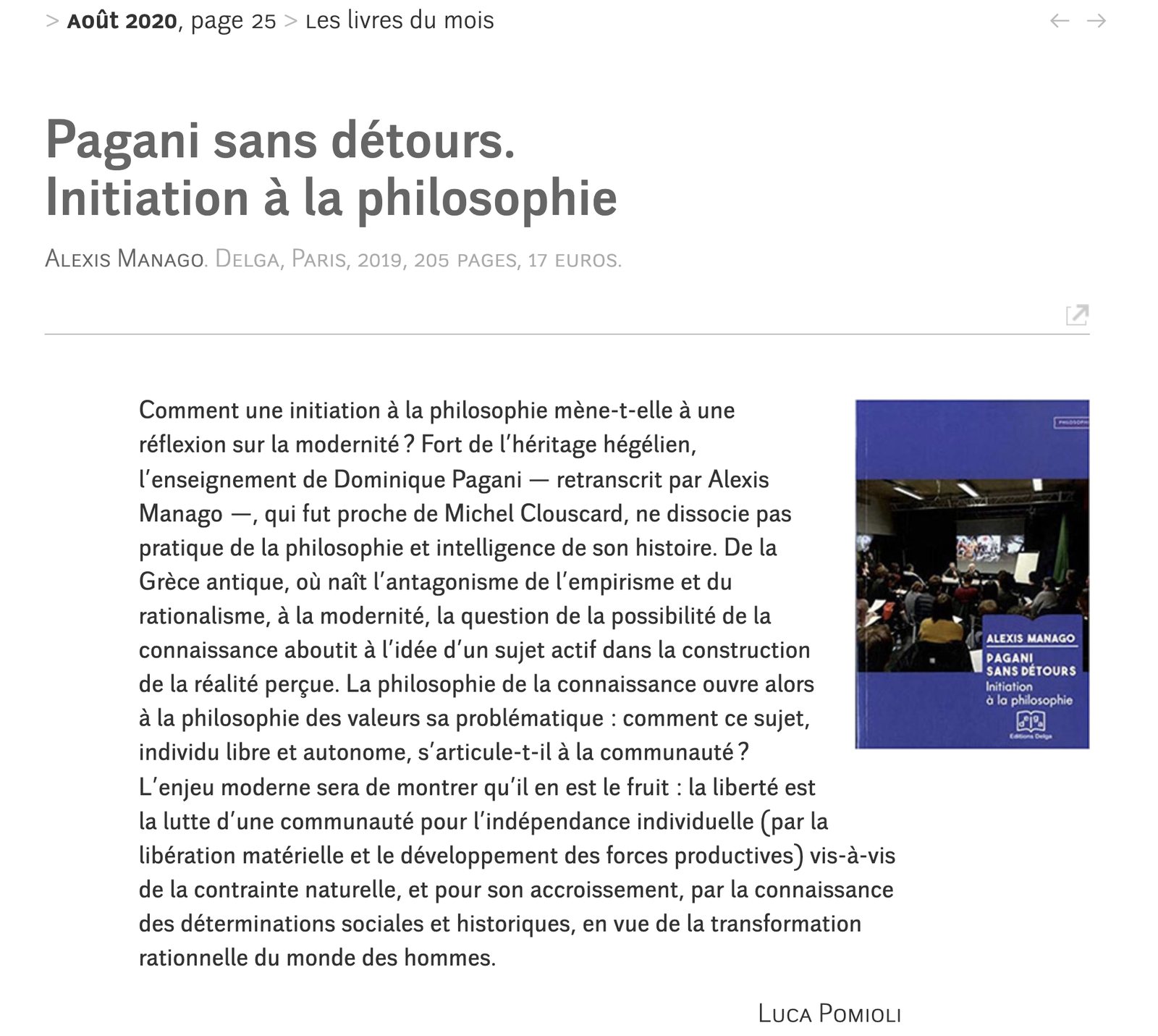
For the first time, a collection of his courses—initially and mainly delivered orally—has been rigorously compiled by Alexis Manago.
A one-of-a-kind instrument, the fruit of a well-tested teaching experience that carries forward the progressive and humanist approach of the people’s university of Georges Politzer, this manual takes the reader, step by step, into the history of thought and the study of its contemporary stakes.
Review in “Les livres du mois”
Luca Pomioli — Le Monde diplomatique, août 2020, p. 25
Review on the JRCF website
Victor — Site des JRCF
Dominique Pagani loves detours. A lot. For this African griot—as though born somewhere halfway between Corsica and Vietnam—has no equal when it comes to taking you where he wants to go, by a thousand paths unknown to his interlocutor. While these charm his listeners when he speaks, it must also be said that the written word is less conducive to this kind of transmission. So inevitably, when this work for 4 hands (by Alexis Manago and Dominique Pagani) finally comes out, a synthesis of several years of classes, you tell yourself that the work involved must have been enormous, and that the wager was a risky one. But, as good Goldmannians on this score, we can say that Éditions Delga and the authors have won their wager, and hands down. The result is quite simply one of the best current introductions to philosophy in general, and to Marxism in particular.
The argument is precise, and goes straight to the point: to demonstrate, without pedantry, the philosophical roots of the emergence of our modernity, and the avenues for action going forward. All of it accessible to anyone and everyone. There is something of the modern Socrates in this crazy old man, who can buttonhole any of his contemporaries on the Parisian agora and lead him to give birth to the truth he carries within him. His problematic relationship to writing is not the least of his resemblances to Socrates. No need to hold a degree in philosophy to understand what is at issue here: just as Howard Hawks liked to make films, as he put it, “at eye level,” Dominique Pagani does philosophy at eye level: or, as Pascal said, “man is full of needs. He loves only those who can fulfill them all. He is a good mathematician, people will say—But I have no use for mathematics: he would take me for a proposition. He is a good warrior—He would take me for a besieged fortress. So what is needed is a gentleman who can accommodate himself to all my needs in a general way.”
But simplicity does not mean simplism. That is the flaw of most “introductions to philosophy”: narrowing the scope of their subject, and therefore its interest, on the pretext of pedagogy. But, as a good Hegelian, Dominique Pagani does not take his students for idiots: it is from them that knowledge will come, not from a professor, an adept of “Marxism of the chair.” The best proof? Even holders of the agrégation in philosophy will find something in it for themselves, for the book teems with 1,000 teaching tricks, which, you can tell, have been tested on generations of students. You will even find in it a few brilliant intuitions, and references forgotten by all the young philosophy teachers—for with Dominique Pagani, the philosopher is never far from the teacher.
There is something of Fichte in this great teacher, who never lets the clarity of the concept take a back seat to the demands of pedagogy—or rather: the two are intimately united, for one cannot think rigorously without being able to transmit one’s thought, and one transmits nothing without demanding of oneself the rigor of the concept. Just as Fichte could at once advance philosophy with titanic strides in the Wissenschaftslehre and convert generations of students to the French Revolution and to the progressive philosophy of Rousseau and Kant in the Lectures on the Vocation of Man, Dominique Pagani continues to advance the thought that runs from Hegel to Clouscard—by way of Marx, Lenin, Lukàcs and Goldmann—while enabling thousands of students to think according to the clarity of the concept, and to emancipate themselves from the comfortable obscurity of the advertising slogan, and of self-help.
So let us salute in this modern Socrates one of the finest philosophy teachers since Fichte, one of those who keep alive in France the great tradition of critical rationalism and materialism, against the School of the lackeys of big capital, who, from Victor Cousin to Jean-Michel Blanquer, use spiritualism, irrationalism and positivism to obscure the thinking of future citizens.
Let us also salute the work, as meticulous as it is colossal, of Alexis Manago, who made it possible for this book to see the light of day, and in a form perfectly suited to its content: short chapters that all converge toward the conclusion. Here we see the result of a collaboration as original as it is successful. In short, a book to be put, without fail, into everyone’s hands, from 7 to 77—or even a little beyond.
Victor, JRCF activist