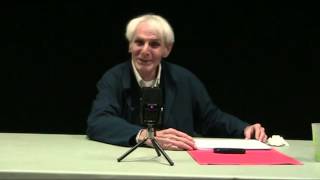
What Dominique Pagani says Dominique Pagani calls Nerval his favourite writer, without making him his hero: this Romantic dreamer who went mad and took his own life serves him as an example of modernity and its dead ends1 . He devotes the 2017-2018 workshop to Angélique. He sees it as an anti-novel built on the search for a book that cannot be found, as a way around the Riancey amendment, and leading to Rousseau's tomb. From the story he retains the legend told by a peasant: by refusing the king's money, Rousseau is said to have ruined the edifice of the monarchy2 . He shows that the scene of the young girls of Senlis and a dream in Aurélia can each be obtained from the other "by multiplying by minus one"3 . In Aurélia, he reads the overflowing of dream into real life, the maternal complex and an anamnesis that blurs at the moment the truth surfaces4 . He also retains the phrase "ignorance cannot be learned" and the "half-drowsiness" of Sylvie, in which he sees the founding state of modernity. He further notes the self-mockery that closes the Romantic cycle, the attention to folk song and to the female voice5 , and borders conceived as surfaces where one can remain.
1 #4.4B Objections à Dominique Pagani 4 Feb 2018 · 0:12 2 Argent, travail, liberté 3 Aug 2019 · 42:57 3 #7 Réponses aux questions (suite) 3 Dec 2020 · 8:07 4 9 #24 "C'est réglé comme du papier à musique !" • Nerval • Baudelaire • 2ème partie 30 Jun 2021 · 44:30 5 Musicosophie 2. De Lévi-Strauss à Nerval à propos de la musique 3 Dec 2020 · 1:12:51 Summary produced automatically from 150 of the passages below, to be reviewed; the numbers link to the moment in the session.
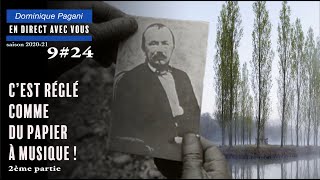
Who is this? Gérard de Nerval (French:; 22 May 1808 – 26 January 1855) was the pen name of Gérard Labrunie, a French travel writer, essayist, poet, and translator. He was a major figure during the era of French romanticism, and best known for his novellas and poems, especially the collection Les Filles du feu (The Daughters of Fire), which included the novella Sylvie and the poem "El Desdichado". Through his translations, Nerval played a major role in introducing French readers to the works of German Romantic authors, including Klopstock, Schiller, Bürger and Goethe. […]
Read the article on Wikipedia Text: Wikipédia , CC BY-SA 4.0 , excerpt · Portrait: Nadar / Adrien Alban Tournachon, Public domain
Series · 4 Oct 2021 #4 Nomad and sedentary - The case of Nerval2:11 Walks and Memories He seems to wander at random in search of lodging, but the female voice and memories divert his route.13:18 Angélique The arrest at Senlis recurs as an invariant of his walking journeys, told with humor.29:12 Daughters of Fire The preface to Dumas shows a rare control and lucidity in one considered mad.58:16 Walks and Memories For the first time he speaks of his mother, dead in Silesia, and links his crises to the mourning that surrounded his cradle.1:28:39 Angélique The original version contains the drowning episode, which Nerval removed out of modesty.Season 9.2 · 9 Jun 2021 9 #23 "Ruled like music paper!" • Bach • Nerval • Lévi-Strauss13:31 Angélique Journalistic account written under the Riancey amendment, a journey longer than the Odyssey within a 50 km radius of Paris.44:20 Angélique The Senlis passage superimposes the decline of the year, of the day, and of the buildings; fascination with the young girls' voices.1:11:46 Aurélia The dream of the ancestor's dwelling is the text of Angélique multiplied by minus one.1:22:30 The Chimeras El Desdichado and Myrtho: hesitation over identity, black grapes mingled with the gold of the braid.2:17:27 His work bends between the mother's tomb and the sage's grave; a unique effort to escape the personal novel. Series · 6 Jun 2021 #3 Nomad or sedentary? - The case of Nerval0:00 Found hanged on the rue de la Vieille-Lanterne after being refused a night shelter, on a frosty night. 15:27 Walks and Memories Commented reading of the search for lodging, from Paris to Montmartre and Saint-Germain, in a tone of humor.56:35 El Desdichado "The prince of Aquitaine with the ruined tower" refers to the destruction of the lodging par excellence, the castle.1:19:55 Walks and Memories His work unfolds like an omega between his mother's grave and Rousseau's.1:27:46 October Nights A young girl's voice at Pantin leads to the obsession with loss and to the universal.Series · 3 Dec 2020 Musicosophy 2. From Lévi-Strauss to Nerval on music54:24 Songs and Legends of the Valois Obsessed with popular song, he asks why it is not given more consideration.1:08:17 Daughters of Fire Worries about the official cataloguing of songs: before writing, man sang.1:12:51 Sylvie Adrienne's song broadens autobiography into the collective; the feminine voice is obsessive in his work.1:16:56 Exemplary of modernity, died in poverty; his absent mother was for him only letters read by feminine voices. 1:21:02 Sylvie Negative relation to the father, eliminated from transmission: "Father, you are hurting me."Season 7 · 17 May 2020 #8 • Harnessed to confinitude53:56 Aurélia Reading of chapter 4: waking dream on the banks of the Rhine; the overflow of dream into real life.59:20 Aurélia Nerval never knew his mother, who died in Silesia; the dream fulfills the desire to reach her tomb.1:08:50 Aurélia The forget-me-not, "Vergissmeinnicht"; the dream blurs at the moment of the secret, without deliberate lying.1:11:31 The Chimeras Artémis and El Desdichado speak of the dead woman; the maternal village is called Mortefontaine — death at the source.1:16:16 The Chimeras Antéros: the return of the repressed in the gentle Gérard, rage against the victorious god, Abel and Cain.Season 7 · 26 Apr 2020 #6 • Harnessed to confinitude13:49 Aurélia Clinical document where he records his visions; in this excerpt everything is red.17:15 Aurélia The dream of the people of the mountain, white garments embroidered with pink: the middle term.51:19 Aurélia Locked in Dr Blanche's clinic, he sees against a mirror background universal history written in traces of blood.1:08:01 Artémis His mother, dead in Poland, explains the dismembered female body; mother and beloved merged.1:14:21 Aurélia Political lost paradise of a pure people who have overcome ignorance; he weeps as at the memory of a lost paradise.Series · 23 Mar 2020 Interview with Dominique Pagani: Introduction to the upcoming workshops0:00 Angélique His discretion means that he reveals the link with the Odyssey only on the last page of Angélique.4:11 Sylvie The image of the vine-branch and the rosebush, taken up from the Chimères, reveals a signifier beneath the appearance of realism.13:30 Angélique Summary and reading of the story: unfindable book, censorship, Angélique's manuscript, detour through Ermenonville.47:22 The Chimeras He avoids Mortefontaine, the maternal village; his mother is buried in Silesia; "La Treizième revient" speaks of death or of the dead woman.1:15:40 Sylvie The opening of Sylvie describes an undecided generation, taking refuge in the poets' ivory tower.Season 4 · 16 May 2018 #4.8 Angélique (by Nerval)8:24 October Nights His mother, who died in Silesia, explains his sensitivity to the feminine voice, detailed in the chapter "Pantin."12:56 Walks and Memories His last completed text, in which he mentions his mother for the first time: he never saw her.20:22 Aurélia Commentary on a dream in which the maternal figure is approached as never before, then blurred.24:30 Angélique The narrative moves from Paris toward the Valois, the point where the Île-de-France, Picardy and the Valois meet: an author of borderlines.37:14 His death without a home, on a freezing night, and his last word to his aunt: "the night will be black and white." Season 4 · 12 Apr 2018 #4.7 Angélique (by Nerval)4:33 Translator of Faust at 19, a conduit of Romanticism, a freelance writer for a long time, he takes years to say "I" in his prose narratives. 27:30 Angélique Reading of the eleventh letter: as soon as one leaves Rousseau's tomb, the setting opposes the walk.49:30 Angélique Reading of the last page: the chain of imitations leads to the Odyssey, then to the hell of the living and to the coats of arms.1:27:25 Isis The end of Isis presents the cult of an immolated god mourned by a deified woman, of which the Passion is only a variation.1:43:20 Sylvie Visit to the temple of philosophy and to Rousseau's tomb: the thirst for knowledge will remain eternal.Season 4 · 15 Mar 2018 #4.6 Angélique (by Nerval)0:52 Angélique First tale in Les Filles du feu, considered disjointed; an anti-novel built on the search for an untraceable book.10:20 A pen name that 'motherizes' him: Mortefontaine is the mother's country, she who died in Poland. 14:49 Sylvie Reading of the passage on the period of the 1840s: the generation of disenchantment, between romanticism and modernity.1:09:58 Angélique Defends the peasant legend: Rousseau ruined the royal edifice founded by Henri IV.1:16:00 Journey to the Orient The story of Adoniram repeats the same triangle as Henri IV, Gabrielle and Rousseau.Season 4 · 12 Feb 2018 #4.5 Angélique (by Nerval)7:06 Angélique Text first published as a serial, whose chapters are letters; a route through three places, with digressions and apologies.31:00 Angélique The arrest in Senlis; Nerval, whose real name is Labrunie, has an uncertain identity.48:29 The False Salt-Smugglers The drowning passage, removed from Angélique, contrasts the ground that gives way with the ground that bears.53:20 Sylvie The same drowning, where the rescuer is the big curly-haired boy, foster brother and rival.1:00:43 Aurélia The dream of an ideal city on high shows that the vertical dimension is an instance of madness.Season 4 · 15 Jan 2018 #4.4 Angélique (by Nerval)2:26 Angélique The scene of the girls of Senlis says the same thing as Aurélia in inverse fashion; the real evaporates there into symbolic function.3:30 Aurélia Text wrested from bouts of madness, written on Dr. Blanche's advice and found on him at his death.50:24 Angélique The fourth letter: the finding of Angélique de Longueval, who recalls the mother, then the pull toward the boundary of three regions.1:04:12 Angélique The banks of the Rhine restore his voice to him; he overlays Watteau's Cythera onto the ponds of the Oise; he has seen the gibbet of Cythera.1:36:27 Angélique The ending likens the Abbé de Bucquoy to Ithaca; the novella moves from maternal repetition toward Rousseau's tomb.Season 4 · 11 Dec 2017 #4.3 Angélique (by Nerval)5:12 Angélique Recap of the comparison between the passage about the young girls of Senlis and a dream from Aurélia.7:18 Daughters of Fire In the preface to Dumas, he refuses to have his work reduced to madness and wants to be judged on the expression.20:55 Aurélia The dream inverts the Senlis text term by term; this rigor need not be conscious.1:14:41 Angélique The goal of the story is Rousseau's tomb, against the pull of the maternal tomb.1:37:56 Sylvie There is in him the double temptation of sublimated love and eros; Pandora combines both.Season 4 · 12 Nov 2017 #4.2 Angélique (by Nerval)0:00 Angélique Text published as a serial in Le National in 1850, under the title Les Faux-Saulniers, then taken up again in Les Filles du feu in 1854.5:59 Daughters of Fire The preface to Dumas responds with irony to those who had believed him dead then mad, and shows a madman in full control of his discourse.13:17 El Desdichado His best-known sonnet was left as a calling card: in his work, major and minor works cannot be distinguished.1:30:54 Aurélia The dream of the ancestor's dwelling takes up the Senlis scene while inverting it term for term, as in a mirror.1:40:07 Sylvie Adrienne's song in the round, a fresh and veiled voice, illustrates his fascination with the feminine voice.Season 4 · 18 Oct 2017 #4.1 Angélique (by Nerval)11:59 Long classed among the minor romantics and the Bousingots; he is said to have swung on the chandelier at the battle of Hernani. 13:27 Angélique A narrative first entitled Les Faux Saulniers, renamed upon the arrival of Louis-Napoléon; a text that only opens up on a second reading.36:41 Sylvie He condenses in one page the era of ebb that Musset describes over an entire volume.53:37 The Chimeras Widower of his mother, theater chronicler, psychotic; Les Chimères is the moment of madness, which is not pejorative from a creative point of view.1:22:14 Angélique The only text in which he overcomes the personal novel to lead to Rousseau's tomb: an opening of repetition toward liberation.Season 9.2 · 30 Jun 2021 9 #24 "Ruled like music paper!" • Nerval • Baudelaire • Part 216:11 Aurélia Angélique and Aurélia superimposed show an antisymmetry; Nerval belongs to romanticism but exceeds it.26:34 Aurélia The dream on the banks of the Rhine: every detail refers back to the mother's tomb and the maternal complex.39:02 The Lorelei One of his first great prose works, a travel narrative.44:30 Aurélia Nerval prevents himself from going through with the anamnesis: an amnesiac force blurs the truth that is surfacing.59:30 Sylvie He turns away from the mother's tomb toward Rousseau's grave, collectivizes his problem, and returns to the Enlightenment.Talks · 18 Jun 2016 At the bistro with Pagani: part 132:46 Aurélia In full delirium, Nerval cannot return to catechism: 'ignorance cannot be learned.' He forbids himself any regression.49:52 Angélique Starting from an amendment against the serial novel, Nerval raises the question of the boundary between history and the novel.1:03:23 His relationship to his father, his mother's grave in Silesia, his suicidal discretion; he precedes Baudelaire, notably on Wagner. 1:08:21 Daughters of Fire Angélique, eclipsed by Sylvie, names Ulysses; the journey on the Rhine makes him creative; he is the translator of Germany into France.Season 12 · 21 Apr 2024 Saving the saviour? Redemption - the end of the cycle or its new beginning?1:01:35 He speaks of the Perceforest. 1:26:55 Aurélia On his doctor's advice, he wrote down his dreams.1:29:55 Aurélia The dream of the charnel house where universal history is written in traces of blood: the excess of red.1:35:57 Aurélia The celestial family dressed in white embroidered with pink, which inspires a love without desire.Season 10 · 24 Feb 2022 #10 UKRAINE: From the problem of "Edges" to the unleashing of war4:55 Took up the title Lorelei from his friend Heine for one of his first prose publications. 16:24 Walks and Memories Reading of the passage on Célénie, a nymph whose dress hem is wet at the edge of the ponds of Commelles.36:28 Letter to Georges Bell Touching the banks of the Rhine, he finds his voice again and composes a sonnet; Aurélia also begins on the banks of the Rhine.55:02 He was one of those for whom borders are not lines but surfaces where one can remain. 2:19:11 Nerval's border-space is like an airlock. Season 7 · 18 Apr 2020 #5 • Harnessed to confinitude7:41 Aurélia Aurélia, written on his doctor's advice, describes the outpouring of dream into real life; Nerval suffers from what is today called bipolarity.12:52 Aurélia Reading of the extract: the soul floats uncertain between life and dream, a characteristic trait of the modern subject.26:02 Aurélia He seeks help in religion but shows that ignorance cannot be learned, and hopes for the marvelous city of the future.34:15 Champion of mysticism, he answers that he has at least twelve religions. 58:47 Mortefontaine, his mother's village, the most tragic toponym in his work. Season 6 · 29 Mar 2020 #6.6 • The Logic of the Subject in the face of the reconstitution of Nazism6:28 Aurélia He compares his experience of madness to a descent into hell; he compared Saint-Eustache to a cetacean.12:13 Sylvie The first sentence shows self-mockery once Romanticism goes out of fashion.44:05 Songs and Legends of the Valois He was mad about popular song.1:45:26 His formula: make the griffin of the sea rise and the crane of the sky descend. Talks · 3 Aug 2019 Money, work, freedom28:02 Sylvie The narrator loves an image; Nerval mocks the romantic hero and shows the ebb into dream after 1848.32:29 Sylvie Nerval becomes a historian: not killing love with gold is "an idea from another time," a recent progress.42:57 Angélique By refusing the hundred louis, Rousseau ruined the edifice founded by Henri IV; his immortal image remains standing on the ruins.Season 5.1 · 24 Oct 2018 #5.1 The philosopher's Odyssey: Revolutionary thought6:25 Pandora Nerval describes a woman there through her ribbons and adornment, as Rousseau does.12:01 Angélique Nerval grants the underlying truth of the peasant who makes Rousseau the rival of Henri IV.1:22:24 Nerval, without the means of the aristocrats, embodies the fate of the middle classes. Season 3 · 1 Aug 2017 #3.3 From Ulysses to Daedalus45:56 El Desdichado Modulating on Orpheus's lyre the sighs of the saint and the cries of the fairy: a model for not choosing.1:21:38 Antéros He takes the side of the pagan gods and of Cain against the victorious god; he assumes both to the point of madness.1:24:23 El Desdichado The three plunges into the Cocytus are his three internments; the siren and the Acheron are not Christian.1:37:14 Torn at once between the saint and the fairy. Series · 29 Jan 2016 What is to be done? 1/39:37 Angélique This story from Les Filles du feu, a pretext for the search for a book by the abbé de Bucquoy, leads to Rousseau's tomb; it is for him the longest journey in all of literature.13:02 Angélique He reports the legend of Rousseau, Henri IV and Gabrielle, then judges it more profound than one might think.17:38 He pointed out, before Baudelaire, the radical novelty of Wagner. 25:20 Journey to the Orient The same triangle is found there with Solomon, the Queen of Sheba and the blacksmith.Season 12 · 4 Jun 2024 The matrix of all illusion: the past lived as present1:25:22 First to devote a cult to Wagner, which is less well known. 2:10:37 Artémis More fixed on his mother than Perceval and Parsifal, he died of it; the sonnet expresses love for the dead woman.2:12:44 Angélique Angélique manages not to carry fidelity as far as fixation.2:18:45 His phrase "banished from joy." Talks · 29 May 2023 Dominique Pagani: From the debauchery of sense to the orgy of sentiment1:09:40 At Ermenonville, an era when even the natural was affected. 1:39:24 Songs and Legends of the Valois Reports the song "Si j'étais hirondelle."1:58:10 Angélique Rousseau's triangle: by refusing the pension, Rousseau ruined the edifice of the Bourbons.2:04:05 In Vienna, a bejeweled woman: one does not know what lies at the center of "all that." Series · 2 Feb 2021 Musicosophy 13. Mozart restored26:54 Letter to Gautier from Vienna: "all that is so well arranged" clarifies Rousseau's "all that." 1:18:46 Angélique The anecdote of the keeper's son at Chaalis founds Rousseau's triangle.Series · 15 Jan 2021 Musicosophy 9. Romantic irony and the Vinteuil sonata10:58 First in France to integrate the dream as a poetic and literary genre. 17:32 Walks and Memories He speaks of himself with modesty: each person's experience is the treasure of all.36:11 Sylvie His self-mockery, with his "suitor," makes him, along with Heine, an end-point of romanticism.1:06:51 French representative of the tragic outcome of romanticism. Season 9.1 · 23 Oct 2020 #2 Benefits and harms of amnesia...3:00 Daughters of Fire In the preface to Dumas he says his sonnets would lose their charm if explained, and calls himself mad with perfect self-control.12:47 Angélique He shifts from a journalistic to a grave tone on the day of the dead and apologizes for a melancholy already out of fashion.Season 7 · 4 Apr 2020 #3 • Harnessed to confinitude38:11 Admirer of Senancour; immortalized Ermenonville. 1:25:06 Songs and Legends of the Valois Berlioz's lyricist, he sees in popular song the most complete fusion of text and music, a tragedy in miniature.1:40:09 Aurélia Account of his madness written on his doctor's advice, compared to a descent into hell.Season 6 · 19 Feb 2020 #6.5 • The Logic of the Subject in the face of the reconstitution of Nazism11:44 His imperative as a poet, "to make the griffon rise from the sea and the crane descend from the sky," expresses the movement of the high and the low. 54:48 Sylvie At the start of Sylvie, he mocks his romantic youth "in full suitor's attire."Season 5.2 · 29 Jul 2019 #5.9 Kafka: An Imperial Message23:11 Octavie Speaks of the islands of the Gulf of Naples in "Octavie."57:28 Angélique The little girls singing at Senlis in the setting sun, in autumn, amid ruins: a gentle melancholy.59:29 El Desdichado "The Prince of Aquitaine at the ruined tower," a symbolic resonance of the towers of Senlis.1:00:49 Aurélia The dream is the exact inverse of Angélique: an enlarged hall, springtime, great ladies and a vibrant voice.Season 4 · 14 Jun 2018 #4.9 Angélique (by Nerval)8:46 Once considered a minor Romantic, though two of his pages resolve a question that runs through contemporary reflection. 1:10:31 Angélique He presents himself as a reporter searching for a book about the Abbé de Bucquoy, then shifts into the symbolic with All Souls' Day and the Senlis scene.1:19:07 Aurélia The dream of the ancestor's dwelling inverts the Senlis scene term by term, with a rigor that allows prediction.1:19:27 The Illuminated Ones Collection in which the story of the Abbé de Bucquoy appears.1:20:29 El Desdichado "The prince of Aquitaine at the ruined tower": the razed building, the opposite of the enlarged dwelling in the dream.Season 4 · 4 Feb 2018 #4.4B Objections to Dominique Pagani0:12 Angélique A romantic dreamer who ended mad and suicidal, taken as exemplary of modernity and its impasses; his favorite writer, but not his hero.2:32 Not quite apolitical: "I have only ever been in opposition"; his relation to Rousseau is a constant. 3:25 Sylvie Sylvie, autobiographical, ends badly: he does not free himself from the personal novel.Season 4 · 24 Sept 2017 #4.0 Dominique Pagani, Presentation of the 2017-2018 workshop: Nerval's "Angélique"5:56 Angélique Angélique, the first of Les Filles du feu, is a neglected story that resists reading; it has neither the density of Sylvie nor the flashes of Aurélia.6:15 Sylvie Sylvie is a miracle of transparency and balance, wrested between two stays in a psychiatric clinic.6:54 Aurélia Aurélia is somewhat the account of his madness, with its oneiric flashes.8:11 Angélique Around the quest for an unfindable book, published as a serial in Le National, he builds a kind of anti-novel, very modern for its time.10:53 The Chimeras Les Chimères often echo Les Filles du feu; he recommends the Folio edition that brings the two together.Series · 1 Feb 2016 Hegel on the Beach 1/51:37:08 Translator of Faust at age 19. 1:45:43 Gone mad and having committed suicide, doubly a German Romantic; the most German of French authors. 2:20:39 "Ignorance cannot be learned": a phrase that sums up the irreversibility of knowledge. Series · 29 Jan 2016 What is to be done? 2/30:00 Angélique Brings out around Rousseau the triangle of the king, the challenger, and the woman.9:02 Angélique Works around the Riancey amendment through an anti-novel centered on a missing book; ghostwriter for Dumas in the theater.Series · 23 Dec 2014 I for Island10:18 Sylvie No one has thought this place as he has; he takes the side of art against nature and of the thirst for knowledge.13:27 Sylvie Facing the island, he deplores the forgetting of the sage's lessons that the fathers knew.Season 12 · 14 Aug 2024 TOO LATE?1:05:11 Angélique The search for the Abbé de Bucquoy's book ends like Ulysses's quest: proof that the two quests are the same.Season 12 · 30 May 2024 From fidelity to grace - From substance to Subject1:00:25 Aurélia The white garments turn out to be colored, then sewn with pink: pink, the middle term between white and red.1:16:28 To those who reproach him for having no religion, he replies that he has at least twelve. Season 12 · 22 Dec 2023 Birth and carnage - The Massacre of the Innocents16:57 Gautier's schoolmate at the Lycée Charlemagne. 1:32:40 Aurélia Dream of an ideal society where the white tunics in fact hold all the colors of the prism.Season 11 · 22 Jul 2023 Worldliness in Clouscard - The world as "cunning of reason"2:16:47 "Deliver the crimson flowers to the flowing streams": reconciling the temporal and the permanent. Season 11 · 18 May 2023 Worldliness in Clouscard, or privileges for all54:26 Journey to the Orient For him, the goal of the voyage is the voyage itself.1:25:08 The peasant who mixes up Rousseau and Henri IV's favorite speaks truly: Rousseau ruined the Ancien Régime. Season 11 · 26 Apr 2023 Worldliness in Clouscard, or "The dominant ideology"33:24 The Image-Maker of Harlem He dreamed of glory in the theater; the tension of this worldly stake played a part in his madness.Season 11 · 18 Mar 2023 A SPRINGTIME OF THE PEOPLES?1:32:32 Walks and Memories The quest for a dwelling: "I shall never be a property owner."Season 11 · 17 Feb 2023 Roots or migration? From analytical reverie to current events, from Hölderlin to the war44:35 Walks and Memories Rêveries analytiques in two parts: "nomad or sedentary?" then "nomad and sedentary."52:50 Walks and Memories He seeks lodging while moving; in Senlis, taking refuge in a caravan, he glimpses the solution of inhabiting what moves.53:30 Journey to the Orient A writer of travel who speaks neither of the pyramids nor of the sphinx.Season 11 · 12 Dec 2022 Hesitation fascinated by hearing and by sight: Siegfried and Perceval1:22:18 Artémis "Love him who loved you from the cradle to the grave": fidelity to the mother, at the end of which lies a corpse.Season 10 · 10 Jun 2022 #14 Caves of Yesterday and Today - From Plato to modernity1:27:59 Aragon knew him admirably. 1:38:56 Making the crane descend from the sky and the griffin rise from the sea: a double movement that might well be the philosopher's task. Season 10 · 24 Nov 2021 10#5 The figure of Antigone, such as into herself at last...1:37:52 Myrtho Cited in connection with the Orient as the morning of the day.1:47:55 Aurélia The dream of the too-fertile garden that turns back into desert.2:18:28 Walks and Memories For him, borders are spaces; the Roma caravan allows one to be both nomadic and settled at once.Season 9.2 · 28 Apr 2021 9 #20 From SIGNAL to SIGN • Einstein22:12 Aurélia Arrested at night in Paris, he fears crushing the police officers with his supernatural strength: megalomania as a pathologically reinforced identity.26:02 Myrtho The line about the pale hydrangea and the green myrtle unites the Christian saint and the pagan fairy.Season 9.2 · 14 Apr 2021 9 #19 Twilight of the Gods, or from repetition to liberation • Part 215:40 Evokes a young Englishwoman swimming in the bay of Marseille; in the author of "the cave where the mermaid swims," nothing is accidental. 1:50:28 Walks and Memories His last completed text, the summit of his poetic prose, will be discussed shortly; it ends with an allusion to Mignon.Series · 25 Mar 2021 Musicosophy 18. What is musical in music58:49 Sylvie The "half-slumber" in which all his youth passes again.1:19:35 "To deliver the crimson flowers to the current of the streams": an image of what is musical in music. Series · 24 Jan 2021 Musicosophy 11. Modal and tonal music44:29 Hated having his literature reduced to his madness. 1:32:32 Songs and Legends of the Valois Raises the question of popular song and its tonality; phonological remarks on the elided liaison z.Series · 17 Dec 2020 Musicosophy 7. The Greeks, myth and music44:13 Sylvie Placed above Proust: in anamnesis he goes beyond personal life and discovers the historical depth of the Valois.57:06 Homage to his collective primal scene. Series · 15 Dec 2020 Musicosophy 6. The Jazz Variation... by Beethoven57:59 Verses about bitter lemons and citrons cited in connection with the citron. 1:41:39 Sylvie Adrienne's song renders in words the detail of the stanzas' musical expression.1:43:38 "Deliver the purple flowers to the current of the streams," isomorphic to the Schubertian letting-go. 1:46:54 His obsessions vary like themes; "the snow of Cathay falls on the Atlantic." Season 9.1 · 10 Dec 2020 #8 Benefits and harms of amnesia...1:01:57 "Ignorance cannot be learned." 1:11:24 Aurélia The dream at the maternal uncle's approaches the memory of the dead mother, then grows blurred: anamnesis and refusal of the trauma.Series · 3 Dec 2020 Musicosophy 1. Schubert and the master singers11:10 Writes to Houssaye that only a prose writer remains in him and gives the flowers of poetry to the current of streams. 56:38 His formula about streams is taken up to describe Schubertian melody. Series · 3 Dec 2020 Musicosophy 3. What is called modern music?1:19:55 His "half-drowsiness" characterizes the inaugural state of modernity, between night and day, waking and sleep. Season 9.1 · 3 Dec 2020 #7 Answers to questions (continued)8:07 Angélique A passage from Angélique and a dream from Aurélia are obtained one from the other by multiplying by minus one: autumn against spring, decline against light, adult against child.Season 8 · 23 Jul 2020 #15 • Return to the logics of the subject6:40 Angélique Before Rousseau's tomb at Ermenonville, he reproaches his generation for having been too weak to make use of the "milk of the strong."Season 8 · 9 Jul 2020 #13 • Return to the logics of the subject25:23 El Desdichado If freedom replaces the good, the sun can go out: the "black sun of melancholy."Season 8 · 11 Jun 2020 #10 • Return to the logics of the subject6:21 Example of the poète maudit, haunted by madness and suicide. 29:52 October Nights Entering a Masonic meeting in Pantin, he tells himself that poets are "of the building trade," like Amphion.Season 8 · 30 May 2020 #9 • Return to the logics of the subject6:32 Aurélia In his dream on the banks of the Rhine, everything becomes blurred at the moment he is closest to his truth, near the forget-me-not, "do not forget me."53:14 Antéros His verses on Abel's pallor and Cain's redness unite red and white.1:02:15 He is right to say that ignorance cannot be learned. Season 7 · 5 May 2020 #7 • Harnessed to confinitude29:25 Recalling the previous session on Nerval. 37:29 Aurélia His vision of carnage, where red overwhelms everything, echoes Jünger's intoxication of roses and blood.Season 7 · 11 Apr 2020 #4 • Harnessed to confinitude22:32 The neo-positivists' equations will not say why he committed suicide. 1:15:15 In the midst of a crisis of madness, he says that ignorance cannot be learned: one cannot deliberately not know. Talks · 29 Sept 2019 The religion of Money17:40 Sylvie The narrator, now rich, refuses to kill love with gold, "an idea from another century": this is modern consciousness.41:16 "We poets, always poor, and often poor poets." Season 5.2 · 30 Jun 2019 #5.8 Nature or Landscape?50:29 Before Rousseau's cenotaph: "you had given us the milk of the strong"; we have forgotten your lessons. 1:46:29 "Ignorance cannot be learned." Season 5.2 · 2 May 2019 #5.6 Nature or Landscape?39:17 A creative Germanist who translated Faust at 19 and some of Jean Paul's dreams. 1:06:08 Angélique A great walker; his "slow obstinacy" foreshadows the tempo of Schubert's andante.Season 5.2 · 25 Jan 2019 #5.4 Introduction / Nature or Landscape?45:43 Aurélia Reminder of the cycle: comparing a dream from Aurélia and a description of Senlis would open a passage between the human sciences and the sciences of nature.Season 5.1 · 21 Nov 2018 #5.2 The philosopher's Odyssey: Revolutionary thought7:20 Sylvie The walker arrives at Rousseau's tomb and greets him as the last echo of ancient wisdoms, already forgotten by 1850.Talks · 2 Jul 2018 The Phenomenology of Spirit1:05:06 A double failure, madness and hanging: he sees signs everywhere and embodies the deadliest form of modernity. Season 2 · 1 Aug 2017 #2.8 Between crisis and war: Philosophising?42:30 Sylvie Cites the formula of the Eleusinian mysteries "I have eaten from the drum and drunk from the cymbal."54:28 Aurélia The dream of the double who marries the beloved woman: himself inverted, an image of paranoia; his last note to his aunt.55:40 El Desdichado The disinherited one, "the shadowed, the widower, the unconsoled."Season 3 · 1 Aug 2017 #3.5 From Ulysses to Daedalus19:40 October Nights The first to speak of Edgar Poe, in passing.47:17 The Black Spot Youthful poem on the black spot after gazing at the sun.1:10:19 Sylvie Half-drowsiness makes one see, in a few instants, a whole period of life.1:34:02 "To make the sea's griffin rise and the sky's crane descend": uniting high and low. 1:49:48 The black sun of melancholy is not foolish. Season 3 · 1 Aug 2017 #3.1 From Ulysses to Daedalus1:26:28 Passage listed. 1:36:24 Journey to the Orient Story of the Queen of the Morning and Adoniram; he dreamed of a play on the meeting of Solomon and the Queen of Sheba.Season 2 · 1 Aug 2017 #2.6 Between crisis and war: Philosophising?27:33 His prose is musical: he counts the N's in a sentence about a nymph crowned with parsley and water lilies. 54:34 "Ignorance cannot be learned." 1:56:11 His feminine ideal, "bionda e grassotta." Talks · 2 Aug 2016 Tribute to Jacques D'Hondt (2)18:59 Daughters of Fire He quotes Hegel in the preface; in Vienna, the censor tells him that the censorship office is the freest place in the Empire.Talks · 19 Jun 2016 At the bistro with Pagani: part 26:35 Angélique Keeps haunting Rousseau's tomb and ends up granting truth to the popular legend of Rousseau and Gabrielle d'Estrées.13:07 Returns to Rousseau's tomb because he knows there is a solution there. Season 2 · 10 Mar 2016 #2.4 Between crisis and war: Philosophising?9:38 His favorite: the first accursed poet, "the most German of French romantics," rehabilitated late. 57:57 Sent to Holland to monitor the counterfeiting of French books. Season 2 · 18 Feb 2016 #2.3 Between crisis and war: Philosophising?1:06:44 Cites Senancour among the illuminati of the Ermenonville suppers who wanted to reform a society grown old on the eve of the Revolution. Season 2 · 15 Feb 2016 #2.1 Between crisis and war: Philosophising?1:46:04 His favorite French prose writer; quotes Pascal and the proverb of the broken mirror: "these maxims are consoling." 1:50:08 In a triangle of madness with Hölderlin and Nietzsche. Series · 2 Feb 2016 Hegel on the Beach 4/551:31 Sylvie The daydream in which he is the only boy in the ring: the dream ignores the other self-consciousness.1:52:11 Quoted: 'ignorance is not learned.' Season 1 · 28 Jan 2016 #1.8 Between crisis and war: Philosophising?34:15 El Desdichado The "black sun": with the modern world, everything is reversed.Season 1 · 11 Dec 2015 #1.7 Between crisis and war: Philosophising?37:32 El Desdichado The "black sun of melancholy"; poem written between two crises and internments at Dr. Blanche's.Series · 1 Jan 2015 R for Reverie3:43 Sylvie The "half-drowsiness" of the famous passage in Sylvie designates precisely a second state, a quarter of sleep.Series · 29 Dec 2014 O for Opposition3:31 Angélique The short story is an anti-novel built on pretexts; Nerval resists in it the quest for the dead mother to move toward Rousseau's grave, toward the collective stake.Series · 20 Sept 2014 #2 Rousseau, a world that begins14:51 A reader of Rousseau, he reports the anecdote of Chaalis: by refusing the louis from Pompadour, Rousseau ruined the monarchical edifice. Series · 6 Jul 2026 From Plato to Proust - Readings on the Spot47:26 Close to the German Romantics, he knew madness and suicide. Season 13 · 29 Aug 2025 STATE AND STATE APPARATUS - The conflict between public and private4:41 Nerval's country, its forests and its autumns Season 13 · 9 Aug 2025 The repression of the subject in bourgeois civil society58:17 Cited with Paganini among the culture that some Marxists neglect. Season 13 · 25 Jul 2025 Naturalist ideology / Answers to questions - Dominique Pagani1:15:19 His prose has been used to show that there exists a rigorous logic of subjects. Season 13 · 27 May 2025 Flagrante Delights57:19 Maxim "ignorance cannot be learned," which Semper eadem seems to contradict. Talks · 7 Feb 2025 [INTERVIEW] DOMINIQUE PAGANI - Michel Clouscard and the betrayal of May 6816:36 Nerval, dream and poetry, which sectarian Marxists do not discuss. Talks · 2 Dec 2024 "Napoleon, or the reasons of cunning", with Dominique Pagani14:18 Speaks of skepticism and the wild orgies of the Directory. 1:00:34 In a mystical delirium, identifies with the Eaglet. Season 13 · 2 Dec 2024 Evil, or the "unknowing" of the self1:01:08 Cited for the "deceptive young girls" in the woods of Mortefontaine. Season 13 · 20 Sept 2024 Sickness, misfortune, evil28:01 Example of a romantic ending in madness and suicide. 49:45 Devoted a text to Cagliostro. Season 13 · 2 Sept 2024 Clouscard: The metamorphoses of class struggle31:14 Making the griffon rise from the sea and the crane descend from the sky: a prodigious attempt at balance. Season 12 · 1 Apr 2024 The quest for the Grail, sanctimony or sacrilege?1:27:19 Red on white, already seen with Nerval. 1:59:04 "Ignorance cannot be learned." Season 12 · 18 Feb 2024 Secularism, the truth of religion?1:12:13 Mad and suicidal: a figure of the mal du siècle. Season 12 · 4 Jan 2024 I am not who you think I am - The elusive identity12:12 Author of the text used for The Damnation of Faust. 1:02:30 Walks and Memories His last text begins with the difficulty of finding lodging in Paris: a quest for a dwelling, a nomadism.Season 12 · 12 Dec 2023 "I is another", or contradictory identity27:49 A fragment quoted as an avatar of beauty. Series · 29 Sept 2023 Kleist "On the Marionette Theatre" - Pagani - Readings on the Spot5:04 He is not known only for his internments, just as Kleist is not known only for his suicide. Season 11 · 3 Sept 2023 Worldliness in Clouscard: Desiring what? Through whom??48:35 "Ignorance cannot be learned": one cannot act as if the Revolution had not happened. 50:26 Initiator of the prose poem before Baudelaire; he spoke of Poe first. Season 11 · 9 Jul 2023 Worldliness in Clouscard - The clash of worlds?9:56 Knew Janin; Baudelaire quotes him in his letter. Season 11 · 29 Jun 2023 Worldliness in Clouscard: Aragon and the positivity of the negative39:04 To speak of Nerval is to speak of the universal. 49:15 Angélique Series showing that scientific rigor can be introduced into the human sciences.Season 11 · 3 Mar 2023 War, neo-fascism: libertarian liberalism45:06 Nerval's country, the setting of the walks with Clouscard. Series · 31 Jan 2023 Mallarmé, or class struggle on the lawn - Readings on the Spot0:49 Precursor of poetic prose. Season 11 · 14 Jan 2023 Beware of misreadings!! Clouscard and the ideology of desire, in homage to Le Précepteur50:09 Sylvie Evokes the wild orgies of the Directoire and the elegant vice of the Regency.Season 11 · 19 Oct 2022 "Speech is the best and the worst of things" (Aesop)20:24 Golden Verses Lines quoted on the gaze in the blind wall and the pure spirit beneath the bark of stones.48:46 A commentator sees in it his true domain, the one that gives unity to everything else; subject of the next session. Season 10 · 23 Jun 2022 #15 Nietzsche: Philosophical or musical relevance? Answers to questions30:02 His relationship to Aquitaine, land of the Cathar heresy, studied by Meschonnic. 1:06:27 Madness and suicide at once: a serious pathology of romanticism. Series · 20 May 2022 Dominique Pagani - Who is hiding beneath the surfaces? Aesthetics and politics25:41 His father was a military doctor in the Grande Armée, where he lost his wife. Season 10 · 7 Apr 2022 #12 From Kafka to Proust, the dialectical passage from the intermezzo to the perpetuated edge28:59 He cites a verse on the heavens shining beneath Iris's scarf. Talks · 19 Mar 2022 Dominique Pagani - Hölderlin, poetry and politics13:36 Guide to the German romantics, struck by madness and suicide. Series · 5 Mar 2022 Panzer-philosophy against the cogito: neo-fascism or the ideology of nature. Heidegger/Descartes36:14 Walks and Memories He read it in the "analytic reveries."Season 10 · 10 Feb 2022 #9 PICTURES AT AN EXHIBITION: Art, seen from here or from the other side?35:24 Reminder of previous sessions on Isis and on his dreams. 1:31:45 Golden Verses "A pure spirit grows beneath the bark of stones": animism.Season 10 · 20 Sept 2021 Presentation of the 2021/2022 workshops - Association membership12:36 Walks and Memories The analytical reveries have followed in his footsteps, with a reading of Promenades et souvenirs.Season 9.2 · 3 Apr 2021 9 #18 Twilight of the Gods, or from repetition to liberation40:27 The line "a pure spirit grows beneath the bark of stones," cited to rule out idealism. Series · 31 Mar 2021 A balance in nature? • Philosophical Q&A • Dominique Pagani14:45 Quoted: he never did politics, only opposition. Series · 10 Mar 2021 Musicosophy 16. Programme music / Pure music50:23 Introduced Poe before Baudelaire, without his energy. Series · 9 Feb 2021 Musicosophy 15. Plato, Rousseau, Hegel and music1:29:28 Line "delivers the purple flowers to the current of the streams," taken up in conclusion. Series · 7 Feb 2021 Musicosophy 14. Mozart once more44:44 Had hallucinations more severe than Gould's. 1:47:10 The first to reveal Wagner, without being heard. Series · 28 Jan 2021 Musicosophy 12. Nietzsche (right up) against Wagner53:21 He evokes the tradition of the fatted ox. Series · 11 Dec 2020 Musicosophy 5. Happiness versus the death drive in music1:21:46 "Ignorance cannot be learned": one cannot go back to noon. Talks · 24 Nov 2020 Between sea and mountain, the standing stones of Valinco (The Corsican Neolithic)9:39 Evokes an inn sign, the hotel of the trout that flees, an image of speech that flees. Season 9.1 · 19 Nov 2020 #5 Benefits and harms of amnesia...41:15 Cited among the reference authors. 48:55 Daughters of Fire Cites Senancour among the guests of the Ermenonville supper; the Châalis estate.Season 9.1 · 6 Nov 2020 #3 Benefits and harms of amnesia...24:28 Already studied for the intermediate state between waking and sleep. 36:29 Quotation: "all this at random, but based on reliable data." Season 9.1 · 8 Oct 2020 #1 Benefits and harms of amnesia...1:12:15 Wrote a review of Frédérick Lemaître's acting. Season 8 · 30 Jul 2020 #16 • Return to the logics of the subject1:16:17 Quoted by a participant at the end of the questions. Season 8 · 21 Jun 2020 #11 • Return to the logics of the subject50:39 Sylvie He describes the time of dream that expands within a few moments.Season 7 · 27 Mar 2020 #1 - Harnessed to Confinitude48:40 Sylvie Ironic text on the aesthetic isolation of the period, at the beginning of Sylvie.Season 6 · 8 Jan 2020 #6.3 • The Logic of the Subject in the face of the reconstitution of Nazism55:43 Almost made his masterpiece on the Queen of Sheba. Season 6 · 23 Oct 2019 #6.1 • The Logic of the Subject • season 6 / 2019-2025:12 For him, borders were not lines but spaces. 48:02 "It is on All Souls' Day that I write to you": a letter written in his mother's home region. Season 5.2 · 26 May 2019 #5.7 Nature or Landscape?7:42 He haunted Les Halles at night and compared Saint-Eustache to the skeleton of a cetacean. 18:29 Journey to the Orient In Istanbul, he finds all the newspapers written in French.Season 5.2 · 26 Mar 2019 #5.5 Nature or Landscape?17:29 October Nights An exact contemporary of Poe, he alludes to him.55:24 Another madman who glorified the Greek world. 1:06:03 He goes mad from receiving the full weight of modern beauty in the face. Season 5.2 · 4 Feb 2019 #5.4 Nature or Landscape?1:27 The work on his wanderings in Paris and the Valois is the origin of the theme. 56:19 The most German of French poets, dead mad and by suicide, like many romantics. 1:10:38 Cited in connection with Hippolytus, a novice in love. Season 5.1 · 2 Nov 2018 #5.1 bis FaceBook Live / Questions57:50 Akin to the German romantics, cited among those whose reason wavered. Season 5.1 · 15 Oct 2018 #5.0 Presentation of the 2018-19 Workshop Season1:04 Angélique Reading followed by the short story, taken from Les Filles du feu, during a previous season.Talks · 31 Mar 2018 Tonight, we repoliticise. Part 257:34 Subject of a reading seminar; one of his novellas starts from a law against the serialized novel. Season 2 · 1 Aug 2017 #2.5 Between crisis and war: Philosophising?12:00 Cited among the madmen for whom he has a soft spot. 1:08:18 "Each man's experience is the treasure of all." Season 3 · 1 Aug 2017 #3.2 From Ulysses to Daedalus1:30:05 True madness, psychosis: seven suns above the Concorde. Season 2 · 15 Feb 2016 #2.2 Between crisis and war: Philosophising?51:05 Ignorance cannot be learned: no return to paradise. Series · 1 Feb 2016 Hegel on the Beach 2/51:57:04 Angélique Developed the objective problem of literary genre.Series · 29 Jan 2016 What is to be done? 3/37:52 Evokes Rousseau's tomb: his immortal image remains standing upon the ruins. 10:49 Sent to the Netherlands to investigate book piracy, a post found for him by his friends. 1:05:46 Repeats a joke of Crébillon's about the embroidered sofa. 1:10:56 Angélique Quotes Senancour and reports the suppers of the illuminati at Ermenonville.Talks · 26 Apr 2015 The Music of History1:37:56 cited among the great stylists Series · 8 Jan 2015 Y for Yonville7:24 Example of deadly imagination: he experiences both madness and suicide. Series · 24 Dec 2014 J for Jeunesse (Youth)5:28 "Ignorance cannot be learned": one cannot deliberately ignore what one knows. 
 Series · 4 Oct 2021#4 Nomad and sedentary - The case of Nerval