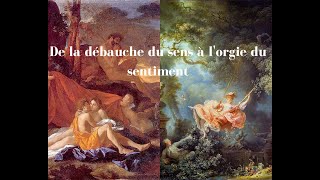
 Talks · 29 May 2023From the debauchery of sense to the orgy of sentiment
- 1:05:04Dangerous LiaisonsOne of the best-written texts in the [French] language; the libertine seeks obstacle and duration.
Appears in 15 videos · 16 passages, 1 of them in depth.
Dominique Pagani almost always discusses Laclos through Les Liaisons dangereuses, which he counts among the best-written books in the French language12. He treats Laclos as a figure of the libertine, the extreme opposite of virtue3, and libertinage as eros without sentiment4. For him, the work marks an era: the eighteenth century appears in it as the century of libertinage, and it gives literary expression to the height of libertine pleasure5. He links it to Mozart in sessions devoted to music56. He draws a historical argument from it: sexual liberation did not wait for 1968, since it already existed in the eighteenth century78. He also stresses its social setting: the great libertines are great aristocrats, and this libertinage does not take place among the proletariat910. In 2023 he adds that the libertine seeks the obstacle and duration2.
Summary produced automatically from 16 of the passages below, to be reviewed; the numbers link to the moment in the session.
 Who is this?
Pierre Ambroise François Choderlos de Laclos (French:; 18 October 1741 – 5 September 1803) was a French novelist, official, Freemason and army general, best known for writing the epistolary novel Les Liaisons dangereuses (Dangerous Liaisons) (1782). A unique case in French literature, he was for a long time considered to be as scandalous a writer as the Marquis de Sade or Nicolas Restif de la Bretonne. […]
Read the article on WikipediaText: Wikipédia, CC BY-SA 4.0, excerpt · Portrait: Attributed to Alexander Kucharsky / Formerly attributed to Maurice Quentin de La Tour, Public domain
Talks · 29 May 2023From the debauchery of sense to the orgy of sentiment Talks · 27 Mar 2023Praxis and psyche
 Cycle 11 · 14 Jan 2023Beware of misreadings! Clouscard and the ideology of desire, in homage to Le Précepteur
 Series · 1 Jun 2022Polymorphously perverse Mozart
 Series · 2 Feb 2021#13 Mozart restored
 Series · 11 Jan 2021#8 Happiness and unhappiness in music
 Cycle 9.1 · 19 Nov 2020#5 Benefits and harms of amnesia…
 Cycle 9.1 · 8 Oct 2020#1 Benefits and harms of amnesia…
 Cycle 8 · 30 May 2020#9 Return to the logics of the subject
 Cycle 7 · 4 Apr 2020#3 Harnessed to confinitude
 Talks · 20 May 2018Work and the right to work
 Cycle 4 · 11 Dec 2017#4.3 Angélique (by Nerval)
 Cycle 3 · 1 Aug 2017#3.3 From Ulysses to Daedalus
 Cycle 3 · 1 Aug 2017#3.6 From Ulysses to Daedalus
 Series · 26 Dec 2014L for Liberty