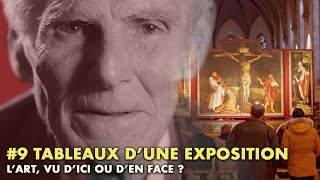
 Season 10 · 10 Feb 2022#9 PICTURES AT AN EXHIBITION: Art, seen from here or from the other side?
- 27:31Read by Hegel from Frankfurt onward.
Appears in 7 videos · 7 passages.
Dominique Pagani discusses Adam Smith mainly through Hegel and Marx. He does not read any of his works closely. In a session devoted to Marx, he places him among the English classical economists, before Ricardo1. He also cites him as a representative of classical bourgeois political economy when he asks how sciences of history can be real2. He stresses that Hegel read him, and early on, from the Frankfurt period3, along with other classical economists. He places the Hegelian "cunning" in Smith's wake4. He also notes that Hegel follows him when pointing out the drawbacks of the division of labour5. Finally, on the question of a balance in nature, he counts him among the economists who appeal to a natural order. For him, Smith thus appears as a source of Hegel's thinking on society and history, and as a figure of classical political economy.
Summary produced automatically from 7 of the passages below, to be reviewed; the numbers link to the moment in the session.
 Who is this?
Adam Smith (baptised 16 June [O.S. 5 June] 1723 – 17 July 1790) was a Scottish economist and philosopher who was a pioneer in the field of political economy and key figure during the Scottish Enlightenment. Seen by many as the "father of economics", or the "father of capitalism", he is primarily known for two classic works: The Theory of Moral Sentiments (1759) and An Inquiry into the Nature and Causes of the Wealth of Nations (1776). […]
Read the article on WikipediaText: Wikipédia, CC BY-SA 4.0, excerpt · Portrait: Etching created by Cadell and Davies (1811), John Horsburgh (1828) or R.C. Bell (1872)., Public domain
Season 10 · 10 Feb 2022#9 PICTURES AT AN EXHIBITION: Art, seen from here or from the other side? Series · 31 Mar 2021A balance in nature? • Philosophical Q&A • Dominique Pagani
 Season 9.2 · 5 Feb 20219 #14 How can sciences of history be real?
 Talks · 2 Aug 2016Tribute to Jacques D'Hondt (3)
 Talks · 2 Aug 2016Tribute to Jacques D'Hondt (2)
 Series · 2 Feb 2016Hegel on the Beach 4/5
 Series · 1 Feb 2016Marx on the Beach 2/2