 Season 11 · 28 Sept 2022And what about the subject in all this? Hölderlin, Mallarmé and Baudelaire
- 36:45According to an ancient legend, having strayed north toward the sources of the Danube, he seeks coolness.
Appears in 26 videos · 32 passages, 2 of them in depth.
Dominique Pagani returns regularly to Heracles, whom he almost always pairs with Theseus: he is the demigod who purges the earth of monsters so that man can dwell on it1. He reads the twelve labours as the image of arranging a space fit for man2, which makes Heracles a tutelary figure, shared by Sparta, Thebes and Athens. One episode comes up often: Heracles smothers Antaeus by lifting him off the maternal earth3. He also finds him in Racine, where Theseus appears as Alcides' successor and Phaedra judges that "Hercules was less costly to disarm than Hippolytus"4. In Hölderlin, he points to the golden apples of the garden of the Hesperides, the legend of a Heracles who strayed towards the sources of the Danube, and the pain of struggling with God as Heracles did5. In music, he notes that in the Baroque period the role was sung by a castrato voice, and he sees in Wagner's Siegfried something of Heracles' "first-degree" quality6.
Summary produced automatically from 32 of the passages below, to be reviewed; the numbers link to the moment in the session.
 Who is this?
Heracles ( Ancient Greek: Ἡρακλῆς, lit. 'glory/fame of Hera'), born Alcaeus (Ἀλκαῖος) or Alcides (Ἀλκείδης) was the greatest of the Greek heroes. He was considered the son of Zeus and Alcmene, and the foster son of Amphitryon. He was thought to be both a hero and a god. No tomb was ever identified as his, and at some festivals sacrifice was offered to him first as a hero and then, upon an altar, as a god. He was widely worshipped as a patron of young men and of gymnasia. […]
Read the article on WikipediaText: Wikipédia, CC BY-SA 4.0, excerpt · Portrait: Antonio del Pollaiuolo, Public domain
Season 11 · 28 Sept 2022And what about the subject in all this? Hölderlin, Mallarmé and Baudelaire Season 2 · 1 Aug 2017#2.6 Between crisis and war: Philosophising?
 Season 13 · 25 Jul 2025Naturalist ideology / Answers to questions - Dominique Pagani
 Season 13 · 2 Dec 2024Evil, or the "unknowing" of the self
 Season 11 · 17 Feb 2023Roots or migration? From analytical reverie to current events, from Hölderlin to the war
 Series · 27 Jul 2022NIETZSCHE - NO PITY FOR WAGNER • Pagani Parle Musique
 Season 10 · 10 Jun 2022#14 Caves of Yesterday and Today - From Plato to modernity
 Series · 8 Jun 2022FREE GOLD FOR EVERYONE - MULLIGAN • Pagani Parle Musique
 Talks · 19 Mar 2022Dominique Pagani - Hölderlin, poetry and politics
 Season 10 · 24 Feb 2022#10 UKRAINE: From the problem of "Edges" to the unleashing of war
 Season 10 · 6 Oct 202110#2 Dialectics of identity and difference
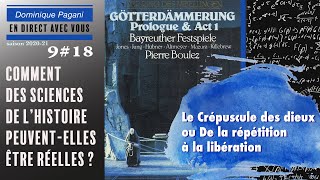 Season 9.2 · 3 Apr 20219 #18 Twilight of the Gods, or from repetition to liberation
 Season 9.1 · 24 Dec 2020#10 Benefits and harms of amnesia...
 Season 9.1 · 17 Dec 2020#9 Benefits and harms of amnesia...
 Season 9.1 · 13 Nov 2020#4 Benefits and harms of amnesia...
 Season 7 · 17 May 2020#8 • Harnessed to confinitude
 Season 7 · 18 Apr 2020#5 • Harnessed to confinitude
 Series · 23 Mar 2020Interview with Dominique Pagani: Introduction to the upcoming workshops
 Season 5.2 · 4 Feb 2019#5.4 Nature or Landscape?
 Season 4 · 15 Mar 2018#4.6 Angélique (by Nerval)
 Season 4 · 15 Jan 2018#4.4 Angélique (by Nerval)
 Season 3 · 1 Aug 2017#3.3 From Ulysses to Daedalus
 Season 2 · 15 Feb 2016#2.1 Between crisis and war: Philosophising?
 Series · 1 Feb 2016Hegel on the Beach 2/5
 Season 1 · 10 Dec 2015#1.6 Between crisis and war: Philosophising?
 Talks · 8 Aug 2015Mythology and Truth