 Season 10 · 22 Sept 202110#1 The eternal irony of the community
- 57:04The David: the essence that the raw block of marble is not.
Appears in 6 videos · 6 passages.
Dominique Pagani mainly cites Michelangelo as an example, in sessions devoted to other questions. He first uses him to say that a work must be approached as a whole and in its real conditions. Knowing only excerpts of Wagner is, in his view, like knowing only the thumbnail of the David1. Looking at The Last Judgment in a small photo is like listening to music on a computer2. The David also serves him to show the difference between essence and the raw block of marble3. He also mentions that the paintings were funded by taxes raised in Germany, as well as the defence of these paintings4. In a session on Nerval, he relates an anecdote by Gustave Moreau about him5. Finally, about a pupil who says he does not like him, he remarks that this judgement speaks of the pupil rather than of the work6.
Summary produced automatically from 6 of the passages below, to be reviewed; the numbers link to the moment in the session.
.jpg) Who is this?
Who is this?Michelangelo di Lodovico Buonarroti Simoni (6 March 1475 – 18 February 1564), known mononymously as Michelangelo, was an Italian sculptor, painter, architect, and poet of the High Renaissance. He was born in the Republic of Florence but was mostly active in Rome from his 30s onwards. His work was inspired by models from classical antiquity and had a lasting influence on Western art. Michelangelo's creative abilities and mastery in a range of artistic arenas define him as an archetypal Renaissance man, along with his rival and elder contemporary, Leonardo da Vinci. […]
Read the article on WikipediaText: Wikipédia, CC BY-SA 4.0, excerpt · Portrait: Attributed to Daniele da Volterra, Public domain
Season 10 · 22 Sept 202110#1 The eternal irony of the community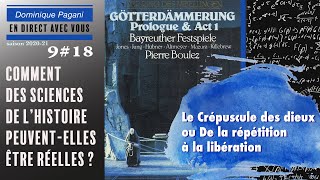 Season 9.2 · 3 Apr 20219 #18 Twilight of the Gods, or from repetition to liberation
 Season 9.2 · 29 Jan 20219 #13 How can sciences of history be real?
 Season 4 · 11 Dec 2017#4.3 Angélique (by Nerval)
 Season 1 · 10 Dec 2015#1.6 Between crisis and war: Philosophising?
 Talks · 26 Apr 2015The Music of History