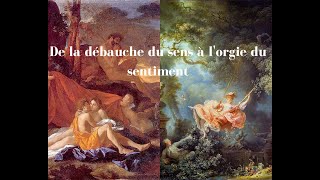
 Talks · 29 May 2023From the debauchery of sense to the orgy of sentiment
- 39:47By banning duels, he emasculates the warrior nobility; the beginning of absolute monarchy.
Appears in 7 videos · 7 passages, 2 of them in depth.
Dominique Pagani mainly refers to Richelieu as the man who establishes absolute monarchy, against the great nobles of the kingdom1. The point he recalls most often, from 2015 to 2023, is the ban on duels. Through this measure, he says, Richelieu "castrates" the nobility of the sword, that is, the warrior nobility, and he sees it as the beginning of absolute monarchy23. He returns to this point in varied contexts: a session devoted to Leibniz, a reflection on whether a real science of history is possible4, and another on the geopolitical metaphor. In a 2014 session on the thought of Michel Clouscard, the name serves to situate a period before absolute monarchy5. Elsewhere, in a session on modal and tonal music, he mentions Richelieu's policy of dividing Germany and connects it with German resentment and the massacre of Magdeburg6.
Summary produced automatically from 7 of the passages below, to be reviewed; the numbers link to the moment in the session.
 Who is this?
Armand Jean du Plessis, 1st Duke of Richelieu (9 September 1585 – 4 December 1642), commonly known as Cardinal Richelieu, was a French Catholic prelate and statesman who had an outsized influence in civil and religious affairs. He became known as the Red Eminence (French: l'Éminence Rouge), a term derived from the style of Eminence applied to cardinals and their customary red robes. […]
Read the article on WikipediaText: Wikipédia, CC BY-SA 4.0, excerpt · Portrait: Philippe de Champaigne, Public domain
Talks · 29 May 2023From the debauchery of sense to the orgy of sentiment Cycle 3 · 1 Aug 2017#3.2 From Ulysses to Daedalus
 Cycle 9.2 · 17 Mar 2021#9.17 The geopolitical metaphor: Planck, Descartes, Clouscard
 Cycle 9.2 · 4 Mar 2021#9.16 How can sciences of history be real?
 Series · 24 Jan 2021#11 Modal and tonal music
 Cycle 1 · 10 Dec 2015#1.5 Between crisis and war: philosophising?
 Series · 26 Sept 2014#4 Neo-fascism and the ideology of desire: on the thought of M. Clouscard