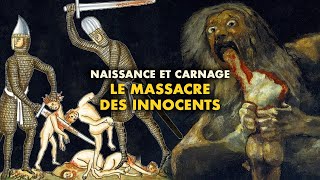
 Cycle 12 · 22 Dec 2023Birth and carnage: the Massacre of the Innocents
- 2:08:54"We can only make our paintings speak": the idea must externalize itself.
Appears in 20 videos · 21 passages.
Dominique Pagani often returns to a sentence of Van Gogh's: "We can only make our paintings speak." He sets it against interpretation: the point is to make the text speak rather than speak about it1, and the idea must be externalised in the work2. He mentions the move to Arles several times: the painter goes there looking for the harsh, vivid light of the South, tired of blur, in the full force of the mistral34. In painting, he links Van Gogh with gradation, which he sets against Gauguin's line5. He compares Van Gogh's stars swirling over the Rhône with "Nuit rhénane", and he speaks of coloured water "à la Van Gogh" in connection with Nerval. He also counts him among those who lived the aesthetic adventure to the end and went under, as a figure of modern madness6. Finally, he finds the way Heidegger comments on Van Gogh's peasant shoes obscene7.
Summary produced automatically from 21 of the passages below, to be reviewed; the numbers link to the moment in the session.
 Who is this?
Vincent Willem van Gogh (Dutch: ; 30 March 1853 – 29 July 1890) was a Dutch Post-Impressionist painter who is among the most famous and influential figures in the history of Western art. In just over a decade he created about 2,100 artworks, including around 860 oil paintings, most of them in the last two years of his life. They include landscapes, still lifes, portraits and self-portraits, and are characterised by bold colours and dramatic, impulsive and expressive brushwork that contributed to the foundations of modern art. His suicide at age 37 followed years of mental illness and poverty. […]
Read the article on WikipediaText: Wikipédia, CC BY-SA 4.0, excerpt · Portrait: Vincent van Gogh, CC BY-SA 4.0
Cycle 12 · 22 Dec 2023Birth and carnage: the Massacre of the Innocents Series · 5 Mar 2022Panzer-philosophy against the cogito: neo-fascism or the ideology of nature (Heidegger, Descartes)
 Series · 4 Oct 2021#4 Nomad and sedentary: the case of Nerval
 Series · 25 Mar 2021#17 Interpretation
 Series · 11 Jan 2021#8 Happiness and unhappiness in music
 Series · 11 Dec 2020#5 Happiness versus the death drive in music
 Cycle 8 · 2 Jul 2020#12 Return to the logics of the subject
 Cycle 7 · 27 Mar 2020#1 Harnessed to confinitude
 Series · 23 Mar 2020Introduction to the upcoming workshops
 Cycle 5.2 · 29 Jul 2019#5.9 Kafka, “An Imperial Message”
 Talks · 2 Jul 2018Tribute to Domenico Losurdo
 Cycle 4 · 15 Mar 2018#4.6 Angélique (by Nerval)
 Cycle 4 · 15 Jan 2018#4.4 Angélique (by Nerval)
 Cycle 4 · 12 Nov 2017#4.2 Angélique (by Nerval)
 Cycle 2 · 1 Aug 2017#2.5 Between crisis and war: philosophising?
 Cycle 3 · 1 Aug 2017#3.2 From Ulysses to Daedalus
 Cycle 2 · 1 Aug 2017#2.6 Between crisis and war: philosophising?
 Talks · 19 Jun 2016At the bistro (part 2)
 Series · 2 Feb 2016Hegel on the Beach 3/5
 Series · 1 Feb 2016Hegel on the Beach 1/5