English translation of the French transcript, made with AI and not yet proofread — click a paragraph to jump to it. Show the French original
Why this poem: a missed demonstration 0:00 I'm going to start with a text by Aragon, and first I'll tell you why I chose it from his body of work. There's nothing more abundant than Aragon's work. The novels, the poems, the essays, the articles—it's a body of work whose immensity is always underestimated.
0:34 For now, I'm not even talking about its value, but I'll say, just in number of pages, it's staggering already. And the erudition, the erudition. But here I've taken a poem, actually a rather long one, three or four pages, but don't worry, I mean, I've trimmed a few stanzas. But why did I choose it? To make up for my frustration, to console myself and take revenge for my frustration at not having been at yesterday's demonstration.
1:14 I had gathered my strength to go, my old man's strength. No, no, but seriously, and then I got laid low for half a day—I won't bore you with my personal troubles, with gallstone attacks. Fortunately it doesn't seriously affect one's general condition, but it's extremely painful. So I started out bedridden by that, then afterward I was dazed for 24 hours by the painkillers—it started in the middle of last week, I won't dwell on it. But that's to tell you why I couldn't go, I saw the pictures of the Delga stand, I would gladly have gone to greet my comrades from Delga, for instance, among others.
1:51 And then above all, the demonstration is the same—given the turnout, I've been a bit picky these last few years. And yeah, demonstrations, let's talk about what they've become, when someone tells me, look, we had a good turnout, we were 10,000, whereas I belong to a generation where we used to have a million, in the last ones. On that scale, as far as I know, it was when we demonstrated in London, Paris and Rome against the Iraq war that wasn't authorized by the UN. All that seems very far away now. It wasn't the nasty Russian, it was 'The Ugly American,' as in the famous novel from the time of the Iraq war.
Aragon hidden in Dieulefit, far from the Paris of the marches 2:28 But so, what does this have to do with Aragon's poem? Well, precisely, Aragon was frustrated too, but for much more serious reasons than mine. He was being hunted by the Gestapo, a communist militant, and at that time he was in hiding with admirable comrades, in the Drôme, in the very commune where my son was born—I can't help it, it's a coincidence—in Dieulefit, quite simply. And I'll note in passing that Dieulefit was awarded the enviable title of 'commune, city of the Righteous,' because this small town of a few thousand inhabitants managed to save more than 2,000 Jews during the war.
3:19 In short, so I count Aragon among the resisters, along with Pierre Emmanuel, among others. So, and so, he was there, safe, yes, but Paris—the Paris where you were yesterday, most of those I'm addressing—the Paris of demonstrations, of avenues black with people, of the rising tide of protest.
3:51 I won't dwell on it too much because Aragon says it so much better that I'd just be stammering, trying to paraphrase him. And so there are many passages that will seem far from the demonstrations, subjective ones, where he laments, first of all, his personal relationship to Paris, right? But I'll read you right away a stanza we'll come back to later in the flow, because it's a bit further along, but I'll read it to you anyway, all right?
4:22 On the squares roared the popular storm, arms outstretched fell unknown heroes, or black processions along the avenues, it seemed to write an oath of anger. O Paris, you cradled the winds in your bare arms. That's the Paris that began at the Faubourg Saint-Antoine during the French Revolution, that tendency which everything on the right, the new right, the so-called left of the left in some respects, rages against, right?
Against anti-Jacobinism: the example of Carhaix 5:01 They can fight over who's worst on that score. And I won't hide the fact that I'll also take revenge against certain forms of regionalism—not all of them, there are regionalisms, sometimes there are people who get sacrificed. But there's such relentlessness against what's called Jacobinism, centralization, against Paris. Let me just give one example to show you what makes me angry. Again, it can sometimes be justified, but if it's about Paris as the seat of the executive, I'm the first to be against it.
5:38 No, but that's not what it's about. In Carhaix, an important town in central Brittany—not the very touristy Brittany, not the one with beaches or little harbors. No, no. In Carhaix, which was already noted by the Romans back in the day, there were two major employers, the town hall—sorry, the hospital, 1,500 jobs, and the train station. Both are closed, so let me tell you.
6:08 A while ago—if you really want to see a sample of what some people call 'peripheral France,' even if that concept is a bit vague, Carhaix is a perfect, I dare not say excellent, illustration—a tragic illustration. You could laugh about it too, in some respects. Now, what did the mayor of Carhaix say? Non-affiliated, moderate center—you know, I've made enough videos about what I call the extreme center, which is anything but moderate.
6:41 All those who weren't exactly clear during the Occupation converted themselves under the label, or lack of label, of 'various moderates,' 'various right,' 'various left,' somewhere between Mitterrand and Giscard—what does it matter, frankly. It's really a whisker of difference, derisory at that level. And so the mayor, at the time, had said 'Paris is stripping Brittany bare!' As if it were only in Brittany, mind you, that capital was going after jobs.
Holding together current events and textual commentary 7:14 There you go. That's to restore the true Jacobinism, well, a Paris. In short, I chose a text that lets me overcome the hesitation I've been boring you with for quite a few videos now. I say that a bit out of false modesty, because I've seen that some of you don't mind it at all, after all. You know, I hesitate between communication tied to the very latest news, or on the contrary a commentary on a text, I don't know, maybe by a sixteenth-century poet.
8:00 Why not? Well, here I manage to combine both, a bit like what we did in our first live readings with Mallarmé. People tell me, oh great, what are you going to bore us with now, some decadent author, 'these primitive spellings,' to quote him. And then, in fact, it's about class struggle on the lawn, to quote him too. You see. Well here, with Aragon, I hold both ends. Someone as little suspected of pro-communist and Marxist indulgence, someone like—well, what's his name, he's dead now, that fine, uh, right-wing writer, everyone knows him, of—of—it's aging, I mean, it's proper names that escape me the most now.
8:53 Anyway, one of the best known said that he was by far the greatest French poet of the modern era, no less. Aragon. So, without further ado, let me set the context: he was in Dieulefit in the Drôme, okay, and Paris is missing him. I won't say more, it's not just any Paris. And I'll begin the reading. Well, I—you have it in front of you, but I'll take the text I sent to Philippe too, because since not all the stanzas are there, I want us to have the same ones, there.
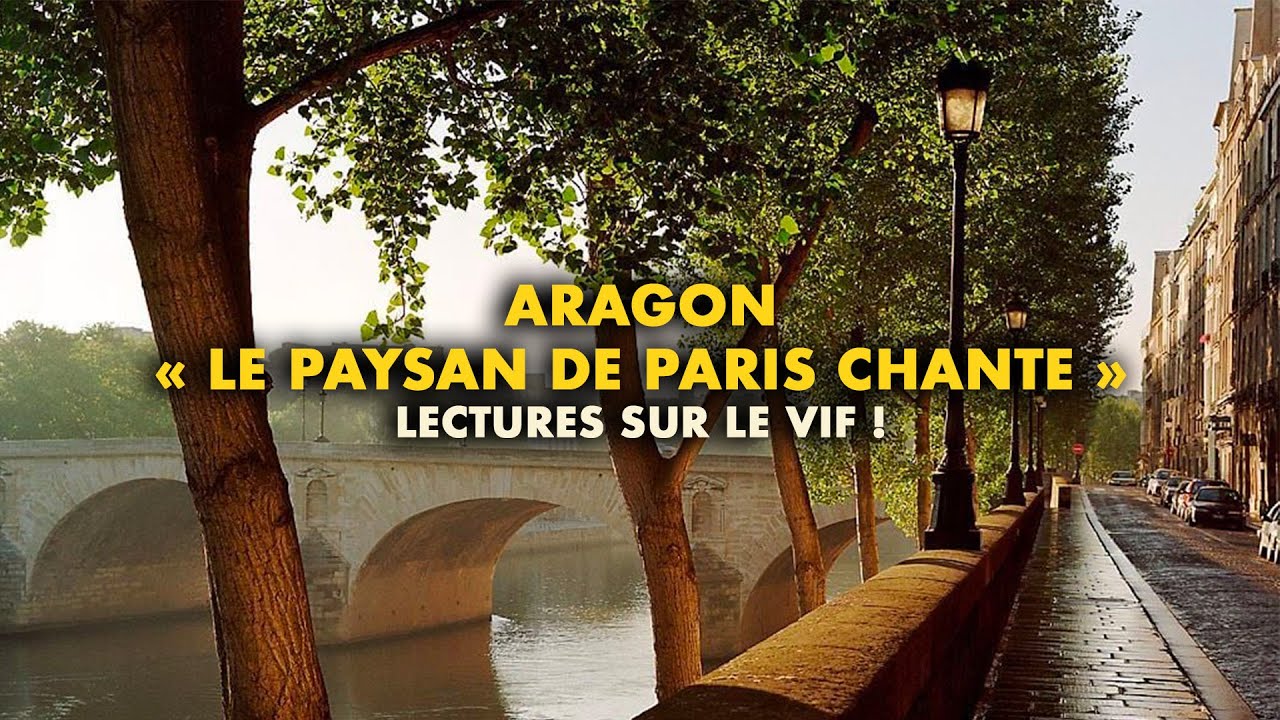
Old photographs of Paris and Paris dreaming 9:38 Just as one leaves a child, so he'll stay quiet, worthless objects lying on the floor, perhaps guessing what liquor I was missing, chance threw me photos of my city. So there, in the provinces, he sees photos, old photos of Paris, the trees, photos of my city, the trees of Paris, those boulevards, those quays. It's about Paris—it has the brow of a made-up actor. It has that haggard eye of people who got up too early.
10:14 And yet it's my Paris in these old photos. But these are the rifles of the guard's soldiers if, as these days, the street is empty of cars. The Paris of the Occupation. The tune a passerby whistles around '60—meaning of course 1860, since the poem was written in the 1940s. The tune a passerby whistles around '60 pleasing under horses' shoes, the cobblestones are polished.
10:48 So you see the temptation now—we leave the seemingly political Paris that was starting to take shape, to move into nostalgia, into subjectivity, into a state of mind. The tune a passerby whistles around '60 pleasing under horses' shoes, the cobblestones are polished. A building moves me that I saw demolished. So he sees a photo where a building is still standing, one that he himself saw demolished. It was Baudelaire who said, in one of the most beautiful poems about Paris, called The Swan—meaning the bird, you can find it in Flowers of Evil—that the shape of a city changes faster, alas, than a mortal's heart.
11:25 A building moves me that I saw demolished. This man who walks away—isn't that Baudelaire? This brand-new luxury of the Rue de Rivoli. I like to imagine the time of crinolines. The Louvre being closed on the Tuileries side by a castle singing in the evening of evenings. The chandeliers shone too brightly at midnight for the spleen the color of printer's blue-black. Back then everything was done with ink and inkwells. That will pass along.
11:58 And then all at once a silence falls at the end of the quadrilles. Paris dreams. And who knows what dreams are its own? Don't ask the academicians. The secret of Paris isn't at the Bal Mabille—a place frequented by Parisian high society—any more than it is at court or in the council of elders. Paris dreams, and never is it more formidable—I pay tribute to those who marched yesterday—and never is it more formidable, more stormy, than when, silent, it dreams.
12:31 of that dream of bridges over their arches of wind. Of that dream with white eyes such as one sees in the eyes of fables. Of that moving dream in the eyes of the living. Paris awakens—and this was well before Dutronc's song, which was ranked among the ten most beautiful French songs of the postwar era, and for which Roger Bourdin, a great classical flutist who accompanies Dutronc throughout, is not for nothing—it's a marvel.
The Pont-Neuf and historical depth 13:07 Paris awakens and I, to recover those myths that burned our blood in our clandestine darkness, I will bury my irritated face in my hands. May the song be reborn—that's C-H-A-N-T [song], of course, for those who don't have the text in front of them—may the song be reborn that the birds imitate and that answers 'Paris' when one says 'liberty.' It's a bridge I see if I close my eyelids—from here I ask, I ask those of you a little familiar with the place, I'm thinking of the Pont-Neuf—but he sees the Pont-Neuf first from the side of the Pont des Arts, you know, when you look at the Pont-Neuf from the Pont des Arts, you see its two arches, as he'll say, of the Pont-Neuf, you see the half-moons—the street vendors back then used to develop their patter, as they say—and these half-moons give it a certain look, he found the image very well, the aorta of the Pont-Neuf, he'll say further on, you'll see, like an artery, and the two meet on the Île de la Cité, at the prow of the island where the Vert-Galant point is, the little Henri IV square.
14:17 there's the statue—I'll tell you everything we'll find again in the poem so it's clear—the bronze statue of Henri IV that dominates the prow of the Île Saint-Louis, and behind him, like a tabernacle, like a sacred slit, behind him two pink sixteenth-century buildings through which one glimpses the marvelous Place Dauphine. There, remember all this, put 'Pont-Neuf' into Google Images and it will all be clear. It's a bridge I see if I close my eyelids—don't forget he's saying this 700 km away. The Seine there turns with its tragic whirlpools, oh drowned in its arms, how does one sleep. It's a bridge that goes off into stone alcoves, resting places rounded in garland shapes, a king of black bronze on horseback—that's Henri IV—surmounts it, and the island it spans in double bloom.
15:33 it looks like a boat on its cast-iron anchor, made to tremble by delivery trucks. The Pont-Neuf's harp quivers like an orchestra where I hear the wine of my twenty years prelude. A wind blows here that comes from times gone by—and all at once, as with all great poetry, in particular, and generally in all art, all great music, all great painting, one sees the importance that has shrunk, like a piece of shagreen leather, with the dominance of culture—I'm not anti-American, I say so often, I'm anti-Atlanticist, but there's a flaw specific to American civilization, which otherwise has qualities I defend—I'm not talking about the policy of the American executive, which began at its founding with slaveholders and slave owners, the Washingtons and Jeffersons, right, and which now fight over between the right and the far right, the two presidents there, Sleepy—Biden and Bush—so you see my slip, and I can't even find
16:44 the most well-known proper names anymore, well anyway—no, no, but there are immense Americans, even when—I don't know, a Faulkner is an immense writer, even if one might find more left-leaning ones; it's not about waging trench warfare here. So why this detour? Because America's main flaw is that it's a country of recent history; you can't say it 'comes,' as here, 'a wind blows here that comes from times gone by, to die in the hair of the equestrian statue'—the heart, sorry, not the heart—the city like a heart, yes here, opens wide with both leaves—it's a heart that opens like that, at the same time it bursts, there's something magnificent and tragic about it at once. So I'll repeat this stanza, which is of such beauty: the Pont-Neuf's harp quivers like an orchestra where I hear the wine of my twenty years prelude. A wind blows here that comes from times gone by, to die in the hair of the equestrian statue. The heart, the city like a heart
Man as a historical animal; the memory of the Great War 17:55 opens there with both leaves. Let me dwell a little longer on what I just said about the United States' too-recent history, to express the long duration, the temporal thickness without which there is no great human worth—man is a historical animal, to give one of many definitions of man, including, as in Rabelais, laughter is proper to man, that's the animal—but this one is no less defensible than the best of them, right, man is a historical animal—I'd even rather say historical than cultural, because all the cultures that exist within humanity are inscribed within a history, knowing that they must perish—the boys of my age, illusion, deceived themselves with a city under a gray sky, we the last-born of a century and its last conscripts, feet stuck in mud and heads in the clouds, we awaited their axe—speaking of Paris—it may sound a bit obscure, but wait, it was written in the mid-1940s, Aragon had lived through the First World War, Aragon holds the Croix de Guerre, I say this because sometimes people take him
19:06 for—what a misunderstanding it would be to take him for a somewhat dilettante intellectual—there weren't many, you know, who distinguished themselves—I'm talking about the Second World War, but he had also lived through the First, which is alluded to, as we'll see toward the end of the poem, when he thinks back on the carnage at Saint-Mihiel in Lorraine, when the song said 'you'll see Paname again' to those a carnation of blood would soon make bloom—the carnation of blood, you see, it's a bit like in Rimbaud's 'The Sleeper in the Valley,' the wound on the one whose corpse lay in the trench, right—those a carnation of blood would soon make bloom, somewhere near Saint-Mihiel or Neufchâteau, surrounding the singer like hands, the flame felt the knife's point tremble within them—they know that, yes, I hope we'll see Paname again, but good God, we have every chance of dying—all of this is still current, isn't it, the war rumbles not so far from us, doesn't it, so many corpses on both sides, such young people—ever since then I've always found in what I love
"Tear out my heart, you will see Paris there" 20:16 a reflection of my city, a shadow in its streets, forgotten monuments, vanished passages, I have written more about you, Paris, than about myself—all at once he exclaims, right, no, no, I'm not talking about myself, he is more than in my own sun, in you, Paris, I believed. On the squares roared the popular storm, arms outstretched fell unknown heroes, or black processions along the avenues, O Paris, you cradled the winds in your banners—there again I salute yesterday's demonstrators, who could perfectly well, mind you, have this stanza, banner—this Paris, this shadow theater that I carry within me, shadow, when I'm exiled there, this Paris of mine that can never quite be taken from me, any more than one can take from lips their cries—what would it have taken to throw me out the door—tear out my heart, you'll see Paris there. It's from that Paris that I made my poems, my words are the strange color
21:26 sorry, laughing—my words are the strange color of those roofs—you know, most Paris roofs, what one doesn't quite realize, is that it's zinc, right—and there's also a bit of the color of the pigeons, so numerous in Paris—I laugh because pigeons annoy so many people, pigeons brushing your throat, pigeons cooing on the rooftops—I have written more about you, Paris, than about myself, and suffered more from being without you than from growing old—and this is the last part, songs, you know, that kind of song, I'm not thinking of 'Autumn Leaves' with an accordion backdrop—a song that speaks of an incurable ache, sadder than midnight at Place d'Italie, alike at daybreak for melancholy, no more dreams for the finger than the sandman announcing pleasure like a merchant of oblivion—sorry for the intertextuality, for interrupting this text, but for one at least as beautiful, I think of one of the last flashes of genius by Baudelaire in the pieces added to Flowers of Evil
Baudelaire as a counterpoint and the popular song 22:36 a poem called 'Meditation,' yet another sunset—no doubt from when he lived at the hotel, there's still a plaque now on the Quai Voltaire, a plaque reading that Richard Wagner, Charles Baudelaire and Oscar Wilde honored this hotel with their stay, no less—I mention this because there's an allusion, you'll see, to the Seine in this poem, I refer you to it, Meditation, because I don't want to quote it in full, just this passage which counterpoints what Aragon says here, 'announcing pleasure' after all 'like a merchant of oblivion,' regarding that line—he speaks to himself in this poem, to his soul: Be wise, O my Sorrow, and keep more still. You called for evening; it descends; it is here. A darkening air envelops the town, bringing peace to some, to others care. I'll go a bit faster now, I'm slowing down—while the vile multitude of mortals—a somewhat decadent, aristocratic, reactionary side
23:46 of Baudelaire—while the vile multitude of mortals, beneath pleasure's whip, that merciless torturer, goes to gather remorse in the servile feast, my Sorrow, give me your hand, come this way, far from them—I return to Aragon—announcing pleasure like a merchant of oblivion, that famous haunting song, a vulgar and sweet song, that is, popular—vulgar comes from the Latin vulgum, which you find in 'Folk,' replacing F with V as in every European language, vulg becomes fulg whether in German or in Anglo-Saxon languages, it means popular, right—a vulgar and sweet song, the voice lowering like a one-night love doubting the morrow, a song that takes women by the hand, a song they hum under the Barbès metro and that changes at Étoile and gets off at Jasmin—it's time to finish—the wind will murmur my verses over the wasteland, it will brush against benches where no one has sat, one will hear weeping
24:56 on the Quai de Passy, and the bridges, repeating the promise of rings, will go off engaged to these rhymes here—which rhyme, from the first stanza, that he repeats to close: Just as one leaves a child, so he'll stay quiet, worthless objects lying on the floor, perhaps guessing what liquor I was missing, chance threw me the photos of my city, the trees of Paris, those boulevards, those quays. Once again, homage—not to yesterday's demonstrators, but to those of tomorrow, to those of the day after tomorrow. Thank you all.