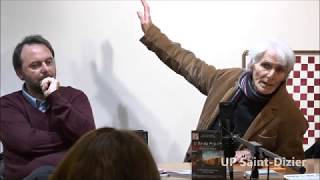
 Talks · 20 Jul 2018Education: can the Beautiful be learned?
Faculty of judgment
Worked through in 3 videos · 6 passages.
What Dominique Pagani says
Dominique Pagani approaches the faculty of judgement through Kant's third Critique. He sees in it the establishment of two domains, nature and freedom, legislating over one and the same territory1. He draws on the distinction between determining judgement and reflective judgement. In the first, the end is given, and one can say that a thing is well made according to that known end. In the second, only the effect of pleasure is given, without its end being known23. Since this end is not known, one must reflect the object, which "knows more about me than I do myself". He traces phenomenology back to this move4. He also returns to the German word Urteil, which he understands as an original division: to judge is to divide the subject by a predicate5. Finally, he contrasts value judgements, which presuppose a goal being pursued, with judgements of existence, which can be measured and bring everyone into agreement6.
- 1#4.3 Angélique (de Nerval)11 Dec 2017 · 43:37
- 2#1.4 Entre crise et guerre : Philosopher ?10 Dec 2015 · 1:10:49
- 3Education : le Beau s'apprend-il ?20 Jul 2018 · 10:58
- 4#1.4 Entre crise et guerre : Philosopher ?10 Dec 2015 · 1:16:50
- 5#4.3 Angélique (de Nerval)11 Dec 2017 · 36:48
- 6Education : le Beau s'apprend-il ?20 Jul 2018 · 13:42
Summary produced automatically from 6 of the passages below, to be reviewed; the numbers link to the moment in the session.
Talks · 20 Jul 2018Education: can the Beautiful be learned? Season 4 · 11 Dec 2017#4.3 Angélique (by Nerval)
 Season 1 · 10 Dec 2015#1.4 Between crisis and war: Philosophising?