 Talks · 27 Mar 2023Interview with Dominique Pagani, praxis and psyche
- 25:24The arbitrariness of the sign separates signifier and signified; it distinguishes the human sign from the animal signal.
Worked through in 24 videos · 35 passages.
Dominique Pagani defines the sign as that which gives presence to what is absent. The first of all signs is the tomb, sêma in Greek, and Rousseau's tomb emptied of his ashes is a pure sign1. He contrasts the sign with the signal. The signal, shared with animals, rests on a natural and causal sequence. The sign is arbitrary and conventional (fumée, smoke, Löwe) and frees us from the here and now23. The sign forms a triangle between me, the other and the thing, whereas the signal belongs to stimulus and reflex4. From this he draws an epistemological distinction: in human affairs and the sciences of history, the sense-sign pair takes over from the cause-effect pair of the natural sciences. In 2018 he specifies that it does not replace it; in 2019 he says that it must replace it. The sign does not come after the sense: it is immanent to it5. Finally, he points to a limit of the sign: after symbolic signification, one must go on to the concept.
Summary produced automatically from 35 of the passages below, to be reviewed; the numbers link to the moment in the session.
Talks · 27 Mar 2023Interview with Dominique Pagani, praxis and psyche Season 11 · 14 Oct 2022Clouscard and the problem of Socrates
 Season 11 · 28 Sept 2022And what about the subject in all this? Hölderlin, Mallarmé and Baudelaire
 Season 9.2 · 9 Jun 20219 #23 "Ruled like music paper!" • Bach • Nerval • Lévi-Strauss
 Season 9.2 · 27 May 20219 #22 Science and/or philosophy of "artificial intelligence" - Part 2
 Season 9.2 · 12 May 20219 #21 Science and/or philosophy of "Artificial Intelligence"
 Season 9.2 · 28 Apr 20219 #20 From SIGNAL to SIGN • Einstein
 Season 9.2 · 14 Apr 20219 #19 Twilight of the Gods, or from repetition to liberation • Part 2
 Season 9.2 · 29 Jan 20219 #13 How can sciences of history be real?
 Season 9.2 · 14 Jan 20219 #12 How can sciences of history be real?
 Series · 23 Mar 2020Interview with Dominique Pagani: Introduction to the upcoming workshops
 Season 6 · 3 Dec 2019#6.2 • The Logic of the Subject in the face of the reconstitution of Nazism
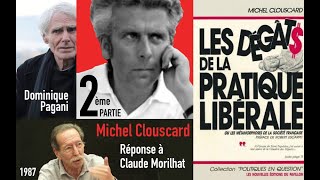 Series · 10 Sept 2019D. Pagani / M. Clouscard's reply to C. Morilhat • Part Two
 Series · 23 Aug 2019D. Pagani / M. Clouscard's reply to C. Morilhat (1987)
 Season 5.2 · 30 Jun 2019#5.8 Nature or Landscape?
 Season 5.2 · 2 May 2019#5.6 Nature or Landscape?
 Season 5.2 · 4 Feb 2019#5.4 Nature or Landscape?
 Season 5.1 · 13 Jan 2019#5.3 bis FaceBookLive / Questions
 Season 5.1 · 6 Dec 2018#5.2 bis FaceBookLive / Questions (1)
 Season 4 · 15 Mar 2018#4.6 Angélique (by Nerval)
 Season 2 · 18 Feb 2016#2.3 Between crisis and war: Philosophising?
 Series · 29 Jan 2016What is to be done? 1/3
 Season 1 · 10 Dec 2015#1.4 Between crisis and war: Philosophising?
 Series · 23 Dec 2014I for Island