 Season 14 · 13 Apr 2026Language and thought: The case of Lavoisier
- 11:58The dogmatist believes he knows everything and spares himself inquiry, the skeptic says nothing can be known: neither is a philosopher.
Worked through in 15 videos · 17 passages.
Dominique Pagani distinguishes two uses of the term. In the precise, Kantian and non-pejorative sense, dogmatism refers to the position that no limit can be assigned to knowledge: starting from a principle and using a method drawn from mathematics, nothing would resist it, not even God or the soul1. This is Cartesian optimism, shared by Spinoza and Leibniz, which Kant brings to an end2. In the ordinary sense, the dogmatist is, along with the sceptic, one of the philosopher's two enemies: the one believes he knows everything, the other that he knows nothing, and both answer before searching and spare themselves the work of inquiry34. He illustrates this figure with the person for whom beauty is the Parthenon. With Hegel, as read by Jacques D'Hondt, he links dogma to the understanding that freezes truth against history5. He rejects this charge in the case of Marx, who constantly reworked his advances, and of Engels, whose apparent dogmatism comes from pedagogical simplification.
Summary produced automatically from 17 of the passages below, to be reviewed; the numbers link to the moment in the session.
Season 14 · 13 Apr 2026Language and thought: The case of Lavoisier Season 13 · 2 Sept 2024Clouscard: The metamorphoses of class struggle
 Season 11 · 28 Sept 2022And what about the subject in all this? Hölderlin, Mallarmé and Baudelaire
 Talks · 14 Jul 2022From Plato to world revolution, by Dominique Pagani
 Season 9.2 · 7 Jan 20219 #11 How can sciences of history be real?
 Season 9.1 · 17 Dec 2020#9 Benefits and harms of amnesia...
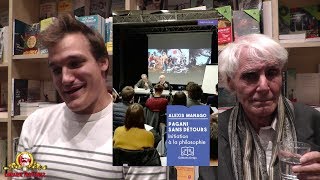 Talks · 21 Sept 2019Pagani without detours
 Series · 23 Aug 2019D. Pagani / M. Clouscard's reply to C. Morilhat (1987)
 Talks · 16 Nov 2017The philosopher's two enemies: The dogmatist and the sceptic.
 Season 2 · 1 Aug 2017#2.8 Between crisis and war: Philosophising?
 Season 3 · 1 Aug 2017#3.5 From Ulysses to Daedalus
 Talks · 9 Mar 2017Is History a subject?
 Talks · 2 Aug 2016Tribute to Jacques D'Hondt (1)
 Season 1 · 10 Dec 2015#1.5 Between crisis and war: Philosophising?
 Season 1 · 10 Dec 2015#1.4 Between crisis and war: Philosophising?