 Season 13 · 25 Jul 2025Naturalist ideology: answers to questions
- 25:34The bürgerliche Gesellschaft, a blind system of reciprocal dependence, is a wild beast that the state must tame with severity.
Worked through in 15 videos · 20 passages.
Dominique Pagani understands civil society on the basis of Hegel, as the translation of bürgerliche Gesellschaft, literally "bourgeois society": in his view, "bürgerlich" and "civil" come to the same thing etymologically1. Distinguished from the State following Ferguson, it forms the middle term between the family and the State, made up of the juxtaposition of families, and it is the world into which one is thrown without ties of blood23. He makes it the site of the understanding, which separates and differentiates4, and an essential concept of modernity, linked to the city and to the mixing of classes. As a blind system of mutual dependence, it is a "wild beast" that the State must tame with severity56. For him, the problem of our time is to reconcile civil society and the State, the latter understood as the general will7. Capitalism, by contrast, has reduced it to a generalised market of desire, and it would like to make it the only horizon8. He attributes its excess to the capitalist option, not to modernity. He also notes that civil society, meaning foundations and NGOs, is used to get around the State.
Summary produced automatically from 20 of the passages below, to be reviewed; the numbers link to the moment in the session.
Season 13 · 25 Jul 2025Naturalist ideology: answers to questions Talks · 7 Feb 2025Michel Clouscard and the betrayal of May 68
 Season 11 · 18 Mar 2023A springtime of the peoples?
 Series · 20 May 2022Who is hiding beneath the surfaces? Aesthetics and politics
 Season 10 · 3 Nov 2021#10.4 From Lascaux to modern music, the permanence of the political stakes in aesthetics
 Series · 22 May 2021A chapter of Marx written by Hegel
 Series · 3 Dec 2020#1 Schubert and the master singers
 Season 7 · 4 Apr 2020#3 Harnessed to confinitude
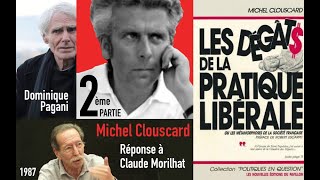 Series · 10 Sept 2019M. Clouscard's reply to C. Morilhat (part 2)
 Talks · 13 Feb 2019Hegel and the yellow vests (part 1)
 Season 5.1 · 2 Nov 2018#5.1 bis Questions (Facebook Live)
 Talks · 31 Mar 2018Tonight, we repoliticise (part 2)
 Talks · 2 Aug 2016Tribute to Jacques D'Hondt (3)
 Talks · 18 Jun 2016At the bistro (part 1)
 Series · 18 Sept 2014The EU means war! (excerpt)