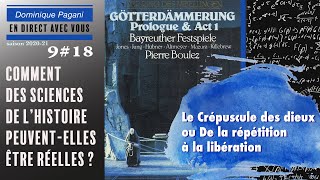
Dominique Pagani returns to Alberich mainly in the 2021 cycle devoted to Wagner's tetralogy, "How can sciences of history be real?". He sees him as the character with whom everything begins: mocked by the Rhinemaidens because he is dirty and hunchbacked, he renounces love to seize the gold. This is the original sin of the work1. He dwells on one formula: with the gold, Alberich will not have love, but he will be able to buy pleasure. From this he draws a distinction between love and libertinage2. He also reads the character in economic terms: Alberich makes the dwarves work like capital and whips his brother Mime, which for him corresponds to primitive accumulation34. He does not reduce him to the role of villain. Alberich is brutal but logical, and he respects the algebra of the Ring, gold or love. Once stripped of the gold, he has neither and curses the ring: he is as much victim as culprit56.
Summary produced automatically from 20 of the passages below, to be reviewed; the numbers link to the moment in the session.
Who is this?
In German heroic legend, Alberich (German:) is a dwarf. He features most prominently in the poems Nibelungenlied and Ortnit. He also features in an Old Norse collection of German legends, Thidreksaga, under the name Alfrikr. His name consists of the elements alb ("elf") and ric "power" or "ruler". It is equivalent to the Old French Alberon or Auberon, from which the English Oberon is derived, and is the source of the Norman French derivation Aubry. […]

 Season 9.2 · 18 Feb 20219 #15 How can sciences of history be real?