 Season 12 · 18 Feb 2024Secularism, the truth of religion?
Spinoza
Appears in 135 videos · 188 passages, 50 of them in depth.
What Dominique Pagani says
Dominique Pagani reads above all the Ethics, from which he often takes up a few formulas. The first, "we judge things good because we desire them," is for him a pre-Freudian thought in which desire comes first1. He also quotes "the idea Peter has of Paul expresses more the state of Peter's body"2. He retains Spinoza's theory of error and illusion: to be mistaken is not to think what does not exist, but to think a displaced reality3. He recalls freedom as the understanding of necessity, a formula taken up by Hegel, and "every determination is negation," to which Hegel pays tribute4. He relies on the last part of the Ethics, devoted to human freedom, against the neo-Spinozists, Lordon foremost among them, who use him to deny freedom or to set him against Marx and Hegel5. He faults him for a positivity without negativity and for a body that remains mechanistic: one must read him, then enrich him with Marx or Freud6. He also mentions the lenses Spinoza ground to remain independent, as Rousseau copied music.
- 1#6 Réponses aux questions30 Nov 2020 · 7:30
- 2#4.2 Angélique (de Nerval)12 Nov 2017 · 24:54
- 3#2 Lénine ou les ailes du rêve18 Apr 2021 · 52:59
- 4"Je est un autre" ou l'identité contradictoire12 Dec 2023 · 1:24:41
- 5#2 Lénine ou les ailes du rêve18 Apr 2021 · 41:28
- 6La laïcité, vérité de la religion ?18 Feb 2024 · 1:44:16
Summary produced automatically from 150 of the passages below, to be reviewed; the numbers link to the moment in the session.
 Who is this?
Baruch (de) Spinoza (24 November 1632 – 21 February 1677), also known under his Latinized pen name Benedictus de Spinoza, was a philosopher of Portuguese-Jewish origin who was born and lived in the Dutch Republic. A forerunner of the Enlightenment, Spinoza significantly influenced modern biblical criticism, 17th-century rationalism, and Dutch intellectual culture, establishing himself as one of the most important and radical philosophers of the early modern period. Influenced by Stoicism, Thomas Hobbes, René Descartes, and heterodox Christians, Spinoza was a leading philosopher of the Dutch Golden Age. […]
Read the article on WikipediaText: Wikipédia, CC BY-SA 4.0, excerpt · Portrait: anonymous, Public domain
Season 12 · 18 Feb 2024Secularism, the truth of religion? Season 12 · 12 Dec 2023"I is another", or contradictory identity
 Series · 18 Apr 2021#2 Lenin, or the wings of dreams
 Season 2 · 1 Aug 2017#2.8 Between crisis and war: Philosophising?
 Season 2 · 1 Aug 2017#2.5 Between crisis and war: Philosophising?
 Season 3 · 1 Aug 2017#3.4 From Ulysses to Daedalus
 Talks · 23 May 2026NEO-FASCISM AND THE IDEOLOGY OF DESIRE: Is Michel CLOUSCARD still relevant? - with Dominique PAGANI
- 51:48EthicsLordon uses it to be ironic about freedom, whereas the last part of the Ethics deals with human freedom.
 Season 11 · 22 Jul 2023Worldliness in Clouscard - The world as "cunning of reason"
 Season 11 · 29 Jun 2023Worldliness in Clouscard: Aragon and the positivity of the negative
- 33:51Theological-Political TreatiseHe says nothing against him, but his Galileo-Cartesian physics of inertia does not see that history constitutes us; it is used against Marx and Hegel.
 Talks · 29 May 2023PHILOSOPHY with PAGANI: D for DESIRE
 Season 11 · 26 Apr 2023Worldliness in Clouscard, or "The dominant ideology"
- 1:28:54Men are wicked because they are unhappy and believe themselves free because they are ignorant of the causes; the weight of the worldly perpetuates this ignorance.
 Series · 20 May 2022Dominique Pagani - Who is hiding beneath the surfaces? Aesthetics and politics
- 1:34:12EthicsHe is consistent in understanding substance as cause of itself, that is, God.
 Season 10 · 8 Dec 202110#6 War and Peace: "The death drives advance in silence..." (Freud)
- 1:07:43A crucial point of modern philosophy according to Hegel; he identifies the single substance with God and derives from it the uniqueness of his definition.
 Season 9.2 · 12 May 20219 #21 Science and/or philosophy of "Artificial Intelligence"
 Season 9.2 · 29 Jan 20219 #13 How can sciences of history be real?
- 26:19He distinguishes immanence and transitivity: God is the immanent, not transitive, cause of the world.
 Season 9.2 · 7 Jan 20219 #11 How can sciences of history be real?
 Season 9.1 · 30 Nov 2020#6 Answers to questions
- 7:30EthicsWe do not desire things because we judge them good, we judge them good because we desire them: desire comes first and makes use of us.
 Talks · 5 Oct 2020Calves and Things (2): Ecologism, the highest stage of capitalism?
- 15:52Dominique Pagani respects his work, but denounces the Cold War neo-Spinozism, an anti-Marxist machine.
 Season 6 · 29 Mar 2020#6.6 • The Logic of the Subject in the face of the reconstitution of Nazism
- 47:19An all-powerful and eternal God cannot lack anything nor be offended by sin.
 Season 6 · 19 Feb 2020#6.5 • The Logic of the Subject in the face of the reconstitution of Nazism
- 40:22Eternal truths impose themselves even on the divine understanding; he grants less to freedom than Descartes does.
 Season 6 · 30 Jan 2020#6.4 • The Logic of the Subject in the face of the reconstitution of Nazism
- 4:45EthicsGreat philosopher of substance, defined as that which needs no concept of another thing.
 Season 6 · 8 Jan 2020#6.3 • The Logic of the Subject in the face of the reconstitution of Nazism
 Season 5.2 · 29 Jul 2019#5.9 Kafka: An Imperial Message
- 31:37Praised by ecologists for his naturalism (Deus sive Natura), yet he refuses to place animals on the same level as men.
 Series · 12 Mar 2019Dominique Pagani ▷II Pablo Servigne
- 1:43:34Homo homini deus: he is right, man is a wolf because he is a god to man.
 Talks · 20 Jul 2018Education: can the Beautiful be learned?
- 6:51EthicsPeter's idea of Paul says more about the state of Peter's body: saying "I like it" tells us about the one who judges.
 Season 4 · 16 May 2018#4.8 Angélique (by Nerval)
- 1:12:07EthicsMaster of illusion: we judge things good because we desire them; the idea Peter has of Paul.
 Season 4 · 15 Jan 2018#4.4 Angélique (by Nerval)
 Season 4 · 12 Nov 2017#4.2 Angélique (by Nerval)
- 24:54EthicsThe idea that Peter has of Paul expresses more the state of Peter's body than that of Paul: appreciation speaks of oneself.
 Season 2 · 1 Aug 2017#2.7 Between crisis and war: Philosophising?
 Talks · 1 Aug 2017Should we save Private Lordon? Dominique Pagani read by G.Protche
 Season 3 · 1 Aug 2017#3.6 From Ulysses to Daedalus
- 1:32:16Homo homini deus: it is because man expects everything from man that he can be monstrous.
 Season 2 · 10 Mar 2016#2.4 Between crisis and war: Philosophising?
 Series · 1 Feb 2016Marx on the Beach 1/2
- 41:26The first to see that error does not exist as a creation: it is a displaced reality, one that is not in its place.
 Series · 1 Feb 2016Hegel on the Beach 1/5
- 2:32:12Freedom is the intellection of necessity, a formula taken up by Hegel.
 Series · 29 Jan 2016What is to be done? 1/3
 Season 1 · 11 Dec 2015#1.7 Between crisis and war: Philosophising?
 Season 1 · 10 Dec 2015#1.4 Between crisis and war: Philosophising?
 Series · 8 Dec 2015Dominique Pagani on Michel Clouscard - The paths of praxis 2/2
- 34:21"Every determination is negation": to establish a field, a forest must be made to disappear.
 Season 1 · 14 Sept 2015#1.3 Between crisis and war: Philosophising?
 Season 1 · 14 Sept 2015#1.2 Between crisis and war: Philosophising?
 Series · 9 Jan 2015Z for Zero
- 8:56A philosophy of absolute positivity and of the logic of identity, without negativity; the soul as idea of the body prefigures Freud, but the body remains mechanical.
 Series · 8 Jan 2015Y for Yonville
- 8:58One of the finest approaches to illusion: these are not nonexistent things, but realities within the imaginary.
 Series · 17 Dec 2014D for Desire
 Series · 26 Sept 2014#4 Neo-fascism and the ideology of desire; on the thought of M.Clouscard.
- 2:07Freedom is the intellection of necessity; he defends human freedom against illusory conceptions of it.
 Series · 6 Jul 2026From Plato to Proust - Readings on the Spot
 Season 14 · 13 Apr 2026Language and thought: The case of Lavoisier
- 2:21Cited against Descartes in disputes between philosophers.
 Season 14 · 28 Feb 2026Their "Europe" means war.
- 17:26According to Lessing, he was treated like a dead dog.
 Season 13 · 9 Aug 2025The repression of the subject in bourgeois civil society
- 37:21"Neither laugh nor cry, but understand": neither deify nor demonize man.
 Season 13 · 27 May 2025Flagrante Delights
- 1:16:56He breathes in God, like the other classics.
 Season 13 · 15 May 2025Imaginary identity
- 51:21Opens a book with: most men are wicked and unhappy, that is, wicked because unhappy.
 Talks · 7 Feb 2025[INTERVIEW] DOMINIQUE PAGANI - Michel Clouscard and the betrayal of May 68
- 2:21Cited among the philosophers he expounds.
 Season 13 · 17 Dec 2024The essence of evil - Innocence of nature, horror of naturalism!
 Talks · 2 Dec 2024"Napoleon, or the reasons of cunning", with Dominique Pagani
- 5:25Neither to laugh nor to weep, but to understand: that is philosophy.
 Season 13 · 2 Dec 2024Evil, or the "unknowing" of the self
- 6:31Implicit reference of the "sad thoughts."
 Season 13 · 13 Oct 2024The eternal return… of the death camps?
- 16:42Only a subject that is cause of itself (causa sui) can do something, which Spinoza grants only to God.
 Season 13 · 20 Sept 2024Sickness, misfortune, evil
 Season 13 · 2 Sept 2024Clouscard: The metamorphoses of class struggle
 Season 12 · 30 May 2024From fidelity to grace - From substance to Subject
- 45:06The neo-Spinozists admire in him the absence of negativity.
 Season 12 · 1 Apr 2024The quest for the Grail, sanctimony or sacrilege?
- 1:17:25Among the more concrete philosophies.
 Season 12 · 4 Jan 2024I am not who you think I am - The elusive identity
- 1:27:18Treated like a dead dog in the century of the Enlightenment.
 Season 12 · 17 Oct 2023Neither left nor right? Islamo-leftism?
- 1:12:47Like Hegel, philosophy deals with what is, not with what ought to be.
 Talks · 4 Jun 2023PHILOSOPHY with PAGANI: E for ENFANCE (CHILDHOOD)
- 2:31The neo-Spinozists reduce man to conatus and to natural determinisms.
 Season 11 · 18 May 2023Worldliness in Clouscard, or privileges for all
- 2:13:12In Hegel's time, he was called a "dead dog".
 Talks · 27 Mar 2023Interview with Dominique Pagani, praxis and psyche
- 31:15Treated like a dead dog, as Hegel was.
 Season 11 · 23 Nov 2022THE APORIAS OF ANTHROPOLOGY
- 27:52"Men are for the most part wicked and unhappy": wicked because unhappy.
 Season 11 · 19 Oct 2022"Speech is the best and the worst of things" (Aesop)
- 34:19Quoted in the Gracq passage.
 Season 11 · 14 Oct 2022Clouscard and the problem of Socrates
- 20:00EthicsProcedure more geometrico, in demonstrative mode.
 Season 11 · 28 Sept 2022And what about the subject in all this? Hölderlin, Mallarmé and Baudelaire
 Talks · 14 Jul 2022From Plato to world revolution, by Dominique Pagani
- 50:36Criticizes, like Hegel, the ought-to-be.
 Talks · 19 Mar 2022Dominique Pagani - Hölderlin, poetry and politics
- 12:02The multiple resolves into the unity of substance, in God.
 Series · 5 Mar 2022Panzer-philosophy against the cogito: neo-fascism or the ideology of nature. Heidegger/Descartes
- 33:28Neo-Spinozist thought refuses the negative: substance is pure positivity.
 Season 10 · 24 Feb 2022#10 UKRAINE: From the problem of "Edges" to the unleashing of war
- 2:16:28"Most men are wicked and unhappy": the secret of the Spinozist expression.
 Season 10 · 24 Nov 202110#5 The figure of Antigone, such as into herself at last...
- 52:45He polished lenses to remain free, as Rousseau copied music.
 Series · 17 Nov 2021Left-washing: Are the woke the most asleep?
- 8:57EthicsA Spinoza distorted for the needs of the Cold War, whereas the last part of the Ethics deals with human freedom.
 Season 9.2 · 30 Jun 20219 #24 "Ruled like music paper!" • Nerval • Baudelaire • Part 2
- 9:37Distinction between immanent relation and transitive relation.
 Series · 22 May 2021A chapter of Marx written by Hegel • Philosophical Q&A • Dominique Pagani
- 28:45Joy comes from an increase in power, as when one receives one's pay.
 Series · 21 May 2021Heidegger, or Panzer Philosophy • Philosophical Q&A • Dominique Pagani
- 8:51Cited in the history of metaphysics.
 Series · 20 May 2021Cynicism of the extreme centre or epistemic heroism? The dialectic of the middle • Dominique Pagani
- 19:28"Neither laugh nor cry, but understand."
 Season 9.2 · 28 Apr 20219 #20 From SIGNAL to SIGN • Einstein
- 14:26Mentioned among the contemporaries of Leibniz.
 Series · 31 Mar 2021"Red-browns", "decolonial": Should we use the dominant language? • Philosophical Q&A • Pagani
- 1:49Pagani quotes his phrase "confused and mutilated idea" to describe the notion of red-brown.
 Series · 9 Feb 2021Musicosophy 15. Plato, Rousseau, Hegel and music
- 57:34Polished lenses to remain independent, as Rousseau copied music.
 Season 9.2 · 5 Feb 20219 #14 How can sciences of history be real?
- 1:24:30EthicsThe order and connection of things are the same as those of ideas.
 Season 9.2 · 14 Jan 20219 #12 How can sciences of history be real?
- 18:42In science, it is not a matter of laughing or crying, but of understanding.
 Series · 11 Dec 2020Musicosophy 5. Happiness versus the death drive in music
- 1:16:53Some goods increase when shared; some also increase with repetition.
 Season 9.1 · 8 Oct 2020#1 Benefits and harms of amnesia...
- 1:28:05He often speaks of him; philosopher of substance.
 Season 8 · 9 Jul 2020#13 • Return to the logics of the subject
- 12:54Cited in Gracq's text; traversed by mathematics.
 Season 8 · 11 Jun 2020#10 • Return to the logics of the subject
- 43:17Criticizes the anthropomorphic representation of God.
 Season 7 · 5 May 2020#7 • Harnessed to confinitude
- 19:15Listed among Descartes's successors.
 Season 7 · 11 Apr 2020#4 • Harnessed to confinitude
 Season 7 · 30 Mar 2020#2 - Harnessed to Confinitude
- 8:32He polemicizes with Descartes; when he cites him, he sides with Spinoza.
 Series · 23 Mar 2020Interview with Dominique Pagani: Introduction to the upcoming workshops
- 1:13:38Men are for the most part wicked and unhappy because they are afraid.
 Season 6 · 10 Nov 2019#6.1-1/2 - Prelude • D.Pagani / Lacan: Function and field of speech and language
- 37:33God, a substance with infinite attributes of which we know only thought and extension: Spinoza remains in Descartes's wake.
 Talks · 21 Sept 2019Pagani without detours
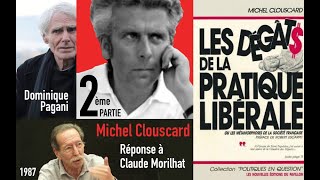 Series · 10 Sept 2019D. Pagani / M. Clouscard's reply to C. Morilhat • Part Two
- 2:16:11The term attributes, for the three dimensions of the State.
 Series · 23 Aug 2019D. Pagani / M. Clouscard's reply to C. Morilhat (1987)
 Talks · 3 Aug 2019Money, work, freedom
 Season 5.2 · 30 Jun 2019#5.8 Nature or Landscape?
 Season 5.2 · 26 May 2019#5.7 Nature or Landscape?
- 49:22EthicsHis treatise more geometrico cheats by using ordinary language.
 Series · 2 May 2019Dominique Pagani ▷II Michel Foucault
 Season 5.2 · 26 Mar 2019#5.5 Nature or Landscape?
- 27:31EthicsHis last part, on human freedom, is rarely commented on.
 Season 5.2 · 4 Feb 2019#5.4 Nature or Landscape?
- 4:51Cited among the thinkers of extension.
 Season 5.1 · 31 Dec 2018#5.3 The philosopher's Odyssey: Revolutionary thought
 Season 5.1 · 6 Dec 2018#5.2 bis FaceBookLive / Questions (1)
 Season 5.1 · 6 Dec 2018#5.2 ter FaceBookLive / Questions (2) following Workshop #5.2
- 2:42Example of an author one can be a specialist in.
 Season 5.1 · 21 Nov 2018#5.2 The philosopher's Odyssey: Revolutionary thought
- 10:59Thinks what is, as opposed to utopia.
 Season 5.1 · 2 Nov 2018#5.1 bis FaceBook Live / Questions
- 36:08His formula "every determination is negation," which Hegel appreciated.
 Series · 5 Jul 2018Being and Code
 Talks · 2 Jul 2018Tribute to Domenico Losurdo
 Talks · 2 Jul 2018The Phenomenology of Spirit
- 46:48Bernard Bourgeois first wanted to work on him; according to Hegel, one must begin with Spinoza without remaining there.
 Season 4 · 14 Jun 2018#4.9 Angélique (by Nerval)
- 24:22Takes up the threefold division of knowledge.
 Talks · 20 May 2018Marxist Café - Work and the right to work
- 1:18:53"Every determination is negation": for there to be a field, the forest must be removed.
 Talks · 31 Mar 2018Tonight, we repoliticise. Part 2
- 1:38:14Preoccupied with the relation between thought and extension.
 Talks · 12 Mar 2018Tonight, we repoliticise. Part 1
 Season 3 · 1 Aug 2017#3.5 From Ulysses to Daedalus
 Season 2 · 1 Aug 2017#2.6 Between crisis and war: Philosophising?
- 1:46:01Joy is an increase in power, sadness a decrease.
 Talks · 2 Aug 2016Tribute to Jacques D'Hondt (1)
- 21:48To be a Spinozist is then to be an atheist.
 Series · 2 Aug 2016With Clouscard
- 1:09:05Freedom as intellection of necessity: Clouscard would be "hyper-Spinozist" (according to a participant).
 Talks · 18 Jun 2016At the bistro with Pagani: part 1
- 25:54Cited in Onfray's liberal-libertarian philosophy.
 Season 2 · 18 Feb 2016#2.3 Between crisis and war: Philosophising?
- 1:31:47"One great sphere," as against Leibniz's monads.
 Season 2 · 15 Feb 2016#2.1 Between crisis and war: Philosophising?
- 1:23:37It is not a matter of choosing Spinoza against Kant.
 Series · 2 Feb 2016Hegel on the Beach 3/5
 Series · 2 Feb 2016Hegel on the Beach 4/5
 Series · 1 Feb 2016Hegel on the Beach 2/5
- 18:23Like Hegel, conceives freedom as the intellection of necessity: the ignorant man is not free.
 Series · 1 Feb 2016Marx on the Beach 2/2
- 37:18His vocabulary of expression: commodities express a labor time.
 Season 1 · 28 Jan 2016#1.8 Between crisis and war: Philosophising?
 Season 1 · 10 Dec 2015#1.5 Between crisis and war: Philosophising?
 Season 1 · 10 Dec 2015#1.6 Between crisis and war: Philosophising?
 Series · 31 Dec 2014Q for Quality
- 6:31Evoked through neo-Spinozist naturalism.
 Series · 29 Dec 2014O for Opposition
- 11:16Every determination is negation.
 Series · 27 Dec 2014M for Music
- 1:53Polished lenses to make himself independent of the powers, as Rousseau copied music.
 Series · 26 Dec 2014L for Liberty
- 6:37A great figure from whom the hedonistic neo-Spinozists are far removed.
 Series · 22 Dec 2014H for Hegel
- 3:35Treated as a dead dog, according to Lessing.
 Series · 19 Dec 2014E for Enfance (Childhood)
- 2:48The neo-Spinozists of cognitive science reduce man to conatus and to natural determinisms.
 Series · 23 Sept 2014#3 The myth of the noble savage in Rousseau!
- 36:38Thinking in terms of connection and relation rather than essence.
 Series · 20 Sept 2014#2 Rousseau, a world that begins