 Season 13 · 2 Dec 2024Evil, or the “unknowing” of the self
Dionysos
Appears in 29 videos · 40 passages, 9 of them in depth.
Summary
Dominique Pagani presents Dionysus as the god of intoxication, excess and the collective, whom he contrasts with Apollo1. He often returns to his emblems, ivy, pine, vine and myrtle, evergreen plants that he interprets as the sign of a libido that never dies2. He stresses his Eastern origin: he is a late god who arrives on a chariot drawn by wild beasts, at the limit of Greek rationality, and the dithyramb in his honour is the origin of theatre3. Though a god who is "not presentable", he must not be excluded from the city4. In Hölderlin, he reads him as the god of shared wine and an intermediate figure with Christ who reconciles day and night5. He also mentions Dionysus coming to console Ariadne on Naxos, notably in Nerval and Roussel. Finally, he follows Nietzsche's reading: the dancing Dionysus set against the spirit of gravity, and the observation that in Wagner, Schopenhauer prevails over Dionysus6.
- 1#2.2 Between crisis and war: philosophising?15 Feb 2016 · 1:06:32
- 2#4.3 Angélique (by Nerval)11 Dec 2017 · 18:38
- 3#5 Harnessed to confinitude18 Apr 2020 · 1:14:43
- 4Evil, or the “unknowing” of the self2 Dec 2024 · 14:49
- 5Hölderlin, poetry and politics19 Mar 2022 · 1:05:44
- 6#12 Nietzsche (right up) against Wagner28 Jan 2021 · 2:08:59
Summary produced automatically from 40 of the passages below, to be reviewed; the numbers link to the moment in the session.
 Who is this?
In ancient Greek religion and myth, Dionysus ( ; Ancient Greek: Διόνυσος Diónysos) is the god of wine-making, orchards, fruit, vegetation, fertility, festivity, insanity, ritual madness, religious ecstasy, and theatre. He was also known as Bacchus ( or ; Ancient Greek: Βάκχος Bacchos) by the Greeks (a name later adopted by the Romans) for a frenzy he is said to induce called baccheia. His wine, music, and ecstatic dance were considered to free his followers from self-conscious fear and care, and subvert the oppressive restraints of the powerful. […]
Read the article on WikipediaText: Wikipédia, CC BY-SA 4.0, excerpt · Portrait: Marie-Lan Nguyen, CC BY 2.5
Season 13 · 2 Dec 2024Evil, or the “unknowing” of the self Talks · 19 Mar 2022Hölderlin, poetry and politics
 Talks · 14 Jul 2022From Plato to world revolution
- 6:06The dithyramb in his honor, born of sacrifice, is at the origin of theater.
 Season 10 · 6 Oct 2021#10.2 Dialectics of identity and difference
- 1:09:48God of the collective, he melts the bubbles that separate us.
 Season 9.2 · 28 Apr 2021#9.20 From signal to sign: Einstein
- 25:38A late god of the Greek pantheon, arriving on a chariot drawn by tigers, crowned with plants that never wither.
 Season 7 · 18 Apr 2020#5 Harnessed to confinitude
- 39:00The wine of the title may refer to Dionysus as much as to Christ.
- 1:14:43The most nocturnal god, origin of Greek theater; his attributes and his chariot of wild beasts recall that he comes from the Orient, at the limit of Greek rationality.
- 1:24:53The nearby god designated by the toponyms of Thebes.
 Season 4 · 11 Dec 2017#4.3 Angélique (by Nerval)
- 18:38God to whom ivy, pine and myrtle are dedicated, evergreen plants: the libido.
 Season 13 · 20 Sept 2024Sickness, misfortune, evil
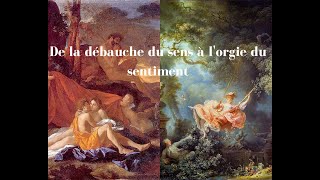 Talks · 29 May 2023From the debauchery of sense to the orgy of sentiment
- 1:31:31Wine, at the center of pleasure.
 Season 10 · 10 Jun 2022#14 Caves of yesterday and today: from Plato to modernity
- 1:00:32He comes to console Ariadne.
 Season 9.2 · 9 Jun 2021#9.23 “Ruled like music paper!” Bach, Nerval, Lévi-Strauss
 Series · 6 Jun 2021#3 Nomad or sedentary? The case of Nerval
- 37:38Montmartre's vineyard evokes him; "Denis" would be the French form of Dionysus.
 Season 9.2 · 18 Feb 2021#9.15 How can sciences of history be real?
- 1:36:05Nietzsche opposes the lightness of the dancing Dionysus to the German spirit of gravity.
 Series · 7 Feb 2021#14 Mozart once more
- 1:06:54We have passed from Dionysus to Schopenhauer.
 Series · 28 Jan 2021#12 Nietzsche (right up) against Wagner
 Series · 11 Jan 2021#8 Happiness and unhappiness in music
- 10:24Figure of popular joy and the collective.
 Series · 11 Dec 2020#5 Happiness versus the death drive in music
 Season 7 · 11 Apr 2020#4 Harnessed to confinitude
- 7:17The "dancing Dionysus" of Nietzschean adolescents.
 Season 6 · 8 Jan 2020#6.3 The logic of the subject in the face of the reconstitution of Nazism
- 1:16:54The sacred is also found in intoxication.
 Series · 10 Sept 2019M. Clouscard's reply to C. Morilhat (part 2)
- 29:08Heidegger is closer to Dionysus than to the Gospel of John.
 Season 5.2 · 2 May 2019#5.6 Nature or landscape?
- 25:52The Maenads are the deities who follow him.
 Season 4 · 12 Apr 2018#4.7 Angélique (by Nerval)
- 1:32:09Immolated god come from Asia, depicted on a chariot drawn by wild beasts.
 Season 4 · 15 Jan 2018#4.4 Angélique (by Nerval)
- 1:04:12The god of intoxication who comes to save Ariadne.
 Season 4 · 18 Oct 2017#4.1 Angélique (by Nerval)
- 1:34:44The pines and ivy, always green, are dedicated to her: libido never dies.
 Season 2 · 1 Aug 2017#2.5 Between crisis and war: philosophising?
- 17:02Comes to console Ariadne and takes her to the sky.
 Season 2 · 1 Aug 2017#2.7 Between crisis and war: philosophising?
 Season 3 · 1 Aug 2017#3.4 From Ulysses to Daedalus
- 1:05:36Poets are like his priests, wandering in the holy night.
 Season 2 · 15 Feb 2016#2.1 Between crisis and war: philosophising?
- 7:46One of the three hunters in Hölderlin's poem.
 Season 2 · 15 Feb 2016#2.2 Between crisis and war: philosophising?
- 1:06:32God of drunkenness, excess, and collectivity, opposed to Apollo.