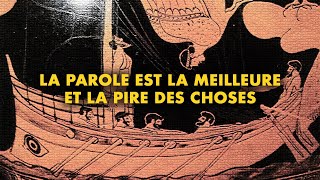
 Cycle 11 · 19 Oct 2022“Speech is the best and the worst of things” (Aesop)
Ésope
Appears in 9 videos · 11 passages, 6 of them in depth.
Summary
What Dominique Pagani mainly takes from Aesop is a saying he quotes regularly from 2016 to 2025: language, or speech, is "the best and the worst of things." He comments on it the same way each time: language educates, transmits, communicates and consoles, but it also serves slander and lies123. In 2022 this sentence gives its title to a session, where he sees it as the expression of a contradiction4. He then compares it with Hegel's Science of Logic, which would also contain the best and the worst5. In 2025 he extends it from language to man himself6. He also presents Aesop as a fabulist about whom little is known, like Homer, and points out that La Fontaine took up many of his subjects and that Molière also drew on him78. Finally, he credits him with a fable about pleasure and pain as two bodies joined under a single head, which he mentions when discussing identity and difference9.
- 1#2.2 Between crisis and war: philosophising?15 Feb 2016 · 1:36:17
- 2Left-washing: are the woke the most asleep?17 Nov 2021 · 54:12
- 3Wagner: the truth of pure music20 Jul 2022 · 13:40
- 4“Speech is the best and the worst of things” (Aesop)19 Oct 2022 · 3:40
- 5“Speech is the best and the worst of things” (Aesop)19 Oct 2022 · 32:24
- 6The repression of the subject in bourgeois civil society9 Aug 2025 · 36:00
- 7“Speech is the best and the worst of things” (Aesop)19 Oct 2022 · 8:04
- 8#3.3 From Ulysses to Daedalus1 Aug 2017 · 56:29
- 9#10.2 Dialectics of identity and difference6 Oct 2021 · 1:03:39
Summary produced automatically from 11 of the passages below, to be reviewed; the numbers link to the moment in the session.
Cycle 11 · 19 Oct 2022“Speech is the best and the worst of things” (Aesop) Series · 20 Jul 2022Wagner: the truth of pure music
- 13:40A fabulist for whom the tongue is the best and the worst of things: it educates but also serves slander and lies.
 Series · 17 Nov 2021Left-washing: are the woke the most asleep?
- 54:12Language is the best and the worst of things: it consoles or slanders.
 Talks · 9 Mar 2017Is history a subject?
- 1:03:56Language is the best and the worst of things: one can communicate as well as slander.
 Cycle 2 · 15 Feb 2016#2.2 Between crisis and war: philosophising?
- 1:36:17"Language is the best and the worst of things": education and transmission, slander and lies.
 Cycle 14 · 9 Aug 2025The repression of the subject in bourgeois civil society
- 36:00Language, and therefore man, is the best and the worst of things.
 Cycle 10 · 6 Oct 2021#10.2 Dialectics of identity and difference
- 1:03:39Reportedly made a fable on pleasure and pain, two bodies with a single head.
 Cycle 3 · 1 Aug 2017#3.3 From Ulysses to Daedalus
- 56:29Reworked by Molière.
 Cycle 2 · 18 Feb 2016#2.3 Between crisis and war: philosophising?
- 1:51:17Language is the best and the worst of things.