Summary Dominique Pagani sees Homer as a figure about whom little is known, an individual or a collective, the first to write down an oral tradition already sung by the rhapsodes, those "binders" of songs who stitched formulas together1 2 . He stresses that in Homer poetry and music are not separate: a sung speech, accompanied on the lyre, which opens with the invocation to the muse, as with the griots. He also notes the absence of any individual detail in the Iliad and the Odyssey. He returns above all to the Odyssey, the matrix of Western literature: in his view it is not a happy ending, since it lies between two slaughters, the sack of Troy and the massacre of the suitors, which he links to the repetition compulsion3 4 . Lastly, he makes it the model for the journey in Nerval's Angélique, a loop bent between Ilion and Ithaca5 , and points to echoes in Ronsard, Nietzsche and Wagner.
1 Mythology and truth 8 Aug 2015 · 6:59 2 #2 From Lévi-Strauss to Nerval, on music 3 Dec 2020 · 1:10:50 3 #9.15 How can sciences of history be real? 18 Feb 2021 · 53:26 4 #12 From Kafka to Proust, the dialectical passage from the intermezzo to the perpetuated edge 7 Apr 2022 · 20:23 5 #9.23 “Ruled like music paper!” Bach, Nerval, Lévi-Strauss 9 Jun 2021 · 2:19:31 Summary produced automatically from 54 of the passages below, to be reviewed; the numbers link to the moment in the session.
Who is this? Homer (; Ancient Greek: Ὅμηρος, Hómēros; possibly born c. 8th century BC) was an ancient Greek poet who is traditionally credited as the author of the Iliad and the Odyssey, two epic poems that are foundational works of ancient Greek literature. Homer was highly revered in ancient Greek society and is considered one of the most influential authors in history. Today, the question of Homer's identity and existence—dubbed the "Homeric Question"—continues to be debated, and scholars generally regard the two poems as the works of separate authors. […]
Read the article on Wikipedia Text: Wikipédia , CC BY-SA 4.0 , excerpt · Portrait: NikonZ7II, CC BY-SA 4.0
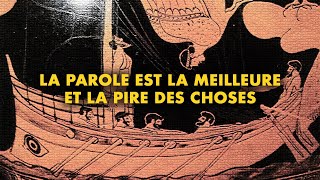
Cycle 3 · 1 Aug 2017 #3.1 From Ulysses to Daedalus12:23 The Odyssey Begins with the invocation of the muse, like the griots.19:07 The Odyssey The most commented work in two thousand years, in which no one has noticed the return of carnage at the beginning and at the end.1:02:16 The Odyssey His description of Bonifacio is the only identifiable site in the Odyssey.1:39:16 The Odyssey Calls Ulysses the ingenious; the episode of the dog Argos and the fortified farms with dung in the yard.Cycle 10 · 7 Apr 2022 #12 From Kafka to Proust, the dialectical passage from the intermezzo to the perpetuated edge20:23 The Odyssey First texts of Western literature; the Odyssey, an apparent happy ending, is framed by two carnages, the sack of Troy and the massacre of the suitors.Cycle 9.2 · 30 Jun 2021 #9.24 “Ruled like music paper!” Nerval, Baudelaire (part 2)37:41 Homer's sirens. 1:21:45 The Odyssey The Odyssey unfolds between two massacres, the sack of Troy and the slaughter of the suitors.Cycle 9.2 · 9 Jun 2021 #9.23 “Ruled like music paper!” Bach, Nerval, Lévi-Strauss13:31 The Odyssey Ten-year journey to which he compares Angélique.2:19:31 The Odyssey A loop bent between two poles, Ilion and Ithaca, from one carnage to the other, a model for Nerval's work.Series · 17 Dec 2020 #7 The Greeks, myth and music30:03 First to write down what was told orally, with formulas and a delivery both sung and spoken. Series · 3 Dec 2020 #2 From Lévi-Strauss to Nerval, on music1:10:50 When he appeared, the exploits of Achilles and Hector were already sung by the rhapsodes, who stitched together formulas. Series · 23 Mar 2020 Introduction to the upcoming workshops2:54 The Odyssey First model, cited on the last page of Angélique: his hero circles Ithaca for ten years.35:45 He describes the carnage in the present tense of the sack of Troy. Cycle 6 · 10 Nov 2019 #6.1 Prelude: Lacan, “Function and field of speech and language”1:13:56 Odyssey The Odyssey is the repetition of a carnage by the same instigator, not a happy ending.Cycle 6 · 23 Oct 2019 #6.1 The logic of the subject1:29:14 Odyssey Ulysses' return is a dreadful carnage, not a happy ending.Cycle 4 · 12 Apr 2018 #4.7 Angélique (by Nerval)4:33 The saltwater sirens. 52:10 The Odyssey First text of literary Western civilization, the primal template of all travel narratives to which Nerval relates his own.Cycle 4 · 15 Jan 2018 #4.4 Angélique (by Nerval)1:40:24 The Odyssey Nerval ends with the author of the Odyssey, who leads his hero for ten years around the Mediterranean to fabled Ithaca.Cycle 4 · 18 Oct 2017 #4.1 Angélique (by Nerval)5:57 Iliad For him, poetry and music are not separate; the songs of the Iliad are rhapsodies, and the rhapsodes are "binders" of songs.Talks · 8 Aug 2015 Mythology and truth6:59 Iliad First to have transcribed the tales, an individual or a team of rhapsodes; the true author of the Iliad is the people.Cycle 12 · 14 Aug 2024 Too late?1:09:43 The Odyssey The Homeric epic, matrix of so-called Western literature.Cycle 12 · 11 Jul 2024 After the vote: entering a zone of turbulence19:43 Odyssey In the original text, Ulysses returns to carry out the massacre of the suitors.Talks · 29 May 2023 From the debauchery of sense to the orgy of sentiment1:26:46 Odyssey The sirens, compared to the Lorelei.Cycle 11 · 18 Mar 2023 A springtime of the peoples?2:07:24 Rosy-fingered dawn. Cycle 11 · 12 Dec 2022 Hesitation fascinated by hearing and by sight: Siegfried and Perceval7:44 The epic precedes the lyric and the dramatic: Homer before Pindar and Sophocles. Cycle 11 · 23 Nov 2022 The aporias of anthropology51:09 The Homeric epics also have variants. Cycle 11 · 19 Oct 2022 “Speech is the best and the worst of things” (Aesop)8:37 Like Aesop, a figure about whom little is known. Cycle 11 · 14 Oct 2022 Clouscard and the problem of Socrates40:39 Iliad Mentioned in Ronsard's poem.Series · 20 May 2022 Who is hiding beneath the surfaces? Aesthetics and politics1:16:53 The winged word, which flees and flies. Series · 17 Nov 2021 Left-washing: are the woke the most asleep?54:37 Like Aesop, little is known of his existence. Cycle 10 · 6 Oct 2021 #10.2 Dialectics of identity and difference1:33:03 Poetry as educator of humanity. Cycle 9.2 · 4 Mar 2021 #9.16 How can sciences of history be real?58:13 Iliad Mentioned in Ronsard's poem.Cycle 9.2 · 18 Feb 2021 #9.15 How can sciences of history be real?53:26 Odyssey The Odyssey opens with the carnage of Troy, which Ulysses repeats on his return: the drive to repeat.56:06 Iliad Wotan emerges from a cloud like the gods of the Iliad.Series · 9 Feb 2021 #15 Plato, Rousseau, Hegel and music7:31 Odyssey The beginning of the Odyssey is an invocation to the muse.Series · 28 Jan 2021 #12 Nietzsche (right up) against Wagner1:56:22 Iliad Achilles' shield, an archi-classical image Nietzsche uses.Series · 15 Jan 2021 #9 Romantic irony and the Vinteuil sonata16:06 He never describes the particular detail of Achilles' life. Cycle 9.1 · 13 Nov 2020 #4 Benefits and harms of amnesia…1:47:22 Since him, variations on the Trojan War have never ceased. Cycle 9.1 · 23 Oct 2020 #2 Benefits and harms of amnesia…8:07 Hesiod is almost as ancient as she is. 13:44 Before her, there is oral transmission. Cycle 9.1 · 8 Oct 2020 #1 Benefits and harms of amnesia…2:02 Often cited by Plato, a staple food of Greek authors. Cycle 8 · 21 Jun 2020 #11 Return to the logics of the subject31:50 Iliad No individual detail in the Iliad and the Odyssey.1:02:31 Legendary founder, perhaps a collective figure; oral tradition and pre-classical language. Cycle 8 · 11 Jun 2020 #10 Return to the logics of the subject46:05 Accompanied on the lyre, between speech and song, he sang at the tables of princes. Cycle 7 · 17 May 2020 #8 Harnessed to confinitude1:03:22 The irresistible songs of the sirens. Cycle 5.2 · 25 Jan 2019 #5.4 Introduction: nature or landscape?26:54 Iliad Among the Greek texts read to the Romans.Cycle 5.1 · 2 Nov 2018 #5.1 bis Questions (Facebook Live)12:37 Iliad The Iliad cited in Ronsard's verse.Cycle 4 · 14 Jun 2018 #4.9 Angélique (by Nerval)1:30:46 His heroes address each other like true Mediterraneans, with epic grandeur. Cycle 2 · 1 Aug 2017 #2.7 Between crisis and war: philosophising?1:44:39 A commentary announced: Racine's myths go back to him. Cycle 3 · 1 Aug 2017 #3.2 From Ulysses to Daedalus46:13 An archaic period; it is not known whether he existed. Talks · 9 Mar 2017 Is history a subject?1:16:38 Odyssey The literate slave reads aloud a passage from the Odyssey.Talks · 18 Jun 2016 At the bistro (part 1)1:08:21 Odyssey Angélique may be the most important work since the Odyssey.Cycle 2 · 15 Feb 2016 #2.2 Between crisis and war: philosophising?31:18 The Odyssey Texts most read for two thousand years, without individual detail.Series · 29 Jan 2016 What is to be done? 1/310:58 The Odyssey Angélique's journey is longer than the Odyssey.
 Cycle 3 · 1 Aug 2017#3.1 From Ulysses to Daedalus