English translation of the French transcript, made with AI and not yet proofread — click a paragraph to jump to it. Show the French original
Session online; language, a language, and speech 0:00 I believe we're live. If that's indeed the case, first I'd like to thank Pierre-Alain and the technical crew in general.
0:32 And then I especially thank you for being here. And whenever we meet again, I feel like I'm always doing something for the first time. The last time we were in contact, it was, that was a big first since we were renewing physical contact with the audience at the Goscinny centre, in the 13th arrondissement.
1:04 The time before that was a session where I sketched out the broad outlines of the cycle awaiting us this season, this autumn, this winter, perhaps even this spring. So actually, this is the third time we've spoken since the start of the year. But in what sense is this time a first? It's the first time we're meeting remotely.
1:34 I don't like this vocabulary, as you might guess. Virtually. At a distance, online, whatever you want to call it. As part of this new season. And as announced, this is a Q&A session, not only to resume a tradition which I said right away would recur often, with formats getting shorter and shorter, increasing the frequency and reducing the length of our Q&A sessions so that as many questions as possible can be addressed.
2:18 Especially since there was one that was overdue; I'll tackle one or two tonight. But the one that was really overdue... But for now, I'll give a very short introduction. First, I greet Rouge Gorge, I believe. That's right. A first contribution. Yes, I prefer the word 'contribution,' your contributions rather than your questions, because sometimes they're not really questions.
2:49 It's a point of view, and one that often has a great deal of interest, even if it doesn't end with a question mark. That's the case here. It's nice. But what's less trivial than the fact that Rouge Gorge is happy about our return is that he dives into the subject of the cycle I broached from the Goscinny centre last time, and which I will keep digging into.
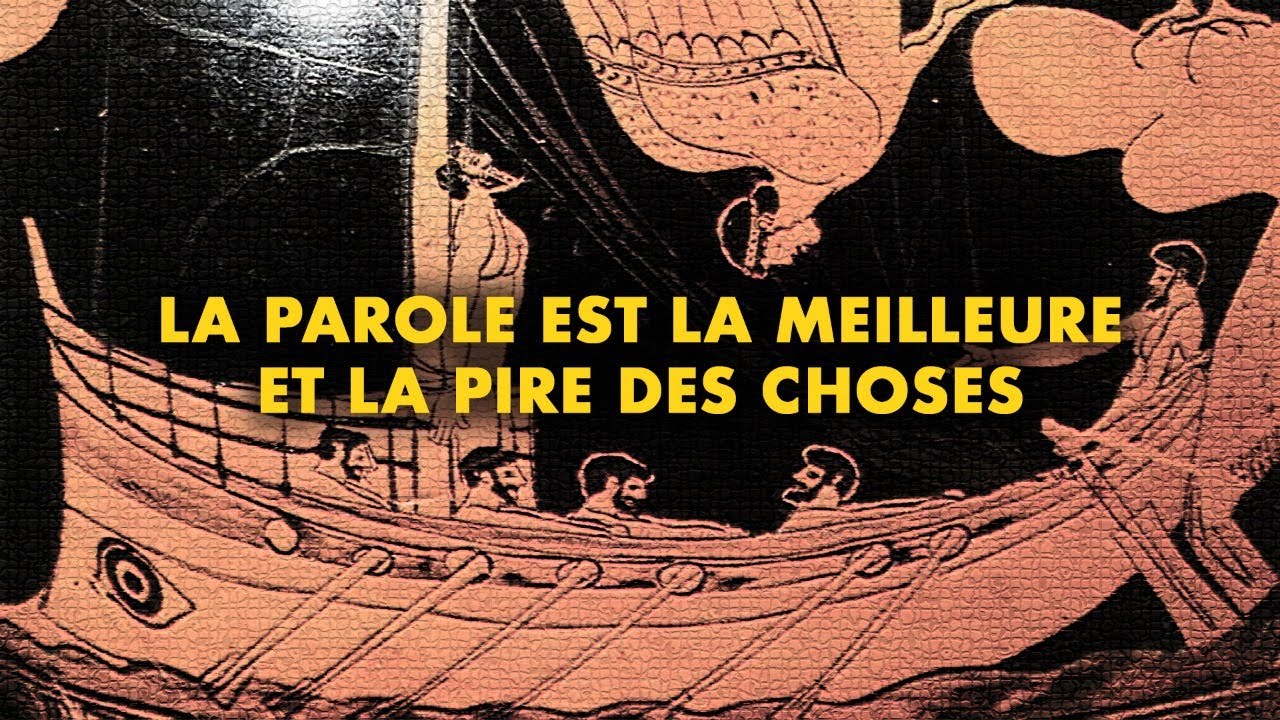
3:22 During this period, during this cycle, it's the problem of words, of language. That's why I'm starting with Rouge Gorge. I won't dwell on it. I thank him for saying 'finally, you're back.' That's always encouraging. And above all for giving us the opportunity to remind ourselves that this problematic of language is indeed the essential one. But before moving on to the next question, following on from what we've just seen thanks to Rouge Gorge, regarding language and words, I'd like to explain a bit the quotation from Aesop that serves as the title for tonight's session.
4:07 It's when he says that speech is the best and the worst of things. Depending on the translation, 'the tongue,' 'speech'—you know that all these notions have been the subject of very important distinctions within contemporary linguistics, that is, modern, contemporary, structural linguistics—not structuralist, I remind you—initiated essentially by Ferdinand de Saussure.
4:39 We can never reduce everything to a single person, but he played a decisive role. And within this linguistics, a clear distinction is made—I've already said this, so I won't dwell on it, I'll say it quickly—between language, a system of communication proper to humanity as a whole, so something that doesn't really exist, because humanity does not speak 'language,' but each person speaks a particular tongue. You see, that's not the same thing, it's already much more restricted: Spanish, Mandarin Chinese, Inuktitut, whatever.
5:20 So language in general doesn't exist, it's an abstraction. Tongues, on the other hand, are already much more concrete; that's what serves as the framework for what is being said here and now. But even here and now, it's not the tongue as a system of rules, etc. I compared it to the highway code, if you remember. No one really drives exactly according to the highway code—who hasn't crossed the yellow line one day, checking there's no one coming on the straight, because a tractor is going 12 km/h ahead of them.
5:59 There you go. It's not a big deal. I mean, the traffic that actually exists isn't quite the traffic prescribed by the highway code, or parking for a few minutes somewhere it's forbidden, just long enough to deliver a package, then getting back in the car, hazard lights or not, depending. And it's the same with a language. I mean, who can boast of speaking French without ever making a single mistake of syntax, of grammar, in agreeing past participles?
6:30 Yes, I won't dwell on it. Germans tell me that Germans make even more mistakes than the French do, relative to the strict demands of German grammar and its complexity, with its masculine, feminine, neuter, its agreements, its declensions, and so on. So what actually exists, in the end—and I go back to the word I chose for the translation I propose of Aesop's phrase—is speech.
7:02 Only speech is actual; it's not merely virtual, you see, it's not merely an ideal, it is real. You see? And so that's the subject of this statement. The subject is speech; the predicate, what is said of the subject, is 'the best and worst of things.' For now, I wanted to start by explaining the subject. It's indeed speech in the sense of the moment when the logos, language, enters into existence.
The best and the worst of things: Aesop and Ulysses 7:34 Because before that, once again, it was a canon, an ideal, so it doesn't exist. So, what does he say about speech? Well, what is the best and worst of things? Look how directly in line this statement is. Do you see why I chose it? To make the connection with last time's session and carry it forward. Well, because it expresses a contradiction. Speech, isn't that right, can be both the best and the worst of things.
8:04 Now, it wasn't at the same moment, remember—the temporal dimension we drew out from the contradictory, or rather from contradiction. But in any case, the most common explanation given of this formula, which is Aesop's best-known one—I remind you that Aesop was a fabulist, and that many of La Fontaine's fables were inspired by subjects already treated by Aesop, subjects involving animals, crows, foxes, foxes and grapes, etc.
8:37 And that he's a fabulist, a fabulous one, meaning we know very little about him—rather like the case of Homer. But still, what has persisted after more than 2,500 years is nonetheless this sentence, which remains perhaps the most emblematic of the man. There must be a reason for that, linked to the content of what is stated here. And so the usual exegesis, the usual explanation, is to say: yes, language is the best of things because it can serve to educate, to transmit, to defend, to sing praises, to console.
9:18 But it can also slander, lie, sow discord, and hence conflict. Yes, that's the common, somewhat simplistic explanation, but it more or less holds up, you see, across everything we've seen in these recent sessions. And that's why I'm glad about this Q&A session. Before moving to the next question, I'll extend this preamble a bit to recall that last time I insisted so much on the ambiguity of language—the one we speak every day, not systems of equations.
10:01 Not all discursivity is properly linguistic. You see, I remind you, mathematics is discursive, but it is not a language, and certainly not speech. On the other hand, it's often written. I want to make clear here that I'm warning against a misreading one might rightly fall into if one stops at what I said last time and hasn't followed what I've said many times before. I am not putting language on trial.
10:32 I say that I'm conducting a 'procès' in the Marxian sense—that is, a process of production, that is, the study, the term 'Prozess' in German means roughly 'analysis,' the process, as you find it in the French notion of 'processus.' But I am not criticizing language by saying my thought is so profound, too bad language, with all its shortcomings and ambiguities, can't manage to express the depth of my thought. No, absolutely not. That's why I hold on to Aesop's quotation. It is the best, but one could just as well say the worst, but just as well the best.
11:07 And above all, I wouldn't want anyone to think that I'm criticizing language in favor of other modes of communication. And that's why—I'll finish my preamble on this—besides Aesop's phrase, around the same period, isn't that right, I asked Pierre-Alain to please use as a card, as an image, to illustrate tonight's session, the image of Ulysses.
11:37 Chained to the mast, listening to the song of the sirens, or rather, trying not to hear it. There you go. Because the sirens do sing. We're not told whether it's just sounds without words. Generally, song involves both music and words. Who knows. I'm not saying anything against language as opposed to more effective ways, shall we say, of accessing truth.
12:12 Far from it. I'll stick with Goscinny's formula from last time, and I'll end my preamble with this formula: how, starting from ordinary ideological language, can one raise it to the necessity of the concept while still remaining within it? There you go. Second question. Now we really get into philosophical territory—this is a question from Cermin Camblon.
Request for a reading of the Greater Logic 12:44 I hope I'm not butchering the correct pronunciation. Pagani, I think, and I'll be with us according to the other and according to me, thank you—that the greatest contribution you could make, which I haven't made and haven't done, would be an annotated reading of the Greater Logic. He's of course speaking of Hegel's Greater Logic. 'This black forest from which few rivers escape.' I'm quite pleased that Cermin was attentive to Hölderlin's text on the Ister, where he clearly saw that this stream, this Bächlein, as Schubert calls it—with Schubert it's always by the edge of some clear water, like that.
13:30 It's never the Amazon with Schubert, it's little streams lost in who knows what forest. But how this... You don't suspect, when you see it at its beginnings, in the Black Forest—that's what I'm picking up from what Cermin says—you don't suspect that it will become one of the greatest rivers in Europe, the Danube, isn't that right? The greatest, in fact, after the Volga.
14:02 So I'm glad he saw that the Black Forest is like something the river doesn't want to leave, as if it wanted to stay in its native forest, isn't that right? A bit like a young kangaroo that the mother has such a hard time throwing out of her pouch. There you go. But let's get to the truly philosophical content of Cermin's contribution: the fact that he asks me, programmatically, to give an annotated reading of the Greater Logic.
14:40 That's an extremely ambitious program; the Greater Logic is indeed Hegel's magnum opus, his most developed work. I cite the Phenomenology more often because the Phenomenology has a didactic, pedagogical scope, which it moreover states very clearly in its preface, summed up in its formula that it is a work in which the task is to bring philosophy down—sorry, to raise ordinary consciousness to philosophical consciousness, and, yes, along the dialectic in the opposite direction, to bring philosophical, intellectual consciousness down to ordinary consciousness.
15:30 Instead of jargonizing away in its corner, isn't that right? There you go, that was the... Yes! This is a classic point in Hegelian studies, I'm not inventing anything, and it's familiar to those who know this work. Let me take this opportunity to mention that a very in-depth seminar is being held this year on Hegel's thought and its relation to history, in particular within the walls of the École normale supérieure on rue d'Ulm.
16:03 It's familiar to everyone who knows Hegel's texts that the Phenomenology itself announces the Greater Logic. The Phenomenology is like a great portal, a great vestibule leading to that high point of Hegel's work which is the Greater Logic. I'll take a bit long with my answer, since it allows us to review many things, or even learn them for those less familiar with philosophical matters.
The circle of circles: logic, nature, spirit 16:37 There's nothing wrong with that. I myself would like to be a bit more familiar with soil mechanics, wouldn't I, or with field theory. But I would like that—this isn't at all a dismissive thing to say. Hegel often compares his system, to use now a term that encompasses all his works, what he calls a circle of circles.
17:12 Try drawing a circle of circles, and you'll see what I mean. You can well imagine that the figure of the spiral is the only one that can roughly account for this formula of a circle of circles. Especially since the spiral has the advantage of being a dialectical synthesis. I say dialectical because the synthesis is of contradictory things—of a thesis and an antithesis, namely the linear.
17:43 It's a line. And then there's progress, like a line that continues, that advances. And there's the circle. The circle is repetition. The line is appearance and disappearance. Unlike repetition, there is stability. The circle, on one hand, to the point that in the old regime and in classical times, some used the circle as a sacred symbol to represent divine immortality.
18:16 For example. Eternity, rather—that's far more important than immortality. And the spiral combines both the recurrence of the circle with its enrichment by a past that comes back and is revisited, but not by returning to zero each time—rather each time with a small step forward, because the next circle is larger, with a bigger radius than the previous one, and so on.
18:51 We can't go on endlessly spinning out metaphors and images. Let's return to rigor. If I speak of a circle of circles, it's because it lets us situate the Greater Logic. That's mainly why. The Greater Logic is the first circle of this circle of circles, of the three great circles by which the whole of Hegel's work can be summarized.
19:21 The circle of the logos—the word 'logic' comes from that, you find it in 'paralogism,' in 'logarithm,' in 'monologue,' in 'dialogue,' everything that relates broadly to language, to speech, and to communication, including in mathematics. 'A over B' is a 'logos'—among the Greeks, in the plural, 'logoi.' You see? You understand well why the notion of logarithm is used in mathematics.
19:52 So the first of the circles of the Hegelian system is Logic. The second is Nature, and the third is Spirit. Right away, you already have a picture in your mind. First, the logos, pure abstraction, the unfolding of the idea, of concepts. We stay within the domain of language. It seems disembodied, far from the real.
20:24 But then suddenly the real arrives with Nature, the second circle, isn't that right? But in Nature, for now, there's no spirit, no self-consciousness in nature, in a stone for example, even if Nerval says in a famous sonnet, 'In the blind wall it fears a watching eye,' and again, in the same poem, 'a pure spirit grows beneath the bark of stones.'
20:54 Right. And so, to return, picking up the thread of the Hegelian system, how Nature—we can't stop there, but there's a third term, which is Spirit, broadly speaking history, a Hegelian term—Hegel goes so far as to say that man, the agent of history, or its patient, however you like—both notions refer to each other—man, says Hegel, you can see how much his comparisons owe to his theological youth, isn't that right?
21:31 I remind you he didn't attend a philosophy university to begin with—that wasn't so simple back then, it didn't exist in that form—but young men came to philosophy through theology. I mention this in passing: becoming a pastor was a form of social advancement, and their mothers encouraged them to follow that path, and of course it was an opportunity to do philosophy, sometimes a bit more than the churches concerned would have liked—well beyond the position philosophy held in the Middle Ages, where it was 'ancilla theologiae,' the servant, isn't that right?
The speculative Good Friday and the origin of man 22:12 The handmaid of theology. There you go. I'm giving reminders here; I haven't yet given the comparison in this serious context, to help you understand the necessity of a third circle arising within Nature. He compares man, the appearance of man in nature, after minerals, plants, and animals—he compares it, I quote, to 'the speculative Good Friday.'
22:49 Do you know what Good Friday is? The idea expresses itself first in Logic, in its unfolding, we'll see that afterward. Then it disappears into Nature. Nature is the entity, it's the idea, it's matter—not even spiritual, it's mineral, vegetal, animal matter. And so Hegel compares this to the death of God on Good Friday, and behold, with man comes Easter, Easter Sunday, the resurrection—the appearance of man is the resurrection of spirit, of the logos that had disappeared into nature, and here it is, resurging in history, from the very first chipped flint stones.
23:40 and it goes together right from the first exchanges of speech. We should have a session on this one day, shouldn't we? Every time anthropologists discuss what constitutes the origin of man, man's specificity in relation to the animal, it's not a matter of denying everything of the animal that is in man, is it? It's a matter of showing what man brings in addition to animality, not "in addition" in terms of value, but in addition in logical terms, precisely, as a new determination unknown in the animal world.
24:19 the attributes that come up most often are language — man is the animal that speaks; there's Rabelais who says man is the animal that laughs, laughter is proper to man — actually that's not Rabelais. We could multiply this kind of distinction, but there are two that come up often: the production of tools — and I won't decide between them — the production of tools and then language. You'll notice that in both cases there is a relation to the other which is fundamental.
25:00 Since that's not quite today's topic, I'll just recall briefly why it's fundamental. The Mousterian child — I mean, from the era of Cro-Magnon man, the one who already lived on stilts, who is technologically — you see, I'm being very careful, I'm not making a value judgment — much more advanced than Neanderthal, and a fortiori than the Australopithecines before him. Man who already lives on stilts, who already has jewelry made of ivory, of bone most often, sometimes of ivory.
25:40 The child of that era doesn't start the whole history of technology over from scratch. He arises into a world that already has a technology — for instance, I'm just making this up — that of metal smelting, which presupposes thousands of years of advances beyond the Stone Age. And the Iron Age is more advanced than the Bronze Age, and so on. So what's the connection with language, with the relation to the other?
26:10 That is to say, without the relation to heritage, to what the child finds already there — I mean he doesn't only have — heredity as capital at his birth. He also has inheritance. That's where we see the difference between history, spirit, and nature. There you go. So these reminders are here to serve. You understand that for topics like this, since I'm keen to keep the question-answering sessions shorter, as I announced to you, I won't dwell on it too long.
The absolute idea, Lenin, and Au château d'Argol 26:43 There will be no shortage of occasions to return to these reflections. On the other hand, I'll answer Axel Hermann that what's being asked here is colossal. It would take, I don't know, ten years, and even then, when you see the richness of a work like the Science of Logic, where we really start from the most elementary, the simplest, to arrive at the chapter on the absolute idea — the absolute idea, which in Hegel is an idea almost, almost close to God.
27:14 I'm not saying it just like that, far from it. That was the great problem of censorship at the time of the ministry that employed him. Hegel was flanked by censors, spies if you prefer, during his lectures. And the goal was to keep an eye on this man a bit. "Our children are in his hands." Their problem wasn't getting lost in the relations of subject and predicate, precisely in what makes up the substance of Hegel's Logic.
27:45 No, the political question was: does this man believe in God or not? Or else, is he so influenced by the Enlightenment and the French Revolution — which nearly toppled all our crowns, were it not for Waterloo and British money and the cannon fodder of Prussia and Russia — there you go, and Austria, to name just those. So Hegel remains very cautious, he's careful not to give a univocal answer one way or the other.
28:20 On the other hand, he is never as close to representations tied to the absolute, to God — call it what you like, the absolute — as when he arrives at the absolute idea. Why am I bringing this up? You can guess, since I've often cited it. Now here, you see, is the ambivalence. Lenin — hardly suspect of not being a materialist, a Marxist through and through, hence a materialist, but a dialectical one on top of that.
28:51 And the proof that he's a materialist, but not a mechanistic one, that he's on top of that a dialectical materialist, is that when he gets, in the enormous work of reading the Science of Logic — that's why I keep coming back to these moments in Hegel — which he managed to undertake, since you need time to grapple with volumes of such difficulty, such density. Now Lenin never had time, he was a militant. That's the big difference with Marx: he wasn't just a theorist, he had to run a party, the Bolshevik party, and then even more, the Soviet Union.
29:27 And in what chaos, what convulsions, with — barely had the Bolsheviks seized power, taken the Winter Palace, than immediately the Westerners landed — the Japanese too, in the Far East, the French with the hyper-reactionary Marshal Weygand landing in Finland, which was the Ukraine of that time already — not exactly to spare Soviet Russia — the British: there's a monument in Baku, now the capital of Azerbaijan, dedicated to the 14 Bolshevik political commissars tortured to death by the British, who had intervened to help the White Russians, who lost the fight. So from the very start this newborn baby that was the Bolshevik revolution had to be strangled.
30:24 This reminder is important, given the times we live in. And Lenin — how could he still find the time to be immersed in this unheard-of abstraction that the Science of Logic reaches? Precisely because he had been exiled for political reasons, and when he was stuck in Switzerland, cornered, so to speak, by the political situation — a bit like Descartes, cornered by the harsh winter of his time, in a stove-heated room somewhere between Champagne and Lorraine — he suddenly, for once, had the time, and that time he didn't spend on idle chatter but devoted it to work.
31:07 the logic of this philosopher whom he knew from a distance, because Marx cited him more than others, even while criticizing him — especially the young Marx — and increasingly defending him as Marx evolved. I'm thinking here of the preface to the second edition of Capital, where Marx is very clear about his relationship to Hegel, and where he places him well above all other philosophers, even though he's not fooled by the mystifying side of Hegel's dialectic. But, arriving at the chapter on the absolute idea, to pick up my thread — and this is where I'll end my answer — to show Axel Mink, who asks a lot of me, and I'm delighted, but here I can only be programmatic.
32:00 Lenin, I've cited him often, so I won't dwell too long — says that this passage on the absolute idea, in short on God, which should exasperate a materialist like him, is thoroughly remarkable — I quote Lenin literally — that it's the most idealist and the most materialist passage in Hegel. You see, we never leave the dialectic, we never leave Aesop: there's the best in the Science of Logic, and the worst — the most idealist, the most materialist.
32:39 So yes, it's a program that Xermaine is asking of me. There you go. I might make a summary a bit less brief than the one I'm giving tonight, but I thank Xermaine for giving me the occasion to recall that this is nonetheless the principal work of the Hegelian system. And if I cite it a bit less often than others, except for excerpts here and there, it's because it's often very difficult in terms of what I try to convey.
33:17 I'll end my answer to this question by recommending something much more relaxing to read — a novel, yes, a novel, we're no longer in abstractions — a novel by Julien Gracq, one of his first novels, published by Éditions José Corti, called Au Château d'Argol. Because the hero of this novel — the author declares him passionate about philosophical speculations, and I'll summarize the passage that will bring us to the Logic, you see, I'm following my thread — he says he had read Kant, Plato, Descartes, but his personal views pushed him, I quote, "toward more concrete philosophies, some dared say more courageous, which, not content with letting a light into reality, demanded of the world its systematic and total explanation, like Aristotle, like Plotinus, like Spinoza" — Spinoza, but above all,
34:27 he had devoted all his strength to the prince of the geniuses of philosophy, to Hegel. And he took with him to his manor in Brittany — you see, the holidays are over, but well, next vacation, if you're up for it — he took to his manor in Brittany that Science of Logic "where the entire Hegelian system suddenly seems to take its august and angelic flight" — I'll end there. Thank you, Max Hermann, for bringing up this work, so difficult, which I don't cite enough.
Analyses of fascism: Chapoutot's documentary contribution 35:01 But I promise to do better. So, Lucas, whom we meet often, and I'm glad of it, Lucas Lederle — I hope I'm not mispronouncing it too badly. "Hello Dominique, thank you for your analyses." Proudly. On the tributes, I'll move quickly. "I had a new question for you: in your view, to what extent is there complementarity and contradiction between the analyses of fascism carried out by proponents of a so-called culturalist approach — Chapoutot, Ingrao, Umberto Eco, Adam Tooze — and those of the Marxists?"
35:45 Dimitrov — this is the great Bulgarian militant who had been accused of the Reichstag fire, and it was so blatant, the Nazis had paid a tramp to say he was a Bolshevik, etc., and it was so blatant that even under that dictatorship, Dimitrov had to be acquitted. A great, great militant and great theorist. Of course Gramsci, of course Lukács, Clouscard.
36:16 So, I'll hold onto this question — I'm keeping the others too, don't worry, they'll get their turn — but I've given priority to this one, because again we're in the vein of what we've been discussing, the contradictions inherent in ordinary language, since he speaks of complementarity and contradiction, but above all because — I quote, though I'll drop all the proper names mentioned there, not because they're unimportant, they're mostly first-magnitude stars — but I'm thinking of Chapoutot, who is probably, of all the historians I know, contemporary ones at least, and even relatively young ones — because you can be contemporary before turning 80, I'm not far off myself, but Chapoutot is still relatively young — yet despite his relatively young age, he's undoubtedly the best-documented historian on the Nazi period.
37:22 It's also, somewhat — I don't much like the word "specialty" — but it's a bit the strength of Chapoutot's approach: he's someone who must have spent more than hours, days, I don't know how long, in the archives. He's not the only one — Lacroix-Riz is an extraordinary archivist too — but Chapoutot had to fight for it, he says so himself, even in Germany it's not always easy to get access to what you're looking for as soon as you deal with that period.
37:55 So you see, it's not just about having the courage to work, to read, to decode — no, you also have to have access, and that's another battle. There you go. I'll move past that, but it was worth recalling. So why does it interest me that our friend Lucas names Chapoutot here? Because he embodies, all by himself, what makes documentary knowledge such an immense asset, something irreplaceable in history.
38:32 I think there are few fields where the ignorant person can say just anything, or think they're speaking, about an immense historical period — since the dawn of time men have known what history is, having lived it. Whereas here, even for a relatively recent period, we advance step by step, page by page, paragraph by paragraph. That's the work Chapoutot does. Here I pay tribute to his friend Ingrao too, his colleague and friend.
39:03 But at the same time, he's a historian, not a philosopher. So you see, I'm not saying he's the greatest living historian of Nazism, since I'm not a historian myself, and I don't want to — I don't want to mix fields, that is, usurp the role of a historian. That's not my job. Even if in philosophy I favor those who understood that, to find one's way in philosophy, it took a long time — it took more than 2000 years to understand that one had to reflect a little on the history that brought us to the present moment in which we speak of philosophy.
Philosophy must take history into account: Jena 39:51 a small illustration of this parenthesis I've just opened: a plausible anecdote, though not certainly factually exact, says that when Hegel put the final period to what is said to be his most brilliant work, the Phenomenology of Spirit, in 1807 — that is, the year Napoleon won the Battle of Jena, which definitively shattered Prussia's hopes at that time of joining the concert of great powers — this legend, I say legend, there's some truth to it: what's true is that it was that same year — the legend has it that he put the final period just as Napoleon's troops were entering the city.
40:47 History comes knocking at the philosopher's door and says to him: "Look here, it's been 2500 years you've been dwelling in timelessness — substance, subject, concept, all that stuff — that's fine, but let's come back to logic a bit, we're not in Spirit, remember? Logic, the logos, Nature, Spirit — the three great circles — that's where we see how useful this distinction really is." There, history knocks at the philosopher's door, in Jena, and asks him: "What brought you here?"
41:20 "What brought you to reflect on being, nothingness, becoming, Heraclitus, Parmenides, Plato, Kant? What brought you to God, matter, what brought you to do all this? Right? How about it — was it through theology? Was it because your mother said, 'Go into theology, at least you'll have a salary, you'll be a pastor, you'll have a nice little wife' — this isn't Catholicism, this is...' Right? 'You'd get out of poverty.'" Taking history into account within philosophy isn't being a historian, but it is taking history into account.
41:56 For that, the philosopher needs the historian, doesn't he? So as not to — someone well-documented, I come back to Chapoutot here, who allows him to move forward on solid ground, as solid as possible. When Hegel alludes, say, to the Roman world, to the French Revolution, or to the birth of industry — Hegel is a contemporary.
Heidegger and the essence of Nazism 42:29 So I still haven't answered the question about the historian, but this preamble was necessary. I'll pay great tribute to Chapoutot again, I maintain that he's the best-documented historian on the Nazi period in our time, but that's not enough to understand Nazism. And I'll give only one example, because otherwise it would take us too far — it would be too long. I'll take advantage of it, actually — there, I have a quarter of an hour left.
42:59 I have a quarter of an hour left. I often say that Heidegger isn't — I'm placing myself beyond the discussion of whether he was a Nazi or not. There are still people arguing over that. Whatever he may say, he did write things like: "We have a duty of Eros toward the Führer," "the greatest event of Western metaphysics is the creation of the Panzer Divisionen," "the enemy is the Asiatic, and Asia, for a German at the time, begins with Poland — we're not even talking about Russia."
43:31 Besides, Chapoutot talks about an SS division that went to the Russian front. You see, that's something he taught me, he's well documented. The motto of that division was that the Russian must disappear from the face of the earth. In case the quality — I'm saying this just to note it. Excuse me — Bismarck, just before the Nazi imperial era, said that if one wants to get rid of Russia, one must hold it by Ukraine.
44:04 All this, pure coincidence. I come back to Chapoutot. I get there via Heidegger. Personally, I don't get into these debates. There are still people wondering, despite all these statements — "the enemy is the Asiatic" — whether Heidegger was a Nazi. So for Chapoutot, he answers quickly, he says, "No, not at all, he's not a Nazi."
44:41 "He's not a philosopher. Why am I getting involved in that?" — in the essence of Nazism. That's fine, isn't it? It's irreplaceable and indispensable that, thanks to Chapoutot, we can talk about Nazism as a factual existence of things. But to make a judgment about whether so-and-so is a Nazi or not requires handling much more complex determinations.
45:13 It so happens that Heidegger is the idol of the entire French philosophical school in which Chapoutot's generation grew up. I understand that he has some trouble taking distance from the likes of Foucault, Derrida, Deleuze. Well, of course — that is, from those who, starting in the sixties, at the end of the sixties, inaugurated the great counter-revolution whose effects we're still suffering today, and which soon leaves no other horizon but an atomic mushroom cloud if we're not careful.
Music and Nerval, announcement of the next session 45:45 That's how I'm treating this briefly. As you can imagine, this isn't the first time I've spoken of this, nor will it be the last time we get the chance to return to this kind of file. I'll ask Pierre-Alain to see if we can finish our quarter of an hour with Redrom. So, yes, I was very interested in Redrom's contribution here, whom I also greet, since he's a regular and these contributions are always very rich in content.
46:15 but it's so rich that I won't risk isolating Redrom this time to answer it, especially not exhaustively this time. But I'll read it to you first because it will serve as the program for the next question-answering session, and I'll start with that one. So I'll just read it, and after that, I'll be sorry to leave you.
46:45 I'll be even sorrier if you leave me. "I have somewhat the impression that the political and philosophical sides of Dominique Pagani's work, which for now make up almost all of his audiovisual output available online, but which I'm beginning to know well without getting tired of it" — I'll skim quickly over the flattering part — "were nevertheless only an introduction to what seems to be his true field of expertise and center of interest." I just said that philosophy as such isn't Chapoutot's field of expertise, which doesn't stop him from giving his philosophical opinion, and I'm sure he knows heaps of philosophical corpora better than the average person.
47:29 "But that's not his true field of expertise" — to speak like Redrom. And he says that my true domain, he specifies, isn't even philosophy either — the center of interest is music. "Unlike the talks, I mean the workshops where I expect to find, and indeed do find, recurring themes that keep coming back like leitmotifs, these podcasts are an inexhaustible trove of surprises." So he's talking of course about the musical broadcasts I made thanks to the team led by Alyosha, whose reception among your ears, in every sense of the organ, still surprises me.
48:12 "These podcasts are an inexhaustible trove of surprises and discoveries even for someone who has already listened to Les Musicosophies" — the series which I'll be resuming very soon with Aymeric Monville — "the recurring themes here occupy only a very small portion, as if all those hours spent — aside from the music, outside the podcasts, in the talks —" Each Musicosophie lasted about two hours, and out of more than a dozen, none had done more than skim the surface of the subject. "Thank you, and keep going." There you go, regarding whether it is...
48:46 I'll end precisely on that. I won't comment on it, I won't answer the question, but I note that what he says here about my relationship to music, another commenter — I must find the name again, I don't want to get it wrong — said the same thing but by saying: it's when Pagani talks about Nerval that suddenly it's his field of expertise, and that he brings together and gives unity to everything else he says. Well, we'll discuss that unity amid the detours through, and across, both music and Nerval's work next time.
49:27 Thank you very much for this great online reunion. Thanks to Pierre-Alain, thanks to you, and I'm delighted to see you again in two weeks, and once again we've barely begun to answer the questions. Thank you a thousand times.
49:57 Thank you.