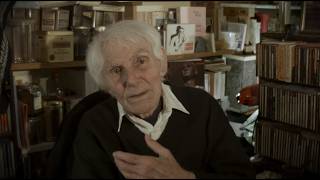
 Season 14 · 13 Apr 2026Language and thought: The case of Lavoisier
- 34:28Linked to phenomenology, he calls epoche the bracketing of urgencies necessary for rigorous inquiry.
Appears in 22 videos · 26 passages, 1 of them in depth.
What Dominique Pagani mainly takes from Husserl is the epoché, the "great theoretical parenthesis" that brackets the immediate world, urgent concerns and practical aims so that rigorous inquiry becomes possible12. He regards the critique of psychologism as Husserl's main contribution3. He links the return to the things themselves to Husserlian phenomenology and sees it as already present in the Cartesian moment. He reads "all consciousness is consciousness of something" as a statement of epistemic caution. Following Clouscard, he treats Husserl, together with Sartre, as a representative of neo-Kantianism: his egology loses the distinction between subject and object, and his phenomenology of the giving of meaning stands opposed to Hegelian phenomenology, which he presents as the first phenomenology4. He describes the Phenomenology of Spirit as the absolute negation of modern phenomenology. Lastly, he recalls that Husserl was Heidegger's teacher, and that Heidegger stopped shaking his hand5.
Summary produced automatically from 26 of the passages below, to be reviewed; the numbers link to the moment in the session.
 Who is this?
Edmund Gustav Albrecht Husserl (Austrian German:; 8 April 1859 – 27 April 1938) was an Austrian and German philosopher and mathematician who established the school of phenomenology. In his early work, he elaborated critiques of historicism and of psychologism in logic based on analyses of intentionality. In his mature work, he sought to develop a systematic foundational science based on the so-called phenomenological reduction. Arguing that transcendental consciousness sets the limits of all possible knowledge, Husserl redefined phenomenology as a transcendental idealist philosophy. […]
Read the article on WikipediaText: Wikipédia, CC BY-SA 4.0, excerpt · Portrait: Unknown (Mondadori Publishers), Public domain
Season 14 · 13 Apr 2026Language and thought: The case of Lavoisier Season 14 · 5 May 2026The foundations of the Platonic and Aristotelian distinction
 Season 13 · 20 Sept 2024Sickness, misfortune, evil
 Season 12 · 2 May 2024Neo-fascism and the ideology of desire - Clouscard, as relevant as ever (cf. Macron's ultra-warmongering remarks)
 Season 12 · 4 Jan 2024I am not who you think I am - The elusive identity
 Season 9.2 · 9 Jun 20219 #23 "Ruled like music paper!" • Bach • Nerval • Lévi-Strauss
 Series · 21 May 2021Heidegger, or Panzer Philosophy • Philosophical Q&A • Dominique Pagani
 Series · 20 May 2021Cynicism of the extreme centre or epistemic heroism? The dialectic of the middle • Dominique Pagani
 Season 9.2 · 4 Mar 20219 #16 How can sciences of history be real?
 Series · 24 Jan 2021Musicosophy 11. Modal and tonal music
 Series · 10 Sept 2019D. Pagani / M. Clouscard's reply to C. Morilhat • Part Two
 Series · 23 Aug 2019D. Pagani / M. Clouscard's reply to C. Morilhat (1987)
 Series · 5 Jul 2018Being and Code
 Talks · 2 Jul 2018The Phenomenology of Spirit
 Talks · 1 Aug 2017Should we save Private Lordon? Dominique Pagani read by G.Protche
 Season 2 · 18 Feb 2016#2.3 Between crisis and war: Philosophising?
 Series · 2 Feb 2016Hegel on the Beach 3/5
 Series · 1 Feb 2016Hegel on the Beach 1/5
 Series · 29 Jan 2016What is to be done? 1/3
 Series · 29 Jan 2016What is to be done? 3/3
 Season 1 · 10 Dec 2015#1.4 Between crisis and war: Philosophising?
 Series · 8 Dec 2015Dominique Pagani on Michel Clouscard - The paths of praxis 1/2