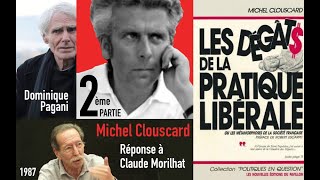
What Dominique Pagani says Dominique Pagani mostly approaches Sartre through Michel Clouscard. As a member of the thesis jury, Sartre praises L'Être et le Code as "a totalization in progress", but judges it too ambitious for a single author to carry out alone1 . Pagani recalls that the book's original title set Rousseau against Sartre, the figure of the intellectual who seeks to be on the left without being communist2 . He places Sartre in the postwar French school, standing in Heidegger's shadow. He reads the Critique of Dialectical Reason closely: in his view, Sartre upholds an absolute individualism there and reduces praxis to individual need, which amounts to animalizing man and regressing from Hegel, while still declaring Marxism unsurpassable3 . He values, on the other hand, The Roads to Freedom, the Sketch for a Theory of the Emotions and The Family Idiot4 . He defends Sartre against Foucault and the structuralist parricide, and prefers "a quarter of Sartre" to today's media philosophers5 .
1 #5.9 Kafka Un message impérial 29 Jul 2019 · 1:05:31 2 Au bistrot avec Pagani : partie 2 19 Jun 2016 · 20:11 3 Ce soir, on repolitise. 2ème partie 31 Mar 2018 · 26:43 4 Préface au mémoire de Simon Verdun, « La critique du néokantisme chez Michel Clouscard », soutenue à l’ENS DE Paris, sanctionnée par une mention très bien. 5 Jul 2018 · 8:30 5 La religion de l'Argent 29 Sept 2019 · 14:02 Summary produced automatically from 81 of the passages below, to be reviewed; the numbers link to the moment in the session.
Who is this? Jean-Paul Charles Aymard Sartre (, US also ; French:; 21 June 1905 – 15 April 1980) was a French philosopher, political activist, and writer, considered a leading figure in 20th-century French philosophy and Marxism. Sartre was one of the key figures in the philosophy of existentialism (and phenomenology) and was a proponent of Libertarian Marxism. His work has influenced sociology, critical theory, post-colonial theory, and literary studies. […]
Read the article on Wikipedia Text: Wikipédia , CC BY-SA 4.0 , excerpt · Portrait: User:T1980, CC BY 3.0
Talks · 31 Mar 2018 Tonight, we repoliticise. Part 226:43 Critique of Dialectical Reason Praxis there is individual and carried by need, which is an animalization of man and a regression compared to Hegel.33:09 Critique of Dialectical Reason He recognizes Marxism as unsurpassable while holding to an absolute individualism that refuses the social.1:45:39 Difference is there primary and final; no new social practice arises from individual praxes. 1:55:01 The Communists and Peace The working class exists only through the party; the second, unpublished volume of the "Critique" is a failure.2:00:29 In him, without immanent unity, political unity can only be imposed, hence police-like. Series · 5 Jul 2018 Being and Code2:23 Member of the thesis jury, he credits L'Être et le Code with a totalization under way; the title is a wink at Being and Nothingness. 5:39 Search for a Method He praises Lefebvre's method: descriptive phase, analytico-regressive, historico-genetic.8:30 The Family Idiot Having evolved toward marxism, he produces with Flaubert a theory of the engendering of the bourgeoisie.40:34 Clouscard finds it absurd to look for Sartre when one has Rousseau. 1:31:31 Figure of moral neo-kantianism: he refuses psychoanalysis in the name of a Kantian voluntarism of freedom. Series · 2 May 2019 Dominique Pagani ▷II Michel Foucault29:35 Foucault dismisses him by placing him in the philosophy of the past, even though he is still alive. 51:55 Calling him a man of the 19th century is a worldly argument; his philosophy is a philosophy of alienation to be overcome. 1:14:39 He said that man has no essence, for otherwise he would be finite and determined. Talks · 12 Mar 2018 Tonight, we repoliticise. Part 131:41 Cited for history as the history of scarcity. 59:29 Critique of Dialectical Reason He loves totalization and hates totality; his work is the anti-Marx, and he admits to failing.1:09:42 Critique of Dialectical Reason Absolute individualist, he reduces all praxis to the individual praxis of need: no meaning emerges. Pagani recalls his 'Marxism, the unsurpassable philosophy of our time.'Talks · 7 Feb 2025 [INTERVIEW] DOMINIQUE PAGANI - Michel Clouscard and the betrayal of May 681:04:15 He would give it a quarter of the weight compared to today's dominant ideology; at the time, Sartre was mostly a matter of fashionable imagery. Talks · 21 Sept 2019 Pagani without detours32:47 The Roads to Freedom One engages a process of liberation starting from situations; the title shows that at the outset one is not free.Series · 23 Aug 2019 D. Pagani / M. Clouscard's reply to C. Morilhat (1987)1:05:51 Kantian without knowing it when he refuses the excuse of the unconscious; the structuralists carried out his parricide. 1:34:15 His problem: staying on the left without being a communist. Season 5.2 · 29 Jul 2019 #5.9 Kafka: An Imperial Message1:05:31 He reads Clouscard's thesis project, sees in it "a totalization under way," but reproaches him for wanting to do alone what requires teamwork. Talks · 2 Jul 2018 The Phenomenology of Spirit51:33 Critique of Dialectical Reason Invoked regarding the subject faithful to an event.1:13:12 An absolute individualist: he envisages only totalizations that never succeed, and never a whole in act. Season 3 · 1 Aug 2017 #3.3 From Ulysses to Daedalus47:32 Man exists first; to assign him an essence would already be to limit him. Season 3 · 1 Aug 2017 #3.1 From Ulysses to Daedalus52:05 Sketch for a Theory of the Emotions Fainting magically annihilates the outer world in the face of sudden danger; one would give anything for a quarter of a Sartre today.Talks · 17 Jun 2017 Adotevi: Negritude and negrologists (1)22:41 Black Orpheus He shows that négritude passes from a concept to a discourse that already announces the revolution.Series · 2 Aug 2016 With Clouscard16:15 Praises L'Être et le code, judging only the project too ambitious for a single author. 51:03 His praise proves that Clouscard cannot be classified as far right. Talks · 19 Jun 2016 At the bistro with Pagani: part 220:11 Quoting his praise of Clouscard is incoherent: Sartre embodies the leftist intellectual whom Clouscard fought, being on the left without being communist. 28:05 His Playboy interviews, studied by Negroni. Season 1 · 28 Jan 2016 #1.8 Between crisis and war: Philosophising?15:47 An example of the disputes between philosophers that he refuses to cultivate. 1:50:49 The Roads to Freedom The best of Sartre; he Hegelianizes Marx: man is not a having but a doing. He organizes with Russell the tribunal on Vietnam.Series · 6 Jul 2012 Radio Galère - Michel Clouscard - 131:20 Opposed to Rousseau in the original title of Clouscard's book; he opens a French school placed under Heidegger's shadow. Season 13 · 2 Sept 2024 Clouscard: The metamorphoses of class struggle19:01 Appears in the title of the first edition: De la modernité. Rousseau ou Sartre? Season 12 · 28 Feb 2024 Clouscard by you - Answers to your questions1:51:55 Marked by Heidegger's shadow. Season 12 · 4 Jan 2024 I am not who you think I am - The elusive identity35:12 The Devil and the Good Lord A title borrowed for the dialogue of the prologue of Faust.Season 12 · 22 Dec 2023 Birth and carnage - The Massacre of the Innocents2:07:32 One has clean hands only when one has no hands. Season 11 · 3 Sept 2023 Worldliness in Clouscard: Desiring what? Through whom??26:29 The Devil and the Good Lord Title of a play cited in passing.Season 11 · 18 May 2023 Worldliness in Clouscard, or privileges for all5:11 The term facticity is dear to him. Season 11 · 26 Apr 2023 Worldliness in Clouscard, or "The dominant ideology"46:25 His bad faith is a species of lying to oneself in the evangelical sense. Season 11 · 3 Mar 2023 War, neo-fascism: libertarian liberalism1:17:44 The French philosophical school from Sartre to Derrida sought to be more left-wing than the communists. Talks · 14 Jul 2022 From Plato to world revolution, by Dominique Pagani9:38 More prominent contemporary of Merleau-Ponty. Series · 20 May 2022 Dominique Pagani - Who is hiding beneath the surfaces? Aesthetics and politics22:09 Example of the literature of action and engagement. Series · 14 Jul 2021 EVERYTHING IS ALLOWED, NOTHING IS POSSIBLE! Michel Clouscard, May 68 and the capitalism of seduction4:36 Member of Clouscard's thesis committee. 22:28 Cited among the intellectual masters of 68 whom Clouscard fought against. Series · 14 Jul 2021 EVERYTHING'S ALLOWED, BUT NOTHING IS POSSIBLE! Michel Clouscard, May 68, French Theory & Capitalism4:30 Member of Clouscard's thesis committee. 22:27 Cited among the gurus of 68 whom Clouscard combats. Season 9.2 · 9 Jun 2021 9 #23 "Ruled like music paper!" • Bach • Nerval • Lévi-Strauss34:49 Reigned alongside existentialism, never Marxist; his phrase "every anticommunist is a dog." Series · 21 May 2021 Heidegger, or Panzer Philosophy • Philosophical Q&A • Dominique Pagani2:29 Unlike the French Heideggerians, he did not yet see the danger in the immediate post-war period. Series · 30 Apr 2021 My eco-cabin in the ZAD: autonomy or alienation? • Philosophical Q&A • Dominique Pagani14:55 Said of Clouscard's L'Être et le Code that it is a totalization. Season 9.2 · 4 Mar 2021 9 #16 How can sciences of history be real?39:24 Mentioned in continental philosophy. Series · 28 Jan 2021 Musicosophy 12. Nietzsche (right up) against Wagner40:44 He spoke of his "slight squint." Series · 15 Jan 2021 Musicosophy 9. Romantic irony and the Vinteuil sonata35:04 Not to be confused with the writer Jean-Paul. 1:33:26 The Russell tribunal on Vietnam. Series · 3 Dec 2020 Musicosophy 3. What is called modern music?1:24:18 Chosen at the Liberation instead of Rousseau, according to Clouscard. Season 9.1 · 3 Dec 2020 #7 Answers to questions (continued)39:20 Being and Nothingness Cited among the authors of being.Talks · 5 Oct 2020 Calves and Things (2): Ecologism, the highest stage of capitalism?24:06 Foucault would have wanted to occupy his place. Season 7 · 5 May 2020 #7 • Harnessed to confinitude59:05 The French school, from Sartre to Derrida, stands in Heidegger's shadow. 1:18:04 Arrested while selling La Cause du peuple, he is released on De Gaulle's order. Season 7 · 26 Apr 2020 #6 • Harnessed to confinitude1:40:29 Opposed to Rousseau in Clouscard's title. Season 6 · 8 Jan 2020 #6.3 • The Logic of the Subject in the face of the reconstitution of Nazism19:04 The "god of Paris," who asks whether the Church is a social class. Talks · 29 Sept 2019 The religion of Money14:02 The Devil and the Good Lord A play cited in passing. He prefers "a quarter of Sartre" to media philosophers.Series · 10 Sept 2019 D. Pagani / M. Clouscard's reply to C. Morilhat • Part Two20:31 He praised Clouscard's thesis. 40:06 Victim of the structuralist parricide. Season 5.2 · 26 May 2019 #5.7 Nature or Landscape?9:55 Example of a literature of engagement. Talks · 13 Feb 2019 Hegel and the yellow vests (Part 1)1:31:31 Object of Clouscard's critique. Talks · 2 Jul 2018 Tribute to Domenico Losurdo6:46 Hegel plus Sartre would give existentialism, according to Druon. Talks · 20 May 2018 Marxist Café - Work and the right to work1:37:12 Grew up in Heidegger's shadow. Talks · 17 Jun 2017 Adotevi: Negritude and negrologists (2)37:20 preface writer of Fanon's book Series · 2 Feb 2016 Hegel on the Beach 5/51:03:25 Postwar philosophy in the shadow of Heidegger. Series · 2 Feb 2016 Hegel on the Beach 4/520:17 He defends freedom against determinism in a somewhat naive and voluntarist manner. Series · 1 Feb 2016 Hegel on the Beach 2/522:37 Makes enormous use of Hegel, but distances himself from him. Series · 29 Jan 2016 What is to be done? 2/352:19 Member of Clouscard's thesis jury, reproaches him for an author's hubris. Series · 8 Dec 2015 Dominique Pagani on Michel Clouscard - The paths of praxis 1/21:51 He saw hubris in Clouscard's plan to work alone, and called for collective work. Season 1 · 14 Sept 2015 #1.2 Between crisis and war: Philosophising?30:17 Linked to the postwar French school, in Heidegger's shadow. Series · 26 Dec 2014 L for Liberty1:30 Clouscard opposes his notion of freedom to that of Rousseau. Series · 22 Dec 2014 H for Hegel10:49 'Hegel plus Sartre gives existentialism,' according to the same speaker. Series · 27 Sept 2014 #5 Libertarian liberalism, libidinal consumption and music...11:44 Boundary marker of the French philosophical school situated in Heidegger's shadow. Series · 20 Sept 2014 #2 Rousseau, a world that begins3:47 His problem: how to be on the left without being a communist. Series · 7 Jul 2012 Radio Galère - Michel Clouscard - 210:41 Starting point of counter-revolutionary philosophy, up to Althusser. 24:26 Nausea Clouscard compared himself to the autodidact of Nausea.Series · 29 Jan 2012 Everything is allowed but nothing is possible - Michel Clouscard - 25:17 a participant says he is not an unconditional Sartrean 31:31 member of Clouscard's thesis committee Series · 29 Jan 2012 Everything is allowed but nothing is possible - Michel Clouscard - 135:46 Existentialism exalts the individual and the particular against totality, within the ideological war. 
 Talks · 31 Mar 2018Tonight, we repoliticise. Part 2