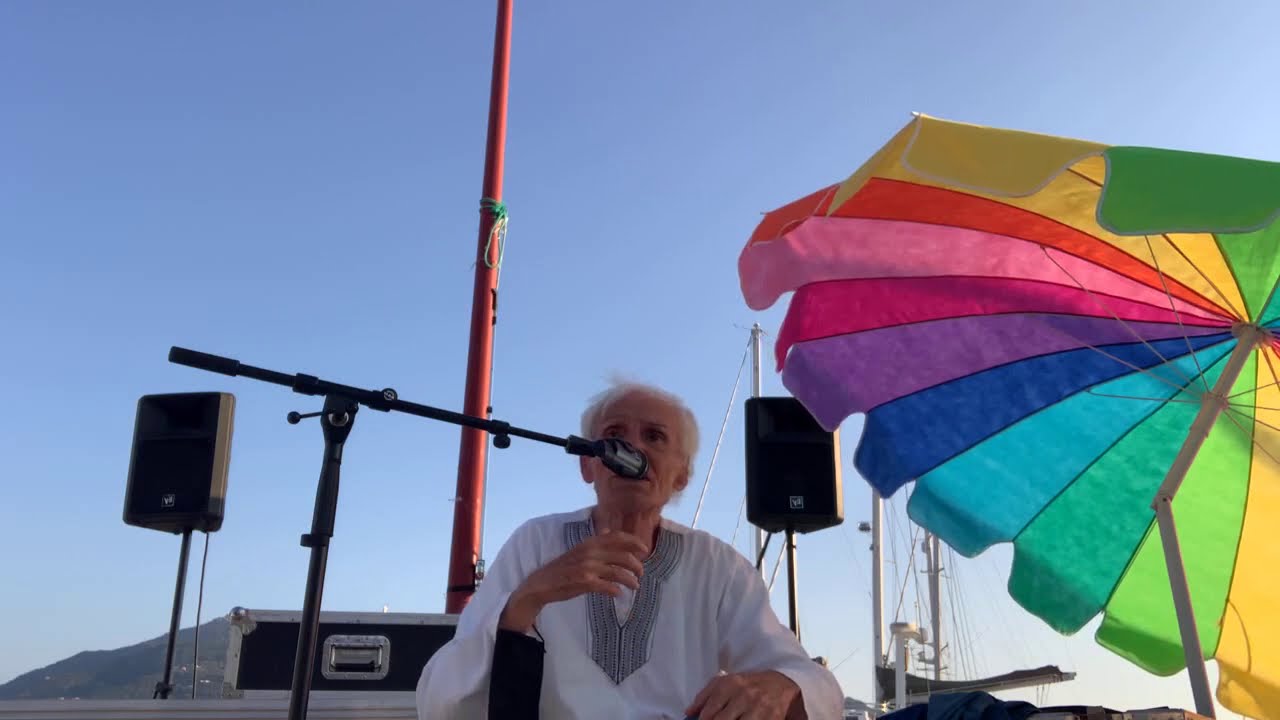
English translation of the French transcript, made with AI and not yet proofread — click a paragraph to jump to it. Show the French original
The megaliths of the Valinco and the pitfalls of chronologies 0:00 As Plato said, writing isn't for memory, but for remembrance. Thank you Serge. Well, but when... Starting off? Starting off, whenever you like. Thank you Dominique for hosting us on the tour.
0:30 Well, I confess I'm dragging my feet a bit for this talk, not only because of my age, nor because of the weather. Women, young people, they love that, the heat, the sun. You've seen a woman on a rock basking in the sun like no man ever does. Still, that doesn't stop us talking about the sun. Noble and brilliant offspring of an illustrious family, You whom my mother dared boast of being daughter to, Who perhaps blushes at the trouble in which you see me, Sun, I come to see you for the last time.
1:08 I'm dragging my feet a bit because... I said it to a few friends informally, well, I dare say it in public. I see myself doing a kind of freestyle on a subject I know poorly. When I say I know it poorly, it's not that I take it lightly. I've been thinking about it for more than 50 years. But the more you dig into it, the fewer certainties there are, the harder it is to draw anything unequivocal from it.
1:40 To speak like a lawyer. All the linguists. So there you go, you see, it's... I have to talk to you. They are particularly dense and numerous in the region where we are. That is, on both sides of the Gulf of Valinco. Whether to the north, around Filitosa, which is the best-known site. And to the south, with the Palaggiu alignments...
2:14 So whether at Cauria... It's the densest region, but... Megaliths, since that's the subject of my talk. Big stones, right. That's what megaliths means. The Paleolithic is the old stones. The Neolithic is the new stones. I'm doing it on purpose. You'll see, I sound like I'm joking. And between the two, between the old and the new, there's what's in the middle, the Mesolithic.
2:47 They're clever, you know, those who make chronologies. They mistake the word for the thing. Everything we don't know, we put in the middle. There's Antiquity, for historians. Then from the Renaissance onward, there's what's called modern times. There's, up to us, contemporary history, modern and contemporary history, as they say in... in academic departments. Then between the two, they've stuffed in the Middle Ages. Middle, that's the middle. Except modern times, 16th, 17th, 18th, 19th, 20th, 21st century, brings us quickly to today.
3:22 The Middle Ages is ten centuries. Where writing is rare. I mean in extent. So, and then, we say Antiquity, the Middle Ages and modern times, we see a third, two thirds, three thirds. But no! Antiquity is 50 centuries. Modern times is 5. But we never think about all that.
History begins with writing: hagiography and certainty 3:52 Anyway, I have to talk to you about island proto-history. Proto-history, history. Prehistory. History. You know it's made to begin where there's writing. In principle. Before that, it's prehistory. There too, it's clever, those who make chronologies, you see. But it's not... as soon as there's writing, there isn't history right away like in our textbooks today.
4:24 Like in Wikipedia. Take the very beginning of writing, I don't know, Mesopotamia, Egypt, China, the Indus Valley. The scribes who write the pharaoh's history, we don't know... It consists of putting up a stele and saying the pharaoh gave the Hittites a thrashing, they'll remember it for a thousand years, you see. In any case, he's the most beautiful, he's the best, he's the beloved of Amun-Ra, of the gods. It's not really... you see, it's hagiography, as they say.
4:55 H-A-G-I-O. It's hagiography, it's eulogy. It's really... But still, thanks to... these first stammerings of the engram, you know, when you pass through Paris, at the Place de la Concorde, you've seen Roman ruins, they're everywhere, the characters wear off quickly. Whereas there, 3000 years earlier, it's carved into the basalt, on the obelisk, with striking clarity. It's extraordinary.
5:26 Thanks to these first stammerings, we have certainties. Well, we're in touch with the certainties they had. Philosophers have worked hard to oppose certainty to truth. There's a great distance from our certainties to the truth. Nothing more certain than... we're on solid ground, right, you see? While we're spinning at 30 km a second around the sun. We were certain of that for a long time. And there you have it, certainty versus truth. Well yes, I'm a philosopher, because whether you like it or not, I'm sorry.
5:57 I'm bothering you with words. Because that's how philosophy starts. It doesn't start when you ask what is this? An astronomer wonders what a black hole is. You don't need a philosopher for that. But the philosopher asks, what do you call a black hole? He doesn't question the star. He questions the astronomer who talks about a black hole. Once you've told me what you call a star, a planet, we'll see about Saturn, etc. What do you call God? We'll see afterward whether it can exist.
Speech as water: griots, bards, and poetry 6:28 And it begins with the word. This reflection on the word, I seem to be bothering you with it, but it's going to occupy us here in this talk. Because I'm in the middle of talking about writing, and I follow someone who has just masterfully spoken to us about tradition, most often oral tradition. And on top of that, it was centered on the liquid element. Sorry, I'm deliberately linking talks together. This festival still has a certain watery homogeneity.
6:59 Feminine, a watery piano. Yes, no, that's not mine. That's from the late René Comer, you know, who founded the Calvi jazz festival. I had told him, I had told him, in Debussy's works, there's something aquatic in his music. He told me, yes, it's a watery piano. This way of referring to the oral source, you see, I say the source, makes me think of another, very different field.
7:39 I was recently able to share with a speaker you know, since she's our other Claire, so to speak. I'm thinking of Claire who comes to us from Brussels and who lived, like me, in Niger. I was very happy to hear her talk about places that are far from here, but also very close in terms of the subject we're dealing with. How do you say river in the Bambara area, if you like, this land that gave us the Mandingo epic which plays in the whole region roughly the role the Iliad plays in Western Europe and in oral tradition.
8:18 Here, I'm making a parenthesis. It seems I'm exasperating with my digressions, although my most regular listeners say what they prefer is the digressions. So, don't tempt me either, but it's important, this digression. I saw on the posters that the festival has an epithet. It's a literary festival. Right? Literary, littera, that's the letter. The letter, that's writing. Now, the literary genre par excellence, it's not me who decides, I wouldn't dare, but in the opinion of authors, of linguists, to the point that the Prague Circle, the linguists, spoke of the poetic function of language in general.
9:01 You see? It's poetry, it's the heart, the first upsurge of all literature. And it's obvious that the Iliad was slammed, rapped, wasn't it? I have a rapper son. Long before it was written. Right? So, whether it's the bards here, right, the aoidoi there, the griots, I go back to my West Africa. The griots.
9:31 Do you know how you say griots in Bambara? You say djeli. And the river is Joliba. Speech flows, it's labial. You see? We find the same, the same thread of metaphors. And in saying thread, I keep playing on the trout that darts away. And yes, it's Gérard de Nerval who speaks of an inn sign at Sallis called 'We used to go to the excellent Hotel of the Darting Trout.' It's extraordinary, isn't it. Try catching a darting trout, especially in a mountain stream.
10:02 I do urge you to try, at Évisa, at the Hôtel du Centre, small trout like that, stuffed with fresh mint and brocciu. It's extraordinary. So there you go. You see, we're very far from our Corsican mountains, in Mali, and yet there's this same isomorphism, if you want to show off a bit, sounding pretentious, talking like France Culture, this same isomorphism between flowing water, the spring, the torrent, the river, and speech.
Stantari: that which stands upright 10:43 What did Rimbaud say? That to understand my words, they must flee and fly. You see? Go catch that in writing. So why am I talking about this? Because I'm talking about exactly the opposite of everything I just said. It's the opposite of what Ms. Akwabiba said. She spoke of the fluid and I was speaking to you of what is most... Stantari, you see, we say, it's S-T in European languages, station, statue, and don't just stand there planted like a statue, my grandmother used to say to my poor uncle Martin Abastia.
11:18 Yes, a statute, which fixes the rules, which are supposed not to move anymore. A metro station, railway stations, that's what doesn't move. Stee, stehen, in German, you see. Stato, the state. Civil society can evolve, but the state sails on a volcano, as Monsieur Prudhomme used to say. The ship of state sails on a volcano. You see, the menhirs, that's it, it's something that keeps defying time, there, north and south of the Gulf of Valinco, still.
11:56 But it's incredible. These are the largest alignments in the Mediterranean that are right there, you have them right at hand, I say that because some have had the nerve to admit to me that they hadn't gone to see them yet, even though they've been here for three or four days already. And their legs carry them better than mine carry me. No, it's extraordinary. And besides, you know, some know it, you'll tell me, but there are megaliths, there are bigger ones at Stonehenge, and... yes, but there's no human figure at Stonehenge.
12:29 In Corsica you have the first anthropomorphic megaliths, again, it's wordplay, we speak Greek to sound clever, it means there's a human form, morphed, you know. Of Europe, of Europe—in Egypt, 2000 years earlier, there were already big stones with quite human forms. But here, in Europe, I don't know, it's beginning, it's an incredible story, really. So, that's not my subject, I haven't even gotten into the subject yet, this is my prelude.
13:04 I'm talking about it almost at the very back of the Gulf of Valinco. There, I'm not speaking metaphorically, there I mean it literally. Besides, they were kind enough to put me up in a hotel where I do this with my right hand and I touch the beach of... Chab, no? Du Bage. Yes. How do you say it? Baracci. Baracci, exactly, thank you. I was about to slip and say another one that sounds similar. There you go. There, we're at the very back of the Gulf of Valinco. Strange beach. Tchinesu, yes. There's never anyone there.
13:34 You see, a bit like at the back of the Gulf of Ajaccio, near the airport. It's serious. Those are the coves, there. Especially along the road to the Sanguinaires, of course, Ariane, etc. But that one is strange. Why am I talking about it? Because those who erected the anthropomorphic menhirs, in all likelihood, landed there. There, I woke up this morning on my balcony, I was almost touching the beach of la Pique.
14:06 You see, there, I'm no longer in abstractions. It's incredible. But who were they? So, we say the Sea Peoples. I don't have wifi, I had prepared notes, I won't bore you with them. And it's just as well, because as soon as you start looking into it, I don't want to feed you nonsense, I did my research. But erudition is an abyss. When you start into erudition, you plunge into an abyss and get swallowed in a chasm. From which you never come out. I say that with great respect. I'm not mocking scholars.
14:40 We wouldn't be here if they hadn't worked for us. That gives us a few certainties. But they're the first to show us how much more complex things are than we think. I told you about the word Théron, no worries. I told you about the Paleolithic and the Neolithic. I said it gets complicated with a Mesolithic in the middle. But I simplified enormously. When you look at the specialists, just within the Neolithic, the New Stone Age, the stantari, the menhirs, the dolmens, appear roughly between the end of the Neolithic and the beginning of the Bronze Age.
15:26 Roughly. You see, that's enough of a frame for you, because if you start being more precise, it never ends. And at the beginning of the Bronze Age. And I was talking about anthropomorphic statues. Many statue-menhirs are armed with a sword, to the point that the local inhabitants never called them menhirs. That's not a local name, of course, but they didn't call them stantari either. That's a term that was quickly spread by archaeologists or professionals.
The middle term, the edge, and the thesis 15:59 They called them paladins. Yes, yes, paladins. You're thinking of swordsman, and you're right. Spada means sword. The language knows things. It knows more than we do, we who use it. It's exactly the middle term of the most subtle dialecticians. We think we're using a means. My slave, I call him, bring me the ashtray. I say that because I knew a Frenchman in Africa who called his 'boy,' who was 50 meters away, to bring him the ashtray that was right there.
16:33 That would be a means. There's me, first extreme, the object I desire, second extreme, and between the two, I have a means, the tool, the slave. My wife, my husband, no, I mean for Madame Lagarde of the IMF, I'm her means, well, we are. And there you have it, the means turning against the end. Language knows more about us than we do.
17:07 Freud showed us that—ah, that's not what I meant to say, but yes, that is what you meant, my dear. Yes, that is indeed what you meant, what you didn't mean to say is exactly what you said. What matters isn't what you think, it's what you express. And I come back to speech, where much more is expressed than in writing, where you can cross out, control, go back. I don't reclaim them. All philosophers, they don't do anything but argue with each other, that's all they do, but. We have a consensus, a bit like musicians about Mozart.
17:38 And yes, musicians argue about Wagner, about Beethoven, about Bach, but about Mozart, never. There must have been reasons. I'll make a parenthesis, Mozart, America is coming, but. Old Haydn, he was a man of such kindness, you know, Haydn died almost 100 years old. Genius, in general, doesn't like contemporary genius, they're jealous of each other. Old Haydn said to Mozart's father—I don't want to betray it, I'm thinking in German—yes, your son, he didn't say he's the best musician, he said he's the greatest of artists in all arts and in all times.
18:13 Good old Haydn. So, the middle term, why am I talking about this? Because it's my subject, I'm getting to it now. Did you think I was wandering off? No, no, no, no, I'm at the back of the Gulf of Valinco. What is that? An edge. An edge is a middle. It's like a switch, you'd say, in computing. You see? The edge of a cliff is the passage from horizontal to vertical.
18:43 Do you agree? The bank of a river is the passage from what's still, the rock, I don't know, the bank, to what flows. So an edge is always more or less dangerous, perilous. 'What charm drew her to those dreaded shores.' That's the second time I've quoted Phèdre, and it happens on islands, Phèdre, you see. Ariadne, my sister, you know, Ariadne died on the island of Naxos, well, she died—she nearly died of despair and abandonment.
19:17 'Ariadne, my sister, wounded by what love, You died on that shore, there you were left.' The edge, the limit, borderline, as we say today. These are perilous places in the body, from when am I inside my body and outside, between the two, there are the lips. It's curious, these things. It's complex. So the beach, you see, is like a mouth. And you see, language is thinking us.
19:48 Because Rimbaud, in one of the most beautiful poems ever written, says, speaking of a young girl running on a beach, he says a beach named by waves. You see? Named by waves. The metaphor of the bocca isn't far off. We spoke earlier of a mountain pass, for the bocca. We also say the mouth of a river, but it's a beach. A bit stronger, that interests me. We say the mouth of a river, it's a beach. Ah, language, there you go. Thank you very much.
20:18 Language goes beyond, doesn't it, than... It comes to fill our metaphorical expectation. So there. I'm beginning to get into my subject. My subject is the middle term. What middle term? Menhirs, megaliths. Why? Because Corsica's destiny is still played out, even today, between two extremes. One you have in front of you, the sea, and the other a little further, the mountain.
20:48 The megaliths are the middle term between the two. They're as stable as... as the granite of the mountains, aren't they? And they were brought by the peoples of the sea. It's an extraordinary story. It's really an extraordinary story. Yes. And they still stand there. As a testimony to what? That, I'll be careful not to tell you. We don't know this story very well. It can be formidable.
The Sea Peoples and the Egyptian steles 21:19 Right? Some... When we say sea peoples, I still need to be a bit more precise. We talk about it, the expression, well, it's used for explanatory purposes for the Nuragic cultures, if we're talking about Sardinia, or Torrean, if we're talking about Corsica. We've only been talking about it since the end of the 19th century, let's be clear, since archaeology, roughly contemporary with that, tried to draw a connection between the peoples who left us these megaliths, whether they're cyclopean heaps, or anthropomorphic statues.
22:00 They gave them this generic name, but they borrowed it, and this is where it gets troubling, from two documents dating from ancient Egypt. From ancient Egypt. To be precise, from the beginning of the 14th century—well, actually, since we have writing here, we can be a bit more precise, before Christ, we have two stelae. One of Ramses, the other of Merneptah, you can forget it anyway, listen, you know the internet better than I do, it's not my generation, if you haven't yet seen reproductions of the statues, that's your own fault, if you haven't seen them yet.
22:39 But you type in Filitosa, you type in Corsica Megaliths, you click on the image, but what a marvelous era you're living in from that point of view. It's extraordinary, that's why I can't click through or project things onto a screen, the time doesn't allow for it anyway. But these famous Egyptian stelae tell stories - I spoke of hagiography earlier - stories to celebrate the exploits and worth of the pharaoh, the living god.
23:14 In both cases, they're there to celebrate a victory. Over whom? An anti-Egyptian coalition at the time. Parenthesis: Egypt was rich, for the time, in the context of the Nile delta, wheat production exploded. It's not fertilized by the Virgin Mary. I'm taking shortcuts. But yes, we spoke earlier of the Virgin Mary who took the place of the water deities. No, don't think I'm raving.
23:45 The Virgin Mary, if you look, for example, at how she's depicted in the lovely Burgundian virgins of the 14th century, the wooden virgins about 1.15 meters tall, marvels, carved wood with braids running from the head down to the ankles - she's treading on a crescent moon. So, in other words, popular intuition fused the new Christian tradition with the old cult of Isis.
24:17 Isis is the water of the Nile. The water of the Nile fertilized by the fragmentation into 14 pieces - twice seven - of the phallus of Osiris. That's Egyptian mythology. I hear nothing of it myself. "This bruised Atys whom fair Cybele revives," as the poet says somewhere. You see, when I speak of a middle term, I'm being very serious. The first middle term between you and me, right now, is speech.
Socrates, Plato, and the memory of griots 24:51 Language. Not written speech, you see, otherwise I couldn't take all these detours. The book would run to 12,000 pages, it would be unworkable. That's why I don't write. Yes, I'm a philosopher, and I claim as my master someone who didn't write, who left no written trace - Socrates. You see, because he was wary of it. Luckily he happened upon a stroke-of-genius scribe called Plato, thanks to whom we have some notion of what Socrates meant to say. An unhoped-for scribe.
25:22 Let me remind you that if Plato took up writing, when what he wanted, like all young Greeks of good family - that is, families with property - the word for good people in Latin is boni omnes, "those who have goods." Plato wanted to go into politics. In Greece, it was worth it, you had to know how to speak. It was the first time. It was progress. It wasn't force that ruled, it wasn't "you'll go build the pyramid under the whip." No, it was the assembly. It's where people speak that things take shape.
25:52 It's a small step of progress. Now, there were slaves too, in truth, mind you. But there was a community governed by speech. So the art of persuasion mattered. And so that's what he was destined for. And then he suffered a very serious political failure. I won't tell his whole life story, but I mean, he tried to play the Bernard-Henri Lévy already - the thinker in the service of power. In Sicily, it went badly. In fact I think quite a few of you know the story. He went, he wanted to tell the tyrant of Sicily - tyrant simply meant king at the time.
26:24 He wanted to say, that's not how one should behave, and he ended up behaving badly in prison. And he was made to work in the mines. Luckily he had money and connections in Athens. He was freed on bail. But why am I telling this anecdote? Because it was at that moment that he began to write. And he says in a letter - it's rare to have correspondence that's 2,500 years old, you know, Plato must be so venerated for letters to reach us across that span. We have about ten letters.
26:55 It's in the famous Seventh Letter - Plato says, in a letter fairly close to this, where he recounts his adventures in Sicily. And it was then, while my mind was still turned toward politics, that I was as it were compelled to turn toward philosophy. Compelled - in Greek, ananke - it's almost a religious word, almost a form of damnation. You see, it was a political failure that led Plato to start writing. Let me go back to spoken, fleeting language.
27:25 I lived for a long time, as you might guess - I alluded to it earlier - in sub-Saharan Africa, French-speaking on occasion, in France to give context. There, as with our traditional poets here, in our valleys, in our villages, the poet is not only a poet, he is a poet, a bard - I spoke earlier of the bard, the aede - there's a fusion of auditory, linguistic, historical genres.
27:59 The poet is also the keeper of collective memory. You know, Suleymane, son of Daoud, son of so-and-so, son of such-and-such - I think you were told the story of the griot, but I can't help retelling it here. There's a ceremony in Mali, among the Dogon, that takes place every 60 years, in every valley, all the Dogon peoples gather together, if I may put it that way.
28:30 It's an exceptionally long cycle in an oral culture where memory never reaches back very far, necessarily. There was an experiment done in Yugoslavia - at the end of the 19th century they asked, how far back does this myth go? Oh, it's lost in the mists of time. After investigation, it turned out to go back four generations. Beyond that, it's lost, you see, if it isn't written down. So we know more about what happened in Rome. Rome, we have everything, quarter hour by quarter hour, the jurists - we know more about what happened in the Rome of Cicero than in the Empire of Charlemagne, which was an empire of illiterates.
29:02 Under Charlemagne, there was a priest who would hold your finger to sign for you. Yes indeed, history isn't linear. So let me go back to my sub-Saharan Africa and my griots. There was a griot who directed the ceremony, a ceremony held every 60 years. Between you and me there's language. That belongs to the order of the code. But there's also the channel. And that's - you know what I mean - there's noise on the channel.
29:35 It's not you who's the source of noise, it's the medium. So, yes, there was a griot who directed all this, who was the master of ceremonies, the arbiter elegantiarum, as they'd have said at Nero's court. And he was there doing the genealogies, precisely. "And here is Sidibé, son of Touré, son of Traoré." He worked back through the genealogies. And suddenly he says, "The centipede has too many legs, they cannot be counted."
30:08 Like a discreet remark, you see. "The centipede has too many legs, they cannot be counted." There are too many names, too many families, too many... that meant: listen, folks, I've done my job, my memory goes that far and no further. It wasn't useful to go on. For the first time, I saw an honest historian, you see, who wasn't doing hagiography, praise for those in power, you see.
30:38 It was extraordinary. So when I see these mute statues - and here I am talking about speech, you see - I tell myself that their granite resonates somewhere. And that's why I wanted to place them as a mediation, as I said, between the sea and the mountain, and I return to my Valinco dolmen. Why? I'm being a bit circular. Don't be impatient - I mean, it's not that I'm going backward, it's that I'm turning, but I'm not starting from zero again, I'm turning like a spiral.
Corsican shepherds, Breton sailors, Crete as hinge 31:15 Each time there's a slight shift, we go a little further. I return to the bottom of the Gulf of Valinco, but it's to raise my hand a little and say to you, look, look at the ridge behind. There's Olmeto up there. Olmeto, right? Forgive me, but I learned to speak while in the colonial empire, and nothing could be more Corsican than being born in Hanoi and growing up in Saigon. As you know. And so my parents spoke Corsican to each other so the children wouldn't understand.
31:48 That's not how you learn Corsican. It's a bit late for that. Fortunately I have excellent advisers, male and female, today. The village - you see where you put my hotel - it just explodes with beauty. It's magnificent. It's perched exactly as you said. That marvelous zone between 350 and 800 meters where almost all of our villages are found.
32:18 And you anticipated me - I wanted to talk about the sea, which has always been a source of anxiety for Corsicans. And you mentioned the two main reasons: insecurity, invasions. I won't list them all because there was one after another. I will mention though that the Byzantines hunted Corsicans with dogs, with mastiffs. The pope intervened to say, listen, you mustn't exaggerate - you Byzantines, as I say, you hold temporal power, but the Corsicans are selling their children as slaves just to eat, because of you.
32:50 There you are. And it all followed one after another, coming from the sea. So, the Corsicans and the Bretons - ah, I've arrived at this - two granite lands, poor regions, saved themselves how? The Bretons through the sea. Poverty made sailors of them. Corsica - poverty made shepherds of them. Berg, in German, is mountain. It's an old Indo-European root. Bergen means sheltered. The shepherd, you know, protects his flock.
33:23 So there it is. A middle term also, between these two extremes of sea and mountain, and a middle term too, of the circuit. Because if it's a bit about the eastern Mediterranean sea, you might think of the Phoenicians, great navigators. Look at a map of Europe and the Middle East, you have what you were taught in sixth grade, you know, the great empires - Egypt isn't far, it's there. I don't say below, I say to the south.
33:53 Mesopotamia, the Near East, Lebanon, that is Phoenicia, then you have Greece, the next stage in our history books. After the East, Greece, after Rome, and then afterward, it's you, it's me, so to speak. But between the two there's a small hyphen. Between the East and Greece, there's Crete, you see? And graphically, it's like a hyphen, look closely.
34:24 Well, the Minoan navy dominated the Greek world at one point. You see? And you all know this. You've all heard of the exploits of Theseus, of the Minotaur. But if Theseus went to put an end to the fact that the Minotaur needed, every year, 14 young people from Athens - 7 boys, 7 girls - to devour, that certainly symbolizes the fact that the Greeks, the Athenians, at that time, paid tribute to the Cretans. And Theseus was—
34:54 I'm sorry? What did I say? Theseus is that liberating hero who allowed Athens to emerge, to free itself from the Cretan yoke. Cretan yoke - that still smells a bit of the East, you see? This Minotaur is still one of those figures where animal blends with human form - bull's head, man's body; the sphinx is the reverse, isn't it? The human form trying to break free from the animal body - the sphinx, that's the East, it's magnificent.
35:28 I'm not making value judgments, there's an unmatched force of mystery in Egyptian art, I don't know. But the body isn't set free, the arms are somewhat stiff along the sides, it's not freedom, it's not the Parthenon, it's not the Capitol, the beautiful Capitol, the true one - we're not in Plato yet, Capitol meaning virtue, "go build the pyramid, we'll discuss what virtue is afterward." You see, I'm caricaturing a bit. And there you have it. So I return to my stantari, which stand there to bear witness to this extraordinary circuit of peoples who came from the mountains, probably from Anatolia, the region of Turkey, or the Hittites, driven out by - it's certain, all historians agree - a political cataclysm around the 14th century BC, which upended the historical status quo that had lasted for millennia up to that point.
From the mountains of Anatolia to the Shardana: an active syllogism 36:24 The great Egyptian and Mesopotamian empires disintegrated starting from those dates. And the Sea Peoples played a major role in this upheaval. So I imagine people from the mountains - back to my middle term - fleeing the heights of Anatolia, coming down, fleeing by sea, landing as what the Egyptians called the Shardana - that's why I've been talking about this all along, the sardines, we're not so far from home now - the Shardana, and their depictions, it's very precise, in the Egyptian frescoes, on the stelae, there are helmets with horns - that's how the Sea Peoples are depicted, these horned helmets, and you find them again in the Sardinian nuraghi. So the connection with the sea is obvious, from mountain to sea, and from sea driven back to the mountain again - it's an extraordinary story, it's really an active syllogism, you might say in logic, you see - well, I've more or less come full circle in my talk, a rather spiraling circle, I grant you, but how could it be otherwise, I don't know, in a sunset over the Valinco. I'm listening
Orientation of the statues and shifting identity 37:35 to your questions, but before that, I'd like to encourage you to go see all this up close - it's a stone's throw away, I think it takes 20 minutes to get to Filitosa from Propriano, by car roughly, I mean, something of that order, and maybe half an hour to head toward the south of the Gulf. Yes! And a question you're asking me, sir, the question is: do most of them face the sea, or the setting sun, or both? I've asked myself that question ever since I started working on this subject.
38:06 So I'm glad the question is being asked. They're oriented east-west. The faces are oriented east-west. Most of the time, absolutely. But since most of them, mind you, were found lying down, if we want archaeological truth, most were found in indescribable disorder. Here we must give a certain credit to the administration of Napoleon III, who asked Prosper Mérimée to make an inventory of France's heritage, and he carried it out in Corsica with such scrupulousness that he was the first - the shepherds knew there were things like this around.
38:37 But in Bastia, nobody knew anything about all this. Does that mean the logic was to place them in that direction, Dominique Lebrun, can you come closer? Are there people listening to us live? Yes. They won't hear your question. Good idea, Franck, thank you. Was the logic, quite obvious at the end of the 19th century - one couldn't orient them toward nothing, something had to be found. So the sea and the setting sun, that's meaningful, that works. In my mind, it looks toward the sea, but toward the eastern sea.
39:07 Exactly. Ah, well yes. Of course. Most of the time, I'm not - I'll be honest, I'm neither an archaeologist nor a historian, I don't want to settle a question that specialists themselves still argue about to this day. It's not - some say it was the Sardinians who went to the eastern Mediterranean. Others say no, there's a god Sardus, we mentioned him earlier, son of Zeus, who already existed, who was already quite an eastern figure. Others say that on the contrary it was the Hittites - I mentioned the Hittites, the mountain people, from Turkey.
39:40 If there's one thing, where there's an invariant structure, that interests me, because it's also true of the relations between Tibetans and China. There are always mountain peoples who have nothing to eat, let's be clear. Before tourism, in Corsica, there was no Super U supermarket to go buy food. There was no casino. So you see, when people say Corsicans were lazy - terraced fields down into ravines where goats barely dare venture - it's really extraordinary, the work our ancestors did. Because there are people who have the word "Corsican identity" on their lips every day, but they never had that word on their ancestors' lips - they just built the transhumance paths.
40:16 When you see, as you might have tackled yourself, the Capronale pass, the Bocca a Capronale - I'm talking about transhumance in the Filosorma - these are works of titans. It shaped Corsica, no need to add anything, that's identity. Especially since here we clearly see how mobile identity really is, it came over the water. That answers your question a bit. Exactly, thank you. But personally, if you ask me to commit to a position, well, it has no scientific value, it's rather intuitive, but let's say I've offered you a well-supported reverie.
40:52 There you go. Supported by - well, I've spent, it's been half a century that I've been researching this question. So, it seems to me most likely that it was the Sea Peoples connected to what is today somewhere between Syria and Anatolia, roughly. As for the figures - because there are even menhirs, we can call them menhirs, in any case that's how they're described, figures 1, 2, 3, 4 - which is... There, they have one particular feature.
Warriors, the defeated, and standing gisants 41:23 There are some, though, when you see them at daybreak or nightfall, there's a timeless expression to them. You really have the impression of standing before a figure, rather someone who is looking at you. You spoke of the relationship with the body, but for me, I have the impression that it does that to me. Not all of them, at least one, number 11, I don't know. I don't know what you think of it. This figure that looks at us, that's timeless, it's very striking. There's something that is... That's why I said at the start that if I was dragging my feet a bit, it's because the subject had something formidable about it.
41:57 These are not particularly peaceful figures. And the fact that the locals - I don't like that term, well, I mean it literally, I'm not talking about Corsicans in general, I mean really the people of the Valinco who knew these places. It's not... at Araguina-Sennola, they probably had no idea. Or the Lady of Araguina - no, wait, the Lady is at Bonifacio, I mean, the accumulation of deer, of hollowed-out deer antlers in the Araguina cave, which is one of the oldest traces of human presence in Corsica.
42:31 But what is certain is that these were warriors, and the fact that local people call them "paladins" shows they clearly noticed they had a sword across the body. So there you have it. Now, to be honest, I'll tell you what the specialists conclude: did these people depict themselves, or did they depict their defeated enemies? That remains to be settled. Here we get lost - I tell you, there's a threshold of scholarship beyond which one plunges into an abyss and drowns in a chasm.
43:10 There you go. I don't want to keep you from your aperitif. I didn't hear you, madam. I think roughly as you do, intuitively. Maybe they had their reasons. Now, your question is interesting, because once, my wife and I were asked - my wife is German, she was, I should say, since we're separated, we get along very well, but she's still German - to pose for a painter who had been commissioned to depict recumbent tomb figures, gisants.
43:57 I'm rather thin. Recumbent figures are gaunt. That works out well. I remember when I took my shirt off, he said, ah, magnificent, one shoulder is lower than the other, I don't like symmetry. It's hard being a model. So he told me it was because it was a Breton commission, and in Brittany there are recumbent figures who are standing, facing the sea. It's meant to represent the dead, you see, perhaps victims, perhaps the defeated, but they're standing, not lying down like our kings, like the kings of France at Saint-Denis, or like a warrior struck down by treachery.
44:36 That's what I think of when I see how the menhirs, the stantari, were found - lying down. I often think too, when I see toppled temple columns in ruins on the mainland - you get the impression that a whole army was mowed down. And so, yes, intuitively I think as you do, but it's not impossible that there's a symbolic element in depicting a standing enemy. Maybe it means they were threatening, but in the end we got the upper hand, I don't know.
Conclusion on Mallarmé's Tombeau d'Edgar Poe 45:07 There you go. I'd like to close with the superb tribute from Edgar Poe - sorry, I made a slip there - from Mallarmé to Edgar Poe, in "The Tomb of Edgar Poe," since the tomb is itself a poetic genre. Mallarmé had heard that in Baltimore, over there in the United States, where they had found Edgar Poe dying of liver cirrhosis in a gutter, they had put up a statue on his tomb - with a sword in hand, like that, which suits him rather badly.
45:42 And Edgar Poe says—here I'm thinking of my megaliths—it's like a conclusion: "Calm block, down here, fallen" — from the verb 'choir,' to fall — "calm," yes, it's unfortunate, but it has to be translated into French: "Calm block, down here, fallen from an obscure disaster, in the tomb of dazzling skin, that this granite, at least, may forever show its boundary stone to the black flights of blasphemy scattered in the future." There.
46:16 I thank the festival, I thank Claire, and I thank your presence, of course, first and foremost, and for having the chance to be able to speak on this subject. I'm not a creator, I just pass on what I've had the good fortune to be taught, and it gave me a very good opportunity. Thank you, Philippe. Can people find things about you on YouTube? A lot of things. I have young listeners who spend their time putting online on YouTube what I say.
46:47 And otherwise, you can get in touch with you through the festival. You put Dominique Pagani on YouTube, there's an association—so delete the picture and keep the sound. When I see this crazy old woman fidgeting on the screen, I say, I haven't turned into that, it's not possible. I'm not condemned,