 Season 10 · 6 Oct 202110#2 Dialectics of identity and difference
Aesthetics
Worked through in 21 videos · 28 passages.
What Dominique Pagani says
Dominique Pagani starts from etymology: aesthetics refers to the sensible, to the world of what appears rather than what is, which is why "every aesthetics disappoints"1. He distinguishes aesthetics from art: it is a part of philosophy, a recent one, that reflects on the beautiful and on works2. It is born with Kant, at the moment when a world steps back from its works; one produces an aesthetics when art has lost its function of representing the absolute3. He links it above all to Hegel, who prefers to speak of a philosophy of fine art and orders the arts from spatial exteriority towards interiority: architecture, sculpture, painting, music, poetry. He nonetheless holds it to be necessary to philosophy, since the beautiful object informs the subject about itself. From 2018 onwards, he stresses the relation between aesthetics and politics: in Hegel, each is always thought in terms of the other, and the truth of aesthetics is politics45.
- 1Education : le Beau s'apprend-il ?20 Jul 2018 · 37:59
- 2#12 • Retour aux logiques du sujet2 Jul 2020 · 18:29
- 3La Phénoménologie de L'esprit2 Jul 2018 · 1:31:27
- 4#4.4B Objections à Dominique Pagani4 Feb 2018 · 5:23
- 510#2 Dialectiques de l'identité et de la différence6 Oct 2021 · 48:28
Summary produced automatically from 28 of the passages below, to be reviewed; the numbers link to the moment in the session.
Season 10 · 6 Oct 202110#2 Dialectics of identity and difference Season 10 · 20 Sept 2021Presentation of the 2021/2022 workshops - Association membership
- 9:49The book's subtitle announces the relation of aesthetics to politics within the Hegelian system.
 Season 9.2 · 9 Jun 20219 #23 "Ruled like music paper!" • Bach • Nerval • Lévi-Strauss
 Season 9.2 · 27 May 20219 #22 Science and/or philosophy of "artificial intelligence" - Part 2
 Series · 7 Apr 2021#1 Mignon, or the song of silence
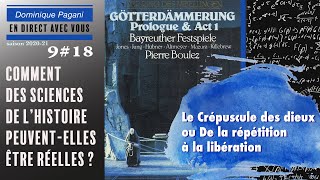 Season 9.2 · 3 Apr 20219 #18 Twilight of the Gods, or from repetition to liberation
- 1:27:32According to Hegel, painting abstracts from the third dimension; music no longer has any spatial dimension, it is a material disturbance in time.
 Series · 25 Mar 2021Musicosophy 18. What is musical in music
- 29:32Art is the place of unity between necessity and freedom, particular and universal, sensible and rational, which Kant leaves unresolved.
 Series · 17 Dec 2020Musicosophy 7. The Greeks, myth and music
- 3:32The difficulty is not to link art to a social form but to explain why it still gives aesthetic pleasure and serves as a model.
 Series · 3 Dec 2020Musicosophy 2. From Lévi-Strauss to Nerval on music
- 1:01:30Hegel's hierarchy of the arts is a hierarchy within the concept, from exteriority toward interiority; yet poetry does not leave the world of sounds.
 Talks · 6 Oct 2020Calves and Things (3): The dictatorship of the bobotariat
- 36:02Ecology is the aesthetic, in the old sense too, that is, the surface beneath which liberal ideology is perceived.
 Season 8 · 2 Jul 2020#12 • Return to the logics of the subject
 Season 8 · 21 Jun 2020#11 • Return to the logics of the subject
- 7:20Aesthetics is not art: it is a branch of philosophy that reflects on artistic corpora. The word dates from the eighteenth century.
 Season 8 · 11 Jun 2020#10 • Return to the logics of the subject
 Season 5.2 · 2 May 2019#5.6 Nature or Landscape?
- 1:28:39The word designates the universe unfolded by our senses, which are not in contact with truth and reality but with a surface.
 Talks · 20 Jul 2018Education: can the Beautiful be learned?
- 37:59Aesthetics, as the word anesthesia reminds us, belongs to sensibility: it is the world of what appears, not of what is; every aesthetic experience disappoints.
 Talks · 2 Jul 2018The Phenomenology of Spirit
- 1:31:27One makes an aesthetics when art is finished; art continues, but it has lost its function of representing the absolute.
 Season 4 · 12 Apr 2018#4.7 Angélique (by Nerval)
- 1:38:33Illusion and truth of aesthetics: Hegel devotes several volumes to it in order to show its limit, bound to its power of truth.
 Season 4 · 4 Feb 2018#4.4B Objections to Dominique Pagani
- 5:23Hegel subsumes aesthetics into the political: the truth of aesthetics is the political.
 Series · 2 Feb 2016Hegel on the Beach 5/5
 Series · 31 Dec 2014Q for Quality
- 7:29Human aesthetics goes beyond the formal or morphological criteria of beauty of the Greeks: it integrates the millennia-long work of history.
 Series · 27 Dec 2014M for Music
- 7:21In Hegel, the arts move from spatial exteriority to interiority; music, pure temporality, crowns the edifice.