 Talks · 2 Dec 2024Napoleon, or the reasons of cunning
Cunning of reason
Worked through in 17 videos · 25 passages.
Summary
Dominique Pagani takes up the Hegelian cunning of reason. He understands it as the articulation of essence and existence: reason is an essence without existence, a truth that lacks reality. It can enter into existence only by making use of what is already there, that is, the passions and interests of individuals, states and collectivities1. His main example is Napoleon: reason uses his ambition to set up the modern state, then casts him off to Saint Helena2. For him, a reason that uses cunning is not all-powerful, any more than the devil is, who uses cunning because he is less powerful than God. He sees in this weakness what is materialist in the notion34. He relates it to Providence and distinguishes it from perverse effects. He also connects it to the tool in the young Hegel5. He gives other examples: the colonial school that trains the leaders of independence, the geocentric calculations that advance mathematics, the return of Marx.
- 1Napoleon, or the reasons of cunning2 Dec 2024 · 27:45
- 2Napoleon, or the reasons of cunning2 Dec 2024 · 19:32
- 3#5.2 bis Questions (Facebook Live)6 Dec 2018 · 1:16:19
- 4Worldliness in Clouscard: the world as “cunning of reason”22 Jul 2023 · 35:25
- 5Tribute to Jacques D'Hondt (2)2 Aug 2016 · 3:58
Summary produced automatically from 25 of the passages below, to be reviewed; the numbers link to the moment in the session.
Talks · 2 Dec 2024Napoleon, or the reasons of cunning Cycle 11 · 3 Sept 2023Worldliness in Clouscard: desiring what? Through whom?
- 1:33:46The collective deepens by penetrating each individual, as the history of music illustrates.
 Cycle 11 · 7 Aug 2023Niger special: should we “blacken the corpses”?
 Cycle 11 · 22 Jul 2023Worldliness in Clouscard: the world as “cunning of reason”
- 35:25Reason, weak because it lacks existence, must come to terms with what already exists: this is what is materialist in the notion.
- 41:42Reason enters existence by using movements already present in matter, such as Napoleon's ambition.
- 2:25:28What comes about is not what was in the minds of those who produced the tool: the colonial school trains the leaders of independence.
 Cycle 11 · 9 Jul 2023Worldliness in Clouscard: the clash of worlds?
- 2:00:12Reason, a truth that lacks reality, passes into existence by making use of the ends of individuals who do not know they are working for it.
 Series · 2 Feb 2021#13 Mozart restored
 Series · 11 Dec 2020#5 Happiness versus the death drive in music
- 56:39Modern reason uses the demonism of the individual Napoleon to establish the modern state, then dismisses him.
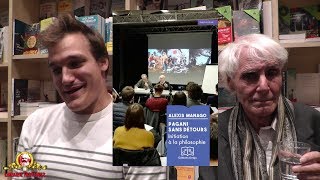 Talks · 21 Sept 2019Pagani without detours
- 41:07Truth, which lacks reality, makes use of particular interests that already exist, such as Napoleon's, to advance one step.
 Cycle 5.2 · 29 Jul 2019#5.9 Kafka, “An Imperial Message”
- 1:02:08The setting is never so determined as when I believe my free imagination is tracing its outline.
 Cycle 5.2 · 30 Jun 2019#5.8 Nature or landscape?
 Cycle 5.1 · 6 Dec 2018#5.2 bis Questions (Facebook Live)
 Talks · 12 Jun 2018In conversation with Bernard Friot (1 June 2018)
- 54:05Reason uses contingent existences (Napoleon, Louis-Philippe) to bring essence into existence, then discards them.
 Cycle 3 · 1 Aug 2017#3.2 From Ulysses to Daedalus
 Cycle 3 · 1 Aug 2017#3.1 From Ulysses to Daedalus
- 1:45:58Reason, essence without existence, can enter existence only by cunning; it is the progressive emergence of freedom in history.
 Talks · 2 Aug 2016Tribute to Jacques D'Hondt (2)
- 3:58Cunning marks the opposition between intention and event. It comes close to Providence and theodicy, an unconscious thought, and is distinct from perverse effects.
 Talks · 19 Jun 2016At the bistro (part 2)
- 24:00Through a cunning of reason, reactionaries advertise Clouscard by using him against his meaning.
 Series · 25 Dec 2014K for Karl
- 5:40The return of Marx, thought buried, is a cunning of reason.