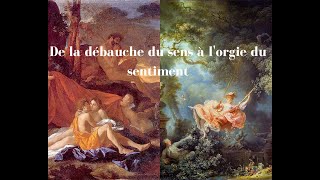
 Talks · 29 May 2023Dominique Pagani: From the debauchery of sense to the orgy of sentiment
- 41:42His music is part of the entertainments at Versailles.
Appears in 9 videos · 9 passages.
Dominique Pagani refers to Lully mainly as the musician of the court of Versailles1. He places him within the political order of Louis XIV's reign: the composer, protected by the king, who himself danced in his comedies2, is in a sense offered by the sovereign to a pacified court3, and his music is part of the entertainments of Versailles4. He returns several times to Lully's collaboration with Molière, particularly the music for Le Bourgeois gentilhomme, which he presents as a musical comedy56. In his "Musicosophie" sessions he draws a point about the history of forms from it: the turquerie already begins with Lully and the ceremony of the grand Mamamouchi7, and he cites him for this genre when discussing variation in Beethoven8. Elsewhere, he simply counts him among the great composers before the Russian school9. These mentions are brief and do not lead to a detailed study of his works.
Summary produced automatically from 9 of the passages below, to be reviewed; the numbers link to the moment in the session.
 Who is this?
Jean-Baptiste Lully (born Giovanni Battista Lulli; 28 or 29 November [O.S. 18 or 19 November] 1632 – 22 March 1687) was an Italian-French composer, dancer and instrumentalist, who is considered a master of the French Baroque music style. Best known for his operas, he spent most of his life working in the court of Louis XIV and became a French subject in 1661. He was a close friend of the playwright Molière, with whom he collaborated on numerous comédie-ballets, including L'Amour médecin, George Dandin ou le Mari confondu, Monsieur de Pourceaugnac, Psyché and his best known work, Le Bourgeois gentilhomme.
Read the article on WikipediaText: Wikipédia, CC BY-SA 4.0 · Portrait: Ducarme, Public domain
Talks · 29 May 2023Dominique Pagani: From the debauchery of sense to the orgy of sentiment Season 11 · 12 Dec 2022Hesitation fascinated by hearing and by sight: Siegfried and Perceval
 Series · 15 Dec 2020Musicosophy 6. The Jazz Variation... by Beethoven
 Series · 3 Dec 2020Musicosophy 3. What is called modern music?
 Season 9.1 · 19 Nov 2020#5 Benefits and harms of amnesia...
 Season 8 · 11 Jun 2020#10 • Return to the logics of the subject
 Season 6 · 30 Jan 2020#6.4 • The Logic of the Subject in the face of the reconstitution of Nazism
 Season 3 · 1 Aug 2017#3.2 From Ulysses to Daedalus
 Talks · 26 Apr 2015The Music of History