Philosophy of knowledge
3 videos, newest first.
What Dominique Pagani says
Dominique Pagani approaches the philosophy of knowledge through Plato's allegory of the cave, which in his view answers the question "what can I know?". On the board he reconstructs the ascent: from doxa, immediate knowledge, to dianoia, discursive knowledge modelled on mathematics but which does not go back up to the unhypothetical principle, then to dialectic and to theoria, silent contemplation12. For him, this ascent is only half the way: the descent back into the cave opens onto the philosophy of action, because knowledge is universal only if it can be shared. With Descartes he discusses dogmatic confidence in the order of the real; with Hume and Planck, the limits of law. He also rejects the idea of a pure origin2. He traces the progression from empiricism, which gives reality without truth, to rationalism, which gives truth without reality, and then to Newtonian determinism. The crisis of this determinism makes freedom a postulate3. With Kant, who limits knowledge to make room for faith, he moves from knowledge to "what ought I to do?"13.
Introduction produced automatically from the 3 sessions on this theme, to be reviewed; the numbers link to the sessions.
The 3 videos
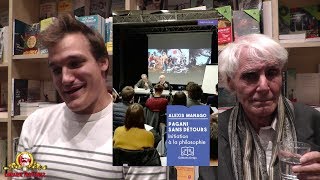 At the Tropiques bookshop
Pagani without detours
21 Sept 2019How can a book give linear form to Dominique Pagani's oral teaching, and what does this teaching say about the specificity of philosophy, of modernity, and of the question "what must I do"?
 Season 3
#3.5 From Ulysses to Daedalus
1 Aug 2017Why does Plato's allegory of the cave already contain the whole program of philosophy, from knowledge to the return to politics?
 Season 1
#1.7 Between crisis and war: Philosophising?
11 Dec 2015Why does the philosophy of knowledge lead to the question "what must I do?", and what content should be given to freedom?