English translation of the French transcript, made with AI and not yet proofread — click a paragraph to jump to it. Show the French original
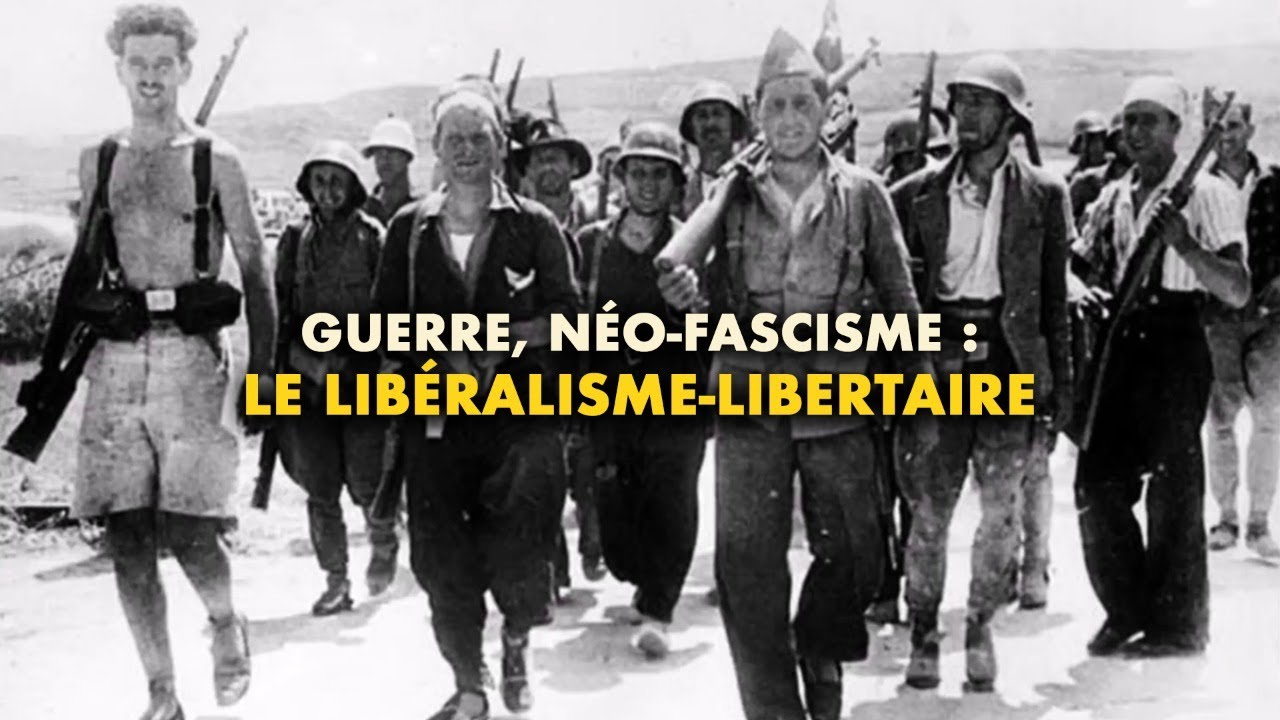
Spaniens Himmel, song of the German International Brigades 0:00 The Thälmann Column. Spain's sky spreads its stars over our trenches, and morning already greets us from afar; soon we shall go out to fight anew.
0:40 The homeland is far, yet we are ready, we fight and conquer for you, freedom. We shall not yield to the fascist, even if he sends bullets thick as hail. With us stand comrades without equal, and for us there is no retreat.
1:19 The homeland is far, yet we are ready, we fight and conquer for you, freedom. ...the world. So this is our question-and-answer session that I had announced for the last live broadcast two weeks ago, and which the urgency of the situation made me postpone until today. So I'm keeping my promise. And if I've had trouble getting my voice back, it's because of the emotion stirred up by what was the anthem of the German international brigades during the Spanish Civil War. Given the Nietzsche texts I analyzed in the "Lectures à vif" series,
2:34 there are some who might think, who might make this gross misreading, of taking me for a Germanophobe. I am a Germanophile as far as culture is concerned — these words don't mean much anyway. One can be a Germanophile for the music and a Germanophobe for the German Christian Democrats, who have been the majority party since the end of the war. Very Christian, not very Christian at all, and not very democratic either, between you and me. But here I have a thought for those who are always forgotten, namely the German communists, who were so numerous, who were the strongest party in capitalist Western Europe — I don't like the word "West," it's the same thing — before the war, and who were annihilated under conditions you can imagine. If, among all those who could illustrate tonight's title, which I of course want to come back to, if I decided to illustrate it, among a thousand possible examples that could
3:45 relate to current events, that is, to neo-Nazism, therefore to neo-fascism, therefore to war — not the danger of war, but the war that is here and that is drawing closer, closer in time, alas, in probability, and in space, it's not very far — throughout the Cold War, the two superpowers, as they used to say in the media, managed to fight only through distant proxy countries; these were trifles, trifles resulting in massacres — 3 million dead in Korea, 3 million dead in Vietnam, all because Korea, now North Korea, and Vietnam had the outlandish idea of adopting a Marxist and communist orientation at the time of their independence, and because, 10,000 kilometers away, Uncle Sam found this an unacceptable aggression.
4:49 Well, Uncle Sam — actually NATO, actually the NATO powers, and the main power — you know I don't like anti-Americanism, which often masks the real culprit, which is Atlanticism, and one can be an Atlanticist while being Chadian, French, Baltic, Polish, or belonging to certain Ukrainian circles of course — and conversely there are people in the United States who hate this policy, there are even elected officials and prominent journalists with a wide public platform who are far more hostile to NATO's policy in the Ukrainian matter, and appalled by the neo-fascization it expresses with fewer and fewer masks, than a certain segment of the French intelligentsia — sorry, American intelligentsia — which is obviously much less covered by the media,
Heimat and Vaterland; Guernica 6:02 it's not that — as you like to say — the mainstream media, to put it in French. So if I chose this deeply moving "Spaniens Himmel," "Spain's Sky" — that's the title of this song, this song of the German international brigades who got themselves shot up over there, far from their homeland — and here's the refrain: "Die Heimat ist weit," "The native land is far."
6:36 I'll come back to this translation — I say "native land" rather than "fatherland." It seems more or less the same, but after all, not everyone is born in their fatherland. One can be born far from the Father's land — that's literally what "patrie" means — and in German the equivalent is exactly the same, "Vaterland," the Father's land, isn't it? But here it's a matter of "Heimat," which is more intimate when one is in danger, isn't it?
7:08 And we hear the howling of the German Stukas overhead, bombing on behalf of the Spanish fascists — you see how all this seems both distant and present and current, doesn't it? When the Spanish Civil War, like the Ukrainian one today, served as a testing ground for new weapons, especially on the fascist-Nazi side, I mean the Italo-German side, but mostly German — the most famous, and regrettably famous, bombing illustrated by Picasso, I'm thinking of Guernica; the town was burned by incendiary bombs, by Stuka dive-bombing, and by a few Messerschmitts too.
A listener's comment: Haile Selassie and the Spanish Republic 8:06 So, 109, I mean. If I started with that, when I had the choice among several — alas, there's no shortage of choices right now to illustrate the topicality of this unmasked, less and less masked, return of fascism — it's because I was very moved by a question. So maybe we'll start there; I'm going to send it back to Pyrales in a certain order, which might start there, since it's a question that should have come fifth, but you'll see right away why it's so in tune with the intro that Pyrales kindly passed on to me, so let me start with it right away, if you don't mind.
9:06 It's not really a question actually, it's a comment — a question and a comment on this session. So, "Dear Dominique," — yes, I won't even give the pseudonym, so as not to violate the privacy of the writer, since he recalls some of his most personal information, while still staying within a political framework, and not just in personal feelings.
9:38 Judge for yourselves. "Dear Dominique, I was moved from the very introduction" — he's referring to the last video, "Roots and Migrations," my latest workshop, where the video began with the speech — he didn't even have time to make a speech, with the few words that the King of Kings, the Negus, the Emperor of Ethiopia, Haile Selassie, tried to stammer out, or rather to articulate very clearly, in 1937 before the League of Nations, at the very moment his country was being ravaged by a fascist aggression, that of Italy.
10:19 A war that today we would call asymmetric, wouldn't we? Planes and armored vehicles against edged weapons and a few rifles, not even automatic ones, on the Ethiopian side — a slaughter. And the emperor had been forced to flee, I recall, I've already mentioned it, but I'll repeat it because there are always newcomers. The emperor — and also because this history isn't taught very much in the West, is it?
10:49 You understand now why I really don't like that word. He was forced to take refuge in London in haste, because at that time England had a strong presence in the region, through Egypt, through Sudan — what was then called, the largest country in Africa by area, was called Anglo-Egyptian Sudan, which borders Ethiopia — so he went to take refuge in London, and then went to the League of Nations to alert world opinion to the Italian aggression, and he was the target — no Western country lifted a finger to condemn the Italian intervention.
11:31 Yes, I can hardly bring myself to say it. He had barely begun his report before the General Assembly of the League of Nations when suddenly whistles broke out, and there were of course commandos planted in the audience, on purpose, remote-controlled by the Italian regime — but still, I mean, the extraordinary dignity of the Emperor of Ethiopia wasn't enough to convince the Western powers, which weren't yet called "the free world," that they should condemn the aggression he was suffering.
12:25 And by analogy — now let me pick up again, I interrupted it, the comment from our dear friend, a loyal listener of our broadcasts, whose comments are always very relevant, interesting, and instructive — and here you see the connection between the forgetting that surrounds this Ethiopian history and the forgetting that surrounds the Spanish Civil War, except when it comes to bashing the communists, who are despised and forgotten by our collective memory, the Ethiopians and so many others.
13:14 "These very first minutes" — those I broadcast of the Ethiopian emperor's speech before the League of Nations — "these very first minutes resonate within me with a violence that goes back far before me. First-born in France of my family, from another country" — he's one of those so numerous Spanish comrades who had to flee, not because they disagreed with the ideas — it really is about ideas — fleeing the massacre and the slaughter they would have suffered, isn't it?
13:52 "First-born in France of my family, from another country, forgotten, the Spanish Republic" — yes, the short-lived "República española." The forgetting in this case, you see, we come back to that forgetting, is so deep that it exists even where my roots lie. That means that even in certain places in Spain, nobody there gives a damn, isn't it? People know Michael Jackson better than the Spanish Civil War. "Among the hundreds of thousands of anti-fascist fighters and innocents still in mass graves — there too children were dying.
Chapoutot: the Nazis against the Jacobin State 14:28 under the bombs, while the equally forgotten Franco-British Non-Intervention Committee held sway, so-called democratic." Now I'm going to take a detour to stay at the heart of our friend's message. I have to dwell on this, and I've noticed that almost all of you appreciate it when I restore the passages that get erased, which the media skip over, isn't it, from our past, without which the present is absolutely incomprehensible.
15:12 And that's precisely why this past is passed over in silence. There was of course a great division within the Western political world. I'll stay at the French level for now so it's clearer for everyone. Should France intervene in Spain to help against this massacre or not? If ever there was an asymmetric struggle, it was that one.
15:43 Because it's needless to tell you that the volunteers — forever glorious — of the International Brigades, who came from every country to lend a hand to the Spanish Republicans against the Francoists and Francoist fascism, against so-called "Nationalist" Spain... I should mention that none of these International Brigades had any aircraft at their disposal.
16:14 The war really was asymmetric. So there was the debate in France: should we intervene to save the Spanish Republic? And you see, the answer is already there in the very name of this committee, the Franco-British committee — the two beacons of Western Europe at the time, France and England — the Franco-British Non-Intervention Committee. So you see, the same people who now say, "but we have to fight the war in Ukraine now, we have to intervene" — it's the same people. That is, the anti-Russian, anti-communist, anti- camp...
16:49 Putin has nothing of a communist about him, he's even fiercely anti-communist. But that doesn't matter. In Nazi ideology, Slavs, whether communist or not, are subhumans who must be reduced to slavery. Here, I'm merely reporting texts. I'm not indulging in delusion or interpretation. The texts are accessible to everyone. Above all I recommend, if one really wants, how shall I put it, the most up-to-date review of this ideology concerning the plans Germany had for these so-called subhumans east of the Vistula, that is, the current German-Polish border.
17:36 I recommend the work of Chapoutot. He's not on my side politically. He's an immense historian. He is by far the best informed on the Nazi period, given the time he's spent in the archives and the effort he made to gain access to them. It's never as simple as one might think, in Germany no more than elsewhere. He's often less known but so essential that he's absolutely unavoidable. I say he's not on my side because he doesn't even see that Heidegger was a Nazi.
18:09 According to him, he isn't. That's not his field, philosophy. I don't want to make an unfair case against him. But I've already cited him elsewhere regarding one of his publications, where he reveals, based on the publications — he doesn't engage in intent-based prosecution, he works from the archives, he cites texts, he doesn't take them out of context — on the contrary, it lets him sketch the whole context of the period, the years just before the war and during the war of the Nazi regime.
18:43 The colonizing enterprise. And he recalls that, contrary to a legend, a false divide — ideology always begins with false divides, false oppositions. I'm sometimes asked to take sides between one or the other term of an opposition, whereas I set them back to back. You'll understand why. For example here, namely private versus public, private-sector liberalism versus totalitarian public statism, or Jacobinism as we say in France, isn't it?
19:21 Or in the far-right fringes of regionalism — regionalism isn't necessarily far-right, but there you go. So what does he say? He cites texts where Nazi leaders say, "Our enemy is the State, it's the French model, it's precisely Jacobinism." And they want to replace, on the nationalization side, State administration with agencies.
19:52 But look at current events — that's exactly what our leaders are striving to do. So here I come back to France, through the whole series — Giscard, Mitterrand, Jospin, Sarkozy, Hollande, and now the icing on the cake — namely, to liberalize everything that had been, at the cost of so much blood and tears, brought back into our common fold, that is to say, yours and mine, in the two stages before the war under the Popular Front and after the war under the CNR, the National Council of the Resistance.
20:41 So, contrary to a widely held view, if I'm making this long detour, it's precisely to recall that... Who was in power in France at that moment? A Popular Front led by Léon Blum, an anti-communist social democrat. Not a visceral one. He did...
Léon Blum, the Popular Front and the legitimacy of the street 21:12 He didn't have much choice, because things were rumbling in the factories, there were strikes. If there had only been Léon Blum's government, isn't it, we wouldn't have paid holidays and the great gains won by the Popular Front's social movements. But the communist wing of the Popular Front, being highly Leninist, understood well that no form of struggle should be scorned — parliamentary struggle, which should never be scorned, it's a form of democracy — but also social struggles.
21:45 What I'm saying is barely even topical, on the eve of March 7th. When democracy disappears from its institutions, when it only functions through Article 49-3, and when it unravels everything painfully won by the best of our forebears, at that point, legitimacy lies in the street.
22:15 It's not an anarchist speaking to you here. I'm restoring the spirit of Rousseau's Social Contract. It would be hard to pass him off as an anarchist. When he speaks of the general will — I'll come back to this later, because there's a question about what I mean by the distinction between the State and the State apparatus. We're doing philosophy. I talk a lot about war, about the present, I seem to be doing politics — no, not the politics of TV panel shows, we're doing philosophy.
22:46 And so, I'm going back to our friend's text, but I wanted to make this digression. The government — and I'll end on a crucial philosophical distinction — the Popular Front government, headed by Léon Blum, did not want to intervene in the Spanish Civil War. Now, we're rushing in — the French Socialists, and even part of what's left of the Communist Party, isn't it?
23:18 I have trouble even calling them communist, they've drifted so far from it — are going to back the Ukro-Nazis, aren't they? And the same people, back then, said no, we absolutely must not intervene. And with the best possible argument, one you would certainly accept too, that nothing is better than peace compared to war. Yes, this is where I want to draw a distinction, isn't it? The same individuals, the same parties, the same tendencies, the same groups, the same people, can be at once — this deals quite a blow to the principle of non-contradiction here — both warmongering and pacifist.
Pacifists in Spain, warmongers in Finland 24:00 What's Pagani going on about here? Either you're for war or you're for peace. Yes. But remember Aristotle's marvelous work on the conditions under which one can truly say there is a contradiction. Three conditions are needed, and in each one you find the word "same." I remind you, we're doing philosophy. For there to be a contradiction, two opposite attributes — smooth, rough, hot, cold, warmongering, pacifist — cannot belong...
24:35 So watch out! At the same time — first "same" — to the same subject, in the same respect. So I said they were, at the same time, all of anti-communist France, broadly speaking. That was a lot of people, at a time when the Communist Party was strong, when it was far from negligible — it brought together the traditional right and social democracy.
25:06 I'm anticipating a question about social democracy. Yes, I'm saving time by showing all the connections between these apparently unrelated questions. At the same time, one can't let chaos speak in its entangled state — one has to sort out its elements, but to recall that in reality, they are indeed intertwined. So, back to it. The same people were against France intervening, for example, against the French army intervening in Spain, to relieve the suffering of the Spanish Republicans and of the volunteers helping them, the International Brigades, whom — I come back here to our friend's text — let's not forget the International Brigades either, called upon by posters saying "Hoy España, mañana el mundo."
26:05 Well now, that's something quite different from the objective consensus now found in what's called "the West," isn't it? "Today Spain, tomorrow the world." Ah! May you bring such moments back to life — I'm addressing the younger ones especially, of course — may you bring moments like that back to life. It's high time. Let me go back to the distinction I haven't yet delivered.
26:36 The same people who refused to intervene in Spain to help the Spanish Republic — let me condense this. And you might say, well, I too prefer peace to war, after all one understands the hesitation. No, no — but they didn't hesitate to wage war, at that very same moment, against the Soviet Union, in Finland. That was the Ukraine of the time. I'm not going to say the Finns were Nazis. They were anti-Russian, anti-communist, whatever you like.
27:07 In any case, less Nazi still than those who display their swastikas everywhere. As soon as a prisoner is taken by the Russians, as soon as they strip him, you can barely see his skin, there are so many Nazi insignia on it. "Oh but no, that's marginal, just a few hotheads like that." Yes, yes, it's the hotheads who order, at government level, the names of avenues and monuments, isn't it, the disappearance of monuments to Soviet martyrs from the Nazi era, and on the contrary, isn't it...
27:42 The glorification of what was the worst in European Nazism. Not only Nazi, the worst. I tell you that even the SS were stunned by the atrocities committed by the Banderites. Named after Bandera who was at the head. The sinister head of the Ukrainian Nazis. It wasn't all of Ukraine, far from it, no lumping together. And who massacred the Jews, the communists, of course, that goes without saying, but also the Poles. Those Poles who now come as eternal friends of Ukraine, isn't that so?
28:15 And who are just waiting for an occasion, aren't they, to seize the west of Ukraine, in case things turn bad. Well, let's not anticipate the near future. No, you see, the same ones... And you see, they were at the same time. Pacifists in Spain, warmongers in Finland, well I never. You had to think of that one. You see that these words mean nothing anymore. Mr. Pagani, are you a pacifist or a warmonger? Are you for war? Are you for peace?
28:46 Spontaneously, I would answer, I am for peace. Who isn't for peace when he looks at his children? Or his grandchildren? Right? But that doesn't stop one from waging war on the neighbors. On the neighbors' grandchildren. You see. So, you see, that's what philosophy is. First and foremost, I'll always come back to this. Seeking what speaking means. Giving a purer sense to the words of the tribe. Those words are impure.
29:18 Well, they do have a noble meaning, but most of the time, when they're used, pacifist, warmonger, they have an impure meaning. It's to encourage war when we need it, isn't it? Or to let it massacre the other when we don't feel like helping that other. There you go. I'll go back and finish the magnificent text from our listener. Over there too, children were dying under the bombs while the equally forgotten Franco-British non-intervention committee was in full swing.
Roots, migration, and the dialectic of here and elsewhere 29:54 That one isn't told often. Franco-British democratic. Second intervention, much shorter. I have an important question, very short, that was asked of me. But what do you mean by liberal-libertarianism? There are those who don't know about it, which is normal, because it isn't much publicized. Well, it's still a good moment to talk about it. There's no better way to introduce it than to show how far back it goes, because it was already in the name of liberty that liberties were being crushed by fascist arms.
30:28 Over there, at home, a home I only knew for a few months of vacation, and only on one half of the family, the other half being in a region that was forbidden to us by Francoist repression. I lived through that era. I didn't experience it as a Spaniard. Some of you may remember that I had a German wife, whose little brother, who came to Spain very young and didn't want to return to Germany, is named Bernd, and doesn't want to be called Bernd, but wants to be called Bernardo.
31:12 I pay tribute to him here, Carstin, who are very nice and whom I like a lot, who doesn't have the same political leanings as I do, but isn't against them either. It's not really his concern. This young man, at the time, used to tell us to be careful in the streets of Palma, when the guardia civil, the Spanish police of the Franco era, when the guardia civil was looking for a thief, for a burglary that had been reported, he said not to go out too much there, because since they're too lazy to look for the real culprit, they grab the first ones they find, repression, it was terrible.
31:51 And so, a personal testimony now, I saw in a big café in Barcelona, a tourist from a northern country who was in shorts, on vacation like that, at the café terrace, the guardia civil coming to tell him 'Sir, go get dressed.' That was an era! And that's for foreign tourists, so imagine what it was for descendants of Spanish communists, or simply supporters of the Spanish Republic. So there you have it, the other half being in a region forbidden to us by Francoist repression, the memory is being revived again by the grandchildren of the martyrs.
32:33 Today, nothing would stop me from going back to Asturias, a magnificent region of Spain. And yet, I'm incapable of it. That's the region, you know, that's in the northwest, that rises toward the Cantabrian Mountains. And then, to the northwest, toward Spanish Brittany, if I may call it Iberian Brittany, I'm thinking of Galicia. I'll make a third, very short digression. A Spanish legend says that God was asked which is the most beautiful region in the world.
33:06 And he placed his hand on the Spanish Finisterre, because there are five capes, like the five fingers opening onto Galicia. Today, nothing would stop me from going back to Asturias, and yet I'm incapable of it. Yet I thought I had no emotional tie to this region. Even after so long living in France, you see, the conclusion is magnificent, isn't it?
33:41 You don't just shed your roots and your family history like that. Oh no, I'm not just wandering off into feelings, in any case I don't forget everything else for the sake of feelings alone, because we do have the right to have them, after all, when they're of such a universal order. Last time, I spoke about roots and immigration. You don't just shed your roots and your family history like that.
34:16 the dialectic of here and elsewhere, of identity and otherness, of origin and journey, of residence and migration. I maintain that migration is an intrinsically anthropological dimension of the human species.
34:46 of the human species, from the African jungles to the caves of the Périgord or of China, whether it's Homo erectus, Java man, those who painted the Altamira caves in Spain, or those whose extraordinary fossil remains were found at Bougraïve. It'll come back to me, in Morocco. I made an edition about that, excuse me, but I'm making a modal connection with the prison the Americans have kept in Cuba.
35:25 I recall here that this is the history of an immense migration that isn't over, but which doesn't exclude long pauses. A migration doesn't exclude the possibility of taking a break. The best moments of our great hikes, in the most beautiful landscapes that nature and man's shaping of nature could offer us, is when we have a picnic in the most beautiful spots, after all.
36:00 Or even when we camp there. There you go, I wanted to share this testimony with you, and I wanted to stress the many connections. You see how it lets you connect with the questions that follow. I'll ask Pierre-Alain to move on, in whatever order there is now. It doesn't matter. There you go.
What should be made of the distinction between the State and the State apparatus? 36:30 So, Bobby Fischer. This concerns people who asked me questions two years ago. I have such a backlog of questions that I realized this backlog kept building up, because I was starting from the latest videos, then working back to the earlier ones. Actually, now I take the oldest and the most recent ones, that way I try to widen the range of my answers to your questions. So here's what Bobby Fischer told me almost two years ago.
37:03 The State must not be confused with the state apparatus. I told you we'd come back to this. 'Certainly, but what to do with this information?' No, that one is more recent. But anyway, we'll get back to the older questions right after, which go in the same direction. 'This one is more recent.' 'Certainly, but what to do with this information?' So, I mean, Bobby, there's an enormous amount to do. It's so enormous that we don't see it, that's it.
37:38 It's not blindness in the physical sense, it's willful blindness. Sometimes, too much sun, as Pascal says, too much light dazzles, doesn't it, and not enough darkens. I'll first recall what the distinction consists of. It's still the most important thing. We're in philosophy. Because everyone talks about the State. Everyone says 'Ah, I'm fed up, it's the State's fault.' Yes, of course, anarchists, why not.
38:09 The one who sees, for the umpteenth time, a parking ticket on his windshield, when he's working with his vehicle, but also nearly the entire MEDEF employers' federation, isn't it? 'Ah, the State imposing taxes, laws, restrictions on us...' I'll let you in on a confidence: my mother, may the earth rest lightly on her, complained about having married, I quote her, 'the only Corsican who is honest and doesn't know how to play cards.'
38:45 I'll leave that joke as is. There are honest, hard-working Corsicans. There are even many of them. It's true that my father had a reputation for being incorruptible, which is rather rare in the colonial administration in general. I didn't add, among Corsicans in particular. And he dragged his feet when it came to getting cousins out of prison who weren't quite on his side, of his family... well, anyway. In short, he didn't like doing that. So...
39:15 It's interesting to note that he was insulted in Ivory Coast. I'm talking about my father, which is very rare for me to do. It's even the first time, as far as I know. Because there had been enormous, exceptional embezzlement by a French agent of the colonial administration at the time. It was in the sixties, to put it in French terms, who had been caught red-handed.
39:50 And it was so blatant that he had to get back on a plane. Which was exceptional. All the embezzlement going on at that time had to be penalized. But this one was especially glaring. And so, in Réunion... it was a very powerful ministry of the economy, finance, and planning. There was still a ministry of planning back then. The Ivorian minister was named Saller at the time. That makes a lot of my Ivorian friends laugh.
40:20 But he was already called that at the time, so much did he watch over his ministry's accounts. He was called 'The Wages of Fear.' So my father was asked, along with others, to say who could be put in his place to replace him urgently. My father had the nerve to propose an Ivorian civil servant. It wasn't just that it wasn't done. You know the insults he faced. And yes, but that's the State. But that's not the meaning the MEDEF gives it. But already, the MEDEF fumes against the State.
State forests, hospital, school: the State broadens my freedom 40:51 Anyway. You see that private and public, here again, don't mean much. I'm coming back to that now. Or rather, now I'm at the distinction: the State is a limitation on my freedom. It decides, without asking my opinion, to raise the retirement age by one year, without consulting me.
41:21 It decides to concentrate all the money we would so badly need to relieve injustices. There are always injustices, but there are far more of them than there have ever been since I was born. You'd think I was born at the time of the greatest government France had had since the Convention and the Popular Front, at the end of the war, in the immediate postwar period, if you prefer.
41:54 But the enterprise of unraveling, which I alluded to earlier, of these gains. Some people died to get them, these gains. There are those who speak of the welfare state as a religious notion, as if these things fell from the sky. He also speaks of privileges. Can you imagine? The Ancien Régime, privileges, that's what we saw as being by birth. And here, paid leave, that's not the same as pay-as-you-go pensions, but that's privileges. It's fantastic, it's a swindle. 'Now, give a purer sense to the words of the tribe. Let's keep those words, but avoid their impure meaning.'
42:30 'May an impure sense water our furrows,' I'd say, to paraphrase the famous words. Liberalism, libertarian, the State must not be confused with the state apparatus. We see it there, because I'll get to liberal-libertarianism afterward. I'll share the following question. 'When the State means the arbitrary limitation of my freedom,' that can range, as I told you, from the parking ticket I see on my windshield, right?
43:05 An unjust tax system compared to others who earn incomparably more than me, but who've stashed it away in the Cayman Islands, or in the Panama Papers. Well, anyway, I don't know who among you I'm going to teach a lot about this to. Or else, the State means not something different — the second meaning isn't different, it's the opposite.
43:36 The State is the institution that expands my freedom. 'Ah, that's a good one, we'll have to see about that.' 'You're about to see right away.' 'But you're forgetting.' I have to remind you, I don't hold it against you, you know. To give a purer sense to the words of the tribe. I must recall what was entitled — in the title, sorry — the title of a work I've often recommended to you, by a sociologist from the 1950s, Maurice Halbwachs, 'The Social Frameworks of Memory.'
44:08 'What has no relay to remind you of it disappears from your memory.' That doesn't mean it didn't exist, you know. So, now is the moment to recall it. 'Which one? The sense in which the State expands my freedom.' No, no, I'm not going to look for rare things, these are very common things. Come on, let's move from the spring that's opening today — there really was a little spring air. To autumn, the season that resembles it most because it's exactly symmetrical, like in a mirror. It's the same as spring, a transitional season, but everything is reversed.
44:39 It's not birth, it's decay. So, yes, but precisely, mushrooms grow on decaying matter. Come on, let's go mushroom picking. And then, bam, we see a wall: 'Mushrooms, private property, no mushroom picking.' Ah well, I resign myself, because with a forest, it looked pretty good there. There you go, I'm not saying to hop the wall and trespass. With Clouscard, that used to happen to us. Because we'd go make little incursions into Nerval's countryside, like that, sometimes.
45:12 And there were little gaps in the walls, old 18th-century walls. And there you go. Anyway, properties that now belong to the emirs of Kuwait, if you want to know. 'Mushrooms, private forests, no mushroom picking.' Must be respected.
45:42 I move along, I go elsewhere. And then suddenly I see a sign. 'State forests of Ermenonville, state forests of Halatte, state forests of Chantilly,' all of them right next to each other. 'State forests of Pontarmé, of Compiègne, the largest in the north of Île-de-France, like that of Fontainebleau, the largest in the south of Île-de-France.' And there, I can pick them. There, the State expands.
46:12 That land belongs to me. But not to me privately, it belongs to me, to you, to him. And as I told Clouscard — forgive me for laughing, you'll understand — he had lived through the Occupation, not me, right? So I was being picky, that's the word for it. There are years when there are so many mushrooms that there's enough for everyone. So I'd tell him, well, let's just take the young ones, we'll do infanticide, we take the small ones like that. Then we leave the others, there are a lot, some are too old. Well, right? You don't take those, at least you who didn't live through the war.
46:44 Well yes, you want to take everything. We're free. And that, that's the State we're smashing, it's the hospital. It's the healthcare service I go to, where I don't have to pay anything. Because I'm classified for full reimbursement, full coverage, if you prefer. Where else do you find that? You know very well there are countries — I won't just point to the United States, but others too.
47:14 Where you're there with blood spurting, lying by the roadside in the gutter, near your smashed-up vehicle, an ambulance arrives and asks you first for your credit card number, or your health insurance card number. And then it goes through the machine, the insurance card, before they start treating you. There, the State expands my freedom. And finally, school, well I'll... it's obvious what I'm saying, but obvious things need to be recalled, because by dint of being passed over in silence they become less and less obvious.
47:51 The work of destroying memory, isn't it? Of amnesia. I did a series on that, didn't I? On Mnemosyne, the deity who is the origin of memory and words and language, how curious. So there you go. So, I wanted to make this abstract separation.
The far right and the restoration of the state of nature 48:25 There is a State that limits my freedom, which I run up against, isn't it, in my daily practice as a small shopkeeper, a motorist, a mushroom picker... And then there is a State that expands my freedom, at school, at the hospital, and in the state forest. And I could go on, I could give a thousand other examples. Now, I'll answer this in a much more concrete way, through another intervention, another comment, that of an old acquaintance, Christian Régnier, whose comments are always, like the previous one, very relevant in content.
49:09 The pickup by the far-right YouTuber was following the video I had devoted to this person, whom I didn't know, but I was advised to watch one of his videos, to see what I thought of it. And the pickup by far-right YouTubers of all the common clichés of this intellectual filth of the new right has, in my eyes, one merit: it highlights the complementarity, indeed often the complicity, of these discourses — those of the far right — with the political acts carried out by the official representatives of the upper bourgeoisie. And we come back to the MEDEF, which never presents itself as far-right, so it fights it, on the contrary, doesn't it? By calling them populists, conspiracy theorists.
50:02 Yes, of course. If you say that the United States has long wanted to do away with Russia, I mean, well before even the current government in Ukraine, and well before the events of the Maidan, you'll be told, yes, yes, that's conspiracy talk. One of the tribe's words. Indeed, successive governments make permanent targets of governments. Here, we're no longer talking about small hotheads, skinheads with swastika tattoos. No, governments, respectable people, people of substance.
50:43 Successive governments make a permanent target of education, and, hey, of public freedoms. We no longer have the right to follow Russia Today or Sputnik. It's extraordinary, it's the first time — I'm between 75 and 80 years old now — it's the first time I've seen media like that struck off, and struck off by major states. American media were never censored when they caused millions of deaths in Vietnam, in Korea.
51:18 There you go, wait, I'm not going to put words in anyone's mouth, I don't like bashing Americans, there are good people in the United States. They have no interest in speaking out. Indeed, successive governments make a permanent target of education, public freedoms, social rights, mechanisms of solidarity, etc. In short, they, the governments, rely on an ideology and implement policies aimed at restoring and legitimizing — listen carefully, he understood all the advances of the most fruitful modern thought, from Rousseau to today, through Kant, Hegel, Marx, Lenin, Clouscard.
52:00 I made a small series of videos on this progression, it's called revolutionary thought from Rousseau to Lenin. At the time I hadn't dared include Clouscard in it, as being too recent — well, I regret that now. In short, it relies on an ideology and implements policies aimed at restoring and legitimizing a state of nature based on what reigns in nature: force.
52:31 Nature isn't evil. I mean, a wolf that slits the throat of a fawn, a doe's little fawn — yes, there's a kind of racism in our relationship to animals. Oh, the poor little fawn — but we never say the poor little lizard. That's rare, much rarer, that people feel sorry for an iguana the way they feel sorry... To legitimize a state of nature based on force.
53:02 It has to feed its young, the wolf too, like wild dogs. They have to feed their young. They do neither good nor evil. Those notions already presuppose that one has left the state of nature. But I won't recite to you every time the famous chapter 8 of book 1 of the Social Contract. I'll give you the reference, this is the moment to reread it — book 1, chapter 8, it's all on Wikisource, of course, of the Social Contract. On the distinction between the state of nature and the civil state.
53:34 A state of nature based on force, restraint, submission. Brrrrrr. Here, Christian Régnier is putting flesh and blood on my abstract distinction between the state that diminishes my freedom, that opposes it, and, on the contrary, the state that increases it. What is he saying, in fact? This is the great mystery hidden from you about modern times: it's the far right that is going to pass itself off as progressive, that is, as standing for freedom.
The right seizes freedom: the "free world" 54:10 As being on the left. Freedom was the enemy of the right for a long time. Until when? Ah, all these secrets need to be brought back into the light now. Until the Cold War. The Cold War, that was the crusade. The West — now I say it, with lots of scare quotes — the free world against totalitarianism. Sure, right! We could go on, well yes, so what about 3 million dead in Vietnam?
54:42 They were communists, weren't they? Yes, we have freedom of opinion, non-intervention in countries. What non-intervention? More bombs dropped on Vietnam than on all the battlefields of the Second World War. There you have today's moralizers. Not just moralizers, mind you — pit bulls, Dobermans, barking so that you and I follow them into war.
55:20 So that we get infected by the pack, right, that wants to feed on Russians. And let me repeat, I am not pro-Putin, far from it. What does it matter! As if it were because of what I dislike about Putin that the Americans, the French, the Germans, the Poles, the Balts — the most Nazi-leaning countries in Europe currently, Poland, the Baltics, Ukraine, the Baltic states.
55:55 No, I'm not exaggerating here. I mean, in the Baltic states, they smashed a statue that was a memorial to Soviet war dead — tens of thousands of dead who liberated the city when the Red Army was advancing, Soviet soldiers. And they replaced it with the statue of an SS man who, at the time, organized one of the largest per-capita deportations of Jews in Europe — that happened in the Baltic states, along with Hungary, for example.
A giant State apparatus at the service of private capitalism 56:28 I'm not talking about the massacres on the ground, that's Ukraine — Bandera's Ukraine. There you go. So, thanks to Christian Régnier for helping us understand, and I'll conclude on that. I'm going back a bit to the abstraction, but made more understandable and enriched by the flesh and blood brought here by Christian Régnier. Today's biggest political scam is to build a gigantic state apparatus, instruments of power — police, army, judiciary, the 49.3 constitutional clause, membership in Brussels Europe even though it was rejected by referendum, and by a large majority.
57:18 That, the state apparatus doesn't care about. But why doesn't this state apparatus care? Because it serves not the state in the second sense — that is, the general interest, what Rousseau calls the general will, the common interest, yours, mine — for education, health, everything concerning our children, our loved ones — no! For ourselves — no! This state apparatus serves... oh dear!
57:48 Yes indeed, you understand, the opposite of the state — you have to admit, that's something! Yes, it's hard to give a purer meaning to the word of the tribe, I feel like I'm stumbling. No, it's clear! On the contrary, this is exactly where it becomes clear. A gigantic state apparatus, the biggest there has ever been — there's wiretapping now, satellites — the Third Reich's control system was small-scale regional stuff by comparison. In the service of what? Of this mortal enemy of the state, which is private capitalism. There you go.
58:19 There you go. What to make of the state / state-apparatus distinction? You can't say it isn't very topical. You see how the questions have a family resemblance, it's curious, isn't it! And there you go! So, Mister! Mister, colon, question mark. I have a question: are leftists the same as social democrats or not at all? Then there's a second question that was added a bit later, the same day.
Who are the leftists? Lenin and Mitterrand 58:52 Good evening, could you, from the same Mister, could you specify exactly who you're talking about? By liberal left or libertarian? You see, there's no getting out of it. And how does it lead to fascism? Tonight's session title isn't arbitrary, as you can see. So I'll start with the first question: are leftists social democrats or not at all? Well, here again, I'll start with a small distinction.
59:25 There's the term 'leftist' in the mouth of someone from the right. It's quite simple: it's everything to his left, isn't it? So he lumps everything together — the leftists in the precise sense, which I'll explain afterward, and which has existed for a long time, since as early as the 1920s Lenin published a very famous text called 'Left-Wing Communism: An Infantile Disorder.' So there was already, back then, a fight by Lenin's communism against the leftists, who at the time were scattered among the SRs, the Socialist Revolutionaries.
1:00:07 Anyway, I won't get lost in the groupuscule chaos that characterizes leftism properly speaking, I'll come back to it. But for now, the first meaning, used by the right, and especially by today's right, isn't it: everything to its left, or what it thinks is to its left, even when that's not the case — this is where it would be comical if it weren't so serious in its consequences — they call that 'leftists.'
1:00:39 I think even within pro-Russian parties — you see, I'm trying to be intellectually honest — which are pro-Russian parties, some of them are so anti-communist, right, yet they talk about Macron as a leftist, you see? Yes, yes, yes, yes. There are so many outfits on the internet that I don't need to spell it out, most of you know all these little chapels well.
1:01:16 So now I'm going to tell you what I propose, how I propose to speak precisely about leftism, and not muddy the waters in such a way that the trees end up hiding the forest, and the branches hide the trees.
1:01:47 One should have hidden the branches. So here are the leftists, that is, those who were the fiercest opponents of the Communist Party and the CGT during the events of '68 — I say this for the many young people who don't know it, and which people are careful not to mention, especially those on the right who also call — well, that's the internal quarrels. Oh really? Fine.
1:02:17 Take Jospin too, you've heard of him, it wasn't that long ago that he was Prime Minister of France, Socialist Party — well, the new Socialist Party founded by Mitterrand. Let me note in passing, since we're going to talk about social democracy, that Mitterrand carried out what you'd call a takeover of the Socialist Party — he didn't even have a membership card and found himself General Secretary of a party he wasn't even a member of, while coming from the right, from a right heavily marked by the far right.
1:02:49 All that is well documented, look it up. I often quote one of Foucault's rare barbed remarks, which I recommend: Mitterrand is Vichy. But what are you talking about? But Mitterrand, still, he had the courage to abolish the death penalty. Yes, but Mitterrand is a politician, not like de Gaulle, not a statesman. He's a politician, he's clever. There hadn't been any convictions, any executions, for more than ten years.
1:03:23 So all it took was a small nudge, so that fact and law would coincide. It was about time. Well, that's better than nothing. Well yes, I'm for it, I'm for the abolition of the death penalty. But when he was Minister of Justice, when he was in power under the Fourth Republic, he refused to pardon a communist who sympathized with Algerian independence fighters, and who was beheaded following the refusal of the Minister of Justice, François Mitterrand, to grant him clemency.
The extreme center and the three species of leftism 1:04:05 That's social democracy for you. The one that refused to intervene in Spain out of love of peace, love of peace, love of freedom. I gave a talk which, I see now, exists in short form, thanks Pierre-Alain, on the extreme center. I won't go back over it. What a joke it is to wonder whether I'm center-left or center-right, you know. You see that?
1:04:35 It's dissonant. The closer the notes, the more dissonant it is. A well-placed dissonance can be excellent, like a spice in a dish. But here... Center-left, center-right, they're so close, aren't they? Go on, distinguish them. You know, it's my image of a segment AB. If the midpoint M...
1:05:06 What is the color of the midpoint M? Given that AM, the first half, is painted blue, wet blue paint, and the second half, MB, is wet red paint, and the midpoint — everyone knows it's going to turn purple, point M. That is, you never know whether it's red-browns or blue-reds. Extreme center. I pass myself off as liberal, the free world. I sum it all up: I fight for freedom, I fight for democracy, against what are now called authoritarian regimes.
1:05:40 Totalitarian, authoritarian. Well I never! I cast my vote in a referendum. We don't want your Brussels Europe. It doesn't exist. It's a puppet manipulated by Uncle Sam. It's even written in black and white, I'm not putting words in anyone's mouth — look at the draft European constitution that was put to the French people. As soon as it comes to foreign policy and defense policy, you see NATO. NATO isn't specifically Europe to begin with.
1:06:13 All right. Let's not get worked up. So, the leftists. I took the example of Jospin, I'll come back to it. He was a Trotskyist in '68. So he was positioned as being to the left of the Communist Party. You see, the leftists are those whose stance is to be to the left of the institutional communist parties — either official communist parties, or communist parties actually in power.
1:06:45 That is, there are several families. Within the leftist category, there are three sub-species. Now I'll speak precisely, since we're doing philosophy. In chronological order, so as not to wrong anyone: the anarchists, which go back further in history — the libertarians, that is the anarchists — the Trotskyists, and the Maoists, from the 1960s-70s onward, in Western Europe.
1:07:19 Here I'll open a small parenthesis. I will always have the utmost respect for the man who allowed China to escape shame and misery. Misery, that goes without saying — at the time when human manure was trodden into the rice paddies with bare legs to fertilize them. Those who point the finger at China now didn't point at it back then — curious, when it was suffering incomparably more than now.
1:07:59 I will have immense respect for the man who pulled China out of that, for the Mao of the Long March. A distinction — not between two Maos, but between two eras. And then there was the Mao who had lost some of his standing in the leadership of the Chinese Communist Party at the time, and who, to regain power, was behind what came to be known historically as the Cultural Revolution — we saw 14-year-old kids armed with Kalashnikovs, former companions of Mao who had made the Long March, branded as bureaucrats, sidelined, and above all a strong anti-Sovietism.
1:08:44 They don't tell you all that. That China — which thankfully has disappeared, that China of the Cultural Revolution — I did not say Maoist China has disappeared. What's essential, thankfully, remains: the nationalization of the major means of production and exchange will always be what reconciles all communists, in principle. Not your toothbrush and your wife — the major means of production and exchange. You are a major means of exchange if you're Carrefour, Auchan, Dassault, Bouygues, Danone.
1:09:23 The Maoists I'm talking about — I'm talking about French Maoists here. There are plenty of them nowadays among the ecologists who've reconverted. There's one at MEDEF, the employers' federation, number 2 or 3 of MEDEF, I don't quite remember, who said we've had enough, we need to get rid of the government inherited from the CNR, the institutions of the National Council of the Resistance.
Frankish freedom and revolutionary freedom 1:10:13 And just as you have Jospin the Trotskyist — I take the three families — Jospin ended up saying, well after '68, when he was Prime Minister: my program isn't even socialist — that 'even' is my addition. But he said, my program isn't socialist, whereas in '68, to come to power, one had to — because in France, you need to give yourself a left-wing face since the French Revolution to have the slightest credibility.
1:10:44 This is a tribute I'm paying to France here. It's not irony, not criticism. It proves your strength, it proves how much power needs your adherence, what's called public opinion. Hence the importance of propaganda and the media. There you go, the rest you know. But you understand better now where it comes from. It's aimed above all against the French Revolution's tradition of social justice and freedom — yes, but not the freedom of the fox in the henhouse or the wolf in the sheepfold.
1:11:20 That's the medieval sense of freedom. 'Frei,' which gives 'Frank,' 'Frankreich,' 'the land of the Franks.' The Franks, the Franks were throat-slitters. You know how Clovis settled the matter of the Soissons vase? He smashed the skull of the man who had stolen it, just as the man had smashed the vase. Remember the vase of Soissons.
1:11:51 'Frank' here means 'he who, in war, got the upper hand in battle, who pointed his sword at his opponent's throat.' He said, 'Well, either these are your last seconds, or you live as my slave. I am the free man. Frei, Frank!' That's not the freedom we've been fighting for since the French Revolution. As Rimbaud says, what I loved was free freedom. And yes, it takes a 17-year-old kid.
To the left of the Communist Party, to the right of De Gaulle 1:12:22 Let's get this straight. So, the leftists in the precise sense are the union, in the mathematical sense, of three species. The anarchists, whom I could feel closest to, given a certain tradition — because there's a vile right-wing anarchism, I'm thinking of Céline. But there's an anarchism that got its hands dirty, that was a victim — I'm thinking of the Commune, for example — alongside the working class, or that simply emanated from the working class.
1:12:57 I will never say a word against that. No, no, I'm talking about those who put on a left-wing face in order to carry out the most right-wing politics. I'm reminding you — I'll conclude on this, on Mister's first question — that those who called themselves to the left of the Communist Party, more radical, more revolutionary — the Maoists, the Trotskyists, the anarchists, right — I take part in demonstrations. I too demonstrated in '68 alongside plenty of people who were more inclined toward Cohn-Bendit than toward Georges Séguy, the CGT's General Secretary at the time.
1:13:37 It was at the end of the demo, which was a great success — there were a million people. Nowadays a demo is considered a success when there are 5,000, 10,000. More than a million. And then, at the moment of dispersal — it was a great victory, and the sheer strength of that march alone — suddenly there was a bunch of leftists saying, 'No, let's go burn down the stock exchange, what good will that do?' Burning down the Bank of France's stock exchange, I swear. Honestly, it hasn't been there for a long time. The stock exchange, yes, the shares, yes — but that happens inside machines and computers now.
1:14:13 They're not the brownshirts. So this coming together of anarchists, Trotskyists and Maoists, those who called themselves to the left of the Communist Party, truly on the extreme left, in the proper sense, that's me, at the very end, at the far end of the political arc, at the extreme of the left you find the leftists, then the communists, then the socialists, the social democrats — you see, I'm answering both questions.
1:14:50 Social democrats, we come back to the extreme centre. In fact, it was a mask for those who were to the right of De Gaulle. Now I'm being serious and I'm coming back to what is most topical. How many times did the Atlanticists, first and foremost, of course, the flagship, the American executive, try to get rid of De Gaulle at the time when he reigned, when he was leading France.
1:15:24 How many times? Each time it failed. They tried with centre-right people, precisely. I'm thinking of Lecanuet, for instance, the former mayor of Rouen. It didn't work. It didn't work, precisely because of what I told you. There is a revolutionary tradition in France. The French are quick to bristle.
1:15:55 A quotation in French from Hegel, then from Marx, who was very grateful to the French political conscience, which, like a sea serpent, periodically resurfaces. Most recently, it was the Yellow Vests. Just when you think it's been forgotten, that it's disappeared, that it's been absorbed, that everyone has become bourgeois, that's when it shows itself. There's a little bit of hope. So, those who called themselves to the left of the PC were to the right of De Gaulle. On what point, above all? Participation in Europe — well, well!
1:16:27 Whereas De Gaulle pursued the empty-chair policy in Brussels. And he was opposed to Britain's entry into the Common Market. Because he knew it was so that sheep — wool from Australia and New Zealand, in short from the Commonwealth — would come and compete. French and European farmers who were already struggling to hold agricultural prices, to stop them from collapsing. But above all, opposed to NATO.
1:16:59 You see, you see how all this is more topical than ever. So there, the leftists were NATO's favourite weapon. Wherever there was a communist danger. Not in England, not in Sweden. No — in Sweden, social democracy... now it's thanks to neo-Nazis that there's a political majority in Sweden. Look it up, it's the last elections, it's not complicated. You read the press.
1:17:29 Some of you get a chill down your spine. Let's move past that. France and Italy. The two countries where there was a powerful communist party, more than a quarter of the population. In those countries, it was understood that by claiming to be even further left than the communists, you could gain credibility. And that produced almost the entire French philosophical school, from Sartre to Derrida.
1:18:02 Passing through Deleuze, Foucault, etc. So, are the leftists the same as the social democrats? Not at first! The leftists saw the social democrats, the socialists, as bourgeois, rotten, and so on. But as soon as they're in power — I'm thinking of Jospin, a former Trotskyist! A prime minister of Mitterrand's, a former Vichyist, says: 'My programme is not socialist.' There, everything's been said.
1:18:33 So I've already answered three-quarters of the second part of your question, Mister. Good evening, could you clarify exactly who you're talking about? By liberal-libertarian left, and how it leads to fascism? Well, I just told you, I'll repeat it, because I try to be rigorous — we're in philosophy, not at the corner café. Those who called themselves to the left of the PC were, for the most part — because some of them genuinely believed the poor are the victims, that's the hippies you see with dogs in public places in Paris, who are aging badly.
1:19:14 That's very marginal. So, those who called themselves to the left of the PC, the political forces that proclaimed themselves to the left of the PC, were in fact, under that mask, to the right of De Gaulle. But wait — De Gaulle never claimed to be on the left, himself. He never played that game. He was a man of the right whom I fought, whom I always voted against. But I would give everything that currently makes up the French executive for a quarter of a De Gaulle today. If I really had to make that choice, I'd rather have him.
The libertarian works for the liberal: the path to fascism 1:19:44 But he never claimed to be on the left. So, to the right of De Gaulle — that's to the right of the right, if you please! But there, I've answered your question — and how does it lead to fascism? Well, here we are. Now, the money that isn't going to pensions, the money that isn't going to hospitals, the money that isn't going to schooling, to housing. A young couple trying to find housing in Paris — 1.3 euros, but what an obstacle course!
1:20:14 Young people without money — because there are some, there are young people now, not very many, who own several apartments in Paris. It's serious, what we're witnessing, it's extremely serious. I'm saying that those who proclaim themselves on the margins of society, anarchizing, libertarian, as they say naively — well, there's your question, libertarian.
1:20:48 Working for whom? For the liberals who belong to the MEDEF. Listen to an anarchist, he'll start by spitting on the state. Listen to any important member of the employers' association, he'll start by spitting on the state. Not on the state apparatus. The state apparatus that Macron uses to impose, whether people like it or not, what are called 'reforms' — which now, more and more, make the French people want to vomit, because they know that as soon as the word 'reform' comes up, it means a counter-revolution is being prepared.
1:21:18 There, that will be my conclusion. But I'm sure Mister — I presume he must be young to ask questions like that, because it's a whole history that his generation was never taught. But let him check it, let him certainly not take my word for it, because he's going to learn all sorts of things I don't have time to detail here. And let him go further, much further than I do. Reality surpasses fiction. I'm going to ask Pierre-Alain for the time.
Announcements: donations, translation of Clouscard, live reading 1:21:48 Or rather — ah yes, all the same. Well, I think I'm going to suspend the questions and answers there so as not... I've noticed that you were engaged — without going all the way to short — I don't want to go from one extreme to the other, but I've noticed that your attention and your involvement in the comments and questions have bounced back since we've been making an effort to do somewhat shorter formats, because demanding an effort of abstraction for two and a half hours straight is a bit difficult.
1:22:26 So I suggest we meet again in two weeks, since you see we've resumed our regular schedule, if I may allow myself that pleonasm — but before that I have two announcements. First, we've received emails on the association's mailbox from two people who wish — and I thank them profusely — to credit the association's account. One, I believe, is a member, I think it was Mandrine, if I remember correctly — I assume that's a pseudonym — and another whose name I don't know, but I'm afraid of getting it wrong, along with all those I've just mentioned and recalled, who would like to credit the account, but not by credit card or PayPal, and so — sorry, what am I saying — who wish to pay either by cheque or by bank transfer.
1:23:41 So I'll tell them right away — I'll of course reply in writing, first thing tomorrow morning. But it's very simple, I'll send them my address in writing, I'll give them my address to make it quicker, because if it's a cheque, I could go and deposit it directly into the association's account in Paris. It's only a few RER stops. And as for the bank account for which our friend wishes to make a transfer, I'll have the account details tomorrow morning, thanks to our treasurer, who will let me know first thing tomorrow at the latest.
1:24:22 There, that's the first announcement. The second announcement is to thank everyone who has already done so, but to urge those who haven't yet, to help us with the big crowdfunding operation, if you prefer, to finance the English translation of Michel Clouscard's work. And then I had a third point that I'm in the process of forgetting.
1:25:02 But it will come back to me. In any case, as soon as I find it again — and if I stop looking for it — I'll let you know on social media, which I'm delighted you follow so faithfully. Thank you for that, and I'll see you in two weeks. Oh yes, yes, there it is, that's the third point. I just wanted to specify that, before the two weeks are up, there will be a new live reading, done with Philippe Moreau, probably during the coming week, starting next Monday.
1:25:38 There. So, very different — that one is text commentary. I've noticed that, to speak like my son, a lot of you are really into that. So I won't shy away from that exercise. See you very soon, and thank you very much for your attention this evening, and your ever-faithful loyalty.
1:26:13 See you soon.