Pedagogy
3 videos, newest first.
What Dominique Pagani says
Dominique Pagani approaches pedagogy from a thesis that recurs from one session to the next: the pedagogical is the antechamber of the political12. He first defines it logically as a species of the genus transmission, a middle term that proves as essential as what it transmits, as in Hegel, whose dialectic is a syllogistic2. He traces its historical lineage, from Rabelais and Montaigne to Émile and the Encyclopédie: two critical moments separated by the reign of Louis XIV. He reads the Phenomenology of Spirit as a Bildungsroman, a mediating work in the line of Wilhelm Meister1. He goes back to the Platonic dialogue: in the Meno, knowledge is constituted in the very act of transmitting, and the philosopher must go back down into the cave to free the prisoners23. Regarding Clouscard, he sees in the image adequate to the concept, such as the "potlatch of surplus value", an answer to the Socratic problem: moving from ordinary ideological language to the concept3. In his view, the didactic work from the Renaissance to the Enlightenment aims at a political "critical mass", hence his formula of collective elitism2.
- 1La Phénoménologie de L'esprit2 Jul 2018
- 2#5.1 bis FaceBook Live / Questions2 Nov 2018
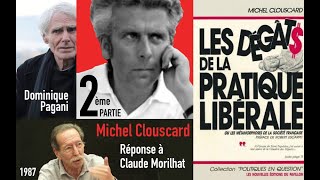
- 3D. Pagani / Réponse de M. Clouscard à C. Morilhat • Seconde Partie10 Sept 2019
Introduction produced automatically from the 3 sessions on this theme, to be reviewed; the numbers link to the sessions.
The 3 videos
 On Michel Clouscard
D. Pagani / M. Clouscard's reply to C. Morilhat • Part Two
10 Sept 2019How does Michel Clouscard's reply to Claude Morilhat illuminate the form of his writing, the relation of image to concept, and the question of the State?
 Season 5.1
#5.1 bis FaceBook Live / Questions
2 Nov 2018What place does transmission hold in the pedagogical movement from the Renaissance to Rousseau, and what are the stakes of the dissolution of the separation of genres?
 At the Tropiques bookshop
The Phenomenology of Spirit
2 Jul 2018Why must we reread today Hegel's Phenomenology of Spirit as a philosophy of the true, opposed to the philosophy of sense?