English translation of the French transcript, made with AI and not yet proofread — click a paragraph to jump to it. Show the French original
Announcements, the Clouscard fund and the image of the evening 0:00 Good evening everyone. Sorry for these few seconds, maybe even a minute, of delay. Actually, I'll tell you the truth. Pierre-Alain and I were dying of hunger. So we tried to eat before the ordeal.
0:40 Right, let me take the opportunity to… I'm going to pay quite a few tributes tonight, since it's going to be about you, your questions, your comments. And I'll start with… this wasn't planned, actually. I'm sorry for him, but I want to pay tribute to Pierre-Alain, because it's been a while since we've seen each other. Right? And that's not because he had cravenly abandoned me, but because he was triumphing in Canada with his exhibition, with our Quebecois friends. And barely back, barely had the plane really landed again on this side of the Atlantic, he offers to do a livestream tonight. And, good news never comes alone, same again next Sunday, where we'll do a Clouscard special… I'm saying this mainly for the benefit of our friend Stavisky, to keep with his pseudonym, who is legitimately impatient, isn't he, for us to make another teaser to speak French, which pushes people, some of them,
1:50 to contribute to the fund which will soon allow us, because the sum is starting to become substantial, to pay for a translator for Michel Clouscard. There you go. It's a translation into English that would allow, I won't repeat it every time, that it would be an enormous leap forward, not only because it makes Clouscard known, I don't know, say, in Nebraska, or in Devonshire in England.
2:27 No, but it's true, I often think of a Chinese student, his first foreign language, and when he has one, it's still English, isn't it? So there, it would considerably widen the reach of a discourse that is more and more coming into its own, if I dare say. So, a thousand thanks to, I know I'm bothering him, Pierre-Alain, for immediately having offered, not offered himself up sick, but that's an expression that's very Clouscard.
3:00 I want to call in sick, because I have pages to write. And for making himself available for me, for you, so for us. There. And I'll come back to it in a moment, because I'm going to quote a comment. There's the answer to questions, and I told you, comment on a comment. There's a comment I'm going to quote, for now I'll just mention it. I'll force myself a bit to read it to you, because it's very flattering to me.
3:40 And I'm vain. I'm not saying I don't like it. I do like it when I read it. But I don't like, you know, trumpeting it in public. Except there will be an even more elaborate tribute for the technical crew, that is, for Pierre-Alain. So, that's to tell you I'm lucky. We're lucky. If you can call it luck, there's some chance involved. That's it. And so, I move on, I told you, so there will be a livestream next Sunday, around Clouscard this time.
4:19 And I'm trying out a new format, if you will, which I'd like to keep going pretty much until the end of the school year, until the end of June roughly, and which consists, not in giving you the floor like tonight, but in leaving it to you until June. That is, I will always start from comments.
4:49 Multiple advantages. First, I like answering comments, especially when they're relevant. I take my time and sometimes I deal with three questions and it's all I can do to fit them into two and a half hours. So, at that rate, it's unfair to all the comments I pass over in silence and which gratify me enormously. So it's quite unfair. Here, we'll always stay within answers to your questions.
5:23 And I repeat, it wasn't a joke when I posted it on Facebook, when I say new and old questions. Because there are some I haven't answered, say, for three years for example, because I was taking my time answering others. There. Not because they seem to me the most interesting, the priority ones, but because I manage my time badly. So, I'm going to start from a few questions.
5:58 There are a few I'll dispatch quickly because they're very short and very specific. Let's start right away. I'm going to ask Pierre-Alain to present us with question number 1, which comes from our friend Sébastien Deville, who still lives at the foot of the Alps, in Grenoble, between the Chartreuse and the Vercors. So, you see, since it's short, he says 'I had a question. What's your view on what's happening in Africa?' Senegal, Burkina Faso, Democratic Republic of Congo, etc.
6:32 Well, I'm all the happier that he's asking me the question because I'm not going to answer it tonight. So, because, good news, well good news for the person asking the question, and I presume he's not the only one, because it's the subject of my talk at the Marxist café on rue de la Butte-aux-Cailles, at the café called the Spoutnik, a periodic meeting organized by comrades from the PRCF.
7:09 It can happen that I have a few small disagreements with the PRCF, but they're comrades, they will never be adversaries. And they had the kindness and generosity to invite me to their summer university in Dourdan, and I won't forget it, it was very gratifying and instructive. And there, they periodically hold a talk in a café that hosts them at the Butte-aux-Cailles, called the Spoutnik, there you go.
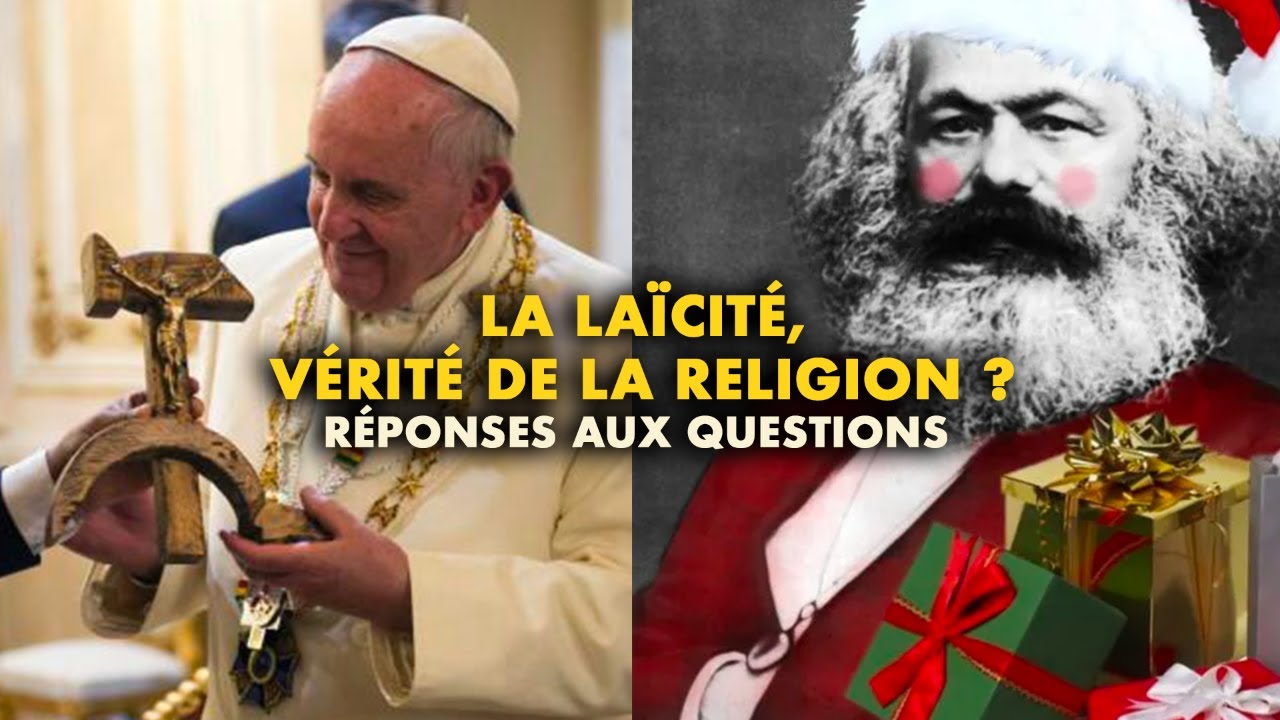
7:42 And here, I'll pay a little tribute, that's how the evening is, since it's been a while since we've seen each other. I often think of our friend Yannick Dutertre, aka Kinaï. First, I apologize for having swiped his logo, right? It's Pierre-Alain who put together tonight's image. But I suggested to him, since we're going to be talking, as you'll see in the next question, about the relationship to religion, against the backdrop of a Marxist song, I thought it fitting that it coincides with a Christian holiday, so to speak.
8:26 Because Christmas, I don't picture in Palestine, well in the Holy Land, I don't picture snow-covered larch trees growing, Santa's skis, and the reindeer pulling his sleigh. And especially the little red-nosed reindeer. Oh, how cute he was, the little red-nosed reindeer, red as a nightlight. Don't you know that song? Well yes, that's because he'd had a little drink, that reindeer.
8:57 So, in Finland, more likely, it seems the origins are Nordic, that's what I mean, Germanic, Nordic, Scandinavian, whatever you like. But anyway, this imagery, which comes in relatively late, comes in to celebrate an eminently Christian holiday, of course, in terms of content. So there, Marx as Santa Claus, right?
9:29 Or the Pope, rather puzzled in front of Evo Morales's gift, right? Comrade, he leads Bolivia, in the glorious lineage of, let's say, of Bolivarianism, if I dare that barbarism, right? Among the regimes most at the forefront in that permanent bloodbath that is Latin America, under the rule of death squads and funding it receives from Uncle Sam.
10:03 so hats off to Evo Morales, who offered this gift, right? of a crucifixion against a background of a hammer forming the cross. And the Pope puzzled, with the sickle in his hands. There. I thank Pierre-Alain again for pulling off this montage. I'm answering here indirectly to our friend, to this man, whom I didn't know, must be someone new.
The fruit is the truth of the flower 10:35 Pierre-Alain will remind me. Controlled opposition. Yes, controlled opposition. He made a very brief comment, he said 'funny title.' I'm glad he says that, because it's a bit meant to challenge that title, it's good that people notice it. But allow me to retort, 'funny pseudonym.' But I like it a lot too, it's not 'controlled opposition,' that's a whole interesting program. So there, I don't know what it's going to be about.
11:10 I'll say it quickly, even though I'll develop it in the course of the next question, is that here, truth, you shouldn't take it, you shouldn't isolate the phrase. It's 'the truth of.' It's an eminently Hegelian expression. The fruit is the truth of the flower. And the flower is the truth of the bud. The bud is the truth of the seed. The truth of all these moments is the plant itself as an organic unity.
11:46 I won't dwell too much on these naturalistic metaphors to illustrate the thought of an author who is anything but a naturalist, right? And who knows that spirit, to speak in Hegelian terms, or praxis, to speak in more Marxian terms, or history if you prefer, since the term praxis isn't very frequent in Marx, begins when nature recedes.
12:17 There's this common thread. So, 'the truth of,' you see, the fruit is the truth of the flower. I start with a representation to help you understand this singular usage. He's right. Our friend, uncontrollable, uncontrolled, sorry, or rather very controlled.
12:47 And he's right to be surprised, this isn't the usual use of truth. Truth is the opposite, the true is the opposite of the false, or of the lie. As I've done tons of lecture series on this, I won't go back over it too much. It's not the same thing. When the true is opposed to the false, in mathematics, for example, the result of an operation or an equation, or of roots, is true or false. On the other hand, when the true is opposed to the lie, that's a different problem.
13:21 Especially when it's the lie as the supreme category of evil in the Gospel. You see, we're still in the religious field. Since, I've often quoted it, I won't dwell on it too much, but I'll recall this Christ-like statement from Holy Thursday, a last conversation of Christ with his disciples before the ordeal, 'The prince of this world is coming, but he is already defeated, for his essence is a lie.'
13:53 But 'the truth of' departs from these acceptations, I don't mean acceptance, from these meanings, or rather from how it's understood in usage. 'The truth of' is at once the fulfillment—and here you understand better—the fruit fulfills what in the flower was marvelous, fragrant, seductive. You see, all the classic metaphors that revolve around the flower, which is always tied to the feminine gender throughout the history of every culture.
14:29 and I say that to give a little kick to the relativists who always think 'Yes, that's true for us, but not for the Bantus.' Anyway. So, look at the first name Yasmina, as it's common in the Muslim world, jasmine and its flower, so fragrant. So the flower is the moment of seduction, but it's meant to lead to the fruit, which is the following moment.
15:06 But the two cannot be simultaneous. The fulfillment is at the same time a suppression. That's what's eminently dialectical about it, and I insist on this, because we're less used to this conception of truth at the cost of a suppression of whatever follows the 'of.' Here, I said, the truth of the religious. There. That's to comment on this title that our friend 'controlled opposition' is quite right to point out.
The three lines set against each other 15:45 so, I'm now going to tell you question number 2, which is precisely the one that opens this reflection on the religious field, from someone who's not new, I'm thinking of Lucas Lederle, who tells me, well, hello, this is a question I'd like your opinion on. I find that on the question of religion, the militant debate is torn between three sterile lines.
16:17 You can feel someone here who has a dialectical mind. There are three lines, so three points of view that will oppose each other, but which end up dismissing all three together. So, yes, I'll specify already, that for pedagogical reasons, I'm going to present things, of course, in a caricatural way. Well, intellectual honesty, he knows it's more nuanced than that in reality, but for reasons of clarity in the transmission, it's good to give priority to clarity and trust the listener for the nuances.
16:54 of what he modestly calls the caricature, but he means sticking to the essential, without all the scoria of the particulars. So, there you go. I'm going to present things, of course, in a caricatural way. So, first line, first position on religion. I hide behind the 1905 law, the law that instituted, right, secularism in our Republic, to avoid getting my hands dirty.
17:32 There. So no one says I'm Arabophobic, right, Islamophobic, no, no, no, I'm only defending secularism, well spotted. Well spotted. There are plenty of hypocrites, sorry, there, you see what I mean. There are also others on the other side, who say they're anti-Zionist, not to say antisemitic, well, that's familiar to you, that's not tonight's subject.
18:04 I'm not talking about what's happening in Gaza, that's more than tonight's subject, it's… It's… Next year I turn 80, I've lived quite a lot after all, I've never seen this horror. At the level of the civilian population, never. That's not tonight's subject, it remains a topical subject for a good while.
18:34 Unfortunately, I hide behind the 1905 law to avoid getting my hands dirty, to avoid admitting that, in fact, it's a somewhat xenophobic weapon. Line 2, typical among certain PS and LFI leaders, yes, sorry, typical among certain PS and LFI leaders, that's line 1. Line 2, less, criticizing religion is oppressive, that's not good, it's, you'd say, politically incorrect today, right?
19:05 Typical among postmodernists, intersectionalists, EELV leaders—it's good that a distinction is made there, right, from those hyper-Atlanticist, aggressive, warmongering politicians who are the leaders of the Green party, whereas among their electorate there are people, maybe, who have illusions, but who are sincerely attached to democratic values quite often. Not always, but a lot of them.
19:36 There's nothing more aggressive than cyclists in the street, curious, isn't it? There are pedestrians who get annoyed, of course, when they see cars, but the most aggressive ones are the cyclists. I won't dwell on it. All that is fairly contingent. If you want, I'll retract it, I'll do it, but anyway, it's statistically true. Line 3, priests, all to the gulag. Well, so, the point of view on religion typical among Lutte Ouvrière or certain Stalinists.
Leftism in the Leninist sense and the Vendée of the chouans 20:10 So, he lumps together the leftists and their mortal enemies the Stalinists, right? And vice versa, for the Stalinists, the mortal enemies are… the leftists, in the Leninist sense, careful—I say that because I'm a bit alarmed. I sometimes get the impression that there's so much more of the left in our country—if it were just in our country, when you look at Europe, Europe, I'm not even talking about the United States where the debate is between two rights, an extreme right against a far right.
20:40 You have to see it to believe it. Well, but here, in particular, more and more, I hear the term 'leftist' used by people who lean, and who are far-right, when they say that, whether they're aware of it or not, for them it's everything that's to the left of them. Obviously, since they're very far right, that includes a lot of people. For them, Macron is a leftist, Biden is a leftist. Yes, you know, there are YouTubers among you, you can see very well who I mean.
21:15 Not in the singular, they're swarming. They're swarming. Getting off track. No, I take it first out of intellectual honesty, to know what we're talking about when we use words. They're not insults, they're concepts once you make them explicit and precise. Leftism, in the Leninist sense, is the union, I'll say it, I'll propose this, in the quasi-mathematical sense I'm giving to this term, of three subsets of the far left, I don't know how to say it, three distinct subsets, though sometimes they overlapped, which are, in chronological order so as not to offend anyone—the oldest are the anarchists, a good part of whom I respect.
21:58 That said, there's nothing more anarchist and anarchic than capitalism, whatever the libertarians who believe they're in opposition to capital may think—listen to the bosses, as soon as they're among themselves at a business dinner, all they do is spit on the state. Come on, enough with the masks. On the other hand, there's an anarchist tradition that has stayed committed to being a companion in the struggles of the working class, for which I have the greatest respect. There, I'm thinking of those who distinguished themselves in the unforgettable Commune, right?
22:33 in particular. In chronological order, there were three species within the leftist genre: the anarchists, the Trotskyists, and, a bit more recently historically, the Maoists. For these three, their worst enemy was the CGT and the PC during May '68. I wanted, if you prefer, to put it that way.
23:05 You see? And, well, let me make a confession, so to speak. At the time, I was a teacher, I hadn't quite finished my studies yet, but I had the nerve to teach philosophy in a private school in the Drôme, where my son was born—I know, I say it every time, I say it every time because he was born in Dieulefit, quite simply. It's a bit flattering, still. And, in that school, which was private, expensive, fee-paying, I got my first taste of it there, I discovered teaching, and I was later invited by the parents to Paris.
23:48 These parents, they were from big families, they were in the entertainment world, business circles. I remember there were some at the big Paris flour mills, for example, you see, this is a time when people talk about farmers, there are farmers, there are farmers. So, they had great wealth, some of them had three children at the same school. That's a fortune. That's a rent in the golden triangle of Paris, that much, every month. So they invited me to their home, they were very kind to me, I had gotten their son through the baccalaureate, who was a desperate case, as is often the case in private schools, the kid was shuffled around, something like that, anyway.
24:22 And then, so, they learned that I was a communist. This was in '68, right in the middle of the events, I don't know. And they said to me, you might be pro-Chinese, at most. But still, but honestly, you see, well yes, it's the era of Godard's film La Chinoise, well yes, that's it, the leftists, in the precise sense, Leninists, that's it, that's it.
24:55 and the gathering of anarchists, Trotskyists, and Maoists. I'll just finish talking about this to say that I have the greatest respect for the hero of the Long March, I'm thinking of Mao Zedong, and the victor over the Japanese. 17 million dead. But yes, these are the two great communist countries with the most deaths. Even if China was not yet entirely communist at that time, still, the fight led by the communists was decisive in crushing the Japanese.
25:34 To drive them out of China. But I distinguish that Mao from the one who, much later, somewhat lost his grip over his party and, to regain control, had the old companions of the Long March gunned down by 14-year-old kids with a Kalashnikov, the Red Guards, you know the rest. Today's China is so far removed from that that I won't dwell on it, fortunately, for the Chinese people.
26:09 And yes, nuance is needed. I'm afraid of becoming inaudible when I make nuances. People only hear the categories they're used to. But when one does as Lucas Hölderlin does, when one sees positions set against each other that seem to oppose one another, to differ, even to be opposed, it's worth taking a little time, as I'm doing, to make sure I'm understood a bit. So there, priests, all to the gulag, typical of Lutte Ouvrière or certain Stalinists.
26:43 And there we have it, which brings us to confess, to use his term, I confess that having grown up and made my first militant steps in Cholet, a bastion of reactionary Catholicism. Cholet, military Vendée, no but I worked in Niort, a bit further south, but I had a friend who was a sub-prefect there, whom I had known as cultural advisor in Côte d'Ivoire, and I ran into him again by chance when I was directing the Carrefour Médias Jeunesse in Niort, my first directorship position actually, and I was happy to see him again and I said to him, so how are things going here?
27:20 He told me, well here they're really royalist rebels, Chouans. Or else they come and throw rabbits against the wall of the prefecture, like that. My boss - he meant the prefect, he himself was sub-prefect - my boss was terrified because they were protesting against the importation of Chinese rabbits.
27:54 And the prefect said to him, personally I think they don't taste so bad, Chinese rabbits. And my friend said, this isn't the moment, Mr. Prefect, this isn't the moment. And when it's the 14th of July, they're so counter-revolutionary that they invent an apple festival or whatever you like, so as not to celebrate the Republic. There you go. All that is provincial French stuff for now.
28:24 All that is respectable in itself. So, our friend Lucas grew up in that, and I understand, I understand, that from time to time he feels like, as they say, bashing priests. So, Cholet, bastion of reactionary Catholicism if ever there was one, I can sometimes give in to that tendency myself. I like his way of expressing himself, and the self-distance it implies.
28:57 It's not a problem to have feelings that aren't the right ones. The whole point is to become aware of them and to take some distance from them. I find my neighbor's wife charming, that doesn't mean, well yes, you see where this is going, but still. I like that shirt in the shop window, I'm not going to break the glass to take it. These three approaches don't seem to me - wait, now, we might get the impression that everything has been said about the point of view on religion, tra-la-la - these three approaches don't seem to me to be materialist,
The aporia is aperitive 29:33 nor dialectical, nor historical, nor rational. Excuse me, I think that's a sigh of relief, because hearing Lucas's words is a bit of a change from what we increasingly hear in this country, which has been deserted by the progressive tradition. So, what are, for you, the main paths considered for getting out of this aporia?
30:03 I should clarify, for those who have just recently gotten interested in philosophy, that aporia means a theoretical dead end. Here, I'm not putting a damper on it - no, a damper means toning down - no, I leave Lucas's words their full force, but a small course correction. I myself wouldn't have said a dead end, because a dead end means it's blocked ahead, you see, ahead - a dead end in the literal sense, a street that's a dead end, there's a wall - whereas aporia is fruitful in philosophy.
30:36 It's true that thought is blocked, it seems blocked, but above all it's a difficulty. Let me give you an example of aporia - the Greeks loved that. It was said to Socrates that it's impossible to set out in search of truth, as the philosopher claims to do. Because where do you start if you don't already know it? Should you go left, right, forward, backward? And if you stumble upon it by chance, how would you recognize it as the truth, since you don't know it?
31:06 Or else, starting from how many hairs is a bald man bald? No, but these are problems the Greeks actually posed, I'm not caricaturing. If ten hairs remain, is that a bald man? If three remain, two - you see, these are undecidable. Starting from how many pebbles do we have a heap? If I put two pebbles side by side, is that a heap of pebbles? None of it is obvious. You see? You find these notions still being discussed today in philosophy and in the hard sciences, dichotomies like the continuous and the discontinuous.
31:42 For example, aporia - but here, I'm going to quote Ricoeur, I don't quote him often, not everything about Ricoeur pleases me, but there are excellent things, in particular, I recommend it to philosophy students, his course on Plato and Aristotle in the Cahiers. Remarkable. About 70 pages. Remarkable. On such a well-worn subject, without dragging it out, that's not bad. So, he makes a pun that I like, I'll bring it back out for you, he says that aporia is aperitive.
32:19 Aperitive. So that's why it's not a dead end. On the contrary, it prompts the philosopher to do what Lucas has just done with his three tendencies, to set them against each other and to bring in - how does he put it - a materialist, dialectical, historical and rational approach, which none of the positions we saw earlier are, taken separately. There. So, I can't help but arrive at this point where I've lost my mouse.
Opium of the people: a force, not a reductive formula 33:01 Let's see, let's see, let's see. You need to use the mail. Oh yes, sorry. So, I'm used to... how do we do this? You're not searching. Oh, no. Oh yes. Do I have it there? It's not obvious. A text by Marx that I had noted in a playlist. So, wait, I'll find it. But I can't manage to exit. Oh yes. Oh yes it's there, it's good. It's good. So, there, there.
33:34 So. The very famous phrase that everyone knows from Marx. Religion is the opium of the people. Right? There. And then, that seems to settle it for a Marxist, tra-la-la. Some people believe they've settled the matter of religion.
34:06 They're Marxists since religion is nothing but the opium of the people. And of course, Marx's opponents are even worse. How can one be so reductive about a millennia-old civilizational phenomenon, concerning so many different cultures, like religion, and dispatch it into a dubious drug? I'll start there. Dubious - have you ever tried to get someone off heroin?
34:36 Because I took that on myself. Among jazz musicians, there were quite a few users, as they said at the time. On horse, as they say, on heroin, or on Helen, depending, well, that's how it starts, I'm always... and I knew William Burroughs, I'm sure some of you, maybe a bit older, know him, part of what's called the Beat Generation, American literature.
35:12 They're something like the accursed novelists, the equivalent, and I had spent time with him in Tangier, back then Tangier was an international city, and there was a Tangier radio station that was excellent, and I accompanied a friend who was a jazz pianist, for a jazz show there, and we spent the evening with him, with Malcolm, etc. And I was young, I was a bit of a groupie, admiring of adults who were great intellectuals, and the day after that evening, I said to Malcolm, how interesting yesterday's discussion was, and he told me, do you know what I was thinking about during the discussion? Whether you'd turn around long enough for me to take your wallet to buy myself a dose.
36:02 He said, that's heroin, kid, try to avoid it, because it absorbs your whole mind, everything. So already, it's not nothing to say religion - that means it has a force, a force. I'm also thinking of alcoholism, I mean alcohol dependence, I'm not talking about the wine that brings us all together on good occasions, a little tipple, no, no. It's a hard drug, alcohol at a high level.
36:32 And the most addictive are the alkaloids, the opium derivatives, heroin, morphine, whatever you want to call them, and alcohol at a high level. So already, that should put us on the track that this expression is poorly received when it comes to belief, that it's reductive. It means, if you want to eliminate religion, you have to replace it with something damn powerful and worthwhile, so that the person concerned is satisfied with it.
37:05 That's the problem - if you're dealing with young drug addicts, etc., what do you give them in exchange, if they stop? Alright, let's continue with Marx's text. You'll see we go from surprise to surprise. For Germany, the critique of religion, yes, let me clarify, this is taken from Marx's first major publication. It's not his very first work, there was already his thesis on Epicurus, on... anyway, or on Greek mythology, but it's Marx's first major theoretical publication, his critique of Hegel's philosophy of right.
37:44 Hegel reigned for a very short time over the university, over German philosophy at that moment. And of course, Marx, who doesn't yet have his own bearings, who is not yet in dialectical materialism, still less in historical materialism, attacks whom rightfully? Good, at that age. He's still a Feuerbachian, a naturalist, almost an ecologist at the time. For Germany, the critique of religion is essentially complete, and the critique of religion is the condition for all critique.
38:18 That means: I come after Feuerbach. Feuerbach got his hands dirty up to the elbows tackling what had decided the fate of societies for centuries - not for the bulk of societies, that is, religious alienation. And I'll go quickly because it's a familiar notion. In truth, our subject isn't that. Our subject is: is it really as reductive as all that, when Marx says religion is the opium of the people?
38:50 Let's follow along. In truth, religion is - watch out here, it's not only the opium of the people, here he expands - it is the self-consciousness. Generally, booze, heroin, weed, are rather meant to drown consciousness. You see? and the self-consciousness and self-feeling of man who either has not yet found himself, or has already lost himself again.
39:22 So there's a tragic dimension there. That's the essential point I want to insist on. One isn't a Marxist if one hasn't been through a season in hell, to speak like Rimbaud. Even if, to conclude like Rimbaud, that has passed, I know, today, how to greet beauty. One isn't a Marxist if one hasn't been through - here, let me linger a bit before continuing this admirable text, which is not yet Marxist, or Marxian if you prefer, whichever you like, it's all the same to me, you know I'm not a structuralist, about signifiers, whatever you want.
Modernity hates modernity; philosophy is born of crises 40:03 I'm not going to speak in your place. But what interests me is how much we're steeped here in modernity, in what I usually refer to with you. You know, the one that follows the English industrial revolution and the French political revolution, both of which occurred in the eighteenth century, toward the end of the eighteenth century, with industrialization, urbanization, the world we live in.
40:38 Yes, this modernity expresses itself in the economic field through the notion of capitalism, in the cultural field through the notion of romanticism - yet the Romantics don't like capitalism. Yes, yes, but these aren't contradictions, they're oppositions. As I often repeat, what's typical of modernity is to hate modernity. You'll come to see it.
41:08 I've devoted whole cycles to that, which I won't dwell on too much, and anyway, you know well that I'll come back to it. I haven't yet said the essential point governing Marx's text here regarding the misfortune one must go through, the crisis one must pass through. Look at that, it's like philosophy, no philosophy. When philosophy appears, or when it crosses decisive moments in its history, its most important advances, it's always by virtue of a crisis - the crisis of the Greek city, the emergence of the Socratic question, the crisis of the Middle Ages, you have it all, the humanist reflection of the Renaissance, an incredible ferment, an intellectual ferment of ideas that would give rise to the Renaissance in southern Europe and the Reformation in the north.
42:03 These are crises, you know, and then, the crisis of the monarchy, of feudalism under the monarchy or of feudal monarchy, whichever you prefer, the Age of Enlightenment. Philosophy arises against a backdrop of crisis, that too is worth recalling. You see, I'm making a parenthesis within the parenthesis, but it's a bit the approach I'd like to follow until June - to start from you, from your questions, your comments, and to see and review things we've often looked at together, in a more concrete way, and often through your own expression and your manner of posing problems.
42:46 So that it's really what I often call a chat, because people tell me, 'you're talking alone, how can you call this a chat?' Well, that's what we're doing, it's not each cause on its own. Here, with you and thanks to Lucas's contribution, because I'm listening to him. So, for now, let's have everyone listen to Marx, and I'd like to clarify the most important thing, which is that before this modernity, before the Age of Enlightenment which did so much to prepare the work of a Feuerbach and then a Marx - Feuerbach, stream of fire - that is, which did so much to deal decisive blows to what religious consciousness represented in the traditional societies of the Old Regime, of the Old World, quite simply.
When the answer preceded the questions 43:44 What characterizes that world, the Old World, is that the answer preceded the questions. Agreed? Look, the apex of so-called classical philosophy, the one that follows Descartes upward - Descartes, Spinoza, Leibniz, Malebranche - the apex of Western metaphysics, practically, there's fairly broad agreement on this since afterward it leads to Kant, from whom metaphysics starts to falter - what characterizes those thoughts is that they're steeped in God.
44:27 And yet, these are vigorous thinkers, even a Spinoza who has the audacity, to the point of saying, watch out, when I say God, it's not the God one hears talked about in the street, namely, God must not be the refuge, I quote Spinoza, the refuge of ignorance. Whereas here, after the Age of Enlightenment and the French Revolution, all of a sudden - you see why I'm talking about secularism, we mentioned it earlier - all of a sudden, for the first time, man faces his destiny without transcendent recourse, transcendent or immanent, because animist religions are the most widespread and the oldest, well before Christianity, Islam and Judaism - sorry, chronologically, Judaism, Christianity and Islam - well before these three religions, all three of which appeared in that tiny pocket handkerchief of land that is the desert.
45:26 But the place was none other than the desert. You have to have lived in the desert to see that salvation won't come from nature, in the desert. It's not Tahiti, it's not enough to grab a coconut, drink the juice and eat there. Our own coconut, when we're in that void that is the desert, is a marvel - I'm not asking for aesthetic appreciation here - but you tell yourself either there is no God, it's an abandoned world, or if there is one, he is beyond.
46:10 You see where transcendence comes from and why it appeared in desert lands. As long as nature gives us the illusion that there are gods more or less everywhere, divinities, in springs, in fruits, in plants, in trees. But there, the first great crisis, the disappearance of animism, which had given a soul, anima, to every thing. No, no - what follows may be even more radical since it forbids the representation of living beings, as you know.
46:40 Hence the arabesque. Long before people talked about abstract painting, the arabesque. It's an admirable script, this magnificent graphic form. The answers preceded the questions, for the first time, late 18th century, 18th century, you understand why I speak of crisis. It's no accident that the century that pursued happiness, the 18th century, was followed by the mal du siècle, the sickness of the century.
47:10 And which was to reach a paroxysm of crisis, with cases like Baudelaire, Rimbaud - I was thinking of A Season in Hell earlier - without even going as far as the even more modern anxieties, I don't know, Kafka, Joyce, at times. And when I say that one isn't a Marxist if one isn't modern, one isn't modern if one doesn't own up to one's modernity, that is, if one hates modernity, which is typical of the modern, I repeat.
47:57 I only listen to music from before the French Revolution, baroque music. I will never say a word against the baroque repertoire, when one can do no better than Bach. If there's a consensus among musicians, one before whom we are all mere grandchildren, as Schumann said, I'm not talking about the baroque repertoire itself, I'm talking about the way this repertoire resurfaces today, and above all the discourse that sustains this resurgence, if I may put it that way, linguistically.
48:31 First, the return of this repertoire, and that's good, I'm in favor of it, because we passed over in silence the good church-organ writers, Clérambault, Vivaldi, Albinoni, yes, a lot of Italians, but also Telemann, but of course, all this culminates in the immense work of Johann Sebastian. Fortunately we recovered this repertoire around the end of the 18th century, Hegel praises the St Matthew Passion in his Aesthetics, that would have been unthinkable with Kant, for example.
49:09 And yet Kant is still alive when Hegel is young. These things move fast, modernity. And it's not the repertoire that I'm discrediting, but the anti-romantic discourse, the bombastic romantic interpretations—that's how the early-music people talk, you have to play it the way it was played at the time. But no, look at Bach's texts, his pleas, his petitions to those who employed him, the Protestant consistories that employed him and for whom he had to write a cantata every Sunday.
49:43 He complained about the orchestras he had. He was not at all satisfied with the performances of his time. He had very meager budgets, didn't he? He had to teach the choir students to wash themselves, to be clean, to blow their noses, it was complicated. So, no, it's this discourse that pits baroque against romantic that I'm objecting to, when the latter is the fulfillment of the former.
50:14 Yes indeed, yes indeed. Look at Chopin, you can't get more romantic than Chopin in the popular imagination, he's the romantic composer par excellence, the most emblematic, if I were to speak like journalists. Well, Chopin, when asked which musicians he preferred, said Bach and Mozart. He's a modern who prefers the old regime. You see? Quite contemporary, really. So, this crisis, we have to embrace modernity, we still haven't done so, less than ever, the crisis that is undergone not by the world, not by humanity.
Defeat of Atlanticism and a second wave of independence 50:55 You shouldn't always believe that what's happening to you is exemplary of humanity. Right? What's his name? Todd. I thank our friend Estavisky here, whom you know well, and who was kind enough to send me this book, which I won't introduce to you since it's being presented everywhere. It's striking, it comes at just the right moment. But you know it's not a concept of mine, the West. I say it's the defeat of Atlanticism.
51:26 Because the West, ever since we've known the Earth is round, is wherever you want it to be. I can plant a flag anywhere and call it the West, any spot on Earth. It will always hold true. In Poland, I'll be west of Russia and east of Germany. There you go. That said, I say I'm anti-Atlanticist. Atlanticism isn't the same as the West. The West, the Atlantic, is better situated. But it's interesting, isn't it. I don't believe it's a coincidence that it's called the North Atlantic Treaty Organization, in French OTAN, that its location is in the fleet, you see, between the United States, Ireland and England.
52:05 It's curious all the same. Offshore. And yes, these are Viking cultures, all that. That's exactly what I'm telling you. When I say offshore, I know what I mean. They don't like the continent, centralized states, they like to do as they please a bit out at sea, not without taxes exactly, but out of sight, out of reach.
52:36 And yes, the Panama Papers, you've heard of them? That's offshore, all of it. It's often on islands, haven't you noticed. 88% of daily stock exchanges at Wall Street, at the New York Stock Exchange, are done not with Japan at all, not with Europe either, not with Germany, no, with the Cayman Islands. Look it up. So you see where we stand, this modernity, when it doesn't own up to itself—and right now Atlanticism is in crisis, but boy, it's moving fast.
53:21 Now, I'm not interrupting myself, quite the opposite, I'm just pausing while Pierre-Alain presents the question to us—represents it, sorry—question number 1 that I started with, from Sébastien Deville, right? Remember, where he asks me—it's easy to remember—well, what do you think about everything that's happening south of the Sahara, if I remember correctly, where's my newspaper?
53:52 I have it everywhere, it... There, this quarter, sorry. Yes, there, thank you Pierre-Alain. I had a question: what's your view on what's happening in Africa, Senegal, Burkina Faso, yes, the defeat of the West—the defeat, we think of Ukraine, but have you seen the speed at which it's happening? Avdiivka, the impregnable, since yesterday, it's over, since yesterday, but it's terrible, and no sooner is it over than the Russian forces are deploying toward Robotyne, Robotyne, and Kupiansk, up north.
54:32 Despite the sanctions, despite—I've already told you I wouldn't vote for Putin, but, mind you, yes, if I were a Russian citizen, if I lived in Russia, and if Russia weren't surrounded by nuclear missiles up to its throat, as if to punish it for having crushed Nazism. Because you won't get rid of the idea that Stalingrad was never digested. When you don't digest Stalingrad, you get another Stalingrad handed to you.
55:06 There, I'm not demonstrating this, I'm just stating it outright. And current events are there to illustrate my point. So, Ukraine, Gaza, listen, I see a headline here, it's Hamas that has already won the war. That's not my view, I'm not talking about the unbearable things happening to civilians who are neither Hamas nor the IDF. It's unbearable, what we're seeing.
55:37 What we're seeing is nothing compared to what's happening on the ground. And in Ukraine, same thing. Thankfully we're no longer in the era of voyeurs, except—what's it called—dark media, dark television, I don't know, the dark net. There are those who take pleasure in showing Ukrainians stumbling over corpses, right, over their comrades, their brothers in arms on the battlefields. My goodness, that hurts all over!
56:13 Yemen, have you heard about Yemen? Oh yes, they're thugs, the Houthis, they're the ones blocking trade, blocking the Red Sea. Sorry? Listen, just a few months ago they were calling it the greatest humanitarian catastrophe of the present time. Remember? If you've forgotten, I'm sure you'll remember now. Yemen, they showed—since Auschwitz we hadn't seen people so emaciated. Right?
56:43 And we're waging war on them, crushing them under English and American bombs. Ah, because we have to police it, free movement, of goods and property. But why am I bringing this up? Because, I mean, it was unthinkable. But sorry? Netanyahu's government being taken to court before the International Court by South Africa. Listen, things move fast. You'd have told me all this six months ago—
57:14 Listen, it's not April Fools' Day, I know I'm a bit naive. You see, we don't realize how fast this is moving. And there, the question touches on—and I'm getting to it—the same debate. It's a very simple thing in what's called Sahelian Africa. As I was discussing with him on March 16th, I'll be careful not to go into detail and spoil the subject. That's why I said, half-joking, half-serious, to Sébastien, that it's not today that I'll give him an exhaustive answer, if that's even possible.
57:45 But in any case, at least a developed one. But I do want to point out that here too, things are moving very fast. And I'm fortunate to have access to unexpected and rare documentation thanks to my former students from Niger. Oh yes, oh yes, oh yes. They formed an alumni association of the music school that I had the honor of directing, thanks to you.
58:15 It was the European Union that funded it. Like the European Union, whose budget is funded by you, by the taxes of Europeans. I've never earned so much money, thank you. And in the poorest countries, the most recent being Niger, where I lived for a few years, well, precisely, my former Nigerien students had the joy of discovering I was still alive. They're very loyal. They made me honorary president.
58:45 And thanks to some extraordinary documentation, demonstrations taking place in the streets. Macron, get out. It's incredible how fast things are moving. Take Niger, the poorest of the three. That's saying something, because they can really take the prize. In the multinational chancelleries they're called LDCs—the European Union, the World Bank, the International Monetary Fund. LDCs, the least developed countries.
59:16 And the developing countries which include the bottom tier. LDCs, the bottom tier, in terms of income per capita. Now, for over half a century, the bulk of our electricity has been drawn from uranium extracted in Niger. A bit less now, it's become somewhat more diversified in very recent years, but still, I mean, the bulk of the energy we've had for half a century came from there.
59:47 And well, as I speak to you, more than 85% of Nigeriens don't have electricity at home. Go figure. You'd think this could go on forever, under cover of what's called, no doubt by antiphrasis, development aid. Have you ever seen one country help another become its competitor? Tell me where. I've never seen it. There are countries that have gone from underdevelopment to the top of economic power.
1:00:19 I'm thinking of Japan, at the end of the 19th century, in what historians call the Meiji era. But there, it came from Japan itself, from the Emperor. It never came from the World Bank, the IMF, or English, French, or German cooperation. It happened in full sovereignty. And now I feel like I'm witnessing a second wave of independence. I lived through the first, as a kid.
1:00:49 I was a kid. It was my proto-adolescence. I was 14, I was in the courthouse of Abidjan. I'd been told, don't miss this opportunity. And I see all the future elites of the country gathered there. And I see President Houphouët-Boigny, the one who initiated Côte d'Ivoire's independence, the first president, right? Who later became the darling of the West—to speak, as I don't usually speak, of the Atlanticists—because he was the main bulwark against Soviet penetration into Africa, especially French-speaking Africa.
1:01:27 So, watch out, this is someone who was affiliated with the communists at the end of the war in the French National Assembly. But, fortunately for the enemies of communism, he was de-affiliated on the initiative of a then-unknown figure named François Mitterrand. Curious, isn't it? You see? You learn things when you work on this region. So, check all this. It's too important to just listen to me talk without verification.
1:01:57 But all this is very well documented if you dig a little. Here, I recommend a historian who isn't much talked about, on this region, who has been dead for a long time—Suret-Canale. S-U-R-E-T, hyphen, canale with an E. And I recommend, in cinema, the extraordinary films of Vautier. But I'll come back to that when I do something special on... one of the rare filmmakers who invested so much—to the point of being blacklisted, practically never shown—in colonial exploitation.
1:02:38 There. So, that's not my subject today. I won't develop it. I'm not going to define what the Sahel is. But I'll say, to conclude, that it's one illustration of the collapse that Todd, with a somewhat different vocabulary from mine, but we're talking about the same events—that's what matters, as long as it designates the same sets, the same realities, right—but there, who would have thought, it's precisely where things were moving the least.
1:03:09 It was moving the least. The impression that... You're laughing, well, Pagani, but they've been independent for a long time, it's more complicated than that. Sorry? Listen, I was in Côte d'Ivoire before independence, during, and after. I'll tell you the difference. I'll say something measurable, we're not dealing in opinions. There's only science of the measurable. Before independence, there were typically 5,000 French people. Twenty years after independence, there were 50,000. I mean, 5,000 expatriates.
1:03:39 A free-for-all, French, Japanese, Germans. It's a good deal, this independence. So, we're witnessing a second, there. There's so much to say. My dear Sébastien, I really appreciate Sébastien, I recommend his posts. He posted, I think it was today or yesterday, one of the most beautiful excerpts from one of the most beautiful poems of modern times, Aragon's Le fou d'Elsa. I recommend that post if you go to his page. There.
1:04:09 So, thank you for the question, Sébastien. We'll meet again on March 16th. It will be filmed thanks to our friend, comrade, Yannick, aka Kinaï. I don't know. There. From there, I'll go back to the questions. You want Marx's text? Yes, yes, exactly. Put it up full screen.
A world turned upside down and a de-divinized world 1:04:40 I have it here, I have it right here. Because, well, that's why I needed it earlier. So, well then. We're all the way to the right. Sorry? All the way to the right. But that's it, yes, that's right. Yes, I'll pick up from the second paragraph, if I may say so, at 'in truth,' you see, 'in truth,' it's on the fourth line.
1:05:12 'Religion is the self-consciousness and self-feeling of man who has either not yet found himself'—so, who hasn't yet achieved this modernity that emerges at the end of the 18th, beginning of the 19th century, the industrial revolution, the shift from countryside to city, and then there's no longer God to explain everything that happens. God means eternal life and all that, and that's a lot to lose. Well. But 'man'—this isn't the rights of man, you know, the abstraction—worse, Marx attacked this very expression, the rights of man and of the citizen, as if the two—as if you could distinguish them—you know, a human society, sorry, a human individual who is not a member of a collectivity, of a society, who is not a citizen or a subject, or whatever, of some collectivity.
1:06:09 That's how we now speak of struggles, of social and ecological development. So, what does that mean? Pollution—we don't suffer from it in the same way depending on whether you're powerful or wretched, as Molière would say. So, man is not an abstract being, curled up, cut off from the world, it's not a generality, it's not the universal in the pejorative sense, because I myself defend the universal against a certain postmodernity.
1:06:44 When it's concrete—but here it's the abstract universal. The one you ask, what is this, Mozart, he answers, he's Austrian—which isn't crazy exactly. I mean, you don't know much about Mozart yet, because Hitler was Austrian too. 'This state, this society'—you see, there's a demonstrative there, 'that one,' in the singular—'produce religion, an inverted consciousness of the world, because they are themselves an inverted world.'
1:07:14 Can you imagine the audacity. And yet he's still young, Marx, still far from having formulated the theory of surplus value and the tendency of the rate of profit to fall. Marx's greatest breakthroughs—no, he's still far from those. But still, to dare say, right, 'this state, this society, produce religion.' Generally, for millennia, when there's a divine principle, it's that which produces everything else, right, which is the genesis, as they say, of everything else.
1:07:48 So there, 'religion is the general theory of this world, its encyclopedic compendium, its logic in popular form'—these formulas are admirable, so fitting—'its logic,' you might think that's reductive, but no, all this is a whole, it embraces everything, meaning religion is no small thing, at least under Marx's pen—'its spiritualist point d'honneur, its enthusiasm, its moral sanction, its solemn complement'—it's almost, my goodness, I'll say it's almost Wagner, which is sacrilege, because Marx hated Germanic tin-pot bombast à la Wagner—though I'll say there is an art of ceremony in Wagner, right, in Baudelaire, in Mallarmé, which echoes what Marx says here, right, it's admirable, the formula, 'its ceremonial complement, its universal source of consolation and justification'—if you need consolation, it's because there's misfortune, I come back to this, I hammer this home.
1:08:58 if you can't get past this misfortune, this absolute misfortune, the cross—it's not the omega sign, where there's a little opening, still, that gives a bit of hope, that gets through—the cross, that's it, and that's going to be the symbol of the modern world from the end of antiquity onward, the crucifixion, an individual writhing in pain on a cross—I'm not saying that's the truth, but you have to pass through this truth. But now you're starting to understand tonight's title. It's the example I often use: to say that if there are nymphs in this spring, that's staying at the religious level—why not, it makes for beautiful poems, and you never know, you shouldn't attack the spring too much, because the nymphs might take revenge—but from the moment you decide that the water flowing from this spring is H2O, and that's the age of Galileo, Descartes, and we come back to what prepares modernity, the 17th-century scientific revolution, the industrial revolution.
1:10:09 mid-18th century, the political revolution, end of the 18th, the French one—but you know, this is all being prepared, from the moment you say—Descartes doesn't say H2O, but still for him it's good that there are no nymphs in springs—and there's a key term there in Descartes, a mechanism, you have to embrace that, meaning a de-divinized world. Oh my, I'm in the process of saying that Christianity, Christian civilization, has as its originality among other religions, in common with the two other religions of transcendence and monotheism, the de-divinization of the world around us—I didn't say reducing it, never has landscape been so glorified, right, I'm not talking about nature, landscape, as from the Romantic era onward—never has the countryside been so alluring as from the moment it begins to disappear.
1:11:16 Look, this isn't me—it's Madame de Staël's most famous phrase, 'light comes to us from the North'—she wasn't always the sharpest, but she came up with this felicitous formula, because it's true that Romanticism first explodes in the Northern countries, you have to wait a generation for it to come to France. In France, officially, in the textbooks—it doesn't happen, as I often say, on December 31st at midnight—but well, they say the first properly Romantic publication is Lamartine's Poetic Meditations in 1821. By that time, all the German Romantics were already dead, mad, or had committed suicide, already, already.
1:11:51 The greatest are from the late 18th, early 19th century—Hölderlin, Novalis, Kleist, Büchner, dead at 23, the extraordinary author of Lenz, Woyzeck, and Danton's Death. One of the rare German Romantics who wasn't counter-revolutionary. What's going on? There's a crisis. A crisis. I say mad, suicidal. As for Nerval, it's both.
1:12:23 The mal du siècle. Yes, there. So, it's not reductive, as they say, 'it's the opium of the people.' It's that for all of this to be livable, there are two ways to survive this misfortune, this crisis, when you suddenly realize. How does Pascal put it? 'The eternal silence of these infinite spaces terrifies me.' That's one of the first sentences of modernity making its way. Because he's a great scientist, Pascal. He knows very well that there isn't...
1:12:53 Isn't it… that this is not the world of Aristotle, of Ptolemy, with the domes that are concentric, with the Earth in the middle and me in the middle of the Earth, no. What is man, nature—I quote Pascal—a whole in relation to nothingness, a nothingness in relation to the whole, a middle between nothing and everything, to produce the vertigo, between nothing and everything. This crisis was needed to build the world we live in, and modernity, that is, to deconstruct the old one.
Reading of Mallarmé's L'Action restreinte 1:13:30 And it's not over. We haven't finished all at once with this story. And there, I'd like to move on to… I don't know if I posted it, the text by Philippe Moreau. I think that… sorry, I'm going here, don't worry. There we go. Where is my… What was this text?
1:14:01 On my… I can put it for you… Do you have it? Yes. Ah yes, we just need to put it on screen. There's the little quote from Philippe Moreau, you notice, it starts like this, no? Yes. There. And then afterwards, I put in a bit of context. If you go back on Stringer, you'll… Ah, it's true I wasn't, I was telling myself yes, okay. Sorry. So, there. So, yes, you see, I was saying what vertigo, and we haven't quite come out of it yet.
1:14:35 How could we possibly get out of such an upheaval? On a historical scale, all this is quite recent after all. Look at Egypt, that's pharaohs, that's 3000 years, at least 3000 years, I'm not even counting the Ptolemaic period, you see? Here, it's not even three centuries. Barely, really. Now, why do I suddenly bring in the question of our young old acquaintance, isn't that so, Philippe Moreau, without whom we wouldn't have had its beginnings, not only in technical terms, with his contributions of content, and Philippe, with whom I often have discussions, precisely, not about modernity in general, but about one of its aspects, which is the scientific world.
1:15:36 That's not quite the topic tonight, but where he quotes this text, one of the most beautiful texts by Mallarmé, a prose text called 'Variations on a Subject.' You find the same texts under another title by Mallarmé in 'Divagations,' in the plural, and where Mallarmé says this—he's addressing a young man who had written to him, a young man in crisis—'You notice, one does not write luminously on a dark field.'
1:16:12 It's true, we write black on white. 'You notice, one does not write luminously on a dark field.' The alphabet of the stars alone thus indicates itself, sketched out or interrupted. Man, be it understood, on the contrary, for his part, pursues black on white. But it's not merely formalism, there's something at stake with that blackness.
1:16:44 You see? It's an extract from a part of Variations on a Subject, from a subsection called 'Restricted Action.' I'll tell you a bit about the context anyway because I'm drawing all this from your comments. What luck, I don't know, to have such an attentive and relevant audience. In this text, Restricted Action, Mallarmé—he's known as hermetic, that's the accepted term.
1:17:19 It's not easy, quite difficult sometimes. At times you have to translate it into French, translate the French into French. So I'm telling you anyway, so there isn't too much obscurity—there will remain some, but that's precisely what we're talking about—that there is blackness in expression anyway, darkness. I'll give you roughly the gist of this section called Restricted Action. A young man had written to him, as often a tormented young man does: what should I do, what use is literature, poetry, what must be done?
1:17:51 I want to… I would like to commit myself to some action, hence the title Restricted Action. Mallarmé is going to restrict his taste for action. I would like to devote myself to a cause. Well, so, Mallarmé begins by telling him that… So I think I put it afterward, still further, I think, stop, still not, indeed, still further along.
1:18:21 No, no, it's fine, let's go back to the beginning, excuse me, let's go back to the beginning, you notice, there. So I'll go fast because I'm not doing an academic textual commentary. Mallarmé ends up saying: if you want to act, action par excellence—and it's unexpected—write, write, my boy, write. You see, look. To write, a dash, a blank space—this blank is a black background here, isn't it—and on the next line, the inkwell, crystal.
1:18:56 It's not silly—you wouldn't know this, because nowadays everything is keyboard, streaming, but at the time, writing was tied to ink, and ink to the inkwell, and the inkwell often had a beveled shape, a shape, I don't know, hexagonal, etc. And so the comparison, when one has known that era, is obvious—the crystal inkwell—but crystal is made to swallow up and refract, and make light that enters it radiate, and give it back to us a hundredfold; inside the inkwell, on the contrary, it's darkness, the ink—what is darker than ink—the crystal inkwell, like a conscience, with its drop at the bottom of darkness, relative to the fact that something should be. Then he still addresses the young man: push away the lamp, perhaps you will have written one line, two lines, three lines, that's done, the rest will be for tomorrow, push away the lamp.
1:19:58 I think of Clouscard, whom I never saw go a single day without filling at least one page, with his schoolboy's handwriting in schoolboy notebooks. And that's where he continues with the passage that Philippe Moreau quotes very aptly: 'You noticed, one does not write luminously on a dark field, the alphabet of the stars alone thus indicates itself, sketched out or interrupted, light against a background of darkness, man pursues, black on white.'
1:20:30 And there he justifies why there must be darkness, the fold of dark lace. These are the interlacings, the arabesques—you don't know this either, on the computer, it's the same look for all the letters, I don't know. You can put them in italics from time to time, but a manuscript, you see, there were tails, fly-legs, the fold of dark lace that holds back the infinite woven by a thousand, each according to their thread or extension, unknown to the sign that the lettered reader may grasp, no matter, whether or not it's all clear, whether or not it's all unhappy—but you see, the central metaphor is clear, as dark as it is, that the lettered reader grasp this tenuous secret—secret, that's what's inside, that's the darkness, you see, that's what's not put in full light—let it not break it, despite distant interlacings that fold themselves into a luxury for inventorying it, sedge, knot, foliage—it's a metaphor for handwriting on paper, isn't it, cursive, handwritten writing, we say cursive when it's by hand, like that, at the whim of the pen.
Mystery must be expressed: Hegel, Schiller and the share of darkness 1:21:40 So, sedge, knot, foliage, and to present it overprinted to others as an invitation to take interest in it, with—he keeps coming back to it—a trace of mystery, at the outset, indispensable, yes, he justifies it, which remains expressed somewhat—that's the dialectic—how can the mystery, that is, what's inside, what we don't see, what's hidden, what's in the box, what's inside, in my chest, in my brain, but which I don't disclose—how can the secret, the mystery, be, ex—that's the outside—be expressed, however slightly, but unfortunately, this is precise, Hegel says that the idea is not the idea if it does not externalize itself, and he's taken for an idealist, that God is not God if he does not create the world; without the world he would be—these are the last lines of the Phenomenology—without the world he would be solitude, without life, I quote, it's almost sacrilegious.
1:22:50 speaking of God, he would be—except that, and this I'm adding—except that, to tell you the rest, and these are the last lines, and they are not Hegel's, he gives way to the poet—this incredible work, this odyssey of thought that the Phenomenology of Spirit is, ends with a quotation from Schiller: 'Aus dem Kelche dieses Geisterreiches, sois'—he would be solitude, without life, if he were alone, if there were no creation, no creatures, you, me—this I add so you understand, but Schiller says: without which he would be solitude, without life, but from the chalice of spirits, of spirits in the plural, of other subjects, foams up to him his own infinity.
1:23:44 There, and so, very rightly, I go back to the very beginning of the quotation, if you would go back, because there are a few of Philippe's words that interest me, precisely about language. There. After having quoted Mallarmé, and having given the source, Restricted Action, 1897, we're at the end of this century that never finishes ending—it will take the carnage of 1914, it will take the start of the century of evil, that of world wars and death camps, for us to suddenly pass from the 19th century to us, from the sickness of the century to the century of sickness.
1:24:31 There's the essential mystery of humanity. And this is Philippe Moreau continuing on. Language put back in its true place? No. Well, since he's asking me the question, I say yes and no. We have a very fruitful dialogue with Philippe on this level. Because he justifies, here, he's not saying there's an essential mystery we'll never decipher—that's given to quantum theory, that's not Mallarmé. No, Mallarmé says.
1:25:01 That it is necessary that there be this share of mystery, perhaps because I don't want to know, it's not that I can't. Ah, when it comes to knowing that there are satellites around Saturn, there's nothing that will stop me from knowing it, except on a purely technical level—but that's where we make the most progress, we end up knowing. That's the easiest part. It's not necessary to know how many satellites there are around Saturn now. On the other hand, when this knowledge relates not so much to objects but to the subject—to you, to her, to him, to me, that's everything.
1:25:35 I don't want people to say just anything about me. There, we're concerned. And so we hold back. And there it is, the share of darkness. These are not the darknesses of substance, of nature inherent in matter. These are darknesses that are found in a subject nowhere else. After all, I'm not criticizing it, after all, the subject has a right, as they say on the internet, to their pseudonym. There you go. So I'll finish, sorry, I'm making you juggle, there, with the top and bottom of the text.
"There is no present": language, the high and the low 1:26:08 Pierre-Alain, I'm going to conclude with the end. Because I told you about this young man who had written to him, and I could have stopped at the problem of language—it's not very philosophical—but I can't not quote the incredible—I was going to say kindness of Mallarmé, it's a theme he wouldn't have liked, but still, you see, when he says, right after this, you see, just after, the ellipsis, in parentheses, 'suicide or abstention'—doing nothing—implying that the young man had told him he had suicidal urges, as was so frequent, that century's sickness of the century.
1:26:46 Why? Why not kill oneself? Once only in the world. You have to tell a young man this, isn't it? Once only in the world, reminder. Because, owing to an event I will always explain, one can find an explanation for everything, but let's go straight to the essential. 'There is no Present.' And the P is capitalized. One must give up believing that one will get the definitive illumination, isn't it, that ends the quest, the Grail, there, that's it, I can stop.
1:27:22 'There is no Present.' A present does not exist, for lack of—look carefully—the Crowd declaring itself. Good grief, that's because everyone clings to their own mystery. And so, in the language we exchange, we exchange clarity. Here, pass me the salt, you see, that's precise. And at the same time, there are darknesses in our ways of speaking.
1:27:54 I always use the same examples because there are newcomers—for their sake, pedagogically, it needs to stay clear. But when I say 'the day holds,' 'the day rises'—that is, the most elementary phrases, the most basic ones that we say a thousand times a day. 'The sun sets.' We're in poetry, we're not in astronomy. How could the sun possibly set? Where are its sheets? Where is its bed? Besides, it's not the sun that moves, it's us! We know it, we forget it, language traps us.
1:28:25 You see? The day rises. It's fortunate when it rises. Better an erection than a castration, as they'd say in psychoanalysis. Well yes, it's better to go upward than downward. Sorry, I sound a bit crude, but what do you want? Languages revolve around this all the time. It's not me! Look at the French language, but other languages are the same. We say his highness. Alto, that's up high.
1:28:56 An alto voice is a woman's voice. There's higher, there's soprano. But alto is more than tenor, which is the highest voice among men along with countertenor. Yes, yes. Altitude. Altimeter. 'Guardai in alto e vidi le sue spalle vestite già de' raggi del pianeta che mena dritto altrui per ogne calle.' I was looking up, this is in Dante. He speaks of a hill and I saw its shoulders already clothed with the rays of the planet that leads every man straight along every path—the sun.
1:29:33 On the other hand, the opposite—the low—is always connoted pejoratively. He dragged me through the mud. Mud is what's under our feet, and I'm not inventing this, I'm not interpreting. You say it, I say it, everyone talks like this. He dragged me through the slush, he rolled me in the mire, he wallows in the mire. Isn't it so? That girl is a tramp—dragged along by the hair, from below. No, but listen, everything downward, it's not me.
1:30:05 We're not at all conscious of it, but language, language, that's what's common to us. I'm not talking about my own speech with my accents, my intonations, my types of speech, yours, his. I'm talking about the language, what is common, the code that's common to us, forces us into a distribution of values we're not always aware of. We'll hold the high ground of the pavement. Please, madam, because at the time, you know, there were open sewers.
1:30:35 When the unnamable circulated through all the streets in the middle, so when there was an elegant lady with a pretty dress, out of courtesy in the so-called land of gallantry, they left her the high ground of the pavement, which was a bit cleaner. So, literally as much as figuratively, you see, these notions distribute themselves once and for all in the world, because owing to an event I will always explain, there is no Present.
1:31:08 I go back to this admirable passage. No, a present did not exist. For lack of—the Crowd declaring itself, so I made this long parenthesis about high and low, isn't it? Because the Crowd doesn't say everything I just told you, but it uses it. It does better than express it, without noticing that it says it. Lack, lack, and then, lack of everything. You see, he doesn't reassure the young man cheaply.
1:31:38 Lack of everything. Ill-informed, and now I come to the present time, today, where we believe we've made it, we're postmodern—the fools, who are postmodern when they haven't even managed to be modern yet. They can't manage to assume their modernity and they're postmodern. Well, look, look how we get there. Ill-informed, whoever would believe himself his own contemporary, who would cry out—sorry, who would proclaim himself his own contemporary.
1:32:11 Me, I live in the present, I'm not some intellectual, some dreamer. His own contemporary, deserting, usurping, with equal impudence—look carefully—when, from the past ceased, and when a future is delayed, you see, the in-between. But yes, but yes, thank you, I hear well-informed Marxists to whom this comes to their lips, the quote from Gramsci, isn't it? Between a world that is slow to come and a world that is slow to disappear, there's an in-between and it's in this in-between that monsters arise.
1:32:50 There's a lot happening right now, what speed of monsters. You see, that's why—I go back to this passage, I didn't want to skip over it, even if it took us a bit away from the problem of language, very well posed by Philippe, isn't it, with a very good choice of extract—but you see, a present does not exist, for lack of—the Crowd declaring itself—lack, a dash, of everything, so many things are missing, one would have to list them, lack of money, lack of health, lack of the Crowd declaring itself, lack of everything, also, watch out, he tells the young, keep watch and be there, ill-informed, whoever would cry out being his own contemporary, deserting, usurping—now I won't stop—with equal impudence, when the past has ceased and a future is delayed, or when the two mix together confusingly in order to mask the gap.
1:33:51 And we say he's an incomprehensible author—how clear it becomes when you dig a little, isn't it? And how it illuminates our present! Thank you very much, I might check the time though, because I wouldn't want to keep you too long. 10:44 pm, we started at 9 pm, but what if we moved on to questions, and replenish the stock of questions—you can rest assured, until June, I'll be spending my time answering your questions.
A depoliticized Marx; Spinoza, Hegel and Marx as thinkers of what is 1:34:21 I have a question in three parts, so I... Yes, let's go, a question in three parts, you say, Pierre-Alain. Yes. So it's down there, right? Yes. Hello Mr. Pagani, knowing your theorization according to which we liquidate Hegel the better to liquidate Marx—well now, some people are following along, yet a long time ago I told him this—I read elsewhere, from an author who doesn't reject Hegel for all that, that at a certain time when the 1844 Manuscripts were published, a certain bourgeois philosophy tried to draw out a philosopher Marx, the better to depoliticize him.
1:35:00 Best regards. Well, these aren't empty compliments, it's a fine and pointed question, if I may say so. Except that—I was going to say, taking it the wrong way—Philippe, a bit lopsided, because the second part of the question, both parts are excellent, but the second part seems to me to pose a different problem than the one promised in the first. There. I thought he was going to say: at a certain time when the 1844 Manuscripts were published—you know they were discovered late, this work of Marx's youth, which is of an admirable richness, properly philosophical at that, he hadn't yet realized the poverty of philosophy and of ideology in general.
1:35:47 At the time when they were published, a certain bourgeois philosophy tried—I thought he was going to say—to draw Marx toward Hegel, contrary, isn't it, to what you say, that most people, couple Marx and Hegel, a philosopher Marx the better to depoliticize him. But having said that, I appreciate that Philippe alludes to that moment. I think, I think—I don't know if he's talking about the existentialist period or the one that followed, the structuralist one, because in both cases it illustrates Philippe's point very well, since he clearly knows his corpus well.
1:36:29 But I no longer see what's in question, which is why I said a bit lopsided. Is it, implicitly, a distortion of Marx, I believe, because he tells me, drawing out a philosopher Marx the better to depoliticize him proves well that Philippe—and rightly so, and there I agree with him—is up in arms against an attempt to depoliticize Marx and turn him into, I don't know, someone who takes part in debates between mechanism and finality, between rationalism and empiricism, in short, debates among philosophers.
1:37:09 Whereas the debate in Marx, I don't know, pits social classes against each other, not individuals, social classes. Ah, which comprise many individuals, but that's not at all the same thing, the whole is more than the sum of the parts. So, there, I find the question pertinent, but I no longer see where it poses a question in the second part.
1:37:42 Thank you very much, in any case, for recalling that era, and it seems to me, and it's fitting to appear so opposed—in any case, I am at this level, our friend Philippe—that we took the pretext, isn't it, maybe that's what he meant, because it's Hegel who disappeared in the second part. Maybe he meant that we no longer spoke of Marx except through Hegel, for example.
1:38:12 It's possible, I mean, that was somewhat the case at the end of the existentialist period and the beginning of the structuralist period. There. Even though the structuralist period was violently anti-Hegelian. Maxime Bernadé: would you advise starting to read Marx before Spinoza, or the reverse? There are some questions. Well, listen, I'm not very… I'm not comfortable, well, I am comfortable. I say this because someone asked me 'Why do you never talk about Spinoza?'—it's someone who says 'Mom, don't follow my videos,' that's not the case here.
1:38:44 But, what I often talk about, in particular regarding this incredible pre-Freudian sentence of Spinoza's, "The soul is an idea of the body." Spinoza always seems simple, but it's extraordinary, isn't it? How pre-Freudian it is. I think it's my soul that expresses itself, but it's the body that makes it say what it says, that makes my soul say what it says. Or else, when I quote above all, "The idea that Peter has of Paul expresses more the state of Peter's body than the state of Paul's body."
1:39:15 And finally, one of the best known, which is so fruitful, so fruitful, it's such a simple and clear sentence that we don't see its depth. We do not desire things because we judge them to be good, we judge them to be good because we desire them. In other words, what comes first is not knowledge. That's not where it begins. If it ends up with knowledge, that's already a stroke of luck, but that's never where it begins. It begins... I said earlier that philosophy first began with a crisis.
1:39:49 And it will take time for the crisis to find philosophical expression, for a Socrates to go down into the streets of a city threatened by an empire. There, it was the Macedonian, and later, Rome. The model of the city is collapsing. And Socrates, for all his questioning, won't prevent it. Philip of Macedon wants to make one mouthful of Athens. Which is what Hegel would say twenty centuries later, twenty-five centuries later.
1:40:22 In any case, as for what—I quote it in the preface to the Philosophy of Right—as for teaching how the world ought to be, ironically, all the preaching, we note that philosophy always comes too late. When it emerges, a manifestation of life, I quote, has already finished growing old. It cannot be rejuvenated with grey on grey, but only known—comma—and the formula that concludes this rather twilit paragraph.
1:40:54 And that one, you know it: only at the falling of dusk does the owl of Minerva, philosophy, spread its wings. So there, that's why the question, should one begin? I will answer by way of exposition. How, in my view, should we see the relation between Spinoza and Marx? Is it a coincidence?
1:41:24 I don't think so—I'm going back to the fact that Maxime Bernadé's question follows the one we just saw with Philippe. It's incredible, because both raise pretty much the same problem. There was Marx and Hegel, and now it's Marx and Spinoza. And it's often said that Spinoza and Hegel are very close as philosophers of what is rather than of what ought to be. Spinoza says, with that simplicity that is his alone, which is never reductive at the level of content, it is not a matter of laughing or crying, it is a matter of understanding.
1:42:00 And Marx, he doesn't say, "Here is the communist society we must build." No, he studies what is, because he wants to know what is—it's capital. If you can come to terms with it, all the better for you. If, like the majority, you want things to change, you'd better know how it works. So if I were to draw a relation between Marx and Spinoza, you see, through the mediation I made via Hegel—I'm thinking back to the previous question—it's that all three are more concerned with what is than with giving lessons about what ought to be.
1:42:44 Through punitive ecology or the LGBT movement that forbids using certain words, isn't that so? You know you're not supposed to say someone is fat, you have to say they are "horizontally challenged." No, no, but I heard it, I didn't believe it, I thought it was a joke. You're not supposed to say someone is short, but that they are "vertically challenged." No, no, that's not it—Hegel, Spinoza, Marx, these are people who study what is.
1:43:14 And who do not put masks on being. So that doesn't exactly answer the question of where to begin, but you'll see that the answer lies in the relation between the two that I'm trying to develop. Namely that Marx—I told you he anticipated Freud, but he anticipates Marx too when he says that the soul is an idea of the body—that's incredibly materialist, it's the material part of man, the body, here, that determines what the head thinks.
1:43:49 As if there were already the notion of ideology that is so important in Marx—there, the later Marx, the 1844 Manuscripts, especially from the late 1850s onward, roughly, I'm thinking of what was to be, originally, the title of Capital, Critique of Political Economy, A Contribution to the Critique of Political Economy, and its 1859 preface. But let's leave aside, for now, what is academic and erudite.
From dualism to a tertium quid: the unconscious 1:44:21 The difference is a difference of content: in Spinoza, the body is still the body of Galileo and Descartes, it's still a mechanistic vision of the body. Between body and soul, there is no third term. As with Descartes—even though they disagree on certain points, on eternal ideas for example, things like that, or on the natural light—well, in any case, what's common to that whole movement I called earlier classical seventeenth-century philosophy, the apogee, classical metaphysics, is that there is the res cogitans, the thinking thing, in the act of thinking, cogitans, in Latin—it's the present participle, it's the English progressive form, the -ing form if you like—there's the thinking thing, and the res extensa,
1:45:32 the extended thing, the body, everything of the order of bodies—I don't know, the planet Uranus, particles of light, photons, elements of organic chemistry, all of that is extension, it's within extension, within space. There is the res cogitans, the res extensa.
1:46:02 Now modernity consists—and this is where Marx takes a step forward compared to Spinoza. So read Spinoza and enrich him with Marx, in whichever order you like, but either you start with Spinoza and you'll discover—I haven't said this yet, the advance, I haven't formulated it yet in any case—that there isn't just my thought on one side, the soul, and then the body facing it; there are, between the two, thoughts that I do not think, that I refuse to think—we come back to the darkness that, thanks to Philippe Moreau, we saw buried in all the shreds of language and in the writing that fixes it on the empty paper that whiteness defends, to quote Mallarmé again.
1:46:55 Well, there it is. We move from two to three—it's not one, thought facing the extended thing, soul, body, spirit, matter, all of that is dualistic, dual, dichotomous. All of that stems from the devil—I'm playing on the word on purpose, because "devil" comes from that, from double, diavolo, devil, the dyad in Plato, the dyad of a…
1:47:30 No, there is a third term, there are thoughts that I do not think—try and make sense of that—wills that I do not will, oh, that sounds stronger, it's not... wills that I do not will, I scratch my head, memory, I want to return to that memory that eludes me, but at the same time there's a force in me that does not want to recover that memory.
1:48:01 And here I refer to a film—I think I've mentioned it before—a masterpiece from the Hollywood era, and I'm not a film buff, I'm not saying that dogmatically, I'm not a specialist—I see... sorry, there are the stupid things people say about music, I don't want to do the same in a field I know less technically, and I respect those who know it, but who have confirmed to me that the period I prefer in the history of American cinema, for instance, is roughly the '50s, the apogee of Hollywood. At that time there's a film called Suddenly, Last Summer, a film by Mankiewicz, with an Elizabeth Taylor who must be between 17 and 18, but that's not why—because she's already very much a woman in the film—and that bastard Montgomery Clift—no, no, I adore him, only he was my wife's favorite actor, so there, that's resentment.
1:48:55 It's not the one who also plays so admirably in From Here to Eternity, and who has to treat, in a psychiatric asylum, a young woman who was locked up there by an aunt because she said obscenities—and we find out later that it was really because she was disturbing, above all, since she had seen her brother murdered somewhere on vacation in Spain. Every time they ask her to reconstruct what happened, sweat pours off her, she can't manage it—that's the whole stake of the film, what happened last summer, Last Summer. So that's how I answer Maxime—that's new, that's modernity, it's no longer the classical era. I say that because there's a temptation to jump over Hegel and Marx to stay with Spinoza and Kant, but of course, of course—but I have nothing against Spinoza, far from it, as long as he isn't turned into an object of regression, that is, that we don't love him
1:50:05 only in order not to make the advances that were made after him. He did the most one could for his time—it's extraordinary, Spinoza, to the point that Hegel, who wasn't of the same generation, said every philosopher has two philosophies, his own and Spinoza's. I'm not speaking against Spinoza, any more than earlier I was speaking against a single note of baroque music, but against the discourses by which people try to bring it back by saying there was nothing better afterward. So, there, that's how I answer: start with Spinoza to properly pose the problems, but then see afterward what is missing and what will be filled in, as you choose, by Freud or by Marx. You know, for me, for me, Freud is contained within Marx—the reverse isn't true. There is a class unconscious that psychoanalysis has not explored, so
1:51:15 I'll spell it out here: either you start with Spinoza and enrich him with Marx by bringing in this tertium quid, to speak as Freud would, this third thing that is neither entirely spirit nor entirely body, that is neither soul nor body, that is neither the res cogitans nor the res extensa, but that is a corporeal soul and an animated body—or you start with Marx, and then you admire Spinoza even more, you say, good heavens, that Dutch—Portuguese-Dutch Spinoza, what had he seen, what had he sensed! That's it, sensed, that's it—very interesting, your question—and let's recall what they have in common. What is it that Marx and Spinoza share? Well, we still have to get there—I'll end with a quotation from Spinoza that I've already given and that I repeat.
Primitive Christianity and communism 1:52:25 It is a matter neither of laughing nor of crying in philosophy, it is a matter of understanding. Vexalor, whom I've already seen—Camille, good evening—Dominique, wasn't early Christianity in fact the first attempt to set up a communist society? Yes, that's an idea that has often circulated, of course. So let me recall what feeds this idea—it's neither sacrilegious nor very new, moreover; the proof is that Christianity is said to have begun that way, and above all it has been backed up by passages from the Gospel itself. The only time Christ is the subject of violence—he who is otherwise all gentleness and love—is to drive the merchants out of the Temple. That's enough for some to say it's an antisemitic text—extraordinary, it's written by Jews for Jews, isn't it—but the very same people who massacred the Jews now need it to subjugate the Arabs. In both cases people are antisemitic. Let me point out here that the word "Semite," especially from a linguistic point of view,
1:53:35 designates communities of which the most numerous by far are the Arabs, well, let me point that out. So if you're antisemitic, you're anti-Arab and anti-Jew—you can't play one off against the other. If there was a need to play one off against the other in order to reign over that region where the source of energy was so important, well, it's good to have someone sowing discord in the middle against the majority. Well, yes. So—but it's true, let me close this parenthesis, which almost puts me in a rage when I see the horror of what's happening now—but it's true that Christ drives the merchants from the Temple, and that's not all. What brings us closer to certain aspects of communism—I'm not identifying them, I'm showing you what brings them close—is what's called in mathematics the intersection of the two, where the two sets overlap on a certain surface which is precisely
1:54:46 the intersection—there are several passages. You cannot worship both God and Mammon—Mammon being a religious personification of wealth in the Hebrew language, for instance—and above all the anecdote of the rich young man, sorry, the parable: there's a rich young man who comes—we're talking about Jesus—who comes and says, look, I follow the Ten Commandments, I live according to the Law, I strive to be just, what remains for me to do, I've understood the Ten Commandments—and Christ answers him, leave your possessions and follow me. But it's what comes next that's even stronger, almost humorous, if I dare say—not what comes next, here it is, it's in the text: "and the young man went away very sad, for he had many possessions." So there you have it, and then, love one another. But to be honest,
1:55:57 intellectually, that's it—now, as for those who oppose them, in a violent way—not as an enemy, I'm not preaching some kumbaya-and-teddy-bears reconciliation where everyone is beautiful and everyone is nice—I'm thinking of the fact that during the Resistance there were believers and non-believers—I'm not... I'm thinking of Aragon's poem, the one Aragon immortalized, called "La Rose et le Réséda," and in its obsessive refrain: "he who believed in heaven, he who did not" who found themselves together, side by side, against the occupier—"they loved the same women, he who believed in heaven, he who did not." So I'm speaking here of differences, not of conflicts. But there is "my kingdom is not of this world," whereas communism wants to realize itself in this world. Since I'm being asked the question, I'll try to be honest—if I refine the analysis, I'd say my kingdom is not of this world so long as there hasn't been
1:57:07 the Last Judgment, because when you get to the Apocalypse, the heavenly Jerusalem finally descends to earth and becomes the earthly Jerusalem. That's how the ultimate epilogue of the New Testament, the Good News, concludes—to translate exactly what the word "gospel" means—namely that God is no longer beyond, he is here. And I quote the extracts that dazzled Clouscard—Clouscard used to make me repeat this, because he had been raised by a schoolteacher who was an atheist, he never went through catechism—so, and the Spirit and the Bride say, "Come"—these are the last words of the Apocalypse—and let the one who is thirsty and who wishes take the water of life freely. There, we're not far from communism after all—to each according to his needs, to each according to his abilities—that's not in the Gospel, but still—and the Spirit and the Bride say, "Come," and the New Testament ends with that... he'd say, ah yes, he says that, the guy—the guy is John the Evangelist after all. Thank you very much
Religion binds, capitalism isolates 1:58:17 for those magnificent questions from Vexalor, who is an old acquaintance—I hope a young old acquaintance—whom we'll see again, I hope, very soon, in any case at the latest next Sunday. One last one, yes, it's in three parts, from Stavisky, which somewhat connects with that—yes, let's go, because I wanted to conclude precisely on—on the next session, Clouscard and the fund—but let's go, because I know Stavisky—let's go. So, good evening Stavisky—I'll say thank you publicly, I already said it privately but I'll say it publicly—I watch a lot of interventions, you know, on YouTube, but well, I mean, I'm more a man of paper, of my generation, than a man of the web. So, religion binds people together—ah, there's someone who knows the etymology, religare, to bind, isn't that so—capitalism isolates people—that's a good start, I don't know, there aren't any questions yet
1:59:27 but then I'm almost overwhelmed with joy there, it's clear—but yes, how does it isolate people, capitalism—women against men, I don't know, Blacks against Whites, Arabs against Jews, Roma against Arabs ["rebeux"], the young against the old, forty-somethings taking jobs from the young—it's disgraceful, each in their own bubble waging war against each other—what is it, does capitalism bring civil war to the poor? Religion binds people together, capitalism isolates people in order to turn them into consumers who can each be targeted more easily individually. So I'm overjoyed by the beginning, I balk a little at what follows, but here—Philippe, I never said he was a Marxist, an honest man—but that doesn't stop us; when you follow a river, it's not required that everyone be on the same bank, we can go down it or up it together, can't we—no, it's when he says "consumers," capitalism
2:00:38 turns people into—I would say, in order to make producers of them: produce and shut up. Well yes, I never understand why this term "consumer society"—when they show me consumers in a supermarket, in a big store, I see my poor wretches, I watch a grandmother looking down or a mother looking at the cheapest prices because she's got four kids at home, isn't that so, and she's not just grabbing everything without looking at the prices, and above all she has produced value all day long, putting chicken pâté into cans at the factory, or at the post office getting insulted while standing in line because they cut jobs—I've argued sometimes in the queue, saying, listen, you voted for people who had jobs cut, so stop—don't make her carry the blame, the poor lady standing there, you see. So there, it's just annoying—I'm a philosopher, so I dwell on semantics—me, I wouldn't have said "consumer," I would have said "producer" who can be targeted more easily individually. I think capitalism
2:01:48 prevents us from consuming—yes, that's the scandalous thing I say against the dominant ideology, but you mustn't let yourself be fooled, even partially, by the dominant ideology. Capitalism wants us to consume certain things—oh yes, I can't watch something on YouTube or look up a piece of music without getting 20 ads, etc.—how are we going to make money, you haven't bought the virtual pen yet, I don't know, I'm saying anything—no, no, but that's under-consumption, that's cheap junk, as Clouscard says to Séguéla, when Séguéla has the nerve to tell him, but I don't say that Oulit washes whiter, I say that Oulit washes more beautifully—but it's not the advertiser—I add to the banal act of consumption, banal for him, I add the dream. And there Clouscard tells him, that's not dream, that's cheap trinketry, dream is Tristan, you know—yes, but you should have seen Séguéla's face when he mentioned Tristan, how many angels flew by then. So, anyway, what I take from Stavisky's question, which isn't really a question, by the way—it's in three parts—ah, sorry
2:02:58 very well, in any case, for now I'll retain his magnificent dichotomy at the start: capitalism goes in the opposite direction from religion, which we were talking about earlier, and whose truth intrigued people—the text, secularism as the truth of religion. Truth, that is, sublation: suppression and preservation—preservation of what is most important in it, binding people together, and suppression of the fantasized form in which it first arose. Second part, then: some say communism was a religion because it too sought to bind people together again, differently, in order to set them in motion. Well, there you go, thank you—look, we're all in agreement now, including with those who were asking earlier why the title seemed strange—tonight it's a religion suppressed from the moment religion is realized. I just said it, the Gospel—we mustn't be more Christian than the Gospel—and the Gospel ends with heaven coming down to earth. There is no more religion, there is no more beyond, there is the community
2:04:09 reconciled with itself. But no, there will always be evil in man—that's what people on the right say, that's the law of things anyway, there has to be evil, there have to be jihadists in the Sahel—I said this in my talk on March 16th—to justify one's permanent military presence, in order to go subdue those people whom I need so badly to justify my presence. Well yes, the Malians got fed up, because before the arrival of French troops, who were supposedly there to get rid of that—two or three of their brothers were being slaughtered; ten years after the intervention, they're being slaughtered by the thousands. So, third part—but I fully agree with the second part, provided you see the negative relation of communism—but negative in the sense of the positivity of the negative, like the fruit that supersedes the flower: the petals have fallen, seduction is over, we move on to the substantial, but the programme of the flower is fulfilled. Some take the opportunity to say that if religion is
2:05:19 the opium of the people, then communism is its methadone—what do you think? Well, that they're anti-communist, they're entitled to be, too bad for them, there you go. I don't think the fruit is inferior to the flower. Of all seasons, I prefer autumn—oh, I'd completely forgotten that one, I learned it in fifth grade ["CM2"], it just came back to me—it's by a poet named François Fabié, whom nobody knows except our teacher, maybe a friend of our teacher's: "Of all seasons I prefer autumn, / it is the season of fruits, / I prefer, to the song of trees full of nests, / the mournful, monotonous lament / sung by the golden harp of the great yellowed oaks." There, I mean—look, I even made a podcast, thanks to our friend Aliocha, about a magnificent version of that unforgettable ballad "My Funny Valentine" by Gerry Mulligan and his baritone sax, and the title was "Gold for Everyone, Autumn Is Free." I'll close here with Rousseau: the gold of the broom-flowers, the crimson of the heather struck me
Conclusion: the fund and an appeal for a former Nigerien student 2:06:29 with a luxury that touched my heart—but that luxury is offered to everyone. So yes, we can compare them, but there's no competition, the programme is the same, but it culminates with the descent of the heavenly Jerusalem onto earth. There you go, listen, thanks to your questions I found we went back over lots of things we've often said before, partially, a bit more developed, a bit more condensed, but we clarified them, because we come back to them thanks to your questions. So thank you for chatting with me like this, and for having perhaps put a few dots on some big i's. There, and now I'll give you our appointment, since we're ending on Stavisky—our friend Stavisky, who is so attached to Clouscard's fund operation, and I thank him for that—I'd like to remind you
2:07:40 we'll make a teaser, I already said next time—but I'd like here first to pay tribute to those who have already contributed, and among them—I'm not putting on an awards ceremony, that would be obscene, but well, I'll give names—I'm thinking of Pierre-François Boursé, for instance, and I'm thinking of Réginald Duquenois, who has gifted us so generously to advance toward a translation of Clouscard, and indeed also for your servant's social situation. There, I wanted—I was waiting for this livestream, because there hadn't been one since his contribution, I wanted to wait for this occasion to express to him publicly everything we owe him, and so many others. I'm just as moved by someone who sends 20 euros
2:08:50 as by someone who sends 500 or 1000—I'm not saying it makes no difference to my finances, I'm saying I'm just as moved. I remember that young unemployed man who sent us 5 euros—I will never forget that. And I'd like, since we're on the subject, I really dislike the term "charitable"—that's not what this is about, it's about doing justice—but I'll talk about Africa, that will be my conclusion. On March 16th I'll keep you posted about the links for accessing the video that will be shot on that occasion—it's not our usual set-up, so I can't tell you more for now, but what is certain is that I was contacted by a former student from the music school of Niger—I'll only give his first name, Magloire—who had started out playing trumpet in small bands, in clubs, like any young musician
2:10:02 starting out, who had a style blending Fela Kuti's melismas—from Nigeria, that is, though he himself is Beninese—with the admirable syncopated fanfares of the highlife style, as they say in Ghana—we'll come back another time to this whole sub-Saharan sonic profusion—but anyway, he's one of the former students who formed an association, and I was devastated to learn that he's suffering from a stroke while still young, and he sent me a distress call. But he doesn't know—so let me tell him now publicly—that I am under legal guardianship ["tutelle"], that I don't even have the right to have a credit card. I'm not complaining, I've rarely felt so at ease in my own skin, isn't that so, I'm not going to tell you my life story, but I had to cover medical expenses for relatives who weren't insured—well, the Corsican story, let's not even go there—and so I'm under guardianship
2:11:12 I don't even have the right to hold a credit card, and I'm not allowed to spend more than 400 euros a month, so I'm always a bit tight—I think back to Christianity and capitalism just now, and communism too—I didn't do it on purpose, well, who knows—I committed a kind of social suicide, and I really didn't do things by halves, let's say, but I fight so that people can have money—I'm not, you see, another difference again with Christianity, with the religious viewpoint—it's that I fight for everyone, and yet, apparently, I just wasn't cut out for it. I would like, with the same recipient to whom you send your contributions, to try to do something, because he'd like to have a scan done and doesn't have the means, or else—well, I don't know how much it costs, but any contribution would be welcome. I haven't told him yet that to anyone—I don't know, I can't do much, I can't do anything, but if among some of you
2:12:23 there are those who would be less reluctant to try to help him, let them send their contribution to the same address, specifying "for Magloire," M-A-G-L-O-I-R-E, there you go. And of course I will call him and wish him, as I've learned to say in Africa, a good recovery. Let me add, to end on a more positive note, that he told me in his message: "I was very disabled for two years, but thanks to the treatment I've started, there's improvement"—so it ends on a positive note. Thank you again to everyone, thank you for your support, and don't stop—soon we should reach the sum that will let us pay the demanding and indispensable translators we need. Have a very good evening, and I'll see you next Sunday, and thanks to—who—to Pierre-Alain, there, thank you all.