Summary
Dominique Pagani approaches the human sciences from two angles. The first is critical: in his view, they were invented to ward off Marxism and have repressed the history that Clouscard restores1. He sees them as caught between positivism and irrationalism2. Discussing Foucault, he links their formal systems to Lévi-Strauss's neo-Kantianism and to the "reign of necessity" put in the place of man3. He distinguishes the critique of subjectivism from the elimination of the subject. The second angle is constructive. A science requires its own object, laws and measurement; he therefore refuses to speak of established human sciences and treats bringing them closer to the form of science as a task still to be done4. He sets the pair cause-effect against the pair sign-meaning, and natural determinism against a human determinism that can be undone. He prefers to speak of "sciences of history" and seeks to cross the Kantian abyss between the hard sciences and the human sciences5. He gives examples: Aurélia read as Angélique "multiplied by minus one", Lévi-Strauss, Wagner's Ring. He concludes that determinability has been established and that the step to determination remains to be taken6.
- 1Preface to Simon Verdun's master's dissertation, “The critique of neo-Kantianism in Michel Clouscard”5 Jul 2018
- 2T for Triangle3 Jan 2015
- 3Michel Foucault2 May 2019
- 4#8 Benefits and harms of amnesia…10 Dec 2020
- 5#9.11 How can sciences of history be real?7 Jan 2021
- 6#9.23 “Ruled like music paper!” Bach, Nerval, Lévi-Strauss9 Jun 2021
Introduction produced automatically from the 16 sessions on this theme, to be reviewed; the numbers link to the sessions.
The 15 videos
 Cycle 9.2
#9.23 “Ruled like music paper!” Bach, Nerval, Lévi-Strauss
9 Jun 2021How can it be shown that the historical sciences have an object as rigorously determinable as that of the natural sciences?
 Questions and answers
“Red-browns”, “decolonial”: should we use the dominant language?
31 Mar 2021Should we take up the notions of "red-brown" and "decolonial" produced by dominant ideology, and what is lost when the subject is eliminated in the human sciences?
 Cycle 9.2
#9.12 How can sciences of history be real?
14 Jan 2021How can understanding, the faculty of the sciences and of the "if… then," axiologically neutral, be put to the service of evil, and how does Wagner's Das Rheingold show this?
 Cycle 9.2
#9.11 How can sciences of history be real?
7 Jan 2021How can sciences of history, that is, sciences of the human subject, attain a rigor really comparable to that of the sciences of nature?
 Cycle 9.1
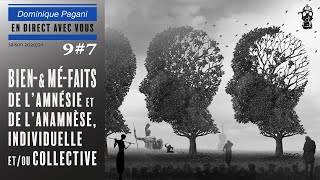
#8 Benefits and harms of amnesia…
10 Dec 2020Why does the nostalgia for a lost substance found every reactionary ideology, and what does the ambivalence of memory and language reveal?
 Cycle 9.1
#7 Answers to questions (continued)
3 Dec 2020How should one answer public questions on Nazism and esotericism, contemporary music, ontology in Marx, orbital resonance and a variant of Capital, and how to announce next semester's program?
 On Michel Clouscard
M. Clouscard's reply to C. Morilhat (1987)
23 Aug 2019What does Michel Clouscard's response to Claude Morilhat (1987) reveal about the place of philosophy and about his concept of neo-Kantianism?
 Play ▷II Pause
Michel Foucault
2 May 2019What is the value of Michel Foucault's project, in his 1966 interview, of an ethnology of our own knowledge that announces the end of philosophy and the death of man?
 Cycle 5.1
#5.3 bis Questions (Facebook Live)
13 Jan 2019What distinguishes the philosophical question "what do you call...?" from the scientific question "what is it?", and how does the sign-meaning pair separate from the cause-effect pair?
 On Michel Clouscard
Being and Code
5 Jul 2018What does the concept of neo-kantianism mean in Michel Clouscard's L'Être et le Code, and why does this book, which restores the precapitalist history of France, remain relevant today?
 Other videos
In conversation with Bernard Friot (1 June 2018)
12 Jun 2018Does a communism already exist, as a "real movement," within the institutions won in 1946, and how can it be philosophically thought and defended in current struggles?
 Cycle 4
#4.4 Angélique (by Nerval)
15 Jan 2018What does the comparison of Angélique and Aurélia reveal about the evaporation of the real into surface, about the notion of edge in Nerval, and about the possibility of a determinism of human affairs?
 Cycle 1
#1.4 Between crisis and war: philosophising?
10 Dec 2015Why did modern thought banish the notion of end, and how can it be rehabilitated without returning to naive finalism?
 A Philosophical Alphabet
T for Triangle
3 Jan 2015Why is geometry necessary for philosophy to rise to the universal, and why is it not sufficient?
 Interviews for L’Affranchi
#2 Rousseau, a world that begins
20 Sept 2014Why can one say, with Goethe, that with Rousseau a world begins?