English translation of the French transcript, made with AI and not yet proofread — click a paragraph to jump to it. Show the French original
Time that devours its children, Baudelaire and the Philosophy of Right 0:00 A very long absence, to borrow the title of a very famous contemporary novel, which I recommend by the way. Yes, I let you come back in. I myself was fairly busy, as most of you must have noticed. I spent a few days in Toulouse at the invitation of the Institut Catholique. They were kind enough to want to post some souvenir photos of the event. I had the pleasure of finding myself there with my colleague Georges Gastaud.
0:52 Aymeric Monville was supposed to come, but he was prevented for family reasons. And so we find ourselves here to begin this new cycle. Now, the title must have seemed a bit abstract to you. And indeed, today it's going to be a bit less historico-political. I won't say it won't be at all, but it will be more directly philosophical.
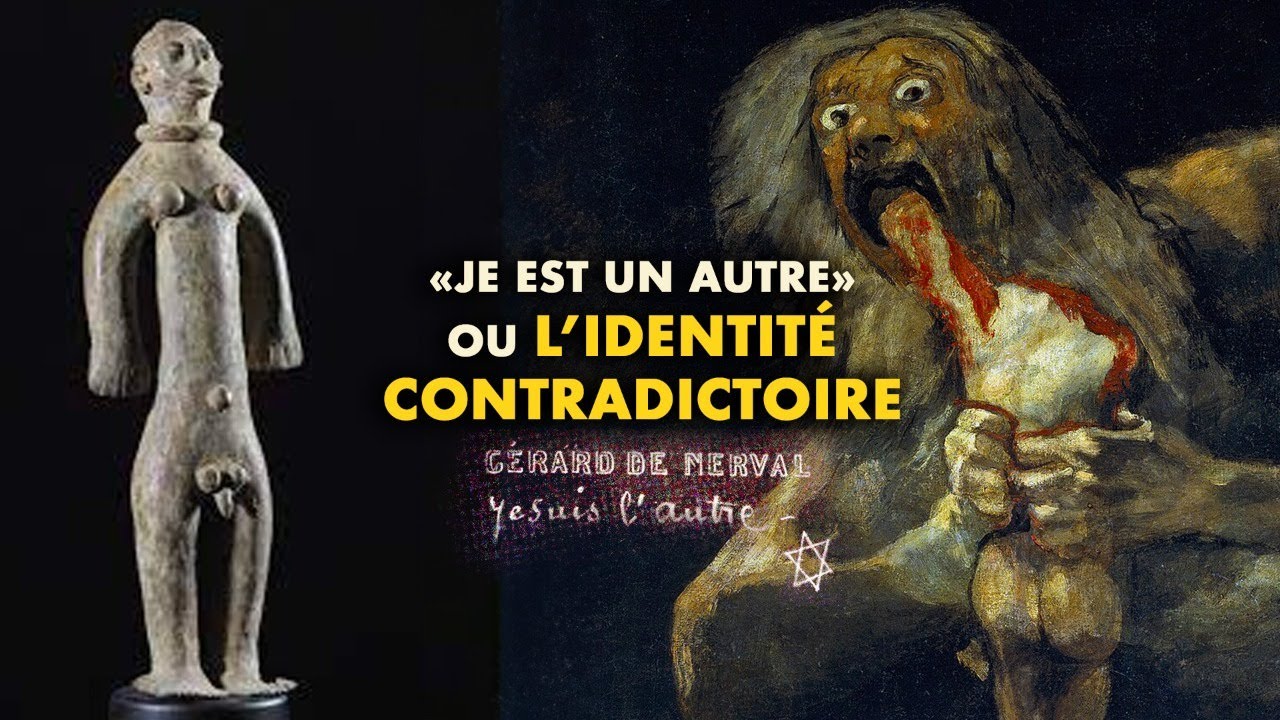
1:26 We need to work, including from time to time, on tackling what can seem abstract. And I say that because, given the theme before us, which is that of contradiction running through the inside of the subject, to put it simply. That is precisely why I am delighted and very grateful to Pierre-Alain for having insisted on the horrible painting, the magnificent painting by Goya, isn't it, of Time devouring his own children. That's the mythological given.
2:02 But Goya, a good Spanish painter, represents the unsettling, nocturnal side of a certain Spanish graphic tradition, pictorial, I should say. Goya made something worse than a nightmare, didn't he, with this painting. What does that have to do with contradiction inside the subject? It's that Time devours its children, in fact, that is, devours everything that is inside time, therefore ourselves. So time devours itself. I'll come back later to a text that says this explicitly.
2:32 So it's a bit hard to render plastically a being that devours itself. Some have tried it that way, devouring its own hand, but it's not very convincing, it's much less expressive. I find Goya's picture, and the panel Pierre-Alain made of it, far more expressive. Yes, time itself is a contradiction, we'll come back to these things.
3:05 But you see, since these are difficult considerations, abstract, eminently dialectical, we're going to recall a few basic foundations of the higher mathematics of dialectics, if I may put it that way—it's an analogy, of course. These are quite distinct disciplines, but not in distinct conflict. To help ease the effort of abstraction I'm asking of you, I've put two poems on today's agenda, two poems by Baudelaire, a poet precisely because Baudelaire, whatever he's talking about, whatever the most complex content he stirs up, that he's willing to share with us, is always clear.
3:57 We need that after the difficulties of the Hegelian text. And these two poems, which I had already used in the midst of lockdown, during the very cycle which we had baptized, with rather heavy-handed humor—it was your humble servant who titled it that way—"The Workshops of Confinitude," at a time when you had to request written permission to go out, and produce it for the police, in order to have the right to walk outdoors.
4:37 And I had already used these two poems in episode 1 of that series, "The Workshops of Confinitude," on our site, and you'll see the video in question. And I had already insisted on their character—there's no other word—"contradictory," and it's the same author.
5:09 So it's almost already contradiction inside one and the same subject. But still, in order to show right away the importance of the philosophical stakes immanent to this problem, inherent in this problem, I'm going to go ahead, even though I'll come back very quickly to the poem, and start with the first of the texts. You see, the texts by Hegel are all taken from what I often call his political testament—I'm not the only one—namely the Elements of the Philosophy of Right, published in his last period in Berlin, which have the advantage, whichever edition you want to refer to, of being divided into paragraphs.
6:01 So I've indicated the paragraph numbers, which is better than page numbers, because pagination depends a bit on the edition, whereas here, whatever the edition, when we say paragraph 6, we're dealing with the same text, or 5. There, by the way, that's the paragraph I used, it's 5, 6, 7. You see, so this is at the beginning of this very dense work. And also a late work, where the old Hegel no longer has much to prove, where he is a bit—not exactly cantankerous, but as sometimes happens to him—à la Beethoven, who was born the same year as him, in 1770.
6:38 Beethoven isn't always tipsy, is he? I'm alluding to one of my podcasts that Jérôme Jocher was kind enough to put together. But there's an image of a somewhat cantankerous Beethoven, and he's a bit like that, when he gets worked up against the Romantics. Anyway. The man is a bit elliptical, as if he were a little tired of spelling out for the thousandth time what he had already spelled out.
7:08 And so, there's a very scholarly side to it, it's a course. It's a manual made to facilitate access to his lecture course, the course he gave on the philosophy of right. In the 1820s in Berlin, a few years before his death. It's structured around the philosophy of right, to better convey right, freedom, that is, boom, boom, you see, alpha, beta, gamma, that's what we're going to see.
"Je est un autre": the subject is not consciousness 7:39 But anyway, we're here among ourselves to spell out everything that might seem a bit elliptical or allusive and rushed, whereas the stakes, as you'll see, are enormous. So, whether you think contradiction, internal dialectic, what is dialectic, isn't it internal contradiction, I don't know, self-determination, or free determination, you see, well yes, it's that these are contradictory expressions, and that's why we—Pierre-Alain and I—were keen on the title for this first session, namely Rimbaud's famous formula, "I is an other," where Rimbaud pulls off a double stroke of genius: first, recalling the split of identity typical of modernity, but above all, with the problematics of the unconscious, for instance, whether it's the Freudian unconscious, whose content is the libido, to go quickly, or the Marxist unconscious, whose content is class struggle and praxis, isn't it,
8:50 these are determinations that belong to the subject, but not to consciousness. There was a whole discrediting of the philosophy of the subject that was very fashionable in the heyday of structuralism, in the '60s and '70s, and often what was called a philosophy of the subject was in fact only a philosophy of consciousness, that is, of the visible tip of that gigantic iceberg which is the subject.
Reading of paragraph 6: immanent versus transcendent 9:26 There we are. So, we'll start with the first of these excerpts, which has the merit of being rather clear and which announces the program of the other excerpts. So don't be surprised if I quote an excerpt from paragraph 7 before developing it in paragraph 6, it doesn't matter. Now, I don't know if it will appear there. There we go. So, paragraph 6.
9:57 Isn't that so? Ah yes. Now, there are two—there are several editions of the Elements of the Philosophy of Right. I recommend two to you. The older one in French, translated by Kahn, K-A-H-N, in the Idées collection, Gallimard at the time. And then an excellent version which has the advantage of being more up to date and which, moreover, cites many of the variants that Hegel had introduced into this work.
10:32 So I'll give you the reference later. But here, whatever the text, this is Kahn's, because I had it on hand. So I'll read this excerpt from paragraph 6. "To conceive of immanent negativity"—I'll come straight back to that word—"within the universal or within the identical, as within the I, was the further step that speculative philosophy still had to take, an entirely necessary step, of which those who, like Fichte, do not perceive the dualism of the finite and the infinite within immanence and abstraction, have no inkling."
11:24 So, let me go back to explain a few terms, even ones that seem ordinary, but I've told you, this is extremely dense and addressed to students familiar with the meaning these words had under his pen. "To conceive of immanent negativity." Now, when you come across "immanent," you do as when you want to properly see the green, you put it against a red background, not against a turquoise-blue background, because then you no longer know where you stand.
11:55 Sometimes with turquoise, I never know whether it's blue or green. I'm not colorblind. There we go. So, generally speaking, when you want to spell out a concept, it's better to bring it out as a figure against a background, opposed to the figure that concept represents, the form, the determination, in contrast to the background against which it appears. So, what's the antonym, the word opposed to "immanent"?
12:25 Well, it's transcendent. There you go. These are classics, both in philosophy and in theology, aren't they? Thus, one can say that animist religions, in general, are all immanent, in the sense that the divine element or the supernatural element, if you like, to take a very broad term applicable both to the religion of Australian aborigines or pygmies and to Greek religion, for instance, whose details are contained in Greek mythology—in each case the divine, supernatural element is interior, in the piece of wood, in the little statue, in the tree, in the leaf, in the wind.
13:13 The wind is a god, it's Aeolus, among the Greeks, or the wind turbines. And sometimes the wind is even personified, as we see in the admirable painting by Botticelli called "Primavera," which I'm sure most of you know, where we see the veils of the young women such as the painter might have encountered in Florence, isn't it? The young women, their veils lifted—it's spring—lifted by figures, masculine figures hidden off to the sides, like that, who are blowing on these veils, and who of course represent the gods of the wind, right?
13:54 There's Aeolus, but there are also ones divided into species like Zephyr, isn't there? Aquilo, when it's the north wind—Aquilo flees carrying the storm, as Hugo says in Stella. There you go, I mean, immanence is that, it's the "in" of "in-1," it's "in," but before "m," the "n" becomes "m." I learned that in primary school, in Benin, back when—I'm so old that it was still called Dahomey then, I think—and we did a dictation every day with a Beninese teacher, and he was even called Mr. d'Almeida, as is often the case, on that coast of slaves, as it's called in geography, Benin, Togo, some African families took the names of their former masters and owners, Portuguese ones.
14:47 So we did a dictation every day, and together, collectively, we corrected it collectively, and as soon as there was a mistake, the whole class had to repeat in chorus the rule which, had the pupil had it in mind at the moment of the dictation, would have kept him from making the mistake. And yes, that's rote learning—I'm in the process of rehabilitating here, not the "head crammed full," because it would take more than millions of things, even billions, for a head to be full, but at least I mean not to dismiss with disdain everything that is rote learning.
15:25 Because knowing texts by heart, or rules by heart—as you know a bit, I know that some of you are great philosophers, you know very well what the dialectic is between language and thought, that language isn't simply a means used by thought to communicate itself. That can happen sometimes for things like "train number 8 will arrive tomorrow at 10:26," fine, I see that, but language has other things to express, doesn't it, than that kind of thing, or "pass the salt."
15:57 so, we believe that language is a means, and in fact it's often the reverse: it's thought, isn't it, that is manipulated by language, by the words we choose, that we use, that we've heard or that get drummed into us, which force us somewhat to think in this way rather than another, depending on whether the same person is called a terrorist or a resistance fighter, for example—that changes everything, and yes, it's not because I change the word that I keep the same thought.
16:32 So, all that to recall that we would correct the dictation together, and when we got to someone who had written "imbattable" but had put an N instead of an M, the whole class would say—excuse me for saying it with the accent, but it makes me feel young again, I was a little kid in fourth grade—before M, B, P, you put an M instead of an N, except in bonbon, bonbonne, bonbonnière.
Christianity, Islam and immanent causality in Spinoza 17:08 I haven't reviewed this since 1954. It's not—there's something good, still, in these traditional methods. There you go, so in "immanent," you replace I-M, not I-N—it means those who remain, manere, that's the maintaining, same root, not moving, those who remain, but inside, inside. There you go. The genie that's in Aladdin's bottle, you see, you rub it a little, pop, out comes a genie, but the genie is in the bottle.
17:45 There you go. That's the complete opposite of the transcendent God, who is beyond, as in "my kingdom is not of this world," like the god of Muslims, who cannot, and must never, be represented, any more than these living creatures, for that matter—it's as if one were stealing their soul, isn't it? That is, the transcendent part of themselves. And that is why, because there is no representation of God, whereas in our painting, in the Italian Renaissance, there are plenty of figurative depictions.
18:19 God the Father, not so much, apart from some rather unapproachable-looking fellow with a beard, up in the heavens, but that's not very inspiring for a painter. On the other hand, the Son—there's plenty with his suffering, isn't there? The Descent from the Cross, and of course the Madonna. But that's our Christian religion which, thanks to, or because of, or by means of, the theme of the Incarnation, the greatest sacrifice God made, isn't it?
18:54 It's the sacrifice of his own son, a contradiction within—it's his own flesh, his son after all. It's himself, it's a part of himself, and what part? It's himself, according to the unitary doctrine of the Trinity. You see, I'm staying close to my theme, contradiction within. In Christianity, and thanks to the theme of the Incarnation, God is both transcendent and immanent, whereas in Islam, he is outright transcendent, without compromise, and that's why, in the graphic art of Muslim religions, cultures and civilizations, what decorates the most beautiful mosques in the world—that is, those at the extremities of the geographical extension of Islam, the eastern extremity, Iran roughly, the western extremity, the Andalusian world, Spain, the Spain of Granada—you have what are called arabesques.
19:58 And yes, abstract motifs, already, abstract graphic designs, because there's no question of concretely representing God. There, that's for commenting on "immanent," "to conceive of immanent negativity." And it's not someone from outside telling me "No, you don't have the right, you're not allowed," or who seeks to beat me up physically, or guillotine me, or shoot me. That is a negation, not an immanent one, but one that comes from outside, that is transitive.
20:34 Second antonym of "immanent." I said transcendent, that's mainly in the religious domain, or metaphysical, if you prefer. But in Spinoza, you very commonly see the opposition of immanent and transitive. For example, when he says that God is the cause of the world, but not a transitive cause. That is, there isn't someone who first says "let there be light" and then, right after, bam, isn't it, light was.
21:08 Ah no, no, no. In Spinoza, God creates by the mere fact of being. God's creative act—one must even set aside the notion of creation in the somewhat mechanical sense, like a potter making a figurine or an ashtray. One must instead conceive that creation is made, from all eternity, by the mere fact of the existence of that unique substance which is God, isn't it?
21:42 Whether or not one believes in God, at least Spinoza is consistent—no one can say otherwise. And so he commonly says things like: God is the immanent and not the transitive cause of the world. It's not two moments in time, a bit like, say, the evaporation of water by the sun over the ocean and then afterward, the rain. That's a transitive causality. That exists in the physical world. But in God's world and in the metaphysical world, there should be no such thing—it must be immanent causality.
"I have changed": the identity of the self and the universal 22:20 So, to conceive of immanent negativity inside ourselves, look, but not only within the universal or the identical, as within the I. So, oh la la, are we really going to bounce off three different words? That's going to take forever. But no, it's a bit the same thing, said three times. If I start with the last one, with the I, you see, a simple statement like—I told you, I'm asking a small effort of abstraction from you, but you'll see, very simple and within everyone's reach, without jargon.
22:59 When I say a statement as simple and as ordinary as saying "I've changed." For example, yesterday I was sick, today I'm better. Or the reverse. Saying that yesterday I was in good health and now I've got a bad cold. I've changed. This is often given as a homework exercise, in logic, in philosophy, to see whether one is dealing with fairly sharp pupils, to find out whether this sentence expresses a contradiction. Now, plenty of them say no, I've changed, I don't see where the contradiction is, and yet.
23:30 This statement "I've changed" expresses at once change—I was sick, I'm in good health—a change at the level of my health, say, or my body, if you like—but at the same time it says "I" each time: I was sick yesterday, I'm in good health today, it's always the same "I" speaking. The "I." So there's something, there are things one sees, agreed? A runny nose, and now a nose that no longer runs, somewhat red eyes, and now clear, bright eyes, handkerchiefs filling my pockets, and now I have none—that's the attributes, the things one sees, but there is also something that persists, and that one doesn't see, which is what Descartes called the cogito.
24:30 First person of the verb "cogitare" in Latin, which means "to think." "Cogito" literally means "I think." Here we're dealing with a subject. That's what a subject is. It's someone who can say "cogito," and who has no being except through that. So, to conceive of negativity now within the universal, or within the identical, or within the I. You've already seen that "identical" and "I" are no longer, at this point, two distinct notions where you have to move from one to the other.
25:04 You can clearly see it's the same thing. It's the "I" that indicates the identity between yesterday, when I was sick, and today, when I'm in good health. You say to me, well, Dominique, are you feeling better—that means you recognized me. I am the same. Identity. Agreed? And since this "I" accompanies me throughout all my avatars, metamorphoses, as you like, including if I come back from the war with two arms and two legs fewer. But yes, that's not tied to—the "I" is not tied to physical presence.
25:38 There's a very fine, famous text by Pascal on this, isn't there? I say I love the person—this is Pascal speaking—"If smallpox spoils the face of a woman we love, is it that we still love her?" Whom do we love? What is this "I" that we love? You see, he did a fine job of problematizing the apparent obviousness of what the "I" and each person's "self" is. But no, it's always a dialectical notion comprising a part that varies, often tied to the body but not only—I can also change my mind, the worst agents, lackeys of the political right, isn't it?
26:28 often started out on the left, which prompted someone - I no longer know who - to say in the 1930s that the worst of the right wing is recruited, scraped together, from the dustbins of the left. A word of warning to those who persist in thinking there's no difference between left and right - let me take advantage of this to point out, it's not my subject, I say it for free so as not to clutter the debate, but when people say there's no more left or right, that it doesn't mean anything anymore, that means there's only the right left, that's serious. Look at the conflicts happening right now, there's nothing left, nothing at all. There were three million people in the streets a few years ago saying fascism shall not pass, and now it's taken for granted, thousands of people, kids, are being wiped out on one side or the other - that's serious, you see. So there's what doesn't change and what changes, so of course...
27:38 if one is somewhat conservative, one will insist on sameness - Plato, for instance, you see, he insists a great deal on the soul, which in us is the part that allows us to see the eternal truths, the identical, the Idea, that which doesn't move. Because whether the beautiful is a beautiful sunset or a beautiful actress or a handsome actor, or a beautiful landscape, it changes completely each time for the eyes, for the five senses. Nevertheless we keep the beautiful, we say 'it's beautiful' whether it's a twilight over the sea, isn't it, where 'I drowned myself in your daughters' blond hair, o my mother Eva' as Nerval says in a fragment - Eva with an extra H, Eva, well, they are that - and so yes, there is an infinity of avatars of beauty around us, but there is something universal that doesn't get particularized, namely that each time we say 'it's beautiful' I feel a pleasure that is sui generis, as they say, that is comparable to no other pleasure...
28:49 like that of eating or making love or floating on your back in the first days at the beach in summer, on your back or on your stomach - aesthetic pleasure, pleasure provided by an object I find beautiful and which therefore pleases me. If I say it's beautiful, that's because it pleases me; if it pleases me, that's because I feel pleasure - listen carefully, it's in the word, it's not me who decides. So you see clearly that the universal, that which doesn't move, whether it's here or there - it's not like 'truth on this side of the Pyrenees, error beyond' - polygamy here, monogamy there, no. There is, on the other hand, a universal in all human societies: the prohibition of incest. I didn't say there is never incest, I'm saying that everywhere the rule - it's not a law, laws being left to nature, the fall of bodies - the rule, the difference being that a law cannot be broken, a body cannot fail to obey the fall of bodies, but incest can occur - it is forbidden.
30:00 to run a red light - but I can run it, nobody on the left or right, at three in the morning, at night, no policeman - one shouldn't do it, don't make me say what I haven't said. We are much freer within the law, within the rule enacted by man, than within the laws of nature. There are those who believe that to free themselves it's enough to wander in the forest to escape every form of constraint - we see that those people eat their fill and that back home the fridge is well stocked, or the pantry, depending on the era. To conceive of immanent negativity within the universal, within the identical - here or within the identical, you see the 'or' there is justified, as in the 'I' one resists a little more, as in negativity within me - but no, I am a little bit positive - was the progress, the step forward, the new step forward that speculative philosophy still had to take. So there too I'll stop on 'speculative' - it's the word in this sense in Hegel, and it replaces 'dialectical'.
Speculative comes from speculum: the mirror and mediate knowledge 31:10 in the last years of his life, roughly in his last works, the Berlin works, to put it in a somewhat probabilistic way if you will. And look carefully at its origin - it's simple: speculum, Spiegel in German, it's the same, it's a European language, it's the mirror - spectacles for glasses in English, everything related to optics, aspect, having an aspect, an idea, a form, a being - 'fallen from the azure into a muddy, leaden Styx where none of the sky penetrates anymore,' Baudelaire. So speculum is the mirror - but what relation does the mirror have with dialectic and negativity? Well, look at yourself in a mirror, you say 'there's my right' - no, negative, no, what you can carry to the right is on the left. I myself am very clumsy every time I try to cut a bit of my hair, something like that, in the mirror I go completely the wrong way, I don't know how to use a mirror properly, I forget, I really believe it's me there when it's the inverse of me.
32:20 it's not two, it's minus two. To conceive of negativity inside the self - well, inside the self that reflects - wait, reflect, reflect in the proper sense, let's leave metaphors aside - reflection in the proper sense, a reflection, well that's what there is in a mirror. From that moment, you see, philosophy, reflection, speculation - in every case we're dealing with, let's take a term common to all this now, mediate knowledge, that is, knowledge that is not immediate like the antelope in the African savanna with the immediate presence of smoke molecules brought by a brush fire not far from it - it's not immediately in contact with its nostrils, it bolts. That's - it has knowledge, it knows there's danger, but that's instinct, that's immediate knowledge, very useful. Thankfully it's not by reflection that I digest or that I breathe...
33:30 that my heartbeats occur - thankfully that happens without my thinking about it, it's a game which can be an 'us,' better if it is - but so it's good, the program of our instincts unfolds well, except that it also condemns us to have no evolution as individuals. Over millions of years the species can evolve, but as far as individuals are concerned, they've disappeared - biology, the forces at work in the biological world, one of the so-called natural sciences, do not - do not unfold, despite the illusion we have of it, for our benefit or for the benefit of the individual, isn't that so, it's for the benefit of the species. Think of the grasshopper, the locust, which dies immediately after mating, or that extraordinary Pipa toad - this has been studied - an enormous batrachian, an enormous toad, I'll spare you the descriptions, covered in pustules, which exists mainly in Amazonian South America, and where the female...
34:42 is forced to kill herself, to poison herself, immediately after the male pushes her to release her eggs - it's a fairly complex process that has been studied. There, the species renews itself, so we no longer need the individual, who believed that the pleasure he felt - I don't know, say, in the act of reproduction, etc. - was for himself, because nature is well made, 'this gives me pleasure, yes' - in fact no, it's in the process of doing away with me. There you have it. Nature, on the other hand, watches over the survival of the species. There are those who already find themselves too cramped within a society - so imagine what we shouldn't say about nature, which drowns us in the species. So there: to conceive of immanent negativity within the universal, or within the identical, as within the self, was the progress that speculative philosophy - in other words dialectical philosophy - you see how much clearer all this is now - dialogue, that's two things, there's the self reversed and the self upright - still had to take. So...
To determine is to finish: Fichte and post-Kantianism 35:52 it was the progress it still had to take, as a necessity - and there you have it, necessity, of which those are unaware who, like Fichte, do not perceive the dualism of the finite and the infinite within immanence and abstraction. You'll say to me, 'wait, your subject was internal determination' - well there you go: determined - go find me a synonym for 'terminated' and you'll tell me 'finished,' you're right. So we can replace 'determined' with 'defined,' and look, the finite and the infinite - we've arrived at throwing things - language, isn't it - what is determined is what is not infinite, it's what is terminated, and starting from the 'de' which is determined - it's the 'de,' the English 'from' - it means terminated starting from other things, isn't it - I am determined by military discipline to stand guard, there, I mean it's an end put on me, it's an external determination. And I say this because it seems...
37:02 that it's not - but what's most painful in military life, when you ask soldiers, is guard duty sessions - yes, whether it's raining or windy, even if it's hot, staying in the same spot the whole time, especially in England, isn't it, where a young Japanese tourist twists your mustache and you mustn't move - I recall this, and the British, some of them try to bring a challenge, a dare, to the famous British stiff upper lip. So what is this story about Fichte? Fichte is the one who went furthest in the Kantian advances after Kant, even going so far, frankly, as to cross certain limits that Kant would never have crossed. But I'm not giving a course on Fichte, I'm just situating him - it's exactly what's called post-Kantianism, and I'll take the opportunity to review, since this is a dense text - when you develop it like this you cover...
38:12 a lot of useful things. Post-Kantianism characterizes this immense philosophical school which, in the history of philosophy, the history of philosophical ideas, is usually called German idealism - which is contemporary with German Romanticism, and even the German Romantics - not philosophers there, but writers, musicians - I prefer to include them within the notion of German idealism. I say this because at the time the boundary between philosophy and literature was not obvious. There are, in Hölderlin, properly philosophical essays of very high quality on the notion of becoming, of the perishable, of limit, and so on. And then there's a poet with philosophical essays, and conversely, in Hegel, there's - remember - the young girl with the fruits, with the sparkle of her gaze, which makes him think about the museum, isn't it, that it's even deeper when the fruits are detached from the tree, but when they are offered by the woman selling...
39:24 mandarins - yes, there are poetic passages in Hegel, that's not all. Remember what he says when we look a man in the eyes: it's the night of the world advancing here to meet each one, we then see a dreadful universe - it's Hegel speaking, when one looks a man in the eyes it's the night, the negativity he's talking about there - I'm laying a bit of groundwork for the dreadfulness that's going to break loose in the text I'll read a bit later, the text by Bonaventura, I give his pseudonym because even now people wonder who was hiding behind that pseudonym - at Hegel's time, a contemporary of Hegel, of Hölderlin, all this is late 18th, early 19th century, the years 1780 or 1803, it's the same - Fichte, German idealism - I'll close this little revision aside, which concerns the history of philosophy more...
Subjective, objective, absolute idealism: Fichte, Schelling, Hegel 40:34 than properly philosophical reflection itself - these three stages, here is how they're traditionally taught: subjective idealism, objective idealism - antithesis - and finally synthesis, absolute idealism. So let's put proper names on it: subjective idealism is Fichte, who extends Kant, Kant already extending the Cartesian initiative of the cogito, when Kant says the 'I think' must be able to accompany all my representations, whether they are real - I see a mountain over there - or imaginary - I picture a departed friend by saying we miss him - in every case the 'I think' must be able to accompany, must be able to, whether I'm conscious of it or not at that moment, the 'I think' accompany all my representations - the lineage of Descartes. So you see here the subject adheres to all its representations, the subjective subject - adjective with subject - that's Fichte. And there I told you Fichte crossed a threshold beyond which Kant never ventured, namely that Fichte goes so far as to say...
41:48 that there is only one thing that truly exists, and that's the subject. Yes, that seems strange to me because spontaneously we, the man in the street, are not idealists in the metaphysical sense - I'm making parentheses here today, forget idealist in the ordinary sense, the guy full of ideals like that, a bit naive, who still believes in it - nothing to do with it. In philosophy, idealism is a philosophical position according to which the external world, what we believe to be a world, a reality outside us, does not exist in itself but is only a representation of the self, of the subject. Ah yes, that seems strange to you, it's a way of saying that everything outside me is a bit like my dreams - my dreams, take away the moments, the dream disappears too. Whereas the realist is the one who says: if I disappear, that doesn't stop the park behind my window from continuing to exist without me - that's realism. Yes, it's different, it's not realism in the aesthetic sense, it's metaphysical realism, there is a reality...
42:58 independent of the subject. And then there's metaphysical idealism: it's the subject that constitutes reality - that's Fichte. And Kant never went that far. Kant forbids us from taking a stance in the idealism-realism debate because for him these are antinomies of pure reason - let's review, that means contradictions that are within reason itself, which is quite humbled in Kant and in which it flounders - and so it's just as pointless to decide between the two as to know whether the world has a beginning - the Big Bang, current science - or whether it has existed for all eternity. Yes, that will get debated, people will say 'but if there's a beginning, what was there before the beginning, then it's not the beginning, it's precisely what was before' - let's leave these antinomies of reason at that level. Fichte, on the other hand, boldly - and he's going to be the idol of the new generation by saying something that will please the Romantic poets, all of them, isn't it, a poet like Novalis, who is perhaps the most Romantic of the German Romantics...
44:08 says that 'in us or nowhere are eternity and its worlds' - in us or nowhere is eternity, it's not in the Amazon, the Sahara, in the Nièvre or wherever - no, no, I'll say it's within us. That's Fichte, philosophy of the subject taken to its paroxysm. One small detail to finish with Fichte before moving to the second stage - there are three, remember: subjective idealism, objective idealism, absolute idealism - a detail: Hegel, I'll tell you right away who represents absolute idealism, who dismisses both subjective and objective idealism back to back, or rather who makes a synthesis of them and not a compromise - he's not a centrist, Hegel - at the end of his life in Berlin, shortly before his death, asked to be buried next to Fichte, even though he had dismissed both Fichte and the representative of objective idealism back to back...
45:19 I'll give it to you now so we have all three: Schelling, younger than Fichte, an exact contemporary of Hegel and Hölderlin - don't forget that the two greatest philosophers of their time, and some say the greatest poet of all time, though that doesn't mean much, Hölderlin, were in the same digs as students at the Protestant theological seminary in Tübingen. And I can't help - too bad for those who've already heard this - thanking Sébastien Michéa once again for kindly taking me in his car from Strasbourg and driving me to a place I thought I'd never see again at my advanced age, with his mother and his little boy, and letting me see again that marvel of a city which, miraculously, was not razed this time - one of the rare German cities not razed - all terraced like that, if you go over there toward the Hölderlinturm, as they call it there...
46:29 the Hölderlin Tower, where there's a museum on the banks of the Neckar - it was marvelous, and it was all three of them there. There's a small museum where you see inscriptions like: Hölderlin went to prison for two days for insulting a guard, you see, and the three young men, to celebrate the first anniversary of the storming of the Bastille on July 14, 1790, planted a liberty tree in the courtyard of that seminary, the Stift as they call it there. So, Fichte - subjective idealism; objective idealism embodied by Schelling, I'll come back to him, I haven't spoken about him yet; absolute idealism, Hegel. So Hegel asks to be buried, still in my little detail, next to Fichte, even though he had dismissed them both back to back, Fichte and Schelling - his first publication, Hegel's very first publication, is a work titled The Difference Between Fichte's and Schelling's Systems of Philosophy. We're right in the middle of the debates of German idealism, and the conclusion...
47:39 of Hegel's is that he dismisses them both back to back, even though he's more Schellingian than Fichtean. Well, there you go, at the end of his life it's a return to philosophies of the subject - I'm telling you this because it's very political, look into how the old Schelling evolved into one of the pillars of the French counter-revolution, and how Fichte, like Kant in the lineage of Rousseau as far as the philosophy of action is concerned, and Descartes as far as the philosophy of knowledge is concerned, remained faithful to the questioning of every constraint, whether given by nature or by God. One learns a lot when reflecting on paragraphs like this that seem simple and are very dense. Let me reread it a bit as a whole: to conceive, through immanent negativity, when you read...
The flower suppressed-preserved in the fruit: Aufhebung 48:49 'negativity,' try to have 'suppression' in your mind. The fruit is a negation of the flower, because for the fruit to appear in autumn, the flower that was there in summer, but since spring, must disappear - and yet, you see how dialectical this is, it's not a disappearance for nothing, it's not that we take the flower and throw it in the trash - it's that the flower remains within the fruit, or rather what was at stake, the stake of the flower, the accumulation of wealth - wealth biologically produced by the sun, by the mineral salts under the roots of the flower, by the sun above its petals, by the beneficial rainwater trickling down - all that causes an accumulation, a wealth, that will blossom...
50:00 afterward into the fruit and will become - look at a fig as it ripens, the quantity of sugar accumulated - so we can say the fruit is a 'suppressed-preserved' of the flower. You see, in French we're forced to use two words, and there's been quite a bit of reflection - I'll isolate the two that concern us here, Hegel's and Freud's - they never coordinated, Hegel would have had a hard time, but even Freud doesn't cite Hegel at all when he says it's nice that in the German language there are terms that express contradiction, whereas we're forced to say both terms, 'suppressed-preserved.' Well, there's a well-known German term - even for philosophers, French ones, who have tackled the Hegelian mass - it's the famous Aufheben, a very common term in the German language. Ask a German on the street who doesn't do philosophy, he'll say it means 'to lift, to suppress,' but it also means 'to preserve' - to lift...
51:10 to suppress, to preserve. Some have proposed as a translation - because we struggled to translate it into French with a single word - and I find there's one that's not bad as a translation: 'the relief' - the changing of the guard - I was talking about the guard earlier, not the English Tommies - well, there's a guard who goes to rest, he disappears, but the relief is assured, the guard as such is preserved - we've suppressed one guard, we haven't suppressed the guard - a bit like the self earlier, which was sick and is now healthy, it's fine, but don't think it's like Mont Blanc, which stays there, doesn't move, and was pink in the morning and becomes dazzling, even blinding, at noon, or invisible, hidden by a cloud if the weather turns bad - no, no, that's not at all the same way of being invariant, of staying there, of not moving - it takes action for the 'I'...
52:20 to maintain itself. The plant, to maintain its identity - because you say this plant, whether it's a bud - the bud progresses, bursts and becomes a flower, the flower - the petals fall and the fruit is inserted in place of the flower as its truth - which is also in the preface to the Phenomenology, yes, it's from him that I borrow these biological metaphors, it's a biological analogy - but careful, for this movement to take place, an effort, an act, must not stop at every instant - the act of suction that the plant performs, of mineral salts in the soil, of absorption of light rays and rainwater by the roots or on the surface of the emerged plant, its leaves and petals. So the maintenance of this identity - you see, I'm working my way toward what negativity is, negativity which, when it relates to itself, becomes a positivity...
53:30 I maintain myself in time, but merely to stay standing, as you well know, that takes an effort every single second, and to hear a sound, for the sound to keep going, for us to keep hearing it, and I'm talking about a sound, isn't it, I'm going to demonstrate, I'll make a little effort, there - if I do that, look, if I do that - there, it doesn't sustain itself, but if I make the sound sustained - the identity is maintained, but for that vibrations must keep reproducing, you know, it's materialized by a sinusoidal curve, if we had to graph it acoustically, there. So let me reread this - you see why I started with paragraph 6...
54:42 even though it comes after paragraph 5, which I'll take up again afterward, because it has the merit of giving a bit of the program for everything we're going to see, the program of the essential stakes: to conceive of immanent, internal negativity within the universal, or within the identical, as within the self, was the progress that speculative, dialectical philosophy still had to take - a necessity of which those are unaware who, like Fichte, do not perceive the dualism of the finite and the infinite. He saw very well that there was a dualism between the finite and the infinite, Fichte, but he did not see it within immanence and abstraction. In other words, abstraction must be understood - it's the one word I haven't commented on much, but now's the time - it must be taken not in the sense of 'abstract' as opposed to 'concrete,' but on the contrary as the most abstract thing there is...
55:52 it's the effort to abstract - the French verb, right - so, on my piano where there are all sorts of objects, I abstract my electronic cigarette, I abstract from the whole set on my keyboard my glasses, I don't know if they can be seen, yes, there - I abstract the remote control. 'Abstract' doesn't mean a hazy world where there are only ideas - because when I want to abstract from something, or even from someone, that can be very dangerous for that thing or that someone - well, that's what we're going to see in the following texts. So this time I'm going to take - I'll ask Pierre-Alain to move on now, yes, to item 7, why not, thanks. So item 7 picks up a bit on what we just said, so I won't linger on it long - the demonstration and discussion of this core of speculation, he insists, solemnly, in a work...
Paragraph 7: negativity that relates to itself 57:02 that is nonetheless fairly dry, the Philosophy of Right - I told you, Alpha, Beta, Gamma, a bit elliptical, without much demonstration - I haven't spent my life proving it, I'm not going to start again - the demonstration of this core of speculation, this core of the dialectical nucleus of the common infinite - not the infinite as n plus 1 plus 1, what Hegel calls the bad infinite, it's not the abstract infinity - the infinite as negativity relating to itself. Look now, we can look at it, I don't know if Pierre-Alain can put it back up, the placard, isn't it, with which our session began this evening, the incredible Goya painting - thank you very much Pierre-Alain, I'm always amazed by technology and by the know-how of those who know how to use it. Listen, this is not a negativity relating to itself, we recognize it - I'm cultured, I know my mythology - it's Time devouring its children...
58:12 yes, the children of Time - first, as we saw earlier, my child is a bit myself, flesh of my flesh, one can say this of a spouse, but even more of a child - this self-devouring, I'm not saying that, but not far from it, not far - negativity relating to itself. I'm trying, I'm trying to feed your capacity for synthesis, I know some of you are following and establishing connections between these different materials that I seem to be treating a bit haphazardly. So let me add two, three quotations, maximum, but without wearing you out. Novalis, whom I quoted earlier, the poet, said: the philosophical act par excellence is the murder of oneself. Not long ago I commented on Rimbaud's A Season in Hell, that incredible crisis...
59:22 an incredible crisis in which one also finds many very dialectical passages, in particular the one where he says, enigmatically, 'there is no one here and there is someone' - contradictory, there's no one, there's someone. Well, we'll come back to this in a text, timely as a problem, but the philosophical act par excellence is the murder of oneself. What is there in Rimbaud? Something of him has died - the Rimbaud of revolt, he's beyond that now, he's in revolution, which is much deeper. And he says of that period when he played a bit of the smart aleck, isn't it, against the bourgeois - one has to go through that, it's healthy, especially at the age he was - but he says, 'what foolishness that was' - I know today how to greet beauty, something iconoclastic - well, iconoclastic without remission, because he was always thorough on many levels, especially in the face of injustice...
1:00:32 'what foolishness that was, I know today how to greet beauty' - I no longer find it bitter, as he says at the beginning of A Season in Hell. I say this because there are those who stop there, for whom Rimbaud is just the guy with his hands in his pockets like that - it's good that he went through that phase, it's even better that he went beyond it. There's an example of murder of oneself. Another quotation I borrow from theology, Christian theology here - I'm very far from Rimbaud, absolutely no holy-water sprinkler - 'whoever wants to save his life will lose it' - that's dialectic, whoever wants to save his life will lose it. And as for those who feel closer to Nietzsche, Nietzsche too fits within this self-negation, isn't it, when he speaks of the metamorphoses - man must...
1:01:44 be a camel, that he take it like a camel that can be loaded with a pack like that, and that must abstract from its needs, its thirst for water, that takes it upon itself, and 'as Moses lifted up the serpent in the wilderness, even so must the Son of man be lifted up' - I'm coming back to Nietzsche - so there's the camel, then afterward there's the lion, you know the three metamorphoses, the lion - that's the moment of revolt, Rimbaud earlier, the smashing everything, destroying everything, the lion that cleans house around it with claws and fangs. And then there's the third term, the child, the one who says yes, who affirms, the opposite of negation - but you see, it's an affirmation that had to pass through negation. But you all learned this, not in arithmetic but in algebra, from the very first steps of algebra, from the beginning of middle school - ah, my word, you learned that minus times minus makes plus...
Minus times minus makes plus: the negation of the negation 1:02:54 and there we're reviewing things that will help us understand what he calls negativity, and above all how negativity is the source of everything positive in us. Remember, sorry, that sound that continues as long as it continues - there's negation of silence, then it stops there, it's the sound itself that is negated. Yes, I'm introducing one of the most Hegelian notions there is, that of negation of the negation. You learned that minus times minus makes plus - not just any positivity, look, the remote control is placed on my book, that's positive, I place it there, that's mere positing, none of that's very interesting - but I'll take another image that stands opposed precisely to this naive positivity. I take a lit cigarette, I no longer smoke...
1:04:05 since my heart attack - maybe not nostalgic - in the dark, some of you have already played with the cigarette making dots, the cigarette does this, then you see something red, but if you do it fast you see a red circle - you see the effort and the act, I must, each time, negate, suppress the position it was in a fraction of a second before, in order to suddenly posit a circle that didn't exist until then - it's this positivity born from an act. Earlier I spoke of the act by which - and I quote Novalis again in the Hymns to the Night, who says the meditative plant is all suction - but hey, that's not passive at all. And remember - but yes, I know some of you are already thinking of it, the best among you - the sixth book of Plato's Republic, the end of the sixth book, the end of the quest - there, not only have we left the bottom of the cave, not only do we finally see the Ideas, because we're even beyond the intelligible truths...
1:05:16 which govern the sensible - as is the case in mathematics or among geometers, to speak as Plato does - we're in dialectic, and then finally we arrive - there, there's no more discourse, no more language, whether it's mathematical discursion or dialectical dialogue - there's no more - there's contemplation, theoria - there's no more - a contemplation of what? Of the sun as representation, that is, of the Good in reality - it's stated by Plato - except it's not theory in the passive sense, there's no more - the opposite of action, no, for you'll notice, says Plato to Glaucon, one of the disciples, one of his interlocutors in the Republic, or to Adeimantus, I'm not sure which of the two - you'll notice that the sun does not merely allow the eye to see and the object to be seen - it's this third term that in fact enables our theoretical relation to the world, knowledge - but it gives to our being growth and nourishment, as the meditative plant...
1:06:27 which is all suction, and the sun which gives beings growth and nourishment - our very first existence, even before birth, in the maternal womb, was all suction, or absorption, of the amniotic fluid so full of nourishing things. It's an act, this positivity - for it to be, something else must cease to be, just as for the calf to grow and become a cow or an ox or a bull, grass must be suppressed, along with all the elements and minerals that are in the grass. So the demonstration - the demonstration and discussion of this core of speculation, of the infinite - how much clearer it is now - but as negativity relating to itself, with the act I perform to negate all the time, negation, and thus to posit myself...
Paragraph 5: the reflection of the self into itself in Descartes 1:07:37 as this ultimate source - I hadn't said this yet - of all activity, solemnly, of all life and of all consciousness. The demonstration refers to another discipline than law, to logic as purely speculative philosophy. There. Well, I think there was another text, still taken from the Philosophy of Right - I asked Pierre-Alain not to rush - yes, so this one I'll start to tackle, and you'll say to me: but why not start with the poems, it's more concrete - yes, you're perfectly right, but I'm going to show you why I isolated these two poems, because each of the two illustrates one of these two moments - the alpha, you see, the will contains, first moment, alpha, the element of pure indetermination, I'll come back to it - and then, beta, we'll see on the contrary where I accept a determination. Each of the Baudelaire poems I chose expresses precisely these two contradictory, or in any case inverted, moments...
1:08:48 let's say that all the attributes of the one are contradicted by the attributes of the other - we'll see that when we read these poems. So I'll first read the beginning: the will contains the element of pure indetermination, or of the pure reflection of the self into itself - yes, aren't these words clearer - the reflection of the self into itself, not the reflection of the policeman wondering about clues, 'I wonder if the motive isn't behind the crime,' that's reflection, but not inward, not the reflection of the self into itself, but reflection on something external - the self into itself, that's Descartes, yes, Descartes, yes, what humility, he thought he had plenty of certainties - 'look, what do I see through this window, I see men in the courtyard' - or rather, what do I see - it's him speaking - if not - yes, I know some of you have the answer - coats, hats. Why do I say I see men? It's a manner of speaking, because what I see...
1:09:59 in the truly proper sense, with my eyes, is coats, hats - it's the era of musketeers, of capes, backs turned - and I don't see, but I think, I judge - ah well, there you see, it's less immediate, it's less the eye, there I'm certain there are men behind them, but Descartes says: yet these coats and hats might cover mere automata, machines moved by springs - oh, the Cartesian heroism there, that's the reflection of the self into itself, to take up Hegel's formulation - I too, Descartes, believed I see men - no, I have eyes that work quite well, my eyes, if we really take what they see, they see coats, hats. But this is the era when mechanism appeared, thanks to Galilean physics - 1636, Galileo's condemnation; 1637, Descartes's Discourse on Method - it's not made up, it's called the scientific revolution, that extraordinary era that saw the emergence of today's sciences, the collapse...
1:11:10 of finalist thinking, which explains everything, isn't it, by the purpose pursued by the planets, plants, animals, galaxies, the air and the wind - the wind that opens up to reveal a bit of Botticelli's Primavera - replaced by a mechanics where there is no longer a subject, only objects that act on one another, like an acid that produces bubbles on limestone, on a piece of chalk when you run the experiment. And it's this world of which Pascal will say, a generation after Descartes, right after Galileo: 'the eternal silence of these infinite spaces frightens me.' It's the scientific world - Pascal is a scientist, as devout, as Christian as he is, he knows very well that if God exists, one shouldn't look for him in the galaxies - it's not very generous toward God to stuff him with nitrogen and hydrogen...
1:12:21 and sulfuric acid, what have you. There, I wanted to help you make progress in understanding what, here, negation - negation as sublation - in this text, or negativity, is: negation of a negation, that is, a continued negation, if you prefer, as you see - if we still hear it, that's because the sound before it has been suppressed but preserved. Yes, that means that in the air, materially, there are vibrations that continue to reach your ears - it's not entirely suppressed, but for them to reach your ears, for you to have that positivity, for you to have the sensation of it, the sound of each instant must, in time, be suppressed and renewed. So...
Cartesian doubt and the evil genius 1:13:33 I repeat this solemn passage, right, well I'm going to stay just before, but here it's a bit more explicit: the will contains the element of pure indetermination — and here now I stop, because this is much clearer, for me to say cogito with no determination at all, not "I am a Frenchman, I am a Poitevin gentleman" — that was Descartes, my name is François-René, I have a beauty spot on my right nostril — he abstracts from all that. In other words he reaches a stage where you too, at least all those who go through this process, who abstract from every determination, you see, pure indetermination — that's much clearer — so as to keep only the fact that I am in the process of thinking. Perhaps everything is deceiving me, including the evil genius who is as powerful as God but who is evil whereas God is good, according to what I hear — I don't know, because there are basic things I'm not sure of, because I might know things like that — but let's make the hypothesis that there is an evil genius who employs all his industry to deceive me. But let him deceive me
1:14:44 as much as he likes, he will never manage to make me be nothing so long as I think that I am something. Or rather, so long as I think I am, I am — and you know what follows: negation, negation, I was in the process of denying all the certainties I had, and that's what suddenly makes the first positivity appear to me, the first thing that resists doubt, which seemed to be going on to infinity, doubting everything. Let me remind you of the path quickly: I start by doubting what is obviously doubtful — a noise in the distance, is it a car, a truck, a plane, thunder, who knows — that's the "distant sensibles" as Descartes says. I'm summarizing the first Metaphysical Meditation, so you have the reference — the Meditations on First Philosophy, first meditation, titled "Of the things which may be brought into doubt." Apparently it seems the answer is everything, one can doubt everything. That's the distant sensibles. But, says Descartes, there are also close sensibles — for example, that I am sitting here transmitting to you one of my little chats, I'm speaking, Pagani, and Descartes says that I am here writing by the fire, and how could I deny
1:15:55 that these hands and this body are mine, unless I compare myself to those madmen — he's thinking of the insane whose brain is so clouded by the black vapors of bile that they think they are kings when they are stark naked, or that they have a body made of clay or glass. But come now, those are madmen. You see, Descartes, the gentleman musketeer who draws his sword easily — no, a man of war, that was his profession as an aristocrat — is not going to destroy himself. And yet what grandeur, like a sky bearing itself up. Full stop. New line. You know that's where we go beyond — Foucault, Foucault stops there. Full stop, new line. However, I have here to consider that I am a man, and that consequently — Descartes is methodical — I am accustomed to sleep and to represent to myself in my dreams things just as insane, and sometimes more insane — sorry, more inept, that word, sorry for forgetting it — as those madmen
1:17:05 the madmen are when they are awake, so that, thinking about it carefully, I conclude — I see so plainly — that there is no conclusive sign that allows me to distinguish waking from sleep. So I can't know whether I am, after all... if I see my grandmother who is there, does it disappear the longer... in a dream it's the same criterion you give me when you say of course it exists because I see it — yes but I see my grandmother in a dream and she's been gone a long time, it's a representation, it's not a reality. And so everything, everything that is sensible collapses — no sensible thing withstands Cartesian doubt. So I'll go quickly, I said I wouldn't linger. Fortunately there isn't only something sensible, there's also — if A equals B, B equals A, then that's intelligible truth, within everyone's reach, that's not the question — but which have nothing to do with what one sees, what one touches. Leibniz used to walk his students in the park saying, find me two identical leaves in the park. Equality is a construction of the human mind, necessary, interesting, but it isn't given
1:18:16 in nature. So let's move on: can I doubt that if A equals B, B equals A? And there Descartes again has an argument — an argument for doubt, even he, an immense mathematician, doubting mathematical and logical intelligible truths. That argument is the possibility that there exists an all-powerful being who created me — no, no, he's not dragging us into theological dogma, he says he has heard it said — we're in the midst of Christendom, even today, even for atheists, they've heard it said that there are people who think there is a God, since the problem hasn't been settled. So it's possible that this God exists, and this mere possibility, since I haven't yet decided, I don't know enough — you see how much simpler things lead us to doubt, so we're not even tackling much harder problems like the existence of God, but if he exists — here's the unanswerable reasoning, we're not imposing that he exists, but if he exists and he made me, it's possible, says Descartes, that he made me in such a way that every time I add
1:19:26 7 and 5 I get 12, not because it's true in itself, but because God wills that I think so. Then there is nothing left at all, neither sensible truth nor intelligible truth — my God, it's a terrible state of crisis that Descartes reaches. And you see, it's at the very heart of negation that the first plus will arise, after all those minuses — but taking one more step forward in the descent, in doubt, to reach the paroxysm of doubt and bounce back, the way you reach the bottom of the sea diving, you give a little kick off the bottom and you go back up — but we're not there yet, we're not quite at the bottom yet, a few centimeters are missing. And here it is: no, it's not possible that God deceives me, since we say he is infinitely good, so he won't deceive me, won't plunge me into error. So I will imagine, says Descartes, so as not to stop along the path of doubt — he's scrupulous, to be sure, right, that he has answered the program set out in the title of this meditation, of all the things that can be called into doubt — I will imagine a being as powerful as God but malicious
1:20:36 there is evil in "malicious," the opposite of infinitely good, and that's the famous hypothesis of the evil genius, and that's where it turns right around to death: if he deceives me, that means I exist. Let him deceive me as much as he likes, he will never manage to make it that I am not, so long as I think that I am something. So that the proposition "I am, I exist" — there's no "therefore" yet, so it's not a deduction, it's an illumination — "I am, I exist" is true every time. Watch how it's an act, it's not something given, remember Aragon: nothing is ever given to man, neither his weakness nor his strength nor his heart, and when he thinks to open his arms his shadow is that of a cross, and when he wants to clasp his happiness he crushes it. No, no, no, no — yes, I exist, it's a great discovery, but only, I'm following Descartes further, every time I utter it or conceive it in my mind. It still requires the act of thinking it and formulating it, that I utter it, you see. It took, in order to negate this negation that seemed indefinitely to go on, in which I was proceeding — my descent, not into hellfire, but my descent
Every determination is negation: the freedom of the void 1:21:46 to the bottom of the water — that's what he was thinking, the diver comparison — it took that for suddenly this positivity to appear that brings me back up to the surface and to breathing. But the will, before arriving at this positivity, contains as its first moment the element of pure indetermination, or pure reflection of the self into itself, in which every limitation vanishes — who tells you, sir, that I am a man? That's a determination, I have a sex — every limitation, every content, however rich and determinate — whether immediately given by nature, I don't know, the color of my eyes, the fact of being a mammal, needs, desires, instincts — that goes with being a mammal, hunger, thirst, reproduction — or given through some intermediary, given through culture, through history — you cross yourself when you pass in front of a church — so every content, however rich and determinate, whether immediately given by nature — needs, desires, instincts — or given through some intermediary
1:22:56 unlimited infinity, indetermination, infinite, finite, indeterminate, infinite — come on, it's simpler than we think: unlimited infinity, no limit, no end, no termination. The unlimited infinity of abstraction and of absolute universality — you agree, everyone who says "I think" is at the same level, it's general, common to all men who at that moment think and reach this stage of their reflection. If I think of a hen, no — because the other person will think, at that moment, of a rooster, or of something totally independent of gallinaceous birds — no, the simple fact that I think, absolute universality, the pure thought of oneself, that's it, I think that, the self, and this act of thought — it's an act, not a being, it's not genes that get passed on through sperm, no doubt — this is the aspect of the will defined here, this absolute possibility of abstracting myself — we'll move up a bit in the text — from every determination
1:24:08 I am not a man, I am not French, I am not white, I am not — in short, from every determination in which I find myself, or in which I have placed myself — this flight from every content as from a restriction, because that's why I flee, because every time, if I define myself by one determination, it's at the expense of another — it's like a crossword puzzle, there are black squares like that, there are white squares that posit and black squares that negate, inclusion, exclusion — one determination — recall Spinoza — every determination is negation. When I say this is a reptile, I'm saying it's not a fish, it's not a mammal — every determination excludes other determinations. If I say this sheet is white, I'm saying it's not green. Shall I say it: omnis determinatio est negatio — Hegel
1:25:20 often pays homage to Spinoza for this eminently dialectical statement. So this flight from every content as from a restriction — you understand why, since it excludes — and that to which the will determines itself is what ordinary representation — always somewhat pejorative, even very much so in Hegel — is what common thought posits for itself as freedom, and this is thus only negative freedom: I am not this, I am not that, I am myself, myself — but a self which I can only reach at the cost of negating everything up to now that was me, and which I have abstracted from in order now to arrive at the pure self. This is what representation posits for itself as freedom, and this is thus only negative freedom, or the freedom of the understanding, it is the freedom of the void, says Hegel. It can manifest itself in a real form — watch, we're about to talk politics soon — and become a passion. Now if it stays purely theoretical, if we stay in philosophy, in speculation, I am only the pure self, I am a pure project, and all — that's religious fanaticism
The fury of destruction and Rimbaud's Conte 1:26:31 of pure Hindu contemplation, well, that harms no one but the person who isolates himself from every determination. But if it turns toward action — I told you we weren't far from politics — it's in politics as in religion — ah, isn't that topical! — the fanaticism of destroying every existing social order, and the excommunication of every individual suspected of wanting a determination, a limit, an order — this is an ox, this is a lion, this is a woman, this is a man, this is young, this is old — excommunication of every individual who wants an order, and the annihilation, once again the negation of all organization trying to break through — absolute anarchism if you like, you know I don't confuse it with the anarchism that is a companion of the working class and for which I have much more respect, even if it's a stage that deserves to be surpassed in the best sense of the term, a stage one must go through. That means, then, it is only by destroying
1:27:43 that this negative will has the feeling of its existence — watch, here the words matter — it is only by negating that this will posits itself, posits itself as existing. But watch, this is not like a reflection, a demonstration the way Descartes does it — "if he deceives me, that means I exist" — no, it's simply destroying in order to feel that I exist. Tell me — yes, I know those who have been following for a long time, this makes them think of the character in Rimbaud: "A prince was vexed at having never applied himself except to the perfection of vulgar generosities." In the Illuminations — that's after "Une Saison," it's Rimbaud at absolute knowledge — it's called "Conte," C-O-N-T-E, like tales for children: "Once upon a time," so the story goes, "there was a prince who was vexed at having never applied himself except to the perfection of vulgar generosities." He gives a bit to the poor. "He foresaw astonishing revolutions
1:28:53 of love" — we're talking about love — "and suspected his women" — that is, his favorites, for a prince — "and suspected his women" — I make this precision so no one thinks he's attacking femininity in general — "and suspected his women of being able to do better than that complacency embellished with heaven and luxury. He wanted to see the hour of desire and satisfaction essentially." He doesn't just want to have the hour of desire, he wants satisfaction — which is practically impious, isn't it?
1:29:38 We know well, from all the analyses — Pascal etc. — that you only need to have lived a little to know that human desire, what is distinctive about it compared to any animal, is that it is forever unsatisfied except for brief moments — whether or not it was an aberration of piety to be both desiring and satisfied — he wanted, he possessed, at least, being a prince, a fairly wide human power — think of the Roman emperors, think of Caligula, Nero, and it starts: all the women he knew were murdered. You see the negation, what Hegel says, the fury of destruction. Before going on with Rimbaud's tale, I go back and forth from the poetic to the philosophical, then we'll continue the text: it is only by destroying that this negative will felt its existence; it thinks it wants a positive state, for example the state of universal equality or of universal religious life, a sect — but in fact it doesn't want it, the positive reality, because this at once introduces some order, a singular determination — you have to eat, you have to wash, you have to feed the children, you have to do the dishes
1:30:48 a singular determination, both of institutions and of individuals, whereas it is by negating all these determinations, this specification and this objective determination, that precisely negative freedom — a moment ago he said it had the feeling of its existence — here he says this negative freedom becomes conscious of itself, right, through the negation of all these limited things. Thus what it believes it wants, even in its own mind, even in good faith, may be for itself only an abstract representation. How many people, in the name of an idea they judge generous and good in their own minds, cause millions of deaths — history and geography, alas, are full of it, full of it. Thus what it believes it wants may be for itself only an abstract representation, and its realization may be nothing but a fury of destruction. I told you earlier that the subject is not consciousness — consciousness can be quite clear to itself: I say, but I'm a decent fellow, what I want is to improve the state of the world and do good
The case of President Schreber according to Freud 1:31:58 for humanity — shall we go on? No I think it's — yes — no sorry, excuse me — yes, if, as I'm thinking here of the fury of destruction and of all those who want to do good for humanity, sometimes at the cost of millions of deaths — there are those who want to do evil, who want to destroy humanity, but there are those who do just as much damage. The subjective doesn't go very far there. Here I have to bring in a new character, colorful if I may say so, who by himself sums up and concentrates everything I'm going to tell you this evening about negativity within oneself. Let's start with his consciousness. It's this work — a work apart in all of Freud's oeuvre — it concerns five psychoanalyses which, for once, instead of recounting an absurd dream and proceeding
1:33:08 to the analysis of it to illustrate some point — repression, negation, condensation, displacement — these are analyses followed throughout the course of the cure, that's why the book is moving, and there are five famous ones: Little Hans — I'll skip that — the Dora case, the Wolf Man, the Rat Man, and then there is — now listen, the one I'm going to tell you about — it's incredible how it illustrates everything we've said so far. Yes, I'm moving from Hegel to Freud — they didn't coordinate, which makes it all the more objective, doesn't it?
1:33:48 So who is Mr. President Schreber? First, Freud warns us he's making an exception to his usual rule — his rule is the talking cure, as they say in English, the cure through speech, the speech of the analysand, of the patient — one could use a more common term — but here, for once, exception: he never met the person in question, but this person wrote the journal of his paranoia, of his delusion, for which he was treated seriously — he made suicide attempts — but at the start he was someone entirely normal, and even afterward he was cured. Well, who is it?
1:34:25 Oh, there are plenty like that in Germany — he's an honorable Herr Doktor who was president of the Court of Appeal of Dresden. No, but he's not a neurotic young adolescent — no, no, no, at the start he's a perfectly ordinary consciousness — well, ordinary but eminent in society, he holds a rank, you'll see. So, here's a bit of it to introduce the character: it concerns — you see it's the second to last, before the Wolf Man which closes the volume — the second to last of the five great case studies, it's called "The Schreber Case," S-C-H-R-E-B-E-R, Schreber. It concerns the former president of the Court of Appeal of Saxony — the rest of the music takes place in Saxony — the doctor of law Daniel Paul Schreber, in his memoir published in book form in 1903, which, if I am well informed, aroused fairly great interest among psychiatrists — you'll see there's reason to. It's possible that Doctor Schreber is still alive today — well, in any case, he gives permission to publish his memoirs
1:35:35 Alright, so since it's long, let me summarize the Schreber case for you. He had a life — to have a doctorate in law in Germany, that's hard work — moreover he says in his account, I don't know if it's true, that at the origin of these crises there is intellectual overwork due to the time when he was preparing his accession to the most eminent title of president of the Court of Appeal. But up until then he's honored in his city — you know how in Germany even his wife is called Frau Doktor, Madame the Doctor, all the prestige enjoyed by those who hold the title of doctor after defending their thesis, even the wife, even if she's illiterate — well let's not exaggerate, but anyway, even if she knows nothing at all intellectually, she's called Frau Doktor. Is there the reverse — can one say Herr Doktor? I don't know if that exists, but why not, let's suppose the hypothesis: it's the wife who got the doctorate, who defended her thesis, and she marries an ignoramus — should he be called Herr Doktor? I recall the problem — so, let's be serious
1:36:45 And so, following this overwork, he has somewhat depressive episodes, to put it quickly, to the point of being hospitalized, being treated, and there begins a delusion typical of paranoia. You know that the two main components of paranoia are megalomania, that is, an inflationary conception of the self, and of course the notion of persecution — we're going to combine both for him, moreover they often go together. So for the moment, there's plenty of paranoia around, but what makes the originality and singularity of President Schreber's delusion? I'm embarrassed to tell you, it's so enormous. He suddenly decides — he who was rather a skeptic, who didn't believe in the existence of a theological God, a personal God — suddenly he tells himself that God has chosen him among all men — there's the megalomania already — why?
1:37:52 To save the world — well, asylums are full of people who are going to save the world, I started from there, taking this example, the appalling banality of the worst pathologies — except that for President Schreber to be in a position to save the world according to God's instructions, he must first comply with God's first instruction, and for that, as a prerequisite, he must be transformed into a woman. You heard right — who tells you, sir, that I am the honorable Herr Doktor — it's extraordinary — so that God — well yes, so that God can penetrate me. I'm inventing nothing, I'm thinking of the truth — decency forbids me from revealing more, but read it, it exists, President Schreber's confession, his account — it's so unheard-of to read in detail. God incarnates himself in the figure of the sun — that too is fairly banal — but every ray of the sun, well yes, penetrates him — that's what it is — and then at the end he even becomes critical of God
1:39:03 Yes, the persecution is that God nonetheless exposes him in this way to being the laughingstock of the whole world — look, let me read you a few incredible passages, one feels like laughing but no, it's not so funny, but at the same time it's enormous, I admit, it's enormous. Well then, a passage like this: he had a trial to determine whether he could keep his rank, his title, and he was acquitted, after having been treated. In his repeated petitions addressed to the tribunal, petitions in which Schreber fought for his release, since he was locked up in the clinic, he did not at all deny his delusion, he did not say "oh no, I was joking, really" — and he did not at all hide his intention to publish his memoirs, rather he emphasized the value of his ideas concerning religious life and their irreducibility to
1:40:13 current sciences — he who had a scientific training, science and law, now despises everything scientific, which is also very fashionable — at the same time he invoked the absolute harmlessness of all the actions to which he knew himself constrained by what his delusion implied. The intellectual perspicacity and logical soundness of one who was nonetheless a proven paranoiac earned him success. In July 1902 Schreber's interdiction was lifted; the following year his "Memoirs of a Nerve Patient" appeared — that's the title of his confession, of someone suffering from his nerves, literally, nerve-patient. It is true that many important passages were censored and mutilated — I'll spare you those, because it's of a scatological order, like Nietzsche — Nietzsche in the hospital said that in defecating he was ready to defecate on the world — megalomania again — yes, yes, it's not the Nietzsche of Onfray or Deleuze, well the judgment — it's the documented Nietzsche — the judgment that granted Schreber his freedom contains the summary
1:41:24 of his delusional system in the following passage — watch, it's the judge's ruling: "He considered himself called to bring about the salvation of the world and to restore to it the lost bliss, but he could only do so after having been transformed into a woman." I began with negativity immanent within the self — but can you imagine what negativity! Going from being one of the most prominent men of the city of Dresden, first president of the Court of Appeal, with his dignity, his cocktails — it seems he was very courteous with the ladies at social gatherings, showing striking memory and intelligence, alongside his delusion — as long as it was a matter of, say, "are you sure God appointed you to save the world," there he would have said, well of course — can you imagine, going from that to this shame! Now he often hears voices — also typical of paranoia — voices that mock him like the voices of young girls mocking him at a fountain, the mocking laughers at the fountains, to borrow from a very beautiful text by Aragon, you'll find that
1:42:34 in the opening pages of the admirable "La Diane française," written in the middle of the Occupation — the mocking laughers at the fountains, laughter, the fact of being mocking — those who've read Tintin, "The Secret of the Unicorn" — you say, what's connected to "La Diane"? No — but we're not far from the mocking laughers at the fountains, remember, they finally land on the island where they think the treasure is, they get closer, the treasure awaits them at Marlinspike where they'd set off from — on the island suddenly there's mockery falling from a tree, they look up and it's macaws, parrots that have learned all sorts of insults from Captain Haddock's ancestor when he was shipwrecked on the island, you know, "Bashi-bazouk," "Ectoplasm," "Freebooter" — and I say this because these are birds, and President Schreber says: I heard voices like bird voices that mocked me like whistles and that ended up saying "what a shame for a president
1:43:44 of the Court of Appeal to let himself be penetrated by God — what a shame, with all the physical damage that causes, which I'll spare you." Well, I continue: the culminating point of the patient's delusional system is that he believes himself called to bring about the salvation of the world and to restore to humanity its lost bliss. He was, he claims, destined for this mission by a direct divine inspiration, as is said of the prophets — I've kept this thread from the start — he doesn't say, in fact it's me, all that, no, he alienates himself, he says it's an external being, an external power, it's God, he cannot think that within himself there is the will to let himself be penetrated — but how — I always found that homosexuals etc.
The alienation of desire and the narcissism of the ideal self 1:44:46 were a shame etc. How can I say myself that this comes from me? Of course I accept being penetrated by God, but it's because it is God who wills it, I am the victim — very much a paranoid delusion, all that — but you see, one more alienation: it cannot come from me. But he continues to have his narcissism, that is, the cult of the image he has of himself, even in his self-abasement, in the scatological delusion, right, of the one who serves as God's female partner — I'm inventing nothing — "He was, he claims, destined for this mission by a direct divine inspiration, as is said of the prophets." "Excited nerves" — precisely, pardon, excited nerves — "such as his had been for a long time would indeed have the faculty of exercising an attraction over God." Individuals whose nerves have been excited for a long time — I don't know, his revisions, his exams, his competitions, his thesis defenses, everything that put a bit of strain on his nerves
1:45:56 raw, made him one of those beings who attract God, you see, well I'm inventing nothing, "an attraction" — "but these are things that cannot be expressed in human language" — but of course, no wonder — "or only with great difficulty, because they are situated beyond all human experience" — this is still the president speaking in his delusion — "and have been revealed to him alone. The essential part of his saving mission would consist in this, that he must first" — and this is underlined — "be changed into a woman." Not that he wants to be changed — because then it would be, it would not be a negation of his identity, it would still be him: "I didn't want it yesterday, I want it today, I've changed" — ah no, that's not it, it's against his will, he is compelled to do it. "Not that he wants to be changed into a woman, it would rather be a necessity founded on the universal order" — and you understand why, when I announced this evening's session, I made a point of saying that the first object of all our repression is internal determination, our first concern is to repress everything that might alter
1:47:07 or contradict — look how confused we get when we're contradicted or convicted of lying in public — you're wrong in public, error at best, lie at worst — so all our effort of repression consists in passing over in silence, and in never letting reach my consciousness, anything that could alter — there we go — the ideal image I have of myself, the necessarily idealized image I have of myself, what is called in psychoanalysis the "Ideal-Ich" — Ich meaning I, in the Freudian field, the Ideal-Ich, the ideal ego, which is the core of narcissism, on which I won't dwell here, although it's very closely tied to our topic, since recognizing the split — what Hegel says, recognizing the split within the subject — means shattering this core of narcissism inherent, here, in humanity. And very quickly, let me sketch some elements at the origin of this narcissism
Premature birth and the myth of Prometheus 1:48:17 typical of anthropology, as I've often repeated — the human species — there I'm no longer in philosophy, I'm in science, this has been studied by physiologists — the human species is such that we, humans, are born before term, before the pregnancy has completed its cycle, biologically and physiologically speaking; there is an incompleteness at the moment of — there is an incompleteness in the prenatal state when we come into the world, in other words we all have a premature, precipitated birth, and the cause of this was studied in the evolution of the species: when we moved from the quadrupedal stance — which all our ancestors, the hominid ancestors in the trees, went through — when we moved to the bipedal stance, the pelvic bones narrowed, and childbirth in particular — I'm getting to the woman's pelvis here — childbirth became much more difficult, problematic, and painful in the human species — "in pain you shall bring forth children," I told you, theology is serious business — sorry, it's Rimbaud
1:49:27 who said it — as I told you, I've seen in the African savanna little baby wildebeests, newborn wildebeests, or antelopes, or kobs, like buffalo, like façade — falling from the mother's womb after a contraction, boom, they hit the ground, the earth is soft but still — and which within a few hours, clumsily, within a day or two, are ready to run off with the herd if a threat appears. How long does it take us to stand on our legs and run? Incompleteness — and it's this minus that makes the plus of man. Ah, there's the dialectic — it's the myth of Prometheus. By nature man did not have camouflage like the polar bear at the pole, right, or variable camouflage like the octopus, right, or the cuttlefish or squid; he did not have claws to dig himself a shelter, right, like the badger, which in a few hours digs burrows
1:50:38 he has no feathers, he has no fur, he has no scales, he's naked as a worm — and it's from this minus that, when Epimetheus said to Prometheus, oh dear, Zeus told me to distribute qualities to the animals, I went about it badly, by the time I got to man I had nothing left — you know Prometheus told him, I'll solve the problem — he went up to Olympus, you know what happens next, he stole fire from the gods. You see, this is something that is not natural, something that comes from the gods, something supernatural, that allowed man to convert this minus into a plus, to negate his own negation. In other words man was not biologically viable, he would not have survived long if he hadn't had — let's now give a content to fire, because that's the image — the fire, even literally, is the fire of forging metals, of man as homo faber, of human praxis, which begins from there. But we're going to give a content to it, because it's precisely because he is deprived, as an individual he is not viable, that social support is needed, if only
1:51:48 the care of the mother, the care of the nurse, the care of the family, the fact that they aren't born thrown down like that on a litter or on the savanna, but born in a house, in a pram, in a calculated temperature, when that's possible — we're not in Gaza, what inhumanity — it's therefore when all these conditions exist that man humanizes himself, that the human animal humanizes itself, it's the relation to the other, especially language, which very quickly — watch the efforts a baby makes, quite quickly, in his babbling, when he manages to use his vocal channel, he makes melodious sounds but not yet the code, not yet the language, right — but the efforts he makes to leave this world of suffering from which he came, which is a world of distress — "Not"
1:52:44 in German, very hard to translate — distress, abandonment, dereliction, like Jesus on the Mount of Olives, abandoned by God and by men, right, and even by his disciples who fall asleep — the spirit is willing but the flesh is weak — it is from this abandonment that the baby tries to emerge, in order to be in that paradise he glimpses — we know it's not a paradise, but for him it's already escaping all these forces that threaten to negate him, to engulf him, and to suppress him, and to accede to this negation of the negation that is the anthropological sphere. That's what I wanted to clarify, and to linger a moment on the president — I'm sorry to put in my earpieces for a few seconds because I need to ask Pierre-Alain — notice the time — no, the time, I don't need him, I'm not going to bother him, I can perfectly well know what time it is. So it's 5:14 pm, and I've been keeping you here since 3 pm, right?
Reading of Bonaventura and announcement of the sequel 1:53:54 So we'll see the rest — I wanted to comment on one last text, I'll do the poems, and that text next time — our program is all laid out, because what we've seen is complicated, so it deserves to be dug into further, and to come back to the same examples. But let me read you anyway the text I won't have time to comment on, by this figure who belongs to the German Romantic movement, but whom we still don't know for sure who he was — under the pseudonym Bonaventura, an Italian-sounding pseudonym, la Bonaventure — and who, in his fiction, is a night watchman, and who recounts each of his night-watches in writing, like that, right?
1:54:38 And in the last of his night-watches, he says this — some have thought of Schelling, but I often think of Hegel — regarding the negation directed at the self itself, you'll see, you'll understand, it's much clearer now: "Behind the mask and its amorous glances, the carnival, right, the illusion — the death's-head is never missing, and life is only the tinkling bauble" — a jester's head with bells, tinkling — "and life is only the tinkling bauble that nothingness dons to amuse itself with its little bells, before savagely tearing it apart and finally casting it far away. All is nothing" — hyper-dialectical, all is nothing, and watch — think of the cartoon, of Goya's painting of Time devouring its children, devouring itself, right?
1:55:47 devouring us and devouring itself, right — "all is nothing and swallows itself, choking itself, gulping itself down too quickly, gluttonously." Well, you'd think he was commenting on Goya's painting, can you imagine, these fantastic figures of German Romanticism, right, and Spanish painting — "all is nothing and swallows itself, choking itself, gulping itself down too quickly, gluttonously, and even this self-devouring is not free from being a perfidious illusion" — so even this illusion is suppressed, a duel of mirrors, speculum, as if there were something, for indeed if life, hastening to swallow itself, wanted for an instant to stop, nothingness would at once manifest itself — if the plant stops sucking up its minerals it withers, it dries up, and it disappears — "nothingness would at once manifest itself, and, significantly, you would be seized with terror" — this is my last sentence — "the mad, I know, if there have been any in German Romanticism, hear and see behind this interruption
1:56:57 eternity." That's what we'll comment on, I hope, next time. I don't know if there are any questions, but if there are, I'm ready to receive them, but Pierre-Alain told me it's not obvious given the unusual hour at which we started. I remind you that Pierre-Alain is kind enough to drive, if I may put it in proper French, this live broadcast from his hotel in Seoul, because over there it's past 10 pm, well past 10 pm, there's an 8-hour time difference, right, and he's there on a mission — we could give a talk on his skills in immersive technology, if I may risk that barbarism — and if that's not the case, and if there are no questions, let me first say I thank you for your loyalty, I thank all those who were patient when we had to cancel the sessions announced last week, before YouTube finally said, very courteously, that the error was on their end, and restored our connection.
1:58:08 ...and to be online again. Thank you for your loyalty, for your comments, for your support, and thank you for being here. Next time we'll try to arrange it for non-working hours. So, thank you, and I'll see you for the continuation of this difficult but thrilling serial very soon — I'll announce the second episode of this new series on internal determination and the fact that we have to repress it. Have a very good evening, and thanks to everyone, and thanks to Pierre-Alain at the end.