English translation of the French transcript, made with AI and not yet proofread — click a paragraph to jump to it. Show the French original
Retelling of Perceval and Wagner's sources 1:11 Good evening, good evening, good evening everyone. Sorry for this slight delay and especially for the postponement until this Sunday evening, since we're doing it on a Friday, to tell you the whole truth. You'll have noticed that behind me there are a few slight changes to the layout of my immense 18-square-metre apartment with no shower. I have a little washroom, but I have a communal shower not far off, just behind that wall there.
1:53 I somewhat overestimated my strength, I played the fool as if I were still 20 years old, and I wanted to take down all my books from ceiling to floor to change the layout a bit and gain some space. And as a result, I nearly fainted, I had heart palpitations, I had to lie down, and I lamentably had to ask Pierre-Alain to postpone things. I was afraid he wouldn't have other availabilities, since he didn't have any. He's often booked down to the day, and he was kind enough to say it wasn't a problem at all and to offer me this Sunday evening. So there we are. And I'm still so caught up in my momentum that I've kept tinkering with a few changes, which explains why, instead of starting at 8:30pm as planned, we waited until 9pm. But I'm so happy to be with you again.
2:48 Especially since it's time to get to the heart of the matter. We did approach it fairly well last time, but in broad outline, in general terms. I sketched out the pitch of the quest for the Grail from the very beginning almost to the end. Perceval the Welshman, raised by his mother deep in the forest, far from the shock of the wars — Zelian wars, Irakundry — so that above all, above all, he would never come into contact with that cruel chivalry which had cost her, the mother, her brothers, her husband, and the love of her life.
3:31 So she keeps him carefully hidden in the forest. This is what's called in psychoanalysis a fixation, a child fixated on the mother, by the mother's will. Because for those who have a naive grasp of the Oedipal triangle, some believe that the subject of desire is only the child, the Oedipus figure. No, no — the parents too have libidinal investments in their children. Libidinal is not a rude word. Well, let's not get sidetracked, we'll have plenty of occasion to come back to it, with that libidinal unleashing that characterizes the second act of Parsifal.
4:12 Now here we're far from the apparent pious church-going of the first and third acts. So when I say get to the heart of the matter, it means things are going to start moving. But on the other hand, I... I might have a few explanations to give. Sorry, let me interrupt myself to ask Pierre-Alain whether, as we can share the image on StreamYard, I could be shown any questions you might ask — unless, if I don't see any, it means there aren't any.
4:47 But as soon as there are some, he shouldn't hesitate to project them onto the screen, because I fully intend to build on your questions in what I say. You'll say, well, it's as if you already knew them in advance. I don't know them in advance, but I do know in advance that in the cycle of the Grail, there is an answer to every question. Not that I would presume to create the answer to every question, but there aren't all the answers. But every question is posed. There we are. So, I'll pick up the chronology of the quest of Perceval the Welshman, or of Wagner's Parsifal, with the invariants — what Wagner kept from Chrétien de Troyes.
5:44 That is by far his main source, but as usual, in working out the text of the Ring, he consulted not only everything he could find in German libraries, not just the texts of the Minnesinger, as they're called, the German troubadours of the Middle Ages.
6:15 He also went as far afield as Iceland. You know, islands — and it's a Corsican speaking to you here — are often, for reasons of isolation, true conservatories. Even the word 'island' is 'isola' in Italian. And just as Corsican polyphonies are probably today the closest surviving manifestation of what the earliest Christian chants were like, because that too was a world of shepherds.
6:49 Abraham grazed his flocks on a boundless land. So, I mean, likewise, it's in Iceland that we find the oldest traditions of the Nibelung cycle, of gods conversing among themselves, right up to their plunging into the final catastrophe, Ragnarök, as it's called — I'm trying for the Scandinavian accent, don't trust me on that — that is, the twilight of the gods, or the final catastrophe. Well, there he consulted, I tell you, the doctrine of grace in Saint Bernard, all the texts on the Cathar heresy, other heresies too, and God knows there's no shortage of them in Christianity, each heresy having a political backdrop — often, not always, it's the base of the Church rising up against the Church.
7:48 It positioned itself too close to the sword. The crozier too close to the sword, to put it plainly. And so, to return to primitive purity, the clearest illustration of this process is of course Luther's Reformation, and then the Cathars — everyone knows about them because they're fascinating — but there are also the Hussites, aren't there?
8:19 In Bohemia — they didn't say Czechoslovakia at the time — the Hussites; the list of heresies would be so long. This is how the Church — how many at the Vatican described these as distortions of texts, seen from Rome's side, right? But even in Corsica, there's — it's fairly little known, even among Corsicans often.
8:52 There was a bit of what happened with the Cathars, on a much smaller scale, but there was the movement of the Giovannali, 'the little people,' literally, in a church in southern Corsica, in the Alta Rocca, for those who know the micro-regions a bit, who were burned to the last one. And they had the same themes — it wasn't the community of goods, they said the community of women, to imply they were engaged in homosexual perversions.
Symptomatic reading and answer to Nietzsche 9:26 In fact it's a metonymy for the community of goods every time, directed against the wealth of the great prelates of the Church. There we are. Let's not be too systematic, it's not all so mechanical, but statistically, that's the essence of the process. And so he dug into all of this, but well, that's why we need to come back to it, which is what we're going to do today — go back over the pitch I laid out last time in broad strokes, in great arcs, if you like, or in great strides, and now be careful where we tread, go back to the beginning, not in great strides but on the contrary, watch out, where we put our feet, every time something tingles, to borrow — I don't often get to make an Althusser reference, but it does happen — the term he used to describe what he called symptomatic reading, right?
10:34 You have to know how, in a text, to detect what should tingle the reader's eye, that is, in fact, prompt their reflection, right? And recognize it as an anomaly, sometimes even unbeknownst to the very author of the text being decoded. There we are. And that's what we're going to do, and you'll see there's no shortage of material in a work like this. Now, I know I got some reactions — I'm quite surprised, I thought the reactions would be more negative in the face of what might look like pious church-going, a bit like what Nietzsche sums up in the passage I read you last time, the famous passage from 'Beyond Good and Evil,' where he says that really, when he wrote Parsifal, he had become senile, that he had betrayed the good inspiration he had.
11:26 When he wrote Siegfried, the hero who with his sword shatters, smashes into a thousand pieces, the laws — the beautiful blond beast, as it would later, alas, be called — who smashes to pieces the spear of Wotan, the chief of the gods, who breaks the anvil on which he forged the sword, who piles up corpses — that of his adoptive father, who wanted him dead, that of the dragon — I... but there's no shortage of material. So that's the hero Nietzsche places at the zenith of Wagner's inspiration.
12:18 And he says — I can't go over it all again, but let me remind you of the essential point — that he largely made up for it in his old age, meaning in his senility, by bringing in this total anti-Siegfried that is Parsifal. Mustn't tickle him too much though, while Parsifal — we'll get to it, damn it — turns the other cheek, the idiot, there.
12:51 So, that's the first thing to remember: for those who might have thought this work was just a pile of pious church-going — I did that on purpose — to have them listen to an excerpt from the preface Julien Gracq, who's going to serve us again tonight, wrote for his first major publication, Château d'Argol, his first novel.
13:26 You know, when he says in the preface — let me remind you of the passage I read — Wagner's oeuvre closes on a testament. And of course it's not about being 'preachy.' Wagner's oeuvre closes on a political testament, which Nietzsche made the grave mistake of throwing all too lightly to the Christians as prey, thereby taking on the heavy responsibility of leading critics astray toward a line of inquiry so obviously superficial, etc.
14:14 In other words, the reaction some people had, saying 'enough of this pious church-going,' is Nietzsche's reaction, but it fails to take into account exactly the opposite. And that's what's added by someone who knows the work very closely, both the text and, of course, the music. Whereas Wagner's oeuvre has always so clearly tended — not just Parsifal, but Parsifal only fulfills a tendency at work throughout the whole of Wagner's output from its beginnings, which never ceased to grow — tended toward what? Wagner's oeuvre has always so clearly tended to what? To further widen the orbits of its underground research. That's already more disquieting.
Kundry, Klingsor and the garden of flower-maidens 15:07 Or more precisely, a formal one. And that's what we're going to see confirmed — not just pious church-going, but almost prudishness on top of it, since after all, the Savior, Parsifal, in this — there are questions about Saviors in the title of tonight's session — so I'm digging a little deeper. The redeemer, the savior, the Erlöser as they say in German, and at the same time the pure one, at the very moment when the beguiling Kundry was trying to bewitch him, had taken him in her arms, disarming his shyness and his innocence in his mother's name, while putting forward her charms, as they used to say,
16:22 with skillful periphrases in the age of Racine. 'Yes, it is you whose budding love, along with my charms, was the first to seize the power of their weapons.' You see, 'charms' here means breasts and buttocks. Since she's speaking of her cousin who watched her grow up, right? 'Yes, it is you whose budding love, along with my charms, was the first to seize the power of their weapons.' Well, there Kundry saw — this is different game from the Grail knights, who usually succumb more easily to the charm of the flower maidens, in Klingsor's enchanted garden, let me remind you of all this — the garden that Klingsor, the former warrior-priest of the Grail, a monk-soldier like the Templars of the Grail, unable to suppress in himself the libidinal temptation, laid a guilty hand upon himself, as the text laboriously puts it — in short, castrated himself, and there's plenty of that feeling in this work.
17:37 And of course, this act got him banished from the Grail community, and to take revenge, he transformed the desert one must cross — he transformed the desert into a garden, in one of the spells, where the flower maidens grow, beings, creatures who are flowers below and women above.
18:09 And who, of course, draw into their snares the Grail knights, who are so many soldiers of darkness, recruited to form an army of shadows by Klingsor, who aim one day to extinguish — above all to extinguish — that light, which they can bear as little as Amfortas, the Fisher King, can. I'm summarizing a bit here, but I'm also mindful of the fact that some of you are joining partway through.
Amfortas and the invariants of the Grail 18:40 Let me recall, still in the mode of reminder, that Amfortas, the Fisher King, is in principle the head of this all-male community of Grail monk-soldiers, on a ridge of the Pyrenees, at the border of the Christian world and the world of infidels already. It is he who is charged, every Friday, with administering the effects of the Grail, that is, with uncovering it, removing the veil that covers it, and the Grail's light, and its nourishment — I'll bring up here what Plato says of the light of the sun, that it doesn't merely ensure knowledge, as a third term between the eye that must see and the object that must be seen, but also ensures for beings, I quote, 'growth and nourishment.' The Grail, despite all its differences — one never knows, I insist a great deal on this — don't have too familiar an idea of the Grail, at least on the empirical level. Sometimes it's a vessel, sometimes a dish, as early as the Middle Ages. No one knows where Chrétien de Troyes got this notion of the Grail from.
19:58 This object, and even the term itself, the word Grail — and God knows there has been research into it, people far more specialized than me, established medievalists, and I believe I mentioned this — some have even gone so far as to attribute an Arabic origin to it, since it's the era of the Crusades, on returning from the Crusades, right, they would have brought it back — that's to give you an idea. But let's not fall into relativism, it's not just anything either, the Grail — there is an invariant. In all the versions, all the variants, and the continuations, because Chrétien de Troyes's romance, his testament, the quest for the Grail, is unfinished, as it happens — there were continuators as far away as Sweden at the time. The invariant is that the Grail has some relation to food.
20:55 That's why sometimes it's not a vessel but a dish. And even in certain versions, like this one — one of those Wagner drew on, his main source of inspiration after Chrétien de Troyes — the Parzival, the German version, later than Chrétien de Troyes. It's Chrétien de Troyes who sets off this whole frenzy around the quest for the Grail, right, by Wolfram von Eschenbach, who's a troubadour, to put it in French terms, a German one of the 13th century.
21:38 There we are. And in his version, the dimension of the fantastic prevails compared to the other versions. And in his version, for example, the Grail is a carbuncle, a precious stone. You see, it doesn't matter — what counts, of course, is what I said is the main variant, that it provides nourishment. That's the concrete invariant of the signifier, what's expressed every time it's spoken of. We'll see it in a text shortly. But besides that, there's above all the spiritual invariant, if you like.
22:13 It's less concrete and less rigorous than the signifier, for which I read you the excerpts I try to bring you and pass on to you. But the spiritual invariant is the fact that the Grail is the Absolute. So call it what you like — God, the Absolute, the end of the quest, the end of the road. The harbor Brel sings of, you know, in 'Le Moribond,' when he speaks of the priest he was fond of: we weren't on the same side, but we were looking for the same harbor. Where you stop sailing.
22:55 Well, that's a bit today's theme, I'm telling you in advance, before the trees risk hiding the forest, before we plunge into this jungle, this symbolic jungle, this profusion of symbols that is Parsifal, and Syberberg's staging in the film we've seen excerpts from, and will see more of — it only confirms that the director grasped this symbolic profusion very well, he didn't handle it with kid gloves.
23:31 But we'll see that later in the excerpts in question. Save the savior — that's it. First, 'save the savior' is merely the French translation of the very last words of this work, which lasts, all the same, between 4 and 5 hours, depending on the musical version.
The final chorus: Erlösung dem Erlöser 24:18 The work ends with an immense chorus that is extremely, extremely — how can I put it — ethereal; I mean, it's not a martial chorus, quite the opposite, but an utterly loosened, immense chorus. But if I had to characterize it — in general all music, whether classical, jazz, or the rest, song — is more comparable, as a liquid matter, to a stream. It speeds up, it slows down. Indeed, we often speak of the 'flow' of words, the 'flow' of song, the same word as for a river or a watercourse. And sometimes it's the ocean rather than a river — that is, with a direction, a sense — but it's the swell that animates the ceaseless waves of the sea.
25:25 But to what words? These are the final words of Parsifal. Everything has been resolved. With the spear, he touched the wound. The wound closed up, for the wound can only be healed by the weapon that inflicted it — the hand that wounds and the hand that heals. So the wound has closed, the one that had been festering in the Fisher King's side for so many years. The Grail recovers the spear and thus regains its miraculous power to make men invincible in battle and, above all, to spiritually illuminate the faithful attending the ceremony.
26:16 But the chorus, instead of saying 'Long live the Savior,' concludes on these words, over which much ink has been spilled: 'Redemption to the Redeemer, Salvation to the Savior, Redemption to the Redeemer, Erlösung dem Erlöser.' And that's going to inspire the first text I'm going to read you. I believe Pierre-Alain will be able to project it, because unfortunately I couldn't find it in PDF, but Pierre-Alain works miracles, I think he was able to copy it out for you.
Au château d'Argol: philosophy within the novelistic weave 27:03 It's again an excerpt from Château d'Argol — thank you very much, Pierre-Alain — where the novel's plot, I won't dwell on it, it's rather in its asides, or its digressions, or its parentheses, that we find the essence of our concerns. Everything that connects to the quest of Parsifal, but otherwise, the main thing is...
27:35 It's in the contemporary world, I mean, a young Parisian intellectual is breaking in, if you like, the manor he has just acquired in Brittany, at Argol, and he's waiting for a long-standing friend who is somewhat his shadowy double — he himself is blond and solar, the other is nocturnal and dark, and so on. This friend arrives with a woman of great beauty. That's it, I'm going to dwell on this for a moment — not because it involves a woman and beauty, but because one of the great virtues of Gracq's work is to bring into a novelistic framework, into a plot, into drama — into a dramatic thread — philosophical considerations of extreme abstraction, without it ever seeming forced, without it being snobbery or a display of culture, not at all.
28:44 For example, at one point, the hero Albert finds himself in the forest with Herminien, his shadowy friend I told you about, but they're not on the same side. They walk along a small river in a Breton forest, one of those forests of dwarf trees twisted by the wind, kept from growing tall by the force of the west wind. And he says, with his gestures, on the other side, Herminien made a gesture of invitation, inviting him toward a certain direction, and his arms took the shape of a lute, and his gesture called to mind what Kant, not without mystery, called 'a finality without representation of an end.' Only Julien Gracq could bring in such fundamental philosophical material into a novelistic thread without it interrupting it, without it weighing it down. There we are.
29:43 And so, to get to the excerpt I'm talking about, the hero wakes up in the château, notices that the others — that is, the couple — the couple isn't there, the others aren't there. Of course, he has been, like everyone who has seen her, bewitched by the beauty I was about to bring up, Heide's beauty — H-E-I-D-E, which means 'the moor' in German, by the way, and is also the root of everything pagan, everything that comes from the moor, from the wild, whereas Christianity began in the cities.
30:33 When he tries to characterize her beauty, as soon as she appears in the Château, he says: 'No painter, no poet would have attempted to express her beauty without an intimate feeling of derision.' Let me go back a bit higher. Her face seemed made to reveal, to even the least well-prepared, to those unfamiliar with philosophy, the essential difference between quality and degree.
31:10 And it's because quality reigned as mistress that no painter, no poet would have attempted to render her beauty without an intimate feeling of derision, and that it was to music alone that one had to look for an adequate analogy, etc. After that, my memory fails me. You see, it was at once the almost supernatural beauty of this woman, and this recourse to a piece of philosophical material, which not only doesn't weigh down the plot but makes it all the more fascinating.
31:47 So there he wakes up, the couple isn't there, he's worried of course, and he heads straight for Herminien's room. And immediately he realizes, thanks to the arrangement of the objects, the way they've been placed, that clearly Herminien had arranged things before leaving his room, so that Albert — because he guesses Albert will come to see what he's doing and whether he's there — so that Albert, in his absence, would head straight toward something he was meant to see. And that something is an engraving, a small engraving.
Reading of the engraving of Amfortas's suffering 32:34 I won't say any more about it, I'll just take a few lines from before the text you have, just before it, all the same. Sorry, I'm going to take off these honorable glasses for glasses that really aren't beautiful, but suit me better.
33:05 So, this should work here. Maybe there, that's it. "While he was leafing through it again, he was leafing through a collection of engravings that he had just seen, it's Herminien's bedroom. While he was setting the engravings down again on the tall oak table to wipe his sweat-drenched forehead, his attention was drawn for the first time to another engraving of minuscule dimensions, which lay on a shelf at the very head of Herminien's bed and whose slightly wavy edges — sorry, slightly wavy — seemed to preserve, you could observe the traces of very recent handling."
34:00 "Like the very warmth of the attentive fingers which he had, a few moments before, grasped and then set down again, as if along the axis of a perpetual and ecstatic contemplation." It bore witness to a craftsmanship remarkably different in every respect from that of the works he had examined up to then. And that is where the text you have before your eyes begins, this engraving.
34:41 It depicted the sufferings of King Amfortas. And the novel brings us back again to the plot of Parsifal, the Fisher King. Let me recall, for the benefit of newcomers, the one who, in order to put an end to the actions of the magician who, from the desert transformed into a garden of spells and temptations, causes the sensuality of the knights to give way. Amfortas, then, the…
35:12 Amfortas, the one who reigns over the domain of the Grail, had decided, in order to put an end to his doings, to go down — to make a descent, so to speak — and deal with Klingsor, the magician, and to prepare for the combat, arms himself with the spear — the spear. It's not a lance. The spear that pierced Christ's side, the one that made the blood gush forth, which is supposed to be gathered in the Grail — in the Christianized version of the Grail, where it's the vessel that gathered Christ's blood.
36:00 I wouldn't want to oversimplify, but still, I'm not the only one to have noticed that between the aggressively phallic side of the spear and, on the contrary, the side that gathers the liquid, the blood, and keeps it from scattering to the four winds or drying on scorching ground — "And the earth drank as if reluctantly the blood of the nephews of Erechtheus," says Racine in Phèdre.
36:41 Takes the spear itself, and since it concerns the Grail king, it's not just any flower maiden, it's the seductress-in-chief, the famous Kundry whom we'll talk about in more detail today. The one we saw from the first act doing everything she can to try to soothe the suffering, the wound of the king, bringing balms from the other end of the world. When she brings the balm in the first act, she says that if it doesn't work, Arabia will have no more perfume or balm left that could relieve his suffering.
37:22 You see, she roams the world. It's a chromatic spiral that contrasts completely with the rather slow and haunting side of the work. So, it's she who suddenly comes to the forefront, so to speak, and of course Amfortas falls into her arms, and while he is…
37:54 In her arms, Klingsor emerges from his lair, takes the spear from him, the sacred spear, gives him the famous wound that has never healed since, and it's the wound that never closes, says the text, and he's brought back by the pious knight who tells us all this, by Gurnemanz, who gives us the sacred history, so to speak. And it's since then that we've had the world of today, that of a community in decline. The Grail separated from the spear, the feminine separated from the masculine here, but the reverse is the same, the masculine separated from the feminine, no longer has effectiveness, no longer has efficacy.
38:56 That's what needs to be remembered when the name of King Amfortas is mentioned. Let's return to Gracq's text. So the engraving depicted the sufferings of King Amfortas. "At the very center of a temple of gigantic proportions" — this is the temple in which the ceremony takes place that we saw in the first act, which stuns eye and ear — "at the very center of a temple of gigantic proportions, of a heavy, violent and convulsive architecture like that of the works of Piranesi."
39:39 This refers to the famous series of Piranesi's prisons, which indeed expresses an inner composition, an inner architecture that turns fantastical and yet cruelly realistic. "Within a temple of a heavy, violent and convulsive architecture like that of the works of Piranesi, and whose thickness of vaults and walls seemed everywhere attested by an almost unbelievable feat of genius, in the mere inclination of their smooth surface, and made ever prodigious the vertical descent of a dense and luminous ray of sunlight within this depth of abyss" — so within this abyss, Parsifal, it's the final scene of the quest.
40:28 "Touched by the mystical spear" — which he has recovered, we'll come back to that — "the flank of the fallen king, and the faces of the knights shrouded in their long robes were illuminated at the very threshold of the miracle with a supernatural exaltation." All that in the engraving. "The delightful confusion of Kundry" — no one knows, when she does everything she can to try to spare him, to heal the wound, that she's the very same one who seduced the king.
41:01 So depending on whether she's bewitched by the magician or not, she does good or evil, right? "The delightful confusion of Kundry, who had at last delivered the grave joy of Gurnemanz" — the one who tells the sacred history. "The artist had known how to paint them with naïveté and truth." We'll move to the next page. "Certainly it was a marvelous and singular work, profound and singular."
The contradiction of the engraving: the blood of the wound 41:35 The point is that everything we've just said isn't equal to what the engraving expresses. "And yet such a judgment, however unreserved the approval it implied for the technical and spiritual resources of the artist, and for the overflowing and rich harmony" — one thinks of Dürer — "with which it was here arranged, could not be in the presence of this entirely meaningful work."
42:05 "Nor make explicit in any way the trouble that awakened in the soul of the spectator and seemed to be reborn every second from an ungovernable contradiction." And here we are in dialectic. There is a contradiction expressed in the way the artist represents this final scene, which should suppress all contradictions in salvation. That's our subject, don't forget. "And this contradiction was, in the final analysis, reducible to the hierarchy, unusual in every respect, that the composition of the scene ended up imposing on the spectators of the engraving."
42:47 "It was visible that in this pathetic pair, Parsifal the Savior, the Pure One, and the Fisher King" — "that in this pathetic pair, which the sharp bursts of sunlight designated as the heart of the whole composition, and to which the flashes of the spear formed as it were a hyphen well beyond the miracle" — that in this pair, well, the figure of the divine savior, the apparent main hero, all the same, Parsifal. We started from redemption to the redeemer.
43:33 "The figure of the divine Savior paled before the secret wound from which he had forever drawn his charm and his ardor when he had set out to seek the spear in order to heal, inspired by pity and disregarding a sacred equivalence as if in the delirium of an infamous inspiration, it was clear that the artist, whose hand infallibility could not betray" — so it's not a technical flaw — "had drawn from Amfortas's very blood, which stained the flagstones with its heavy pools, had drawn what? The glowing matter that streamed into the Grail."
44:50 It's a sacrilege. It's supposed to be Christ's blood in the Grail. It's Christ's blood that radiates. And as nourishment, which grants invincibility in combat to these soldier-monks, in all their battles. And here there's a confusion between this divine blood and the blood arising from the sin of the flesh.
45:25 "The glowing matter that streamed into the Grail was thus drawn — it was from his very wound that there burst forth on every side the rays of an inextinguishable fire." So, if this isn't clear to you, it means this wound is incurable, "and whose ardor parched the throat like an unquenchable thirst." And it was also clear that the naïve and faithful knight, Parsifal, the fool, did not hope, at the end of his long quest through the dust that dulled his armor, bore witness to the painful and uncertain vicissitudes — Gracq shows that he has read very carefully the details of the poem that Wagner drew from medieval sources.
46:17 "Bore witness to the painful and uncertain vicissitudes, Parsifal did not hope to have at last found the power to close the august revolutions of the Holy Blood."
46:54 I'll come back to this dichotomy which covers enormous stakes. "Did not hope to have at last found the power to close the august revolutions of the Holy Blood, which unfolded in their fierce mystery within a universe situated forever beyond his reach. But he could, Parsifal, only devote to it the testimony of a life that must forever bear the mark of chance with a cruel and provocative gratuitousness."
A salvation given, not earned, and the ring that closes nothing 47:29 "And to the humiliation of him who had" — we begin the fall of this admirable extract — "and to the humiliation of" — sorry. There we go — "of him who had wandered amid sufferings across the world only to forever revive the brilliance of the incomparable wound and to bring the confession of his henceforth perpetual dependence, it was possible to understand that the artist, for his own glorification, had obscurely wished to convey that the quality of his savior was never obtained, but always given." There you find again that no side is settled — well, here it's a great debate between the partisans of Luther through the Reformation and Catholic orthodoxy, so to speak.
48:38 whether salvation is owed to works — as in, I did good in my life, I fulfilled charity, I took care of the poor, I'm caricaturing a bit, but still. Or else that the scoundrel can suddenly have the revelation, in other words, grace itself, radical, that gratuitousness — that it's not the reward of an act, however morally elevated it may be.
49:11 There's a great deal at stake all the same. So I repeat, now that we understand these stakes, "it was possible to understand that the artist, for his own glorification, had obscurely wished to convey" — obscurely because it's not discourse, it's on the aesthetic level, through his draftsmanship — "had obscurely wished to convey that the quality of savior was never obtained" — implied, through efforts, merits — "but always given, and could in no case be measured by merit, but only by the permanence of its inexhaustible effects. For" — this is the last sentence, enclosed in one of the corners of the engraving — "in a ring of iron" — you'll see why it's circular. It's the opposite of coming to close off the linearity of the quest, which would have a beginning, a middle and an end. No, it's a matter of a ring.
50:07 "For, enclosed in one of the corners of the engraving, in a ring of iron hanging on the wall," he, the artist, "had himself paraphrased his own work with the bitter motto which seems forever to close and never to close on anything else." And this itself, the cycle of the Grail, colon — what had Wagner's Grail written? That oceanic chorus I told you about. "Redemption to the redeemer."
Against edification: Hegel, Pascal, and Judith Gautier 50:46 To show you that we're not at the end of our surprises, and that we're plunging deeper and deeper into the underground of what at first sight appeared to be somewhat edifying religious kitsch. Philosophy must guard against wanting to be edifying, says Hegel in the preface to the Phenomenology, long before Nietzsche spoke, very pertinently, of moraline.
51:16 It's not only him that must be criticized here. The denunciation of moraline had already no doubt been made by the greatest Christian thinker — I'm thinking of Pascal — who had already said, in a very famous formula, "true eloquence makes fun of eloquence, true morality makes fun of morality." To show you we're not at the end of our troubles, for those who think there's still too much prudishness, too much puritanical squeamishness about the flesh — why does the flesh frighten to such an extent?
52:05 A document much less known to the general public — I don't have it as a reproduction, so I'll read it to you, but you'll see, it's very clear, so there's no need for it to be backed by a text. It's extracts from a correspondence. And what correspondence? The one Wagner undertakes, a few letters, at the moment when he's in the process of finalizing the text of Parsifal.
52:40 And to whom is he writing? The old lion, he's over 60 when he writes this. He's writing to Judith Gautier, the daughter of Théophile Gautier. She had come as a young girl with her father and other admirers to Bayreuth to see the local god. And, at the time Wagner writes to her, she's one of the most beautiful women in Paris, and a woman that — search the internet — you'll see she's no bimbo.
53:19 She writes remarkable essays, texts, both on music and with philosophical connotations well worth the detour. Yet another woman that bourgeois feminists haven't spotted. No, but look! I'm telling you about extracts from this correspondence. She's in Paris, he's in Bayreuth, we don't know very well what happened between them.
53:49 God knows there were those who wanted to know. There's a passage where Wagner says, "I remember your embraces in Paris as the most pride-inspiring [thing]." He makes mistakes in French because he's writing this in French. But you see, I'm giving you extracts. No, but wait. At the very moment he's writing the story of the fool and the renunciation of the flesh and the chaste and pure fool, here's what he writes.
54:19 One, Judith. He's at the height of his glory, he's in Bayreuth, he's settled down with Cosima, the daughter of Liszt, no less. He snatched away, from the finest match in Europe, right, Hans von Bülow, charismatic conductor, great family, Prussian nobility — he who is a penniless little musician riddled with debts. There, no, he's in Bayreuth. There's a very short one, but which illustrates little of what I'm going to read you, but I'll come back to it — but it's so short — September 1876: "I'm returning from the first walk I've taken since—"
55:09 Two question marks. "Instinct led me toward Maurice Höfen. I spied on the window, I savored your embraces." No doubt a memory of the moment she passed by. "You do well not to write to me. But write to Cosima, write to my wife, to let her know how you're doing. In case of despair on my part, I will always help you." But no, no, no, let's move on now. Wait, but this is incredible all the same.
Wagner's Parisian orders 55:45 There we go, so — the essential element of this correspondence isn't words of love. It's orders. She's in Paris, he's in Bayreuth. And you'll see the unbridled sensuality of this Wagner who is in the process of offering us a renunciation of the flesh, and who is placing orders in Paris — Paris, capital of debauchery.
56:32 The mentality, especially in Germany — they say "happy as God" in France, and the little women of Pigalle. You see the image foreigners have of France. "You will see that I am behaving like an exacting man." There's an extra E in "exact." "For the two pairs of slippers designed by Cosima, it was a question of two dressing gowns that you'll find at Monsieur Félix's."
57:10 "Well, since then this happy Félix has declined to alter one of her gowns. It's a bizarre thing I found in Bologna, at an antique dealer's, the model, that is to say a Japanese garment. Cosima doesn't know how to fit this gown, which lacks an underlayer. Monsieur Félix has also failed at it. It will now be up to you and your Chinese-Japanese genius to find or invent an arrangement that can make this monster of a garment wearable, which, moreover, will only be used for evening events."
57:50 "The funny costume is well invented, ordered, commanded — and please ask what it might cost." He wrote all his life, he has money. Since then he's often had money, he used to tap people for fortunes, but by now he's earning it. "Moreover, you could write to me directly since I've taken care of that. Only the deliveries will go through Monsieur Schnappauf as intermediary." In other words, they have a third party who handles their correspondence behind the back of the legitimate Cosima.
58:24 "I would have liked a word from you, since I always see you here, from my table." Careful, these are some details we have about what happened between them. "I always see you here, from my table, to the right, on the chaise longue, looking at me, God, with what eyes. I send memories to my poor cantatrices. Oh, what is altogether extraordinary is that you are the abundance of my poor life." Wagner is at the height of his glory, recognized the world over. For the first time in the history of art, it's not an artist who travels to the court of kings — which is already a culmination for an artist — and who is received by the greatest sovereigns.
59:09 But the kings, the sovereigns, travel to Bayreuth. And yet, despite that, "oh, what is altogether extraordinary is that you are the abundance of my poor life, so much so that it is sheltered ever since I have had Cosima." And to be fair, with Cosima he found balance. "You are my wealth, my superfluity, intoxicating." He shows, parenthetically, nice French, right? "But it doesn't matter, you understand me. Farewell, Judith." Orders for slippers, for Chinese and Japanese petticoats! Wait, wait, if that were all!
59:52 Here's what I forgot, the next letter, November 22, 1877, "and which obliges me to write to you once again. Oh my dear Judith, the slippers without heels. But no, one more thing, I want to have, for my chaise longue, a blanket, all beautiful and extraordinary, which I would call Judith." I think that the more perceptive among you know that… guess to what extent all this makes such trifles bubble over. It's so very much in vogue.
1:00:24 So, I don't know. This profusion of sensuality, the perfume, a beautiful and extraordinary blanket that I would call Judith. Listen, try to find one of those silk fabrics called lampas, or how about the palest possible yellow satin, scattered with floral patterns, pink flowers on a yellow ground. The pattern not too large, since it's not for curtains. It's used more for small pieces of furniture. If there's no yellow, then very pale blue. I would need 6 metres of it. These are always orders. Other times he would order 10 metres of fabric. All this for the good mornings of Parsifal.
The name Parsifal according to Wagner and Cosima's translation 1:01:08 So those who really believe that it's the renunciation of the flesh, of temptation, of sensuality, that makes Parsifal the saviour, haven't understood, as Julien Gracq says, who tempts the wound. All this for the good mornings of Parsifal. And there he enlightens us about the character of Parsifal, and he enlightens us in voice-over, so to speak. This name is Arabic. People thought it was an agent. The humanisation of Perceval, the Welshman who is anything but Arab.
1:01:43 I cannot perceive it. Perceval, Perceforest, that exists, the Perceforest, as Nerval speaks of it. The old trouvères no longer understood it. Parsifal means 'parsi'. Ah, that's the Persians. 'Parsi' is the language of the Persians. Parsifal, par-si, separated, from phal, the writing means par-si, think of the Parsee, the fire-worshipper.
1:02:14 As for phal, say 'fool', in an elevated sense, that is, a man without erudition, rough around the edges, but of genius. Fall, fellow, in English, you see? Fall, fellow, seems to be related to this oriental root. You will find out, learn, sorry, why this naive man bore this Arabic name. He keeps us in suspense. Later on you'll understand. Farewell, my dearest, my dolcissima anima.
1:02:51 Two or three more, but listen, it's not every day that you get a letter like this from someone you thought was in the process of snuffing out the lanterns of the party, well. Um... Dear soul, the dispatch had arrived, the street, um... You also know it's being sent back to your address with everything you still needed. Did you receive it? You do well not to skimp when buying nasty things. The 1000 francs are being paid to you. Working on the pink satin, it's decidedly not suited for a Christmas present, it's a fancy of its own. I'll remind you that Cosima, Wagner's wife, was born on Christmas Day, 25 December.
1:03:48 It's decidedly not suited for a Christmas present, it's a fancy of its own. Don't insist on rushing the lampas business. Wait to find something worthy of the name Judith, for a blanket. As for the pattern, I only like roses. Perhaps you'll find them on a white background. How can one not think of the flower maidens? I've received nothing yet but the tiny scrap of fabric enclosed in your letter. Should I send it back too? Besides, I can see that you love me a little, taking care of these silly things.
1:04:19 I can see it's childish. He's grateful to her for playing along. Ah! But Parsifal, oh! Write to Cosima with your full opinion. Only, don't be afraid of offending her. Don't think either that she had translated it literally. 'Oh, if you only knew how impossible it is to render the least sense of this poetry' - darn, you thought I was going to tell you everything - 'in your language, so conventional'. That's German nationalism, French cannot render the depth, it's a language made for abstract thought.
1:04:59 Cosima only tried, at most, to find sober expressions, deadly sober. I'll remind you that Cosima was French on her mother's side, the Countess d'Agoult. So much so that she had given Nietzsche, back when Nietzsche wasn't yet on bad terms with the Wagner couple, his greatest happiness was to skip his classes in Basel to go spend a weekend with the Wagners in Zurich. We're still in Switzerland. She had given Nietzsche the essays of Montaigne. That's a curious Christmas present.
1:05:32 And as we know, Nietzsche's investment in the French moralists, whom he tried all his life to equal. He nearly succeeded, he wrote admirably. So: 'Oh, if you only knew how impossible it is to render the least sense of this poetry in your language, so conventional.' Cosima only tried, at most, to find sober expressions, deadly sober, for naive things whose very meaning is unknown to the French. Benedictus was their messenger, he'll tell you something about it once he has the German poem.
1:06:09 Cosima only wanted to give some rough idea of what it was about, while assuming that it would have to be arranged quite differently to make it palatable to the French as poetry. It seems to me that you must have suffered cruelly reading these pages, having to take them for poetry. Still, it would be very good if you got on quite frankly with her. Leconte de Lisle, yes, well, well, we wouldn't ask for better.
1:06:40 Take the last melody as an album leaf, but you'll see in the second act - you too, dear friends, you'll see it in a few minutes - but you'll see in the second act the flower maidens of Klingsor, flowers from his enchanted garden, too small in brackets, who bloom in spring and live until autumn, to seduce, very gracefully and naively, as I said, young girl, the knights of the Grail.
1:07:14 She caresses Parsifal, touching his cheeks like children at play. Perhaps they will sing this melody: 'Komm, komm, holder Knabe' - come, come, as in English, with a 'come' - come, come, young hero, handsome boy. Well, you'll see and you'll be pleased. If not, well - will you love me all the same? I'll make sure of it. Oh yes, and if you don't want to, I'll embrace you all the same. Oh, I already have something I call Judith. Farewell. Farewell.
1:07:50 There are a few scribbles like that. So, to confirm on a lighter note than the infernal aspect unveiled by Gracq, where the blood of the wound comes to substitute itself for the blood of the Saviour, to merge with it. Because after all, there is no Easter Sunday, no resurrection, and thus no salvation, no rescue, without the descent into hell.
Descent into hell and incarnate transcendence 1:08:26 I'll take this opportunity because, given the diversity of the material we tackle, that I approach with my detours, some of you might sometimes think we're straying from philosophy. Even though the most faithful among you know well that nothing is further from philosophy than dry abstraction, than the abstract universal, to speak of bad abstraction.
1:09:01 But when I speak here of the descent into hell, it's one occasion among a thousand to show how much I don't take the side of Christianity; I make you reflect on yourselves, on me. That is, on a so-called Western culture - you know I don't like that word because it's a shifty word that doesn't mean, does it, anything today. Every time someone says, I don't know, that's a challenge, the Westerners, Putin, it means imperialist and Atlanticist capitalism.
1:09:40 But if you take it with its whole historical dimension, if you take the result together with its becoming, to speak in Hegelian terms, and its religious dimension, without placing yourself on a strictly religious plane - I mean whether or not one believes in God - one cannot deny that Europe and its South American counterpart are cultures and civilisations, civilisations in particular, initiated by the implantation of Christianity in Europe.
1:10:20 Why do I speak of this in connection with dialectics? Because what is more dialectical than this religion of incarnate transcendence? Islam, already, is coherent. Transcendence is transcendence, it cannot be represented. That's why it's forbidden in what's generally called Arab-Islamic aesthetics. You know that by far the largest Islamic countries, Indonesia and Pakistan, don't belong to the Arab world.
1:10:54 I'm not speaking of Turkey or Iran. None of these four countries is Arab. But it's certainly in the Arab world, particularly between Iraq and Syria, that this civilisation reached its peak, in terms of science, in terms of philosophy, in terms of artistic creation, thus in the middle, enriched by the two extremes, Iran to the East and Iran [sic].
1:11:30 Andalusia, Spain, Andalusia to the West, saw perhaps the most beautiful flowerings of Islamic art. But where is he going with this? The point is that the representation of anything possessing a soul, even of anything living, was forbidden. To represent it would be to capture what makes it alive, its soul. Hence the necessarily abstract character of Arabic graphic art, and hence the notion of the arabesque.
1:12:12 And this script, which is no doubt its finest illustration - where I'm going with this is that here it's coherent. If God is transcendent, God cannot become incarnate. And then there is the opposite of transcendence: immanence. I'm in the process of answering many of the questions I receive from you, I'm synthesising them here, but they revolve a bit around the same points.
1:12:50 Immanence, transcendence, the religions of the book, in chronological order so as not to upset anyone - Judaism, Christianity, Islam - the three that appeared, as Hölderlin says. But the place was none other than the desert. One really had to live in the desert. Abraham grazed his flocks on a limitless land, in order to bring forth a thought in which salvation is not here.
1:13:23 Either there is no salvation, or there is no God, total nihilism, or if there is one, he is not here, he is beyond - trans, trans means beyond, meta in Greek, trans in Latin - unrepresentable, ineffable, bearing the same relation to everything that is determinate, that has a form, a content, a concept, as eternity does to time.
1:13:59 Indeed, most of the time God is designated by this attribute of eternity - for example, in the Hebrew Bible, Adonai, the Eternal One. But 'the two' - who are the two? Look at eminently dialectical statements. I continue to illustrate the intimate dialecticity of what is essentially Christian, of what is Catholic, Protestant, everything that is an established church, which very quickly accommodates itself to power and very quickly moves away from the evangelical discourse.
1:14:40 But to speak of that again isn't the essential subject here. But here I'm speaking of an eminently Christian dialectic, or of a Christianity that is eminently dialectical, with statements that are well known to everyone - not only those who went through catechism, but which have become almost commonplace in the worldwide Western world: whoever wants to save his life will lose it.
1:15:11 We're not far from redemption, redeemer - whoever wants to save his life will lose it. The first shall be last, I'm sure you can find others. I am the alpha and the omega of Revelation. I am there, I am there, the evening star to the morning star.
1:15:43 And there, what does Gracq tell us? That what was most troubling in this engraving was that it wasn't enough to have an aesthetic ecstasy over the perfection of the graphic execution. It's already marvellous, this engraving on such a small surface, since it's supposed to be tiny, despite all the details that abound in it.
1:16:13 To practise until the end this device, this bitter device of the Grail, as he says, which seems to close on nothing other than itself the cycle, and so does not close the cycle. Redemption to the redeemer. If the redeemer needs redemption, it's because he has saved everyone and everything except himself. So it goes on. There is a new rescue to be made. There is a new quest for the spear. I now return to the most important dialecticity in the Parsifal that concerns us, that of the spear and the Grail.
1:16:56 I said earlier, the masculine, the feminine, but let's be more concrete, because these are just hot air balloons seen from afar when left in abstract generality like that. The spear is also what causes pain, what is sharp. I made this long detour ever since I mentioned the descent. There would have been no Easter Sunday, and thus no definitive solution to the Saviour's sufferings, had he not undertaken the opposite of ascending to heaven, the descent into hell.
1:17:43 Excuse me, an alarm has been cancelled. I apologise. So, between 'whoever wants to save his life will lose it' and 'descend in order to ascend', or again, saying it in Latin, in theology: ad augusta, that is, to fulfilment, the sublime - ad augusta per angusta, angusta being the same root as anguish - to the supreme expansion through the most narrow confinement.
The bloodied swan and Fouquet's Virgin 1:18:31 One must pass through the valley of the shadow, as one of David's psalms says, to emerge into eternal light. You say, 'wait, you're going on and on, if you're going to give us catechism, we can find that out ourselves.' I'm answering many of your questions. I'm returning to themes that apparently have no connection with Parsifal, but which are at the heart of this dichotomy of the spear and the Grail, of what produces the wound and what soothes it.
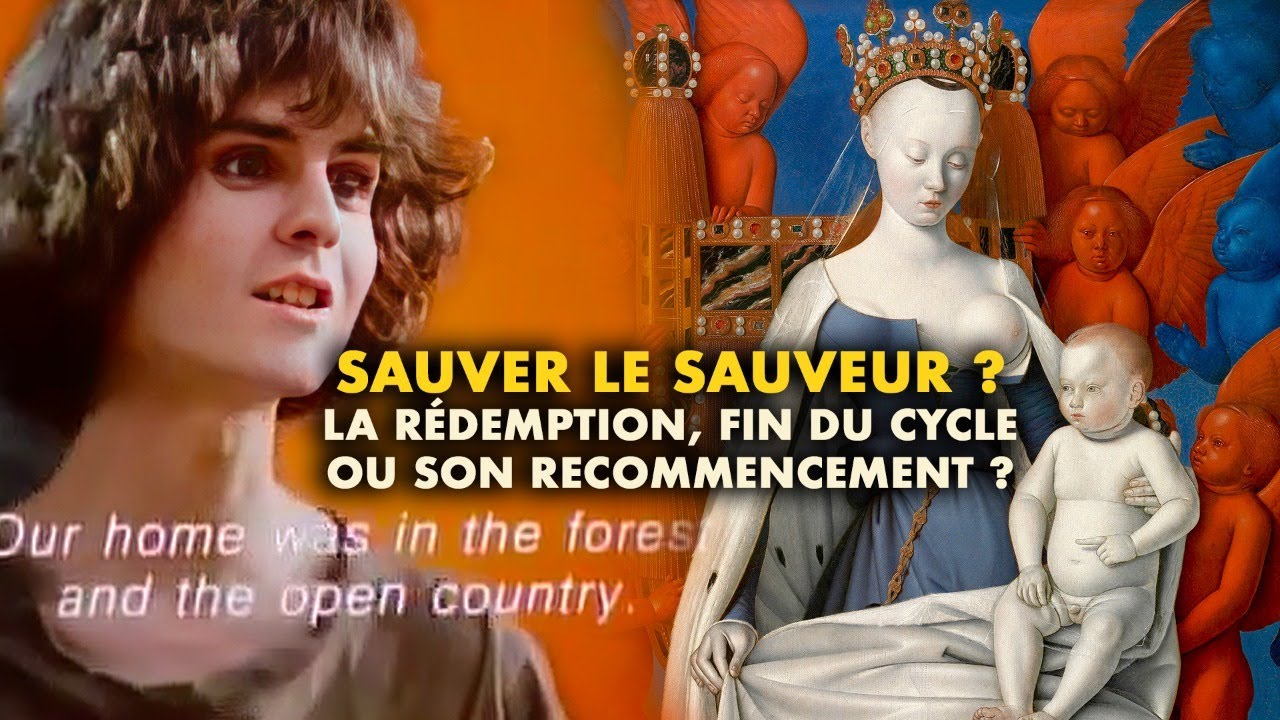
1:19:10 The vessel gathers the blood of Christ, as - look at the magnificent storyboard we owe to Pierre-Alain's editing this evening - Parsifal, whom we're about to see in a moment, stammering answers under interrogation, submitted to by Gurnemanz, comes as it were into this realm of the Grail, hyper-ecological, where it is forbidden to inflict the slightest wound on the smallest animal.
1:20:00 He appears, splattering with blood the immaculate whiteness of a swan, the swan of the Grail - not just a swan, the swan of the Grail, note the definite article. And when he is questioned about this deed before the terrified, traumatised people of the Grail, he answers 'I don't know, I don't know,' until he finally gives a positive answer when he speaks of his mother.
1:20:36 And so I return to the storyboard, the magnificent montage Pierre-Alain made to allow it to be shown - I didn't make it - this evening, where we see Parsifal at the moment, we'll see it quickly now, I'm telling you quickly: 'Where do you come from?' 'I don't know.' 'Who showed you the way?' 'I don't know.' 'What is your name?' He hesitates a moment, he says, 'I've had many, but I don't remember any of them.'
1:21:09 We'll have to wait until the second act, an hour and a half later in operatic time - even if it's an anti-opera as a form of representation - we'll have to wait an hour and a half for his name to finally be spoken by Kundry, the seductress. And for the first time Parsifal hears this name he had completely forgotten, the name by which his mother called him when he was the little wild child raised in the forest, far from the clashes of war, the hatreds. You know there had been trouble.
1:21:41 In choosing this theme - well, choosing this theme - it's possible we're distracting ourselves from the one theme that should occupy us, which is the danger of war that threatens us, like never before. I'm going to turn 80 next year; when I say like never before, to my knowledge - I lived through the Cuban missile crisis, everything you like. I told you we wouldn't spare ourselves much, so much blood, so much carnage.
1:22:20 So at the moment when they ask him these questions, 'I don't know, I don't know,' and then they show him the swan, there's an almost sadistic scene of shaming - they make him look at its glassy eyes, its feathers matted with blood, to the point that he suddenly breaks his bow on stage. And we understand at once that this is a boy who doesn't really know what he's doing, who isn't fully in his right mind. And when, after the swan is carried off with its little funeral march, the poor animal, the old knight Gurnemanz returns to his questioning: 'Tell us at least one thing you know, it's not possible to be this stupid.'
1:23:07 'Thank you' - Falstaff-like, animated - 'I have a mother.' And facing this, you see, at the moment he says this, it corresponds to the left side of the photo that blazons - to borrow a theme by which Baudelaire characterised Wagner's leitmotifs - at the moment he says 'I had a mother,' we suddenly see his face, for the first time, light up, brighten, against a red background that lights up, in any case. And opposite, what do we see? This incredible painting of that magnificent French school - I've gone to the Louvre solely to see paintings from that school, whether Fouquet, Clouet, portraitists between the 16th and 17th, between the 15th and 15th.
1:24:12 This is Fouquet, who made that famous portrait of Charles VII, which spares nothing of this indecisive, weak-willed king. Judging by the painting, a painting that hides nothing. And there, what do we see? We see the Virgin Mary, white, and we find again the two colours of the swan splattered with blood, with white skin, the queen white as a lily who sang with a siren's voice.
1:24:48 In one of the most beautiful poems by Villon, isn't it? 'But where are the snows of yesteryear?' And surrounded by red angels - not angels with a red sword or whatever, red or carrying a red banner. At most, red wings, angels whose whole body is red.
Sterile white, murderous red, pink as synthesis 1:25:20 We find again this dichotomy of white - purity, virginity - but non-dialectical. Yes, I'll come back to it. Do you think I've forgotten? Because, yes, purity is all very well, but if it remains so, it implies sterility, for the Virgin has no child. Generally speaking, I'm not talking about the Virgin Mary, that's rather supernatural. But as long as a woman keeps her purity, man's wife has no child.
1:25:56 The roses must appear on the lilies of her cheeks. That is how the poets of the Middle Ages pictured the ideal face, the one where red and white do battle on a face, with the play of emotions. And the synthesis of these two extremes being of course pink. And here, this wasn't planned, so I'll apologize again for leaving the frame, I know that makes people laugh, but I'm not sorry people are laughing.
1:26:37 And it's interrupted. But speaking of this synthesis of the two extremes, white and red, because red, well, we can't say it's sterile, but at the same time it implies violence and carnage. And the dialectic, the cursor, has to keep moving, I can't stay there because it's a purity, it's magnificent, it's tempting, but it's sterile.
1:27:09 Staying in the red isn't livable either, it's death, tragic death. Now, the message of Aurélia, you know, which is a bit the work where Nerval expresses his pathology the most, since it was on his doctor's advice, I'll go quickly because I had developed all that in a cycle on the angelic, and his doctor had told him, if it can relieve you to put your dreams into writing, which was very modern for the time, don't hesitate, and it's to this prescient doctor that we owe Aurélia.
1:27:56 There we go. There. Sorry. Before telling you this passage about pink as the synthesis of red and white, pink being the color of sentiment, we do say sentimental romance novels, mockingly, without suspecting the depth there is to it.
1:28:37 I am reminding you that Marie-Antoine Rieux, to whom we owe the publication of one of Michel Clouscard's last books, "Vers un nouveau progressisme," which is written in the form of a dialogue between her and Clouscard, Marie-Antoine Rieux being a philosophy teacher in Toulouse at the time. She said—we were present alongside Michel in Gaillac with her, and she had said, or rather we had gone to visit her in Toulouse with Edmond Janssen from Delga and myself, and she had said to Michel in front of us, so as testimony, she had quite a few daughters of immigrants, didn't she?
1:29:36 —taught in the Toulouse suburbs, she had said "thanks to your works, my beurette girls got back the right to be sentimental." I'll close the parenthesis, without further comment. But before getting to this synthesis I just reassessed, that of pink, which isn't as sentimental-romance as one thinks, look where an excess of red can lead—one of the most anguishing dreams Nerval ever had.
Reading of Aurélia: the charnel house of universal history 1:30:13 One night, I was speaking and singing in a sort of ecstasy. One of the attendants of the house—this is the psychiatric asylum—came to fetch me in my cell and made me go down to a room on the ground floor, these would be special padded cells in case of agitation, you see, where he locked me up. I continued my dream and although standing, I believed myself enclosed in a sort of oriental kiosk. I sounded out all its angles and saw that it was octagonal.
1:30:43 A divan ran along the walls, and it seemed to me that the latter was made of thick glass. Those somewhat familiar with the world, with the clinical world as we say, with the universe of clinical practice, know that nothing is more likely to provoke the most severe symptoms of psychosis, namely hallucination, than the presence of mirrors.
1:31:16 A divan ran along the walls and it seemed to me that these were made of thick glass, beyond which I saw treasures gleaming, shawls and tapestries. A moonlit landscape appeared to me—while she is in the dark, of a solitary cell, if you will, poor Nerval. Beyond which I saw treasures gleaming, shawls and tapestries, a moonlit landscape appeared to me through the trellises of the door, and it seemed to me I recognized the shapes of tree trunks and rocks. I had already dwelt there in some other existence. I believed I recognized the deep caves of Ellorah within it.
1:31:57 Little by little, a bluish light penetrated the kiosk and made bizarre images appear. I then believed myself to be in the middle of a vast charnel house where universal history was written in strokes of blood. You see that the vision turns into a nightmare. The body of a gigantic woman was painted before me. Only, its various parts were sliced as if by a saber.
1:32:29 The symptom of the fragmented body, look at Hieronymus Bosch's painting. Fools who think Freud was there already—my God, what repression! Only, its various parts were sliced as if by a saber. Other women of various races, whose bodies dominated more and more, presented on the other walls a bloody jumble of limbs and heads. It's appalling. From empresses and queens down to the humblest peasant women, it's the history of every crime.
1:33:13 And it was enough to fix one's eyes on such and such a point to see. Here, I said to myself, is what the power deferred to men has produced, the eternal type of beauty, so that the races lose more and more in strength and perfection. You see I'm going to sound a bit like an ecologist, but it goes without saying as you know the text. And indeed I saw on a shadowy line slipping through one of the openings of the door the descending generation of the races of the future, when at last I was torn from this dark contemplation by the kind and compassionate face of my excellent doctor.
1:33:55 He arrives just in time, that one. Well, that's the red, that's one of the extremes, isn't it? So there we go, there we go, there we go.
1:34:32 Excuse me, but I can hardly see this evening, it must be fatigue. There.
Reading of Aurélia: the celestial family in white and pink 1:35:35 Don't forget what I was trying to illustrate. I may seem to be indulging in fantasy by dwelling on the two extremes of white and red. Although, as we saw in the painting, it's striking. Don't forget that these are the colors of many flags. Let me say at random, Japan, Switzerland, Poland. The colors of Saint Catherine too, the martyrs of Saint Catherine. Anyway. And here, it's much less dark than what we just saw, it's almost paradisiacal, on the contrary.
1:36:10 Nerval arrives in a kind of ideal society that he saw in a dream, at the summit—well, these are visions, the overflow of dream into real life. Visions are visions. An ideal city, somewhere, as in the Caucasus, elevated, far from the world's clamor, but not primitive, where the people have kept... primitive customs, but with an extremely advanced level of science and technology. Never mind that for now, it's just to give you the context of what follows. And he has a guide, a bit like Dante has Virgil guiding him through Hell, here we are almost in paradise.
1:37:03 And let me first tell you about this society in question. Without asking my guide anything, I understood by intuition that these heights—and at the same time, when it goes forward—at the same time, these depths were the refuge of the primitive inhabitants of the mountain. Always braving the invading tide of accumulations of new races, they lived there, simple in their customs, loving and just, skillful, steadfast and ingenious.
1:37:37 And peaceful victors, peaceful victors, not by shedding the blood of the blind masses who had so often invaded their heritage. Neither corrupted, nor destroyed, nor enslaved, pure, though having conquered ignorance. And then in The Flowers of Evil, Baudelaire says that one must sink execrable things into the well of oblivion enclosed in darkness, but vice does not have science for its mother, and virtue is not the daughter of ignorance.
1:38:15 A quotation from Agrippa d'Aubigné, sixteenth century. So: 'Children amusing themselves on the ground with crystals of shells and engraved goblets, making of it a kind of study, ideal society. An older but still beautiful woman was occupied with the housework. At that moment, several young people, boys and girls, several young people, came in noisily.'
1:38:45 As if returning from their work. I was astonished to see them all dressed in white. But it seems this was an illusion of my sight. To make it perceptible, my guide began to draw their costumes, which he dyed in bright colors. But where do you find that outside of Nerval? Making me understand that they were in fact like that in reality. The whiteness that surprised me perhaps came from a particular brilliance, a play of light in which the ordinary shades of the prism blended together.
1:39:29 I went out of the room and found myself on a terrace laid out as a flowerbed. 'What? They're not electric, they're white, that's all!' And there, that's the continuation. 'Laid out as a flowerbed, there young girls and children were walking and playing. Their clothes seemed white to me like the others, but they were adorned with pink embroidery.'
1:40:06 The difference between poetry and mathematics, forgive me for tirelessly repeating this formula, is that poetry is... I don't know exactly. 'Young girls and children were walking about, their clothes seemed white to me like the others, but they were adorned with pink-colored embroidery. These people were so beautiful, their features so graceful, and the brightness of their soul shone through their delicate form so vividly that they inspired in everyone a kind of love without preference and without desire, summing up all the intoxications of the vague passions of youth.'
1:40:47 I cannot render the feeling I experienced amid these charming beings who were dear to me without my knowing them. It was like a primitive and celestial family, those who are dressed in white with pink-adorned embroidery. It was like a primitive and celestial family whose smiling eyes sought mine with gentle compassion. I burst into hot tears, as at the memory of a lost paradise. There I felt bitterly that I was a passerby. You know that Novalis says in a fragment, when one dreams, what one dreams is that one is going to wake up. There I felt bitterly that I was a passerby in this world both foreign and cherished, and I shuddered at the thought that I had to return to life.
1:41:38 In vain, women and children crowded around me as if to hold me back. Already their ravishing form was melting into confused vapor, their beautiful faces were growing pale. We go back from pink to white, and their sharp features, their sparkling eyes, were fading into a shadow in which the last flash of a smile still gleamed.
Screening of Parsifal's interrogation 1:42:09 There. The matter of the Grail is... I would still like to move on now... Last time, we saw, in a video sequence, in the world of that piece, all of a sudden, a tumult describing how someone has just been killed. He will come back carrying the swan pierced by an arrow, the swan of the Grail, when no animal must be touched, and especially not that swan which delighted everyone who saw it mirroring itself in the azure waters of the lake.
1:42:49 And they carry it, and that's where the extract more or less ended, on Gurnemanz's question, wasn't it? How could you commit this crime? And we immediately see that he's a simpleton. When he answers 'I shoot at anything that flies.' It's still a strange dialectic, that the one who is going to be the savior — I say this before we play the extract — is not the old knight who admirably knows his sacred history, who knows where good is, where evil is, and who tells the whole story that I tried to detail for you in part, to the young squires.
1:43:33 It's not fair. It's the one who commits the fault. It's very dialectical. I'm going to ask Pierre-Alain to play us the first extract, 'A.' The one that corresponds to the letter A. Well, actually, before we play it, we hadn't seen what follows. What follows is the famous questioning, isn't it, where the answers are all negative until he says 'I have a mother.' Let's go.
1:44:14 You could murder... here in the holy forest whose silent peace surrounded you... the peace of animals we do not hold sacred... greeting you joyfully, tame and trusting.
1:45:30 ...so let me shed light on your misdeed. ...that you did not see. ...you laughed, so wildly childish, shot down this morning.
1:46:53 [Singing]-Groch[chchchchchchchchchchchch...] ...not.
1:47:53 ...where do you come from? ...I do not know that. ...Who is your father? ...I do not know that. ...Who sent you this way? ...I do not know that.
1:50:27 ...I made it myself from a bough, to scare off the wild eagles. Yet you yourself seem noble and highborn. ...Why did your mother not have you taught to use better weapons?
1:50:57 ...the mother bore the fatherless child, when Gamuret was slain in battle; to guard her son from a like early hero's death, she raised him, unacquainted with weapons, in the wilderness, to be a fool.
1:52:47 I see that the signal is reacting. So what should I do? Yes, but I don't have the picture. All right, all right. I'm sorry for these inconveniences, I think it's the signal — since this is a shared house where I am, there are often new arrivals and so too many...
1:53:27 There are too many devices connecting that disrupt the signal. But I'll see you again very soon for the continuation of this rich session. Thank you in any case for being here. I won't forget any of your questions and I'll be happy to comment on your comments. Pierre-Alain, and see you very soon.