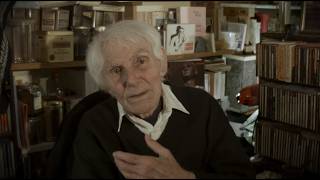
 Season 14 · 13 Apr 2026Language and thought: The case of Lavoisier
- 36:58The mathematician leaves behind the ambiguities of words for a language of signs, univocal, where one advances safely.
Worked through in 5 videos · 6 passages.
Dominique Pagani distinguishes mathematical discourse from language: it is discursive without being a language, because it excludes metaphor and remains univocal12. The mathematician leaves behind the ambiguities of words for a language of signs in which one advances in safety3. He sees in it the origin of a split specific to Western thought: an epistemic discourse that renounces ordinary language, as when the notion of weight replaces the qualities of heavy and light4. He holds mathematics to be the hard science par excellence, but not a science of nature: it is the logic of the arbitrary object5. He situates philosophy in relation to this model. The philosopher seeks the same rigour, but with everyday words1, and philosophy has no need of mathematical formalisation6. Formalisation nonetheless remains central within mathematical discourse itself2.
Summary produced automatically from 6 of the passages below, to be reviewed; the numbers link to the moment in the session.
Season 14 · 13 Apr 2026Language and thought: The case of Lavoisier Season 9.1 · 17 Dec 2020#9 Benefits and harms of amnesia...
 Season 6 · 23 Oct 2019#6.1 • The Logic of the Subject • season 6 / 2019-20
 Season 2 · 15 Feb 2016#2.1 Between crisis and war: Philosophising?
 Series · 29 Jan 2016What is to be done? 2/3