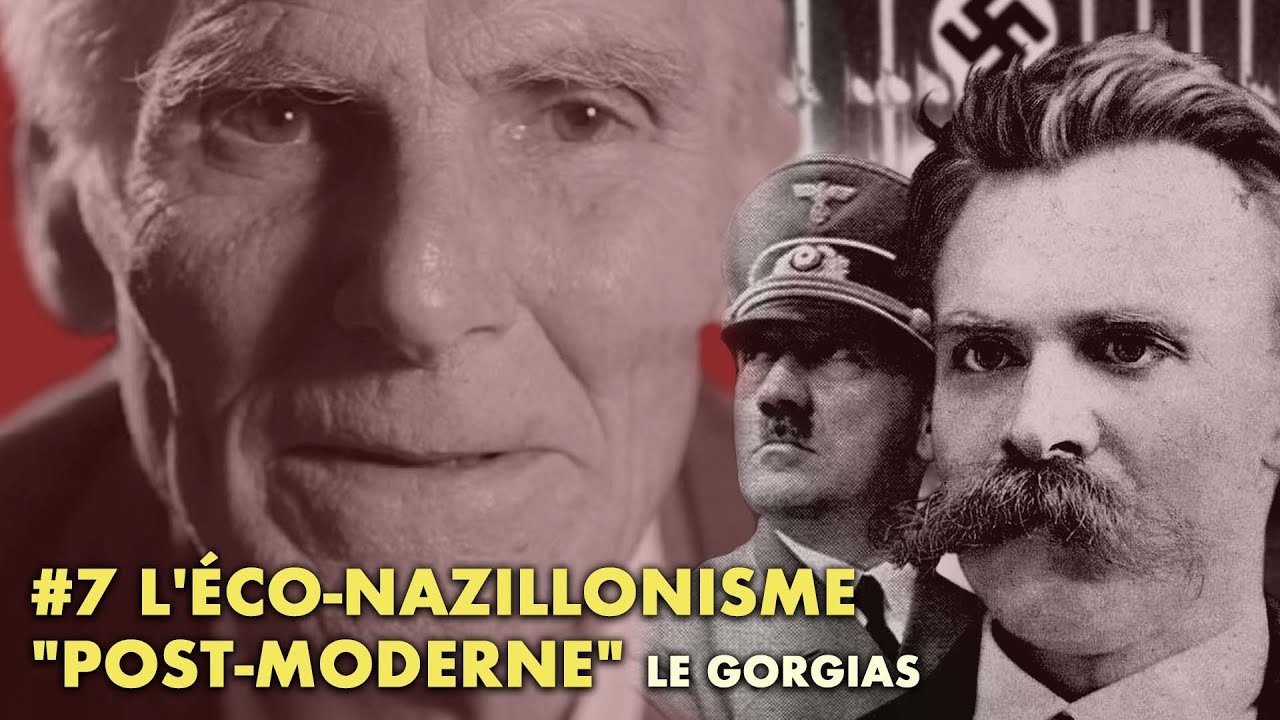
English translation of the French transcript, made with AI and not yet proofread — click a paragraph to jump to it. Show the French original
Julien Rochedy: why be Nietzschean 0:00 So I've tried to summarize seven main reasons that lead one to be Nietzschean. First reason: being Nietzschean gives you an aristocratic ideal of life. Now, what is an aristocratic ideal of life? Obviously, if you went through public education and were poisoned by egalitarian neurosis, then of course, for you, 'aristocracy,' 'aristocrat' sounds very bad to your ears, because it evokes powdered fellows who think themselves superior to others because they have more money.
0:39 So the Nietzschean aristocratic ideal of life is one that already allows you to see clearly, to manage to discriminate between what belongs to the mediocre and what belongs to the good, that is, to the best, the noble, the great, the valorous, to what has value. Because we were raised largely on a division of values between good and evil, whereas the aristocratic vision of life divides values more between what belongs to the good, the fine, the noble, and the mediocre, the low, what should have no part in your life.
1:18 And that's something Nietzsche really taught me completely, even though of course in the classical education we may have received, these elements are present, and these elements are even almost natural to human nature, often anyway, notably regarding everything related to beauty, everything that carries the value of nobility—we're all capable of knowing, of distinguishing between what belongs to the strong and the weak. But Nietzsche is really the one who shows you that in fact almost everything great, noble, and useful that has been done in this world was done by values that always emphasize demand, that always emphasize distinction, that always emphasize strength in the noble sense of the term.
2:02 And once you've read Nietzsche and made his philosophy your own, well, you no longer see the world except through that distinction, that distinction between the mediocre and the good. And then you arrange your life to always pursue, as best you can, an ideal of beauty, nobility, strength, of great things, so that, once again, your whole being turns into light and flame, as Nietzsche said. Second reason to be Nietzschean—now this reason is very important—is that it lets you rid yourself of guilt.
2:39 In fact, Nietzschean philosophy—I won't tell you my life story, but Nietzschean philosophy and encountering it really allowed me to clear away the tons of guilt-tripping that had been attempted on me as a young European, young Frenchman, young white, French, heterosexual—everything that was pinned on me. Nietzsche is dynamite for what's called moraline, for the great moral speeches whose only object and only will is to make you feel guilty, to make you regret what you are, and above all to put obstacles in your path so that other people, obviously, can seize power over you.
3:17 Nietzsche relieves you of guilt because he shows you what actually lies behind morality, Morality with a capital M. One must clearly distinguish Morality with a capital M from everyday morality, that is, the way one behaves, the way one lives day to day. Having rid myself of Morality with a capital M does not mean I'm immoral in my everyday life—quite the opposite, very often. It's a philosophy of the right insofar as you always try to do your best in everyday life, to help people, to behave properly and nobly, but on the other hand, you can no longer stand all the great moral speeches delivered with tremolo in the voice, the leftist speeches, to put it a bit crudely—all those speeches that want to make you feel guilty for being what you are.
4:02 Nietzsche shows us everything that lies behind it, and it's not pretty at all. Take, for example, the speeches of men of the left, men who think they're acting for the Good with a capital G—well, very often, those who think they're always acting for the Good, that is, for Morality, exempt themselves from behaving like good men in everyday life. Whereas for us it's the opposite: we must behave like good men in everyday life, but on the other hand, all the universalist speeches about the Good on earth and Morality with a capital M, where one must always show generosity toward anything and everything—
4:38 As long as it concerns other people's wallets, of course—we no longer want these speeches. And as for the guilt-tripping I had suffered as a young white Frenchman in middle school, already as a little kid, when I wanted to be something other than what I was—well, all that, you end up laughing about with Nietzsche. And honestly, they wanted to harvest my tears; afterward, throughout my whole life, all they got from me was another liquid. You see, they never managed to make me cry again.
5:10 Now, with Nietzsche, we get rid of the crude guilt-tripping that's laid on the West's back. Third reason: Nietzschean philosophy gives us radical clarity about ourselves first, and about others. As I was telling you, Nietzsche shows us what can hide behind morality. But he doesn't just show us what hides behind morality—above all he shows us what hides behind all the great ideas, all the little reasons we give ourselves for living.
5:44 So in fact, Nietzsche lets us understand that behind the what, there's always a who. Behind every idea, behind every justification, behind every piece of reasoning, behind every ideal too, there is an individual. Behind the puppet, there's a real body, a real human body. And often, behind that human body, there are its demons. He's really a psychologist, in fact. He's one of the greatest psychologists in history. It's a psychological philosophy. Most of what we think are pro domo justifications of our deep being.
6:17 Our being has instincts, our being has a materiality, it has desires, a will to power. And in fact, because we don't want to see it clearly and lucidly, we tell ourselves stories, we impose a narrative on our own life. And Nietzschean philosophy allows us to see ourselves in a mirror and to see ourselves naked. That is to say, well, when we're for example jealous of someone, when we feel like disparaging someone, well, Nietzschean philosophy, for example, lets us understand that if we disparage that person and find plenty of good reasons to disparage that person, it's because in fact the reasons we're using very often are covers for something else, for deep instincts that conceal real jealousy, for example.
7:03 Very often, we need to deceive ourselves. We need to deceive ourselves in order to be able to move forward in life. Barrès said that one day we'll all know ourselves so well that we'll all see very clearly that we're nothing but fools. I really like that phrase, and in a way it's true. If you spend your time self-examining and analyzing yourself, in the end a kind of relativism can arise in you, and nihilism can take hold of you. But that's the negative side of things. Now, if you manage to turn that lucid, extra-lucid force into something positive, on the contrary, it can give you incredible strength, extraordinary abilities not to be fooled by others and, by yourself, to know exactly the springs that drive you, in order to be better—better in your personal life, in your individual life, and also in everything you might launch as a project, as an enterprise, everything that can project your being into its will to power.
8:03 This joint victory of reactive forces and the will to negate—Nietzsche calls it nihilism, or the triumph of slaves. Our masters are slaves who triumph in a universal becoming-slave, the domesticated man, the buffoon. Nietzsche describes modern states as anthills where the leaders and the powerful win out through their baseness, through the contagion of that baseness and that buffoonery.
From the Nietzschean YouTuber to Plato's Gorgias 8:44 Good evening everyone. I'm sorry, I'm the first one appalled. I made a mistake in choosing the reciter we just heard, if I may put it that way. But given the length of the selections we'd made from the interminable spiel. So, I'm sorry, because it's already painful to listen to. There were two fragments of about one to three minutes each.
9:17 My mistake—I'm sorry for sending the wrong figures to the control room and to Pierre-Alain. But, on the other hand, it's hard to believe one's ears. I'm not talking about the eyes, that's not my concern. It's striking that he spends his time... And I spared you the prelude, or rather the beginning of his—I'm paying him a compliment when I say prelude.
9:48 The beginning of his video, where he tries to plug his book, there. On Nietzsche, of course. And I spared you that. But because, in it, he spends his time saying that what he likes about Nietzsche is his relevance today. Now, everything we just heard—I'll move straight on—it's going to rinse our ears out a bit. I'll move on, not to different content, I'm sorry for you, it'll be the same again. Denigration of slave morality, of egalitarianism, etc.
10:18 But this is a text from 2,500 years ago—it's Plato. So, for now, I'll be quiet, I'll take up the floor again after Plato. The same theses, but nevertheless written by the greatest artist in the history of thought. Let me read it to you, if you don't mind. Let me just say first of all, as a preliminary—don't worry, this isn't a detour—that Callicles bursts in like a jack-in-the-box in the middle of the dialogue, at the moment when Socrates has just defeated in discussion, in front of everyone's minions moreover, because there's a small audience of groupies all the same, with all these people who were famous at the time.
10:59 Gorgias is one of the richest and most influential sophists in Athens at that time. Polus, all these people, they existed. The only one who didn't exist, whom Plato invented, is the character of Callicles—as if the others weren't contradictory enough, didn't hold up well enough. Indeed, Socrates went and found someone who spoke without varnish and without human respect, as some translations put it. So he defeated Gorgias, who charged very dearly for his teaching of the art of oratory.
11:37 In fact, these were people who taught the young wolves of Athens, the young gilded jackets if you prefer, gilded youth, however you want to put it—who taught them 'what must one say to convince a crowd to elect us?' You see, it's exactly the same, it's still relevant today. I mean, you'd say the media—those who... But I won't specify their profession too much, because that's the subject of the dialogue, so I don't want to give it away. A potter, that's clear; I don't know, a leatherworker, that's clear; a cobbler, as Plato says; a sailor, that's clear; a pilot; a baker—but what do those who teach this to young people occupy themselves with, how to speak in order to convince others?
12:17 And so, to hold power through them, through speech. And this matters enormously, given that we're in a city where what grants power is decided in the Assembly, where people speak. This isn't Egypt, where it's the Pharaoh; it isn't the Emperor of China; it isn't the King of Kings of Persia—there's a bit of progress, though it's still not good, since 20% are free men. And the rest are slaves, roughly, as a proportion, depending on the era. But in this community, I mean, things are decided as a result of speeches, of logos.
12:59 There we go. So, I return—he has defeated them, and Callicles is furious; he's a young wolf, a disciple of Gorgias, and he can't believe that his master got tangled up in his own contradictions by Socrates, who, mind you, doesn't ask for a single cent, a single drachma, to pass on his approach to problems. So, and that's when he explodes and says: certainly, it's the weak, the mass of people, who establish the laws—yes, one gets the impression we're extending Rochedy's thinking, but the style is different, I'm sure of that.
Reading of Callicles's tirade 13:38 So it's according to their own interest that the weak—that is, you and me, roughly speaking—make the laws, that they distribute praise and blame; they want to frighten men stronger than themselves, who might be superior to them. It's to prevent these men from being superior to them that they say it's shameful, that it's unjust to have more, to possess more than others, and that injustice consists precisely in wanting to have more, because what pleases the weak is to appear equal to such men, even though they are inferior to them.
14:14 And when we say it's unjust and shameful to want to possess more than most people, we're speaking with reference to the law. But, on the contrary, it's evident to me that justice consists in the best man—which is what we'd have called earlier the aristocrat, that's the literal translation of 'the best'—the best man having more, possessing more, than the lesser man, and the stronger having more than the weaker. The best, strength, all that is a bit vague for the time.
14:46 Everywhere, that's the least one can say, it is so. That's what nature teaches. Nature comes rushing in, as soon as we speak of force—the first concept one learns in physics is force. But there, one is right, because there we're talking about nature. Nature, in terms of the balance of forces. And not the social contract or law. These antinomies matter—but let's not stray, we'll have plenty of time to discuss them. Let's continue the text. Everywhere it is so, that's what nature teaches among all animal species. That becomes relevant today, because we're constantly being bombarded about what nature supposedly teaches us.
15:19 I'm going to go listen to the trees talk. I saw a publication recently claiming they think better than we do, apparently. Among all human races, and in every city, if the stronger dominates the weaker and is superior to him, that is the sign that it is just. That, you see, is called reducing right to fact. What justice did Xerxes, you know, the king of the Persians, use when he attacked Greece with his army? Or his father Darius, when he made war on the Scythians?
15:49 And yet, these are only two cases among thousands of others one could cite. Well, Xerxes and his father acted, I'm sure, in accordance with the nature of right, that is, in accordance with the law. Yes, but not with the law of justice, no, no. By Zeus, with the law of nature. You see how many times nature comes up? But they certainly did not act in keeping with the law that we establish. You see, there's already this divinization of nature and this denigration of man, which is very current, and which is taught to children day after day in documentaries.
16:20 And poor frogs that cars run over. No one ever tells them that the biggest cause of death in the world is malaria, transmitted by a mosquito—organic, I guarantee you. Among us, the best and strongest beings, we begin to shape them. That's exactly what Rochedy says. You see, the national education system that poisons us—that was Rochedy's own term. From childhood on, we teach young people fear and resentment. Look, I'm in the process of telling you what Rochedy thinks is the most current, even postmodern, thought.
16:53 That very thought, 2,500 years ago, was represented with far more brilliance by our little Nazi Callicles—but let's continue. Among us, the best and strongest beings, we begin to shape from their earliest age, the way one tames lions. You see, with our magic formulas and our sleight of hand, we turn them into slaves, by constantly repeating that one must be equal to others and that equality is what is beautiful and just. But I'm sure that if it happened that a man had the right nature—nature again—to shake off all this rubbish, to smash it to pieces and free himself from it—which is what Rochedy talked about earlier, undoing guilt—if that man, who was a slave, stood up and appeared before us as a master, then, at that moment, the right of nature would shine forth in all its brilliance.
17:46 There, end of quote. I'm citing this text to show you how ancient postmodernity really is—2,500 years old. So, who's speaking there? A young wolf, part of that youth of Athens who have little to do, who are, all of them, enslaved in their little community of free men, but who, on top of it, visibly is a very anxious slave, very anxious about the rest of society, isn't he?
18:16 It's striking to see him say we're surrounded by people telling us that wanting to have more than the other, wanting—that it's shameful, that it's slave morality, whereas on the contrary, in the city of his time, what was normal was, on the contrary, to belong among the masters, to belong among those who work, as you and I do now, that is, who do the theoretical work, leaving to the slaves the job of making sandals or clearing away what's left of the banquet.
The post-moderns and their Nietzschean vulgate 18:56 I insist a lot, let me come back to a few details concerning their master—their master, I say 'their' with an S, because, sorry, their master Nietzsche, singular, excuse me, but I mean their master, all of them, you know, those who are cited as a central and, so to speak, zenith reference for more than two generations now, whether it's Deleuze, whether it's Foucault, whether it's Onfray—I'm putting together people of very different caliber.
19:26 Deleuze is a serious philosopher. To me, he's a scoundrel, but an intelligent and cultured scoundrel. There you go. Foucault is a clever man, but one can discuss with Foucault, I don't know, determinism and freedom. Fine, and with Onfray, I won't stoop as low as Rochedy—there's a whole range. But, I assure you, if I cited him, it's because there's a common set of stock ideas, you see, which is the same whether among those who are academically accomplished, who have their academic credentials so to speak, and those who are simple YouTubers like me—I'm just a modest YouTuber.
20:09 What circulates is the reference to Nietzsche. I mention them like that—the main ones, Foucault, Deleuze, Onfray, Derrida. That's really what counts most in the contemporary thought of the post-'68ers. I'm choosing my words carefully; I didn't say '68-ish,' I mean—I'm delighted that in '68, it's not the minimum wage that only rose somewhat, it more than doubled. I'm glad that trade union rights within companies were established, and so on.
20:42 I'm not mixing up—it's actually more June, by the way, after the Grenelle Accords—I'm not mixing up the '68 of the workers with that of the sophists, of whom I listed a few characters. It might seem like I'm being reductive, but look, when he says, at the end of the text I just read, 'But I'm sure that if it happened that a man had the right nature to shake off all this rubbish, to smash it to pieces and free himself from it, if that man could trample underfoot our grimoires, our magic tricks, our spells.'
21:18 Three words that are exactly what Nietzsche denounces. Nietzsche, in a different style—he's still the one who makes the German language resonate best in philosophy at his time. But still, it's a bit funny that he's treated as a philosopher, the way Rochedy does throughout his tape. Let me open a little parenthesis here, just to fit this in. After all, since we're talking behind his back, we should let him speak from time to time—Nietzsche, that is. There's a magnificent poem in Zarathustra that's central to the work, with several stanzas, quite long.
Nietzsche and the denunciation of afterworlds 21:53 I might do it as a text commentary one of these days. There's a refrain—Nietzsche knew music well—structured like a rondo. The refrain is this one: Zarathustra speaking to himself and saying, 'You, friend of wisdom'—meaning literally philosophia, you philosopher, you friend of wisdom—'come now, nothing but a fool, nothing but a poet.' It's even Nietzsche who will say elsewhere, 'I am weary of all poets, they trouble their waters so that they may seem deep.'
22:26 That side of Nietzsche isn't cited often, because it's a bit awkward to bring it up within Nietzscheanism. But here, I'm not an epigone of Nietzsche, I'm quoting him, I'm not talking behind his back. Now, what are we witnessing here? Nietzsche denounces what he calls the afterworlds, the back-worlds, and he says that doctrines of equality and all that, and the Christian religion which is part of it, you know—let me pick at random a passage from the Gospel, when there's the rich young man in the Gospel, Matthew for instance, who comes to find Jesus saying, 'Look, I've come to see you because apparently I'm within the law, I keep the ten commandments, etc.'
23:09 'What do I still need to do, according to you, to gain paradise?' And the other answers, 'Leave your possessions, follow me,' and the text adds, 'And the young man went away very sad, for he had great possessions.' It's a lovely passage. Well, there you go. And then, Christ is heralded by Saint John the Baptist. I sound like I'm defending the Gospel, but listen, I'm bound to defend the one who's under attack.
23:39 And John the Baptist is someone who wears animal skin and lives on honey and locusts in the desert—that's how he's described, isn't it? He's not at Herod's court. Now, what are we seeing here? What Nietzsche says—that this whole discourse is a kind of incantation and magic—those are exactly the terms Plato uses, five centuries earlier.
24:09 It's not Christianity—that's what's funny—to characterize what Nietzsche would call a will to power. The weak, lacking power, have a will to power. They exercise their power by intimidating the rich, by frightening them with punishments after death, etc. There, there—it's not a very complicated line of thought. But it's not really the content as such, because that's quickly grasped—it's not the content of the thinking that interests me here, it's the pretension these contemporary devotees have of acting as though it were new, current, modern, and even postmodern.
24:48 Right, that's what I wanted to make a short format about this evening. Yes, I apologized because I was leaving you facing Rochedy for a bit too long, but I should also have apologized for apparently changing the subject, even though I can see through your comments—it makes me very happy—that those who follow me most regularly and even most faithfully, and I thank them for it, can see that when I seem to be moving from one subject to another, in fact I'm always dealing with the same subjects if you look closely.
25:25 And here, precisely, it's because it's the holiday season that I stepped away a little from the Antigone series, and I had already stepped away last time, but for serious reasons which I maintain and which haven't disappeared—on the contrary, you see, there's the tension in the South China Sea on one hand and around Russia's borders on the other, and also the tension around our armies in sub-Saharan Africa.
25:56 I'm talking about it because nobody talks about it, and it's causing damage. There's a whole country where they're telling the French to leave, and no one ever talks about it, right? Or else they say it's only because the Russians are stirring things up, right? Anyway. So I have a few sources that make me think the problem is far from over. So, there you go, I had already interrupted the Antigone series at that point, and now I'm interrupting it again because several people have recommended YouTubers of the same water, if you will, of the same ilk as that poor fellow.
26:29 I say—I don't know—because even Nietzsche, Nietzsche, sometimes I feel sorry for him, you see, that is, we make him out to be a great stripper-away, a great demystifier, whereas he was riddled with complexes. Once, when he was quite young, he was still keeping company with the Wagner couple, he wasn't yet on bad terms with them, and he arrives at the Wagners' home—he was still a professor at Basel at the time, Nietzsche, etc. It's the same Nietzsche who, at the end of his life, would say he'd rather be a professor at Basel than God.
27:00 He didn't spit on public education, that one. So as soon as he had a free moment, on weekends, he'd go, you see, to enchant himself, literally, at the Wagners' house, who took advantage of it to ask him to run errands for the children. That's another story. It would take fifteen volumes, easily, or a dozen films. But once, Nietzsche knocks on the door—how old is he? He's 32. It's in the 1870s, roughly, a bit before '72.
27:32 and it's Wagner who opens the door for him, treading on his own feet as he walks. Wagner is 30 years older, he's already an old man, you see, what energy. It's Wagner, too, like Zarathustra, a dancer, right? I'm about to scandalize the Nietzscheans who all believe Wagner is the very incarnation of resentment, of Christianity, etc. And it's the period when Nietzsche is still antisemitic—because that too is never mentioned, since Nietzsche is undeniably philosemitic, as he says, for example, about a part of light and evil, that it would be good to revive pure Prussian blood with the blood of Jewish mares, I'm quoting—but he became philosemitic when he broke with Wagner, to put it in French, because of Cosima Wagner, who was pathologically antisemitic, at the very least.
28:27 Even though these things aren't reducible, of course, to the psychological realm. So, what strikes me is the continuity of themes. And secondly, the frequency—how could anything be more topical—of the word 'nature.' Stand in front of a pharmacy, anywhere, in Paris or elsewhere. Because in a pharmacy, that's all there is in the window. Natural products, trace elements, organic, it's...
28:59 So, I once said to a cashier at the pharmacy, there's nothing for me in the window, it's all stuff for losing weight—and naturally, at that. There. No, I'm serious, I mean, you can clearly see that when it's not nature that needs protecting, it's the planet. As if rocks needed protecting, right? Sure, there are dangers, there are threats, watch out—but it's humanity that is the danger. The planet will still be there, even when humanity—I don't know how many millions, billions of years from now—even in the scenario where we'd all disappeared because we'd been struck by fifteen meteorites, or even just one, for that matter.
The word nature: heredity and heritage 29:38 That's the size it deals, or through the nuclear madness of men, the madness of nuclear war, right? It will still be there. It fears nothing—how could what isn't alive die? Nothing to fear. Now, the word 'nature' keeps coming back. And here I'd like to draw your attention to something else that isn't said enough. Well, it's language that says it every day, but we don't pay attention to the language we use. It's terrible, because language tells us everything, if you look closely.
30:10 I'm thinking of the word 'nature.' You've seen how often it comes up. It comes up here. The man, the man, the master, is the one who acts according to the law of nature, that is, force, right? Which demands that the strongest—the best and the strongest—we begin shaping them from their earliest age, the way one does to tame lions. You see, taming means breaking the naturalness of the lion, of the lion cub, which drives it to devour its prey. Now, all of that is, for now, well known. What I'd like to draw your attention to, however, is the word itself, 'nature.'
30:42 Look closely at the root. N-A-T. We're less than 48 hours from what's called, in Italy, 'Natale.' Christmas. 'Nature' is indeed related to birth, to being born. What is natural in us is what we have, the baggage we're given at birth. That's no small thing, mind you—it's heredity. But there are those who would like to reduce all inheritance to heredity.
31:12 Or rather, who would like to blend into an indistinct confusion what has been acquired through millennia of effort, patience, work—what Hegel calls the patience of the concept. From chipped pebbles all the way to the particle accelerator. I'm also thinking, if you'll leave the philosophical register for a moment, of the magnificent Eighth Elegy of Rilke, where he addresses the angel—an important figure in Rilke's poetry, the angel—he says, angel, marvel, look, right?
31:54 pylon, sphinx, pyramid, the flying buttress of the cathedral, arched, in the foreign city or the familiar city. It is we who could do that. Marvel, angel. And my hand raised before you is like a refusal. For it is we who have been able to do such things. And then he continues his progression: cathedral—and music went even further than Chartres. Music surpasses Chartres. And even a lover at her window.
32:24 almost reaches to your knee. There are those who would like to reduce this inheritance to heredity. They begin the same way, 'héritage,' 'hérédité.' Beware—it's the things that most resemble each other that we confuse the most. You can confuse an African elephant and an Asian elephant. You would never confuse an elephant and a ladybug. That's why I insist. And nothing resembles us more than our reflection in the mirror. That's what looks most like us, apparently, even though everything is reversed.
32:58 Laterally reversed. So, I wanted to make this long parenthesis about the root N-A-T. What we have by nature, birth. And there you see the central place that heredity occupies in Nazi ideology. For example, I'm not making amalgamations here, I'm issuing warnings. I can't be more intellectually honest than what I've already said and what I repeat, namely that I might have been worse than Heidegger—myself, and that's no small thing—in the 1930s.
33:31 You see? And even worse than Nietzsche, who had some reasons not to be among the worst in that movement. But the difference with Heidegger, who persists and signs on even after the war, continuing to rail against the Russian, the worker, technology, the communist, etc. Anyway, I'll calm down. But I might have been worse, given the sociology of the era, the German petty bourgeoisie—I'll explain why in a small parenthesis, not a parenthesis that interrupts, on the contrary.
34:08 We're at the heart of the matter. Before France Musique existed, there was something that served the same purpose every weekend. It wasn't permanent like France Musique. It was on France 3, then it became Radio Strasbourg. Anyway, in any case there was a musicologist, Jean Witold—perhaps some of the older ones among you remember him—who told how, being of Jewish descent, he had been deported to a camp, I believe it was Struthof, the horrible camp that existed in Alsace.
34:39 And he recalls that he was guarded by an SS man in the courtyard who was playing Bach's partitas for solo violin. And every time, at the same passage, the SS man made a mistake, so that finally, unable to bear it any longer, he told him: 'F sharp.' It's Witold who tells this anecdote. The other one looked at him—a prisoner, a slave, does not address the superman, the 'Herrengeschlecht,' the race of lords.
35:13 'Are you sure about your F sharp?' Then they began to discuss it, and he realized he was dealing with someone knowledgeable, from whom he started taking advice. You see, one can be a music lover, know Bach, but of course there are still those who confuse aesthetic relevance with political relevance. Especially on the Nietzsche side, believe me, right? You saw earlier when I said 'everything that is most beautiful, most noble, everything that has value'—he never specifies. So people have said, 'What a beautiful tautology: value is the ideas of valorous men.'
35:46 Now we're well informed, aren't we. It's like saying 'Why does the car move?' Because it has within it a motive faculty. I mean, that would spare us the whole history of mechanics. 'Why does opium make you sleep?' Here, you know, I'm borrowing the superb passage where Molière puts this into the mouths of those doctors who answer the examiner. Because when there's an emptiness of thought, there's a fullness of words, right? 'Quia est in eo virtus dormitiva'—because there is in it a dormitive virtue.
36:17 That means there's something in opium that makes you sleep. Why does opium make you sleep? Because there's something in it that makes you sleep. That's exactly what 'value' means—the value of valorous men. Because we never know who the best ones are in all this, and who decides who the best are. It's like those who think there are also too many people on the planet. It holds together, it's coherent—I'm not jumping from one theme to another here. Look closely at the system rather than the themes one by one. It's systematic. If it's nature that is deified, and the vast majority of humanity has a slave morality that drags us downward, then indeed there must be some who are in excess.
36:54 Except that those who say this never count themselves among the excess. You'll notice, they never say 'I am superfluous, I'll kill myself and leave you be.' No, no, no. They say it's you and me who are superfluous. All right, let's be serious—I am being very serious, but let's be less peremptory and return to this systematics that occupies me this evening. When I alluded earlier to the balance of power, let me remind you that the first pages, at least the first 20 pages, of The Social Contract are devoted by Rousseau to this very notion of the right of the strongest.
Rousseau on the right of the strongest, the systematicity of the ideology 37:42 There's no coincidence in all these references. They all echo each other in these texts. The famous formula: the strongest is never strong enough to be always the master. That means he can be for a few instants, for a while. The strongest is never strong enough. Don't dream, gentlemen, you sub-Nietzschean postmoderns. The strongest is never strong enough to be always the master unless he converts his strength into right, and obedience into duty.
38:13 When I obey like that because I'm afraid of the master's whip, that's not duty. That's not pursuing a duty. It's not because I recognize a moral value. No, not at all. It's because I have no choice. And besides, as soon as he's absent, or as soon as he weakens, it's I who seize power. That's called a palace revolution. So there, I wanted to warn you against this ideology—not so much theme by theme, I repeat, I insist, but in its systematicity. It is based, above all, from the standpoint of its ideological underpinning, as we've just heard, whether in Callicles or in Rochedy.
38:51 So, let's not even talk about Derrida, Foucault, of Being—it is deeply based on an ontologism, an already-there that precedes man. You see? And in this case, of course, the first representation corresponding to this ontology, to Being—to speak like Heidegger, with a circumflex accent on the e—is nature. You see? You've seen how frequently the word recurs. And I'll spare you the whole dialogue, but still, there are passages—listen, I don't need to read a word because I told you we'd make this a short format, but still, at one point, Callicles says very clearly that there must be no discontinuity between natural law, that of force, and the law of the city.
39:40 That is, the city must submit to natural law, so that just as the vulture seizes the innocent ewe, just as the wolf carries off the lamb, so too should it reign among men. It's not just—the same law should reign among men. You see the consequences, more than terrifying. When I speak of 'little Nazis,' I'm not exaggerating. People always think I'm exaggerating, when in fact I'm well short of what's actually terrifying in reality. There. And as I warned you last time about the danger of war, well, there is indeed a certain continuity in my concerns, but I don't want to darken things too much this evening, given the approaching holidays—I don't want to paint too gloomy a picture.
40:23 But still, I'll ask you for ten seconds—I'm going to show you that the reference to force isn't limited to the contemporary period. Look closely. There. I've taken you—I've lost you, but you haven't lost me—here we are again. I'm taking up the Elements of the Philosophy of Right, which, as most of you know, is Hegel's political testament.
40:57 Well, it's considered as such, and that's not entirely wrong, even though it's a somewhat later text, which doesn't substantially change what's laid out here. Now, in this work, there are very few footnotes, but many remarks. It's often said that Hegel relegates the concrete to the remarks. That's also true in the Encyclopedia. But here, by contrast, there are rather few notes. And yet there's one that is very, very developed.
41:31 There. I think it's here. Excuse me. I wasn't sure I had the book with me. I'd lent it out, it's been returned to me. There. It's the note about Mr. Karl Ludwig von Haller, for those who know him, concerning the reading—sorry—in the chapter on the State. Sorry to waste time, but I'll find it for you.
42:15 I know it's not there, but then... There. So, you see, it's a really long note. And... You see, excuse me, I'm putting them side by side, you see, Hegel's text is here, and the note is this. You see, this and this. It's written in small type. I'm not going to read all of it to you, but still. Before the note, Hegel says this, right? Just—I'll give you the last sentence. It is still here the particularity of the individual that constitutes the principle of knowledge.
Hegel's response to von Haller 42:54 Only, it's no longer even a matter of the thought of this individuality, but on the contrary of the empirical individual, according to his contingent qualities—strength or weakness, wealth or poverty, etc. Doubtless such an intellectual taste for omitting what is infinite and rational in and for itself, for eliminating all general thought from the conception of its inner nature, has never manifested itself so purely as in—and he cites the work—The Restoration of the Science of the State, by Mr. von Haller. Good, and there he refers to the note by saying this.
43:27 The book cited owes its originality to the character mentioned. The author's bad temper, taken by itself, could have had something noble about it, in that it was fired up against the false theories previously mentioned—which is one of the weak points of The Social Contract, which thinks it's enough for individuals to associate, right, a slight confusion between the State and civil society, and above all against its attempts. But Mr. von Haller threw himself, to save himself, into the opposite—the opposite of Rousseau's thought, of the French Revolution, that, and he notes it—he threw himself, to save himself, into the opposite, which is total absence of thought.
44:01 So much so that one cannot even speak of content in his work. It is the bitterest hatred of all law. Listen closely, because here you'd think you were hearing the MEDEF. Of all legislation, of all right, formally and legally defined. It exists. There are too many regulations, too many laws. We must let things be, let them pass. Hatred of law and of legally defined right is the shibboleth by which fanaticism, weakness of mind, and the hypocrisy of good intentions reveal themselves and are infallibly recognized for what they are, whatever garments they disguise themselves in. I'm going a bit fast because I slow down when we get to the heart of the matter.
44:33 An originality like Haller's is always something astonishing. I'll give a few samples for those of my readers who haven't yet read the book. Now, attention, I'll give the floor to a postmodern from before modernity, or from the era when it was just barely beginning to bloom. Mr. von Haller first establishes his fundamental principle: 'Just as in the inanimate world the great oppresses the small'—you'd think you were rereading Plato, or rereading Rochedy. 'Just as in the inanimate world'—
45:03 This is the era of Christianity—the inanimate world, animals, nature. 'The great oppresses the small, the powerful the weak. Likewise among animals, and then among men, the same law reappears under nobler aspects.' And Hegel adds, in parentheses: doubtless also less noble ones. It's not less noble, alas. 'And that it is therefore the immutable and eternal ordinance of God that the more powerful must dominate and always will dominate.' You'd think it was still paraphrasing the same theme. And yet this is a jurist, mind you.
45:35 From 1815. Excuse me. Yes, and will always dominate. One can already see from this, then—it's Hegel taking up the point again—in what sense force is meant here. Not the force of the just and the moral, but contingent natural force. You see? Rochedy is an apostle of virilism, you know, of virility. Well, but contingent natural force.
46:05 Next, he invokes in support—among many other reasons—that nature has arranged, with admirable wisdom, that precisely the feeling of one's own superiority irresistibly ennobles character and fosters the development of the virtues most necessary for subordinates. He asks, with a schoolboy display of rhetoric—and here he quotes Haller—whether, in the domain of the sciences, it is the strong or the weak who most abuse the authority and trust placed in them for selfish, base purposes, and to the ruin of credulous men.
46:36 Whether among jurists and masters of science it is the legists and the pettifoggers who betray the hopes of credulous clients, who make black white and white black, who turn law into a vehicle of injustice. He held it against public education, that one—here he holds it against the administration of justice. Really, one can't just do whatever one wants with labor law. He asks, with a schoolboy display of rhetoric, well there—who make black white and white black, who turn law into a vehicle of injustice, reduce to beggary those who need their protection, and, like vultures, devour the innocent ewe.
47:12 End of quotation. Provisional. And Hegel adds here: here Mr. von Haller forgets that this whole display of rhetoric has precisely the purpose of supporting the proposition that the domination of the powerful is the eternal ordinance of God—an order according to which the vulture is quite right to devour the innocent ewe. Well, I'll stop there, to show you what—to arrive at a sentence that is in this note and that I quote often, from Hegel. Yes, it's in this note, it's in paragraph 258—I'll give the paragraph number because depending on the edition the pagination changes.
47:51 Paragraph 258, right at the bottom, contains the famous sentence where Hegel, impatient with the incoherencies on top of this emptiness of thought, says this, right: that after all, there's no need to waste time putting two thoughts together where there isn't even one. Which isn't contemptuous—it doesn't mean there's no thought at all, it means that for a thought to be intelligible and defensible, it must at least be free of contradiction, that it must be one, in the Latin sense, right, one and only one, and that one mustn't forget on Tuesday what one said on Monday.
48:24 There we are. Nietzsche can allow himself that; in Nietzsche, page 13 always contradicts what was said on page 12, and then vice versa. And so on throughout all his works. Except that Nietzsche honestly claims this—he says it clearly. He says, "I am not a philosopher," which matters. A little confidence between us, about Nietzsche—I say this too, I'm trying to make a reading guide for those who want to read Nietzsche a bit more intelligently. Good and evil are not Nietzsche's problem. True and false are not Nietzsche's problem.
48:56 That has to be left to science, the true and the false. And good and evil, that has to be left to those who haven't acquired the notions of good and evil through knowledge—neither in physics, nor in chemistry, nor in biology, nor even in philosophy. So in Nietzsche, the decisive pair of values is the normal and the pathological, health and sickness. He is terrified by the threat of illness.
49:26 For him, modernity, socialism, egalitarianism—these are symptoms of a sickness spreading through humanity. Like his devotees, who have less talent than he does and merely develop these ideas. The pathology, isn't it, in short a lack of power, isn't it, and who try to compensate for their weakness with numbers, with the mass. Let's come back to you and me, if I may, or at least to me perhaps.
The Gorgias, a tragic dialogue and Socratic rationality 49:58 There may be among you some who think they belong to that aristocratic elite Rochedy was talking about, but honestly, I doubt it. I come back here to Plato's dialogue, the Gorgias. I'll summarize it for you because the dialogue is very tight, but I recommend reading it. First, look, you can find it in the little classics collections, it's not very long. But it has a dramatic intensity unique even within Plato's work, and that's saying something. Fourth parenthesis. It doesn't have a direct connection to my point, but I want to say it because I know some of those listening to us are very sensitive to these issues, and they're quite right to be.
50:40 When you look at that precious compilation, which has a bit of everything in it, which is the first history of philosophy—I'm thinking of Lives, Doctrines and Sayings of the Illustrious Philosophers—that compilation made by Diogenes Laërtius in the late Roman Empire period of antiquity. Still, it's thanks to him that we have first-hand information: Anaximander supposedly said this, Parmenides supposedly said that... You know that almost all the texts of those people have been lost.
51:12 And if we have a body of work from Plato and an important one from Aristotle, it's because their thought already mattered so much at the time that they had many copyists. But why am I bringing up Diogenes here? Because when he gets to the chapter on Plato, which is one of the longest, he says—curiously, he places Plato not in the history of thought and philosophy, but in literary history. You see? And I'm going to talk about tragedy, because it's the most tragic of dialogues. But here we're talking about genres that are very codified.
51:44 When I speak of tragedy, it's not just an epithet added to make the voice tremble. It's very serious and very precise. He says this: at the origin of tragedy—"tragos" means "goat" in Greek—at the origin of tragedy there is the sacrifice. The sacrifice of... what's it called? There's an expression in French... Ah! The sacrificial animal.
52:15 The scapegoat. Thank you. Goat, tragos, tragedy. What's the connection with tragedy? Because the very first actors were the sacrificer. Look. Almost all the elements of the future theater are there. A silent, attentive crowd. The crowd of the city, of the collectivity, that is there. It could be deep in the Amazon jungle, doesn't matter. Or in the earliest stammerings of Thebes, Sparta, and Athens. The crowd is there, and there is a sacrificer character.
52:49 And Diogenes adds. Then Thespis added the responding chorus, as if the collectivity, from time to time, I don't know, dialogued with the soloist. Plato added an interlocutor and created dialogue. You see, Plato emerges in the history of poetic genres, particularly the dramatic genre. And particularly tragedy within the dramatic genre. I close my parenthesis. But this can be a very useful and fruitful avenue for many things.
53:20 Don't forget that Nietzsche's first publication is called The Birth of Tragedy, and it is dedicated to Richard Wagner. That's where we find the dichotomy of the Apollonian and the Dionysian. So I refer you back to this notion of sacrifice. And why? Because, as I told you, it's an extremely tense dialogue. We're on the verge of what we'd call a brawl.
53:51 Not like in the bars and the housing projects, among which I live in the suburbs—I'm not speaking familiarly here. And that's not, you can't distance me from that. But there it is, Callicles bluntly tells Socrates at one point, "If you weren't so old, you'd deserve a whipping." It's rare, you know, for a dialogue to reach such intensity, isn't it? Because at that point, it's over. When violence enters, we come back to my obsession with conflict and war.
54:21 When there is violence, that's the end of arguments, of argumentation, of rationality, of coherence, of reconciling viewpoints. It's too late. Yet when the dialogue continues, after he's made this apology for force, what does Socrates do? So I could summarize Socrates's response as... Yes. Fourth interruption. People often say, "Plato has it easy—Socrates says whatever he wants and the interlocutor just says 'Yes, perhaps,' 'Yes, certainly.'" Well, we mustn't exaggerate.
54:51 There is Callicles. He fills four pages with his speech. Four violent pages. And that's not the end of it. So Socrates answers him by "socratizing," that is, by returning to rationality, to the search for definitions and clarity, because we still don't know what it means, force. If he says, "What is force?" But indeed, what is force. Look at the animals. Physical force, first determination. If force is physical force, says Socrates, then the city, all united together, will always be physically stronger than the isolated tyrant.
55:25 Well then, of course, Callicles is a bit embarrassed. "Well, yes, but it's not just physical force. Socrates, there's also the force of the cleverer ones, the force of intelligence." You've heard that in recent years, haven't you? There are winners and losers. You know, there are the clever ones who succeed and pull off schemes to knock out those competing for the same tender, for a job application. It's cleverer. And when Socrates points out his contradictions, he explodes and says, "Socrates, you're tiresome because you always harp on the same thing."
55:57 And here Socrates answers something very important. I call on my logician and mathematician friends here, because the reference isn't immediately obvious. Socrates answers him, "But I reproach you for the opposite. It's that you never say the same thing. First you say force is the force of bodies, physical force. Then afterward you say it's the force of mind of the cleverest." What is he saying? He's showing what we... That's why I read you Hegel's note, isn't it? We mustn't waste too much time trying to put two thoughts together.
56:28 And besides, there where there isn't even one thought—that is, where thought isn't unified, where the speaker, the one talking, isn't aware of his own contradictions. There. Since I said I wanted to be brief, I refer you to this dialogue. Still, before leaving the Gorgias itself, the text itself—after which I'll pay attention to your questions—I'll remind you that this dialogue doesn't conclude. That is, Callicles isn't entirely convinced at the end, because we often say that in the end Socrates gets everyone to agree.
57:02 No, no, this isn't Hercule Poirot or Sherlock Holmes finding the murderer. It's not like that with Socrates, after all. That's not how Plato uses the figure of his master. It ends with incantations. Since Callicles isn't entirely convinced, Socrates, as often in Plato, resorts to myth. And it will end with myths of the last judgment, which, as for the rest, doesn't matter—he doesn't much care. There. But I wanted to remind you that in this dialogue—what is irreplaceable in this dialogue compared to others, I'm not saying it's more important than other works of Plato, far from it, but still—there is at once a political problematic of decisive importance and current relevance, and at the same time there is all of Plato's rationalist legacy.
58:00 And here again, I'm quoting myself—I believe I told a few friends, I believe I even said it in public once, that when René Comer was alive, when he made sure the table run by Clouscard in his restaurant was well stocked, he dreamed of a banquet in the Platonic sense where all the great minds in the history of thought would be present, and he'd say, "I'll arrange the tables, that's my job as a restaurateur, but there would be one big table in the middle, at the end of which would sit Plato and Hegel."
Hegel as reader of Plato's Republic 58:35 And the proof that he wasn't entirely wrong—because he was a restaurateur who had a library at home in Corsica, which was worth quite a lot—is that in the preface to the Philosophy of Right, all of a sudden, before taking leave of his readers—so this is roughly the late Hegel—Hegel refers to Plato and to the Republic. "In the course of this work I have pointed out"—this is in the preface, so he doesn't demonstrate it—"that the Republic of Plato itself, which passes proverbially as an empty ideal"—people often bring up the Republic as typical because it's the utopia, isn't it, this is how the city should be, the ideal city, in short, far from reality.
59:23 "In the course of this work I have pointed out that the Republic of Plato itself, which passes proverbially as an empty ideal, essentially grasps nothing else"—meaning those who say that miss what is essential and important—"nothing else but the nature of Greek ethical life." That means Plato, even without realizing it, his political thought expresses exactly the historical and political situation of his time, namely—let's explain—he became aware of a deeper principle than the one governing the Greek world, which was breaking into that ethical life, but which at that stage could only be an unsatisfied aspiration, and consequently could only appear as a principle of corruption.
1:00:02 Freedom and universality begin to become values. Plato, moved by this aspiration, sought a remedy against it. But since help could only come down from above, he could at first only seek it in an external, particular form of that morality. He's alluding precisely to Plato's struggle against the sophists, sophistry being one of the forms of the new subjectivity beginning to appear and to call everything into question, to deconstruct everything, as we'd say today.
1:00:34 "He could at first only seek it in an external, particular form of that morality, thereby believing he could master corruption." And I'll give you an example. In the Republic, Plato says no one is to leave the city as he envisions it before the age of fifty. Otherwise one might go pick up new ideas from others that would upset what had taken so much trouble to establish—it's a bit constraining, after all. Well: "believing thus to master corruption, and succeeding"—listen, this is great Hegel here—"only in wounding intimately what was deepest there."
1:01:07 Colon. And this is the modern world—it's the free, infinite personality. We're no longer in the world of the slaveholders, listen carefully. "And yet he proved that he was a great mind." We mustn't dwell on Plato's solutions in the Republic, we must attend to the spirit that animates this dialogue. I continue. "And yet he proved that he was a great mind because precisely the principle around which what is decisive in his idea turns is"—listen to this incredible sentence—the pivot, this principle I've illustrated for you: non-contradiction, rationality, you define first, before demonstrating; it's not a matter of you agreeing with me or me agreeing with you.
1:01:46 It's a matter of each one first being in agreement with himself. That's what's done in mathematics, for instance, isn't it? You start by laying down clear things, first notions, postulates, axioms, definitions, and you then try to advance statements that strive not to contradict what was admitted at the outset by the mathematician and by those to whom he makes his "demands," as Euclid put it—which presupposes the other's agreement, after all. You see there's a link between rationality and democracy. "And yet he proved that he was a great mind because precisely the principle around which what is most decisive in his idea turns is the pivot around which turned—"
1:02:24 —turned what else? Hold on: "the world revolution then in preparation." Colon. And here comes Hegel's most famous sentence, you can guess it: "What is rational is real, and what is real is rational." That doesn't mean that whatever is real is good and shouldn't be changed, as fools would have us believe—people try to make Hegel's thought say that. We had to wait until the 1950s for Éric Weil, with his thesis on Hegel and the State. He's not a Marxist. He himself saw that reducing Hegel to being the spokesman for the Prussian administrative monarchy was a bit much.
1:02:57 I've just told you that what he reproaches Plato for is having tried, powerlessly, to restrain the free, infinite subjectivity—to use Hegel's phrase—which was beginning to announce a new era, the era of modernity as opposed to antiquity. So there, I wanted to quote these two passages—a third one and I'll be done, and then I'll move to your questions—because I'm selecting the passages that show how anti-totalitarian Hegel is, at least in relation to those who absolutely want to make that word mean something rational.
Hegel against the innocence of the state of nature 1:03:37 which is not the case for Heidegger's groupie, after all—the most Nazi of philosophers. So the development, sorry, paragraph 185, I'll skip ahead—the independent development of particularity, the appearance of individualism in a society. You know, I know African societies where women are forbidden, listen to this, from thinking of their husband's name when they have their period.
1:04:08 If you forbade me from thinking of something, I'd automatically think of it right away—I mean, I pity them, how would one even verify it, but yes, because it has to be forbidden, because it's impure, and so they'll spoil the hunt, as they say in Africa, isn't it—if he starts thinking of his wife's name while out hunting, he'll come back empty-handed, etc. Well, I hold nothing against these peoples, who already have a hard enough time dealing with the nature around them and with neocolonialism, next to which old-fashioned colonialism and "Sansonnet's tuppence," as my grandmother used to say—I'd rather say bird's balls, well, those who don't have any, I should specify—"the independent development of particularity is the moment that manifests itself in the ancient states through the introduction of the corruption of morals"—indeed, in all traditional conservative societies, this is still what he's talking about, I don't know how to put it without getting scolded by my compatriots, but still, it isn't only flaws, there are virtues, these are societies, isn't it, where what matters precisely is tradition. I know a friend—I won't say her name, of course—who has two boys, 14 and 17, who have just converted to Christianity, it's a different religion.
1:05:19 So then one of our mutual friends asks them why they converted—she asked them, sorry, it's she who tells the story, why they'd made this decision—to conform to tradition. Well, a reason like any other, but it's clear that individual whim has no place in traditional societies. Now look closely at these states that still hold to the patriarchal or religious principle, or to the principle of a morality that is more spiritual but yet simpler, and which are generally founded on immediate, primitive intuition—there's a very fine analysis of traditional society here—"could not endure within themselves either the division of this intuition of the immediate"—that's coming—"nor the infinite reflection of self-consciousness upon itself"—the restlessness of the seeker, of the modern person, isn't it—"they succumbed to this reflection when"—it's starting—reflection is the opposite of thinking the immediate—"they succumbed, sorry, to this reflection when it began to appear in consciousness and then in reality, because their too-simple principle did not possess true and infinite force."
1:06:30 So here we're talking about force again, but you see it's not the same as physical force—true and infinite force, which is only found in the unity that allows contradiction—look how anti-totalitarian this is—that allows the contradictions of opposition, if you prefer, of reason, to develop in all their strength in order to then master them, which maintains itself within this contradiction while at the same time unifying it within itself. This is a text that matters, after all. Plato in the Republic—well, sorry, excuse me—and so, curiously, he goes on to anti-ecological considerations—yes, the word didn't exist, but listen, judge for yourselves whether I'm just projecting meaning onto it, look closely, paragraph 187: "the conceptions of the innocence of the state of nature"—well, my late Pierre Rabhi, I won't attack him, but I'll say may the earth rest lightly on him, as they say in Africa—well, no need, there are so many others, aren't there, still alive, pushing us toward degrowth, isn't it—she explains, that's it, the Malian woman, that we must degrow, that she absolutely must not have a sink, running water, and that she must keep doing her daily water-fetching chore—"the conceptions of the innocence of the state of nature, of the simplicity"
1:07:40 "of the customs of primitive peoples"—and on the other hand, antithesis—pay attention, this is pure Hegel, the dialectic, antithesis—think of Don Giovanni, we'll understand each other—"the pleasures and comforts of particular private life as absolute ends"—the libertine, if you prefer—"both of these have one and the same corollary"—well, well, these two opposite extremes, the dialectician sees what they have in common—so, we must beware—"the belief in the external character of culture"—everything that is collective, culture, history, what Hegel elsewhere calls spirit, heritage—as if it were something external that just comes along like that, as I said earlier, from childhood we treat our children as though we were clipping the claws off lion cubs, we regard culture, in the first case—I'm speaking here of culture in the anthropological sense, of course—that is, the collective element in what I say, what I do, what I think—I speak a language that is French with you, it's not me who decided that or codified it all on my own—so, "culture is regarded in the first case," in traditional patriarchal states, "as corrupting."
1:08:50 culture, distrust of the intellectual and so on—"and in the second case as a mere means"—you know there was an insult in decadent Rome, the old Romans who stayed loyal to the old Roman tradition of the peasant-soldier didn't hesitate to call educated men graeculi, meaning "little Greeklings"—roughly meaning, more or less, a bunch of faggots, excuse me, but that's really what it meant in their mouths, because for them, for the Latins, as soon as one was cultured in Greece—sorry, in Rome, one had a Greek slave one would call for, saying, "Come read us canto 23 of the Iliad," because people read aloud—so, "culture is regarded in the first case as corrupting, in the second as a mere means to my ends"—I don't know, I use my culture to pick people up, I don't know, that's not what he means—"either opinion betrays a misunderstanding of the nature of spirit"—you see how these three terms are linked, culture, reason, spirit, the universal so decried by the dead—"spirit has reality only insofar as it divides itself within itself, gives itself natural needs and relations"
1:10:00 "to external necessity as its limit, its finitude"—and yes, one would still always need to eat in order to live—"and precisely by forming itself therein, and thus overcoming this, it acquires its objective existence. The rational end is therefore"—watch how he sends both extremes packing—"neither this simplicity of natural morals, nor the pleasures obtained through civilization in the development of particularity"—isn't it, everything is fine, that's what I meant earlier, the extinction of all guilt, of everything that's a moral value that keeps me from reaching my ends, from enjoying the satisfaction of my desires—I'm following what these people's desires do—"in the development of particularity, it is on the contrary the synthesis"—watch closely, it's a way of thinking, an action of subjecting to a work of clearing—"the simplicity of the nature of knowledge and of will, or again immediacy and individuality in which spirit is shipwrecked, and of giving first to this externality the external rationality"
1:11:10 "of which it is capable, the form of universality, conformity to the understanding. Only in this way is spirit at ease and at home within this domain that is externality itself." You'll note that for an idealist, spirit is only at home once it has shaped an externality, isn't it, according to the mode of understanding and reason, once it has, in short, gotten its hands dirty—spirit isn't merely interior. Here again he rejoins Plato, because in the Phaedo, the dialogue where Socrates—yes, I know I'm delaying the answer to your questions, but I know this really interests me, what I'm about to say—the conception one shouldn't have of spirit, to understand what that means in Hegel—the most widespread conception is illustrated by a joke in the Phaedo: when Crito, who's a bit like the Saint Peter of Plato's disciples, the naive, dim-witted one, who says at the end, "That's all very well, but you haven't told us how we should bury you"—because in the Phaedo, his last dialogue, in the cell before drinking the hemlock, Socrates says, "However you like, on condition that you can catch me"—first of all—
1:12:20 and secondly, one of his interlocutors, when Plato has given a demonstration—there are several in the Phaedo—of the immortality of the soul, the harmony-soul—I'll go quickly—Socrates replies, "Your demonstration is interesting, but you see, I can't get rid of the fear that at the moment of my death my soul will disperse like a breath." Socrates says, well, let's resume the demonstration, on condition that we say a prayer to Aeolus that there be no wind that day. That's what it means to conceive of spirit, of the soul, and so on, as a matter somewhat more subtle than other matter—no, no, spirit is what is outside us, isn't it, it's our relation to others, and we're much closer to spirit when we look at concepts like Rousseau's general will, or Kant's kingdom of ends, isn't it, than when we try to imagine some kind of subtle matter hovering around tables being turned, isn't it—"Spirit, art thou there?"—well, because spirit—I'd answer, I'm not stupid enough to be there, I mean, well, there you go, that's the magic of our production.
Personal development, narcissism and reason 1:13:31 that is, Pierre-Alain's magic is such that—I'm going to look at your questions—it's extraordinary that at the time, isn't it, there's Raoul Le Bœuf, good evening Raoul, I'll take the opportunity to wish all our friends the best holidays possible, hoping that the holidays they'll celebrate with their loved ones and with whomever they wish will be the best they've had so far—I won't wish much more. "How can one promote the Hegelian rational becoming in the face of the pull exerted by personal development, which feeds on everyone's narcissistic tendencies, a simulacrum of spiritual quest?" There's a good question. I'll start with an answer whose objective and informative content I owe to our dear bookseller Dominique Mazuet, whom I greet in passing, isn't it, who runs, with the talent we know, the Librairie Tropiques, and has for quite a while now, who once told me, "It's because of this personal-development nonsense that bookshops make money, otherwise there's the children's section and personal development" to show—
1:14:41 —the topicality, and Raoul's question, isn't it, I'll answer Raoul that we need to go back to a Hegelian notion like the unhappy consciousness to understand what's going on here, after all, these things have spread like poverty over the poor world, to put it as my grandmother used to say, as our grandmothers used to say—mine was older than the average grandmother—and what has spread since the fall of the Berlin Wall—I repeat that I might have ended up in the gulag, I'm not defending anything at all here—I will always defend Putin's Russia against those attacking it today and who are ready to go all the way to war—look into it, what's happening is terrible, the buildup of forces stretching from the Baltic states to the Black Sea, I'll stop there, I devoted an episode to it and I'll come back to it, current events certainly won't spare us from returning to it, unfortunately—and so I defend it—
1:15:51 in that sense—but if I lived in Russia, and if it weren't threatened by the most powerful armada of all time, all the forces of NATO combined, including French forces by the way, and the missile batteries in Ukraine—well, it's not at all obvious that I'd vote for Putin—you've guessed that means I'd rather vote for something else—so let's be clear, it's since the fall and decline of the Marxist ideology that reigned tyrannically over the university—people made your generations believe that—we got out of it, and that's actually, you see, Rochedy's cry of relief, "enough with the guilt"—and I recall he's taking up a theme that was common among people a bit more cultured than him, the "new philosophers" as they were called, you know, who used to say, yes, we're sick of this Marxism that made us feel guilty—why be guilty about what?—it made the burnous sweat—one should decide—there are some who drop their masks without realizing it sometimes, isn't it—well, but above all, people made you believe—factual error, a lie—
1:17:01 no, no, a lie, easily, easily corrected on a more empirical level—that Marxism reigned, particularly in philosophy, in history—I guarantee you, but check for yourselves, never take my word for it, I hate anything resembling a guru, don't take my word for it, go verify—you could take the agrégation exam in philosophy, take it, and pass it, without ever having read a single line of Marx. Marx never reigned over philosophy. At the start of my studies it was rather Bergson; afterward it became a mix between Kant, Hegel, etc.—fortunately I got my degrees before Foucault and the others came in—but that's what dominated the university, not Marx, and I pay tribute here to my former research supervisor, Bernard Bourgeois, who is not of my political camp, who himself says he's a Hegelian of the right, and says so calmly—but the Gaullist right, which is less right-wing than Mitterrand's left or anything descended from it since—that is, what governs us now. You know what I often tell you: it's not that those who called themselves—
1:18:11 —to the left of the left, to the left of the Communist Party, so in '68, were in fact to the right of De Gaulle—and De Gaulle himself never proclaimed himself a man of the right—we arrive at an implication: that it was damned right-wing to be to the right of De Gaulle, and that is what now considers itself left-wing, isn't it—work it out for yourselves, I seem to be joking but unfortunately it's more serious than that—so I come back to this aspect of things regarding Raoul's question, when he asks how to promote the Hegelian rational becoming in the face of the pull exerted by personal development, etc., when irrationalist discourses are on the rise like that, isn't it—I should specify, there is a formidable rational thought within the dominant ideology, a part that seems rational provided one is imprecise about the terms—this matters, what I'm saying now, sorry, it's not for me to say whether what I'm saying is important or not, but still, I draw your attention at least to this point—it's the distinction—
1:19:21 Classic, if you know a bit about the history of thought, especially starting from Kant, of the understanding and reason. Rational comes from ratio, ratio means reason — when you take any Latin dictionary, ratio is reason. But reason is not what is at work in the sciences; what is at work in the sciences is the understanding, the intellect if you prefer. If... then... with if... then... you already have practically all of mathematics in potential — you just have to work it out. And that is the understanding; in the understanding there is no finality at all. Science doesn't like — science and finality: it's right, it doesn't have to concern itself with what ought to be, does it. So science doesn't have to concern itself with good and evil, with what are called values — myself I don't much like that word, because they say it's authoritarian societies, isn't it, who challenge our values — it's Russia, China, roughly speaking, Iran and so on. My values are not about a 16-year-old going to the electric chair while innocent, which has happened so many times, that's not...
1:20:31 It's not just the lynchings, the slaughtering like dogs of men of color by cops in Houston or elsewhere, isn't it, with no legal consequences, or so little that it's not even worth mentioning — except when it's convenient for a president to get elected on societal issues, which is still progress, but still. So, to come back to it, one must not confuse reason and understanding. Why do I bring this up? Because the two dominant currents of thought today, completely opposed to one another, are on one hand a neo-positivist scientism — and scientism has as little to do with science as the ecology I wish for, for once, listen to me carefully, I mean paying rational, collective and democratic attention to the problem of our environment, which is not limited only to nature. If they decide to tear down the Place des Vosges to build five McDonald's there instead, I mean, I might sign a petition, I'd sign it...
1:21:41 I mean, that's it. So again, there is this neo-positivism, this scientism which only retains reason when it applies not to us, not to morality, politics, history, but to things, to galaxies — very well, but then I stop, that's not my field. It's those who know no other logic than that of objects — that's the understanding. Above all there's no logic of the subject, of oneself — never, no, that's unknowable, no, you have to limit yourself — unless we reduce the self to stimulus, reflex, brain imaging, enzymes, then fine, we're back to objects. As Auguste Comte says, one cannot be on the balcony and at the same time watch oneself go by in the street. So this is that division — Heideggerian or Nietzschean irrationalism, for instance, is not the opponent of rationality that is democratic; rationality is what is, as Descartes says — that's why Descartes is the enemy of all these people, if you look closely it always starts...
1:22:51 like that — the Foucaults and so on, the critics of Descartes, because Descartes begins with a kind of provocation aimed at all these post-moderns. The most famous first sentence, so famous that we forget it, of the Discourse on Method — he had learned to give a discourse with the Oratorian brothers — he happens to write it while under surveillance; the Discourse was published in 1637, Galileo was condemned in 1636 — do you believe in coincidence? You see there can be rigorous human sciences. And the first sentence is: good sense is the most fairly distributed thing in the world. He knows it's shocking, he knows he has to start with a sentence that grabs attention — what's he telling us here, after all there are intelligent people and stupid people — what does he say? Good sense is the thing in the world most equally distributed, for everyone thinks himself so well endowed with it that even those who are hardest to please in everything else do not usually desire more of it than they already have, etc., and then you know what follows. What is he doing? He's building an intellectual and political atomic bomb. He's saying: if there are differences among us, they don't come from birth — he's not a naturalist — they don't come from nature, from birth, from nature, no...
1:24:01 They come from the different paths we have taken since our birth — and that's the famous passage: for since we were all children before being men, and since we had to be guided for a long time by our appetites and our tutors, who often disagreed with one another, we cannot judge where we would stand had we been guided by our reason alone from the moment of our birth. Extraordinary passages — that's an atomic bomb, meaning there's an equality of right at the start. And then, when we ask what is good sense: the power of judging well and distinguishing the true from the false — language wasn't yet fixed at the time, it's not Kant, I'm not saying 'apodictic,' 'imposed,' 'ostensive,' no, don't worry — given all that, Descartes answers: good sense, or the faculty of distinguishing the true from the false, or the understanding, or reason — for now he uses all these words interchangeably — but the faculty of distinguishing true from false: if A equals B, then B equals A — that's good sense. He says, generally, when you say Pierre is Paul's brother, everyone knows Paul is Pierre's brother too, right? So I don't remember anymore if that's called symmetry, commutativity, or reflexivity — no, it's not reflexivity, that's A equals A — but anyway...
1:25:11 if A equals B, B equals A — I think that's symmetry. So that's my answer, unfortunately it looks like I'm powerless — not at all, because he adds something interesting, a term that comes up — it's narcissistic, the attraction exerted by personal development, which feeds on everyone's narcissistic leanings. I guard against it myself, hard, I do guard against it, but for those who may have thought about it less than he has, it's an extremely complex notion, especially since Freud carefully distinguished narcissism in the ordinary sense — in the sense where we say of someone, look how pleased he is with himself, how narcissistic he is — well, that's the ordinary meaning — from primary narcissism, which applies to all of us. That's where it gets interesting, what he says — I'm going to try to dig into this a bit, forgive me for dwelling on this question, but it's important, it's quite topical: in the state of distress in which the newborn — this is Freud's research that led to these results, check it too, in particular an article by Freud called...
1:26:21 'On Narcissism: An Introduction,' in a collection the editors titled — not him — 'Life and Sexuality,' where there are quite a few very concrete things, in particular the choice of object in matters of love. On Narcissism: An Introduction — well, here we are, it's fitting to talk about introduction because we all began that way. As what? As that sort of — forgive me, I say this irreverently, for those who have newborns or very young babies — that sort of little wailing animal that isn't even yet at the 'infans' stage, not yet at the phase of speech, is it?
1:27:07 And for whom I want, like everyone, the greatest love — I never tired of watching my children fall asleep when we put them to bed, when they were very small. But their distress — they have only their body. Primary narcissism as a source of pleasure and also of pain — it's from their body that their pains come, colic, and they don't really know where it comes from; that's why it's hard, when a baby is crying, to know if it's the belly, the head, the feet, the teeth, etc. — often it's the teeth before it's the ears. And so the body is the main source of pleasure. We all began by loving ourselves before having what is called an object libido — there is an ego libido, of the subject toward itself, focused on the body, which precedes all the others. Why do I insist on this?
1:28:07 Because — later, this is the doctor, the shrink speaking now — the severity of psychic disorders will depend on the period to which the patient's regression goes back. The further back one regresses to an archaic, ancient stage — for example the so-called sadistic-anal stage, which is the time when teeth start coming in and there is sphincter control, so the child can begin to grant or refuse what is expected of him — you see what I mean, don't you?
1:28:41 His burp, for example — you know, there are moments when people wait for him to burp after his bottle — well, there's a period when he can't control any of that, and then there's a period when he can. The first relation to the other begins with a kind of little blackmail like that: I give it or I don't give it — and that's about giving, yes, indeed. So the further back a regression goes to an ancient stage, the more severe it is. Now, in depression — I'm making an argument, it may look like I'm doing an interpretation, so I'm working within what mathematicians call an axiomatic system, let's agree on this — I start from an axiom which I ask you to grant me, it's not compulsory, Hegel's axiom, that all desire is destructive at the outset. If I desire an apple, etc...
1:29:26 I'm going to crush it — that's not — if a monkey desires a banana, it's going to be mush in its stomach, fine, I have nothing against that. But all desire is destructive, and every desire, as soon as it is fulfilled, isn't it, at the moment it is fulfilled, when it is satisfied, destroys the object of desire. Not at all, some will joke with you: well, I desire my wife but I've never wanted to destroy her, look closely, right, I include myself here, you never know, you know there are plenty of people who want to transform someone's character before connecting with them like that — but careful, these things are complicated, you know the myth of Pygmalion. Let's agree that desire is destructive, just to see the reasoning through — but when desire runs up against bones, so to speak, forgive the poor phrasing, when desire meets failures in the external world, it withdraws into itself — I'm in the process of tracing the genesis of depression, which was the illness of an era — at the time of Freud it was rather — there are illnesses typical of an era like that — it was rather hysteria, since psychoanalysis begins with Studies on Hysteria, done in collaboration, but...
1:30:38 in our era it's rather depression that has taken over. Now depression is very well analyzed on the basis of this axiom: desire, unable to be satisfied externally, flows back toward the ego, and there the person rediscovers primary narcissism — he waits there, and the regression is much more severe. There I answer, and I agree with Raoul, hence the difficulty in confronting this narcissism, because it corresponds to extremely archaic and therefore very strong drives. But where I reassure a bit, that it's not unmanageable, is that this intellectual misfortune, isn't it, spreading to the extent we know today, which Raoul rightly deplores, has had essentially historical-political causes. Instead of telling oneself: I'm a poor guy, I've failed at everything anyway, I've never managed with women, I've always gotten fired from wherever I worked — there are bitter hours where everyone can...
1:31:48 find themselves such refrains of self-deprecation, which are typical of depression, one of its major symptoms. And I would say — I'm in the process of creating groups opposed to one another, I even pity those who have never gone through that — how shall I put it — among the elites, the aristocracy, the best, there are those who have no complexes — that's fine, and it's serious — and the object libido flows back onto the ego and thus destroys the ego. Let's apply the initial theorem: desire is destructive, you see, I'm putting myself down, I'm a poor little thing — and there I answer Raoul directly, I'm explaining the mechanism of the success of this personal development, or the religious, mystical, spiritual factor, call it what you like, but there's always a god hiding its claws, including in methods for how to peel apples, I don't know, anything at all, you always find one somewhere, isn't there, just in the vocabulary — Zen meditation, whatever you like. So those who don't like the word 'religious' because it would be discrediting will say, no, no, it's not the word 'religious,' it's 'spirituality' — fine, all right, it's possible.
1:33:05 This backflow which destroys, which is supposed to destroy the personality, if it has such prevalence, that's why I said, a bit hastily, since the Berlin Wall fell — because it's obvious that thoughts claiming materialism, whether dialectical or historical, isn't it, are affronts to narcissism. Freud said there had been three great affronts to everyone's narcissism in history — it's important, I'm talking about collective trauma here, individual trauma is another matter. First, the passage from the Middle Ages to the Renaissance, to the scientific revolution, that is, the passage from geocentrism to heliocentrism — that was an affront, learning that I, who believed myself the center of the world, am in fact at the periphery, I, man — that's an affront, isn't it, to the representation man had of himself at the center of a universe created by God — first affront. Second, the theory of evolution, how to put it...
1:34:17 A snippet — 'A Season in Hell' — I who called myself a magus or angel exempt from all morality, am brought back down to the ground, with a rough reality to embrace, a duty to seek — some are far from that today, judging from the way we started this video — yes, and then suddenly along comes another who tells me: no, that comes from monkeys, it's more complicated than that, we understand each other — that we have an origin at least of animal, bestial nature. Second great narcissistic wound. Then the history of ideas, and psychoanalysis, which says that the center — me, my thought, my consciousness — oh sorry, that's not what I meant to say, but Freud says: yes it is what you meant, and you said it, and in fact it's in your slip that we're going to interpret you, involuntarily, it's real — we know very well you're a decent guy working for the good of humanity, but you're causing millions of deaths on the other side of the planet, so there's a little problem. I say that because there's nothing more devastating these days than human-rights-ism — I mean, go ask the Iraqis, the Afghans, it's terrible, what a shame, and it's not over. Third...
1:35:31 The third narcissistic wound: the emergence of the notion of the unconscious, which decenters the subject — that's how the subject is decentered. You see, take an octopus — they say you have to turn octopuses inside out so they don't grab your arm — take a glove, you turn it inside out — that's what analysis has to do. And there I'm talking about analysis, you see, so that we understand each other at the level really of the psychoanalyst, etc. But when it's Marx, and when it's social analysis, oh my, when it's the notion of ideology taking the place of the term repression in Freud — ideology, that is, how I don't want to face the truth, so I wrap it, isn't it, in a fantasized and fetishistic discourse — it's difficult, it's a great story, that of narcissism. So the opposite of narcissism is assuming the division that exists inside the subject, the division within each of us, the division, the contradiction — we all knew the first days in the schoolyard without mommy — that's one way of assuming the contradictions between collective life, isn't it, and private life. You see we weren't far...
1:36:41 from Antigone, between family and civil society. Now you see that in the very first passages, in paragraphs 6, 7, 8 of the Philosophy of Right, there's this remark — always a remark, after having criticized certain forms of will, that's not our subject — each consciousness conceives of itself as a universal, as the possibility of abstracting from all content: I am not French, I am not Christian, I have no this, I have no determination, I am myself, myself is myself, as Fichte says — as the possibility of abstracting from all content — and as particular, with a certain object, a certain content, a certain aim. Yet these two moments are only abstractions; the concrete and the true — and here there's a parenthesis I ask you to reflect on if you want to understand Hegel, where he says: and the true is always concrete — are the universal, which has the particular as its opposite, but a particular which, listen carefully, through its reflection into itself...
1:37:51 has attuned itself to the universal — this unity is the individual. An extraordinary definition of the individual — it's not the particular, à la Hannah Arendt, opposed to the wicked society oppressing it, no, no, it's the synthesis of particular and universal. Let me repeat this sentence, it sounds abstract: the concrete and the true, and everything true is concrete, are the universal, which has the particular as its opposite, but a particular which, through reflection upon itself — I say I have nothing invested in this or that, is that really certain, am I looking closely, because the other day I was saying the opposite, yes — a particular which through reflection upon itself has attuned itself to the universal — this unity is individuality, not in its immediacy, as one says such-and-such a cow in the herd is individual because it has a black patch over its left eye — that's individuality in the contingent sense — but according to its very concept. The first two moments, the abstract universal, the bad universal, and the particular that takes itself — that isn't the force, up to the individual — the first two moments, that the will can abstract itself and at the same time be determined by itself or by something else, are easily reconciled or conceived because, taken each on its own...
1:39:01 they are abstract moments without truth. But the third — listen carefully, here we come, I started from the split that must exist within each of us — listen carefully: the true, the speculative, and the true as conceived can only be so speculatively — that's the term he uses to replace 'dialectical' in his later works, speculative, the mirror, everything is inverted, you saw that earlier — the third: the understanding always refuses to penetrate — you rightly said that the equal belongs to reason, but the understanding has limits, because the understanding always refuses to penetrate — precisely because it always calls inconceivable the concept — the demonstration, listen carefully, this is the heart of it, the demonstration and discussion of this heart of speculation is the infinite as negativity relating to itself. Hegel is a great Freud, you see, on this — you know he was a great friend of Goethe, his great contemporary, and Goethe had a famous formula regarding the Romantics complaining, 'I can't take it anymore, I'm going to kill myself,' the melancholy, the world is unlivable — Freud would say: stirb und werde, die and become, my friend, take it on, and then move on to another moment of your personality — stirb und werde.
1:40:11 So the demonstration, excluding this heart of speculation — here I slow down — the infinite as negativity relating to itself, quite a solemn matter, of this ultimate source of all activity, of all life — and here it's not biological life in the post-modern sense — and of all consciousness. The demonstration, then, since for now he only states it, is the object of logic; here we can only note — he refers to his other works — here we can only note that when one says the will is universal, the will determines itself, one expresses the will as a subject or substrate already presupposed, but it is not something completed and universal prior to determination and prior to the suppression and idealization of that determination, the negation; for on the contrary, it is only will as an activity that operates upon itself, a mediation to enter into itself. In other words, that's when someone says, I'm not French, I'm not Christian, I'm not even a man, don't call me sir, that I'm a man — we all remember those who want to deny every determination.
1:41:22 But you have to go through that, that's fine, it's a liberation from traditional societies, that's very good, but if you stop there, you're stuck in the abstract, in something that doesn't exist. So afterward you have to come back to particulars: I am French, but in a free manner and no longer an authoritarian one, seeing what that implies as advantage, as drawback, etc. — I'm from the Paris region, whatever you like, Corsican, whatever, you get the idea — I wanted to go all the way to this heart of all thought and speculation. Thank you Raoul. How to face — I repeat his question again — how to promote rational, Hegelian becoming in the face of the attraction exerted by personal development, which feeds on everyone's narcissistic drives, a simulacrum of spiritual cases? Well listen, on the ideological front, I know no better instrument than speech. I mean, if one has political power, one can do something else, one can act, that's even better, I'm the first to say so — but in the meantime, and this is my serious answer this time, Raoul, I don't want to dodge — I mean it's speech that consists...
1:42:32 in going back over what I call the cursed triangle of this dominant postmodernity, that is, the triangle whose three corners are the universal, man, and progress — the three most reviled notions, the most deconstructed, isn't it, and most called into question by dominant thought. That would already be no small thing — and to practice not defending sometimes man, sometimes the universal, sometimes progress, but showing that all three proceed from the same concept, that all three, which the understanding separates, are reunited in reason, isn't it — if you look closely, if you remove man, you remove the universal too, you remove humanity as well. Let me illustrate my point — then I'll move to another question — but I want to end on a concrete case. It's often said, today's naturalists — I'm speaking at the ideological level here, I'm not at all addressing the specialists in natural sciences, whom I respect enormously and from whom I try to learn as much as I can understand — but one often hears the naturalist ideology say: but man hasn't invented anything, look at the firefly...
1:43:42 it invented the LED lamp, you know — I mean the badger invented the excavator when it digs its burrow, and so on — yes, they forget, silly as it sounds, but it must be said quickly all the same — it's incredible, because they know it, what I'm about to say, in order to refute it, they know it perfectly well, they have far more than enough intelligence not to say such nonsense — the point is that the poor badger can only do that. The polar bear — take it away from the pole, put it in the Amazon, it won't last 48 hours, it'll be spotted right away, or it'll vanish like a white wolf. It's adapted to its environment, where it can hide in the ice and so on. The animal is not in the universal, it's specialized to a biotope, as ecologists rightly put it, a way of life, and its whole body and its whole heredity are made to persist in that way of life forever and ever — it has no possibility of sometimes going through the air in a plane, sometimes going out on the sea. I come back to Plato, who has a very beautiful line, I believe it's in — yes it's in the Laws — he says there are three kinds of men in humanity: those who work the land, those who go to war, and those who go...
1:44:52 out on the sea — remember Greece is largely an archipelago. Man has no specific determination, he has only a universal determination. It's scandalous that we ever produced, ever conceived the notion of a minimum vital level at a time not so long ago, as if — well fine — if a man has enough to eat, to sleep, etc., and to reproduce, that's enough, what more does he ask for — for the employers' federation that's brilliant, what a sleight of hand! You cannot assign an end in every sense — that is, a limit, and at the same time a goal, to human desire. That's why Hegel said that what Plato could not master was the emergence, in his time, of the free, infinite personality. Remember the conclusion of Baudelaire's 'The Voyage,' isn't it: O Death, old captain, it's time, let's weigh anchor — after trying every form of escape, there's the unhappy consciousness of the age — O Death, old captain, it's beautiful as an image, it's time, let's weigh anchor — this country, that is, the empirical...
1:46:02 real as a whole, this country bores us, O Death, let's set sail! If the sky and sea are black as ink, our hearts, which you know well, are filled with rays of light — a new withdrawal into interiority — pour us your poison so that it may comfort us, we want, so much does this fire burn our brains, to plunge to the bottom of the abyss, Hell or Heaven, what does it matter, to the bottom of the unknown to find something new — the last words of The Flowers of Evil — indeterminate, no matter what it is, so long as it is new. And another poem where he says, 'Stranger, what do you love best?' 'The clouds... the passing clouds... over there... over there... the marvelous clouds!' — yes, everything that is a somewhat vague, indeterminate form — that's the era of Impressionism, we understand each other. Thank you, Raoul, and thank you for following us so faithfully. So, this is a question you had last week, it's in two parts, so this is the first, and it's the second part — yes, oh yes, absolutely, Armin Chahardoli — so the second part is this one — no, this is the first — ah, all right — ah yes, yes, the reminder, because I had seen that one — can the Faustian condition be considered an essential stage in the passage to modern thought? Since I was very busy I didn't have time...
The Faustian condition and the infinity of desire 1:47:12 to have a brief written exchange with Armin to find out what he means by 'the Faustian condition' — I'm sure he knows the story of Faust very well, but what does he mean, because there's a lot in Faust. As he explains in the second part, it might become clearer. If this condition is important in the passage to modernity, is it still relevant today? — question mark — meaning: is it still relevant? Must we necessarily strike a bargain with a Mephisto in order to live our personal Bildungsroman? Now there's a fine question, I must say. Let me remind you — this isn't what's extra, we compare Chinese that I'm not going to be reducible to — that nothing satisfies me in all this, and so out of desperation he decides — he says, what if I asked the devil, after all he knows about it...
1:48:22 after all, when it comes to satisfying desire — I mean, he certainly knows plenty of ways to make us enjoy ourselves — and so he summons the devil, isn't it, he knows enough magic to summon the devil, the spirit Mephisto, who introduces himself by saying 'I am the spirit that always denies' — and there, I don't want to waste time, very quickly — here's the deal, you know how it goes with the devil, the deal is quickly seen: what he wants is the soul, the sinner's soul, isn't it, he keeps his accounts, the more souls he has, the more he wins over God, isn't it, it's a long war. And when Faust tells him, I'll give you my soul, no problem, on one condition — maybe that's the condition, I'm not sure it's the same — that you make me feel a happiness, a pleasure such that I could imagine time stopping, without ever tiring of it, and that I could say to the moment: verweile doch, du bist so schön — stay, you are so beautiful, isn't it, very famous. And it took him 40 years to write the whole of Faust — I mean, God knows a devil has resources, he even goes so far as to resurrect the ancient Helen of Troy...
1:49:32 the most beautiful woman of all time, to offer her to Faust. Well, it pleases him for a moment, but in the end it passes like a cloud. And so it's this infinity that makes man superior both to God and to the devil. Remember the quotation from Hölderlin that I tried to fit in from time to time — that we are superior to the immortals, in the context of the Greek gods, in that we know the limit, we know the limit, and so we have a psyche, worries, that the immortals do not know, for they cannot do everything — the gods, mortals before them, you and I reach the abyss; thus with them, with you, with me, with us the echo changes, for time is long — a beautiful thought about history — time is long, but the true comes; but it is long, it takes patience. Must one strike a bargain with Mephisto to live one's personal Bildungsroman? I sense Armin is a bit tempted to bargain with Mephisto — well, Mephisto does have resources, I admit, it's difficult...
1:50:42 not to let oneself be seduced by such a tempter — he doesn't just present temptations to us, he's the very incarnation of temptation. But what reassures us is that he doesn't manage to satisfy us. And there, if you will, Goethe rejoins a bit — one of the few Christians Nietzsche held dear was Pascal — Pascal, with his analysis of diversion. Pascal, from a Catholic standpoint at the time — well, Jansenist Catholic, they were persecuted by the official Catholic Church — Pascal said that the best proof we are not from here is the fact that nothing here satisfies us. You've already glimpsed this modern infinity: when I examined men, I found that all their unhappiness comes from one single thing, that they are unable to stay quietly in a room. So one must not bargain with Mephisto — meaning, if we take the deal rigorously in Goethe's text, it would mean attaining a pleasure such that we could conceive of ourselves a bit like the language of bees...
1:51:53 hasn't evolved since there have been bees, isn't it, whereas the French I speak now would have been incomprehensible to Rabelais's contemporaries, and vice versa — history is not nature. So, remaining unsatisfied, but on condition of still trying every possible satisfaction, only to see that none of them suffices. So it's my turn to play the tempter here, you see — that's how I answer Armin. Sacha: what justifies certain Marxists' deep aversion to Foucault, beyond the often hasty critique of post-modernism? I find it hard to believe Foucault should be thrown out wholesale — nobody said he should be thrown out, let's be clear, first of all; but if I'm crossing swords with him it's because he's there. But that said, Sacha seems to forget that he's first of all a dominant ideology, a master — you can't write a work of Anglo-Saxon philosophy without seeing the 'French Doctors,' and at the top, Foucault. One has to ask questions about that — it doesn't mean it's foolishness, I even said earlier that he's still a philosopher, still someone who knows the texts, someone with culture, especially pictorial culture...
Foucault, dominant ideology and reading of Descartes 1:53:03 more than musical culture — that's another debate, I say that because it's the same with Heidegger, curiously, one day I'll devote a session to this — but isn't it time to rethink from time to time this dichotomy between arts of space and arts of time, while realizing that cinema plays on both registers, it has both time and, at the same time, image, space — opera too, for that matter. Coming back to Foucault, what I reproach him for is coming at the right time for the establishment: it was urgent to de-Marxify the world. I mentioned earlier that the world was never Marxist, but there was at the time, isn't it, a balance, a power capable of making people think — look how 3,200 aircraft were shot down during the Vietnam War by the Vietnamese, helicopters, American planes — have you heard of many American planes shot down in your generation, in any conflict since, because the Soviets aren't there anymore, isn't it...
1:54:13 And why didn't the people of apartheid South Africa's racist regime pop champagne in Marxist Angola when their troops were 15 kilometers from Luanda? Because the Cubans came to lend assistance, isn't it, to the poet-revolutionary president Agostinho Neto — I mention that in passing. Foucault arrived at the moment when it was necessary to get rid of that unbearable tutelage, isn't it, that Marxist temptation. Don't forget what happened in the 1930s — the most severe crisis capitalism had undergone before the one we're living through now — some say since 2008, though it began well before that, but let's say we can no longer hide it — as they say in Africa, you can't hide the sun with your finger — that since 2008 it hasn't stopped worsening, if you follow a little what's happening on the financial level, I don't mean the stock market level, the stock markets thrive right when things are worst, I mean that's well known, on the eve of the great crash, of Black Thursday, the markets had risen like never before. I say this because some confuse finance with the stock market. So, back to it — what happened in the 1930s?
1:55:23 At the moment when the capitalist model, the West, saw itself discredited as never before, when there were 20 million unemployed just in the United States, 20 million — in Germany it was colossal — and at that same moment there were the five-year plans on the other side, and the Soviet Union, which had started from a kind of peasantry, a thousand-year-old misery, became the world's second industrial power in two five-year plans. That's the moment when intellectuals were drawn to a certain — a real appeal — to Marxism. That's the moment of the Philby network — have you heard of Philby?
1:55:57 No? You should. Philby, P-H-I-L-B-Y, the spy of Her Majesty, the spy who was like a snake warmed at the bosom of Her Majesty. Listen to this, it's unbelievable: he was a member of the Intelligence Service, and even, second, he was responsible — the top person responsible — for the liaison between the Intelligence Service and the CIA, between American and British espionage, well, between American and British counter-espionage, that's it, Philby was in charge of the liaison, and he was a Soviet spy, quite something. He was surrounded by a group they called the — I don't remember, I think it's the Cambridge circle, because they were all — yes. And they were drawn in because, you see, what was happening was that a world was collapsing and another one, isn't it, was suddenly giving humanity hope again. And Foucault, he represents the liquidation of all that. And second reproach — why not, if it's a debate of ideas, perhaps — I'll reassure you, every evening I question again...
1:57:07 what I thought that morning — I'm not going to reassure anyone definitively on this level. Maybe all of Marxism is one immense error — I'm talking about Marx's own work, not about how it's been embodied here or there — and still, I prefer Cuba's record to that of Afghanistan under the American boot, or of our loyal Saudi Arabian allies, who have made enormous business deals right now, as you know, isn't it, where people are beheaded in public squares, and where women weren't allowed to drive — well, anyway, but that's coming, the Americans will advise them to give women a license, because otherwise it's looking worse and worse, and the societal issue matters now for capitalism in distress. I'm specifying something directly connected to his question: it's intellectual dishonesty — yes, I'm adding to the charge against Foucault, I'll give just one example, and I come back to Descartes — one of the most famous passages in Foucault's work, isn't it, is showing how the contempt, the reductionism with which, in the age of reason, madness is treated...
1:58:17 in a work remarkable, moreover, for its erudition, for the finesse of its analysis — I'm not talking about stupidity or ignorance, we're not — I won't name the other postmodernists — he's someone, that's why I'm harsher on him, there's less excuse, he knows Descartes' text well. Now what does he say here — the famous passage from the First Meditation, titled 'Of the things that may be brought into doubt' — anything at all where you can find the slightest occasion for doubt, you must doubt it as if it were entirely false — that was a good strategy of Descartes — 'I resolved to regard as false everything that was merely probable, so as to be sure of not being deceived' — it's Descartes' almost paranoid obsession with not being wrong. And in this extraordinary passage, I really recommend it — read the First Meditation, they're incredible texts — it begins by saying, what can we doubt?
1:59:16 First, what is most evident — a distant noise, is it a truck, a plane — he doesn't say plane — a truck, an orchestra... an orgy... a storm, I'll never know, I don't know, because that's what he calls remote sensory things. And then, closer in, they think like everyone, like you and me: I can't deny that my book is here, that my piano is here, and that there's a screen in front of me. Ah, but wait, listen guys, we can doubt remote sensory things, but I cannot deny that I am writing here, by the fire — this is Descartes speaking, writing — it's extraordinary, you have to read it — it seems to me deliberate that I extend this hand and that I write, I am not dreaming. He's noticing that — if not this, doubting nearby sensory things the way I doubted the distant rumor without knowing whether it was a storm or a truck — nearby sensory things, if anyone doubts those, well those are madmen, that's where he speaks of madmen — unless I compare myself, let me quote the text exactly, to those insane persons whose brains are so troubled and clouded by the black vapors of the bile — a rather odd causal explanation...
2:00:26 of madness at the time — that they constantly assert they are kings when they are utterly poor, or that they are dressed in purple when they are naked, or that they have an earthenware head, or that they are pitchers or made of glass — but no, these are madmen, and here you can sense the musketeer, suddenly, drawing his sword almost — but no, these are madmen, and I would not be any less mad myself if I regulated myself on their example — and there's my madman closing the passage. That's where he's dishonest, because it goes on, doesn't it, and there — at the age of reason, since man is defined as reason, everything that isn't reason gets classified in an inhumanity that is the object of the great confinement — I continue with the sentence, the line right after, full stop, next line: however, Descartes says — however — I must nonetheless consider that I am a man, and that consequently I am accustomed to sleeping, he's a methodical man, Descartes, and to representing to myself in my dreams the same things, or sometimes even less plausible things, than these insane persons do when awake. What self-humiliation — one of the great moments in the history of thought, what self-humiliation, here is someone who, like Hegel, carries negativity within the subject itself.
2:01:36 I thought I was sure of this, I cannot doubt that this hand here, which I am writing with — and yet how many times have I said in a dream, 'Hi Christophe, how are you?' and in fact there was no Christophe, nobody was whispering 'Christophe' in my ear while I slept — strange, isn't it, my criteria in the dream are sensory too. But I tell you I saw my grandmother in a dream — well yes, well, I saw her, so sight is not a criterion, sight alone. Touch either — ah, I know when it's cold, when it's hot — ah yes, yes, but you don't know if what you call cold and hot corresponds to 17 degrees, because what is cold for an African is hot for a Russian. So let's not go killing millions of people arguing over whether it's hot or cold — we invent the thermometer, and that's a work, it's not an extension of the eye or of touch, it's an extension of thought, of reasoning, because you have to correlate the length of a column of mercury with the outside temperature — it took millennia to get there, or to build Huygens' clock, which lets us measure time, quite simply, isn't it?
2:02:41 So when we say it's 18 degrees, whether you then consider that hot, that's your business, that's not science's business, those aren't scientific terms — qualities, adjectives — I say that because for 50 years we've been bombarded with 'quality of life,' and I come back to the eco-warriors — but yes, you see how it all holds together — we know very well that quality is what disappeared with science; adjectives, for heaven's sake — black, yellow, blue, green — but since Newton we've known that all of that consists of modifications of a single substance called light, and that they are quantitative differences, namely of frequency, of vibrations per second if you prefer — that matters, that's what we're getting at here. So that's what I reproach Foucault with — regressing away from these very achievements. And then there are also, once again, those neo-positivists who criticize Foucault the way I do — he's an intelligent, cultivated fellow, but there are plenty of fine, cultivated people in Paris, there were plenty during the Occupation too — but quality — because there are...
2:03:51 who tell you your wage demands, all that, all that, it's all quantitative — you remember Cohn-Bendit's contempt in '68, métro, boulot, dodo [commute, work, sleep], that's it, the prols, that's all that interests them, métro, boulot, dodo, you have to have real arrogance to get to that point, and above all you have to know for sure where you're going to sleep — you mustn't have any employment problems to arrive at that contempt, that hatred of the masses which is common both to a certain environmentalism, to post-modernism, and to the other view which says that apart from a few elite individuals, all the masses sell themselves for the slaves' whip — that's what I hold against Foucault. I'm not putting him on the same level, I'm trying to be honest. What I hold against Foucault is his intellectual dishonesty, because he knows very well — perhaps better than I do — the passage from Descartes, when I speak, perhaps he knows it by heart, where there is a self-humiliation and an indirect homage to madness, where he says: after all, in my dreams I represent to myself things just as extravagant, and sometimes more extravagant, than those madmen do while awake — and now I'll finish Descartes' sentence — so that, thinking about it carefully
2:05:01 and going back over it, I notice that there is no conclusive sign that would let me distinguish sleep from waking, that I am quite astonished by it — and at the time, careful, astonishment [étonnement] is thunder [étonnement/tonnerre] — I am quite astonished by it, and that this thought is almost able to persuade me that I am dreaming. We are far from the Cartesian spirit, as they say, feet on the ground — we are on the verge of madness. It's magnificent. That's how I answer Sacha. I'm absolutely not — I am not throwing Foucault in the trash, I would rather spend the evening with Foucault, provided we talk about music, than with plenty of others, let's be clear. So the discussion is not closed. Hello Karim, Nazim, good evening, sorry — do you know the situation in Denmark, the social democrats who are pursuing a far-right policy that even Hungary wouldn't dare pursue? Well look, someone who's informed, that reassures me. I have the impression that the worst is developing, especially in Europe, without anyone getting worked up about it. Sorry, I've already spoken about the danger of war, I won't go back over it, I told you I would come back to it
Danish social democracy and the far right 2:06:11 but not tonight — but the fact that in countries presented to us as the most democratic — it's not the Scandinavian countries for instance, it's not — and this is several times now, my videos bear witness to it, that I say: look closely at the coalitions in power in these countries, none of these coalitions would be in power without governing agreements with openly neo-fascist parties, and I'm not just talking about Austria — yes, yes, I know it, Karim, thank you for putting it on the table and making sure we talk about it a bit more than usual. Yes, the social democrats — but what about the social democrats? Look, you want me to say something good about Foucault? I'm thinking of the earlier question while answering Karim — I mean, he said one intelligent sentence in his life, the most intelligent one, when he said 'Mitterrand is Vichy.' You know that story about him, Mitterrand is Vichy, yes, it's an old story. The social democrats — I'm not talking about the social-democratic electorate, there are very sincere people attached to memories, like Jaurès, to democracy, to the Republic, within the social-democratic electorate, though they're getting
2:07:21 rare now, the proof is, I see the figures — but for a long time it was the base from which those who appropriated a left-wing electorate drew shamelessly, even though it had never belonged to the left. I remind you that when Mitterrand became president of the PS [Socialist Party], he didn't even have his party card — it's quite extraordinary, a story like that. He was in structures — well, everyone knows he was active in the Camelots du Roi, in royalist outfits, that he marched with placards, that he wrote outside 'the Métèques' [foreigners, pejorative] — you know, even Zemmour doesn't dare talk like that yet, well not quite — so it's an old story. So when Zemmour attacks the left, the left, he's no doubt targeting the Mitterrands — that makes me laugh, and Karim Nazim surely suspects that all this is a bit of the same color anyway, the same grayness, as you like. Thank you very much, Karim. How can one refute the theses against Hegelianism, says Marc C.
Is Hegel a liberal? A reply to Negri 2:08:26 of Antonio Negri — well, you're not going to bring up Negri to me, I'm sure you're worth more than that, Marc, frankly they're clowns, sorry, I'm being a bit brisk, maybe it's because it's late, I'm tired, I'm old, I don't know. For him, Hegel advocates liberalism and the dominant bourgeois class. We'll answer that right away, won't we — I'm going to move for a second, there we go, there we go, sorry, but since the book is falling apart I put it in an envelope, so it's a bit awkward. Here, Hegel is talking about the emergence of liberalism, it's his era, he's writing this — it's an early Hegel, we're in 1803, it's really embryonic, the first factories in England, look closely
2:09:36 and he writes pages — I won't say whose, everyone says it's Marx — that's it, he's just been talking about a pin factory, well anyway, let's not digress — these varied labors speak of modern industrial civil society, these varied labors aimed at satisfying needs taken as things must likewise realize their concept, their abstraction — don't pay attention to the beginning which is a bit abstract — their universal concept must likewise be a thing like them, I'm telling you right away in case you get lost, he's approaching the definition of money, of currency — their universal concept covering all needs must likewise be a thing like them, but a thing insofar as it is a universal that represents them all: money — and this is underlined — is this existing material concept — careful, not all concepts exist, the concept of an angel, a supernatural being with wings etc., is a concept, that doesn't mean it exists — money is this existing material concept, the form of unity — the form is when you get paid, when you have your wages, you're king of the world, you go into the shop you didn't often go into because you were a bit broke
2:10:46 and there you say to yourself, 'right, this time I'm going to treat myself' — you see, we all get a little euphoria when we suddenly have money in our pocket or in the bank account, I mean, because we don't yet know what we're going to do with that money, you see what I mean — formal, there's no content to my desire. What's mad about money, and what drives us mad through money, is that money doesn't tell us at all what we're going to do with it, what we should or could do with it — it doesn't give a content to the absolute form, which is a real form, not a Platonic form. So: money is this existing material concept, the form of unity, or again, listen carefully, the possibility of all things of need — but possibility only, I haven't yet fixed my desire on this or that, I don't know if I'm going to Prague for the holidays, or if I'm going to go see the girl and say 'you see, I told you, but now you're mine' — well, I lean toward the Mediterranean side, well, being a boy isn't the point — need — now listen carefully, this is quite serious, I'm answering here — need and labor raised to this universality form thus, for themselves, in a great people — I'm in the process of refuting the thesis of the liberal Hegel — in a great people, an immense system
2:11:57 that's it, economic liberalism, the bourgeois world of community of reciprocal dependence, a life that moves within itself, within itself autonomous, of a dead reality — a life which in its movement stirs blindly and elementally and which, like a wild animal, continually needs to be tamed and mastered with severity. There you have it for Hegel's liberalism. Come on, one has to work a little from time to time — I'm not talking about you, I'm talking about the Negris, that's funny, that's the '68 leftover crowd — don't waste your time, you're worth better than that, and if you're young especially, time is limited, there are serious things to read: Plato, Descartes, and I don't know, Lukács, Clouscard, there are contemporaries, I'm not always in antiquity — you have to listen to contemporary music, not current music — I'm talking like the ministries do — current music is rock, pop, folk, techno; contemporary music is something you never listen to, there you go, a few music lovers do, but people never listen to it, there we are, Marc
2:13:08 I seem brisk, don't I? No — I refer you to the source, the first Philosophy of Spirit, 1803, it's practically the last page, the chapter called 'The Spirit of a People,' where for the first time a philosopher dares to say that at the base of spirit — one must show that he is neither a liberal nor an idealist in the ordinary sense — that at the base of spirit there is the tool, the instrument, that if there had been no tool there would be no spirit. Not bad for an idealist. There's the productive force, as it will be called later, not much later. Thank you very much, Marc, sorry, I got worked up, it's not against you — I said I'm far worse than you, I talk like an old man — when I was your age I did plenty of unforgivable stupid things. Do you want to do a last question?
Drives in a classless society 2:13:57 Go on, one if we have time — it's a two-part question, yes, from Joffrey — that's the first part — Geoffrey asks: you were describing two weeks ago, says Joffrey — yes, that's Freud — the death drives that advance in silence, yes, and the incoherences to which repression leads — yes, that's more serious, the incoherences are more serious than that — how do you imagine the management of these drives within the framework of communism? That's a fantastic question, bravo, frankly, Joffrey, bravo — this repression, could it take another form, given the failures of the real socialisms, or even disappear? That's one of the best questions I've had put to me in a long time, and among those Pierre-Alain sent me, there are quite a few good ones too. So I'll answer first — not as a joke, but with a saying of Clouscard's — people often asked him: 'but look, Michel, I have sympathies for communist ideas, but what's going to become of this economy — love, for instance, what do you do with it?'
2:15:07 'you see, you're asking me to talk about the noumenon' — he would answer, with his Tarn accent — 'you know, the noumenon in Kant, the unknowable thing, the thing in itself — we are so determined by class division that we cannot think what a communist society is. The true noumenon is there, it's the classless society' — so it's not unknowable, is it, but it can't be formulated just like that, by an answer from Pagani thrown off the top of his head, is it. But it's very good to ask the question, and you're right, that's the deepest aspect of your question, to link it with the failures of real socialism — thank you for the euphemism in the word 'failures.' There were some, there were crimes, there were, there were injustices, crimes — it happens that I say things that exasperate my friends at the PRCF, where I have many comrades, and they are comrades, not adversaries, when I say that I would perhaps have been the first shot under Stalin, with my big mouth — well, sometimes it took less than that — but I must also say that I live comfortably in France, I don't mean, with my big mouth, that — I mean, when there was a Soviet Union, barely, barely had the Bolsheviks come to power — sorry, but there are other questions there too, but not really
2:16:17 though we may be at the very heart of your question — barely had they come to power, they hadn't even yet — they hadn't even decided on a first plan yet, and already the English and the French were landing, weren't they, to put an end to the revolution, Weygand at the head, weren't they, in Finland, and at the other end, over there, of immense Eurasia, the Japanese and the Americans — we always forget that the Americans landed in eastern Siberia to put an end to — the Reds are rounded up, they didn't press the matter, that's important — when we see that, surrounded by enemies like that — I'm not defending Stalin, but I mean, going to Baku, it used to be better to go, but now it's in an Azerbaijan infiltrated by Turkey and by NATO — well, like everything Islamist, isn't it — Islamist, not Muslim — Muslims are the first victims of Islamism, aren't they, Mr. Zemmour, he couldn't care less, Zemmour, who has 80 deaths a week from Baghdad — not his problem — but let me get back
2:17:27 going to Baku, there's a monument to the dead, to the political commissar tortured to death by the English during the civil war — nobody ever talks about it — the English who, during the Sepoy Mutiny in India — I'm leaving the geographical area for a moment — made the Sepoys they had captured drink the blood of the English soldiers they had killed, on the steps of a staircase — well, I won't play the voyeur about it — so you're asking a very good question, and in any case you're right to ask it, because we won't manage to achieve the classless society if we don't ask it — it doesn't happen just intellectually, that's not how it happens, is it — but you see, if I often quote, and sometimes on purpose to tease certain people who call themselves Marxists, if I often quote a great decadent bourgeois rentier, but one of the greatest writers of all time, I'm thinking of Proust — I think of him to illustrate the class struggle, which he illustrates far better than many Marxists — that's precisely relevant to your question, when he speaks of the group
2:18:37 of young girls on the jetty, in Within a Budding Grove, and he tries to define what it is that, even though there's a blonde, a redhead, a small one, a tall one, one who is slim and slender, another who's a bit chubby, makes this group seem homogeneous and have a mad charm — and he says, no doubt too, the class to which they belonged, or the habits of sport and comfort beginning to spread from that class, which produces in quantity beautiful thighs, beautiful hips — but you see, I'm answering your question there — there's a possible reconciliation there, and there I'll point you to someone who will answer your question in more detail, starting from the principle I'm trying to lay out — it's Clouscard — there is the union of praxis and psyche. So don't tell me 'there's social justice, but we mustn't forget the psyche and the feelings' — one is a function of the other. I compare — you see, in the Mediterranean, you arrive with a flashy car — I don't know, a Ferrari, whatever, a Porsche, I don't know — it's like an American car, as they used to say back then
2:19:47 when it does 50 liters of gas per kilometer — well, per 100 [km] — a few weeks ago, uncle Pixou's long car, I arrive in front of a café in Cannes and all that, I wanted to show off, didn't I, the girls who say 'is he a producer?' — I do that to guys too, I'm wary — and you couldn't do that in Lille, I say that because I had a thunderbolt for the countries of the North, I'm a perverse Corsican, I adore the Nordic countries, and that's just how it is, and for various reasons I spent some time at the Wazemmes market, for those listening from Lille, bravo, in the north of Lille, and there, the people, given what they've lived through, you can't go there acting flash with a nice car — that's what I'm saying. So you see, we can't separate praxis on one side — the economic — and on the other the world of feeling — there's an intimate articulation. But you're right in your question, and that's the most interesting part, that this union has been too neglected, and too often within real socialism, not always. I'll finish
2:20:58 on a fine example of political will. During a holiday I was in East Germany — part of my in-laws' family are there, by the way — in the '70s, when East Germany was beginning to emerge from the ruins etc. Later, I lack — West Germany took the Marshall Plan — not only did it take the Marshall Plan, but it also applied the Potsdam treaty, that is, the war reparations owed to the Soviets — as soon as they built a railway wagon, off it went, you see, it was terrible. From the '70s onward, because the Soviets saw how much the United States was pumping money into Western capitalism, they granted greater autonomy to the East German economy — anyway, it took off from that point on. And I was received at the Humboldt Universität — my dream, I'd seen it in engravings, the place where Hegel taught, it's sentimental, I went to see — and first I was told that the person who deals with visitors from the West wasn't there, and as I insisted a bit, saying, look, I don't come often, there's only
2:22:09 the person who deals with comrades coming from the East — I said, that suits me fine — so I was received by a philosopher, Udo Schwarz, I suddenly remember his name, which I had forgotten, Udo Schwarz, who receives me, a philosopher who was a Hegelian, and at one point we're talking about this and that, and I bring up the subject of employment — let's tackle the serious problems — I haven't told you this, but at the time in East Germany, every 50 meters in the street you had signs in front of every shop, every business: 'Wir stellen ein,' we urgently need staff — it could range from the girl mopping the floor to an engineer doing research on electron spin — I mean it was really everywhere — there was a labor shortage, partly because of the enormous losses of the war, and the survivors fleeing to the West, drawn by the exchange rate of five marks for one D-mark — let's not go back over what East Germany was like before the Wall was built, before Le Monde ran that resounding headline I've spoken about once, and which I recommend to you, and which I found thanks to Pierre-Alain in Le Monde's archives, by the way — the real miracle is happening in the East — it's not L'Humanité or Pravda, I'm talking about Le Monde saying it
2:23:19 1972, so I'm received by this fellow, I say to him, okay, fine, there's no unemployment, that's good, there's no unemployment in the country — it's not like with you, in fact it's even the opposite problem, a labor shortage — well then, for that labor, couldn't you come to an arrangement with the Poles, they're not far, across the border, and over there there's no unemployment either, it's communist, that's very good — it's expensive, isn't it, having no unemployment, don't you see — he looked at me, he said to me: 'you see the Maghrebis in your country, you want us to do the same? You see, it would suit us economically, cheap labor, and Poles — well, and then who would do, here, the jobs nobody wants to do, that get done last — and we, who took so much time, we German communists, for the first time there was a Germany, wasn't there, an anti-capitalist Germany, that's huge in history — we, who worked so hard to try to denazify them and remove that idea that comes back, because that's where it started, of the master race — we would suddenly see our Germans again saying 'Polak, Polak' the way they say 'bougnoule' [a racist slur], very pejorative terms, it's not
2:24:29 good for the immigrant worker — well, there, I admired the political will: 'it would suit me economically, but I won't do it.' There you go. So thank you very much for that superb question, I'm not going to stop — I'll stop tonight because my time isn't unlimited, nor is yours of course, nor is the production team's, nor my friends', but I'll come back to it, Joffrey, and keep in touch with us, it's a real help, this kind of question, thank you very much, good evening, Sébastien — Sébastien, happy name day if I may — there, the thing in itself is the class struggle, he concludes, and his critique of libertarian liberalism — well, there's someone who's read Clouscard, that's good — yes, the thing in itself, isn't it, that people have sought beyond the confines of the universe, mental and material, or psychic or ideal — yes, it's the class struggle, it's the classless society — is that not true? There we go — what will become of love in all that? Well, I too would be very glad to know, so I'll take this opportunity
2:25:39 to thank you for the quality of your questions and to tell you, well, see you in two weeks — I'm sure we'll treat you to some short films by then — short format, sorry, short format, there we go — that means, in my mind, I'm now going to try to get below an hour — when I say short, everything is relative. There, I'm trying to make progress, have a very good evening, and see you very soon