English translation of the French transcript, made with AI and not yet proofread — click a paragraph to jump to it. Show the French original
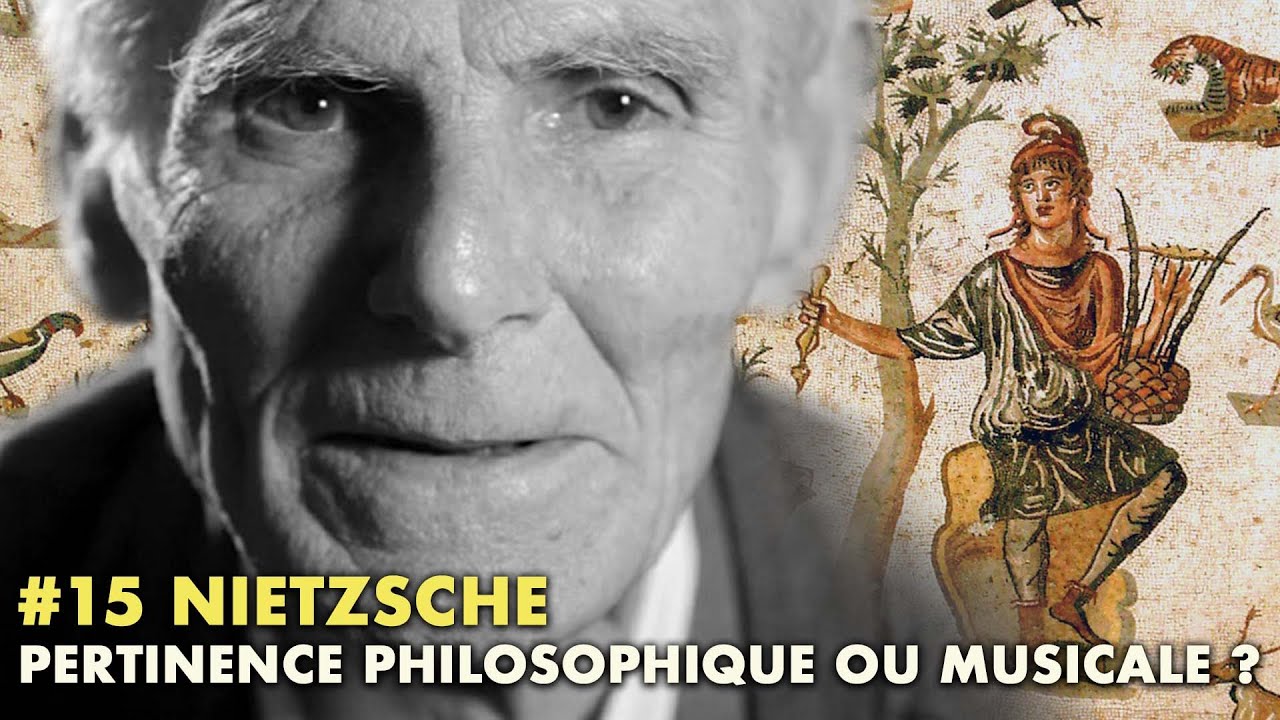
A session of answers to questions, between workshops and podcasts 0:00 Good evening everyone, I'm sorry that my silhouette, well, the silhouette of my face, comes to block, in tonight's session photo, the beautiful figure of the singing god Orpheus, whom we're going to be talking about among other things tonight, since basically, I tell you, I do intend to make a new episode of answering questions tonight, let's be clear, not only because there are overdue questions that deserve to be updated, and often coming from our most faithful and regular audience, and often the most relevant too, so I sometimes feel bad about taking so long to answer them, but there are so many questions.
1:08 But at the same time, they're thematized, so this is a session in its own right, insofar as I'm very touched by the reaction of most of you to the appearance of the podcasts made around Aliocha by his team, whom I'll never thank enough—well, this isn't the last time I'll say it—because I'm astonished every time by the technical quality of the result.
1:44 I allow myself to say this because I had nothing to do with it, the technical quality—on the contrary, I'd even say that even my flaws are corrected by the work, the prodigious mixing work that was done here, which I salute. So why am I talking at the same time about the answers to questions concerning our regular workshops and the musical podcasts that recently came out—you'll get the next one next Wednesday, I won't say more—because of the theme common to both, which will allow us to answer both questions and/or comments made on the occasion of the recent workshops and those made on the occasion of the recent musical podcasts, so to speak.
Rimbaud's "Conte": "Learned music is lacking to our desire" 2:44 There we go. I'll make a small preamble before you and I read together the text of the first question I'm going to force myself to answer, which is that I remind you—I've been doing a lot of reminders lately, and now is the time, since we've worked enough that it's become necessary to sort things out sometimes and stick to the essentials during the reminders.
3:21 Just in the last workshop, I allowed myself to refer you to old, earlier videos which each had the merit, remember, of being synthetic, that is, of being in themselves summaries of several other lectures, several other workshops, for recurring issues. You can imagine it's always more or less the same ones that come back. And in particular, I come to tonight's theme, to one of these videos where I was answering, it was at the Goscinny center, several years ago now, and where I was answering someone who was telling me, regarding the commented reading of the tale—the admirable tale, T-A-L-E—by Rimbaud, an excerpt from the Illuminations, about this prince who becomes a fury of destruction because he wants to see, I quote, 'the hour of essential desire and satisfaction,' and who becomes a bit like the Neros, the Caligulas, like all those who have absolute power, which reveals to them that their desire is infinite, and so they can only satisfy themselves by destroying everything that is finite.
4:33 That said, in passing—we'll have time to look at it again, it's not the subject—but at the end, since it's like a tale, it finishes in the simple past: the prince and the genie probably annihilated themselves in essential health, how could he not have died from it, so together they died. But this prince died in his palace at an ordinary age—the prince was the genie, the genie was the prince. For those who don't know this text or are discovering it, don't worry, what needs to be remembered is the tone, which is that of a fairy tale—yes, there's already a prince, plus the simple past, so there you go, it's over, he's dead, because he finally fulfilled his desire, but at the cost of this step into death.
5:18 But we're not yet at tonight's subject, period, new paragraph, and there's this strange fall that Rimbaud added, which are the last words of this very short poem, half a page: 'Learned music is lacking to our desire.' And one of those who attended the workshops we used to hold in person, as we say now, at the Goscinny Center, said to me, 'What does that mean?' And on that occasion I made a development, for the first time, recalling my famous triangle that I allow myself to propose right at the very start of the introduction to philosophy, that is, when I conclude the first stage of this introduction by saying that the philosopher's proper domain is situated as a middle term between, on one hand, the mathematician and, on the other, the poet—two things apparently as far apart as can be, isn't that right?
The mathematician, the poet, the philosopher and music 6:21 And the philosopher, torn between these two extremes, as a middle term—not as a centrist who takes a bit from each to make a compromise, in fact anything but a compromise, it's a tearing-apart between what? Between the need for rigor, I'll get to that, which is proper to mathematics and which means that to the questions philosophy asks, it tries, would like to answer, in the mode of epistēmē, of knowledge, and not in that of opinion or bar-room chatter, as we often say.
6:55 So that's what brings the philosopher closer to the mathematician—I'm not talking for now about what separates them—but on the other hand, in terms of content—that was for form, the form of rigor, non-contradiction, all that, coherence. On the other hand, as for content, it's not at all the same content, of course, as mathematics, nor indeed the hard sciences that mathematics enables as soon as it becomes applicable to physics, chemistry, biology.
7:25 It's not a matter of a logic of objects, that's where I've arrived. With philosophy, it's a matter of 'know thyself,' so it's a logic of the subject. Yes, we're getting there, we're already starting to orient ourselves toward music. And so, I had really insisted last time on this reminder by saying why the philosopher doesn't make the leap the mathematician makes, which consists of dropping so-called natural language, as linguists call it—everyday language, the one I'm using with you right now, and which is the one philosophy uses from a syntactic point of view, isn't that so?
8:07 For another, much more coded, formalized language, which is—you see, I can't even say it in words, because it's not of the order of language—which is that of mathematical equations. Right? And I can say things, but they're mathemes, if you like, or algorithms, right? 'There exists,' right? And moreover, that's a symbol saying that at least one exists.
8:37 The backwards E, or the A to be flipped, to say 'for all members.' In short, the universal quantifier. There's no need to say words, algorithms replace them. Silent mathematics—mathematics is discursive, but it doesn't speak. Let's really hold on to what we're seeing here, because we'll see that this is how we arrive at the musical exception. And then there's the philosopher who, as I just said, would like to answer questions concerning the self, know thyself, with the same rigor that the mathematician brings to the study of equations, number theory, or galaxies, when it's applied mathematics.
9:31 But the philosopher, for his part, cannot leave everyday language behind. Why? Because it's precisely in this everyday language that there's the subjective, which is the very object of philosophy, and which science skips over—and rightly so, because science is objective exteriority. I really want to insist on this.
10:04 So there you have it, a triangle, two extremes, two opposite vertices of the triangle, the mathematician and the poet, not conflictual, but opposed—these are not at all the same approaches, even though both have a relation to language, but a negative relation—and the mathematician who puts language in parentheses in order to develop a formalized discursivity, with symbols proper to it, and common to all mathematicians.
10:36 So, two extremes, the mathematician, the poet, and the philosopher torn between the two. That's our triangle. And so it was, on the occasion of this answer to the question 'Why does Rimbaud end his poem with learned music is lacking to our desire?' that I said, 'What if we introduced music at the center of this triangle, as a point at the center of the triangle, perhaps at the center of gravity—you know that in geometry, the center of gravity of a triangle is where the three medians, at the intersection of these three medians, if you like.
11:14 That is, lines that start from a vertex and go cut the midpoint of the opposite side. The three medians meet somewhere, at a point G, the barycenter, as it's also called in physics. Why? Because music is exactly the opposite, isn't it, of what we've seen for mathematics.
11:48 It speaks, but without saying anything. I can't say, well, this music says precisely that I'm going to arrive at 5 pm—no, it doesn't have that precise determination of language. But on the other hand, it speaks essentially to the soul, it says—we're listening to—these moans, these laments, these triumphs, these prostrations, its casualness, whatever.
12:28 The musician can do all that. So tonight I'm returning to this hesitation between a trilogy—poet, mathematician, philosopher—or a tetralogy, that is, music as a point in the middle of the triangle, to make four. There it is. I can't fall into the mysticism of figures and numbers, I'm not Pythagoras, even if we must credit Pythagoras with the merit of having, from Antiquity, brought together the spheres of mathematics, of music too—we speak of Pythagorean intervals in acoustic theory—and of harmony, and of course philosophy, when he says that everything is number.
Rousseau: "a sadness I would not have wished not to have" 13:21 There we go. I'll move straight on to the questions now, which for now won't relate directly to what I've just said, but I'll give the floor right away—well, I'll take into account the words of Sébastien Brunois, whose interventions are always very interesting and very rich, and whom I regret having neglected, because I always think I can answer him on a private channel, which is a foolish line of reasoning. So he tells me this: just a small question, the Rousseau quotation, when he says that sadness which I would not have wanted not to have, which I would not have wanted not to have.
14:09 So let me recall here—indeed, I'm glad Sébastien paused on this admirable formula. So let me say right away, Sébastien says—I thank him—for Rousseau, it's absolutely magnificent, and it recalls Victor Hugo's, when he speaks of melancholy, evoking this happiness of being sad, except that when Victor Hugo says it, it's practically all of Romantic Europe saying it, whereas when Rousseau says it, it's absolutely new, isn't it?
14:39 So he asks me where this quotation is found—very precisely, it's in the very beautiful Letters to Malesherbes. Let me recall that Monsieur de Malesherbes was an honest man, one should say, in the sense of the era, who tried to mediate, to serve as interface, if you will, between Rousseau and some of his adversaries in the intellectual world, particularly certain Enlightenment philosophers, encyclopedists, who said, 'Rousseau, you defend yourself badly, try to explain yourself,' there you go, and he had in particular questioned him about, after all, what charm do you find in wandering through the forest, we're still better off near a good fireplace, with pretty women, good drinks, good food, nice rugs, wood paneling—I'm redoing it a bit in the worldly vein of Voltaire, I don't know—and Rousseau responds, I think, there,
15:49 I'll be even more precise, there are four letters, they're the Letters to Malesherbes, they're there on Wikisource, Letters to Malesherbes, not Malherbe, Malesherbes, with an S at the end, and it's the third one, Sébastien, the third Letter to Malesherbes, where Rousseau decides to respond with the account of one of his days at the Hermitage, at the residence whose usufruct Madame d'Épinay had left him, near Montmorency, in the forests of, not far from Nerval's Valois, right there next to Chantilly, south of Chantilly, and where—I don't want to repeat it, this letter, given its truly inexhaustible richness—it's there that he says he doesn't flee society, although everything seems to show, doesn't it, that he has the discourse of the paranoiac who wants to be alone and for whom every relation to the other is a threat: 'I hastened my step for fear that someone would come and seize me before I could slip away'—there you go—and I'll clarify, quickly, since I've said it more often, that it's not a matter of paranoia in the clinical sense, since clinical paranoia
16:59 in the clinical sense, is when the subject complains of imaginary, fantasized dangers, whereas here, it's still—it's not, hunted from home to home, pursued by the three greatest European powers, banned from residence, in short, he's a hunted man on one hand, and—but one might think he's still a misanthrope when he says once, and I quote word for word, 'once I had managed to round a certain corner, with what sparkle of joy I said to myself, here I am master of myself for the rest of this day.'
17:34 'I then walked with a calmer step in the forest, seeking some deserted and wild places where nothing showed the hand of man'—and if I get to that phrase, it no longer has anything to do with The Social Contract, it's someone turning his back on society, finding his happiness, isn't it, in relation to himself or to trees and plants or to animals, but certainly not to man. But there, 'where nothing showing the hand of man,' and I'll continue now, 'would announce'—with its circumflex—would come to announce servitude and domination.
18:07 Which reminds us that Rousseau is not against society in general, against—it's not that some contrive to exploit others, but he's against this society—you see my finger, I'm pointing, I'm speaking in the singular, not society in general, but this society where reign—and that covers a lot—servitude and domination. And there, at the moment he leaves the forest, on the contrary, we're at the very heart of The Social Contract and of that sentence from The Social Contract where he says, 'the strongest is never strong enough to always be the master unless he transforms his strength into right and obedience into duty.'
18:42 There. Or when he says in The Social Contract, 'force made the first slaves, their cowardice has perpetuated them.' There you have it, servitude and slave, a pairing that will become servitude and domination, which will flourish—it will be the master and the slave of a generation later with Hegel, it will be, won't it, class struggle and exploitation with Marx, indeed, isn't it, and exploitation. So all this is a reminder of the context in which he speaks of his happiness at being, finally, freed from this bad society, isn't it, which is all the more unbearable, isn't it, in that it doesn't even grant that negative liberty one had in the state of nature—and that's where he says, he broadens his reverie a little, he says, even if all my dreams, if all my chimeras had turned into reality, it would not have been enough for me.
19:45 There we see modernity beginning to emerge, infinite desire, Romanticism and modernity. 'I would have dreamed, imagined, desired still.' And that's when he says—and here I come to the quotation—'Well, sir, that very thing was enjoyment, for I was pervaded by a feeling of sadness which I would not have wanted not to have.' There you go—thank you very much to Sébastien for giving me, first, for having an attentive ear, since we're going to talk about music, it's welcome, and for giving me the opportunity to recall these decisive and admirable passages.
Security: conservatism or revolution? 20:21 Second question, much shorter, but very dense, from our faithful Daniel Arias, whom I truly salute and thank because his remarks and developments are always welcome, and he never forgets that I always read them with pleasure and interest. I greatly appreciate his lucidity and his experience, but he asks me, he poses this question: is security conservatism or revolution?
20:55 It's as simple as that. But if we really had to choose a set of questions for high school seniors or undergraduates or those preparing the agrégation, for that matter, since philosophy teachers at any level always say that the most important thing at the start of an essay is to pose a problem—that is, to end the introduction with a question mark, roughly speaking, informally.
21:26 But be careful, not every question is a problem. What time is it? There's a question mark. That's not a problem, it's a question. What's your name? That's a question. It's only a problem for Parsifal, who never knows what name he has—I say that because he answers the old man who questions him. 'At least tell us your name.' 'I've had many, but I don't remember any of them.'
21:59 There. Since that could go on for 5 hours, I'll stop there. But here we clearly see the difference. Daniel isn't just asking a question. He's genuinely posing a problem, an intensely philosophical one. Why? I'll answer you first formally. What distinguishes a question, plain and simple, from a problematic question is that a problematic question cannot be answered immediately by yes or no.
22:31 That doesn't mean I'm going to answer in Norman fashion—sorry to the Normans—that is, 'maybe yes, maybe no, I don't know.' Yes, in one sense, it's conservation. In one sense, it's revolution. No, no, it's conservatism. In one sense, it's revolution. No, no—I'm going to answer in a more committed, more engaged way. But I'd like to say here that security is an extremely rich term. Alright, now let me dive into the content. In today's societal debates, one might think that security is on the side, let's say it plainly, of the right, of conservatism.
23:14 You only have to see how the need for security comes back recurrently among all reactionaries, doesn't it? Does that mean security is a reactionary term? That would be an incredible insult, and above all contempt and cynicism toward those thousands—hundreds of thousands—of poor souls who, with entire families, cross the desert, then the Mediterranean, and face the most terrible insecurity, that of those at-best hazardous boats—sorry for the euphemism, it's more tragic than that.
23:51 Who is going to lecture them about facing danger? That would be obscene, wouldn't it? So that's where we see the richness—the Hegelian conception of moment—there's a moment of security that is vital. And it's not hard to answer those who say freedom is above security—and there it doesn't matter whether the answer comes from a man of the right or the left, because it's well founded.
24:30 This answer, which consists in saying the first of liberties is security. When a gazelle faces a panther ready to pounce on it, fleeing is its first liberty. That is, seeking security through flight, fleeing danger—that's exactly it, seeking security is fleeing danger. It's the best way, for the moment, to exercise what freedom it has left, as long as it has it. I'll reassure you, moreover, very often, isn't it, it loses the predator.
25:05 It has to try several times. So, Daniel's question is all the more interesting, isn't it, in that one can even reverse it, contradict those who make reactionary use of security, and say that if we insist on the necessity of social justice and social progress, it's to ensure security for millions of people who don't have it, who have neither food security, nor health security, for themselves, for their children, for their loved ones.
25:41 It's still staggering that in the twenty-first century, and in the fifth richest power in the world, our hospitals are in the state they're currently in. So when the medical profession, isn't it—the admirable hospital staff, whoever they are, whether great professors, great heads of departments, or, how do you say, cleaning technicians—thank goodness they're there, in any case—or, as they used to say, ward maids, who deserve special tribute, who do their jobs in their place, they come face to face with the most basic security, and this security is a liberation for the one to whom it is granted.
26:40 It is granted. There you go, so thank you very much, Daniel. One can make a reactionary use of the notion of security, that is, reduce the collective, the general will, the State—I know that makes anarchists grumble. Well, I'm not talking about the State apparatus in service of the private sector, here, which characterizes the bourgeois State and the capitalist State, a State apparatus in service of this enemy of the State which is the private sector.
27:12 And that's where the anarchist and the MEDEF [French employers' federation] have a certain complicity, their relentlessness, isn't it, against the general interest. Not all of them—there's an anarchist tradition, comrade of the working class, whom I salute and with whom I fraternize. But there's a right-wing anarchism that's flourishing right now. So I'll take the opportunity, through Daniel's question, to stress that we mustn't leave the monopoly on true security to them—security that is inseparable precisely from social justice and thus from equality.
27:59 There you go—I've spaced out my appearances at the Librairie Tropiques a little because, I'll say, I like, I respect Professor Bernard Bourgeois, who was my research director, so I always have a small reflex of deference toward the opinions of someone who produced excellent publications, but still, I was a bit tired of hearing it repeated incessantly that equality is all well and good, but still, freedom comes first. When one knows dialectics as Mr. Bernard Bourgeois does, one cannot, one should not allow oneself to flout the most elementary dialectic, which shows that freedom becomes an empty, abstract form—the freedom of the void, an unreality—when it is not combined with progress, social justice, and thus with equality. That's what I answer Daniel Arias: no, no, I haven't forgotten security within equality and justice, on the contrary, I insist and I repeat, and I'll end on that note.
Meschonnic, language as the set of works, and the surprise of the poem 29:09 The answer to this question: the requirement of social justice is in itself a requirement of security extended not to a few, to a handful of privileged people, but to the whole social body — at least the basic securities I listed earlier, which I confirm. So I'm very glad to find the most faithful members here this evening, so good evening Arnold, good evening again — and I'll greet in passing the poet and linguist Henri Meschonnic. I'll take the opportunity, before reading on with the question, to point out that in the journal Europe, which is of very good standing and not beholden to the Brussels Europe — you see, despite appearances — in the journal Europe there was an old issue, you'll find it on the internet, devoted to Nerval, special Nerval issue of Europe, in which Henri Meschonnic writes an extraordinary article, an almost detective-like investigation.
30:19 But a fascinating and gripping one, on Nerval's relation to Aquitaine — 'Prince d'Aquitaine à la tour abolie,' that is, the land of Cathar heresy. I won't say more, I would take you quite far. So I'm delighted to find here someone as sharp and fascinating as Henri Meschonnic. He wrote that what constitutes a language is the sum of the works of that language. I recall here, to illustrate this first point for anyone to whom it might seem a bit vague or obscure, that the linguist clearly distinguishes three instances, from the most abstract and general to the most concrete and closest to existence. Let me explain: there is language in general, a system of communication common to all humanity, but humanity does not speak 'language.' As soon as a man speaks, he does not speak language in general but speaks in a determined language. So there is language, and then there is a tongue, much more restricted in extension of course, but more concrete because, once again,
31:29 one does not speak language in general but a determined tongue when one speaks — and we're not far from our story of mathematical discourse, poetic speech, and soon musical speech. So 'the sum of the works' — with the word 'work' you can clearly see the concrete side, the actualization, when language does not remain an abstraction but passes into existence, into the real, into effectivity, into the 'Wirklichkeit'
32:00 as Hegel puts it, into actual reality — he raised the poem up as that fullness of meaning and fullness of subjectivity which are self-sufficient. Thus the poem — so one of the three summits of the triangle, mathematician, philosopher, poet, music nicely colored, all that — thus the poem is not elitist, for it does not need to be commented on, decoded, analyzed, or paraphrased in order to be grasped by everyone; it is the work of the poem to effect this grasping of subjects. Good reversal — it's an experience far more terrifying than a mathematics test, because — if it's sometimes enough, you see, it's curious, we find again the dialogue of the mathematician and the poet here, because that's why I'm very pleased with this question from Arnold — because if in mathematics it is sometimes enough to find an unknown from rigorously defined formulas that one only needs to know in order to reason, theorems to apply for example, or definitions to recall, but with the formulation of the poem one can find oneself in the unknown, where a new meaning arises and surprises us — and you can guess here
33:10 that Arnold confirms the relevance — through Meschonnic he confirms Mallarmé, who comes to say: the poet, of course, uses the words of the tribe, it's not like the mathematicians, he says apples, pears, bananas, horizon, sun, moon, whatever you like — but he doesn't use them the same way, does he, as everyday language; everyday usage is the non-poetic use of language; he gives a purer meaning to the word of the tribe, and that's why it comes to surprise us. And speaking of surprising, I'll just give one example to illustrate the surprise Meschonnic speaks of, through what Arnold recalls of Steiner — it's a remark made by Aragon. Aragon, besides his friends the rap-poets and his novels — let's not even talk about those — also wrote many critical works, or rather works of reflection on writing in general,
34:20 on poetry in particular, and among these, he tells how the first time he read one of the last poems, part of what's called the last poems, 'Bannières de mai,' before A Season in Hell, before the Illuminations — the Illuminations, sorry — this poem which begins 'On the bright branches of the lindens dies a sickly hallali, but spiritual songs flutter everywhere the currants'
34:52 and Aragon said, I told myself there's a printing error — you see how far the surprise goes, he clearly believed there was a printing error; he thought it should say 'among,' 'but spiritual songs flutter among the currants' — there, everyone understands, it's banalized, no — no, Rimbaud really did write 'but spiritual songs flutter everywhere the currants' — 'everywhere' is a familiar word, 'currants' is a familiar word, we're not in mathematics, it's not 'X equals,' it's not 'implies' — no, it's the manner of using it that is surprising, and so, at once, what lies at the bottom of every surprise is something — everyone knows that surprise can be as delightful as it can be terrible, the same reason for saying it's an experience far more terrifying than a math test, because it is a test, isn't it — there, surprise can fulfill just as it can also terrify. Thank you very much, Arnold, because
Is the romantic concerto a "conflicto"? 36:02 this question brings us closer to the subject I would not want to stop addressing this evening, which is how music comes to add perhaps the dimension that was missing — not to crown all the others, mathematics, poetry, philosophy, but to redistribute the triangle according to a more complete logic, if you will. I move on to Clomissi, whom I'm also very glad to find again, always relevant — so, if I understand correctly, and if we wanted to make the words of the tribe purer, you see how it all links together, wouldn't it be more judicious to call the concerto — this concerns one of the podcasts, doesn't it, where I'm going to talk about the form of the concerto, the genre concerto, the concerto from Romanticism onward, our current modernity, the 'conflicto,' since I was saying that within the concerto genre one can distinguish the concertante concerto, if you'll allow the play on words, right up to the end
37:12 of the old regime, where the soloists converse among themselves — the soloist or soloists, there can be several, it could be a concerto for two or three instruments, for flute, violin and harpsichord, as was the case for example — I'll give the example of Bach's fifth Brandenburg Concerto — whereas in the more modern concerto, after the French Revolution, in particular the grand — because it's grander, often in scale, in duration — the Romantic concerto, the soloist has a more dramatized relationship to the orchestra, isn't it, it's not just a few voices over a consensual background, a consensual orchestral background; there's often, isn't there, a wrestling match between the soloist — piano for example — and the orchestra, or between the violin and the orchestra, and I refer you to the podcast here because it's tedious to go into detail without a sound illustration, but the question
38:23 is very interesting: wouldn't it be more judicious to call the concerto, from Romanticism onward, from current modernity, the 'conflicto'? There, so I'll finish — the question is about conflict between the solo and the tutti, conflict between the solo and the tutti, the soloist and the orchestra, so between the individual and the collective for example, or between the individual who has the material timbre to be able to detach himself, and the collective base from which his freedom takes shape. So there I answer again yes and no — often there is a conflictual relationship, but it can also, on the contrary, simply be a challenge, that is, the orchestra can serve as a springboard for the soloist, if I may put it that way, to spur him on, so to speak, and to see him spring forth, isn't it, to see how high he can leap and perform, as a virtuoso, the boldest capers. There, that's rather quick to answer, I understand what Clom means here — it's often the case, but that wouldn't be true of all Romantic concertos, far from it. There can be
39:33 on the contrary, sometimes admirable reconciliations between the piano and the orchestra — I'll give just one example, but the one that comes to mind now because it's an admirable work: Brahms's second piano concerto. Even those — there are fewer and fewer of them now, but for a long time Brahms was snubbed, especially in France, a musician who took a long time to cross borders — he seems to me one of the most German of musicians, a bit like Fauré took time, doesn't he, to be appreciated outside France, so French is his charm. But Brahms — you see, sometimes it took extra-musical aids: Françoise Sagan's novel 'Do You Like Brahms?' and then Louis Malle's film 'The Lovers,' with that incredible erotic scene, isn't it, in black and white, with Jeanne Moreau against the background of a Brahms sextet — an unforgettable page from the second movement of Brahms's first sextet. For a long time Brahms passed for a minor musician because, to earn his living, he did what one would call
40:43 — in terms of lyrics, when I say pop music in his day, it's fine, it's nice, that's not the point, but it's a bit like piano bar — he really did piano bar work to earn his living, that's it. But even so, at the time people said, well still, still, he did the second piano concerto — I'll come back to it — I recommend the incredible version, there's a magnificent one but there's an embarrassment of choices, but there's one version that, both for the sound recording and the performance, brings together two titans — at the orchestra the great conductor Erich Leinsdorf, who long conducted the Boston orchestra, one of the best American orchestras, and even one of the best in the world if not the best American orchestra — or maybe Cleveland — all these orchestras, isn't it, benefited from the migration to the United States of people fleeing the Third Reich, in the 1930s in particular, and that's the case of George Szell in Cleveland, and here of Erich Leinsdorf in Boston.
41:55 So, the second piano and orchestra concerto — at the orchestra Erich Leinsdorf, at the piano the immense Soviet pianist Sviatoslav Richter — a dream recording, put that on: Brahms, Piano Concerto No. 2, Richter, Leinsdorf — because Richter played other versions too, Richter-Leinsdorf, Erich Leinsdorf, you'll tell me what you think. Yes, in the last part of the first movement, there — there's a terrible wrestling match, which I actually kept to illustrate the 'conflicto' side in the podcast — but then suddenly it reconciled, it calmed down, almost with the intensity of a lover's embrace between the soloist and the orchestra, when the beautiful theme on the horn returns — the theme that opens the first movement returns near the end, amid the almost aquatic shimmerings
43:05 of the piano — there you go. So, yes, broadly one could say 'conflicto,' but that would be at the expense of many passages where the wrestling was a pretext for embracing, if you will, for the embrace. So, yes, I'll take the opportunity to move on to Redrum too, who always asks very interesting and precise questions — in all this evolution of the concerto genre, how are we to understand this dominance of the 'concerto for orchestra'? Well yes, he says anything, Pagani does — he says that what characterizes a concerto, compared to the symphony where all the instruments — none of them dominates the others — that all the art of the symphony composer is to make all the instrumental groups sound — strings, woodwinds, winds, percussion — in a homogeneous, blended way, whereas in the concerto there is a soloist who stands out, the flute, a soloist for flute, a soloist for bassoon — I told you Mozart, who was passionate about timbres, who had an ear diseased with timbre, I mean
Bartók's Concerto for Orchestra 44:15 fond of timbre, wrote concertos for glass harmonica, barrel organ, oboe, bassoon, clarinet of course, and of course piano, violin, and even sometimes double concertos, like the admirable Sinfonia Concertante for violin and viola — and then suddenly along comes Bartók with a concerto not for piano, not for flute, but for orchestra. So where is the opposition between soloists and orchestra there? Very good question. I remind Red Room here that a composer always has the right to choose a title, doesn't he, which is a little wink to the audience — I'll take a small detour via another title, the beautiful title Ravel gave to one of his most beautiful piano pieces, 'Pavane pour une infante défunte' — people said, but what is that, an allusion to what, is it a Spanish infanta, she was from the Basque country, after all, Ravel, why not — you know what Ravel
45:25 answered: for the pleasure of making an alliteration, I couldn't resist — 'l'infante défunte' — you see how far a title can go. We see the 'concerto for orchestra,' it's a bit precisely to provoke your question, Raedrom, to say how can there not be a concerto for orchestra, a concerto is a concerto for a soloist and an orchestra — but we can see where this is heading anyway. So I'll answer Raedrom's question more positively: in this admirable concerto for orchestra, I remind you that at that time Bartók, by way of illustration, is one of those who fled Nazism, isn't he — not because he was Jewish, but because he was first and foremost an avant-garde composer, so he risked being accused of making 'degenerate' music, and above all he couldn't stand — he detested — he detested, didn't he, the leaden weight that was starting, you know there was in Hungary — he was Hungarian, Bartók — and there was one of the worst of the Nazi-aligned regimes, that of Horthy, isn't it, with a Y, and as soon as this regime
46:35 began to take hold, Bartók distanced himself, and he did well. So when he was in the United States, someone of radiant kindness like Menuhin, who was already a refugee in the United States, the immense violinist Yehudi Menuhin, a boundless generosity, knowing that, like many migrant musicians, he was simply broke, isn't it, and at the same time a bit lost in a world much less musically cultured than the one he was used to in old Europe, particularly in Hungary where there is an extremely dense musical past, isn't there, going back essentially to Liszt, but not only, isn't it, and with the richness of a folk foundation from which Liszt drew enormously, if I may say so — one need only think of the Hungarian Rhapsodies. So this Bartók, a bit lost, isn't he, isolated and broke in the United States, well, to put a little butter on the spinach, Menuhin manages to persuade the great
47:45 American philharmonic ensemble to commission a work from him, and that is going to be this Concerto for Orchestra. Now here's where I give a positive answer: he pits groups of themes against others, there are contrasts between the strings for example — one has the impression at times that it's just a string orchestra, and then suddenly, contrast, there's a group of wind instruments; among the wind instruments he'll set the woodwinds against the brass — there, that's what could justify the title 'concerto for orchestra,' as if there were little orchestras inside it, isn't there, that isolated themselves, a block of woodwind instruments — flute, woodwind, bassoon — of brass — horns, trombone, trumpet, etc. — of strings — violin. Thank you for that question. So now we return to philosophy, so to speak, to theory, with the vertiginous, intimidating question from Lucas Lederle, or Lederle, I don't know, who asks me
A synthesis of Plato and Aristotle? Kojève and the two works 48:58 'Dominique, do you know of a work of dialectical and historical materialism' — so an author who belongs to that field — 'that achieves the synthesis' — you'll see why it's dizzying — 'of the precision, the rigor, and the exhaustiveness of the Aristotelian treatise' — meaning, I presume, the whole body of Aristotle's work on the one hand — 'and of the dramaturgical grandeur, the ability to speak through images, the pedagogical concern, the ability to restore thought as living, processual, and polyphonic, in the Platonic dialogue' on the other hand. Dizzying — so he's asking for a work of dialectical-materialist resonance, at any rate one belonging to the requirements of that revolutionary field, to achieve the synthesis of the two titans, isn't it, who stood in the Socratic lineage, Plato and Aristotle — here, in the order of the question, Aristotle and Plato. Let me take the opportunity anyway also
50:08 to make a small clarification, because I see I'm answering several questions at once, but a lot of it is a point of the history of philosophy which I'll go through fairly quickly, but it's a clarification: people often bring Hegel close to Aristotle — Alain already said 'Hegel, the Aristotle of modern times' — there's the same systematic side, like Aristotle, encyclopedic, touching on almost every domain of thought. It's not — and it's a misreading — Hegel is more profoundly Platonic than he is Aristotelian; he is Aristotelian only viewed from the outside, through those aspects, the somewhat encyclopedic side, etc.
50:59 but on the other hand the positions actually at work in him take him quite far from a certain empiricism proper to Aristotle — I'm not making a value judgment, they're titans in both cases — and besides, between us, it's been nearly 25 centuries that Aristotle and Plato have been opposed to each other; with hindsight, what unites them against the sophistic opportunism so fashionable since postmodern thought — the counter-revolutionaries are not the ones who rehabilitate them in the wake of Nietzsche for instance — but on the other hand they're indeed together in saying, first, that truth exists, whatever the skeptic sophists — often skeptics — may say; second, that it is to be sought, that's against the dogmatist, the opposite of the skeptic, that truth is not simply my immediate opinion just like that, that it's a long labor, the result of an immense effort of work, but
52:10 which succeeds, which is not endless, which can arrive at a truth; and third, that language is the path of that work. There, that's a small clarification I'm making here, where I bring together Plato and Aristotle as the summit of the Athenian school, if you will, speaking in historical terms, and of the Socratic lineage, without neglecting — but on — the differences that set them apart, and which Aristotle makes no secret of. So, I would say, it's too enormous a task, you see, that this imaginary dialectical materialist is being assigned, who would carry out this fabulous synthesis — well, there's basically none, except — if there were one, it would be someone about whom I sometimes have reservations, and also someone strange, and, well, strange, I don't know how to put it, ambiguous, but very protean, very rich in content, abundant — I'm simply thinking of one of those
53:20 to whom we owe the introduction of Hegel into France — it's Hyppolite, of course, but that's not who I mean — it's the other one, it's Kojève, and I'm alluding to a magnificent series, I'll try to find a copy, let me show you a moment — there you go, you see, there — of Russian origin, sorry — Alexandre Kojève, so in the Tel Gallimard collection, isn't it, 'Essai d'une histoire raisonnée de la philosophie païenne' — 'pagan' being very precise here, isn't it, not Christian at all, you see — here, volume 3, so it's an immense triptych, isn't it, which begins with the pre-Socratics, continues with the strong period, Plato and Aristotle — that's number 2, which answers directly Lucas's question — and the third
54:31 here, as you see, sorry, excuse me, concerns the period after the disappearance of Plato and Aristotle — the schools, the Epicureans, the Stoics, so-called Hellenistic philosophy, the Neoplatonists. So, I can only recommend this immense effort, because Kojève makes explicit his reference — this immense grappling with ancient, pagan philosophy, to use his own word — he has, as the key to its construction, in order to present it, the schema of Hegelian absolute knowledge. So that's what I see as coming closest, and most likely to offer, however rare it may be, a positive answer to Lucas's question. There, thank you very much.
55:41 In any case, it's a question rich in potential. I would add, before returning to Sébastien, that Lucas is right to insist on the polyphonic side when he speaks of Plato — it's true that there's nothing that opposes Plato and Aristotle as much as style or form does, if you will — but I've already said this, and maybe many new members weren't there, I said it right at the beginning of my talks — but both of them have an esoteric work and an exoteric work — we shouldn't take 'esoteric' in the sense of initiate, hidden, etc., that's not what it originally means — 'esoteric' refers to the courses each of them taught with their pupils, among themselves; and then there are the publications, an effort of elaboration into literary forms,
56:51 etc., which sometimes results in those absolute masterpieces that the Platonic dialogues are, especially the most successful ones — I'm thinking of the Phaedrus, the Symposium, certain passages of the Republic — almost all of them, actually — and this incredible dramatic and political tension that runs through the Gorgias for instance. But as it happens — is it chance? — anyway, that's how it has come down to us — we lost Plato's courses, so his pedagogical work, and kept those public works, those dialogues, so elaborate, again, artistically, literarily — and for Aristotle it's the reverse, isn't it, we lost his dialogues, for he wrote some, and they had a great reputation in antiquity, and we kept only the courses — in the courses, alpha, beta, gamma, firstly, secondly, thirdly — so we have a rather blunt, rather roughly hewn Aristotle, and a Plato who is one of the greatest artists in the history of thought.
58:01 That may be due in part to chance — there, all the more reason to speak of polyphony. In any case, I don't know whether Aristotle's dialogues were as accomplished aesthetically as his contemporaries claim, but in any case Plato's are masterpieces. There, so I come back to Sébastien — I'm very glad, when we greet the team, especially in light of the recent podcasts, I'm really struck by the technical result — I wanted to come back to my question on Nietzsche, knowing he's a very widely read and appreciated author among those who today — I'll interrupt right away with another question that comes at a good moment, because one might think I'm jumping from one question to another out of order, but no — if someone — if a philosopher has never thought about music, has not only thought about it but has produced some, since he was also a composer in his own way, and in whose work music, if we remove all the pages where Nietzsche
In Nietzsche, the healthy and the unhealthy rather than the true and the false 59:11 talks about music, there wouldn't remain — I'm not saying there wouldn't remain much, but you remove an enormous amount — there remains an almost negligible portion. So I wanted to come back to my question on Nietzsche, knowing he's a very widely read and appreciated author among those who today are doing or beginning philosophy — some of them — what would be a good reading of him, whether that reading is favorable or unfavorable to its author. Of course, you've already talked a bit about Nietzsche, particularly by stressing that in Nietzsche what matters is the healthy and the unhealthy — as I'm relieved, I'll say happy — it concerns me, but relieved to see how attentive the ears are, I repeat — could you develop that? So I think the question isn't finished — if it must be so, would you please something like that — well yes, but gladly — who has crossed out — what is the right use
1:00:22 of Nietzsche — that's what Sébastien is asking me, that's no small matter. So, first, on the political level, I refer to the pamphlet by our comrade Aymeric Monville, who wrote 'Misère du nietzschéisme de gauche' — well, that a reactionary claims Nietzsche can be in the order of things, but left-wing Nietzscheanism is no doubt the most — forgive my French — two-faced, isn't it, and thus the most pernicious, since it tries to persuade us that Nietzsche was something bracing, invigorating. So let me be clear, because I seem to be starting to muddle things — I'll be extremely clear — the right use of Nietzsche, Sébastien has just summed it up, is one that doesn't forget that the essential dichotomy in Nietzsche, the essential oppositions, the essential stakes, are not, as with most philosophers — and that's quite defensible, there I concede the point —
1:01:33 are not the true and the false. There are those who want to make him a champion of truth, as if others got everything wrong and he alone would be in the truth, and we'd make the Derridas, the Deleuzes, Heidegger — I'm thinking of 'Nietzsche and Philosophy' — as if he came to bring the truth while other philosophers were mystified. Whereas I maintain — yes, I insist and I confirm — I'll give an illustration of it, otherwise it would pass for a mere opinion, and thus something arbitrary and contingent, and that would be a poor transmission — the essential position in Nietzsche is the healthy and the unhealthy, if you prefer, health and pathology, whatever you like — and that is not indifferent for us moderns. I recall, I never stop
The emergence of romanticism as trauma 1:02:44 reminding — thank you for the illustration — I never stop reminding that the emergence of modernity, in its first broad cultural expression, which was Romanticism, in every domain of expression — musical, literary, philosophical (German idealism), political, legal, historiographical, if I may — Romanticism penetrated all these disciplines, including those that seem — I'm thinking of the field of law or of history — which seem least suited to lyricism. I recall that this emergence of Romanticism was traumatic, and that the first to bear it, to receive it full in the face, that is, German Romanticism along with Nordic Romanticism, English too but especially German — don't forget the celebrated sentence signed by Madame de Staël, who comes to tell France — when Romanticism has already been going on for a generation in Germany —
1:03:54 comes to remind the French that light comes to us from the north — which is a complete inversion, not at all what was usually thought; it's soon the holidays and everyone will go looking for light in Greece, Corsica, Italy, Spain, or even toward the Fortunate Isles, to Isola Bella amid the Italian lakes, the Borromean Islands. I permit myself this reminder to say that this opposition between the normal and the pathological cannot — and so I give the point to Nietzsche — in what way?
1:04:35 because the modern subject cannot avoid this threat that constitutes the emergence of the absolute at the end of the 18th, beginning of the 19th century, and which we have not gotten past, and which will cause this hecatomb of madness, of insanity, of suicide within German Romanticism. I notice that right now on YouTube there's a blossoming of videos about figures who dealt particularly well with the field of German Romanticism — I'm thinking of Armel Guerne, who is no doubt one of the best translators, but also Jaccottet, the one who translated the Hölderlin volume in the Pléiade, Philippe Jaccottet, sorry, an excellent poet himself, by the way, there you go.
1:05:45 I mean the 'Denken' of Hölderlin, within the blossoming I just mentioned, quite recent, and I'll come back to it. So this wave of madness, of suicide, of neurosis quite simply, isn't it?
1:06:27 Or even both — look at Nerval, madness and suicide at once. So you see, I often talk to you about Hölderlin, about Nerval, these are two grave pathologies. So there, when I say the healthy and the unhealthy, we're at the opposite of the bracing, invigorating Nietzsche, etc. I'm going to illustrate my point, and it will be much more — I'm going to show to what extent Nietzsche can contradict himself, isn't it?
Nietzsche against the text of Parsifal 1:07:01 And thereby contradict those who thought they were his devoted worshippers — the accusers, the incense-bearers, as Clouscard used to say, the accusers with an axe to grind, the incense-bearing accusers. Among these worshippers in particular, those who most claim Nietzsche as their own, isn't it, and who attack Hegel because Schopenhauer, one of Nietzsche's masters — so he broke away from him at some point, but still one of his masters — and so I know that Sébastien is a great reader.
1:07:43 In my opinion, one has to know how to get out of it — I'll come back to that. But anyway, I myself went through that phase, and this evening I won't speak too ill of Schopenhauer, since he's one of the rare philosophers who spoke quite intelligently about music. One has to be fair. But still, I mean, he detested Hegel, for extremely petty reasons, and by the way I know Sébastien laments that they didn't get along. There's a passage where Nietzsche himself says: Hegel and Schopenhauer, full stop, these are two minds that fought each other the way only brothers can quarrel.
1:08:25 You see, well, but leaving Schopenhauer aside for now, I return to these worshippers, I don't know who, who take his side against Hegel — Schopenhauer having gone through that — against Wagner of course, and I'm going to dwell on Nietzsche's relationship with Wagner. There isn't a single work in which Nietzsche doesn't need to settle a score with Wagner, either to bestow upon him the most dithyrambic, most laudatory admiration a philosopher has ever given a musician, or on the contrary to drag him through the mud and ridicule — and that will be the case.
1:09:16 In the text I'm going to read you here, and I'll open a file, it's to what extent Nietzsche completely changed his mind, to the point of contradiction — and it's not just that he modified his point of view, it's that he went to exactly the opposite point of view — sorry, but my book, as is often the case with the 10-18 editions, is falling apart a bit, there — yes, sorry, there — how, regarding a specific work, which is the testament, the musical, dramaturgical, philosophical, mystical testament, whatever you like, of Wagner, namely Parsifal, which is the Germanization of Perceval the Welshman, of the Arthurian romances, the Arthurian romances in particular, of the quest for the Grail, by Chrétien de Troyes, who is the first, of course, to bring this character to light, and the first to speak of the Grail, since in the introduction to the tale of the Grail, to Perceval the Welshman, he says,
1:10:27 in the introduction, 'The finest tale ever told at a royal court, this is the tale of the Grail.' Good, so, on this point, let's be brief now, and factual — Nietzsche comes across, in the 1880s — Wagner dies in '83 — the text I'm going to read you was written in 1884-85 — Nietzsche comes across the text, isn't it, not yet, he hasn't heard a single note of the music, but he comes across the text of Parsifal, and he says this: 'Good God, I had one of my — glasses on, and there.'
1:11:09 So he contrasts him with another Wagner character, whom he prefers, "Siegfried, youth, optimism, the bounding one, very well, you're quite right to appreciate all that," and he says that Parsifal is an anti-Siegfried, so here we go, it's going to be much clearer, you'll see, "Perhaps by pushing the comparison further, one will discover, to the credit of Wagner and his Germanism" — so there he gives him the point — "that in every respect he went higher, showed himself bolder, stronger, harder, greater than a nineteenth-century Frenchman could have done, for the reason that we Germans have remained closer to barbarism than the French of the 1880s."
1:12:11 "Perhaps even" — you see how weighty these words are — "Wagner's most astonishing creation" — this he admires — "will always remain, and not only at present, inaccessible, foreign, inimitable, for the Latin race in its decline." In short, the French will never understand — understand what? Siegfried, we're getting there. "It is of the character of Siegfried that I wish to speak, Siegfried, the very free man" — it's underlined — "and perhaps indeed too free, too hard, too jovial, too robust."
1:12:44 You already see — robust, that's not the sick man, like Parsifal, who stammers, who is the equivalent, at the same period, of Dostoevsky's Idiot. Something is being sought, at the end of the nineteenth century, in pathology. The idiot, the one who, if you strike him on one cheek, turns the other, right? Whereas Siegfried is the one who, with his sword, breaks the old laws, and even breaks Wotan's spear, the king of the gods. He castrates the father. "Perhaps he is even too hard, too jovial, too robust, too anti-Catholic, for the taste of old, weakened civilized peoples."
1:13:22 Siegfried is strength, is youth. It's the moment when Germany is rising, historically. "Perhaps he is even a sin against romanticism, this Siegfried, unsympathetic to the Romance peoples. But Wagner, in the days of his sad old age" — we're going to get to Parsifal, which is his last work — "Wagner has largely atoned for this sin, anticipating a taste that later became a policy." He writes well, I already have goosebumps, it's so well put. "He set himself, if not to follow, at least to preach, with the religious fervor peculiar to him, the road to Rome."
1:13:56 You know, in Germany, these are serious matters, all this. The greatest event in German history, culturally, is the Reformation, the break with Rome. One must never forget all these allusions. And here he accuses Wagner, before the Germans, of taking the road back to Rome. "He set himself, if not to follow, at least to preach, with the religious fervor peculiar to him, the road to Rome." "To cut short any ambiguity" — I will resort to a few well-turned verses, we're going to get a short poem of Nietzsche's, sarcastic, against Parsifal.
1:14:32 "Verses which will betray, even to the least subtle ears, what I mean." Good, that's going to be clear. "What I reproach the Wagner of the last years, and the music of his Parsifal, for" — here he lies, because he hadn't heard a single note of the music when he wrote that, we know it, we have the dates and the correspondence. He had only seen the text. I'll read you afterward what he writes the first time he hears the music. But let's first read what the text suggests to him. "Is this still German, these muffled groans — would they come from a German heart?"
1:15:06 "Are these German bodies mortifying themselves here?" Because in Parsifal, there's a lot of talk about the wound — borrowed from the tradition of Arthurian romances, of the Fisher King — which never stops suppurating, which never closes. The maimed king, the king who has the wound, sometimes in the hip, sometimes — well, the point is, it's an abyss, like all wounds to the groin. "Are these German bodies mortifying themselves here. German, these gestures of the blessing priest, this lubricity with vague whiffs of incense."
1:15:40 "German" — but it's merciless as a text — "German, these abrupt genuflections, these swoonings" — we're right in pathology here. Genuflections, swoonings, that means fainting — "these staggering gaits" — that's not Siegfried's valiant step — "and this uncertain jangling of bells" — because there are real bells — "these nun's ogling glances, these tinklings of the Angelus" — in short, what in French would be called pious kitsch, in the pejorative sense — "these faked ecstasies, whose surge claims to surpass heaven itself, is all this still German?"
The letter to Peter Gast on the prelude to Parsifal 1:16:23 "Think about it — you have not yet crossed the threshold" — and it's underlined — "what you hear is Rome, it is the Roman faith without its creed." That's what he writes when he becomes acquainted with the story, the narrative, the text of Wagner's — it's not pretty, I understand, there's a lot of bleeding in that text, and he doesn't much like pathology, our friend Nietzsche. And now, here, so I'll be obliged — I'm going to leave the screen for a moment, but because I have to go consult a text that's here, here it is, there — you see, Nietzsche has just listened for the first time to the prelude of Parsifal, in — we're in '87, this is the late Nietzsche, he only has a few very short years left before sinking into madness, following the mistreated horse in Turin — and there he says what it's — what it is, this music he hears for the first time at the Monte Carlo festival,
1:17:33 because he was often on the Côte d'Azur in winter — excellent rhythm, winter, isn't it, by the Mediterranean, and summer at 3000 meters altitude in the Upper Engadine, between Switzerland and Italy. So here's what he writes to Peter Gast, a mediocre composer with whom Nietzsche corresponded. "Well, I recently heard for the first time the overture of Parsifal."
1:18:05 "When I see you again I will tell you exactly what I made of it. Apart from the questions that are irrelevant to it — to what use can or should such music be put" — he's sharp — and speaking from the aesthetic point of view: "has Wagner ever done better?" Yes, yes, yes — a moment ago, the nun's ogling glances, that pious kitsch, and now, hearing the music, he says that this Parsifal of Wagner's — he never did better. "The supreme psychological clairvoyance."
1:18:37 The Nietzscheans will grant me that, coming from Nietzsche's pen, this is homage. Nietzsche believes a great deal in psychology, at the expense of logic. But then, one mustn't ask too much of him. He's not a philosopher, he's a philologist who knows a few philosophers. He knows Plato because it's in Greek, and he specialized in Greek philology. But he knows Kant or Hegel less well than a student preparing the agrégation. Than an honest student working for the agrégation. I'm serious. It's not a flaw. One can be ignorant of the philosophers and be an immense writer and have interesting ideas.
1:19:12 "The supreme psychological clairvoyance." Clairvoyance. "And the exactness regarding what has to be said here. To express. To communicate." "With the most concise form adequate" — sorry — "the most concise." Whereas usually he reproaches Wagner for bombast, for gigantism. I repeat his expressions. "The sursum boom-boom." You see, sursum boom-boom. It's not macadam cowboy, it's macadam boom-boom.
1:19:42 And here he says, on the contrary, the briefest and most direct form. It lasts 5 hours. Because it had to. "Every nuance of feeling being developed" — listen carefully — "to the point of the epigram." One of the briefest forms in the poetic genre. To the point of the epigram. The little medallion, the concentrate. "A precision of the music as art that brings to mind a shield of accomplished workmanship." Those are Greek criteria, not romantic ones. All of a sudden.
1:20:12 Accomplished, determined, determined, defined. Like the temple of Poseidon facing the infinity of the sea, the sky, and the wind at Cape Sounion, 50 km east of Athens. "Like a shield of accomplished workmanship, and finally a sublime and extraordinary feeling, an experience, a sensation of the soul at the very depths of the music, which does the greatest honor to Wagner. A synthesis of states that to many men, and even to superior men, will seem irreconcilable."
1:20:47 "A synthesis of implacable rigor, of elevation" — I remind you this is a liturgical theme. The elevation is the high point of the Mass where the corpus christi is raised. The bread and the wine. It is elevated. Everyone must bow their head. Beautiful dialectic. So, "an elevation in the formidable sense of the word, with a knowledge and a penetration that pierces the soul like knives."
1:21:23 If there was a pathology in Nietzsche, it's masochistic. No, no — in what Wagner does to him. I repeat all the same, I mean, elevation in the formidable sense, it's not — "a penetration that pierces like knives, and with a compassion for what is seen here and judged. These things are found again in Dante, nowhere else. Has any painter ever painted a gaze so laden with the melancholy of love as Wagner does in the final strains of his prelude."
The letter to his sister: an elevated and healthy soul, Christian answers 1:21:53 That's written to Peter Gast when he has just heard for the first time the music of the Parsifal prelude. At the same time, he writes to his sister — there, he has very intimate relations, doesn't he? And, you know, this famous sister about whom people say, "but no, Nietzsche isn't a fascist." Yes, he talks about slavery, he loves slavery, he loves elitism, he does the selecting. But it's all metaphors, you see, it's not serious. Well, then, you know left-wing Nietzscheanism.
1:22:25 I was reading Aymeric Monville, who talks about it very well. And I once discussed it with Domenico Losurdo, the late, the immense Domenico Losurdo, that immense Marxist, communist Italian philosopher, who perhaps wrote the most exhaustive work ever done on Nietzsche, right? Published by Delga editions, and translated into French — sorry — by Delga editions, and I had said to him, well then, I know full well that his sister falsified these Nietzsche texts, because left-wing Nietzscheans claim that Nietzsche's Nazi passages were in fact added by his sister because she was a fervent Nazi, as was her husband too, for that matter, they even fled to Argentina, to Latin America.
1:23:27 I don't know, was the refuge of a good part of the German far right, well, the refuge, a training ground, let's say, and Losurdo answered me, "but his sister is less fascist than he is." Yes, she altered those texts because she was afraid he would give himself away too much, his antisemitism, she was more political than he was and found that he was too explicitly radical, that he should have — well, all to Nietzsche's credit, being blunt about it, not paying attention to appearances — that's to say which sister he's writing to and with whom he has intimate relations, I remind you that Nietzsche lost his father very, very early, he practically never knew him, he was raised by women, by his mother and his sister, well, in the company of his mother and his sister.
1:24:23 Nietzsche always talks — sorry, I forgot to tell you, he's talking to his sister, I forgot to tell you — so what does he say, of course, a few words about the music of Parsifal, "you're surprised, of course, but how can you go listen to this music after having spat on it like the text" — in fact, the text I read at the beginning is an extract from Beyond Good and Evil, you'll find it in the last part, in the chapter called "Peoples and Fatherlands," so near the end of the chapter — he says, "you're surprised?"
1:25:00 "Well yes, I heard the prelude of it." Where? At Monte Carlo, so — very strange, you already see — that same evening, "I cannot think back on it without inner upheaval" — inner upheaval, indeed — "so much did I feel my soul elevated and healthy." Thank you, Sébastien. Again, it's health that's being called for here — healthy. So here's Wagner's music, which he denounces throughout the rest of his work as being a danger, as being sickly and an epidemic against which one would do well to guard oneself, I tell you plainly, which romanticizes, which feminizes the human being.
1:25:48 This is very current, it's problematic, by the way. Because I have contemporary sub-Nietzscheans who don't have Nietzsche's courage to contradict themselves on contact with a piece of music. That's already asking too much of them, isn't it? I don't even want to know what music they listen to. "I felt as though" — but wait, watch this, I'm going on — "it's as if" — listen closely — "finally, for the first time in years, someone" — that someone being Parsifal's music — "spoke to me of problems that concern me, without naturally giving me the answers I would have had all ready" — the answers that contemporary sub-Nietzscheans lap up with delight, right?
1:26:43 When you're a pimply teenager, taking yourself for the Übermensch, I admit that can be tempting, it just shouldn't last too long. So, someone speaks to me of problems that concern me, without naturally giving me the answers I would have had all ready, but the Christian answers — yes, you heard right, Nietzsche, who is the most formidably anti-Christian machine there is, used, moreover — well, I greet him here, someone I know is going through hard times and who has given me tokens of friendship, this is an occasion for me to return the favor.
1:27:16 First, I'm thinking of David L'Épée, who lives in Neuchâtel, whom I greet, in Switzerland anyway, I don't know if he's still in Neuchâtel, who often uses Nietzschean themes in the service of a very fashionable neo-paganism, and who claims that Christianity came to rot us with guilt. I'll come back to that. And here, the same Nietzsche who says — the late Nietzsche isn't someone who was Christian in his youth and then sowed his wild oats afterward.
1:27:58 No, no, the opposite, the most accomplished Nietzsche. Right? So it's as if — well, for the first time — I resume and go on with this crucial sentence — "for years, someone spoke to me" — I'm quoting Nietzsche, I'm not reading between the lines. You see why I don't like interpretation, I prefer analysis. "It's as if, for the first time in years, someone spoke to me of problems that concern me, without naturally giving me the answers I would have had all ready" — the Übermensch, all that, pitiless — "but the Christian answers."
1:28:29 "Yes indeed, you heard me right, which were, in the end" — it's not over — "the answers of the strongest souls of our recent centuries." But in Nietzsche, this is homage — strong souls, that's not force, it's always with him — in the ancient sense, he knows his Latin well too, right? Better than I do myself, that's easy. Forti, that's also courage, isn't it? Virtue is like virtue, that is to say, often courage, strength.
1:29:00 Look, when we speak of the virtue of certain plants, that is, the power they have to heal or, on the contrary, to poison. Truly, in listening to this music — well, there, I'm going into family details, but it's to show to what extent it's clear, once and for all, that what matters for Nietzsche is not truth or falsehood.
The "music sister of the palm tree" and the good use of Nietzsche 1:29:30 I quote another passage from Nietzsche which is magnificent, in which — yes, I have affection for this great big goofball, because I have affection for him on condition that he be taken as a great big goofball who needs to be reassured about his health, and who has a lot of merit. In particular, he has the strength, which Nietzscheans lack, to contradict himself, to say on page 12 the opposite of what he says on page 11, and with the same force.
1:30:00 And I'm going — since I'm being asked here about Nietzsche's relation to illness and health, I'm going to lend, sorry, but my book is falling apart, just the time to piece it back together, thank you. There, that's something else, there, I've got it, don't worry, I'm now going to speak of the music that Nietzsche dreams of, he gives us the composite sketch of — of whom, for him?
1:30:48 And there I pay him homage, because the musics he's going to describe, which don't yet exist, which aren't yet developed in his time, are those which will matter most after his death, and in the modernity that will become the flagships of so-called avant-garde music in the twentieth century. I'll say no more, you'll see. "I hold that one must use great caution toward German music." Caution, yes, already, in the diet.
1:31:21 "A man who loves the south the way I love it" — opposition of south and north. North is Germany, Germany is Wagner, it's the fog, it's sickness, it's romanticism, it's the feminization of the world, in short, softening. "A man who loves the south as I love it, as a great school of healing, for the soul and the senses." But wait, this is someone who's going to end up in a psychiatric asylum — diseases of the soul.
1:31:56 "A man who loves the south as I love it, as a great school of healing for the soul and the senses." Well, for once we're in true Nietzsche, let's make the most of it. "As a profusion" — when he talks about music, how relevant he is — "as a profusion of light, of sun" — those are not Nordic values — "which transfigure all things by pouring themselves out over sovereign beings, full of faith in themselves, and not stammering decadents like Dostoevsky's idiot, or Wagner's Perceval or Parsifal."
1:32:28 That man, those who love the south as Nietzsche loves it, that man distrusts German music, which, by causing him to relapse into his bad taste, risks also compromising his cure. You see, the aesthetic criterion, bad taste — that is, the aesthetic criterion is even determined by a medical criterion, the cure. "A southerner of this kind, a southerner by belief and not by origin" — yes, Nietzsche can hardly pass for a southerner by origin.
1:33:02 "A southerner of this kind, a southerner by belief and not by origin" — it's entirely his right to claim it, I might say. "If it should happen to him to dream of the future of music" — there, Nietzsche tries to imagine what music will become at a time when music is searching — of a fertility, a complexity, and the evolution of music at that moment. Broadly, it's the moment of the flowering of the so-called national schools, Romanian music with Enescu, Norwegian with Grieg, Czech with Dvořák and others — I'm naming the best known.
1:33:38 Because there's also the magnificent Smetana in Czechoslovakia, in Bohemia at the time, of course, the miraculous fountain of Russian musicians, with this force of renewal against old Western Europe which was wearing itself out a little in post-Wagnerism. So soon jazz, then the ruptures, outright, the Stravinsky-style ruptures, The Rite of Spring, the avant-gardes, which are the equivalent in the sonic domain of the Demoiselles d'Avignon in the history of painting, which would move from the impressionist world — still fairly late-nineteenth-century, still a bit decadent — to Cubism, for example.
1:34:24 Well, he feels all this coming, you see — the southerner of this kind, "it may happen to him to dream of the future of music" — the music that is coming, and by means of freeing music from the grip of the North, of war, of melancholy, all that, of the fog — "he will hear in himself the first strains of a music deeper, more powerful, more cruel, and perhaps more secret, a music" — and it's underlined — "more than German" — this is the era when German music crushes everything — "which, in the presence of the blue sea" — German music, in the presence of the Mediterranean, of the voluptuous blue sea, and the clarity of the southern sky — "would cease to appear" — German music — "expiring, faded, pale, as all German music does."
1:35:21 In short, he would hear a music more than European — see how he anticipates the musics, doesn't he, that the whole planet now sings in chorus — not South American music of African origin, whatever you like, I was talking about jazz earlier, there's also the introduction of the blues via the African-American component. So, a music more than European — I had already said in one of the podcasts that Spain is the African limit of Europe, just as Russia is the Asian limit, and all that is on the borderline of extra-Europeanness.
1:36:02 it was musical, wasn't it. So, more than European, a music more than European "which would affirm its own worth even facing the copper-hued sunsets of the desert." Good grief. "And it would set out" — sorry — "from the desert, a music" — and this sums up this admirable text — "a music sister to the palm tree." One could hear Baudelaire, "There, all is order and beauty, luxury, calm, and pleasure."
1:36:34 This is the moment, one might say, that goes against romanticism — calm, order, and pleasure, and not sentiment and melancholy. "A music more than" — today's — "a music sister to the palm tree, which would feel at home among the great, beautiful, solitary beasts of prey" — this picks up the word cruel again, you see — "and would go roaming with them. Oh, this dreamer would imagine a music whose rarest charm would be to know nothing of good and evil" — hard to get rid of Europe's old ramparts, to speak like Rimbaud — "except perhaps a vague nostalgia would sometimes brush it, of vague golden shadows and tender weaknesses, a music which would absorb into itself, come from very far away, the tints of a declining moral world" — the West, the West meaning it is declining, it's the sunset — "or is it a music which would absorb into itself, come from very far away, the tints of a declining moral world" — become almost, when one is in the middle of the desert and surrounded by beasts of prey in the jungle,
1:37:44 almost unintelligible the Western world, a music, well, it's the fall, hospitable and deep enough to welcome these belated fugitives, a kind of prose poem. There. So, since Sébastien, thank you for asking me this question which lets me stay at the heart of the sonic matter and come back, right, to our problematic, when he says the important thing is the healthy and the unhealthy, and above all, Sébastien's key question, what good reading can be made of it?
1:38:29 It's not a matter of getting rid of Nietzsche with a backhand wave, nor of turning him into the stripper, the master thinker who was so useful for de-Marxifying the university during the Cold War, let's not overthink it, the stakes are small — well, small as ideas but not small in military and social terms, believe me, there was real damage, it's not Nietzsche's fault, but he was one of the ideological devices, one among others, structuralism was another, the university had to be de-Marxified, it was urgent at the time, well, but there are still some people stuck in that, it's over, the Cold War is over, the battle was won, right, for the bourgeoisie at the time — it might be time, thanks to Sébastien Brunois for giving us the occasion, it might be time to go back to Nietzsche in order finally, finally, among the millions who read him avidly and completely against the grain, to make good use of him,
Rousseau, the sole romantic of the Enlightenment 1:39:40 in favor of music, sister of the palm tree. So, Julien Belmonté, is Rousseau the most romantic of the Enlightenment philosophers? Oh, that's not hard, because there isn't a single Enlightenment philosopher who's romantic, let me say right away — I'll make an exception for one of the most complex, Diderot, who in certain respects also takes part in what was called at Rousseau's time the awakening of sensibility; it's usually illustrated by Rousseau, but we shouldn't forget that Diderot is one of the greatest actors in this, in particular the richness of his aesthetics — that's quite rare, aesthetic reflection at the time is absent in Montesquieu, in Voltaire, I'm talking about aesthetics; in Diderot it's very rich. But apart from Diderot, who has a few, let's say, a few traits that can approach romanticism, he is not a romantic, far from it, he still keeps extremely classical tastes. So it's not that Rousseau is the most romantic of the Enlightenment philosophers,
1:40:50 he is the only one, he is even the first, to announce romanticism — the word doesn't exist yet at the time, the adjective exists, as far as I know, unless some scholar contradicts me, which I'd welcome in order to refine this, but as far as I know, the first occurrence of the term 'romantic,' the adjective — 'romanticism' will have to wait a long time, until the 19th century, for the word to appear — but the adjective 'romantic' is in the Fifth Walk, at the beginning, when Rousseau says the shores of Lake Biel are wilder and more romantic than those of Lake Geneva. And there we see the very precise meaning it had at that time, that is, in the middle of the 18th century — it's very precise, it's not romanticism in the immense, broad sense it will soon take on, but it's still very significant, it announces what is coming: it's a way of making gardens, so-called English style, as opposed to the classical order of French-style gardens, quite simply.
1:41:58 and Rousseau adds, to make his thought precise, they are wilder and more romantic than those of Lake Geneva; if one sees fewer meadows and cultivated fields there, one sees more forests, shaded refuges, etc. In short, it's the wild side — I don't know, what Kant, soon, at the end of the 18th century, will assign to the so-called aesthetics of the sublime as opposed to the classical aesthetics of the beautiful, which is already announced in Rousseau, in particular with that infinity I mentioned earlier in response to the clarification Sébastien asked for about that magnificent formula: 'I was pervaded by a feeling of sadness which I would not have wished not to know.'
1:42:51 There. So, of course, I would even say, because I don't want — it's important, as a question, how do I — there are romantics in the broad sense and in the narrow, strict sense, the strict, restricted, scholarly and academic sense — not pejorative, that counts too, especially in France; it's the movement that appears roughly starting with Lamartine's Poetic Meditations in 1820, that is, at a date when the greatest German romantics are already either dead, physically dead, or dead, psychically, in madness.
1:43:28 So, 1821, publication of Lamartine's Poetic Meditations, and it's usually made to end in 1853 — if ever someone cuts it off differently, that's fine — but the pretext taken is the failure of a play by Hugo that had been successful until then in the theater, Les Burgraves, which sort of sounds the death knell, and that's in 1853, mid-century — I spoke about this elsewhere regarding Nerval. I won't dwell on it, and one senses that romanticism is going to give way to the new literary current in the novel, realism — very quick, all this — and in poetry, the Parnasse, or the theory of art for art's sake, which governs, by the way, as much a Flaubert as a Théophile Gautier — a Flaubert in the novel as a Théophile Gautier in poetry.
1:44:18 There. So that's romanticism in the strict, limited sense, but romanticism in the broad sense, which Hegel sees very well as a concept, that is, it identifies — as I said earlier — with the emergence of modernity, right up to us. We haven't gotten out of it, including when we want to get out of it. We're never so romantic as when we thunder against romanticism and say, oh dear, these romantic, bombastic musical interpretations, we must return to baroque sobriety, right, to reduced forces — there's nothing more romantic than escaping one's own time like that, to go into an older time.
1:44:54 It's so nice, that time whose ending we already know. It's so much less worrying than the time that is coming, which is within time. I don't want to talk again about our time of war — what could be more ignoble than war, whoever brings it and wages it. There. So, yes. More than the most romantic — the only one to be incredibly romantic in an era, I don't know, or even compared to Voltaire, who still remains the absolute model — for Voltaire, his roots are the classical order.
Germany's rearmament and German depth according to Nietzsche 1:45:38 We're going well beyond that. Sébastien, I'm also very glad — someone who has a great musical background. Good evening everyone, and thanks again to the whole team for the music podcasts. Since we're talking about Germany, what should we think of its recent news? I'm thinking in particular of its rearmament. Well, listen, I'm going to reread some Nietzsche. The question Sébastien is asking is so important, and I thank him for it.
1:46:09 It's strange, Germany right now, you've noticed — he's right to ask the question. Sometimes people say, oh dear, it's dragging its feet, it's not helping the Ukrainians the way the Baltic states do, the Americans who are the most warmongering, especially since it's not the Americans who die, that's wonderful, as long as it's the Ukrainians getting their skin punctured. Let me clarify here, since young people haven't been told this, and so they can't know it, unless they're specialists in the history of that era — but during the Vietnam War, it started to come out in the American press, the Atlanticist press — there are many Americans in the United States who fought against the Vietnam War, one shouldn't lump all Americans together.
1:46:53 How many times should I say — just a right-wing theme to begin with. A theme starts to emerge about these GIs, well, about the corpses, the coffins that were coming back — there were 50,000 Americans who lost their lives in Vietnam, there were 3 million Vietnamese killed. You're not going to compare, as the saying goes? It's terrible. 3 million in Korea, 3 million in Vietnam, and that's what gives lessons to the whole world.
1:47:24 Well, let's move on, that's not our problem. But the expression in question is that, faced with American public opinion increasingly worried about seeing these boys go off to get their skin punctured, it was said: train the South Vietnamese army quickly to take over from American soldiers. And, you see, just as I was arriving at the Ukrainians — the expression was 'we need to start yellowing the corpses.'
1:47:54 You heard me right, 'yellowing the corpses.' There. We must 'Ukrainize,' right, the corpses that NATO needs to ensure its expansion and weaken Russia. Quite a program, as the general would say. But, sometimes people say 'Germany is dragging its feet, not giving weapons.' But now, on the contrary, the declaration — yesterday, I saw it, you've seen it — you say, it's over, there will never be normal relations with Russia again, it's a barbaric state.
1:48:28 You see, it goes from one extreme to the other, it's strange, Germany's zigzagging. Well, I'm going to read you one of the most interesting texts there is. You see, it looks like I'm going out of my way to look for Nietzsche when I'm reading masterpieces of his, right? There. So, excuse me, it's terrible, these books that fall apart.
1:49:04 Ah, right, it's upside down. Right, okay, so, wait. There, there, so. It takes a moment, so, wait, the... so, excuse me, it's coming.
1:49:39 I'm confused by pages that overlap. Yes, it's there. Or it's there. Well yes, I'm trying to dig out passages, I'm sorry. Maybe it's there. There, there, excuse me. So, there was a time — I'm answering Denis's question, rearmament — but no, Germany, now it's over, it's understood, it's democratic, the most democratic states — more democratic than centralized France, it's brought up, we hear that, we've heard that from all those who did everything in the name of Atlanticism from the 1960s onward to bring down de Gaulle on the right and the communists on the left.
1:50:37 The two forces that were preventing — it's not Atlanticist imperialism, it's not about annexing Western Europe — but let's leave aside accusations of intent and get to the factual, to the textual. There was a time when it was customary to bestow on the Germans the laudatory epithet 'profound.' And yes, the Germans, that's profound, Kant and Hegel. Now, don't forget this is written in the years when Prussia, after having unified Germany, launches wars in which, in three swift blows, it annexes the Danish duchies, it annexes Alsace-Lorraine from France, it crushes the Austrian army, one of the oldest dynasties in Europe.
1:51:21 One blow after another, that doesn't go with profundity. Profundity goes a bit with heaviness, and there, in short, Nietzsche is going to be much more precise than me. Now, it is to quite another honor — implying, other than profundity — that the German aspires. And all profundity now seems to him no doubt a lack of forward momentum, of advancing march. It is thus almost timely and patriotic to ask whether this old praise, that Germans are somewhat more profound, has not always been a mistake.
1:51:54 In short, whether German profundity is not in reality something else, and worse, a quality of which we are, thank God, on the point of ridding ourselves. What is said to be profound is heavy, it must be avoided. Listen, worrying, I've never — but at the same time lucid — look, let's try a little to revise our ideas about German profundity. It will suffice for us to practice the vivisection of the German soul. So, I'll skip a page. The German is everything and its opposite.
1:52:24 That's fine. For example, a sentence I'm extracting: 'The Germans are, for this reason, more inconceivable, more vast, more contradictory, more unknown, more disconcerting, and even more frightening than other peoples imagine them to be. They escape everything.' This is written before the two World Wars. 'They escape all definition and thereby already constitute the despair of the French.' There.
1:52:54 Just go live for a while among the Swabians, a province in southern Germany. The heaviness of the German scholar, his awkwardness in society, combines in a frightening way — and there, again, I'm answering Denis, frighteningly — with a taste for inner acrobatics and a reckless boldness that all the gods have already learned to fear. In particular, I've just listed Austria, Denmark, and France. If one wants proof ad oculos, before everyone's eyes, of what the German soul is, one need only glance at its taste.
1:53:29 Well, I don't know, we know that German aesthetics is an anti-aesthetics for Nietzsche. So, the German drags his soul around like a ball and chain, he drags behind him the entire content of his existence. You see the pathology again, he digests badly what he has lived through, he never gets to the end of it. There. And now I'll take the continuation, the conclusion, right? The German loves frankness and good-natured bonhomie. We're among democrats, frankness and bonhomie.
1:53:59 It's so convenient to be frank and good-natured. This is perhaps today, of all the disguises the German masters, the most dangerous. And the most successful — an admirable text by Nietzsche — this familiar, considerate German honesty, which always plays with cards on the table, is his truly Mephistophelian talent, and one that can lead far. The German makes himself at ease. He fixes on you the empty gaze of his honest blue German eyes, and the foreigner at once mistakes him for his dressing gown.
1:54:39 There's my answer to Denis, who is intelligent and subtle enough to understand how much I believe I'm at the heart of his questioning, which is not reassuring. I haven't tried to reassure. There. We are at 10:58 pm. Good grief, I wouldn't want to jeopardize your evening. Is sovereigntism compatible with the rule of law? asks Julien.
No rule of law without sovereignty 1:55:09 Personally, I'd like to turn the question around entirely, you see, and ask: is the rule of law possible without sovereigntism? What does a rule of law without a subject mean? Now, the sovereign is the subject. I'm going to be very concrete here, because I sound abstract, even though I retract nothing of what I just said, but it doesn't hurt as long as it's abstract. Suppose a region of France obtains its independence.
1:55:39 I know this is still speaking abstractly to you, but it could be Brittany, it could be Alsace, it doesn't matter. It could even be a region that, for now, doesn't claim its identity — it could be Alsace, whatever. Suppose it becomes independent and decides to reinstate the death penalty. Now that's some rule of law. That means — when we say what is democratic, thanks to excellent questions, we manage to problematize notions that are too often — as in one of Hegel's most beautiful lines, since we're repeating ourselves — what is well known, because it is well known, is not known.
1:56:29 It's only now that we start to know it, when we see that it's not obvious, these notions. It's because there is a sovereignty of France over a certain territory that we can speak of law. Imagine a region deciding to execute people by electric chair or lethal injection — horrible things that still happen in the United States — and that it happened in our regions.
1:57:00 That would come to flout, and it would even be criminal with respect to our own law. I can't answer any better. It's very important that when a constitution — a legal notion here — establishes a rule of law, the territoriality over which it operates be clearly defined. Because if there's no border, it's not a rule of law.
1:57:31 If secession can happen internally — I'll give the example of that region that would reinstate the death penalty. I can't be clearer than that. There. Since it's getting late, I might just leave it at this problematization. I never want to settle it definitively, because I don't feel I have the right to. It's not that I'm trying to please everyone. I think we can see the other side clearly. As for me, I'm clear: there can be no rule of law without sovereignty. And the notions are mutually implied — it's not like 'dog' implying 'mammal.'
1:58:03 If it's not a mammal, it's not a dog. There's no sovereignty — therefore, there's no rule of law. Now, sovereignty doesn't necessarily imply sovereigntism. There are those who have 'sovereigntism' constantly on their lips, right, but who deny the right of sovereignty to others. There. Be careful. During the colonial wars, there were French sovereigntists, but for whom neither Vietnam nor Chad had the right to claim their sovereignty.
1:58:38 And quite recently we've had a foreign minister who allowed himself to say of a sovereign state like Mali, where citizens are being slaughtered every week in appalling numbers ever since our government did what we know it did in Libya, and as a result the Sahel has been ablaze ever since, in places that were among the most peaceful in the world, and with real merit in being peaceful given the poverty in which these populations are steeped,
1:59:09 that Le Drian, not to name him, dared to call this junta — speaking of a regime that is, in fact, far more popular in Mali than Macron's executive is in France, going by the latest figures — 'this illegitimate and irresponsible junta.' A sovereign country, illegitimate, irresponsible. There. Which doesn't even have the sovereignty to worry that its compatriots are being slaughtered in the presence of an army that is supposed to prevent these slaughters, for more than ten years now, and which justifies its presence by saying it came to put an end to these slaughters.
1:59:55 There have never been any others. I'll stop there. Listen, thank you. Thank you very much to the audience of the workshops. Thanks a thousand times, and see you at our Thursday appointments for the workshops. Thanks a thousand times to the podcast audience. I notice it's often the same people. There's a lot of overlap between the two. And thanks again — I think I'm speaking for everyone, including our most loyal audience — in saying an immense thank you to the team.
2:00:32 Pierre-Alain is part of it, because it wasn't yesterday that I met Pierre-Alain, let's not forget — to the team that has come to this... Sorry, I'm not a geek myself, this is a bit new to me, it's technical, I'm realizing what the work of mixing and editing involved in the final success of the podcasts is like on the technical level. There, I'm always very happy when the technical team gets praised in the comments.
2:01:04 Thanks a thousand times, and see you next Thursday. See you in two weeks, sorry. And to those of you getting ready to leave, I'd say have a good vacation. Don't forget — it's not the phrase that Clouscard and I used to repeat to each other, chuckling with pleasure while picnicking somewhere in the Corsican maquis: there is no vacation in the concept. There. Very good evening, very good rest of the evening, very good night.