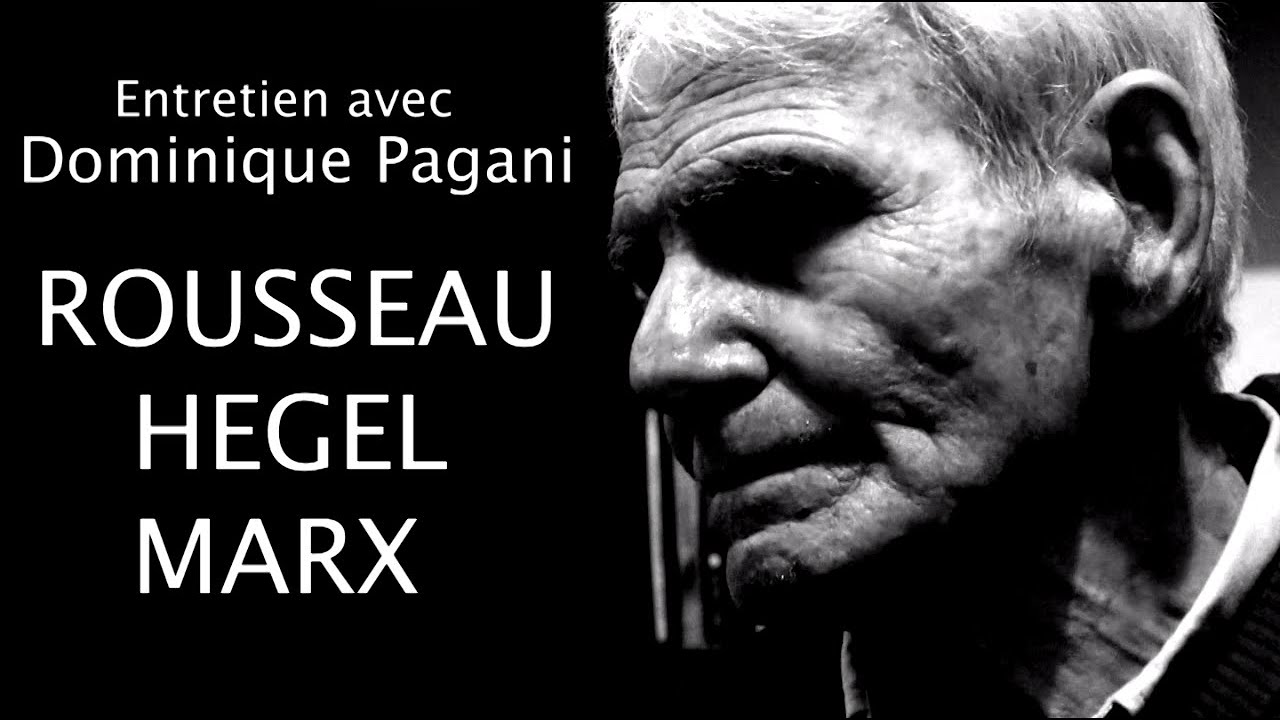
English translation of the French transcript, made with AI and not yet proofread — click a paragraph to jump to it. Show the French original
Rousseau, the first to unite praxis and psyche 0:00 The Mediterranean, no, no, no, no, no, that's not Africa to me, that's Corsica, that's the cousins, that's the Mediterranean, that's the sheep, the goats, that's fine. No, no, the real border is that, like flying over it for two hours, the nothingness there, it's really... So, among Black people, especially in the dry season, like that, especially during Ramadan, the poor guys, they have gut trouble, you see, it's rough on the digestive system. Yes, it's very hard. And this, this lubricates things in the evening, you see, it's hibiscus juice, actually, in which you have to put sugar, of course, because the guys, poor things, haven't eaten anything all day, and fresh mint that I cut myself, I mean, I made the juice with leaves, not with tea bags.
0:39 What's it called? Bissap juice, béli de zé sapé. So, uh, yes, but there you go, because there's still the mint floating around. Do you want to taste just a little bit? Oh yes, gladly. It's just to taste, though it might not be to your liking. I'll add more if you like it. It's just to look at. That's for Adrien. Dominique Pagani, hello.
1:18 Good evening, Pablo. So, you were known as a close collaborator of Michel Clouscard, you're a specialist in the thought of Rousseau, of Hegel. To begin, can you tell us about Rousseau, about his originality in the history of philosophy, and perhaps the parallel that can be drawn with Michel Clouscard, who moreover devoted a book and a great deal of work to him? Yes, of course. Listen, thank you very much for the question. I'm glad we improvised, not technically, because you're much better at that than me, but I mean we improvised the idea of this interview.
1:54 And during the visit you were kind enough to give me in Cachan, well if my cat will let me speak, but just a small caveat first regarding your question, if I may: I'm not a specialist in anything. I'm not a specialist in Rousseau. I mean a specialist in the truly technical sense of Rousseau. That's someone who knows the letter he sent his grandmother at age 12. I'd be dead in the water. I mean, so, in that sense, I'm not a specialist, but I often come back to Rousseau as an unavoidable and privileged reference.
2:26 Roughly, that's what I presume you mean. And that was also the case for Clouscard. To move on to the second part of your question, Clouscard, whose only precedent he could claim was Rousseau in the history of thought, no doubt. Why? Because now I'll move on to Rousseau. Because Rousseau is the first to have attempted a fabulous synthesis of two things that were until then two completely separate, even opposed, elements. And he is the first to have unified—not merely attempted to unify, but actually unified—in a powerful synthesis.
3:00 And this synthesis, he is the only one to have achieved it, Rousseau. It was never done before him, nor ever after him, except by Clouscard. It is the synthesis of praxis, a concept that makes us think of the Marxist genre, and the psyche, the interiority of the soul, of the heart, of whatever you want to call it. Not thought—thought is already understanding, that's different. But the psyche. In other words, Rousseau achieves this tour de force of being at once the author of The Social Contract—note there's praxis there—but also the Discourse on the Origin of Inequality, we're not in...
3:38 But at the same time, there are the Reveries of the Solitary Walker. How can one write both The Social Contract, that is, my relation to the other, and the Reveries of the Solitary Walker? One would need to know. You see, it seems contradictory. You see, the richness. We can sense the profound dialecticity of Rousseau coming. That is, a contradiction, but a fruitful contradiction, not a paralyzing contradiction, or proof of incoherence—on the contrary. We'll see that in detail. So, and Clouscard, curiously, is the only one to have not only asserted but developed over almost 80 pages, in the very first part of his critique of libertarian liberalism, and in the first title, which was Rousseau or Sartre of Modernity, where he said that Rousseau was a fabulous dialectician, even though he is not classified among the dialecticians.
4:34 On the same footing as a Heraclitus, to go back to the origins, Hegel, Marx, Lenin—dialectics. It's also dealt with in Kant, but pejoratively, as in Aristotle. There you go. Rousseau practically never uses the word, but he is one. Even if he doesn't express it, I've just shown this union, this very fusion, of praxis and psyche. So, being at once the author of The Social Contract, to be concrete, of the Discourse on the Origin of Inequality, but at the same time of Julie, or the New Heloise, which is a novel that unleashes an amorous passion of an intensity, sometimes even erotic, rare, in the century of libertinism.
5:20 The century of the Marquis de Sade, of Dangerous Liaisons, and so on. On the one hand, and this is already the... I used an Anglo-Saxon word, but it's because it... it clutters our media now, the linkage, if you will, the link, that is. The articulation. I prefer this French word, which is very precious, because it has movement inside it, which is dialectical.
Infrastructures and superstructures in the 1859 preface 5:53 An articulation is made to... The knee is made to move. The elbow too. So, the articulation of... of what in Marxist terms we would call the world of infrastructures, praxis, the development of the productive forces, of the relations of production engendered by the productive forces. Sorry, I'm making hatchet-job summaries here, but these are notions familiar to you. And when we see the relation of the productive forces to the relations of production, we arrive at the mode of production.
6:24 You see this interplay of concepts, of a rigor that Marx knew how to develop like no one else. And that's on one side, only Marx. And you see, as everything holds together, Marx, in the famous 1859 preface, which I return to often because it has the advantage of synthesizing all this, put forward a bit early in Marx—I'm not even going back to the time when he's still somewhat libertarian, well I mean eco-minded, somewhat Feuerbachian.
6:57 That is to say, it's good, but Feuerbach deserves credit, doesn't he, for fighting against religious alienation, especially at a time when it was truly a dictatorship over thought. But on the other hand, once one is liberated, for Feuerbach, from religious alienation—here's the negative point—it's in favor of nature. We must rediscover our nature. And no, Marx says, it's history. It's from the moment Marx becomes aware, isn't it, that it's history that determines us, not only nature—nature determines us too.
7:27 Until the end of my life, I'll have to eat to live. That has nothing cultural about it. I mean, it's not humans who decided that. But the fact that I eat at such and such an hour, with chopsticks here, with forks there, and that I like having guests, and that when there are friends and comrades over on Sunday, I put an embroidered tablecloth on the thing to mark a bit of a difference, that, biologically, adds strictly nothing to instinct. But on the other hand, I'm not recognized as a human being if I don't do all that, if I throw myself on my food on the floor, not even in a bowl. Even my cat has a bowl, as it happens.
7:59 There you go. So, I recall all this. Why? Because Marx says very well, I develop the infrastructure-superstructure relation, praxis-psyche. You see how the two are conjugated already. The praxis-psyche opposition is, in Clouscardian terminology, the Marxian infrastructure-superstructure. Good. And that's where we see the articulation of the two. Now Marx, in that same text, where he talks about the material base, etc.
8:31 But here, Marx introduces something eminently dialectical, which is temporality, in this passage. As he says, at a certain stage of their development, the productive forces come into contradiction with the relations of production within which they had hitherto developed. Then an era of social revolution opens. This passage is enormous, because it means that the entire first part of this extraordinary text is not true Marxism. It's abstract Marxism, not yet the real thing.
9:01 By the way, down below—infra means below, doesn't it? And super means above. So infrastructure is what's below. There you go, the stomach. And then above, there's the brain, so to speak. Ideas, all that. Yes. So ideas express the economy. But that's schoolbook, crude Marxism. In fact, says Marx, that never happens, because there's a time lag. Superstructures take much longer to change than infrastructures. Because here I have a revolution in agriculture, you see, the horse collar—sorry, the collar, which meant one could pull loads without the horse choking, in the Middle Ages.
9:35 That was a huge leap forward in agricultural productivity. I'm not even talking about the steam engine a few centuries later. That's the development of productive forces. It can be fast, sometimes. But we still use, in the legal systems of modern countries today, entire sections of Roman law from 2500 years ago. Superstructures change much more slowly. Mentalities, if you prefer. Everything that's in the head. So Marx says clearly that these superstructures—one shouldn't say that because it's a superstructure, it's mere fancy, nonsense, ideology.
Émile: learning a trade in order to rise to the state of man 10:05 So, we throw it in the trash and only look at the economy, and think we're being Marxist. No. Because Marx says that it is in this form, this ideological form, that men become conscious of the relations of production. So that's why I insist so much. And to come back to Rousseau, Rousseau anticipates all this when he holds together—precisely him, he doesn't separate—the study of, I'll give an illustration of what Marx will call the productive forces, if you will, and the relations of production they engender, of what that, the genesis, produces within the interiority of each and every one of us.
10:50 Sorry, of each one and everyone. I'll give an example taken from Rousseau's Emile. That famous passage where the one directing the operation—well, the educator, since it's officially a treatise on education, it's a novel of formation as they said at the time. Excuse me. Pss, pss, pss.
11:20 Cats are opportunists. In Emile, at a certain point the tutor wants to persuade the mother of his pupil, who is an aristocrat—an aristocrat of the Ancien Régime, in which the notion of work is unthinkable. What characterizes the Ancien Régime is that those who rule do not work. And especially not with their hands. They already dislike working in commerce, all that—they leave that to Voltaire, to the bourgeoisie. And so he tells her, he must learn a manual trade.
11:54 A trade for my son, my son a craftsman, sir, do you even think about it? And Rousseau—that is, the tutor, well the educator—replies: I think about it better than you do, madam, you who only ever wanted to make him a marquis, a lord, a prince, and perhaps one day, less than nothing. I quote the text verbatim there. As for me, I want to give him a title he can never lose, that he can never lose. I shall raise him to the estate of man. And whatever you may say, he will have fewer equals in that title than in all those he holds from you. That's important.
12:25 That means real men are rare. It's not enough to be born as such, from a man, to be a man. One must assimilate an entire culture, everything that is not natural, precisely. Everything that is not innate but acquired. This makes me think of that magnificent poem by a great communist, I'm thinking of Aragon, in one of his most famous texts, since Brassens set it to music, and whose refrain is 'There is no happy love.' And which begins with 'Nothing is ever given to man. Neither his strength, nor his weakness, nor his heart.' It's not like the color of my eyes, that's given at birth. Neither his strength, nor his weakness, nor his heart.
12:57 'And when he thinks to open his arms, his shadow is that of a cross. And when he tries to hold his happiness close, he crushes it,' etc. Well, that's the richness of man, after all. He has an undeniably natural part. But if we stop only at that, we're not true materialists. We're only half materialist. I tell you, I will always have to eat to live. That's material. But a hammer is no less material than a flower.
13:29 I would even say it weighs more. It's matter, but it's not natural matter. It's matter that owes its existence to what the Greeks call 'techné,' which we translate as 'art.' The words 'technique' and 'art' are the same in Greek—'techné.' Whereas we distinguish the artist as such from the craftsman. So, back to this business of learning a trade. Why? This is where it becomes most important. We'll see the relation, not only to freedom—true freedom, which is not that of liberalism, as you might suspect—but also to property.
14:08 Three problematics grafted onto manual labor: freedom, property, and determinism—the opposite of freedom. When he says this extraordinary passage: everything that men have made, men can destroy, undo. There are ineffaceable characters, things that cannot be destroyed, only those that nature imprints. So one might say, Pagani contradicts himself, since he's very naturalistic there.
14:40 Yes, but he adds, 'and nature makes neither a rich man, nor a prince, nor a great lord.' The relations of production are not of a natural order. So they can be changed. It's not like the color of my eyes or my sex. He says the same thing in The Social Contract. But of course! 'Force made the first slaves, but their cowardice...' There, we're exactly in Montesquieu's vein—thank you, Pablo, because that's exactly along those lines. You cite the passage that's at the beginning, in the first book, that is, where he sets about criticizing the so-called right of the strongest.
15:16 For pages and pages, all this begins—The Social Contract begins by relentlessly dismantling the supposed right of the strongest, which cannot found anything, even though it exists. Force exists. But it can never found a right, precisely. Because if I'm the sovereign and there's a coup d'état, a palace revolution, whoever eliminates me in the night governs just as legitimately as I did, since it's force that speaks. Well then, that legitimizes nothing. So precisely, since you mention The Social Contract, I wanted to get to a key passage in The Social Contract, still in Book I, but in chapter 8, where Rousseau speaks of this relation between man as animal—one can't yet call him a man—what he calls the state of nature, and the civil state.
Social Contract I, 8: the passage from the state of nature to civil society 16:04 But in fact, in this passage, he speaks neither of the state of nature, of the animal, nor of the civil state, of you and me. He speaks of the passage from one to the other. That's dialectical. The passage contains both. Since one is no longer the previous state, and not yet the next one. In the same way, one will sometimes speak rather of liberation than of freedom. Exactly, quite exactly. Since we're talking about movement, passage, hence action, hence liberation, and not freedom as a quality one has or doesn't have.
16:34 So this passage, precisely, I'll begin to quote it. It's he who says 'this,' with the demonstrative. This passage—so that is indeed the object of his reflection, the passage itself. 'This passage from the state of nature to the civil state produces in man a very remarkable change, by substituting justice for instinct in his conduct'—we find the human world and the animal world—'justice for instinct, and giving his actions the morality they previously lacked.' We note in passing that there is no morality in nature for them.
17:05 That is to say, there's no evil, but there's no good either. And vice versa. 'And giving his actions the morality they previously lacked. It is then only, when the voice of duty'—only then, in the civil state—'the voice of duty succeeding physical impulse'—we come back to instincts—'and right succeeding appetite'—the impulse, force. Man, who until then had regarded only himself'—that's nature, the individual—'finds himself forced to act on other principles, and to consult his reason'—we see that reason is linked to the collective—'before listening to his inclinations.'
17:46 Full stop. 'Although in this state he deprives himself'—now he starts to see what is gained and what is lost. It's very rigorous. 'Although he deprives himself, in this new state, of several advantages that he holds from nature, he gains such great ones in return.' Watch, Rousseau suddenly becomes anti-naturalist. Colon: 'his faculties are exercised and developed.' So I'll go fast, but I'm a philosopher. For example, his faculties are exercised and developed. The acquisition of language suddenly produces thought. You're moderns, you know very well that without language, there would be no thought.
18:29 Try to think of the difference between 10 to the power 27 and 10 to the power 26 if you don't have language, the numerals, the symbols that express these quantities. Even the Romans were crude—one bar, two bars, three bars. From four onward, we get confused, so there's a V. There was no great Latin mathematician. The Greeks, yes. 'Although he deprives himself, in this new state, of several advantages that he holds from nature, he gains such great ones in return.'
18:59 'His faculties are exercised and developed'—that's prodigious. 'His passions are ennobled.' Ah, that's no longer thought, theory, and knowledge. Passion, that's precisely the psyche. Sexuality, eros becomes love, romantic marriage, in passing to culture. It's not... Is that the passage to monogamy and exogamy? No, not even going that far, I laugh because I'm thinking of... They did experiments on sticklebacks, fish, well, on animal psychology.
19:33 They put a... Because the female has a red spot when she's in heat. A red spot appears on the fish, and the male rushes at it, like a brute. So, they took a small rectangular board with a red spot, and the male rushed at it. You see what I mean? Well, that's stimulus-response. Right? That's passion. We're passive there. Passion, in the sense of the period. It's not yet really romantic. It means to suffer, to be passive. Hunger—I'm hungry—that's a passion. Right?
20:03 Fatigue is a passion. I mean, I'm not active there. So, um... um... 'His passions are ennobled.' There's a crescendo, you see. 'His faculties are exercised, developed, his passions are ennobled, his whole soul is elevated to such a point that...' This is always where I stop the text. I suspend it, sorry. Because one might think, if I stop here, that we gained everything by passing to the civil state. Why does anyone complain? Have we been taught Rousseau wrong? So, he's a man who criticizes society. There are plenty of texts that might suggest this. In Rousseau: 'Man is born free, and everywhere he is in chains,' for example.
20:35 Uh... this is where an incredible sentence arrives. I say it in advance because it's solemn, where he anticipates the horrors the modern world has known. It's not unrelated to the great world conflicts, which all come from what is called the West. And its great democratic values. So, when he says... I'll take up the sentence again and continue. 'His whole soul is elevated to such a point that, if the abuses of this new condition did not often degrade him below what he came from'—man—'as perhaps below the animal.'
21:10 That means there's something below the beast, yes, bestiality—which is human, which is not the animals' affair. Animals are just beasts. That's bestiality. There, he develops a theory of evil. He anticipates what will soon become the 'mal du siècle,' the malady of the century, the Romantic era after him. And after the 19th century and its malady of the century, there will come the century of evil itself, that of the death camps and fascism. This is important to understand. All of this is in that sentence: 'if the abuses of this new condition'—the abuses of the civil state—'did not often degrade him below what he came from.'
21:44 So pay attention now to the tense and mood of the verb. 'He ought'—man—it's no longer the indicative—'he ought to bless unceasingly'—bless the happy moment that tore him forever'—we don't go back for Rousseau—'that tore him forever from the state of nature, and which, from a stupid, limited animal, made an intelligent being and a man.' But if we go on saying Rousseau is a naturalist after a text like that, it's because we haven't read him. There you go. What does this tell us? That the psyche itself is a creation of praxis.
The tool, the instrument, and the sign 22:18 Because now I come back to it. That's why I started from manual labor. There had to be, for there to be technological progress, so that we would no longer be at the stage of chipped pebbles, nor even worked stone, nor bronze, nor iron, but well beyond that, all the way to particle accelerators, lasers, and so on, and artificial intelligence—there had to be tools. A mediation between the working subject and the worked object.
22:50 So one might say, the monkey uses a reed to grab a fruit, that's true. And even more complicated things than that. And birds—well, one says 'birdbrain,' but still, birds have been seen breaking a thorn with their beak, sticking it into a hole in a branch to draw out a larva. That's complicated. That's not exactly a tool, though. And Hegel drew the distinction very well—that's the instrument. There's above all a great communist author I recommend, Vietnamese, from the 1950s, whom you surely know.
23:27 Trần Đức Thảo. Thank you, well done. Trần Đức Thảo, a great, great, great philosopher who thought a lot about this problem and who clearly distinguished the simple instrument that the animal knows. Or even seagulls. The brain of a seagull isn't that of a chimpanzee either, but it flies up in the air with a shell that it drops so it breaks open and it can eat. Right, that's it. So it uses altitude as a means, after all. What's the difference with a tool?
23:57 It's that the tool has a typical form, Trần Đức Thảo showed this. You always find the same arrowheads in the Sahara, by the thousands on the dunes, from the Neolithic era. That is to say, there's an idea in the head, there's a thought before producing. And Marx illustrates this perfectly when he says what immediately distinguishes the most incompetent architect from the most skilled bee — because the bee makes hexagonal cells, it looks like a real engineer — is that the architect has his house in his head before producing it in reality.
24:27 That's called a thought. A representation. Inside. I keep coming back to this back-and-forth between praxis and psyche. Now, the tool was necessary for that. Why? Because otherwise there would have been no technological progress. Because children born at a given time — I'm just making this up — of iron, they don't go back to bronze. They don't start from scratch every time, like animals that repeat their genetic program. It's true that bees are born with a genetic program that lets them do that dance which locates food, and all that, communicating it to the hive.
25:02 There's information there that isn't a language, but there is communication. Here's where the loot is, here's where the food is, at what distance and in what direction. Not bad. Well, it's been studied. But it's not exactly a language precisely because there's no dance conservatory like that among bees. It's learned, it's innate, on one hand, and above all, there's a link between the signal and the content. Whereas when I say "lion" in French, in Malinke, well "Bambara," it's said "djara." There's no relation at all. There's a total disconnection between signifier and signified.
25:35 The arbitrariness of the sign, as they say in linguistics — that's man. Moreover, that's the difference between the signal for bees and the sign for man. Exactly. We enter the domain of the sign, therefore of the logos. Now, logos is straightforwardly identified with God in the Gospel. That's no accident. Whether or not one believes in God doesn't matter at all. I mean, the fact that it's said God gave, in the earthly paradise, as a privilege distinguishing man from animal, the naming of creatures, giving them a name, proves that the ancients had understood the importance of language, to the point that everything proper to man, he alienates it into God.
26:12 That's something else. But there, it's still progress. It's better than naturalism, which would say language, sure, but it's like the bees — we have the language of bees, just more refined. No, it's very different. Precisely, there's the arbitrariness of the sign that makes a break with that. Right, I don't want to bore you with long developments. To come back to Hegel, by the way, who's very often lumped in with an idealism supposedly outdated. Yes, of course. Yet he's the philosopher who, when speaking of the three powers of spirit, immediately points to memory, language, and the tool — which is quite materialist for an author supposedly thrown in the trash.
Hegel: the tool among the powers of spirit 26:53 Excellent reference. That's more than remarkable. It's the first time, as far as I know, in the history of thought, that a philosopher integrates the tool as a power of spirit. That means spirit would never have existed without the tool. We're not far from Marx there, really. That's extraordinary. It's in the first Philosophy of Spirit, 1803. And we're barely at the stammering stage of the industrial revolution, especially in Germany where it's still very much behind. Yes, very good reference, Pablo, because it's...
27:28 I'll go back a bit to what I just said. It's Hegel who gets mistreated. History unfolds like that, reason as a kind of providence, an idealism, spirit. For Hegel, it's not a vapor, a smoke, or some mysterious thing. It's chipped flints, it's hammers. He says somewhere that it's nobler for man to make a hammer than to make a child. Making a child is nature. But making a hammer is something else — anticipating the sentence from Marx I quoted earlier about the most incompetent architect compared to the most skilled bee.
28:04 So, but yes, what he's doing — I go back — when Hegel is criticized, in fact, it's often underhanded attacks against Marx. We know very well that Marx is merciless with the philosophers of his time, and he makes an exception for Hegel, whom he criticizes, but says none of the others come close to him. It seems to me it's Jacques D'Hondt who, in one of his books, says if Marx criticized Hegel so much, it's because he regarded him as... it's because he valued him much more than the others, more than Schelling, for example.
28:36 Ah, of course, but Schelling is downright reactionary, of course — see Lukács. But an immense philosopher too, mind you, I mean, but it's no accident that Schelling was the greatest idol of German Romanticism. But back to Hegel — Marx criticizes him mostly in his youth, when he's still a Feuerbachian and hasn't yet grasped the concept of history. As soon as... The turning point is the Theses on Feuerbach. In the Theses on Feuerbach, he goes so far as... I think it's the eleventh thesis, the fourth. I'm hesitant about the numbers.
29:07 I'm getting a bit senile, I'll get it mixed up. But it's in the Theses on Feuerbach — it's quick to read, it's not long — where he says that German idealism, since it was reproached for being idealist, had the merit, compared to Feuerbach and all that, to the merely mechanistic and non-dialectical naturalist materialism — it had the merit of insisting on Tätigkeit. I say it first in German, I'm not an idealist, don't worry, but because Tat is the deed, the fact, factuality, meaning... insisting on activity.
29:37 Praxis? Of course! What it ultimately amounts to... They were the first to understand — the German idealists — that spirit is not a mirror passively recording everything that comes from outside, sensations, impressions... No! There's already Leibniz, the immense seventeenth-century philosopher, and one of the greatest mathematicians of all time — we owe to him, after all, the now most widespread formulation of the derivative. Leibniz said, against the Anglo-Saxon empiricists already, that there is nothing in the mind — I'm thinking of the mirror — that has not first passed through the senses; there's nothing in the glass, there's nothing in front of the glass — roughly, that's what it means.
30:12 Except, Leibniz adds, the mind itself. Because depending on whether the mirror is convex, cracked, etc., you don't get the same image — watch out! There you go! So, Marx insists on Tätigkeit, and he'll be... and I say the opposite of Althusser, that's why I'm dwelling on this a bit... Althusser spent his whole body of work trying to decouple Marx from Hegel, claiming the young Marx was Hegelian in his youth, which is a misreading — that's where he's most severe.
30:43 Marx's first publication is the Critique of Hegel's Philosophy of Right, which is a declaration of war on political philosophy, on the last text, the political testament of the old Hegel of Berlin. Whereas when you look at Marx's texts, the more he evolves in his writings, the more he draws closer to Hegel, on the contrary, up to that famous declaration in the preface to the second edition of Capital, where he says: I criticized him at a time when he was treated like a dead dog.
31:15 Like Spinoza was treated at the time? Because he wasn't Catholic, because he was this, because he was Jewish... Hegel was mistreated, as you just said! Mistreated, right? But he says we owe him — the most important thing is the dialectical method. And moreover, certain authors have pointed out that when Marx talks about writing a dialectic, or producing a work, working on a piece that would in some way be a kind of beacon of Marxist — not Hegelian — dialectics, in the end he never managed to produce it.
31:53 Yes, yes, you know your texts well. "Once I've finished Capital, I'll come back to the dialectical method," he'll say, so he'll return a bit to philosophy. Or rather to dialectics, which is perhaps a sublation of philosophy as ideology. That's interesting, because he did write Misery of Philosophy after all — what you're saying is really important. And yes, Marx died just after having written down as the title of the third book he was about to start on Capital. What was the title? "Classes."
32:23 Yes, bravo, "Classes." We were finally going to find out what Marx would say in detail, because he'd said other things. We understand well that the division into classes is tied to property relations. But still, that's abstract, that's general. He had to spell it out now. Right? And then he dies. But he spent his life — Marx is a workhorse — leaving one work unfinished to move on to the next. Look at Capital, which was first called Contribution to the Critique of Political Economy, then called Capital — fantastic, the exact opposite of a dogmatist, of someone fixed in place.
32:57 It's not the Ten Commandments decreed from Sinai. And maybe that also reflects a difficulty Marx had in fully extricating himself from Hegel. He criticized him harshly, he was surely aware of certain limits, but he never managed, or maybe he... For once I'd say almost the opposite. Why "extricate"? Maybe... There's a term of Hegel's that answers this very well, the famous "Aufhebung," which we don't have in French.
33:27 "Cancel, preserve." That is, he preserves what he called "irreversibly revolutionary" in Hegel, which he often insists on — he says one hates dialectics because Hegel showed that nothing is permanent, everything is transient, everything must give way to something more developed, etc. But... so he preserves that and cancels what's fanciful in it, he sets it right side up, that's it. Because Marx wasn't burdened, like Hegel, by religious censorship, he didn't compose...
33:58 I know that Hegel's Aesthetics, four volumes, his longest work — the longest, in French — he didn't write a single line of it. It's the notes of his students; he wasn't foolish, but he didn't want to put in writing, because he feared censorship, what Jacques D'Hondt shows very well. There you go. Let's not dwell on such details, but what's certain, and this is what I wanted to conclude with, is that we started from the intimate union, the prodigious synthesis first achieved by Rousseau, of praxis and psyche, and that we find it throughout revolutionary thought.
Lenin, reader of the Great Logic 34:33 If I may, I'll allow myself a philosophical selfie, to photograph myself, but I devoted a whole series of videos — if you look at our YouTube channel, Philosopher avec Pagani — I'll allow myself to recommend that sequence, one part of which takes place within the École Normale Supérieure, moreover, which traces the development of revolutionary thought over a well-defined sequence from Rousseau to Lenin, passing through Kant after Rousseau, in their chronology — bluntly, Hegel, Marx-Lenin.
35:11 I'll recall the chain up to Clouscard. Lenin, who moreover stresses in the Philosophical Notebooks the absolute necessity of studying Hegel with the utmost seriousness, on pain of not truly understanding Marx's work. In my opinion, Pablo, you should sit in my seat, because you're anticipating exactly what I wanted to conclude with. No, no, but it's true, we're really deep into it here. And it's precisely because too many people neglect this passage from Lenin, which is incredible and also shows just how unsectarian Lenin is. Because at the start, Lenin was raised on the common, sometimes crude, vulgar Marxism — he's self-taught.
35:45 There are the great revolutionary thinkers, I think — the Blanquis, and then I respect — that's different from Fourier, still. The... under the French Revolution, ah, the communard, the first communist, Babeuf, people like that, fine. And then, when it comes to Hegel — well, yes, as Marx said, there are things to take, that's good, he's a bit different from other bourgeois philosophers, but still, he's fanciful, he's eaten up by religion, by mysticism, etc.
36:20 And then he tackles — he tackles, because I know you've worked on Hegel, you've seen it takes time to have the time. Lenin doesn't have the time, he's a militant. In his complete works there were entire volumes of correspondence about how to get a wagon of wheat into Moscow, during the famine — it's dreadful, he died practically of cerebral exhaustion, Lenin. So how did he find the time to tackle one of the most difficult works in the history of thought? Because he was exiled in Switzerland, banned from entering, and so there he was forced into inactivity — instead of a sterile activity, he tackles the Science of Logic.
37:06 And that's the text you just mentioned, thank you — it's a unique text because it's a reading of a reading. He reads — or rather we read — Lenin's reading of a text by Hegel. That's really extraordinary. In other words, Lenin's text consists of notes in the margin of Hegel's text. So it starts off: idealism, he talks about God. "I eliminate the good Lord when I read Hegel." There you go, there you go. And the further it goes, the more you see. "Ah, that's not bad. Very good."
37:36 Excellent. And it keeps building up to the passage you're talking about, where he reaches the seemingly most idealist passage, the one titled, in Hegel's Logic, "The Absolute Idea." There, apparently, we're more in theology than in historical materialism. And there's my Lenin saying — this passage on the absolute idea is extremely remarkable. I quote word for word here, in the French translation — is extremely remarkable.
38:06 Colon. It's the most idealist passage, sorry, and at the same time the most materialist in Hegel. It's contradictory, but it's a fact. Well, we're not going to be more Leninist than Lenin. If Lenin acknowledges that this opposition has become obsolete, that's what it means. One has to be beyond the opposition of materialism and idealism to deeply understand the Marxist message. And I believe that dialectics is precisely being beyond that opposition.
Sacralization of the tool and the proper of man 38:38 As we saw earlier, one has understood nothing about infrastructures if one doesn't understand that they never present themselves as pure infrastructure. It's always first in the form of superstructures. Right? You have to see that the ancients worshipped their tools, for example. Because they had well understood that without them... We even made gods of them. Of course, they were deified. They were... Of course. Look at this. You see, these are spoons. These are ritual spoons from Ivory Coast. You don't eat with them, they're not made for that, they're sacred.
39:08 Right? It's too big, you're not going to put that in your mouth. Well, no. There you go. You see the elephant up there? That's Ivory Coast, at the top of the spoon. It's a marvel. I'll bring it closer anyway. Since Adrien has the idea of filming it. We're going to kill ourselves. So, look at this marvel, look at that. There, it's magnificent.
39:41 With the animal totem, that's it. Moreover, we can note a correspondence across all civilizations on this point. Think of Mjolnir in Viking culture — the hammer, after all. Thor's hammer, of course. We think of... which we find again in Wagner, in the Ring cycle, which also produces the sound of thunder. Of course. In many African mythologies too, I believe. Everywhere, there are sacred drums that are never shown, that stay in the huts, that no one can see, that are only brought out for war.
40:12 War drums, for example. Of course. And the Grail, in Celtic mythology. The cup that collected Christ's blood is, even in a late Christian adaptation, because the Grail dates back to pagan origins. The whole thing is complicated. But the Grail is never separable from the lance, regarding this. The bleeding lance. The lance with blood trickling from the point on the blade.
40:43 Because it pierced Christ's side. There's a further sacralization of the weapon. The first tools were mostly weapons. What the film 2001: A Space Odyssey shows very well. With the bones, the first thing he does is make something to slaughter his fellow man. There you go. That echoes, in the end, what Engels said in his article on the role of labor. On families and... Of course. Yes, and then in... I don't remember if it's in the Dialectics of Nature or what.
41:14 Yes, yes, that's it. He says the role of labor in the transformation of ape into man. He says it's labor that created man himself. So exactly, there you go. And that's where we see the limit of bourgeois thought — even the best of it, even the loftiest. I'm thinking of the best of neo-Kantianism. Because there's the worst too. But there's the best. I salute here, in passing, our friend who devoted a thesis to... Simon Verdun. Thanks to Simon Verdun, who did remarkable research work on this. "Critique of Neo-Kantianism and Dialectical Reason in Clouscard."
41:50 You can see it well in that work, the broad spectrum of neo-Kantianism, which yielded the worst — I'll skip that — but also the best. The best is that, at its finest, bourgeois thought, in its rigor, produces structural linguistics, for example. That is, reflections on language as also a means, like the tool, a means of communication. But it never goes as far as the materiality of the tool. Now, I say that the first genesis — what is proper to man? That's an old debate.
42:21 For Rabelais, it's laughter, straightforwardly. Laughter is what's proper to man. We can have a good laugh sometimes among the French. But it always circles around the same thresholds, language, the tool. Right? I would say the grave. When you find burials with funerary rites, you no longer ask whether it's still an ape, etc. That settles it, we're sure. Yes or no? Of course. It's that the awareness of death also plays a role. So what does that mean? That all this hangs together. It's not either the tool or language.
42:53 What do they have in common? It's that through language, through the word, thanks to the word, I communicate something to you. There are three of us. Me, the sender, or you. It works both ways. The sender, the recipient, and the word as mediator between the two. Right? It's the same with the tool. There's the cliff, there's a stone, there's the roadworker who's going to make something out of it, or the clay, we're going to make a brick out of it. We're going to give form to matter, we're going to inform it.
43:23 Right? That's not natural, by contrast, because the brick is rectangular — it's the 8-year-old children in India who pay off their parents' debts by making bricks and who never go to school their whole lives because of it. I saw a documentary about it, one child had tears in his eyes about not going to school. Meanwhile, our folks here say school deforms children — anyway, I'll get worked up. And so this act of informing matter means that, and this is the big difference with language, you don't start from zero again.
43:59 There's progress in the tool. And the passage you have the merit of recalling from Hegel — I come back to your three powers of spirit. He's young, he still has a Schellingian vocabulary, the notion of power is still borrowed from Aristotle, by way of Schelling. The three powers — here you should understand roots, the three things that make the appearance of spirit possible. And Hegel says: memory — up to that point, Schelling could agree — language, these are people who know Greek mythology admirably, where you find all this.
44:38 In Greek mythology, there's a divinity — not a goddess, but a divinity — called Mnemosyne, which has the same root as mnesic memory, Mnemosyne. Right, impregnated by Zeus, and following that impregnation by Zeus, it produces the nine Muses. Mnemosyne is no small thing. And for the Greeks, she was a divinity of memory and therefore of language.
45:08 So the link that Hegel makes was familiar enough for that — even Schelling would go along with it. And then all of a sudden, the third one, the tool — that, on the other hand, was scandalous for the time. How, how, how, how could my spirit, that divine thing, so lofty, immaterial, supernatural — how could it suddenly come from hammers and flints, what next? Because precisely, and Hegel says this, it's transmitted across generations. And if it's transmitted, it can be perfected.
45:38 You can sharpen an arrowhead, you can make it out of metal after having made it out of stone, the arrowhead. After having made it out of flint, once you move to the Bronze Age, you make... and so on. And in the end, you arrive at the particle accelerator, or the radiation treatment of a cancer. Which definitively wrings the neck of a big received idea about Hegel, that he'd be the dreamy idealist who... It cancels that out, it's more than that, it's not just a nuance, it's not just a nuance.
From the rank of king to the state of man 46:09 Hegel says, without the tool, the third root of spirit is missing, it never appears. That's huge! And so there we're not far from the master and the slave. Which by the way also corresponds chronologically to the French Revolution, since it's a philosophical reflection of the French political Revolution. Have you read Jacques D'Hondt? During which, ultimately, who proclaims itself the nation? It's the Third Estate, it's those who work.
46:40 Including the bourgeoisie which manages to put on a show and win a certain number of privileges. But still, it's the demand of labor facing the... You bring me back to the start, that is, to Rousseau's text in Émile which is sublime. It's among... I'm not special... I don't deify Rousseau. I'm neither a Rousseauist, nor a Clouscardian, nor a Marxist. I take from each whatever... But I notice that when I have Marx, I have all the others that interest me.
47:11 But the reverse isn't true. It's in Marx that I find the most of it for now. Give me something better and I'll take it. But there it is. But I notice that in Rousseau there's this unmatched passage in Émile which comes a few lines after the one I quoted earlier. He's still speaking to the duchess, the mother of his pupil. And he says, you trust the present order of society, the feudal monarchic order, without thinking that this order is subject to inevitable revolutions.
47:43 This is 1765, if ever anyone was a prophet. And that it's impossible for you to foresee or prevent the one that may affect your children. You'd think he's anticipating what they would become, the émigrés. The great becomes small, the monarch becomes a subject, the rich become poor. What will this satrap do in his baseness, whom you will have raised only for gold? What will this pompous fool do in his distress? This is written by Rousseau, right? Whom you will have raised only for grandeur.
48:14 Let people admire as much as they like this defeated king, he makes a historical allusion, who is Sardanapalus, who wants to bury himself in fury under the debris of his throne. I despise him, I see that he is king only through his crown and is nothing without it. But he who loses it and does without it. Do you hear him working? Because many émigrés did a bit of work in London to earn their living. We find again Hegel's dialectic of the master and the slave. There, you got it all. That's what I'm leading to. But he who loses it and does without it is then above it. And that's where he becomes incredible. From the rank of king that a coward, a madman, a wicked man can fill like a man.
48:47 I like talking about the king like that from the century before. He rises to the state of man. From the rank of king, he rises to the state of man. Immense dialectic in Rousseau. From the rank of king, he rises to the state of man, which so few men know how to fulfill. We are not at the level of the concept of man. History is not finished. Man is the movement that goes all the time from the animal to the human ideal. But it's the movement. It's not one of the two poles. Besides, we speak of a historical process, so of a permanent process of hominization.
Kant, neo-Kantianism, and the destruction of reason 49:18 Exactly. That's exactly it. And it's also a difference between dialectical thought and neo-Kantianism, which systematically sees the glass as half full when it comes to history, when it comes to progress. Kant defines freedom negatively, as what is determined by myself and not by the outside. Yes, because Kant has the impression that to be truly free, you have to do what displeases you. Let's not exaggerate either.
49:48 Whereas Hegel will see in history the ground on which concrete freedom is realized, liberation. Hence also his interest in art. Aesthetics is a great work of his. Because in art there is a freedom that manifests itself, which is very particular, which has no equivalent. It doesn't come to satisfy a need to eat or reproduce. And it's funny because we see the contradiction between certain limits Kant could have on that level and the Hegelian dialectic.
50:23 We find the same contradiction 150 years later between the neo-Kantianism of a Foucault or other thinkers whom Michel Clouscard criticizes as representatives of that current. And Marxism, insofar as Foucault's relativism is systematically backed by arguments consisting in saying, 'Look, progress doesn't exist, there's always alienation, there's no proof of any concrete historical progress.' I understand. It's systematically a definition of freedom by the negative and not by... there's no taking history into account.
50:58 I understand, but for the audience who would do us the kindness of listening to our conversation, I still need to specify that you pay great tribute to Foucault, etc., by comparing him to Kant. Because the neo-Kantians are far more guilty than Kant. Exactly. For them there was a political task, which was to de-Marxify the university. Kant doesn't spit on progress, he says there is progress, except it's a progressive asymptote which is never reached.
51:28 There you go. But, careful, Clouscard often insists that Kant is something other than neo-Kantianism. Yes. Because Kant says Rousseau is the Newton of morality. Well, he doesn't say of politics, we shouldn't ask too much of Kant. As I was saying earlier, Clouscard's quip is magnificent. It sums up pretty much everything there is to know about Kant. It's that Kant saw everything, but quickly pulled the curtain shut. I can still hear him say that with his Tarn accent, it was striking.
51:59 Afterwards, he'd chuckle with laughter. Kant saw everything. But immediately, he pulled the curtain shut. When he saw it, he saw class, history, all of that. Uh-oh, there's blood there. There you go. So I put that caveat in. I mean, the Foucaults, the Deleuzes, they knew what they were doing. I mean, they use the limitation Kant imposed on the knowledge of the thing-in-itself to smuggle in contraband merchandise trafficked in every direction, which is not the case with Kant.
52:34 Yes, exactly. Kant is at the limit of his time. For them, it's a regression. After Marx and Engels. Besides, on that level, Michel Clouscard seems to converge with the philosopher Lukács. Of course. Insofar as both clearly identified the reflex of the bourgeoisie, once installed in power, which consists in wanting to make philosophy stop at Kant and refusing to move on to the Hegelian dialectic. Exactly. And in the end, it's very emblematic.
53:04 You're talking about someone whose most emblematic title is The Destruction of Reason. If you destroy reason, that means there was an edifice. So it's a regression, that's exactly what I'm saying. With the Enlightenment, a rational edifice had been painfully built, which is necessary, not sufficient, but necessary. And now suddenly, even that is too much. Because we know full well that from there, the path toward absolute knowledge is inevitable. By the way, it's Lukács's work that has been consigned to disgrace. But of course, and to oblivion.
Heidegger, neo-fascism, and ecologism 53:36 It was René Girard who did the French translation in the 1950s. Yes, a great man whom I respect. But we only had that translation before Delga republished it. Exactly, that's right. We're in agreement. We're in agreement, it's incredible. When you see the importance, it's really the whole philosophical itinerary, from Schelling to Nietzsche, well, to today's sub-Nietzscheans. And besides, it's very symptomatic. Because that poor fool Nietzsche was quite something else too. It's grandiose. There's the same distance between Nietzsche and the Nietzscheans of the Cold War as between Kant and the neo-Kantians.
54:07 Besides, that says a lot about, let's say, a form of counter-revolution identified by Clouscard starting from '68. Exactly. It's still a very strong symptom of this counter-revolution that Heidegger remains so influential... For whom Nietzsche is also central, Heidegger? Yes. Who was an avowed Nazi... But no, you haven't understood anything, Heidegger is complicated, that's simplistic. Yes, yes. Well, to understand Heidegger you have to be gifted, I don't know, but it's...
54:38 No, no, he's not a Nazi. Even Chapoutot, who is a great... Do you know who Chapoutot is? Yes, of course. I think no one is as well-informed on the Nazi archives as Chapoutot, so I pay him that tribute. But at the same time he says no, no, Heidegger isn't a Nazi, when asked. Listen, isn't he a historian who doesn't deal with philosophy? Yes, knowing that moreover we now have the publication of the Black Notebooks. No, but he's not a Nazi, Heidegger. He's the most Nazi of the great philosophers. There are little ones appointed by Hitler at the time, I don't even bother with them. But Lukács spoke about him. There's a magnificent article in the Circle of Friends of Georg Lukács, which you can find online, called - you type Lukács, colon, Hegel and German Fascism.
55:17 Yes, which was published by the... Extraordinary. So there you see the list of philosophers I'm talking about, the Kriecks, the... Well, I won't list them all, but... Baeumler, people like that, well. Those are practically Nazi functionaries. But Heidegger himself, he's the most Nazi of the great philosophers. What I can't forgive him for is that he's not a fool. And who never disowned, contrary to what people believe... Never. A certain number of the prerequisites... No, but wait, it's not just that he didn't disown it. He continued after the war.
55:49 Because maybe I too would have been a Nazi, I mean, at the time, with my colonial upbringing and all that, I mean, you see, the class determinants, not knowing, I mean, I'm not moralizing with moraline, as Nietzsche would say. On the other hand, I mean, once you've become aware, you don't go back. Now he, even after the death camps were exposed, etc., during the Cold War, he continues his critique of technology. Saying that all of it is the worker's fault, basically, industry's fault, that all of it is monstrous, that's the cause.
56:19 No, but wait, wait, wait. That's a very convenient way for the bourgeoisie to drag the worker into its own wrecked galley. No, but there's already ecologism, not ecology. I'm the first to want a healthy environment and all that, I don't lie under cars breathing in their exhaust fumes with delight. Nobody does. This kind of discourse, I mean, there's never any contradiction in it. Whereas he, yes. He announces the ecological discourse well before. That's where we see all these dangers, where Clouscard will place it in the generic category, not of neo-Kantianism this time, but of neo-fascism.
56:57 Exactly. Which we can observe with the fascization of public debate, including philosophical debate, for several decades now. I won't insist on the link to be made between the whole continuum running through these questions and Hegel's dialectic of the master and the slave. It's obvious that the slave's superiority over the master is that he has transformed matter. So he is freer on that level.
The Servant, liberating labor, and degrowth 57:28 Whereas the master, who feels the presence of the slave there to serve him, is lost. And I'll conclude with a film I recommend to you. You may have seen it, but it's a masterpiece for... It's not me making it up, I'm no cinephile, but all the cinephiles I mention it to tell me, as I say, it's one of the best films. It's The Servant. A film set in England, with a young lord, which happens today, well today meaning the 1960s, in the modern era, with a very stylish servant, a young lord who has him serving as butler at home, who has a mistress, all that.
58:05 There's a cat-and-mouse game played between him and the servant, but you'd think he had devoured Hegel, Losey, who directed it. And at one point, following a dispute, the servant stops. It's a strike. And the other one, he's lost, he sees his stubbed-out cigarettes, the tobacco, the mess, after the parties, he's never once moved his backside to go tidy up his own mess. So he is far more determined by matter than the one who transforms it.
58:36 There you go. To say that there's an obvious link between what we said about the liberating side of labor, when it isn't plundered - it depends on the relations of production, not on production itself - no to degrowth. And there, that was to conclude on a note that doesn't quite go along with those who now say that we are too many, except for them, they're never too many, it's the others who must be in excess, but not them. Yes, it's always the Third World. There you go, there you go, there you go. Especially if it has the bad idea of developing and thus polluting.
59:07 There you go, there you go, there you go. We see the material basis on which the racism of the coming decades could develop. And then someone's going to talk about degrowth to the Malian woman who every morning walks 10 km to fetch water, then 10 km more, that's already 20, to fetch wood to heat the water, in a country with neither water nor trees. He's going to talk to her about degrowth, that she consumes too much and wallows in consumption. By the way... And that it's because of her that the Earth is warming. By the way, if there's one good example of very successful degrowth over the last decades, it's Russia in the 1990s.
59:41 Yes, of course, but after the shame of the era, there's the sign, of course. No, and especially China. Yes. While we're talking, there are millions of guys moving out of a thousand-year-old poverty, where they used to tread down human manure with bare feet, like that. But who now, it's not Neuilly, but who still have a small apartment in Shanghai. It's incredible. And especially with a life expectancy... I believe that in human history in general, there has never been, on such a scale, such a transformation of a society.
1:00:11 Yes, it's unprecedented. And it's still too early for us to fully grasp it. And yet we can grasp it just by comparing with India, which started from the same point. Of course. No, no. We clearly see the difference. But we don't fully realize everything these changes imply in mentalities, in inner life. We'll see it later. It will produce filmmakers, things, writers. It's a bit the same kind of issue that's also close to what the Soviet Union experienced. Of course. After the five-year plan, of course. Since, mind you, Russia entered the modern world in the space of a few decades, after 1905.
1:00:45 With the first five-year plans. There you go. Of course. Whereas these are profound upheavals that we experienced over the span of 150 years. I'm glad you're paraphrasing Lenin. Communism is the Soviets. Plus electricity. Well, let's end on current affairs. Because electricity, they're going to take it away from us. I mean. We don't have communism, we don't have electricity. Capitalism, let's say. It's neither communism. No. It's capitalism minus electricity. Do you want?
1:01:27 Little box? Look, look at that. Little box. But it still stays stuck to the radiator even when it turns around. That's important.