English translation of the French transcript, made with AI and not yet proofread — click a paragraph to jump to it. Show the French original
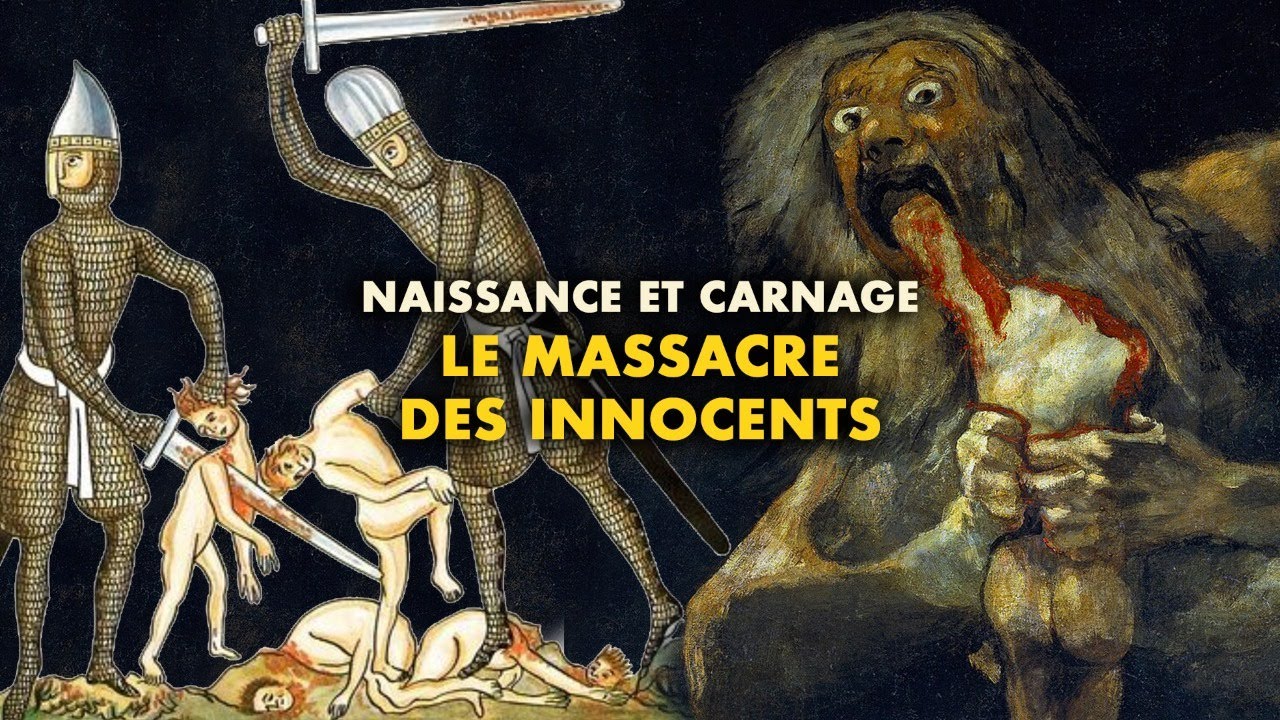
The massacre of the Innocents and the negation of nature 1:00 I believe we are live. I'm delighted to be back with you live. And especially for this last session of 2023. You've seen the poster, it doesn't look very cheerful for the Christmas season, but it's an opportunity to remind you, before we get to practical matters we're going to sort out, it's the moment to recall that just before the birth celebrated by the feast of Christmas, there is the appalling massacre of the innocents.
1:56 That's why I insisted that in the poster that Pierre-Alain put together so wonderfully, there should be, besides the generic image of this cycle which is time devouring its children — and that's the reflection on dialectic, on negativity, and on the fact of affirming oneself through a self-negation, if I may put it that way. Well, some people think I'm speaking Chinese, but it's actually very simple, isn't it?
2:32 Nature destroys me, nature forces me to die. I say this because some people still believe that it's nature that makes us live. Of course it's true that only the living can die, there's no life without nature, but life is mortal. So what am I saying? I'm saying that — not to go back to the very origin, I'm talking about when humanity was still in its infancy, barely trying to emerge from the clutches of naturalness, isn't that right?
3:07 That's somewhat what mythologies represent through images, precisely. For example, through the pleonasm of human forms emerging from an animal body, like the sphinx for instance — you see there's a human head coming out of a lion's body — like the centaur, you see, which has a man's torso with the hindquarters of a horse, or if you like, of a bovine. And I could go on: there's also the feathered serpent of the Latin American Indians, the Aztecs and Mayans, which has a serpent's body and an anthropoid head, if I may say so.
3:57 But at that level, I mean, in order for man not to be negated — I keep coming back to negativity, I want to show you that although it may seem abstract, it's actually very concrete — in order for man not to be, let's say, suppressed instead of negated, and it's simple: in order not to be suppressed by hunger, by thirst, by violence — physical violence here, since I'm talking about nature — by drought, or on the contrary by flooding, the development of praxis, of technē, if you like, of technique — the split pebble, the passage from chipped stone to polished stone, then to metallurgy — is a way of negating, of suppressing, the suppression that nature would have exerted if we hadn't had these forces of resistance. So you see, for man to assert himself,
5:07 he must carry out a double negation — well, he must carry out a negation against the negation that nature exerts upon him. Every day, hunger returns, for example, and if I don't feed myself, I disappear. That's famine, and God knows there's been plenty of it in history. There you go. You see that negation, negation — it's not just abstract, it's very concrete.
5:37 The simplest way to see it, or rather to state it, and thus to retain it in one's verbal memory, is to remember that for there to be a field, a forest must disappear, or a marsh must be drained. You see, the suppression of one is needed for the other to appear. For there to be that marvelous landscape — I say this often — a Romanesque chapel in the middle of a wheat field, or at the edge of a wheat field and a forest, a great many things had to be suppressed, a great deal of work was needed.
6:16 There you have it. And this work consists in negating what was there naturally at the outset, but what was there at the outset was a negation of myself, of ourselves. Let's not forget. Let's not forget that at birth, man is rather handicapped compared to other animal species — I won't go back over his generic prematurity, etc. As I'm going to come back to it, I say etc. not to rush past it and leave things confused, but because I'm going to come back to it, practically right away.
6:55 But before that, we're on the eve of the holidays, and I'm going to dwell fairly at length on the celebration of Christmas, to stay within the calendar after all. But before the holidays — especially Christmas, the presents, the presents, the giving — I'm thinking of the Clouscard fund, this is the moment, if any, when I address those who have been very generous, very generous relative to their income, and I thank them for it — but we need to reach the target we set, which is around 10,000 euros.
7:44 But we need to get there, and for now we're getting closer, but we still have a good gap to close, so forgive me for starting practically with that, but don't forget — I believe, ah yes, I see that Pierre-Alain has put up the link where to send the transfers, for the translation of Clouscard, the payments, there you go — and I have the pleasure of announcing to you, and I have the pleasure of learning, and of announcing to you, and of passing on to you what I've learned, namely that our comrade, friend and publisher, Aymeric Monville, plans in turn to make, as I initially did, a teaser — I believe that's the word in French too — to encourage those, especially those who have newly joined the agrégation, we're delighted that more and more of them are joining our association, to motivate them,
8:54 in the direction of this contribution to the fund, which must — we must reach a minimum amount to pay the English translator, sorry, for Michel Clouscard — not because we're aiming only at the American or English market, but at the world market. It's quite obvious, as I've already said, that a Chinese or Nigerien student, or Chinese, if they speak a foreign language besides their mother tongue, it's generally, in all likelihood, English first — so it's a considerable extension.
No internal contradiction without interiority 9:42 There you go. Thank you for not forgetting it. So, I come to — I'm going to finish a bit abruptly from last time, as happened to me, too often, I ran a bit over time and didn't want to sacrifice the questions, so I ended a bit abruptly at that point, and I sacrificed — that's why I'm going to start with them — two texts that will bring us back to that antagonistic diversity that exists within the subject, the subject that is you, me, him, her, each and every one of us, as a subject.
10:33 There is no internal contradiction outside of man, since there is no conflict between the mountain and the precipitation of rain, snow, ice and sand that erode the mountain — these four factors that erode, the famous tafoni, the holes — that's what it means in Italian — which still have, inside, the granite, are made by the combination of the force of wind and thousands of grains of sand.
11:13 But it's not a conflict when the sea attacks the chalk cliff face at Calguerre in the Pays de Caux, in Normandy, or in Picardy, I mean — there is no conflict between the sea and the cliff. It's we who turn it into a conflict by personifying the cliff and personifying the sea. But the cliff doesn't fight. It doesn't struggle against it. Agreed? It's a purely physical relationship.
11:45 And I recall here that there can be oppositions, if you like, if you insist on it, between the sea's flow and the calcareous solidity of the cliff. But when I speak of the subject, I speak of internal contradiction. For the contradiction to be internal, there still needs to be an interiority — don't attribute thoughts to the cliff or to the raging sea.
12:20 There you go. Personifying as much as one likes at the poetic level, at the level of metaphor, of course — it's not at all forbidden to say that the wind shakes the trees really as if someone were shaking the tree, like a plum tree, as we say. But leaving poetry aside, and if we stick strictly to the plane of physics, which is the only scientific way to speak of nature — I'm playing on the word deliberately, physis, that means nature in Greek. Phusis, exactly.
12:50 There's a verb that means to grow — you already see the Greeks, you can't help but see everything in an organic way, even inorganic matter or galaxies, stars, all of that — it's phuô, to grow, from which comes phusis. So, to illustrate — since this is one of the most difficult parts of philosophy and the most eminently dialectical, internal contradiction at the heart of the dialectical notion — I'll seize this occasion to answer our friend Laurent Melito, who is not far from the Spanish border, in the Basque Country, to tell him I haven't forgotten the question he left as a comment, or the comment in the form of a question rather, after my last talk, where he asked: after all, what exactly is dialectic?
13:59 He's right to raise the question in a fundamental way, because that's why I'm dwelling a bit on this notion of internal contradiction. And since it's very abstract, and so as not to tire people's minds, I state it first in an abstract way, as I've just done several times, by saying internal contradiction, contradiction within the subject, which presupposes an interiority — but all this requires a bit of reflection that we're not spontaneously used to.
14:37 And that's why I'm going to compensate for this abstraction with the most concrete illustrations possible, thanks to the greatest creators — I mean in terms of texts — who have managed to express these antagonisms, these internal contradictions proper to the subject that we are, in a much more vivid, much more evocative way.
The Parnasse and the reading of "La Beauté" 15:07 And so I begin with the two texts I mentioned last time, the two texts by the same author, by Baudelaire, and you'll see that they express two moments that are not only different but opposed, to illustrate my point. So I'll start with the first one. Let me say right away that this isn't the Baudelaire I prefer. Well, what I like is beside the point; what matters here is Baudelaire.
15:39 I've already told you that when someone says, "Oh, I don't know, I don't like Mozart," they teach me nothing about Mozart — they teach me about themselves. They're talking about themselves. They think they're talking about Mozart. On the other hand, if they tell me they prefer the quartets to the symphonic works, or vice versa, well, already they're talking a bit less about themselves and a bit more about Mozart's music. One must know how to step outside oneself when one wants to be objective, by definition.
16:15 So when I say this isn't the one I prefer, it's because it's the one that, in a word, in literary history — not our field, so I'll go through it quickly, but literary — will be easily understood — it's the one that, as is the case with this poem, illustrates the Parnassian ideal. The Parnasse was the poetic school that succeeded, toward the middle of the 19th century, so toward the late 1840s, 1850s, that succeeded and was a reaction against Romanticism, which was starting to go out of fashion — I've said this several times, so I won't dwell on it — around the middle of the 19th century.
16:57 There are names like Banville, like Théophile Gautier — Théophile Gautier, who was, so to speak, a buddy, as we'd say today, of Nerval; they were at the same school, the Lycée Charlemagne, on the Faubourg Saint-Antoine, very close to the Bastille. Théophile Gautier — let's not forget that Baudelaire's Flowers of Evil is dedicated to the "impeccable poet, perfect magician of French letters" — I'm quoting the dedication, or rather the quip Baudelaire put at the start of his volume — to the magician of letters, the impeccable poet; that's what Baudelaire says of Gautier, and "impeccable" is exactly it: the Parnasse, in reaction against the Romantics who, caught up in their passion, their interiority and their subjectivity, tended too often to neglect formal perfection, the somewhat objective side of the poem.
17:57 Look at a title by Gautier like Émaux et Camées — émaux, the plural of enamel. So we're not in the realm of reveries and smoke and tears. Émaux, enamels — that's hard, it has a well-defined form. Enamel — Émaux et Camées, that's a term from jewelry-making. That's the Parnasse — I don't want to dwell too much, but why? Why chat on when Baudelaire says it so well? The poem is called "Beauty," and we'll see there's another Baudelairean beauty afterward, which I'll tell you right away is much more musical than plastic — but here, let's stay with the Parnassian side, the plastic side of beauty, and you'll see right away that it will be much more a question of statue, isn't it, than of melody.
18:46 Look: "Beauty speaks: I am beautiful, O mortals, like a dream of stone." You see, I never interpret — everything I've just said is only stating what the text says. "I am beautiful, O mortals, like a dream of stone," and my breast, where each in turn has bruised himself, on a breast of stone.
19:17 I beg your pardon, it's my fault, I forgot to turn off my phone. Hello, dear friends, dear comrades, I'm right in the middle of a live session, I'm sorry, but you can call me back whenever you like, starting from 11 pm, there we go. See you later. Please forgive me for this incident, but on the other end was the person inviting me to Brittany for Christmas, and I'm leaving tomorrow morning at dawn to join them. Yes, sometimes it seems to me I'm more rushed than before my retirement.
19:55 But it's a rush I owe to you, and I'm quite happy about it, aren't I? And it's a rush that I miss a great deal when I'm deprived of it. Once again, my apologies for that little parenthesis — Beauty speaks, and right away, you see, she is — people often said of the Parnasse that it was marmoreal. Marmoreal, marmor, that's marble in Latin, isn't it?
20:26 There you go. So, that means, in any case, the forms are well delimited. You can already guess the opposition that's coming. The determined — and yes, that's our subject. The de-, finished, terminated. The determined, the defined, what has a sharply outlined contour. We're not in Turner, Monet, Impressionism, where the contours — you no longer know where the sea ends and the sky begins. No, no, we're in what is clear and distinct, as we would say in Descartes' terms.
21:04 Now, the advantage is precisely that: things are impeccably drawn. On the other hand, whoever says marble, says something rather cold. It's a bit cold, isn't it? So, there — I'm not giving a literature course, but let me return, let me give the floor back to Beauty, whom Baudelaire has speak. "I am beautiful, O mortals, like a dream of stone," and my breast, where each in turn has bruised himself — an image of all those who try to produce beauty, artists, who are in a permanent challenge — I'll keep speaking French — a permanent challenge to produce beauty without ever achieving it as they would wish — so my breast, where each in turn has bruised himself, is made to inspire the poet.
21:59 Let's take it in the general sense — it could be a painter, a musician, a creator; a poet comes from poiein, a Greek verb meaning to create — is made to inspire the poet with a love, notice this, eternal and mute — we're not in music here — eternal and mute, like matter — a dream of stone, eternal and mute, matter — we're not in movement, we're not in dialectic.
22:29 I'll make a small remark for Laurent Melito — I haven't forgotten his question — when I do a somewhat more abstract summary, which will be made easier for us by these superb Baudelairean metaphors, after this poem and before tackling the other. "I sit enthroned in the azure" — a throne isn't for running about or dozing, it's to remain there motionless and attentive. "I sit enthroned in the azure like an uncomprehended sphinx."
23:02 "I join a heart of snow to the whiteness of swans" — the cold, the snow, the white. "I hate the movement that displaces lines." One could not be more Parnassian than that line. "And never do I weep and never do I laugh." Romanticism is over there. Romanticism weeps or laughs, it's always steeped in feeling. Here we have a kind of imperturbability, as we say in French, isn't there — almost an insensitivity, in favor of formal perfection.
23:35 "And never do I weep and never do I laugh. The poets, before my grand postures, which I seem to borrow from the proudest monuments" — again the plastic metaphor, we were in sculpture and now almost in architecture, monuments, in what doesn't move — "The poets, before my grand postures, which I seem to borrow from the proudest monuments, will consume their days in austere studies, for I have, to fascinate these docile lovers," the poets, "pure mirrors that make all things more beautiful: my eyes, my great eyes with eternal brightness."
"Harmonie du soir": music as movement 24:18 There you go. The antithesis, now. The same Baudelaire. So, that was "Beauty," "I am beautiful, O mortals, like a dream of stone" — that was the first line. And here, from the title itself, we're in music. From the title, we're in movement. Because it's not just any harmony. Because there can be a chord, you see, I don't know — it resonates, it doesn't move.
24:54 I play the same one. I sound out notes, but the chord resonates. I don't change, I don't know. Here, I change chord. No, no. Here, it's "Harmonie du soir" [Evening Harmony]. Now, the evening isn't noon or midnight. It's the passage from day into night.
25:27 Ah, well there you go. Here, we're in movement. In two senses. Because it's musical. And because music, at every instant, as soon as you hear a sound, puts you in time. Otherwise, how could it be? If the sound didn't last, even for a millisecond, how could you hear it? It has to continue, to reproduce itself. In other words, to negate itself. There's my negation. The sound at instant T1 must negate, at instant T2, the sound that was there at instant T1.
26:04 The sound that remains. If I lift my finger off the keyboard, the sound stops. And as long as I keep it pressed down, or if I use the pedal, so that my two hands can be free, they carry on sounding. Isn't that so? If the sound continues and we go on hearing it, it's because at every instant of the present it drives out the sound of the past. We're far from the statue here.
26:34 Come now, this is only the beginning, you'll see it's going to become more and more musical. "Behold now the time when, quivering on its stem, each flower" — a flower has a form, that's plastic — ah, but no, look, "each flower evaporates," no sooner does the flower appear than it evaporates into its scent.
27:04 "Each flower evaporates like a censer." A censer, you know, in churches, is the object by which the intoxicating scent of incense is diffused. Baudelaire plays enormously on scents. Scents — try to catch a scent; a statue, you can touch it, a building, you can frame it, draw it, can't you? Who could point a finger at a smell, except within a poem?
27:34 Or taste, when you're very thirsty and you cut open an orange and drink its juice in that very first second. How do you grasp that flavor which slips away almost as soon as it's there? "Behold now the time when, quivering on its stem, each flower evaporates like a censer." It doesn't give much to see — there's the word flower, but we're not told whether it's a tulip or a rose; what matters is its aroma. "Each flower evaporates like a censer."
A logic of sensory qualities: perfumes and eros 28:10 Now, the sense of smell — I pay tribute here to Caroline Champion, you know, who played a big part at the beginning of our talks and of the association, who did superb research; she works mainly on flavours, not on smells. But what do flavours, smells, and music have in common, since that's where we started? It's that these are three arts — the art of flavours is cooking, the art of smells is perfumery, cosmetics, whatever you like, the great perfumers — and of course, music.
28:59 What do they have in common? It's that they don't lose their effectiveness, the impression they make on us, when we close our eyes and when we set aside the outside world, the visual outside world — because, on the other hand, scents come from outside. Ah, that's interesting. These are sensations that, by metaphor, we'll call nocturnal, because you can close your eyes and pass into the inner night — you can feel Hegel's text coming, which we'll get to later, the night of the world advancing to meet each person. I close my eyes — indeed, often, when there's an exquisite dish, some people go 'Ah, it's been a long time since I've tasted that.'
29:48 But instantly, the eyes close, or a scent, in another — Baudelaire dug deep into this business of scent. I'm dwelling on this a bit to train you in the logic of things — not the abstract logic of words, of reasoning, but the logic of sensations. Lévi-Strauss himself said he wanted to 'rehabilitate' what had been set aside in the logic of Aristotle, in classical logic, which is important, but which is a logic of concepts, of judgments, but not a logic of smells, of sounds, of scents — it is, says Lévi-Strauss, a logic of sensible qualities, of what comes through the senses.
30:38 A logic of sensible qualities. Traditional logic gives no importance to what are called secondary qualities, somewhat pejoratively, as too fleeting, too evanescent, and too contingent to be the object of austere logic. So, to convince you of the opposite, that there is a logic of sensible qualities — I was saying, Baudelaire, the reference to scent plays a very large role in every literature textbook.
31:13 You'll find that in a Baudelairean study. Playing a particularly important role, as never before, let's say, in Baudelaire's poetry. As rarely or almost never before. Now, Freud — you see, when I tell you there's a logic, I move to something completely different. Freud, who is not a poet. But Freud too dwells on smell, on scents. And he notes that the sense of smell is much less developed in humans than in dogs, in cats, in wild beasts, and plenty of other animals.
31:58 And Freud connects this to the repression of the sexual drive in humans. This is when we see the role that smell plays in the sexuality of mammals. You see how I'm teaching you to see that there is a logic of sensible qualities. And when we look at what psychoanalysis calls sublimation, that is, what is forbidden — I can still enjoy it through a sleight of hand, that is, by converting it into something that gets past the censor.
32:33 Thus, smell, the properly erotic drive, gets converted over thousands of years into the art of cosmetics. You read the oldest texts, the Egyptian texts, and you see that there was already a culture of perfumes, of incense. Why the regions of southern Arabia which were a little wetter than now?
33:05 Which were less scorching, and in particular Yemen, which has been making headlines ever since the Houthis — forgive this parenthesis, but I began with the massacre of the innocents. Many innocents are being massacred these days. It rarely stopped in history, but it has rarely reached such an unbearable level. And yes, the Houthis live there — now Yemen was part of what antiquity called Arabia Felix, Happy Arabia.
33:49 It was rich because it lived — and I'll come back to this — above all from cultivating and exporting, and from the caravans that transported incense, which was their merchandise, their oil so to speak, their wealth. There you go. When I say I'm shuttling back and forth between Baudelaire and Freud — Baudelaire himself sees very clearly, not with the same rigor as Freud, but he sees very clearly, intuitively, the relationship between eros and scent.
34:23 'As others on music, my soul, O beloved, swims on your scents.' You see, for example. And another poem in The Flowers of Evil called 'Perfume' — I'll give you the beginning, you'll see how it slides from smell to eros. 'Reader' — that's Baudelaire's text. 'Reader, have you sometimes breathed in, with intoxication and slow relish...' One might think he means eating?
34:54 No, no, breathed in. This grain of incense that fills a church, or from a sachet the ingrained musk. Musk is that scented substance extracted from the glands of certain mammals of the mustelid family, and civets, etc., which you find at the base of many perfumes, in hairdressers' shops. And for a long time it was mainly found at the hairdresser's.
35:31 'Reader, have you breathed in, with intoxication and slow relish, this grain of incense that fills a church, or from a sachet the ingrained musk?' So, one would say, yes, we clearly see its intoxication and perfume and roses. 'Deep and magical charm, by which we are intoxicated in the present by the restored past.' All of Proust, a generation earlier, is already there. The restored past, lost time regained thanks to a scent.
36:04 'Deep and magical charm, by which we are intoxicated in the present by the restored past. Thus the lover' — here we come to it — 'on an adored body, from memory, gathers the exquisite flower.' You see — well, Freud dug into this and saw clearly that the fascination with the art of cosmetics, in the development of culture in every sense of the term, since the highest antiquity, is a form of sublimation of an odor that was perhaps less exquisite at the origin.
The pantoum, the score, and the sun that freezes 36:47 I come back to the text after this long olfactory parenthesis: 'Each flower evaporates like an incense burner' — 'the sounds and the scents' — let's not forget, as we've seen, that sounds and scents, whether our eyes are open or closed, and all the more so if they're closed, we savor them no less, and even rather more — 'the sounds and the scents turn in the evening air, melancholy waltz and languorous vertigo' — 'each flower evaporates like an incense burner' — each stanza repeats a line from the previous stanza, this is an extra-European tradition that comes from Malay poetry, from Malaysia, and this kind of poem is called a pantoum, when a recurring line is repeated — 'each flower evaporates like an incense burner' — the violin, from the olfactory dominant we move to the sonic dominant — 'the violin quivers' — earlier the flower vibrated on its stem, here the violin quivers.
37:57 Yes, all these movements, which are far from the marble statue — 'the violin quivers like a heart that is afflicted' — 'melancholy waltz and languorous vertigo' — 'the sky is sad and beautiful like a great resting-altar' — 'the violin quivers like a heart that is afflicted' — no, no, I'm not being a snob when I say 'the violin,' it's so there are twelve syllables, it's to respect the music, which plays an essential role here — 'the violin quivers like a heart that is afflicted, a tender heart that hates the vast black nothingness' — you see, it's as if the sentences never end, it's an incredible boldness for the time, because these are sensual notations, in the literal sense, that is, coming from the senses of hearing, smell, taste, but without any plot, without any drama, without any action, without a story — it doesn't narrate anything, it doesn't say 'yes, this was the time when I was coming, when I was loved' — no: 'the violin quivers like a heart that is afflicted, a tender heart that hates the vast black nothingness' — there's the first person.
39:07 who appears, but very vaguely — 'a tender heart' — it could be masculine or feminine, we don't know — 'a tender heart that hates,' that has hatred for 'the vast black nothingness' — we're clearly in the evening, so it's someone who doesn't want, who would like to postpone the moment when night will come, who therefore turns his back on the night and looks toward the past — that tends toward all of Proust's In Search of Lost Time — 'a tender heart that hates the vast black nothingness' — look carefully: 'the sky is sad and beautiful like a great resting-altar, the sun has drowned in its blood which congeals' — I'll come back to this line — 'a tender heart that hates the vast black nothingness' — this is the last stanza — 'from the luminous past gathers every vestige' — as I was just saying, he turns his back on what is coming, on the future — it's life turning its back on death, day turning its back on night, on nothingness — that's the word he uses, isn't it — 'a tender heart that hates the nothingness.'
40:17 'vast and black. From the luminous past gathers every vestige' — it's truly the moment of evening — 'the sun has drowned in its blood which congeals' — we find this line again, on which I'd like to dwell — and the fall: 'your memory in me' — second person, presumably a woman, but it's so vague, let's respect the text as it is, let's not over-interpret — 'your memory in me shines' from the verb 'to shine,' 'like a monstrance' — I note very quickly that from the first stanza to the last, all the terms ending in '-oir' designate objects of worship, sacred objects: the censer, the resting-altar — that's the platform carried during processions, when from time to time you had to stop with the statue of the Virgin or of the Saints, a pilgrimage resting-place — and of course the monstrance, the chalice in which the corpus Christi is gathered, which reminds us of the importance in Baudelairean poetry.
41:27 here too it's not romantic — of luxury, the luxury found in temples, in churches, where what matters most is, the sacred, the gold of worship — that gold which the Vikings came to plunder when they came into the estuaries south of their region. I told you 'the sun, blood which congeals' — we must dwell on this, because look, there's such verbal magic in this poem, such musical art — I've already analyzed it, so I won't do it again, but I'll remind you quickly for the newcomers all the same — taking the first stanza, let's go back to the first one — if Pierre-Alain would please — 'Here come the times' — there, thank you — you see, 1,2,3,4,5,6 — here I'm not talking at all about what's happening, the images, the flowers, the perfumes, I'm speaking only of what is for the ear — listen carefully because there's a score, there isn't just a text, there's a score — 'here come the times.'
42:39 1,2,3,4,5,6 — but here the voice stops — 'here come the times' — that's called a masculine syllable, where the sound stops resonating — 'or vibrating on its stem' — there it doesn't stop, there's a mute 'e' that makes the vowel prolong, a feminine syllable, or rhyme, when it's at the end of the line — so if we were to write the score, we'd put an M in the middle — 1,2,3,4,5,6 — it's an alexandrine of twelve feet, so the middle is 6 — 'here come the times' — 1,2,3,4,5,6, M — we put an M for masculine — or 'vibrating on its stem' — F — M, F — 'each flower evaporates,' F, 'like an incense burner' — there would be a mute e, we'd pronounce it the same way, so it's a feminine syllable — I don't know the sound doesn't stop — so first line M F, second line F — so where am I going with this?
43:42 You'll see where Baudelaire is taking us: 'the sounds and the scents,' bang, like the first line, M F — it doesn't say the same thing, but musically it's exactly the same structure, that is, there's a masculine syllable at the hemistich, in the middle, at the 6th — 'the sounds and the scents turn in the evening air' — F — 'melancholy waltz' — I can't even stop myself — you have to run it on — 'melancholy waltz and languorous vertigo' — the rule, you know, in poetics, the rule is that when there's a mute e — the one ending 'mélancolique' — before a vowel, here an 'e,' we don't pronounce it, we run it together, it's as if there were 'valse mélancoliq' + apostrophe + 'et langoureux vertige' — I tell you, when you recite it, you have to know not to swallow a syllable, or on the contrary add another — 'melancholy waltz and languorous vertigo' — F F — so we have the repetition over 4 lines of M F, F F, M F, F F — when I tell you it's a score, there you go, I won't develop it further.
44:52 there is such verbal magic — but where did I start from, that line: 'the sun has drowned in its blood which congeals' — there we return to the content, I now leave aside the formal and purely musical aspects, but it's connected, because the poet has become — has produced not just a poem but a genuine incantation, in the literal sense, cantare, to sing, cantata is a piece with words and voice — he has so musicalized his subject matter — an incantation has something a bit magical about it, in the French language we're right in it — what is a sorcerer, a magician? Someone who makes rain fall, either by dancing, or through his music, or through his song — I'm not saying that exists, I'm saying that's what it's called — we're in philosophy — a magician, an enchanter, a mage, a sorcerer, a griot — now what is he doing here?
46:01 'the sun has drowned in its blood which congeals' — well, I won't repeat it 36 times — take it literally instead of interpreting it — 'to congeal' is 'to stop' — earlier there was a somewhat muted anguish at the start, and then — 'here come the times' — the waltz, melancholy and languorous vertigo, because it is a bit melancholy, because there's the luminous past, it's wonderful, but there's the night coming — I turn my back on the night, I gather all the pasts, I take up the terms of the poem again, of the luminous past I gather all the vestiges, but I don't want to do this for long, the night will arrive — and no, I stop it, I freeze it, I step outside of time, I come back to the statue, but thanks to music now, not by having ignored it with a bit of marble coldness — no, on the contrary, thanks to verbal magic, the sun stops, like the other one makes the rain fall — here it's the sun that stops — 'the sun has drowned in its blood which congeals' — think of that Monet painting, sunset.
47:13 over the Thames, I think it's called something like that, where you see a mixture of water, air, sky, the Thames and the London fog, with a sun that is exactly the color Baudelaire evokes here — 'the sun has drowned in its blood which congeals,' which stops — so you see, we've seen a Parnassian, marmorean Baudelaire — I'm digging into this because we're in philosophy, we mustn't think we're only in literature — we went through literature in order to solve philosophical enigmas, or rather to rediscover philosophical problems that have nothing to do, here, with the marmorean and the musical, except precisely for this relationship between the determinate and the indeterminate — a scent, a sound, is much less determinate, has much less clearly defined contours, it's not a square, it's not a diamond shape — a scent, a sound, is not a statue, is not a painting.
Is security progressive or reactionary? 48:24 even if impressionist — because a painting, even an impressionist one, is outside time, whereas here, if there's no time, the scent disappears, the sound stops, doesn't it — so, broadening our problematic, this opposition between the first poem — Parnassian beauty, dream of stone — that's the determinate — and on the other hand — does that mean that what's airy, volatile, is inconsequential or has no character? Not at all, quite the contrary — that's where I come back to dialectics and where I answer Laurent Melito's question by a detour, a poetic detour, which prevents us, mind you, from reducing it to the abstract greyness of mere notions — it's the relationship between the determinate and the indeterminate.
49:34 which we find in every properly human problematic — look, I once made a video a long time ago, asking this question: is security a progressive or a reactionary notion? Security — which side would you put it on — on the side of what has a clear, well-defined outline, or on the side of what goes a bit in every direction, or that's a bit like clouds when the wind blows, that seem to have a shape, but hop, no sooner have you made it out than it's already disappeared, changed, grown, shrunk, even vanished — you immediately understand that security belongs to the side of determination — and right now, in the middle of a baby boom, I'm very happy that a fair number of my young followers — I keep stubbornly speaking French — have just had their first child at home, the room where we protect.
50:44 there we're not in the indeterminate — there's the pram inside the room, which is itself an outline within the apartment, which is within the building, which is within the city — you see, these problems you hadn't seen — we thought we were in aestheticism, and there it is, dialectics, which will overlook security, which will believe that security is enough, because this child that we protect will take enormous risks when it comes time to fall in love — and mammals in general, who do everything in nature, in the forest, in the savannah, in the prairie, in the garden, if they are small animals doing everything to preserve their safety, never take as many risks as during mating season — that's dialectics, it's that for dialectics to exist, the two must meet.
51:54 within the same subject — that the two impose their contradictory demands within the same subject — a pebble doesn't know this kind of drama — drama means action — how many times have I told you there is no action in nature, except poetically, by metaphor — we're no longer talking about nature, we're talking about the image, the surface, the landscape at most, but not about nature — and I repeat my statement: the wind shakes the trees — grammatically, in the impression — no, not in the impression, grammatically it's quite clear, the wind is active and the trees are passive, the trees are shaken by nature, isn't that so — any primary school pupil who has learned his lesson well will know that 'the wind shakes the trees,' complement of agent of the active subject, isn't it, the wind — but no, the wind is no more active in reality, physically, than the trees are.
53:04 and the movement of the trees would be the effect — no, the wind itself is the effect of differences in pressure, in temperature, and then we lose ourselves in the infinite chain, as it is in nature, of indefinite causes and effects, where there is no periphery, there is no outline — Pascal says it's a sphere whose center is everywhere and circumference nowhere — that's nature — we're not talking ecologism here — ecology, I have nothing against it, there are many things to change because of ecological harms — but I'm talking about ecological discourse — Pascal already said: 'the eternal silence of these infinite spaces frightens me' — you see, and yes, it's that in the infinite there is no peras, no boundary — that's not very reassuring either, to be — ah, I come back to the massacre of the innocents — to no longer have a home, for everything to explode.
54:14 for a whole city to be reduced to a heap of rubble, and in the middle of a freezing cold season, to be there with thirst, hunger, wounds, right in the midst of annihilation — not of nothingness — of annihilation — yes, there were children who died on both sides, but still, still — do I need to act, my France, still — where are we going, where are we going with this — the massacre of the innocents — and yes, I was talking about security because there are fine minds who say security is bourgeois, that's it — oh yes, oh yes, I'd like to see you, bare-bottomed in winter, I'd like to see you with hunger and thirst, I'd like to see you crossing the Mediterranean to flee tyranny, the dry season, the policy of the World Bank and the IMF that imposes structural adjustment plans.
55:24 on the poorest countries on the planet, to the point that the poorest is said to be Niger — but well, I mean, there's a threshold, that doesn't mean much, there are 4 or 5 that could occupy that spot, you see at what level we are — in international organizations they call it the LDCs, there are a few countries like that, the least advanced countries in terms of income per capita, whatever the criteria — for now, I think I already said it, but I happened to go on tours inside Niger because I was setting up a few musical instruments in youth centers, but in the markets which, as soon as you get a little away from the capital, there are markets in every little village — I went village after village — or in the markets you'd find nothing but onions, there wasn't even a chicken — well, in short, I'm not going to make you cry — Niger, we were on the brink, not me, not you, the Westerners — that's how it's put in journalism terms — we've already seen.
56:35 that this doesn't hold up, moreover — and where do we want, since we've known the earth is round, what does that mean, 'the Westerners' — the Japanese are in the camp I'm talking about, yet it's quite funny — the Atlanticists, the masters of the world, nearly went to war against Niger — yes, because a coup is illegitimate, we're going to restore legitimacy — in short, whoever wanted to do what they wanted to do, wage war on the poorest country in the world — security is bourgeois — you really, you really have to be swimming in silk to spout such nonsense — but on the other hand, if there's only security, that's death — if someone is well enclosed in their shell, in their cave, in their den, in their hole, how are they going to feed themselves — I said earlier that it's precisely during mating season, so that life reproduces and continues, that risks must be taken to seek food.
Kafka's The Burrow and the moments of the seed 57:46 risks must be taken, and there I know no more beautiful text — I haven't put up an excerpt because you have to read the whole text, it's not very long — it's a short story by Kafka called 'The Burrow,' where the animal — it could be a badger, imagine what you like, a mole, whatever, an animal that spends most of its life in underground darkness — it's this animal that speaks throughout the story and tells us how it dug galleries, decoys, things meant to trick the visitor, because its obsession, its obsession is that an enemy might come into its burrow and sink its fangs into its flank — it's the animal speaking, so there are corridors, false fronts, a labyrinth, an underground labyrinth, and it's proud in a way, it has accumulated food, stockpiles — but these stockpiles, as they eat, run out, one has to go out — I come back now, I've praised security and put in their place those who think.
58:56 that it's a reactionary value, full stop — but now I'm defending insecurity — the stockpiles running out, it has to leave its burrow, go find small prey outside its burrow, and there's an extraordinary passage which I recommend, of course, Clouscard sometimes doubled over laughing when I read him a few passages from Kafka, and this one in particular, when the narrator, the underground animal, comes out into the sunlight — there it's a bit of a relief, because this whole underground text — there, you see the sun again, stirring between the branches — but when he comes back, he says, I feel an emotion seize me when I see the entrance to my burrow, which I'm the only one who can see, because it's covered with leaves — nobody can see it unless they know exactly where it is, except the one who built this entrance, who camouflaged it.
1:00:06 and he says, I almost have tears of emotion at seeing to what extent I've made a masterpiece for my safety — and from this the conclusion he draws: 'so that my burrow never protects me as much as when I see it from outside' — isn't that beautiful? There, you see the dialectic, here, the two moments: that of security, which I praised and justified, and that of insecurity, without which we head toward death and disappearance, and we wither, we dry up — the two moments are necessary, remember this word, moments, mutually necessary — the plant is traversed by moments — the seed, but the seed must burst, as in the Gospel: if the grain does not die, it bears no fruit — if the grain does not die, if the grain does not burst open, isn't that so?
1:01:15 well, I don't need to go looking for hazelnuts, I can take the walnut, you see, there it is, a walnut — there's a whole song by Charles Trenet, 'A walnut, what's in a walnut? Do we know what's in a walnut?' He sees cavalrymen file past — well, that's Trenet — but that's the seed — but if it stays hard like that, security well protected, it has to, it has to, at the start, take on its consistency and its fertility — but afterward, the grain has to burst, explode, and a stem has to come out of it, has to externalize itself — and Hegel said that an idea is not an idea if it does not externalize itself — it's not an idea, it's mush, feeling, intuitions, representations, that's not the Idea — and even God, even God — a phrase from Hölderlin comes to me, it's not the one I was looking for, but it comes and takes the place of the one I was going to say, because God himself wears surprising.
1:02:26 garments — even God needs an exteriority in order to appear, even God becomes incarnate — let's be serious, theologically — even God needs the world — God who would be — if there were only him without the world, he would not be God — I'm not talking about God's existence, that's another problem, I'm talking about what we call God would be unworthy of that name if there were only him without the world — that shows us quite a lot — having compared two poems, one for which beauty is mineral, the other for which it is evanescent like a beautiful autumn evening — there — so I'll now move on to some texts — you see, I'm circling around these texts, I'm not progressing only in a linear way, I'm trying to circle around our problem, that of the finite and the infinite, of what is terminated and what is determinate, and what is indeterminate — so I take this text.
Hegel in 1807: the Revolution and the fear of death 1:03:40 which is taken from Hegel's correspondence, which he wrote in 1807 — what a fruitful year — it's in 1807 that he puts the final full stop on the Phenomenology of Spirit, at the moment when Napoleon enters Jena, where Hegel is finishing the Phenomenology — all the same, this work in which, for the first time, a philosopher does not separate the result from its becoming, to speak in Hegelian terms, stops speaking of timeless abstraction but shows that all of this presupposes a history, a past, that all of this is a 'Gewordensein.'
1:04:19 one would say in German, a 'having-become-being' — we are all 'Gewordensein,' beings that have become — right now I'm speaking calmly with you, but when I came into the world I was a wailing larva, not calm, thrashing about in suffering, pain, surprise, and fury, in sound and fury — there are different moments — well, I take up again the moments of the plant to return to this text, isn't that so — the seed disappears into the young shoot, then we arrive at the bud, but the bud bursts into the blossom, and the flower itself is not the final term, it's the fruit that will be the final term, and the fruit introduces itself.
1:05:29 I'm quoting here from the Phenomenology — and the fruit introduces itself in place of the flower as its truth — the flower tried to make me believe it was the final stage of the plant — no, the plant is made of moments, and I come back to the word from which I started this whole parenthesis on moments — these moments, each of these moments, is necessary — that's democracy — one cannot ignore security, one cannot ignore risk — a life, and in particular a human life, requires the dialectical articulation of the two — that's what we're in the process of seeing and digging into, and we're going to see it now not at the individual level but at the collective level, with this text: 'Thanks to the bath of its revolution, the French nation' — this was written in 1807, not long after the French Revolution took place, when it was just beginning to resonate throughout Europe and to become a threat to the old regimes clinging to their privileges.
1:06:39 age-old — 'Thanks to the bath of its revolution, the French nation was not only liberated from many institutions' — often the Revolution is reduced to that: there were injustices, agreed, and the people got fed up, they abolished them, they made the revolution — and it will show that there's overdetermination, of course, there's that, but there's an even deeper meaning — 'Thanks to the bath of its revolution' — I reassure you, this is only the third time, but the last one, then I'll move on — 'the French nation was not only liberated from many institutions that the human spirit, having outgrown its childhood, had surpassed and which consequently weighed upon it, upon the nation as upon others, as absurd chains, constraints' — but there's something else — 'but moreover the individual has stripped himself of the fear of death' — that's what Hegel admires in the French Revolution, that insecurity was risked for a greater freedom.
1:07:49 But moreover the individual has stripped away the fear of death and the routine, the daily grind as we say in French, the usual round of life, to which the change of circumstances has removed all solidity — that is what gives it, the French Revolution, the great strength it shows toward others. There was, there was the English revolution, Cromwell, nothing to do with it, there's something fundamental here: it weighs, this revolution, upon the narrowness of mind and apathy — apathy, the opposite of movement — of the others, the other countries; it weighs upon the narrowness of mind and apathy of the latter. It says this at a moment when France is fighting to defend itself against the coalition of all the great powers of Europe, financed by England and using cannon fodder — that recalls current things. We must, we must prevent
1:09:00 peace from returning to Ukraine, and we must keep fighting until the last Ukrainian to weaken Russia — there are those who have no qualms about it. That is what gives it the great strength it shows toward others; it weighs upon the narrowness of mind and apathy of the latter, and the European monarchies, finally forced to abandon their indolence — indolence, apathy, we are far from the dynamic in favor of reality — will emerge from the one apathy to enter into the other, and perhaps, since the intimate depth of feeling is preserved in outward action, will surpass their master by far. This was written in 1807, and the century of revolutions has only just begun — it's prophetic, you see. We're still in dialectics — don't think I'm boring you by moving from one problem to another, it's always the same one, you see, but under different aspects, a bit like a polyhedron that can be set down on whichever face
1:10:10 you like — it remains the same polyhedron. Here the problem of security and insecurity, which joins — it's not another one but takes up, if you will, takes up and varies the dialectic — already takes up the same, varies the other — which took up the dialectic of the determinate and the indeterminate, but here it joins the side of conservatism and progressivism. At the same time, the apathy and indolence found in conservatism — this isn't the reactionary, the reactionary is more serious, more vicious than the conservative. The conservative tries to conserve — let's put ourselves in his place, it's not that — he doesn't want to lose his advantages. But the reactionary is the one who was also afraid, and who became vicious because he was afraid. These are the émigrés
1:11:20 who left France at the time of the revolution, among the aristocracy, and of whom a historian said — those who lost nothing, sorry, those who learned nothing — they still haven't understood anything of what happened — and forgot nothing — they haven't understood, but they haven't forgotten that they were afraid. That produces deaths, you see — it's the same dialectic playing out each time in different fields, but it's the same dialectic. It's also that of interiority and exteriority — you see, I'm not boring you, it's the same thing. Earlier, the animal in its burrow, it had to come out to the outside, so insecurity goes along with the relation of inside to outside, and not the withdrawal into oneself of the narcissism of interiority that wants to hold only to itself, like those unfortunate people sometimes afflicted with schizophrenia
"Man is this night": to name is to annihilate 1:12:30 in the clinical sense, I mean — that's very serious — and whom one sometimes sees taking shelter under a table in a room, as if the room itself weren't enough to shelter them from the dangers they feel as threats. One sees such things. I'm going to move on now to a stranger text — this one is magnificent, this text of Hegel's — but this one, I already alluded to it a few months ago, barely a few, many weeks, almost a few months, in connection with the magnificent painting exhibition by our friend, our comrade Julien Haudebert, a painter I take the liberty of recommending — he's not a cousin, we're not in the mafia, far from it — but he's a hard worker, someone I have a lot of admiration for, and above all he was so struck by this text, this excerpt from Hegel — I'll give you the reference, since in any case
1:13:40 it will be included with the video — he titled his exhibition The Night of the World, and you'll understand why. Man is this night, says Hegel — this is an early Hegel, we're back in 1803, but already there is what is fundamental in Hegel, absolute risk. Man is this night — it's not that there is night within man, only, he is this night. To think, to speak, is to make disappear — you say lion, you make the animal disappear, you have a representation, it is not there, and it is as if it were there with the word — I said panther to him, you already see spots, but the panther isn't there, yet you already see spots. Let me take the opportunity to say that in Africa, when it rains at the same time as the sun is shining — in France there's a traditional expression, maybe young people know it less, I don't know, because in the countryside it was common — we used to say the devil is beating his wife, don't ask me why, I don't know
1:14:50 I don't know it, but there are certainly etymological dictionaries that will tell you all that. But it's strange, this expression, the devil is beating his wife. Now I don't know if the devil is on the side of the rain, the wife on the side of the sun, or the reverse — it depends on the language. You know that in German the sun is feminine — in cold countries the sun has such gentleness, doesn't it, that one cannot help connoting it with the gentle sex — I prefer to say the gentle sex rather than the weak sex, even if there are some whose strength I fear. Let's be serious, I'll continue my little digression — in Africa, well in forest Africa, in Côte d'Ivoire for instance, or in Gabon, you know how they say it when it's raining and sunny at the same time? They say the panther has given birth to a little amiba — a pretty little expression. Good, no — the word, thought, already means exercising a power over things. God, as scripture says
1:16:01 God gave Adam the privilege of naming the creatures — man becomes master of the world precisely because he annihilates, he brings under his control — well, he annihilates their autonomy, their independence, by thinking them, representing them, and giving them a name. Rover, come here — you see the dog prick up its ears, cats a bit less, I'm watching, there. So, man is this night, this nothing — nothing [néant] is the present participle of the verb 'to negate' [nier]. Never forget things like that. Never forget that in Goethe's Faust, a work that inaugurates modernity if ever there was one, which coincides exactly with that famous modernity of the late 18th, early 19th century, which sees the emergence of the world we still live in, the world of bourgeois civil society if you want to speak in historical or economic terms — don't forget that in Goethe's Faust, when the representation
1:17:13 of the devil, or his representative if you will, Mephistopheles, appears for the first time in the laboratory as an object, as a void — not only, but see it as a present participle, so it's a verb, there is an act of annihilating. Man is this night, this empty nothing, which contains everything in the simplicity of this night. There is nothing harder in Hegel, who is a difficult author, than the term simplicity — I sound like I'm playing on words, it's not me, I'll come back to it — but don't think that means easy here. The simplicity of this night means: I abstract from everything, only one thing remains — but then how much had to be excluded! Man is this night, this empty nothing, which contains everything in the simplicity of this night — a wealth of representation
1:18:23 ah well yes, I close my eyes, there, I'm in the night Hegel speaks of — I no longer have the outer world imposing its contours, its stuff, its laws on me either; if I suddenly see the trees stirring, that has nothing to do with me, whereas here now, I mean I see things, but they aren't truly present the way the trees are, or the lamp, or the screen I was looking at — so for them to be there without being there — ah yes, they are not present, but they are represented. When a country is not there, it has itself represented by its ambassador, its representative, its plenipotentiary — you have to be careful with words, don't you. When I close my eyes, there's a wealth of representation, of infinitely multiple images, none of which precisely comes to mind — we're not in stability, we're not in fixed determination there, you see — or which are not there as present — barely do I grasp one before it has already slipped away, hasn't it. I'll make a digression
The Magic Flute and the Queen of the Night 1:19:36 that I already made about a musical work, an opera — so at once musical and visual, opera is the union of all the arts; today it would be cinema, where you have sound, image, dance, story, text, dialogue — the total work of art. One of the operas almost contemporary, at any rate, with the youth of Hegel or of Goethe, is of course by Mozart, his last opera, almost his last — I'm thinking of La Clemenza di Tito — HV — The Magic Flute. Now, if we admit it, we laugh a lot, there are plenty of gags where Mozart winks at his audience, the children of paradise, the common people of Vienna, of the Vienna suburbs, with — we're süddeutsch as they say, from the southern Germanic countryside, from southern Austria — there are Tyrolean songs, the yodeling, all that, there's all that in The Magic Flute. But there's also the quasi-religious initiation, at the time, into Freemasonry, which was a kind of revival after the discredit
1:20:46 cast on the Catholic religion by the Enlightenment. The sacred returns, for it is a necessary moment. We had the interior opposed to the exterior, we had security opposed to insecurity, we had life opposed — death opposed to life — death, if I stay only within security without ever any renewal. And now there is also, in addition, the sacred and the profane. But yes, the Catholic religion having been discredited, the sacred returns in other forms — it's the fashion for Eastern religions, there were the Rosicrucians, there was what was called illuminism at the time, which was a vast movement, particularly in the Germanic countries precisely, and Freemasonry, which didn't yet have that side of cooptation among buddies and rogues, as some would say, as is often the case in the business bourgeoisie — but it was often a genuine solidarity among people in need, and Mozart
1:21:56 who was in serious financial distress — he managed to have income sometimes, but he was a bit like a bird on a branch — and Mozart joined the Freemasons like a lot of the common people of Vienna, because he felt a solidarity toward its children and all, toward the community. I just want to note in passing — don't fall into the far-right themes that demonize Freemasonry. I'm not defending it, I'm not attacking it, I'm showing the logic of a somewhat vague mysticism that insists on rituals, which comes to occupy a void — the void of discredit that the Enlightenment imposed on the religion that had reigned there for centuries, the official religion. But let me get back to The Magic Flute — we laugh, but there's this seriousness of the initiation of a first couple, a sacred couple, Prince Tamino and his beloved, the daughter — I'm getting to it — of the Queen of the Night. You thought I was straying from Hegel's text — the night
1:23:06 the negative role, the villain's role — and yes, she's a villain — there's Sarastro, the father of Pamina, Tamino's beloved. I don't know — and it makes a nice vowel — a first name very common in West Africa is Amina, it's Amin — but in sub-Saharan Africa, in black Africa, to speak French the way Africans speak it, they add a vowel to soften it: Ahmed becomes Amadou, Ahmed becomes Mamadou, and David, Daoud, becomes Daouda, and Amine becomes Amina. I'm barely joking — Amina has nothing to do with Pamina, but anyway it's supposed to take place in Egypt, The Magic Flute, officially, still on the African continent. So there's this couple, but there's also a couple, one that couldn't be more human, it's Papageno and Papagena — no, it's not Papagani — I say that because the joke has been made, I'm chatty
1:24:16 and Papagei means parrot in German — there's a play on words there, it plays a role in the story of The Magic Flute. He chatters, sometimes too much, often imprudently — there's a moment when one must be silent, there's a moment when one must speak. Papageno is more in the excess of speech than the excess of silence — so I won't dwell on that. What I am talking about, though, is that the Queen of the Night has an almost criminal role — she asks her daughter to give her a knife, we're not in comedy here, to go kill the father, her husband, the girl's father, because he's the king of the sun, in the century of Enlightenment — to kill everything that is progress, reason, science, knowledge, the clear, the plain, the determined. Whereas as Queen of the Night, she presides over everything that is sorcery — you guess that this is the world of dream, of imagination, of everything that exists when one closes one's eyes — it's not nothingness, it's not only pure night, it's not nothingness in the sense, precisely, I was telling you of the void that would be only the void — but it's a darkness
The imaginary: imagination, memory, dream 1:25:27 that is populated with all kinds of creatures — but creatures of the imaginary. You see how we're finding certain moments again — let's go, let's dig into this night — it's the night, the interior of nature — it had to be brought out, what a dialectic — nature is truly what is exterior, even though, when I'm hungry, it's quite interior, nature. We don't often think of nature — we always think of it as speaking of frogs crossing the road and birds, endangered species, the sky, trees — we forget that nature is first of all the fact that we're in distress if we don't satisfy the determinations that nature imposes on us, on pain of death. It's the night, the interior of nature, which exists here purely for itself — yes, I close my eyes, there, I'm in the dark, I see a bird in imagination — it's not a real bird, I can give it whatever colors I want — it's the inner night of nature, which exists here purely for itself, in representations
1:26:38 what is present is the outer world, but when it disappears, if only in daydreaming, in dream, in imagination, in memory — three moments of the imaginary, three species of the genus imaginary — imagination, honor to whom honor is due, everyone knows it; memory, I think of my grandmother, I close my eyes, I picture her, it's an image — unfortunately she isn't really there, something is missing — imagination, memory, and dream, the three great categories whose union makes up the whole of the imaginary. It's the night, the interior of nature, which exists here purely for itself, in phantasmagoric representations — 'phantasma' should be taken in the Greek sense, it means images. Images are not the real. When the Old Testament
1:27:48 says that God created man in his own image, that doesn't mean he created a second God, doesn't mean man is God, and doesn't mean God has hairs in his nostrils — that he created man in his image means there is a link, there's something that makes man resemble God. For me it's much more the aspiration and freedom — except that in man it's an aspiration, whereas God doesn't need to aspire since he is himself the whole, the all-powerful, which means the perfectly free — if you reflect, if you let the words speak, whether he exists or not changes nothing in the logic of what we call God when we say he's all-powerful, for example — it means he can do what he wants. So the phantasmagoric representations — it's the night all around, here in this night then, inwardly, suddenly there arises — this is the strangest passage in this strange text — a bloody head, the dream turns to nightmare there, another white shape
1:29:00 the red and the white, the colors of Japan, of Switzerland, of Poland, of Saint Catherine, of the martyrdom of Saint Catherine — you guess it's Saint Catherine — in painting, when there's red and white, that is, the two extremes of eros — because I'm still going to look for what we're getting at here, where he's taking us, Pagani, listen — either there's only white, virginity for instance, purity, it's marvelous, it's what attracts desire, yes, except that if we stay there, there's no fertility, and you can't have it both ways, so the white has to be reddened — you see, these are almost literal metaphors. In traditional customs — I'm not saying a geographical region, because it's not the monopoly of one region, there's the Orient but also the Far East, or in our own countryside not so long ago — one mustn't, one must stop thinking in terms of identity as if humanity were animal species distributed in space
1:30:10 no, it's the same thing but developing at different moments in time — so what is still current here was still alive not so long ago in the countryside of a country otherwise developed since — it can even be within the same country: the Chinese nuclear engineer living in Shanghai doesn't live in the same world or with the same customs, does he, as his grandfather who trampled human manure with his feet in the rice paddies not so long ago. Without a doubt the greatest event in the history of contemporary humanity is what's happening now in China — but it's so enormous that we still don't have enough distance to gauge its importance. I'm not speaking of judging it good or bad, our moralizing is so trivial next to the colossal importance of the event — but let's not stray. You see a white shape — I was talking about white
1:31:20 and red as the two extremes, there — I'm in logic here, like with extremes, one thinks of a syllogism — you know: all men are mortal, the universal, first extreme; Socrates is mortal, the singular, the opposite of the universal; between the two, one needs a middle term — all men are mortal, Socrates is mortal — to pass from one to the other you need the mediation, Socrates is a man, what's called the middle term in syllogistic logic. Well, between white and red, find me the middle term — you found it, it's pink, my goodness, if that isn't the color of eros, I'm not the one saying it — people used to say pink minitels, the pink column, pink as in erotic content — but it's not only that, it's not only commercial eroticism, it's also the pink feeling, say around Valentine's Day for instance, isn't it, it's warmer
1:32:30 than white, less worrying than red, less violent, and in feeling [sentiment] there's the verb 'to feel' [sentir] as in sensation — it's less physical than sensation but still not cut off from the physical and the body — that's pink. And there I can only refer you to that admirable passage from Aurélia — but I won't dwell on it, because if I get started on Nerval I'll take a real detour in the negative sense — but there's a passage in Aurélia, very precisely, where Nerval recounts a dream — it's a series of dreams, sometimes frightening, sometimes paradisiacal — and in the paradisiacal sequence he's in a kind of ideal society he found on a mountaintop somewhere, a somewhat Caucasian world, let's say, where there's development of technology and science but while keeping traditions, a synthesis of sorts of everything — and at a given moment, I'll go quickly, he sees a band of young people arrive, young boys
1:33:40 young girls, young people, teenagers, dressed in white tunics — you see my point — and he says his guide, for he's guided through this whole society by an initiator who explains things to him, tells him that in fact their garment wasn't really white, that they had all the colors of the prism, but that he himself couldn't see them, and his guide set about drawing them on their tunics to show him how they really were. It's extraordinary, this dream where the white becomes stained, so to speak, with color. Let's return to the night in which all this can be represented — the phantasmagoric representations, it's night all around here; suddenly there arises a bloody head, then another white shape, and they disappear likewise — you see, there is not yet determination, fixity, still less the stone-like status of Parnassian beauty. It's this night that one discovers when one looks a man in the eyes, oh my — and the magnificent
Looking a man in the eyes: finitude and desire 1:34:52 painting exhibition by Julien Haudebert, which he titled, following his reading of this text, The Night of the World — it's a series of portraits, of faces with eyes that are holes in a copper surface — it's extraordinary, isn't it. It's this night that one discovers when one looks a man in the eyes; one plunges one's gaze into a night that becomes — and here the term is emphasized, in italics — dreadful. It's the night of the world — that's the conclusion of this text, stranger than ever: it's the night of the world that advances here to meet everyone. Ah yes, remember, in Kipling's The Jungle Book — I'm leaving abstract philosophical texts — not the cartoon, which is very entertaining, dance of the Bandar-log, it's fine to make a rock song out of it — no, I'm talking about a masterpiece of what's called children's literature, and it's not the English — well, it is, it's in the tradition of the English genius
1:36:02 for producing works — French literature is at least as rich as English literature, but what's peculiar to English literature is that Racine isn't known worldwide — he's a summit for us but not known the world over — whereas The Jungle Book, Robinson Crusoe, Ivanhoe, Robin Hood, are known the world over. In passing, remember what the bear is called — Baloo — and the panther — Bagheera — in the book, not in the animated versions, when Mowgli looks at her she turns her eyes away — they cannot bear the gaze of man, the animal doesn't want to enter into this consciousness of death, of finitude — I prefer to say finitude rather than death — which annihilates everything that is limited, finite, determinate satisfaction. Yes, if I make you eat your favorite dish, the one you dream of eating, that you haven't eaten in so long you'd fall to your knees for a crumb of it — but if I make you eat that every single day, you'll throw up. Man is the animal
1:37:17 who is unhappy — but that, he shares with the animal, when he cannot satisfy the constraints that nature imposes on him, what we call needs — but he's unhappy too, some would say even more so, when he has everything he needs except what's missing — one being is missing to you and everything is depopulated, to the point of losing appetite and sleep, as the saying goes. You see, it's things like that, language — so, let me take the opportunity to keep responding to Laurent Melito, I'm addressing him mostly tonight because he had the merit of asking, after all, what is dialectic, and what element recurs throughout this whole series of texts, references, and developments I'm trying to give. So, I wouldn't want to abuse your patience — are there any questions? But yes, I see questions appearing — can we also speak
Liberal and libertarian: no dialectic 1:38:27 of a dialectic between liberal and libertarian — are these two instances necessary at the same time, and for whom? So I answer right away — thank you to our old companion, a companion of long standing, not much younger than me — can we speak of a dialectic, I answer right away: no, precisely because they are too close to each other. It's not like interior and exterior — there's nothing more opposed, is there, to the security I feel when I open my eyes — I've just had a nightmare, I open my eyes, I'm in my bed, there are the sheets, the quiet night, the moon outside, the walls, the curtains rustling at the slightest breeze passing through the window, if it's a summer night, I'm in security, whereas I'd just had a nightmare, there — that's really the opposition. Whereas liberty — what did Clouscard show, since he knows it well, that's why I use him to illustrate it — is that they are
1:39:38 thick as thieves, to put it in French — that Pompidou and Cohn-Bendit allied themselves — I'm only paraphrasing Clouscard, saying what he says, not interpreting him, just changing a couple of words to go faster — they allied to get rid of the old man, to get rid of the stern father — 'I père sévère,' [I'm-the-severe-father] a pun of Lacan's — I'm the stern father — to get rid of de Gaulle. I'm not making value judgments, in any case, in order to arrange things, Atlanticism — well, look how we come back to that, and I didn't do that on purpose, it's just striking — because the Gaullists on the right and the communists on the left had one thing in common — in other words, the two targets attacked by the liberal-libertarians who were against de Gaulle — the liberal Giscard, first of all, you know he threatened to resign if de Gaulle didn't pardon the OAS assassins who did 'targeted work'
1:40:48 because that's the targeted, targeted work — that's what the die-hard partisans of French Algeria did — I'm not talking well of the pieds-noirs who suffered all these events, but the fanatics who took a revolver and, at the first Muslim or Arab they saw in the street, the Algerian, bang, shot him down — that was called 'doing targeted work,' with that frightening cold language. Giscard was threatening — he held the all-powerful Ministry of Economy, Finance, and Planning, because under de Gaulle there was still a Plan, that's not a Giscardian idea, the Plan — Giscard's a liberal, but here he had no choice, it was de Gaulle who had imposed it, and it began to disappear under him too, in fact, during his own reign. So they're too close, liberal and libertarian, for there to be dialectic — dialectic needs opposition, but real opposition
1:41:59 not verbal opposition — it's not the opposition in parliament, oh no. Do you know many people who say 'I'm on the right'? There's a majority of politicians — I'm not talking about a bar where you can say whatever you want, I risk nothing — but politicians always present themselves as attached to democracy, progress — besides, what's the war in Ukraine, if not the struggle of democracy against dictatorships, that's what you hear. So obviously when you say democracy caused 3 million deaths in Vietnam, 3 million deaths in Korea, isn't it, 500,000 children killed in Iraq through sanctions and embargoes on medicine, food, etc. — trifles, all that — and need I speak of current events, and I come back to the massacre of the Innocents with which we began this program — well, dear friend Stavisky, liberal
1:43:09 and libertarian — Clouscard's great achievement was to have forged this concept, for it is a concept, not an immediate given — on the contrary, in the immediate data, I turn on my TV and watch the news, they oppose liberal and libertarians, whereas when you raise them to the concept you notice they defend the same camp, the one that got rid of Gaullism on the right and communism on the left, that is, those who annoyed them so much. So I'm not talking about the Americans, I never load it onto Americanness, I'm not doing anti-Americanism — plenty of right-wingers do anti-Americanism because for them Americans are a bit too popular, a bit thuggish, uncouth Englishmen, no, no, no — I am anti-Atlanticist, and how many times must I repeat that there are plenty of Atlanticists in the world who have nothing American about them, on all five continents, of all colors, races, whatever you want, identities — you know how sick this identity question makes me, it should sicken all of us, it would cause fewer deaths — and, on the other hand,
1:44:19 there are also, in the United States, people who oppose Atlanticism, perhaps not enough, I quite agree — now let's all agree, the flagship of Atlanticism is of course the American executive — that's to avoid speaking about the American people, because there are lots of things in the American world that I like very much — cinema, jazz, cinema of the 1950s in particular — I thought it was — there's nothing more reactionary than talking in generational terms, as has now become systematic — I don't know what they've put into young people's heads, ah yes but that was — oh, all right, fine — that they repeat things people were saying 300 years ago, not even aware it's already been said 10,000 times — but let's leave that, the idea that everything begins now, the change is now — nothing more old-fashioned than that, no, no. The danger is Atlanticism, is imposing a power relationship on the rest of the world
The scale, indifferent difference, and the societal 1:45:29 of course it's starting to falter quite a bit, but I don't want to stray, we'll have time to illustrate that — what I want to show is that the events of '68, the Cohn-Bendit-ist ones, if I may coin the barbarism — not the '68 of the CGT, of the workers, the two are antagonistic, but read the press of the time, don't take my word for it — Cohn-Bendit, as soon as he opens his mouth, it's to spit on the Communist Party and the CGT, and of course on Gaullist power, the two forces that annoyed the master of the world so much — how curious. So they're not opposed enough to create a dynamic — when there's a Roberval balance, if I put two equal weights, one on each side, it doesn't move, the balance — no dialectic, no movement, it's the statue, not the melody where the perfume is evanescent, it's not the dynamic, it's the pure statue. But as soon as there's the slightest inequality, one heavy and one light, then suddenly things move
1:46:39 it's been a long time since things have moved at that level, I'll say in particular in our country but not only, because a lot is happening for the far right to be in power everywhere now — in Italy, in the Scandinavian countries, almost in England, in Israel — even the staunchest supporters in Israel now say, whereas before it was taboo, the far-right government of Netanyahu, no less — and in the United States, the alternative between Bush — you see my slip — between Trump and Biden, but it's frightening to be condemned to this similarity — similarity how?
1:47:38 Not at all — Biden is globalist, whereas Trump doesn't want to make war on Russia, but to make war on China — I won't even mention how unconditional a supporter of Israel he was — it's frightening, there's no longer any opposition except between right and far right, that's not dialectical, that's on the same slope, we go a bit further, but it's what Hegel calls indifferent difference, purely quantitative difference — one pebble plus one pebble remains a heap of pebbles, whether there are ten or a hundred or a thousand, we're not in dialectic. Dialectic is when I reach a crossroads and must go either right or left — both at once, but that too is dialectic — it's to go at once toward security and toward — sorry — into insecurity and into security, and when two rivers meet, they merge and take a direction that is neither that of river A nor that of river B, but a third that surpasses them and changes the course
1:48:49 which goes neither in the direction of the one nor of the other. Thank you, in any case, for the question — I answer no, then, I'm not fudging the issue in my answer, I answer no, but let me say clearly why: it's that there's a lack of opposition, there's nothing more libertarian than the liberal, and besides, I'll end on this — it's no accident that, running out of arguments in the face of Russia and China — because I was watching documentaries on China, at the technological level it's staggering what's happening, I don't want to go back to it, people will think I'm being paid by the Chinese government soon, whereas I fought in '68 against the French Maoists, the Western Maoists, who applauded 14-year-old kids threatening with Kalashnikovs old comrades of Mao who had made the Long March, because three chickens and a sheep had been found at their place, and so they were dirty capitalists — China has changed a lot, thankfully, and it's since it made that change that it's winning everyone over — but no, but I'm not — it's not the Chinese file that interests me here
1:49:59 it's the Western file, the so-called Western, Atlanticist, Western — that's earlier, you had it in Harmonie du soir, that's the West, the sun sets in the west. When I say Atlanticist, it's quite different — it's millions of tons of bombs, it's sanctions, starved countries where either they're starved, or war is made on them, or both in the same country — look at the state Yemen is in — before the current crisis in the Middle East, not so long ago the UN was saying Yemen was the worst humanitarian catastrophe in the world, and now they're made into the criminals, the Houthis, because they have three canoes facing aircraft carriers each with more firepower than all the armies of the Second World War combined — ah, I'm going to get worked up, you see. There's real opposition and false opposition — again, a man of the right rarely presents himself as being of the right, that's what needs — people think there's a certain left — ah yes, but a societal left
1:51:09 the MEDEF [French employers' federation] can rest easy — I answer that, my dear Stavisky, I answer clearly: yes, one can rest easy. Let's say Madame the Minister — I too prefer, I always find it a bit absurd to say 'Madame le' — well, who cares, damn it, whereas that's where the liberal concentrates, he's progressive only in the societal — and currently, I'll finish on this, since there may be other questions — running out of arguments in the face of Russia, which is doing almost better now than before the sanctions, and China, let's not even talk about it, I compare that to the miles of homeless people you see in American cities — I watch American reports, not reports from their adversaries, and homeless people, no, no, no, it's appalling what's happening — running out of arguments, I'll finish now — and they say, yes, yes, but here we have the right to choose our sex
1:52:19 our gender, there's nothing but that anymore, nothing but the societal. I'm not against it, I'm against putting it in the foreground, making it seem like an opposition to capitalism, when in fact capital rejoices as long as there's that — I don't lose a cent, I say Madame the Minister, Monsieur the Minister, in either case, I haven't lost a tenth of a cent of my profits, that's where the swindle lies. So there, I've answered clearly, there's no dialectic because there's no opposition — there's on the contrary not only no opposition but complicity, complementarity, against the general will — I come back to Rousseau, of whom Clouscard said he was perhaps the greatest dialectician among all the authors who never uttered the term dialectic. There, MZM, there's a pseudonym, sounds like — a historical example of effective dialectic — listen, I've given, I don't know how many, during this talk — I'm not sure I understand the question. The plant
Dialectic is not a politics: classes and recognition 1:53:30 it's indeed the same plant, since I said it was 10 cm, look now it's 40 cm tall — I watered it well, it rained, the weather was good, there was no frost, there was no drought, neither of the two extremes, not too much sun nor too much water — so it's indeed the same plant, and yet it's sometimes a bud, sometimes a flower, sometimes a fruit — this unity is made up of a variety, a diversity of moments, each as necessary as the other — you cannot go from seed to fruit by skipping the flower. There, I have to give you — I wanted to say thank you, MZM, for asking for an example of political dialectic that succeeded in history — success or failure, what matters is that history is dialectical — the dialectics, it's not a policy, dialectic is what allows us to understand what is happening, whether it be atrocious
1:54:40 whether it be lofty or democratic or bloodthirsty and tyrannical, in every case, to understand it we must stop doing psychology, saying the police lost their composure, as if that were psychological, as if it hadn't received instructions, and we must return to dialectics, that is, to what is opposed there — and you know Marx's answer — social classes, which we practically never talk about; yes, we talk about the rich and the poor, but no, social classes aren't the rich and the poor, it's not reducible to that, there's something of that, but it's not only that, believe me. I was watching very recently a debate that took place at the Tropiques bookshop, where there are many interesting debates, and toward which I have a bookshop I have gratitude for reasons everyone will understand, in particular toward those to whom I owe this gratitude, but I bristled a little
1:55:50 there — I'm going to a debate, I won't give names because I rarely make ad hominem attacks, you know I don't like that, the class struggle is not a struggle of persons, it's not a struggle of identities and egos, it's much more serious than that. So a philosopher who presents himself as a Marxist, who is one of the best contemporary Marxists it seems to me — I'll tell you right away he's no longer with us, unfortunately — was saying, to satisfy another man who positions himself on the right, which is quite rare, so a man of the right, much less dangerous than those who pursue a far-right politics while presenting themselves as progressive, liberal, and for democracy — he was saying: I grant you that there isn't only the economic in the class struggle, why not, I'm not dogmatic, one never knows — except his example was strange. He said, for instance, Hegel speaks of the struggle for recognition — undeniably, if there is an engine of Hegelian dialectics
1:57:01 it is indeed the struggle for recognition — I continue answering your question — now he says the struggle for recognition is not only economic, but why do we put recognition here and economics there? Look at the film Citizen Kane, one of the most illustrious films in the history of cinema — I'm not a great film buff, I mean technically I'm not a connoisseur as I would like to be, and as I like to hear it from the mouths of those who are connoisseurs — in no particular order, Alyosha, but also Gérard d'Astuche, whom I just met in Toulouse at the Institut Catholique, are people who know, who were directors, lighting technicians, in 1938 in such and such a film — I'm not a cinephile like that, but I've seen it several times, so inexhaustible is a film like Citizen Kane. I don't know who it depicts — they say it's the press magnate of the era, Hearst, a billionaire among billionaires who has enough material means to embody
1:58:12 the prince I often speak of from Rimbaud, isn't it, in the tale, who possessed at least a fairly broad human power, as Rimbaud says — of course he wants to be recognized, but if I pay a woman every day to say I'm the most handsome, the best, the most intelligent — a woman I love, I mean — if it's for her to love me, I would never be gratified in the same way as if she told me it of her own free and sovereign will. So for me to be truly gratified, the other must cease to be poor, she must be my equal, and so we cannot separate the struggle for recognition from the economic and social struggle. There you have an example of dialectics — I believe there's the social here, the economic there, and the political elsewhere — no, no, no, that's — that's the statuses we spoke of earlier, or as I was saying, the differences within humanity
1:59:22 it's not like animal species where there are blacks here, Zulus, Bantus, Hutus, Tutsis, Corsicans, Turks — no, that's not humanity, it's moments in time, not parts in space. There again is dialectics: there is dialectics when there is difference that goes as far as opposition, even inversion — exterior, interior, inversion — time — we saw earlier that the scale, the movement, so time enters in the moment there is an inequality — it's when there is all of that, that's what's dialectical, but above all within one and the same subject: I was sick yesterday, I'm much better today, I was sick, I am in good health, but it's always I — there are thus at once two completely opposite things, the same and the other, I was myself in both cases. So it's not a political doctrine
Castoriadis, infrastructure and superstructure, politics of the worst 2:00:32 it's reality that is dialectical. Julien Belmont, whom I'm glad to find here again, what do you think of Castoriadis's break with Marxism? He criticized the separation of theory and practice in Marxism, whereas Marx himself, following Hegel, never dissociated them. Well, I appreciate the end of your question very much; as for the beginning, why go back to these intellectual quarrels that have brought us where we are — not society, I don't give that much importance to ideas, that's not very Marxian of me — I'm speaking within Marxography itself, Marxology if you like, the discourses one can produce about Marx — I'm not talking about Marx's own discourse or his words, his texts, but about discourses on Marx. He criticized the separation of theory and practice in Marxism, who separated the two — well it's true there were so-called theoricist schools, I believe you're alluding to that
2:01:42 it seems to me, Althusser for instance, and others who said that what matters is the criterion of practice — let's dialecticize, and dialecticize — and you say it very well in the second part of your question: what Marx and Hegel do is never separate the two. For instance — and here I answer your question substantively — through an example, what could be more trivial, in the common sense, in the mathematical sense of trivial — the most frequent, if you prefer, the measurable one — than the opposition in Marx between infrastructure and superstructure: on one side all the productive forces, from split pebbles up to numerically controlled machines, robots, if you like, ChatGPT, which of course is opposed to everything that is ideology, that's the generic term
2:02:52 that Marx takes — I don't think it takes anything, visibly you know all about the way the subject speaks and constructs and models its discourse with what wasn't made for that — in mathematics there are models, in the proper sense, not the metaphorical sense, but in ordinary language it is not made for knowledge. So I always use the same example because everyone understands it, that's my concern for transmission, that everyone should understand: the day breaks — that's ordinary language, not mathematical language. So the day breaks — it doesn't rise, it hasn't gone to bed, it's a metaphor, we're in poetry, not in physics, not in astronomy — in astronomy it's actually the opposite, it's not the sun that moves, even if everything moves, but in this case the sunrise is rather the earth tilting on its axis. What could be more opposed
2:04:03 in the Marxian translation — I come back to it — than the infrastructures, the productive forces? It's this exteriority that produces our interiorities, according to Marx, and what our interiority retains of it, in the form of ideology. Many so-called dogmatic Marxists — I don't know what to call them, we've made it a pejorative term, call them what you will — would like to say that what counts is the infrastructures, we mustn't say realist, the superstructures are nonsense, as if everything that is — I was going to say in the head — is just as much in the belly, in the knee sometimes. I remember there was someone so antisemitic that when he spoke, every time we said the word 'Jew' in conversation, I guarantee you it's true, he had a vein throbbing here on his forehead. So I don't know if that's in the head — well there it's on the head, but it's not in the head, come on — ideology. Except Marx doesn't say that, he says we must be careful
2:05:13 superstructures are not nothing, they are the forms, I quote, in which men become conscious of conflicts and fight them out to the end. There is no infrastructure without superstructures and vice versa, of course — but the 'of course' grants that there would be no superstructures, thought and all that, if there were no material forces, but we forget the reverse. So I don't know who separates theory from practice — you mean some exaggerate the importance of theories, others the importance of practice? Well then I agree with you, that's what Hegel condemns first and foremost, that's what he calls Einseitigkeit, one-sidedness — like earlier, the one who played the security card all the way, that's the right today, in its discourse it imposes insecurity on the rest of the world. Throughout the Vietnam War, the right — since I'm asked again what I mean by the right, it's incredible, I mean — throughout the Vietnam War, we're not going to say it was the left that favored the war and the right that was against it — if it was Gaullist right
2:06:23 what a small margin within worldwide capitalist right, we're seeing it all over again, these political divides — I voted against de Gaulle the whole time he was in power, so I have the right, I'm actually somewhat better placed than others to speak of what the Communist Party at the time called the positive aspects of the general's foreign policy — I'm not talking about his measures against social security, even if he didn't carry out the liquidation his successors did. But anyway, your question is very interesting, but it takes us back to the debate of the sixties — I mean, we're not there now, the debate today is between the right and the far right — I'm speaking about the West, where we are, I'm not talking about those bridges being thrown in China, in barely explored places, over chasms, with machines — I didn't even know such machines existed — or underwater tunnels, no, no, I'm talking
2:07:33 I presume you too mean what's happening here at home. Castoriadis is at home, yes, and so? It's a bit easy when you're in the intelligentsia, in cafés — I was there too, I don't say this contemptuously — it's a bit easy to distinguish oneself from Marxism in power. Sartre is not my absolute reference, far from it, even though I had excellent friends who were Sartrean, a bit older than me, who were at the height of existentialism, but Sartre used to say that one can only have clean hands when one has no hands — you have to get your hands dirty up to the elbow — and when a Marxist is in power, he does things — implying negative things — that those who remain only in words, thoughts, and abstractions never risk committing. I won't even say concepts, because the concept is not abstract — the concept, says Hegel, which is only the concept, is not the concept. There, I said it
2:08:43 earlier — the idea is truly the idea only when it externalizes itself, that's dialectics. Someone was asking me for examples earlier, I said I'd given plenty — here's one I haven't mentioned, the idea and the more apparent — what's inside produces neurons, to put it naively — the idea is not the idea if it doesn't externalize itself. A painter without a painting — Van Gogh is remarkably courageous when he says we can only make our paintings speak. A painter who's always there, at the exhibition, talking to journalists — that's the arts segment on France 24, for instance, I wanted at one time to change — he only has to write books. Van Gogh says: we can only make our paintings speak — what more do you want me to add, if I could do better I'd have put it on the painting. Geoffrey Joe — that's nice, on Christmas Eve here — capitalism benefits from repression and the need for entertainment — should we hope for a drop in the standard of living
2:09:53 in order to hope for a return of dialectical necessity? Right away I answer: no. I'd like to go a bit fast tonight because the questions are very good, but absolutely not — that's called the politics of the worse. The idea that if people were poorer they would complain more is a total misreading — go check your history, wherever it is, the great moments in history, the great revolutions, the great upheavals, happen when things are going well. When mass unemployment suddenly comes back starting in the 1970s — how strange a coincidence, '68 is the start of the '70s — when ideologies suddenly flourish like ecologism — I'm not talking about ecology — which campaigns for degrowth precisely at the moment when, as it happens, employers found that growth was starting to be a bit much, because it wasn't going the way they wanted, the workers cost them too much in their eyes — how does Macron put it — it costs us
2:11:03 it costs us a fortune, I don't know, he had an expression I think a bit more precise, crazy money or something, anyway — but from the moment my job is threatened, that's it, I find one, it's a good one, part-time, not very well paid, but I'm not going to complain. It's when things are going badly that struggles are put on hold and people try to get by. On the other hand, there are profound changes when several discontents — not when they're at their peak, but several discontents suddenly, from very different milieus, with interests that may otherwise diverge — meet on certain points, as was the case with both the bourgeoisie and the peasantry in the French Revolution, whereas usually they weren't in the same camp. So, I don't want to see that formula again — should we hope for a drop in the standard of living — well, ask those concerned, ask those whose standard of living is barely bearable whether they want it lowered further
2:12:13 and you'll have your answer, and you know very well you'd be the first to say no. I know people who say it was better before and who wouldn't stand a single half-day of the life back then, except in the representation they make of it for themselves. We saw earlier that representation is the mode of the imaginary, not of the real. That said, I'm going to ask Pierre-Alain for the time — sorry, actually no, no, no, I have it, no need for Pierre-Alain to bother, I'm silly. So I'd like — I know it's late, but since it's Christmas Eve, well, we're approaching Christmas Eve, I'm leaving tomorrow for Brittany where a friend has kindly invited me — I say this, moreover, it's our friend, several of you know him, you follow, I hope, his excellent blog called 'le gros rouge qui tâche' — it's Benjamin Le Loirne — but before that I'd still like to
The Christmas sermon in The Opposing Shore 2:13:23 talk to you about Christmas, and let's leave it there. Ever since someone found it hilarious that I leave the frame during my videos, I notice I do it systematically — it's not deliberate, I notice it afterward — but anyway, let's be serious: excerpt from The Opposing Shore — I won't give you the context, that would take hours — the masterpiece by Julien Gracq, for which he won — the Nobel Prize in the '50s, the Goncourt Prize in the '50s rather, sorry — refused by Gallimard, like Proust, well anyway — and he remained faithful all his life to his publisher José Corti, whose shop has unfortunately disappeared — unfortunately, it was the golden age of French publishing — and most of Julien Gracq's texts, his novels
2:14:34 are characterized by a waiting, a waiting, and here of course in The Opposing Shore, the narrator — I'll go fast, it's late — the narrator, and it's simple, here's the pitch: the narrator is a young man, somewhat from the establishment, we'd say today, from the ruling circles of a principality — let's say the names are Italian — but which lies at the border of the Eastern world — it's topical — and the Western world of Europe, and the Muslim world, for instance — it does exist, actually, in geography — and the author, whose real name was Julien Poirier, was a history and geography teacher at the Lycée Claude-Bernard in the 16th arrondissement. So the narrator is bored, has the moods of a decadent, privileged young man, and then he has a heartbreak, and so, through his father's connections, he asks
2:15:44 etc., the great hierarchy of the principality, think of the Venice of the time, Lampedusa, to be sent to the Syrtes front, because several centuries earlier the principality had been at war with, facing it, the desert, Islam, and no treaty — there was never any peace, no peace treaty ever ended this war, but both sides tacitly agreed to cease hostilities, and the war died a natural death — as one would wish were the case in these times, it's frightening to see how the UN cannot get a ceasefire when we see the massacre of innocents. And the hero is sent to the Syrtes front as an observer, a bit of a spy, well, an unacknowledged inspector — what's happening on the Syrtes front, where there's an admiralty dozing off since there's been no war for centuries, where there are now only sponge fishermen making their rounds
2:16:55 well, I won't linger, except the young men get a little bored in this — it's not really a barracks, in this somewhat military garrison, it is still an admiralty — and facing the Syrtes, on the other side of that world, there, from time to time, for amusement, there's a small town not far off, slowly dying on the lagoons, one thinks of Venice, doesn't one, and he attends — and this is why, given the calendar, he attends a Christmas Eve sermon in the church of Saint-Damase in this town slowly dying on the edge of the lagoons, full of rumors of what's happening over there on the other side — and I'll pick it up at the moment he sees the preacher climbing up toward the pulpit, walking toward the pulpit, he undulated — so he isn't preaching yet — he undulated between the rows
2:18:05 without touching them, like a white flame, then when he had climbed the steps, the cluster of candles lit him from below and drew from his jaws a hard, carnivorous shadow — one doesn't expect that from a priest — his whole face seemed to come and surface on the uncertain edge of night. There was, in the congregation, an imperceptible tightening, as intimate as touching hands, and I understood that the time of the prophets had come again. He recalled first — look, the drizzle of the bouquet begins — he recalled first, in a neutral tone in which one sensed a kind of hesitation about the very distinguished place liturgy granted this feast of Christmas, and rejoiced, as at a particular mark of providential favor, that it could be celebrated for the first time in so long, this year, with all its usual splendor, at Saint-Damase — it's a church he described earlier with domes, again reminiscent of the Orient, or Venice, Saint-Damase, but a tiny
2:19:15 Venice there on the lagoons — a voice among all the voices united this night whose choir of the church militant was ever accorded a particular resonance, and in the heart of our people a singular effectiveness — end of quote. After this colorless exordium, the voice paused and rose gradually, sharper and clearer, like a blade slowly drawn from its sheath. There is something deeply troubling — we're beginning a Christmas sermon, and for some of you, you'll understand why I'm giving this Christmas sermon having started with the massacre of the innocents — there is something deeply troubling, and for some of you there is something like a bitter mockery in thinking that this feast of fulfilled waiting and divine exaltation of hope is given to us to celebrate this year on a land without sleep and without rest, under a sky devoured by evil dreams, and in hearts gripped, anguished, as by the approach
2:20:25 of those very signs whose dreadful announcement is written in the book. And yet, in this scandal of our spirit in which our heart has no part, I invite you, brothers and sisters, to read a hidden meaning, and to find, trembling, what we are permitted to sense of the deep mystery of the birth. It is in the blackest depth of winter, at the very heart of the night, that the pledge of our hope was given to us, and in the desert that the rose of our salvation bloomed. Let us not be ungrateful toward the migrants — migrants are those who cannot stay where they are, where it is nothingness, where it is desert. Let us not be ungrateful toward the Bedouins — the Arabic word originally does not designate an ethnicity at all
2:21:35 or a people, not even a language, since those who wrote that language, classical Arabic, in the great Arab intellectual and religious institutions of Kairouan in Tunisia or of Cairo, but who don't speak it — one calls Arab the one who is out in the bush with three camels and two sheep — it's a social class, the nomadic Arab, who would love to be sedentary in a palace, wouldn't he — so let us not forget that it is in the desert — how splendid he puts it, isn't it — that the rose of our salvation bloomed, on this day which is given to us now to relive, Christmas. The whole of creation lay prostrate, mute, speech no longer rose, and the very sound of the voice found no more echo in this night when the stars sank to the lowest point of their course. It seemed that the spirit of sleep penetrated all things — I'll set you free soon, we're getting there
2:22:45 it seemed that the spirit of sleep penetrated all things, and that the earth, in the very heart of man, rejoiced in its own heaviness. It seemed that creation itself weighed down at last with all its mass, like a crushing stone upon the sealed breath of its creator, and that man had lain down full length upon that stone, like one who gropes in the dark toward the place of his sleep. For it is sweet to man to pull the sheet over his head, and which of us has not chased his dreams further still, and thought he might sleep better if he made of his own body a comfortable bed and of his head a pillow. There are also closed beds for the spirit, and not only for bodies. Here, this night, I curse in you this miring, I curse a too-heavy earth, a hand entangled in its works, in its habits — it's Péguy who said dead wood is voices grown used to it — a hand entangled in its works, an arm
2:23:55 utterly numbed in the dough that kneads it, on this night of waiting and trembling, on this most gaping, most uncertain night of the world, I denounce in you sleep, and I denounce security. I wish you, in all safety, a wonderful feast, and thank you for your questions. Yes, thank you, sorry, just a small very short appendix, once again for Laurent Melito, whom I thank for having served, you see, a bit as a beacon throughout this evening's crossing — I note that I'm going to get to it and to the others too, because I see others questioning me about dialectics, and I thank them, because it's not a notion one grasps immediately. Next time I'll read the very first part of Hegel's Greater Logic, which shows the first dialectic at work between thesis — being, antithesis — nothingness, synthesis — becoming, time. I wish you a good night
2:25:05 I wish you above all better holidays, and I'll see you in 2024, God willing, and