English translation of the French transcript, made with AI and not yet proofread — click a paragraph to jump to it. Show the French original
From the Good Friday scene of Parsifal to the irrevocable twilight 0:05 Well, I believe we are mutually faithful to our appointments, even if they're a little out of sync. I'm sorry I stood you up last Wednesday. Sorry, I have a bit of a frog in my throat. But I didn't mean to give you an appointment on Good Friday, though there weren't many other options. For those who really know Wagner's work, since we're coming back to the Ring this evening for the second-to-last time — I'll spell that out in just a moment — I'd still like to point out here, a bit off the record if you will, that Good Friday is a strong moment in Wagner's ultimate work, his testament.
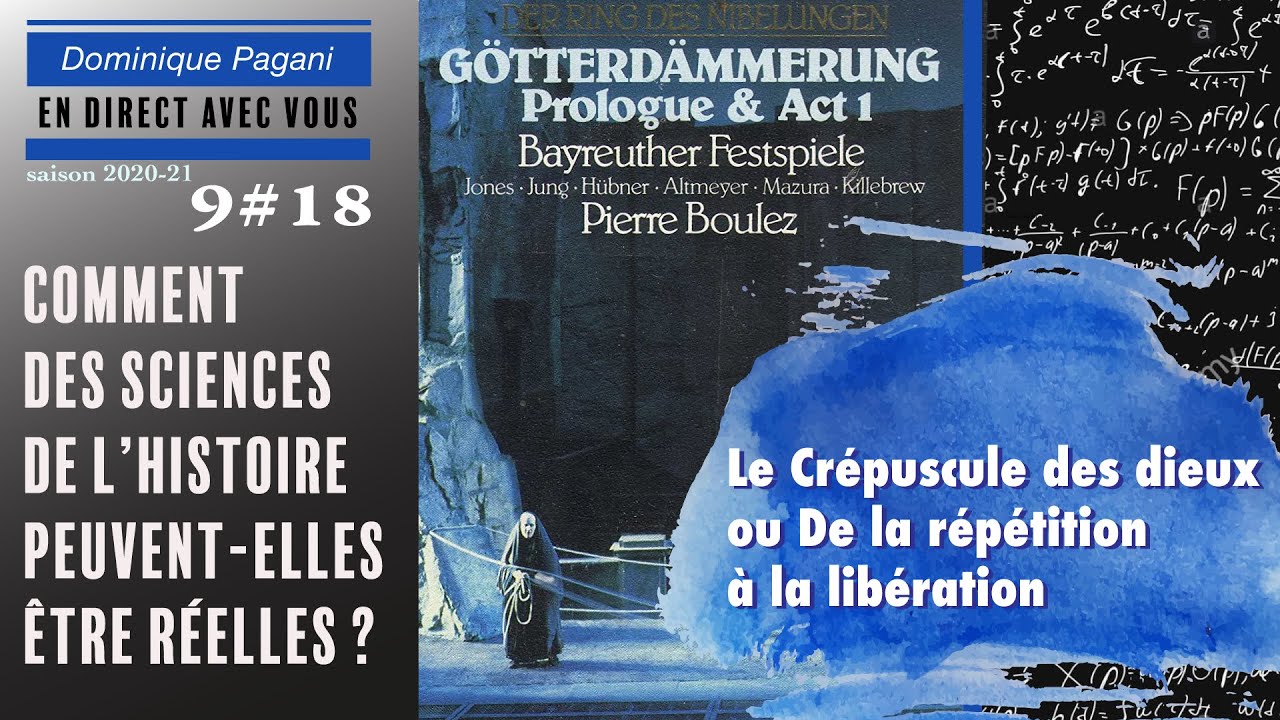
1:02 Parsifal, the Germanized name of our Perceval, from the matter of Britain, Perceval the Welshman, right, Parsifal. Now, I'm not going to tell you — we haven't even seen a tenth of what would be needed in the Ring, I'm exaggerating a bit — but I'm not going to tell you about Parsifal, which lasts about as long as the Twilight of the Gods, which is to say quite a long time all the same. And I say that because we're going to focus mainly on the Twilight of the Gods today.
1:38 It's Good Friday which, as you know, before Christian civilization made it the day of mourning everyone knows, was already a festive moment when the renewal of life in spring was celebrated. And in Parsifal, the character Parsifal doesn't understand why, on this day of mourning, when our Lord died for us on the cross, all the flowers should be opening their corollas in the air. That's the famous Good Friday enchantment, the Karfreitagszauber.
2:21 Whereas, and now I come back to our subject, today we're going to talk about exactly the opposite. It's not springtime, it's not the moment of Easter, it's twilight — and not a twilight like every evening's twilight that returns the next day, but an irrevocable twilight, since it is nothing less than the twilight of the gods, and that certainly needs explaining. In any case, you can feel that there is a world that is going to sink into the abyss. I'll tell you right away that this world of the gods, in Wagner's work, is going to sink into the abyss to make way for that of men, which is rather well expressed, moreover, in the production we'll be following again this time, that of Chéreau and Boulez.
"Brille ab": music before staging 3:19 There's no contract with them, but I discussed the different interpretations at length. It would need much more discussion. But I tried to be a bit systematic in answering one of the questions I was asked, about which are the best interpretations of the Ring. And no doubt someone who loves music, since she said the best audio versions — implying the staging can be good or not so good, but I mean, it's the music that's essential in all this.
4:02 And on all that, we'll need to come back to the respective share of music, text, and action. I won't go into it now, because it's too important not to — well, I don't want to make abstract developments, quite the opposite, for such an important issue I'll condense it into a famous anecdote from Wagner's biographies. Wagner had a guest, invited to attend rehearsals of Parsifal, precisely, his ultimate work. So the hall is empty and a few privileged people have the right to attend rehearsals at Wagner's invitation.
4:45 There is one whom Wagner sees from behind, in the darkened hall. You know that Wagner demanded, well before cinema even existed, total darkness as soon as the theater lights went out. Because music is an art of time — it's not an art of space illuminated by the sun, but of inner light. He sees the character, mouth half-open, completely subjugated by a scene that stuns both eye and ear.
5:25 It's the famous scene of the unveiling of the Grail in the first act of Parsifal. Wagner comes up from behind, puts his hands over the eyes of this man who was all hearing and contemplation, and says this famous phrase — it's not even a phrase, this famous formula — Brille ab. No glasses, please, no glasses.
5:57 Almost an admission of failure, he who fought his whole life to create the total work of art uniting music, gesture, staging, painting. And I'm getting ahead of many things. When I told you that music is nonetheless the essential thing, that's not just a whim of mine. How derisory we are before all these stakes. Subjectivity, yes, but subjectivism as idle chatter — Brille ab. If you lose your bearings, go back into the music, leave the world of daylight.
6:37 So, as I was telling you, it's the twilight of a whole world that will give way to us, to humanity, and then to "modern" humanity, in quotes, mature let's say, mature, if that even means anything. Neither the childhood of humanity nor its decadent senility — it is mature.
7:08 Now, I'll begin — we're going to listen to three great excerpts from the Twilight of the Gods, that's it, before I say where I'll start. Three great excerpts that allow us to... let's say... one taken mostly from the first act and most of the others from the third act. There are always three acts in Wagner's works.
7:39 Two outer acts surround a middle act where, generally, the action takes place. An act that sets things out, an act where the irreversible action occurs that cannot be undone, for better or worse, that saves or damns, and then there's the resolution of all these contradictions, in principle, in the third act. These excerpts are much longer than those we've broadcast to you so far. Why?
8:13 To answer the why — not to bore you with lengthy passages, five hours is hard for the Twilight, five hours ten, I'm not going to play whole long excerpts. No, seriously, because — and this is good news — because we now have the equipment to do it. I thank the association, first and foremost Pierre-Alain, I thank Philippe who came, there's a word for it, to configure — to configure, I believe, my computer so it's compatible with the association's equipment.
8:59 Well, the computer that's at my place, along with the association's other equipment. So you probably have better lighting now, and above all better sound. I hope it's not glitching. And above all, above all, we can now, live, play any sequence — either a streamed sequence borrowed from anything, Deezer, YouTube, Spotify, whatever you like, or a CD — to illustrate the discussion, but at near Hi-Fi standards, high fidelity, standards that are in principle objectively defined. I mean, well, for quite a few of you, the sound you end up hearing when you want to listen to what we send is your computer's sound.
9:58 That is anything but Hi-Fi sound. As long as you only know computer sound, you are very, very far from music. No, no, I'm not saying that with contempt. I have a computer too. Unless you're listening with headphones. That's a bit awkward for long passages and so on. But especially if the headphones aren't just a little earbud bought quickly at a tobacco shop on holiday because you forgot to bring good headphones from Paris.
10:31 It's well known among audiophiles and studio people that, all else being equal, with the same amp, the same playback, the same source, headphones are, of all the elements in the chain, the one with the least distortion. But still, outside headphones, what are the 2 or 3.5 watts of a computer? Not much. It's a bit like looking at Michelangelo's Last Judgment, so to speak, on a tiny black-and-white photo two centimeters across. No, no, I'm not exaggerating.
11:08 Listen, listen, I have... Stravinsky's Rite of Spring, works with quite large forces like that, or a Mahler symphony if you prefer a different feeling, or a Gil Evans big band, Gil, not Bill, who offered all his impressionist shimmer as a launching pad for Miles Davis to take the few steps he grants us when he plays.
11:43 A magnificent, magnificent arranger and orchestra director. Listen to him on your computer, listen to him in an auditorium — there are a few in the big urban centers — at a friend's who has a real hi-fi system. After this very vaguely audiophile parenthesis, still, I was insisting on the fact that music is by no means the inessential part of all this.
Lyric drama as the fusion of the arts 12:15 We're going to have here, we're going to listen to three sequences, I hope in fairly good conditions, and I'll start with a sequence you've already heard in part. Here again, I'm overdetermining tonight's sequence with a sequence from another cycle than the one on historical knowledge — the one I did not long before on forgetting, amnesia, and conversely the return of memory, anamnesis. I did a cycle on that.
12:57 There you go, it's to put to the test, and to see whether those who follow will understand much better — not just what I'm going to say, that's not the most important thing, but especially the Ring itself. The musical, dramatic, textual discourse, all fused together — let me take this opportunity to recall something fundamental. It's so important that we forget to keep repeating it. The notion of drama in Wagner, who, starting with the Rhinegold, when he finds his definitive manner, called in German the Ton — Ton meaning musical — Tondrama, lyric drama, literally sung drama. Many believe that drama, as with other composers, is the text, on a libretto written by someone else or by the composer, which is rare — well, Wagner is the first to do it systematically.
13:50 So drama is a matter of language, of text. Some anthropologists have said it's the feminine part — I refer you to a study done on the theme of the androgyne in Wagner. Don't think I'm trying to re-sexualize the genders — quite the opposite, it's a work that shows precisely that the sexes exchange places all the time. In this devil Wagner, we'll see it regarding the Ring, moreover.
14:24 There isn't drama on one side, language, clarity, determination, and on the other side music with everything closer to the soul than the mind, to passions rather than reason. I'm stating a few banalities, but roughly speaking, it's not entirely false. But that's not what drama is in Wagner. For Wagner, in all his theoretical writings and above all of course in his application of them to each of the lyric dramas that are the Valkyrie, Siegfried, the Twilight of the Gods, the Rhinegold — everything after Lohengrin, which is the last of the romantic operas. In his youth he wrote romantic operas. There are three, in chronological order. Let's review. The first, the Flying Dutchman, based on a legend, not yet on myth. Then Tannhäuser, also a medieval legend. Third, Lohengrin. There, done. That's the romantic opera, inaugurated before him by Weber, who practically created German opera, even though specialists know that the first great German opera is The Magic Flute — but Mozart wrote the best Italian operas.
15:38 He wrote masterpieces in the genre of French opera too, I'm thinking of Bastien und Bastienne, among others, and even Singspiele, as they say in Munich or Vienna. The Magic Flute, The Abduction from the Seraglio, etc. It literally means "sung play," Singspiel. So, let's insist on this: drama is not text versus music. Drama is what results from their fusion. That's where it's very dialectical, I don't know — where everything that opposes itself, the dichotomy I was drawing, one being passion, the other reason, one rather virile, the other more tender, more feminine, in the sense of the roles assigned to these people for thousands of years.
16:28 I can count on it. And for longer than we think, even if we regret it — that's another matter, I'm not the last to think so. All these oppositions suddenly fuse into an entity which is drama. Drama results from the conjunction of all these separate artistic genres — gesture, drama, text, music, song, light, set. There. I close this parenthesis.
The Norns, the Germanic equivalent of the Fates 17:08 So I insist a great deal on the fact that tonight, since we have sound roughly worthy of the score — not just roughly, better than that, but given the live streaming, the Zoom, the reception conditions on everyone's end — I mean, in any case the source is much better than usual, the source being Pierre-Alain, so to speak.
17:38 And who is making this resonate for us from Iceland, hoping that the rumblings of the volcano currently active there won't drown out the music. That would be an extraordinary coincidence, arriving right on cue to illustrate the final scene of the Twilight of the Gods, where everything collapses in flames. There, I don't want to get ahead of myself. Three sequences. The first, I said you know it. We saw it, and I had even programmed it as the opening credits of our first episode on Memory, Anamnesis, etc. It's the scene of the three Norns. You know, the Norns, in Germanic mythology, three female figures, the Norns, are the equivalent in Germanic mythology of what the Fates are in Greek mythology. They have the same function, the same tools, the same objects in hand.
18:33 And the same predicative function. Predicative and predictive. Predicative — they're not logicians — but predictive. They spin the cable of destiny. And you'll see that there's a haunting refrain that comes back in this scene of the Norns. Oh sorry, I'm going too fast. I said they have the same objects in hand as the Fates, they have the cord, the cable, the thread — a very beautiful metaphor, the thread of our lives, they hold it in their hands, right? They hold it not for themselves, but on behalf of destiny, whether there are knots, whether they're loose, whether they're taut. Let's not say they break, that would be terrible, right? There. So, we'd seen part of this scene, except now you'll see it in much better conditions, and here I express all my gratitude to Pierre-Alain, for adding as much light as possible to a recording — I don't mean to speak ill of Deutsche Grammophon, which makes excellent sound recordings — but of the Ring, it's the famous centenary Ring of Boulez-Chéreau, which is often very underexposed, darkened.
19:52 The Twilight of the Gods is already a crepuscular work that often takes place in the gloaming, as we admirably say in French, "between dog and wolf" — the most dangerous hour for driving. At night there are headlights, it's clear, you see light against darkness; in daytime too, but in between — watch out, it's in that light, including in the musical sense, that there are strange harmonies we'd never heard before. Don't forget that Wagner interrupted the Ring right in the middle of it — the Rhinegold, the Valkyrie, Siegfried, the Twilight of the Gods, which lasts a very long time, with Siegfried in the middle, the gayest, most bounding, youngest work.
The interruption of the Ring: Tristan and the Greek tetralogy 20:39 It's often been said that it's the scherzo of this gigantic symphony that the Ring would be if we pursued the comparison. He abandoned, as he says in a letter, his Siegfried in the midst of euphoria in the forest. He has just killed the dragon. All he has left to do is gather the treasure and listen to Ravi — sorry, the bird — the only companion since his birth with whom he's had a positive relationship, since he'd say he had only known the smith who raised him — it's the bird.
21:14 The bird whose voice he hears through flutes and oboes — I'm not in the Twilight of the Gods here, I'm in Siegfried, Act II. We listened to a few passages of what, when played as an excerpt, is called the Forest Murmurs. Siegfried, Act II, the Forest Murmurs, "Waldweben." Yes, I'll remind you again since not everyone was here. "Waldweben," murmur. "Wald" is the forest. "Wald," wild. "Esta selva selvaggia," as Dante says in the Divine Comedy. "Wild," "selvaggia," comes from "selva," the forest. "Silva" — I see there's a Sylvain writing to me, "I greet him."
21:55 "Esta selva selvaggia e aspra e forte che nel pensier rinova la paura" — that made fear well up again in thought. There's the old forest of which Marx says, doesn't he, that one must leave it in peace, or rather beware, of stirring up the forests of Dodona. Well, Siegfried leaves his hero in peace in the forest that murmurs like that, swaying the branches of the fir trees over legato eighth notes.
22:35 And for nearly twelve years, the composition of the Ring is interrupted. Not Wagner's activity as a composer, because his mood had to devote itself to something other than the material of the Ring — the epic, heroic material of the Ring — to the most amorous, most devouring passion ever expressed in music, Tristan. That's when he wanted to compose it, revolutionizing the harmony of his time, which was already being pushed around quite a bit — well, pushing it to its limits; he's not an atonal composer either, but still, he shows he's opening doors toward what will soon be the absence of tonality.
23:28 Let's leave musicology aside for now. So, he writes Tristan. In the Twilight, we're going to hear a Wagnerian writing enriched by all these harmonic advances. Here we're in harmonic, melodic, rhythmic music. And then — and it's he himself who makes the comparison — just as tradition in the ancient Greek city wanted that after a terrible tragic trilogy, terrible stories, the Atreides, Agamemnon killed upon his return from Troy by his wife, his wife killed.
24:10 And so the father avenged by his son, and so on — so much blood. A fate so dreadful, if not worthy of Atreus, is worthy of Thyestes. That's the final couplet Edgar Allan Poe puts in "The Purloined Letter," on which Lacan wrote the famous commentary we all know. A fate so dreadful, if not worthy of Atreus, is worthy of Thyestes. The series of the Labdacids, perhaps even more terrible — that's where we find poor Oedipus, isn't it.
24:45 He tears out, once he knows the truth, his eyes, which served him no purpose in finding the truth, since eyes by definition look outward. He didn't heed the oracle. Gnôthi seauton, know thyself — he did not turn his gaze back onto the one gazing. You know that arrow called reflexivity in mathematics? Thus the reflexive equality, since we can say not only A equals B, but A equals A. He didn't put a mirror, a reflection, before his eyes.
25:29 So all these terrible stories — the Greeks were in the habit of leaving the last day for a return to life, to good humor, in short for a comedy. Trilogy plus one comedy makes four, that's a tetralogy. Wagner, after Tristan, follows up with his only so-called comic work, The Mastersingers — indeed there are passages that verge on farce, on buffoonery. Old Verdi, at 80, is thought to write Falstaff — Verdi, we go from Verdi to Wagner.
Verdi and Wagner, contemporaries of the national unifications 26:08 Yes, they were both born in 1813, I have the right to make comparisons. One identifies with the other. Both are contemporaries of the political movements that would achieve national unity in their countries. German unity happens during Wagner's lifetime; Italian unity happens during Verdi's lifetime, to the point that being a disciple of Verdi was frowned upon by the authorities, because the letters spelling Verdi were the initials of Vittorio Emanuele Re d'Italia.
26:38 Victor Emmanuel, the king of Piedmont, who plays somewhat the role Prussia played in unifying Italy, who was the idol of progressives at that time. Not the king himself, but I mean Piedmontese policy, that of Cavour, the Italian Bismarck. Victor Emmanuel, Re d'Italia, Verdi. There, those who know cinema know there's a very beautiful film by Visconti, one of his early films, Senso, with views of Venice, if only those sequences with curtains drawn like that.
27:19 It's based on a novel, I'm trying to remember. The film opens at the opera while they're playing Verdi's Il Trovatore, with partisans standing up in the audience shouting "Long live Italian unity" right in the middle of an opera sequence, in the midst of the concert hall's silence. So yes, I'm making the comparison. Why? Because at 80, Verdi makes his own Mastersingers, his own Falstaff, based on a Shakespeare play.
27:55 Verdi's two last great masterpieces, his two final works, are both drawn from Shakespeare. And yes, the greatest of Italy's sound-dramatists, in the modern era — since the immense Monteverdi belongs to the 16th–17th century — Verdi borrows his two texts from Shakespeare, Othello, the dark version, one might say, and then a bit of a lark, a jest, which wasn't even meant to be performed in public.
28:29 Verdi wanted to play for connoisseurs among friends, and that's where he goes furthest musically. And Wagner's equivalent is the Mastersingers. And we know that Nietzsche himself admitted defeat and confessed his tenderness for this inimitable work. So this long parenthesis where Wagner writes Tristan and then the Mastersingers, where his mastery of musical writing reaches a degree toward which his whole earlier trajectory had been heading, he no longer has anything to prove, gives the score of Twilight of the Gods a special place within the Ring, a harmonic suppleness, a metamorphic power at every moment, it's a bit hard to follow, so as a result it's shifting.
29:19 Right, that's fine. It's easier to identify geometric motifs than ceaseless curves, like those waves of the sea. The sea, the ocean is the main character of Tristan. Musically, listen to the first act of Tristan, Isolde's great anger over the sea. And you'll understand that the main character is neither King Marke, nor Tristan, and even not Isolde the Fair — it's the sea. And unlike a river, which has a direction, a watercourse, a torrent, a stream, a great river, the sea goes in every direction.
29:56 And there are forms that appear and then fall back into formlessness until a new form emerges. That's what waves are. Wagner managed to put that into music. In Twilight of the Gods you find this suppleness again, but of course, coming back, the tragic, heroic colour which is the very substance of the Ring and of the Germanic myths it depicts.
The Norns against the daughters of the Rhine 30:27 So the Norns scene is exceptional in every respect. I'm telling you this beforehand. First of all because the Norns, these characters who spin the cable of destiny, are the only characters in the whole Ring who appear only once. There are three of them. Does that remind you of three other daughters? Yes, the Rhinemaidens. This is an immense work, no doubt the most gigantic ever conceived by an artist in the history of Europe, since at Bayreuth we speak of a first day, second day, third day, fourth day — a prologue and three musical dramas.
31:12 It begins with the very first scene, the very first words, which are hardly words at all, which are a warbling — if you remember, worth keeping in mind, we'll come back to it. We'll come back to the equivalence between women and birds. From a scientific point of view, we'll see that the note intervals that signify birds and women, in a disturbing correspondence beyond mere analogy, are identical except for the rhythm.
31:44 So we'll have time to look at this in detail. For now, we need to know that we've already seen three women, the Rhinemaidens. The carefreeness, the youthfulness of these eternally immature beings, like kids playing in the water. It's always hard to get them out, you know, children. That's what the Rhinemaidens are like. They're halfway between childhood and maturity, between animality and humanity.
32:15 They chatter away without noticing that they're talking too much. That's what reveals to the dwarf Alberich that the gold they're guarding can give power over the world, and that drives him to commit the irreparable act that will determine the whole work: the theft of the gold. And it's not yet cursed — it will be cursed afterward. But these three Rhinemaidens, fickle, the ondines, sirens, rather mocking — look at the vamp act they put on for poor Alberich, who arrives smelling of fish, as Clouscard puts it in Vers un nouveau progressisme, where he takes up the character of Alberich.
33:04 The Rhinegold — he says the proletariat is that: it's the one being mocked by the Rhinemaidens. He smells bad, he's black, he comes from the workshop, he comes from the factory. He doesn't have all the gestures of seduction. And he doesn't have the pompom of the sailors of the royal navy. And...
33:34 And by a more striking contrast, in anti-symmetry with the three Norns — the three Norns are almost like the living dead, but how to put it, you can see that they are the voice of a kind of immemorial eternity. It's not the youth of the world; in this scene you become aware of the incredible old age of the universe. Its temporal depth, everything it has told. And that's why I'm starting with this scene.
34:06 Because since I can't have you listen to the whole Ring straight through without interrupting, I can only recommend it to you — not all at once, if you're not used to it, not all at once. But once you're used to it, as soon as the four days are over, you want to start again. I guarantee it — I've seen it with people who couldn't have stood it for 20 minutes at the start. You know, as children there were cooked dishes we didn't find tasty.
34:38 It's only later that you say to yourself, "I missed out on that." That's why I chose this scene, because it's recapitulative. That's why I allowed myself — I see that Pierre-Alain was kind enough to transcribe it here for you — this first great excerpt, of the three great excerpts we're going to see, I named it "the aborted anamnesis of the Norns."
Memory is not a recording 35:08 And here, I'd like us to remember... No, not everything I said, we're not going to... I know there's a spiral drawn up there, that we're going in circles, even if it's not to return to the starting point, if you notice carefully. No, no, simply let's remember the result of the inquiry we conducted together — that memory, and here I insist again and defend, the sciences of the subject against those who believe they are studying the subject by turning it into an object.
35:44 I'm alluding to this in my latest reply to questions — a very interesting question that asked me to relate my critique to Durkheim's phrase "social facts must be treated as things." I think I did justice to Durkheim, who is, after all, something other than the objectivism and scientism of the neo-positivism and cognitivism that has flourished across the planet since the counter-revolution of the 1970s, since the financialization of the economy.
36:22 You'll say he's raving now, mixing everything up. As you like. Take the 1970s as a marker and you'll see that quite a few things characterizing the world you live in appeared at that time. '68 is a prodrome of the 1970s. It's the sequel and end of the Cold War that begins. So let's be very attentive — in the last part we saw that memory was not at all what one might think, I'm going to caricature it a bit, for the sake of simplification because I don't have time.
37:02 This is not to do justice to certain people who do cognitive science very rigorously in laboratories, to whom I take my hat off, and who get extremely relevant partial results. It's the way of generalizing them and expressing them in everyday language, which is not the language of science, where all of a sudden ideology slips in. But that's another story, I've had other occasions, and we'll have more, to come back to that. Let's stick to our topic. In this positivist, mechanistic conception of memory, what is memory? I'll put it crudely: we have in our head a microphone, a camera that records, a magnetic tape — excuse me, I'm behind the times, it's digital recording now, there we go.
37:48 In short, something to record, to capture. That's not what memory is. Otherwise we won't understand it. Because with that, the more time passes, the more entropy there is, the more the tapes degrade, the worse the sound gets, the less sharp the image. You look at a photo that's been sitting in your drawer for 30 years — it doesn't have the same sharpness, the patina is still visible. I'm not even talking about magnetic tapes, which many have thrown away as obsolete; with digital there's a bit more durability. But even there, it has to be well preserved.
38:25 Real memory is not a matter of time. I'm incapable of telling you what I did yesterday, just like that, if you ask me, between 9:17 and 9:23. I could just as well have said between 4:32 and 4:34 pm. I don't know. But I can tell you second by second, scenes that happened to me, as to you, when I was three years old. Memory is selective. The tape recorder, the microphone doesn't select everything that passes, it captures. There's no subject there. That's where you see it: the subject begins with selection. This I take, this I don't take.
39:11 The animal world is more of a subject than the mineral world. You see, when I speak in terms of more and less, we understand each other better. I'm not drawing an axe-cut distinction between man and animal. Man is more of a subject than the animal, the animal is more of a subject than... because it's been measured. The best visual system in the animal world, the sight of birds of prey, has been studied, measured — the sight of the falcon, the golden eagle, whichever you like. There's a component of choice. The visual acuity of birds of prey varies — the acuity within the very same individual varies according to whether it is sated or hungry.
39:50 You can guess that visual acuity is much greater when it's hovering over the plain like that, hungry because it's been a while since its last meal. This I take, this I don't take. There's an interest of the subject that has nothing to do with the action, the light rays from the object, all that, all of which exists too, but which comes from the object. I'm not in idealism. The subject is a being that is hungry, it's something concrete, it's not pure spirit.
Negativity of the subject: Mankiewicz and Goethe's Faust 40:27 Nerval's line: a pure spirit grows beneath the bark of stones. No, no, it's not even that. I recall all this to say that this is why I concluded, before coming to the Norns, who will give an illustration, an incarnation of our conclusion about the memory-anamnesis cycle — and I hold to this, forgive me, I glance at the screen from time to time — I insist on the fact that we had concluded by saying that memory never quite goes all the way to the end. It's a back-and-forth.
41:08 I had cited, I believe, but I'll cite it again, that admirable Mankiewicz film called Suddenly, Last Summer, with Montgomery Clift and an Elizabeth Taylor who were barely known at that time. Played admirably — she was very young, a great actress who came from theatre and Shakespeare, like her future husband Burton, for that matter. So the whole film is an effort to make this young woman, who has been locked up in a psychiatric asylum to stop her talking about what she saw — the murder of her brother — remember.
41:48 It's an incessant effort she makes. Sometimes she almost gets there, she breaks into a sweat, has a nervous breakdown, retreats back, and it's like a Sisyphus climbing his slope again. That's what memory is. Because in the person making an effort to remember there is also an effort not to remember. We always forget that in the subject — and that's precisely what makes it not an object — there is negativity.
42:19 When the devil, in the form of his representative Mephistopheles, summoned by Faust, the modern hero par excellence, in Goethe's Faust — when he says, this is the very first scene, medicine, philosophy, law, I've studied it all, here I am, poor fool that I ever was, more and more doubts overwhelm me. In short, the eternal problem of the dissatisfied intellectual. As a last resort he turns to the occult sciences. He knows the formulas, he has the books in his den, in his laboratory, and the spirit appears.
43:02 The spirit of evil, Mephistopheles. And when he can look at him, Faust says to him, "Who are you?" — I've lost my thread, negativity — He answers, "I am the spirit that negates." He'll say to me, "But you're exaggerating, you're asking me to be diabolical — well, to be a subject, one has to have something diabolical about them." Yes, that's what I'm saying, but diabolical in the positive sense. Because, let's quote the text to the end. There's a prologue in Faust, a prologue that takes place in heaven.
43:35 where the good Lord discusses with Mephistopheles, who moreover at the end of the scene says, "He's quite nice really, the good Lord, to chat with a poor devil." When the devil leaves, the good Lord says to his confidants and the angels around him, "I rather like this spirit of negativity; if he weren't there, man would grow soft, man would wallow in habit." In short, he would be a bee performing the same gestures for thousands of years. There would be no history.
44:12 Now here, with the Ring, a history has to be restored. These preambles were important. So we're going to watch a scene of anamnesis. But an aborted anamnesis — now you understand the word abort. I'm telling you now, it's not a detective novel, I can tell you especially, since most of those kind enough to follow my talks have already seen this, that the Norns' thread breaks at a certain point, they can no longer predict the future, something has happened.
44:47 We'll see afterward that it's the freedom of the human hero which means that an implacable logic, supposedly figured by the cable of destiny, can no longer simply be unspooled like that. And they say: we will no longer be able to predict the future, it's over, it's aborted. Not because memory is powerless and so on, but because the future is not settled. It is what we will make of it.
Leitmotifs, Valhalla and Siegfried's solar duet 45:17 So we're going to... I'm going to ask Pierre-Alain to start this scene. I'll make a few comments, since we don't talk much about music — I'll make a few general allusions, but this will be the occasion, if ever there was one, since these are long excerpts, to remind you of some of the leitmotifs, the recurring themes, you know, characteristic of Wagner's musical language. I'll bring them back. This is music that never repeats itself, except in the leitmotifs — and even then, they never come back under the same aspect.
45:53 Which designates sometimes objects, the sword, the helmet, the helm, the Rhine, the river, sometimes people, the theme of Mime, limping and bounding, the theme of Valhalla, the palace of the gods, majestic and a touch almost vain. It was the era, around Wagner's time, when they were building what are called Stalinist buildings — curious, in the anti-communist world, but they're exactly the same. Look at the Trocadéro of that time.
46:36 There were Stalinist buildings in Moscow, Wilhelmine buildings in Berlin, and Victorian buildings in London, all a bit gigantic — that's not the gods for me. The gods are the grand bourgeoisie, aren't they, which reaches its apogee on the eve of the war of 1914. Afterward, the subject changes. So we're going to hear the very first scene of Twilight of the Gods, which is a prologue. There's a prologue to the whole Ring which is the Rhinegold, which lasts more than an hour and fifty minutes straight through. And then there's this prologue here where we're transported. But where? So here we go. Because we're supposed to be at Brünnhilde's rock, the rock where she slept for a long time surrounded by flames. I wish you could see it — we haven't watched it, we can't see everything.
47:28 We haven't seen the admirable scene. Nietzsche said that the sphere of storms and the sublime itself is surpassed, when he spoke of the scene in Siegfried, Brünnhilde's awakening, the third act of Siegfried. Siegfried, act 3, duet — you put that on YouTube, a solar duet, it's not the Tristan duet, deathly, nocturnal and desperate — it's the solar duet. But if I still tell you about this duet in Siegfried, whereas the colour of Twilight of the Gods, as I told you, is much darker, it's because, look, I'll read you the end of this duet in Siegfried — that's the curtain, and Siegfried is over, four hours finished.
48:14 So the Valkyrie's awakening marks the end of Siegfried. Now, what does Brünnhilde say? The two of them say more or less the same thing, as in somewhat ecstatic duets, they say nearly the same words, don't they? Radiant love, laughing death. But Brünnhilde says something that she alone says. She says, at the peak of this solar duet, "O young hero, O splendid boy, you naive treasure" — don't forget she's a warrior-maiden discovering love for the first time — "of sublime deeds, radiant, I must love you, radiant, I want to blind myself, radiant, let us both perish, radiant, vanish world of the splendour of Valhalla," her father Wotan's palace, the palace of the gods, disappears.
49:06 They announce it, one believes it's the most solar, Siegfried, the most optimistic, the most cheerful, the youngest, the most sunny. But at the same time, look at the diabolical dramatic continuity. Brünnhilde already invokes the end of the gods. Look closely. "Vanish, world of Valhalla's splendour, let your proud stronghold" — that is, fortress — "let your proud stronghold crumble into dust, farewell, dazzling pomp of the gods, die in joy, eternal race. Norns, break the thread of the runes." The runes, you know, the sacred Scandinavian writings, which symbolize somewhat the old destiny, the old order.
49:46 "Norns, break the thread of the runes, replace determinism with freedom. Twilight of the gods, rise from the abyss, night of nothingness, pour out your mist; for me Siegfried burns, my star now." We no longer need the sun. "My star now, for eternity, he is mine forever, my possession, my heir, the one and the all, radiant love, laughing death," etc. Well, that's to tell you that it's not cut with an axe. So we're at Brünnhilde's rock. She's been awake for a while, but in the meantime, what happened is that Brünnhilde was awakened at the end of that day. An act of love, wasn't it? The curtain falls.
The Norns' scene, circular time outside the world 50:37 And so Siegfried and Brünnhilde are still enjoying, the morning of their first day, their first amorous awakening. But they are still asleep while the Norns spin outside of time. And that's what's important to see in this scene, this circular time, the cape of destiny. Let me just read you an excerpt from this guide to Wagner's operas which, on this matter of the relation to time — I know how philosophically important it is — is nonetheless better made than the average of the countless books one finds on the subject.
51:20 "In the vast tetralogical edifice, the scene of the Norns, weavers of destinies, occupies a place unique in every respect. It is a pivotal scene which, for the first time, brings to light on stage the mythical foundations of the Ring and, fulfilling Brünnhilde's last wish" — what I just read to you, in Siegfried, "Zerreißt, ihr Nornen," tear the thread — "provides its perspective on the whole of events past, present, and to come." Again the number three, the three moments of time. "It opens the doors to the drama's ultimate outcome, the collapse of Valhalla in flames."
51:59 Is the volcano all right over there? I'm speaking to Iceland. "Situated at the heart of the Siegfried epic, this doubly nocturnal scene" — real night and mythic night, you'll see the importance of the metaphors of darkness — "which alone conjures up one of the vastest spans of time ever evoked on stage, in 15 minutes of music." In 15 minutes, the Norns sum up millennia of the world's becoming.
52:30 "And situated in the midst of two luminous scenes" — I told you, luminous scenes, I read you an excerpt — the final duet of Siegfried, which is going to end, isn't it, with carnal union, whatever you like, in broad sunlight, this duet which begins "Heil dir, Sonne, Heil dir, Licht," hail to you, sun, hail to you, light — we're far from the mists. I say this because Nietzsche said, mocking Wagner, that Wotan is the god of bad weather. Well, he preferred, with some reason if not full justification, the sky of Turin, of Nice, didn't he? And he would gladly have wanted Corsica — we'll talk about that another time, Nietzsche's dreams about Corsica.
53:08 Well, if I tell you a small detail anyway, I'll ruffle the feathers again of those caught up in the cult of Nietzsche, as though that were a word that went with Nietzsche. Nietzsche writes to Peter Gast, his musical correspondent — we should go to Corsica, he's in Nice, now or never — but even then it was complicated, no doubt even more so than today. We should go to Corsica, we'll go to Corte, it's written in his letter, because according to my calculations, that's where Napoleon was conceived.
53:41 It's extraordinary, this fascination with Bonaparte's sperm. Well, come on, no no, up toward the sun. There's going to be another duet between Siegfried and Brünnhilde when they wake up. I'm telling you they're in the middle of... how to put it? At four in the morning in summer, the sleep of love still lingers. Under the groves, dawn evaporates the scent of the celebrated evening. This unique, light sleep, like a shimmering bee. We are between two luminous scenes.
54:19 The waking scene, each time: a waking from a millennial sleep in Siegfried, like Sleeping Beauty, and the waking of the first night of love after the Norns' scene, with a transition — the art of transitions, I would say, of weldings. And between the two, there is this dark scene we are about to see, which takes place in the night out of time, precisely, out of the world. The world is lit by the light of Apollo, but here we are out of the world. Watch closely. It opens the door to the ultimate outcome of the drama.
54:55 Situated at the heart of the Siegfried epic, this doubly nocturnal scene — I repeat, real night and mythic night — which alone encompasses one of the vastest spans of time ever evoked, is placed between the two luminous scenes, you understand better now, devoted to the redeeming couple. A unique scene, a unique character. The Norns are the only important figures in the whole tetralogy to appear only once in the entire work. Having taken up residence at Brünnhilde's rock, they appear here only insofar as they have had to leave their natural place, the foot of the World Ash tree.
55:29 We'll learn more once we play the music. The Norns will begin by singing of the time when, by the water's edge, by the Rhine, by the spring, there grew the World Ash, the Weltesche. Think of the tree of life in the Old Testament, instead of opposing pagan myths and the Judeo-Christian tradition. I'm going to end up tiring myself out. Well, no, but anyway, I always repeat myself.
55:59 They always say the symbolic order, in a few religions — they always say the same things, just not in the same order. The foot — they appear here only insofar as they have had to leave their natural place, the foot of the World Ash, going back further into the past than anyone else in the work. So we're going to have — my son told me that in Star Wars, that's your generation, you know for me it's the third era or episode, I don't know how to say it, Star Wars 3 or whatever, The Lord of the Rings, where we see what happened.
56:33 A thousand years before, you see, it's a bit like this circular time — correct me as we go, I often confuse The Lord of the Rings with Star Wars, in any case it's the ring. So, having taken up the foot of the World Ash, going back into the past further than anyone else in the work, unveiling a present that will not be shown on stage, prophesying a future that draws closer at the very same time the scene unfolds, since Twilight of the Gods will end right there, with the burning of the palace of the gods, Valhalla — they embody time at once as eternity, certainly on the verge of fracture, but also as passage, that is, in its full and entire dimension. This scene is, par excellence, that of prophetic speech in its most total dimension.
57:25 Three Norns, three times — past, present, future — three tripartite narratives, three fundamental musical themes. Here again, after the great face-to-face of Siegfried with nature, the number 3 carries symbols and organizes structures. Now you'll say, we can see you coming with the symbolic order. No, no, no, I'm thinking of the music here. I've already seen these three women, three women who have a lyrical role like this. There I'm thinking in terms of music. Those who know the opera repertoire a little will know I'm alluding to the three ladies of the Queen of the Night in The Magic Flute.
58:01 The three young women who have an initiatory role, since they guide Tamino, the prince, and Papageno, the everyday man — you and me, if I may say so, I hope for your sake — who is not going toward accomplishment, toward initiation, toward the great divine mysteries, but who says, what I need is a slice of ham, a glass of beer, and hey, uncle, could I have a little wife? He asks the three girls that. There's this kind of musical intertextuality.
Commented listening to the prologue of Twilight of the Gods 58:31 So, we're going to play it, and I'll allow myself to comment on a few passages, drawing your attention to a few musical motifs that some of you, I believe, already have in your ear, and that others will discover, and I'll flag it so it sticks. Let's go. So, one moment still — Twilight of the Gods, the last part of Richard Wagner's Ring of the Nibelung, or ring, or tetralogy, Twilight of the Gods, prologue — that is, this isn't even the first act yet, it's the prologue before even the beginning of the first act. Let's go.
59:26 Now here you hear — the cellos come in, da da da da da da da da da da da da da da da. You remember, that's the Rhine theme, we find eternal becoming again, the becoming... slower, more majestic than before, less vitality. The theme of the Rhine's waters. First Norn, second Norn, you see, it's as if... they're a bit ghostly, they're not the three Rhinemaidens who were frolicking and vamping poor Alberich. They're not saloon girls.
1:00:21 So twice, a somewhat similar motif, then a third time. So, I believe it's going to be... the same, it breaks off and we hear the important dark motifs, there, in the brass, the theme of fate.
1:00:59 A bit louder perhaps. You notice that the first words are uncertainty. What light is shining? Is it daytime? Is it a trap? Or is it a light in the night? Loge is the god of fire, don't forget!
1:01:38 The vocal roles are distributed. There's an alto, a mezzo, and a soprano — the one singing now, with the receding hairline, is the highest voice. There's something exhausted about it.
1:02:12 Exhausted in the music — the world is old.
1:02:42 There's the tree.
1:03:13 You see, she speaks of it as of an earthly paradise. It was long ago. [garbled repetition]. Like Adam and Eve wanted to taste the tree of knowledge, Wotan — for it is he — Wotan wanted to drink from the spring of wisdom, of knowledge. He lost an eye there.
1:05:25 And here's the refrain, listen closely, both for the words and for the music. Each time she passes the relay, with this crucial phrase: "Do you know how it will turn out?" That's the best translation. That's our question too, in these troubled times. "Do you know what will come of all this?"
1:07:14 There, she has finished. She has completed her second verse, and again the haunting refrain. Do you know how it will turn out?
1:07:44 wie das wird, werden — becoming. You see, it's a recap of the story of the Rhinegold.
1:08:23 That was the violins there. We're learning.
1:09:04 So we're in the present, in the past, in the future. The end of the gods is already announced. So we're in the prologue.
1:09:34 The refrain. Look how the music and the tangled cables go so well together.
1:10:04 We hear Loge's themes.
1:10:56 The Palace of the Gods rests on a pyre, ordered by Wotan — an ex-pyre — made from what remains of the World Ash.
1:12:08 The theme of eternal sleep. A theme that descends, descends, descends. The extinction of all drives. A staggering scene. The refrain, never the same, always enriched with new variations.
1:12:52 See, see, the eye can no longer make anything out, the shapes blur, the threads get tangled. Anamnesis fails, the networks are scrambled.
1:13:54 The curse of the ring comes to thwart the effort of anamnesis. Watch out! Es riss! That was the curse motif on the trumpet.
1:14:39 The curse, the rope breaking. Eternal sleep. Regressing downward, toward the sea, toward the earth — they are daughters of the earth. As prophetesses often are.
From the prologue to Siegfried's journey down the Rhine 1:15:18 And as at the beginning we heard a few vague allusions to fate, at a moment when they vanish into the bowels of the Earth. There's this scene, which has no equivalent in the whole Ring, doesn't it? There's no point saying "metaphysical scene" — what isn't, in the Ring — but I mean it goes beyond the stakes specific to each of the other characters, as if there were a kind of life, a transversal vision, at once circular, of everything at stake in this cycle. So, what happens next? I'm skipping ahead, it's awful, but we won't see it — I know some of you will hold it against me — we won't see it.
1:16:05 First, the extraordinary piece of work — I recommend it, because you often have it as an excerpt. It lasts ten minutes, a quarter of an hour. The welding is a convention. And the waking of Brünnhilde and Siegfried is the famous passage called "Dawn and Siegfried's Rhine Journey." But above all, let me take the opportunity to tell you that Glenn Gould gives a hallucinatory piano version of it, where you hear every instrument of the orchestra — I don't know how he manages it — technically it's prodigious, especially since there's a multi-voice fugue in Siegfried's Rhine Journey.
1:16:55 "A Rhine Journey" has generally been the English translation used. You can find all this on streaming. So, the waking — and of course, from his very first waking, Siegfried wants to go see the world, travel. He's already fed up. He's not a homebody. You see? And there's a dialogue there, one could be ironic about it: "Don't catch cold, think of me, I give you my horse" — she gives him her horse, she's a Valkyrie after all, a rider, pam pam pam pam pam pam.
1:17:31 She gives him her horse, and he gives her the ring he took from the dragon, since he's now the master of the ring, and he gives the ring to her. She enters the shadow of the ring, you see, from that point on. So Siegfried moves off and will arrive — and so will we — for the first time since the beginning of the Tetralogy, having seen the Rhinegold, having seen all of the Valkyrie, having seen this prologue, we're now finally going to arrive among men. Because until now we were among gods, giants, dwarves, the Rhinemaidens — beings on the periphery of the purely human, as Wagner often says. And now we're going to arrive at a first kingdom, an empire.
1:18:20 We're going to arrive on the banks of the Rhine, among the Gibichungen, as they're called in the epic poem tradition. It's not well known — it's the equivalent of the Song of Roland, if one absolutely had to find equivalents. And then there's the Nibelungenlied, the Song of the Nibelungs, the gnomes who dwell in the underground world. Wagner blended it all together, working enormously — Lévi-Strauss repeats that Wagner is the undeniable father of the structural analysis of myths, as an artist. I'm not saying what Wagner thinks; I'm talking about what he produces, what he has us listen to, the words he puts in mouths, the connections he makes between women and birds, for instance.
1:19:11 You'll see why I say this in passing, for those who don't know, to show that the only difference between mathematics and poetry is that poetry is an exact science, and deliberately so. The Valkyries, originally, in the source material — the learned among you know this — in Germanic mythology, were swans. Yes, birds, swans, which are very common in Nordic countries, on ponds and rivers; they leave their wings and feathers on the shore and go frolic in the water. Originally, that's what the Valkyries were.
1:19:45 There. And it was only later that Wotan gave them the order, flying, to go to the battlefields and gather the bodies of the heroes who died valiantly in combat, to make an elite army for the gods up there, at Valhalla. At the top of the heap, as they say — you know, language knows everything, language knows well that class struggle is behind all this. The gods are up there.
Rousseau: from possession to property 1:20:16 An elite army, to bring back the bodies of warriors who died valiantly in combat, to make an army that would help Wotan fight against the undermining work of the underground world, ever since he stole it — when Alberich, the dwarf, the proletarian, had stolen from the Rhine. After all, there's no property in nature. Magnificent passage from Rousseau in The Social Contract. In passing from the state of nature to the civil state, man loses natural liberty in order to gain civil liberty.
1:20:54 Natural liberty, which has no limit but the strength of the individual — I quote it word for word, and when people tell me that doesn't go very far, well, put a gazelle in the jungle surrounded by cheetahs, lions, and so on. Natural liberty, which has no limit but the strength of the individual; whereas, in return, he regains civil liberty, which is limited only by the general will. But there — I was talking about property, not liberty, though they go together, this change, this passage of state.
1:21:24 He also says that man thereby gives up what he had in nature, namely possession, and finally acquires property instead. Ah yes, these are Rousseau-style distinctions. We should teach that in primary school. Possession: a lion has an antelope in its jaws, it possesses it, until a stronger one takes it away — a rival male. Usually it's a cheetah. A cheetah weighs a third of what a lion weighs. It made twenty attempts to get its poor gazelle — not to feed its cubs. Once it has it, a lion that had been dozing — I've said this before — dozing until then, opens one eye, doesn't he? He sees the other lions aren't too far off, because he likes to make the females do the work, the lions do — he's not the only one. He approaches the cheetah, gives it a slap, doesn't he? The cheetah scurries off, and the lion settles in.
1:22:17 You always have to start with something. You see? Natural liberty. So that's possession, which is nothing but the effect of force, says Rousseau. He gives it up in favor of property, which can only be granted on a positive title, says Rousseau. In other words, possession is binary. Me, I have a candy in my mouth, I possess it, nobody can take it from me, I possess it. I have a female — she's not my wife, it's not a marriage, it's not an institution, it's an instinct for the moment. It's binary. Me and the thing I possess. There, I possess that.
1:23:01 Property is ternary. There's me, the thing, and the other who recognizes me as owner and whom I recognize in turn. She's my wife, dear friend, excuse me. There can be friction. All of the novelistic genre is made of nothing else. But I mean, the fact changes when it's based on right. So you see there, here's a problem I put to those who'd like to write a thesis on the symbolic order in the Ring: did Alberich steal the Rhinegold, and is it therefore legitimate that it be stolen from him in turn? Because that's the argument of that scoundrel Wotan, and of the god Loge, isn't it?
1:23:50 When Wotan says to him, "But how do you expect us to go get Alberich's gold back in the underground world?" and Loge, the god of fire, his damned counselor, his consultant, replies, "Durch Raub!" with a terrifying cry — "Raub," in English, truly theft, but with violence. A theft not far from a rape. So there, we see everything in this scene, let's recap it. There was a paradisiacal age, the ash tree rustled in the wind, the spring rippled, the spring of knowledge, of wisdom, until a reckless god, Wotan — human curiosity — came to drink, to quench himself at the spring of knowledge, which means seeking to know.
The mutilated ash tree and music as the art of time 1:24:44 He was Philosophia. He tasted the tree of knowledge. Result, he lost an eye. He always has a patch like pirates, when you see him. And that must be common among the Vikings. And where does this mythology come from? But you see that in the order of meanings, it isn't specific to the Nordic countries. You find it everywhere. Proof: Adam and Eve, that's their myths. And these are desert countries whereas...
1:25:15 There's a lack of water here and an excess of water there. And even ice. So from there everything degenerated, you saw, the ash tree withered, Wotan tore off — which is again an unlawful act, isn't it? — the world ash tree, he tore off a branch, with this branch he made his spear, his mark, the contracts, the pacts, trying to balance the powers, the giants, etc. And he had this tree cut down, which is now a dead tree, and with its logs he made a gigantic pyre.
1:26:00 From the very start, we see what awaits us at the end of the Twilight of the Gods, we sense how it's going to end, in a final conflagration. Fa come natura face in foco, says Dante, does as nature does in fire. Heraclitus's fire. We return it. So, Siegfried, after this magnificent dream duet, there again I made a long passage in my answers to the questions, to the question from someone intelligent enough to ask me — I don't know if I answered exhaustively, far from it, but anyway I tried to do my best with the reference interpretations of the Ring.
1:26:42 There's a name I mentioned that comes up often, exceptional names. Vocally, no one has ever reached the level of Lauritz Melchior among tenors in the role of Siegfried. There are two or three names, Flagstad, Nilsson and Frida Leider or Lotte Lehmann in the roles of Brünnhilde or Sieglinde, Siegfried's mother, or of Brünnhilde, his future wife. So there you have to listen again — after hearing this in stereophonic recordings, you have to go back and listen to the musicality, even with an old recording from the thirties you hear more things, the importance of interpretation is extraordinary.
1:27:22 Music, the most immaterial of the arts. I'm not saying it is immaterial. If you can hear me here, it's because in the air there's... If there were a vacuum, you wouldn't hear me. There are material conditions. Then, through the waves of the transmitter-receiver in space, there are ionized flows. This is not now the end. A Mozart aria is a little more fluid and evanescent than hard marble or fine slate, to speak like Du Bellay, than architecture, than sculpture, even more than painting, which is already more abstract since dimension, depth in painting — I'm summarizing Hegel's aesthetics — depth is illusory in it, it is abstracted away, painting is always abstract compared to sculpture and architecture.
1:28:16 We abstract away the third dimension. Everything is flat. And as for music, there is no spatial dimension at all anymore, it is purely time. It is a material vibration, yes, but in time. These are durations. They are recollections that have their importance. You have to listen to its illustrious interpretations.
1:28:50 Siegfried's Journey on the Rhine, there's a great orchestral interlude, the one I say is admirably played by Glenn Gould on piano, Siegfried's Rhine Journey, and he arrives — I come back to this, to the first court, the first organized society, civil status, I'm finishing my detour through Rousseau — he arrives at the kingdom of the Gibichungs. And there, he is awaited. Well, awaited — someone is waiting for him. Someone who is the chief advisor to the king who reigns there.
Gunther, Hagen and the law of gold or of love 1:29:27 The king who reigns there — I'll tell you now, it's no mystery — is the symbol of impotence in general. Take it however you like, politically, sexually, psychologically. Gunther. But he has a damned soul as his advisor. This advisor is Hagen, the darkest character in the tetralogy, isn't he? Since even Alberich, who is nothing but hatred and fury, and who is his father — Hagen is Alberich's son. They don't know it among the Gibichungs, but he comes — he's a Nibelung — he comes from the underground world.
1:29:59 He got this promotion, he's advisor to the king of the Gibichungs, and he's plotting revenge against Siegfried who seized the ring for which his father had renounced love. So behind Siegfried's back, the logic continues, there's an algebraic logic. Either gold or love. Alberich played the game — say what you like, he's a dark, negative, underground character, so a bit diabolical — nonetheless, he respected the fundamental deal of the tetralogy, the law that governs it. Yes, law in the sense of the laws of the hard sciences. To obtain gold, the sine qua non condition is to renounce love. I'm not saying that, morally, one ought to renounce love.
1:30:49 And take the gold, or the reverse, never renounce love for love of gold. I'm saying that's what is instituted in the story. And from there, a logic unfolds. So Alberich had renounced love. He had even said this extraordinary line — it's Wagner writing it — with the gold that will give me power over the world, I will no longer have love but I will be able to buy myself desire — excuse me, pleasure, you see my slip. Precisely, with gold I'll be able to buy myself pleasure. Citizen Kane — so there's the whole history of romance fiction, and even many films that recognize themselves in this operative logic.
Commented listening to the scene among the Gibichungs 1:31:35 He arrives, Hagen is plotting his revenge. His revenge is what we're going to see, his schemes, that's the second big part we're going to hear. But first I need to ask... I need to check the time, it's 10pm so that gives us about an hour and a half, it's always at this point that I ask for the time, I notice. We will, thanks to Pierre-Alain's excellent idea which was very well received — thank you for your comments and answers.
1:32:06 I'm moving to the answers to the questions, instead of rushing through the answers in 20 crammed minutes at the end of the session. They'll think there's a special meeting on Wednesdays when there's no workshop, since we now do it once every two weeks, there will be the answers to questions. So we'll try to get through at least this second part, we have the program, and I'll ask — it seemed to me in what I received that there were sound drop-out problems, I hope that can be fixed because there were moments when the sound cut out even though it was excellent earlier during the test.
1:32:45 There. There's Gunther, on the right. There's Hagen, shabbily dressed, the advisor, who tells his master that his glory is worthless because he has no wife. And there's his sister, Gutrune, who has no husband.
1:33:34 Ohne Mann, without a husband. You saw how Patrice Chéreau dressed her as a late-19th-century bourgeoise, you see, in a silk dress. And then, listen carefully, suddenly, an anamnesis, look at these themes.
1:34:04 The Valkyrie, a magnificent woman. Listen to the flutes, listen to the flames, the bird, pam, pam, pam, pam.
1:34:42 You see how impotence is symbolized by the fact that they will never be able to ride through the flames? There pass the themes of Siegfried's parents, we're reviewing the Valkyrie, son of a brother and a twin sister. The Forge, where I write that he spent his youth. I wish him for Gutrune as a mate, ohne Mann. Look, when a woman sings in Wagner, oboe, flute, all the woodwinds, all the birds sing.
1:35:37 Listen to the wind instruments. And how the brass return as soon as the men speak. See the recapitulative scenes.
1:36:08 Pam pam pam pam. Do you see Hagen's bass voice? The Master of the Ring!
1:36:40 Servitude, servitude, the theme. He's furious, Gunther, that the other tempts him by telling him it's impossible anyway. So why does he bring it up? And you'll see. There's a trick. When you don't have strength, there's cunning.
1:37:15 And there we hear the harmonies of the helmet, which allows one to take on any appearance, which we heard in the Rhinegold, remember, symbolizing all the technological advances of which man is capable. Today it would be the hologram, the helmet.
1:38:07 He sings. Look at the wind instruments emerging from his singing. An aviary. Notice Patrice Chéreau's remarkable direction of the actors, which is rather rare in opera.
1:38:48 And there we hear the theme of the renunciation of love, the theme that descends there. I hope that despite the sound problems, we'll hear an extraordinary passage where we hear cello solos, as in chamber music. There, there!
1:39:23 And once again there, Vergessen, to forget, to forget, giving Siegfried a liquid to drink, a potion that gives him forgetfulness. So what do you think?
1:40:15 You'll notice that, like the daughters of Minos in Racine's Phèdre, she hasn't seen him, she is already in love with him because she's in love with the legend that precedes him. Ah, ah, ah, isn't Siegfried approaching?
1:41:15 We hear his horn in the distance. The fugue. Servitude! And your France — the polyphony where all the themes mix together. Everything sings there. The song of the Rhinemaidens, the movement of the river, the boat advancing.
1:42:38 The crescendo! His voice! Siegfried, a tenor voice, of course.
1:43:17 Crucial, the encounters in Wagner, the ceremonies of meeting. Watch out, the curse theme is full of brass. That is indeed the curse.
1:43:53 Siegfried doesn't have an extraordinary voice, he does what he can rather gamely, but he acts admirably. His role as a simpleton, because Siegfried is a bit naive, like Heracles.
1:44:54 Look at the close-ups, they stare at each other like china dogs, there are musical hesitations. You see, Siegfried has no interest at all in the intrinsic wealth of the treasure. For him, they're just toys. He's ready to give away the helmet, the sword.
1:45:36 There's the helmet that allows one to take on any appearance. The Helm, that's helmet. The harmonies of the helmet, the harmonies of the helmet. Like a magic formula.
1:46:28 And still, still, the ring. You see, at the moment they speak of Brünnhilde, Gutrune arrives with a drink. Listen carefully when Gutrune arrives, look at the instruments before that, it's like flowers opening.
1:47:21 You see, how, since Tristan and the Mastersingers, the writing has become harmonically more supple, the slightest nuances, the almost jazzy chords.
1:48:26 Look, while he drinks, we hear a trill, the trill is that, it's always a warning, since Beethoven, a trill is a sign of danger when it's prolonged. Something unclear. Thanks to Bastien.
1:49:08 There, in a few gulps, Siegfried has forgotten Brünnhilde.
1:49:39 There's a German pun there, Gutrune means the good runes, the good runes, the good sacred writings. Lovely theme.
1:50:18 There, we need to cut it off there. Many things have happened through schemes, hatched by the shadowy Hagen who continues to embody the vengeance of the world below, let's not forget.
Final blurring, the oath on the spears and potions 1:50:49 The subconscious is what is underneath, sub, isn't it? And it wouldn't have this strength if it weren't repressed down below. Push a ball down into a bathtub, it springs back up in your face. Throughout this scene, you'll have noticed that it's not very satisfying from the point of view of plot. What's going on? That's what makes this passage profound. I'm not making an external criticism.
1:51:19 Everything becomes muddled at the end of the Twilight of the Gods. Everything that was clear before, the deals, everything seems to get confused. Fritz was the man, it was the absolute couple, the most valiant of heroes and the most sublime of heroines, the former warrior-virgin since she no longer is one. But no, but... Now he's become a man in the banal sense, that is, he can't resist the first skirt that passes by.
1:51:54 And we'll see that it gets even worse when he's in contact with the Rhinemaidens during the hunting party, which will be fatal to him. That will be our third part. But I wanted to show this scene to help you understand what's going to happen. Siegfried will again cross through the flames, disguised as Gunther. Brünnhilde, terrified, will see inside the flames that someone other than Siegfried can come and flush her out, whereas she thought she was safe, surrounded by this magic circle established by her father, by Wotan's spear, which only Siegfried could cross.
1:52:34 She doesn't know it's him, with the magic helmet he has taken on Gunther's appearance. He brought her back hastily, all this in a time that is not real time, it's a mythic time, swift as the breath of an east wind.
1:53:05 I say that because he compares himself to that wind. I have come like the wind from the East. And so a double wedding is being prepared. Gunther will finally be able to have a wife, and what a wife, a prestigious one, a fine match—the Valkyrie whom so many men have tried to possess and failed to. But nobody knows that it's through Siegfried's intervention that he has succeeded, which is rather shameful. And Siegfried, for his part, dreams of only one thing, uniting with Gutrune. And of course Brünnhilde witnesses all this, lost, dazed, like a prisoner.
1:53:42 And it ends—the second act of Götterdämmerung, I'm skipping passages—it ends with the famous oath on the spears, where Brünnhilde, Hagen and Gunther swear Siegfried's death in revenge, each for different reasons. A trio that will only interest those who know the lyric art well, a trio that has often been compared to Verdi's finest achievements. Verdi and Wagner pretend to ignore each other, they have different, even opposite, styles, and both are magnificent.
1:54:16 Don't ask me to choose between the love duet from Otello, which is a stellar, cosmic beauty, and the duet from Tristan, which is also nocturnal, but in such a different way. Don't ask me to choose—what's wonderful, the luxury, is that we have both. Only, at times, everything happens as though each of them were spying on the other. They pretend not to talk about each other, but each kept track of the other. Wagner—everyone who visited him saw Verdi's scores on his piano, and vice versa.
1:54:51 Verdi said, when he saw the score of Tristan, that no one would ever manage to make him believe a single man had done all that. So, it ends with the oath on the spears, and so Siegfried doesn't even know he's in mortal danger, that his death has been sworn. But we will see his death—though I think we'll do that next time. So don't hesitate, you see the whole set of questions that arise. I'm rushing through the richness of content that comes from this story, from the text, the drama, the text and the music—that is, from the music drama.
1:55:31 Don't hesitate to ask; you can well imagine I'd be delighted to go deeper into the questions that arise here. And in any case, I'm more than delighted to benefit from your loyalty. So next time we'll see how Siegfried falls beneath Hagen's spear, since Brünnhilde will go so far as to tell him—wanting revenge so badly that she doesn't know he acted in a certain state. That's the irrational for you. We'll have to talk about the potions.
1:56:10 In Tristan, everything depended on a potion. That's the medieval source material—Tristan and Iseult drank a love potion. It was originally meant for King Mark. King Mark was somewhat old, and so the servant—sexual impotence—had prepared brews meant to be aphrodisiacs, and by mistake, instead of giving the death potion... The faithful servant, whom they ask to bring the death potion that she means to make Tristan drink so they both die together, as a way of avenging the fact that their love is impossible, deliberately substitutes the love potion for the death potion.
1:56:48 It's a story of... For us, modern man, it's a bit disappointing. Love, after all, is sublime—the idea that it depends on molecules in... well, you see? This business of the potion goes far. The fact that it's an artifice means there's a necessity quite external to everything going on in the protagonists' heads, a logic of which they are the prey. That's what we'll see and go deeper into next time, when we watch the end of Götterdämmerung, that is, the death of Siegfried and the admirable final scene where Brünnhilde rises to the highest level of the sublime.
1:57:31 That's it. And I thank, of course, the logistics team and Pierre-Alain, and once again all those listening to us.