English translation of the French transcript, made with AI and not yet proofread — click a paragraph to jump to it. Show the French original
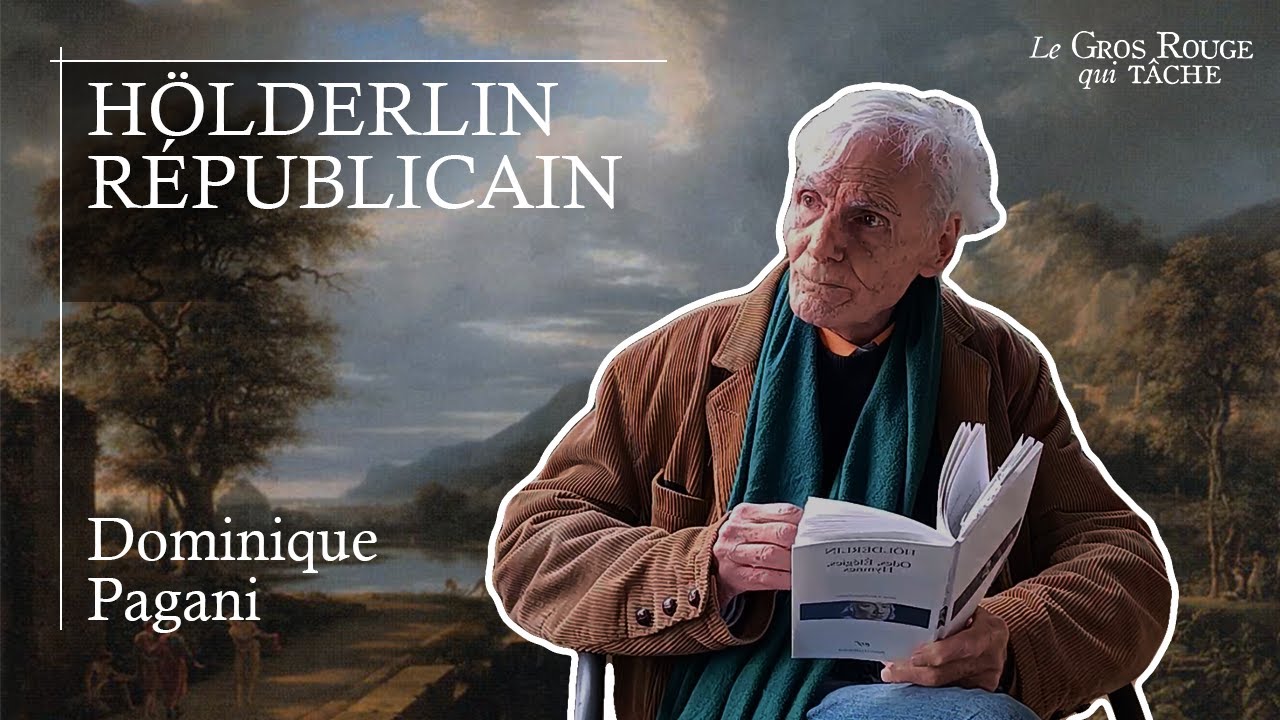
Presentation: the French receptions of Hölderlin 0:00 Music. Dominique Pagani, hello. Thank you for accepting our invitation. We wanted to invite you today to talk about a great man named Hölderlin, a contemporary of Beethoven and of Hegel, an illustrious figure of German idealism and German poetry among other things.
0:51 And if you're here, it's to help us perhaps see a bit more clearly into all the French receptions of Hölderlin's work. A vast program. Notably from the 1930s onward. So we've had interpretations that focused on the revolutionary aspect of Hölderlin. Others that focused on the medical aspect. I'm thinking of Laplanche, if I'm not mistaken, who was a Lacanian and who wrote... The problem of the father in Hölderlin.
1:21 Exactly. And then the Heideggerian reception of Hölderlin and its transmission within a certain intelligentsia... It's by far the one that overshadows all the others in French scholarship. And so, Hölderlin, republican, mad poet, surrealist—you know all these interpretations better than I do. So what I propose is that you start perhaps with this complex author and this complex spectrum of reception.
1:51 So we're trying to see a bit more clearly into the figure. And just to finish, we are among Marxists, and often poetry, literature, has a bad press in certain Marxist circles. It doesn't advance the productive forces. Too bad for that. But it may allow us to see all sorts of stakes, historical stakes, indeed major stakes, in the whole history of the poetic, literary, intellectual superstructure, from the French Revolution up to now.
2:23 So it's perhaps a bit ambitious, but if you can already help us see a bit more clearly into the man, his work, his era and his time, and how it might be useful today to reread Hölderlin in a certain light, I think you would already be doing a great deal. Yes, quite a vast task all the same. Thank you very much for placing at least this substantial weight on my frail shoulders.
"Sophocles is republican": Hölderlin and the French Revolution 2:54 I don't know if I'll be up to it, but I'll do my best because you said the key word. I'm going to hold on to that above all. You're asking to clarify. Within all these apparently contradictory receptions, to clarify. If it's the Hölderlin whose reading the Nazis recommended to young soldiers going into combat because he speaks of German soil—I'm taking an extreme case. That's Heidegger's Hölderlin. When you look closely, I know full well that for Heidegger the model isn't parachuting, but still, I mean, there are texts that don't deceive me.
3:29 Or else, if it's the one who wrote Hegel and the French Revolution, which is hard to find now—you really have to turn to the internet to find it at an exorbitant price, as it happens. Because there is—and I'm starting to answer somewhat informally before diving into the rigor of the texts—there is, it's almost sacrilege to recall the close ties that the latter maintains with the French Revolution.
4:08 So, I'll refer first perhaps to the last text in which he ventures, ventures to express his thought still before what's called the turn into madness. Right? Yes, he still does admirable things, but I mean, these are no longer essays, are they? Because we must never forget—you alluded to German idealism—that what characterizes this movement is the constant passage from the poetic genre to the philosophical genre and vice versa.
4:46 You can find incredibly poetic passages in Hegel, and first-rate philosophical reflections, strictly philosophical ones, in Hölderlin. I point this out because increasingly, and fortunately, in Hegel-Hölderlin studies, if I may propose this axis, over the last twenty years there has been increasing insistence on the fact that Hegel owes more than we think to Hölderlin. And likewise, in those same years, that Marx owes more than we think to Hegel.
5:18 So there's a little syllogism there, you see, which could conclude what I've just said, and which will orient my answer to your question a bit. So I'll begin, yes, with a very clear passage, and manifestly with a will to be clear, regarding this spirit which, as the great actor of the ancient world said, seems, despite the marvels, the summits of his poetry, seems sometimes to enclose itself in obscurity of expression.
5:53 It seems that one understands nothing of it—you must know something about this, all those who've read Hölderlin—at first you say to yourself, well, we sense where he's going. So I say this beforehand, I'll start with this quotation, with two quotations, this one, which is in... I'll give the title now, in the last essay Hölderlin writes before sinking into madness, with sentences that never end, you sense enormous stakes, wanting to say everything in one page. It's the famous Remarks on the translations of Oedipus and Antigone.
6:24 He had just done a translation of the two most unavoidable tragedies, so to speak, of Sophocles. And to present them to the public, he wrote this famous preface. I'll skip over it—it's a problem we can develop in the course of our discussion—but it ends with a conclusion where he says, as clearly as can be, Sophocles is a republican. Which is a scandal in his time—a German shouting this at a time when they're all under surveillance by the Restoration.
6:54 You have to understand, French ideas were, at the time, roughly like Soviet ideas during the Cold War. It smells of sulfur. Jacques D'Hondt, the great Hegel scholar, went so far as to found the Hegelian-Marxist research center in Poitiers. Jacques D'Hondt, whose death we mourn, went so far as to risk the hypothesis that a good part of the difficulty in reading Hegel—since we're speaking of the difficulty with the late Hegel, with German idealism in general—that this difficulty is largely due to the efforts Hegel made to evade the censors.
7:40 So I insist on the fact that saying Sophocles is a republican is a transgression whose audacity we don't suspect. At the time, and in that place, in the Duchy of Württemberg, where there was particular vigilance precisely against the spread of French ideas. I put it in quotation marks—everyone knew what that meant at the time.
Novalis and the Hymns to the Night: reactionary or conservative 8:10 So, Sophocles is a republican. In another passage, I alluded a moment ago, just now, to the obscurity of Hölderlin's texts. So from now on, I'm going to do as—I'll try, forgive me for putting it this way, as Hölderlin does—let's be humble, but without the beauty, only at the level of the approach—constantly move from the literal to the figurative, from the primary sense to the metaphorical sense.
8:46 I just said obscurity. So I'll start with the first dichotomy, day and night. The most emblematic work of German Romanticism is Novalis's Hymns to the Night. Undoubtedly the most romantic of the German Romantics. But very reactionary, very anti-revolutionary. I have enormous admiration for Hölderlin's poetry. Hymns to the Night is a masterpiece. Night—I'll sum it up very quickly, because there's a somewhat repetitive logic in it, but one that gives coherence to this thought.
9:25 However one wishes to present it as irrational, in fact nothing is more logical than these thoughts. Namely, night precedes day, just as maternity, the maternal womb, the darkness of gestation precedes the emergence into daylight. I'm starting to constantly shift from the literal to the figurative, you see. Because it is in the literal sense that the infant spends nine months in darkness. That's not a metaphor. Good. And you'll see where I'm going with this, it's very precise.
9:57 Because of course, night is the maternal image par excellence for Novalis. He begins with a hymn to light. Light is what allows one to admire the splendors of this world. Hymns to the Night begins like that. Profoundly, I turn away from light toward the mysterious and ineffable night. That's the Romantic wager. And from there—I don't want to be reductive—to the SS division Nacht und Nebel, Night and Fog, one can't help but shudder.
10:31 But I don't want to conflate things. Novalis was not a Nazi, he was a reactionary. That's already a bit more dangerous than a conservative. A reactionary is a conservative who has been frightened. There were events, there was the French Revolution, there were those émigrés who, as the admirable formula puts it, learned nothing and forgot nothing. They learned nothing—they're still just as attached to the Ancien Régime—but they haven't forgotten that they were afraid. They became meaner than ordinary conservatives.
Unhappy consciousness and the century of revolutions 11:01 That's interesting. In many respects, I don't know, Descartes, Pascal, Racine—we're conservatives. Right? But they're not reactionaries. You see? These nuances matter. So there is in German Romanticism a profoundly reactionary aspect, and here again, I say this, I allow myself to say it, without it being pejorative for now. That doesn't prevent it from producing masterpieces. And even at the political level, it belongs to what Hegel calls—it's not an insult—the unhappy consciousness.
11:32 The emergence of modernity, one of whose main effects—I'll go a bit fast, because I know this is familiar to you, especially in the Marxist field—one of the main effects of modernity is that answers ceased to precede questions. I'll tell you in what sense. The religious answer ceased to precede the legitimate questions that man can ask himself about what he's doing here in being, more or less.
12:02 The questions, often—the answers used to precede them. Right? There are enormous differences between Descartes, Spinoza, and Leibniz, the great metaphysicians of the height of metaphysics in the 17th century, the classical century. They all have in common that they breathe in God, these people. That's what resolves all the contradictions. What appears to us here as multiple is, in the unity of Spinozist substance, for example, in God. What appears to us in time is in divine eternity. Then suddenly, bang, after a century of Enlightenment, and after thoughts every bit as radical, but much less known, than that of Bonaventura.
12:40 I'm sorry to give you a pseudonym, as they say now on YouTube, but we're still searching, we're still not sure of the identity of whoever is hiding behind the famous Nightwatches of Bonaventura. He's a night watchman keeping his journal—or rather, we should say his 'noctal,' if I may allow myself this barbarism. And there's a text of his in the fourth watch where he is radically materialist—it was written in 1802. I'm not talking—yes, all right, there was already the materialism of Helvétius, of La Mettrie—ah no, no, this is far more radical and unsettling.
13:15 It's not just mechanistic materialism, it's—everything is nothing, I quote the passage, the high point of this watch: everything is nothing and disappears in the force of swallowing itself up. And even this force of engulfment is nothing but an illusion, as if there were something. For if this engulfment ceased—we recognize Hegelian negativity in the same period—if this engulfment ceased, the image of nothingness would suddenly arise, and these thoughts can drive you mad.
13:47 And German Romanticism is devastated by a slaughter of authors who sank into madness and suicide, or, as with us, the one who most resembles the German Romantics, whose translations made him their passeur, I'm thinking of Gérard de Nerval—for him it's both, madness and suicide. So I'm serious. I mean, escapism is the unhappy consciousness Hegel spoke of, it's a relevant concept. Right? We're leaving the psychological field here, when people so different from one another individually, psychologically, all meet the same fate—that means something is happening at the collective level.
14:18 So there it is, it's the disappearance of transcendence. Let me make a small detour through Freud, to stay on this terrain of collective trauma. Freud said there were several great narcissistic wounds on the way to modernity. The first, the shift from geocentrism to heliocentrism. Dang, I who thought I was at the center of the universe, now I'm told I'm in the suburbs, on the periphery, that's not possible. I thought I lived on the Île Saint-Louis, and now I'm told I'm in La Courneuve.
14:50 That's a blow. And that I'm above all a speck of dust lost in immensity, as Pascal admirably puts it in the same period. What is man in the universe? A nothing compared to the whole, a whole compared to nothing, a middle point between nothing and everything. Not reassuring. The eternal silence of these infinite spaces frightens me. I'm deliberately quoting 17th-century authors, because the scientific revolution, which Freud says is a narcissistic wound, visibly preceded the revolution in social and political ideas linked to the Enlightenment.
15:32 Right? And Rousseau pushes it to its most radical expression, for example. There you go, I mean, there's a continuity. That's the whole inheritance of the German Romantics. It's this whole process, or rather the result—this process, this result, of which Hegel eternally says simply: the result is nothing without its becoming. That's why I recall this becoming. This is no time for opportunistic amnesia—German idealism appears against this backdrop.
16:03 On one hand, the Enlightenment, and on the other, the attempt to escape from the unhappiness into which modernity is plunged, without this being a regression. It's complicated. There you go. For the most part, these are often regressions. Not poetic ones in Novalis, but political ones, yes. Let me plug something here: he wrote 'Christianity or Europe.' I recommend this little-known text by Novalis, where you already see what my other comrade—alas deceased, whom I had the chance to know for a few years—Arthur Adamov, the playwright, converted, you see my unconscious metaphor, joined the Communist Party at a time when everyone was deserting it.
16:46 Even though I was among the young theologians at the time. That is, in 1956, when everyone, after Hungary, was deserting the Communist Party, Arthur Adamov, already famous by then. People spoke of Ionesco, Beckett, Adamov, the great triad of the theater of the absurd, who joined the PC. He's been forgotten, by the way. Ask people today whether they know his name. Now, Adamov wrote a play called 'Sainte Europe' ['Holy Europe']. At a time when they were starting to drum into us that European construction, Holy Europe—you can guess the connection with, in Hegel's time, the Holy Alliance, the Restoration.
17:25 Let me take the opportunity to point out that we are not in a revolutionary period, nor are we under the weight of counter-revolution. We are permanently, since the storming of the Bastille, in a conflict between revolution and counter-revolution. Understanding, to close this parenthesis on this crucial point, that periods of counter-revolution have been much longer than revolutionary periods. I mean, right after the French Revolution, there's still the Restoration. Well, then it blows up with 1830. The king comes back. Then afterward, there's '48.
17:56 We think that's it, '48, that was the greatest hope. And moreover, with the first appearance of the working class at the forefront of social, economic, and political problems, which was new. And then it locks down—repression in Germany in particular, targeting what we should, before the term existed, call the soviets of Dresden, Leipzig, etc.—and in France, of course, with the National Guard. And then the lock springs open again with the Paris Commune.
18:30 Right? And then there's 1917, and so on, to the point that I propose calling the 19th century—which doesn't have a nickname like the Age of Enlightenment or the classical age or the Renaissance—I propose calling it the century of Revolutions. It never stops. This alternation, revolution, counter-revolution. Good. And so this is one of the reasons for the complexity—I started from the theme of complexity, of obscurity—of the texts that will illustrate our topic, our conversation.
The Tübingen seminary and the generation of 1770 19:03 This matters. We shouldn't ask people to be more certain and more sure than they could have been at that time, given all these contradictions. First, then, I said—I come back to this central metaphor I started from, where I began my back-and-forth between the literal and the figurative, to sum up, namely obscurity, and hence its antonym, the luminous. So now I'll take a text called Bread and Wine, one of Hölderlin's great elegies—if you look at the Pléiade volume, translated for the most part by someone I also knew in the Drôme, Philippe Jaccottet, who has now passed away.
19:51 He's a delicate poet. In his Pléiade volume, it roughly follows the chronology, which makes the volume seem a bit muddled. There's every genre—Hölderlin's correspondence, etc.—at a certain period, then correspondence, poems, etc. And toward the end, there are the great hymns and the great elegies. That's what I'm talking about, before the fragments of the period of madness. So, Bread and Wine, we'll get to it right away.
20:29 Here it is. Obviously, there are Christian connotations. We mustn't forget that Hegel, Hölderlin, and Schelling were, to begin with, little apprentice seminarians at the Tübingen seminary. Yes, mind you, let me remind you, it wasn't out of religious vocation that they entered the Tübingen seminary. It was their mother who told them to go there. 'My son, you must become a pastor.' The stakes were escaping the poverty that wasn't far off at the time. What was a small German intellectual? There wasn't even the great, centuries-old French wealth of the country best endowed by climate for its agriculture.
21:04 You know, the Germans say 'Glücklich wie Gott in Frankreich' — happy as God in France. That's no accident. Well, black bread, rye bread, etc. There was no industrial revolution yet at that point, which would eventually more than offset, mind you, Germany's handicap relative to France and England industrially. But at that time it was agriculture, and Germany was poor in that regard. It's moraine and glacial soil. So, to escape peasant poverty—when you look closely at the biography of a Beethoven, since you were kind enough to recall that Beethoven, Hegel, and Hölderlin were all three born in 1770, one year after the birth of Bonaparte.
21:42 I don't say Napoleon. I'm speaking of Bonaparte. I say this because there's a poem by Hölderlin called 'To Bonaparte,' before he becomes Napoleon. And as for Beethoven, we know he had planned to dedicate his third symphony, the 'Eroica,' to General Bonaparte. That is, in the minds of German intellectuals, the one who would bring the tricolor flag and liberate us from our petty tyrants, from a Germany scattered into a multitude of micro-states. Never mind whether that was the historical truth from Napoleon's point of view, but from the point of view of German intellectuals, that's what it represented.
22:15 That's what it represented. And so, Napoleon was born a year before—and I'd say the poet Bonaparte, but let me come back to Bread and Wine. Yes. So, their mother would tell them, 'Become a pastor, my son, you'll escape poverty, you'll have a little wife'—pastors could have a wife, unlike Catholic priests.
A nocturne: the market, the lyre, the fountains, the watchman 22:45 There you go. They did all this telling themselves, 'If I could just escape, right before entering holy orders—that is, becoming a tutor, thanks to the diploma I obtained during my seminary years.' That's all they did, Hölderlin included—tutor in a family that could pay them. So here, then, is Bread and Wine. And we'll see that it involves something other than mere sacramental wine, after all.
23:15 You see, all around, the town is at rest. The lit lane grows calm and adorned with torches. The carriages go off with noise beneath, home from the day's joys men go to rest. I'm sorry, but all these translations are a bit precious, especially in the French and Heideggerian reception of Hölderlin. I'll try to correct them when I can. Well. Here then is a nocturnal poem, extremely rare in Hölderlin.
23:47 I remind you that I'm speaking about the dichotomy of darkness and light. Now, the reference to night, which is emblematic in Novalis and which governs practically all the German romantics, night as the first divinity, with all the marvels and the dangers that it can conceal, the dangers of confusion — in Hölderlin, that is very rare. And here he begins with one of the most beautiful nocturnes in the history of poetry, of any culture.
24:17 All around — I take it up again and continue — all around, the town is at rest, the lit lane grows calm and adorned with torches, the carriages go off with noise. From the day's joys, men, beneath, go home to rest, and gains and losses weigh on a sensible mind. One thinks of Holbein's painting where we see the gold-weigher doing his accounts in the evening. Well, we are right in the midst of German mercantile bourgeoisie at the close of a market day.
24:47 Quite content at home, empty of grapes and flowers and of the hand's work, the busy marketplace is at rest. You see this negative turn of phrase. He doesn't say the market is deserted. He says it is empty of activity. Empty of grapes and flowers when there are none left, and of the hand's work, the busy marketplace is at rest. But the lyre resounds far off, and suddenly we hear a sound. I remind you again — I'm moving from the figurative to the literal — that music is not an art whose enjoyment ceases when you close your eyes.
25:26 Some indeed say the opposite. Most piano tuners are blind. They are not distracted by the splendid multiplicity of the world lit by Apollo, and are focused on interiority. So it is no accident. The first poetic connotation, after all this business of the market, the end of the day, of work, is the sound of a lyre. But the lyre resounds far off from the gardens.
25:58 Perhaps over there, over there where this sound comes from, beloved, without... well, playing the lyre, a solitary man who has lost his friends, whose friends are far away and whom he keeps in memory, from the time of his youth. These are commonplaces, roughly. Someone playing — a shepherd alone in solitude with his flocks far from the city, with his pipe plays a melody, generally rather melancholic, which will culminate in the famous English horn solo of Tristan in the third act, when we see the shepherd at the rising of the curtain before the immense sea.
26:32 So, the lyre resounds far off from the garden. Perhaps over there, beloved, a solitary man plays it, far from friends, whom he keeps in memory, from the time of youth. And the fountains — you see immediately, in music, something temporal and not spatial. If I close my eyes, there is no more space, there is no more an object extended in spatiality, but there is time. It's a duration, the sound of the lyre. Likewise for the fountains, which are also a metaphor for the flow of time, as they have always been.
27:03 Besides, the first clocks were made of flowing water, the clepsydra, before it was sand. And fountains, always a source — I make all these interruptions to show the incredible logic there is in the poetic. We always think that the poetic is the little happiness of inspiration, fantasy opposed to the dry rationality of the sciences and of the understanding. No, nothing is more logical. It's nothing but the sequence we're now seeing. After the temporal flow of the sound of the lyre, here is the trickling of fountains.
27:35 And the fountains, ever fresh and springing, make their sound at the edge of the fragrant grasses. Calm in the dusky air resounds the chiming of bells. Again, a sonorous connotation. And, keeping the hours, a watchman calls out the number. At the time, there wasn't... there was a night watchman who went through German towns. It was an emblematic figure. The night watchman in theatre, in poetry, in opera — I'm thinking of the second act of the Mastersingers. There's a watchman who passes with his horn and sounds the hours.
28:07 Right? The only one who keeps watch when everyone else is asleep. This figure with whom the famous Vigils of Bonaventura that I spoke of identify, where it is this night watchman who does his rounds. There. So, and keeping the hours, a watchman calls out the number. Now also comes a breath. It stirs the treetops of the wood and beholds the double of our earth. The silver star, the moon, comes too, in secret; the fanciful one, the night, comes full of stars.
The sensible day and the ambivalence of night 28:38 It's not possible, Hölderlin has really become a Novalisian, romantically speaking. We are far indeed from the Enlightenment. The night comes full of stars, and quite unconcerned with us, the astonishing one glitters over there, the stranger among men, above the ridges. Sadly, splendidly, she rises. Prodigious, the favor of the Most High, no one knows when or what comes to her, from where the night comes. We do say the night of time, which preceded the Big Bang, which preceded the coming of light.
29:12 Thus she moves the world and the hopeful soul and men. No sage understands what she is preparing. One would think he's making a hymn to irrationality. That's clear. No sage, no knowledge, right, understands what she is preparing, for so wills the supreme God who loves you greatly. And here there's this reversal. Listen carefully. And that is why you prefer the sensible day. We're not being structuralist here. It's not meaning destroyed for the sake of the sign. Suddenly, meaning has to be maintained.
29:45 For that, confusion must be avoided. That's why I wanted this passage. But no sage understands what she is preparing, for so wills the supreme God who loves you greatly, and for that is loved by you even more than she, the sensible day. Well, that's clear. Have we taken the side of the Enlightenment? No, we are in the in-between I was telling you about, in the hesitation. But, you see, typically Hölderlin, but — but sometimes, not always — a clear eye also loves the shadow.
30:17 And the clear eye tries, for pleasure, before it becomes urgent, sleep. Or else a faithful man also willingly casts his gaze into the night. Yes, in the end it befits him to consecrate to the night wreaths and songs, because it is sacrosanct. So, today, we would say to migrants — he says to wanderers. You see, you see how the metaphors link together. The day is solid, it is a palace that one sees, the Parthenon, lit by Apollo's light, it is stable, but it is not wandering.
30:51 Wandering is the night, it's fantastic. Someday I would like to develop this, in another of our conversations, the idea that migration is perhaps the first determination of anthropology. From the jungles of Africa to our civilizations, after all, we are all descendants of fabulous migrations. Before we arrive, as in Germany, at the stability of geraniums on the windowsills. So yes, it befits the night that wreaths and songs be consecrated to her, because to wanderers she is sacrosanct, and to the dead.
31:27 But she herself remains eternally in the freest of spirits. But she must also, for us, so that in the hesitant time — you see, in the darkness — something may be tenable for us. If we are condemned to the night, something must be made tenable. Grant us forgetfulness and sacred intoxication, grant the flowing word, which, like lovers, should be sleepless, and a fuller cup and bolder life, holy remembrance to remain, as lovers are heard, awake all night long.
32:02 One must resist sleep in the magic of the night. Magnificent. I remind you that the symbol of philosophy, which is not exactly a nocturnal discipline, is nonetheless the owl. It's a bird that keeps watch when everyone else sleeps. Athena's owl, of course, the symbol of Athena. And so, here, I've given this crucial passage where he says clearly that more than night, day is dear to your heart. Because precisely, that is where meaning is kept.
32:33 So let us not make Hölderlin a militant of darkness. Even if here he admits, in this admirable passage, that one must pass through darkness on condition of not losing memory there. And so, since I detest interpretation — I believe my listeners know this, because I repeat it often — and prefer analysis to it, automatism always has a kitchen-like, subjective side that would be out of place before the gravity of the stakes we're raising. I'm going to confirm what I'm saying, this link Hölderlin makes with night or with light, or with night alone, as a kind of waiting for the return of day, waiting for the end of a period of unhappy consciousness.
33:16 Let me summarize a little. Meanwhile, we'll see this later. Although — let me think, excuse me, I'm doing this in real time, but it's worth it because there are so many passages — I'll try to take the briefest and clearest one. Sorry, but I mean, given the difficulties I'm having with this translation, it's one of my books I can allow myself to criticize after all. But I had forgotten that there are 15 different translations of it, and I'm not bound to land on the best one.
33:52 I'm going to take up the beginning of this poem again without stopping this time, now that we've at least begun to see its formalization — well, a minimum of formalization and rationality — and I'll continue from where I just left off. So, in a translation that is much clearer, though it sacrifices, to say the least, the depth of the content.
34:23 Bread and Wine. The town around us falls asleep, the lit street welcomes silence, and the noise of the carriages with the glare of torches fades and dies away. Sated with the day's pleasures, toward rest go the men, and, satisfied, pensive, a bowed brow weighs losses and gains beneath it. Stripped of those flowers, stripped of those clusters, there, of the labor of a thousand hands, the deserted market sleeps.
34:56 But in the heart of the gardens a distant music awakens and trembles. Over there plays a knowing lover, or perhaps a man seized by solitude who remembers his lost friends, his youth. And in the wheel of flowering beds sing the fresh, tireless fountains. The voice of bells vibrates in the calm twilight, and the watchman, keeper of the hours, cries out a number at the top of his voice. "Oh!"
35:26 Here the breeze is born and trembles at the outermost leaves of the grove. Look! And the ghost of our universe, the moon, mysteriously appears. And the fervent one, the night, comes, peopled with stars, and quite indifferent to our life, the giver of wonder. The stranger among men, over there at the mountain peaks, unfolds and shines in her melancholy magnificence. "O miracle, favor of the sublime night, no one knows the source, the greatness of the gifts a being receives from her.
36:00 Thus she moves the world and the souls of men laden with hope. Even the wise have no understanding of her designs, for such is the will of the supreme God who loves you with great love. And that is why, even more than she, the day is dear to you, he speaks to himself, where your thought reigns. But sometimes, the limpid gaze itself tastes the shadow and, anticipating the hour, seeks sleep as a pleasure. And the man of faithful heart loves to plunge his eyes into the pure night, which is dedicated to him, as befits songs and wreaths, for she is the sacred treasure of the mad and of the dead, and she endures herself, an eternal spirit free of constraint.
36:43 But let her too, the night, for it must be so, at last, that in our slow sojourn in her tombs, something be kept for us and comfort us, that she too give us forgetfulness, that she too give us sacred intoxication and the surging of the word, and that thus, like lovers, eyes never closed, cup brimming full, boldness to live and holy remembrance, we cross the night at the height of wakefulness. I had stopped there. You see, in a superb — not ambiguity, but ambivalence.
37:16 That's still different. Ambiguity is the two-faced person hiding their thought. Ambivalence is an objective contradiction, if you will. You see? Apparently he has just made a hymn to night, to sleep, to intoxication, the very opposite of rationality. But he says, one must cross the night at the height of wakefulness, eyes never closed. We haven't been reconciled with what is malevolent in darkness. And so, I continue now, and you'll see that this is the end of night in the poem. And our heart, in vain we hide it within ourselves.
Toward Greece: "No one bore life alone" 37:49 There wasn't yet the theory of repression, but still. And our soul, in vain, we keep it captive. For who then, we the masters, we the disciples, can break our momentum? Who then would forbid us joy — there, you see the era, the romantic impulse is a fabulous transgression — of all the constraints of past times. We shouldn't forget, after all, that romanticism is extremely alive. It can give the worst, but also, by far, the best. As an expression of modernity. I could say, without wallowing in words, in its virginity, modernity, before it was sullied by restorations and other obstacles set against what is absolutely new in the blossoming of the first romantic expressions of this modernity.
38:36 Let us not forget that it is Rousseau who gave it its first expression. There are worse reactionaries. There you go. He is, after all, the author of The Social Contract who wrote Reveries of the Solitary Walker. And our heart, in vain we hide it within ourselves. Our soul, in vain, we keep it captive. For who then, we the masters, we the disciples, can break our momentum? Who then would forbid us joy? The divine fire itself, night and day, strives toward a sudden blaze. You see? A quest through divine fire for the blaze.
39:07 "Come then and let us turn our eyes toward the expanse." So you'll see where he takes us. And how far this is from night. "Come then and let us turn our eyes toward the expanse." Space, more than time. "To seek there, however far it be, a good that shall be ours." One thing, it's underlined, one thing remains firm. Whether noon strikes or time stretches out in the heart of the night, a measure is there. Ever common to all.
39:38 And yet each one receives his own destiny. Each one goes, each one comes, to the place he can reach. "Come then!" It's not over. And who could scorn contempt itself, if not this triumphant — sorry, this triumphant delirium that suddenly seizes singers in the holy night? What is he alluding to? This triumphant delirium that suddenly seizes singers in the holy night. Well of course, all those who studied mythology gorged themselves on this, and Greek literature too. But this is the cult of Dionysus, the famous Dionysia, the nights when Dionysus's followers roamed the whole earth with torches, and the bacchantes.
40:16 And who could scorn contempt, if not this triumphant delirium that suddenly seizes singers in the holy night? Come, and here we are now, on the shore of the Isthmus. This refers to the Isthmus of Corinth, of course. We move from the German night to its opposite, the Greek day. Come to the shore of the Isthmus, where, over there, the immense roar of the sea rises toward Parnassus, where the snow gleams like a diadem on the Delphic rock.
40:46 There, in the land of Olympus, on the peak of Cithaeron, over there. I recall that the city of Cythera, Cithaeron, is the homeland of Mnemosyne, the divinity who gave us memory and the use of words. He knows all this, I'm just allowing myself to recall it. These are all landmark-words. Not suitcase-words, landmark-words. Proper names, I mean, that mark out the terrain. There, in the land of Olympus, on the peak of Cithaeron, over there, over there among the pines, among the vine-shoots.
41:16 I recall that the pine and the vine-shoots are attributes of Dionysus — the pine because it is ever green, and the vine-shoot, the grapevine, of course — I don't need to draw you a picture, Dionysus and Bacchus. There, among the pines, among the vine-shoots, from where here Thebes and the river Ismenus resound, and the fountain of Dirce. That is where, that is what in turn the near god designates. So here, it seems that Dionysus is the model. That is to say, still, and here again, it's a tribute to the nocturnal, to intoxication.
41:46 Intoxication is not clear rational thought. You see? We continue in this magnificent hesitation between the day necessary for thought, as he said earlier, and the night necessary for fidelity. O blessed Greece — you see, all of a sudden, it's a hymn, the opposite of the one to night. O blessed Greece, O you, dwelling given to all the gods. What then? It's true, what in our youth, one day, we heard, all these young people — even though they had the Gospel and the Bible on the curriculum, they devoured the classical authors they were made to learn, since Greek and Latin, dead languages, were the main subject.
42:28 And in that, Pindar — his hymns, the hymns to Dionysus, the odes, the odes of Pindar. So, what then? It's true, what in our youth, one day, we heard, O hall of feasting, Greece, your soil — but it is the sea, your tables the mountains, once, this alone was truly built for that end. So, you'll say, this is a Hellenophile delirium, but, you see right away — but the thrones, where are they now? The temples, where?
42:58 The urns of nectar and the song meant to gladden the hearts of the gods — where do they shine, then, the oracles, striking from afar like lightning? We come back to Greece today. Delphi sleeps, and the voice of great destiny, where does it sound now? Again, a series of "where": where is the swift god, heavy with universal happiness, from what skies does he in fact spring, does he strike our gaze with his astonishing splendor?
43:28 "Ether, O Father," thus rose the cry from a thousand and a thousand lips. We begin to understand that what is now lacking is what wants to exist — a community, the collective, all of that. Thus rose the cry from a thousand and a thousand multiplied lips. And here there is a key sentence, if we want to understand and answer your initial question, revolutionism, in the very precise sense that the Revolution of '89 gives to that phrase, right?
44:01 The statement that is perhaps the most fundamental: "No one was alone in bearing life." So it's not nostalgia for Greece, for statues, for beauty — it's not Nietzsche and Heidegger, no, it's the collective that has vanished. We're in liberalism, where there's the cult of the individual, and each one — I'll be polite — not exactly in that, but well, in his bubble. That's what he's saying. That's what is longed for. It's the fact that what is unbearable in human life, what is more unbearable than the animal knows — finitude, for instance — is not so serious when there are several shoulders to bear it.
Greek humanism; divergence from Nietzsche 44:36 And on the contrary, it can turn into unheard-of happiness at that point. What is terrible, though, is that this metaphysical misfortune of finitude is compounded by the political misfortune that shuts each of us up in a bubble. There, I'll stop so as not to be abstract, because this will be confirmed in a somewhat more concrete way. For such a good — everything I've just said, such a good, Greece, Parnassus — such a good gives joy through exchange and sharing with strangers.
45:06 Strangers — he's not afraid of the great replacement, he isn't, I mean. A rejoicing bursts forth, it grows while sleeping, the pure power of the word, and here is the eagle of our forebears, the very ancient sign that resounds from afar, struck, fruitful, for it is thus that the divine beings take up dwelling and that, shaking the depths, piercing the shadow, their day descends among men. When mankind is collective, that is a sign of the divine in Hölderlin, as we shall see in another text.
45:37 I'll go on to finish the first day-night dichotomy. They come, but without being guessed. The gods, that is understood. Toward them, only the children strive. Happiness is there, too blinding, too bright, man fears them. A demigod barely knows how to name them by name, those who come to him laden with gifts. But they are generous, and the heart is slowly filled from their cup. He scarcely knows how to use his treasure. He cries out, the prodigal, and the profane almost becomes sacred to him, which he touches and blesses lovingly with his drunken hands.
46:13 These things that the gods suffer to the utmost, then, in the reality of their presence, they appear, and men grow accustomed to the day, to happiness, to contemplating, to revealing the face of those who once named the whole and the one — one would have to mention the pre-Socratics, for example, Parmenides — those who once named the whole and the one, filling the sacred heart with free and vast plenitude, and the first, the only ones, to have every desire fulfilled. Such is the man whom his true good awaits, which a god himself prepares for him from his gifts; he cannot see it or recognize it until he has borne it beforehand.
46:51 He cannot recognize it before having borne the weight of joy, not the weight of the divine. But here it is named at last, this supreme good. At last! With words springing forth like flowers. And now man thinks to render solemn worship to the blessed divinities, that everything to them be a true song of praise, nothing is worthy of the day. We are no longer at night, there is nothing that does not please the god. No vain gesture before the shining ether is fitting. Then the peoples, to merit these immortal presences — and here there is a striking summary of universal history by this contemporary, the closest comrade and friend of Hegel.
47:30 Then the peoples, to merit these immortal presences, rise up, splendidly ordering their shoulder-to-shoulder crowd. They bring forth the beauty of temples, the firm foundation and the nobility of cities raised high above the shore. You see? But where are they? Once again the anguished question in our world, where capitalism shuts each of us into bubbles. I say liberalism, but really, that's just the fig leaf for capitalism. So now I'll say capitalism. But where are they? Where do they bloom, the most illustrious crowns of the festival?
48:02 Athens has faded, and Thebes. Has the clamor of weapons, of rival golden chariots, fallen silent forever in the echoes of Olympia? If you look closely, these references — Olympia, that's where all the Greeks gathered despite their quarrels, their customs, their cities, the Olympic Games. There are only two things that unite the Greeks: religion, mythology, and the Olympic Games. Language, of course. There you have it. Has it fallen silent forever in the echoes of Olympia? And have the ships of Corinth lost their crown forever? And why this silence still in the ancient and holy theaters?
48:35 Why is the dance dead, and its ritual joy? And why does a god no longer mark man's brow? Second reason too for the nostalgia for Greece — but not nostalgia in a deadening sense — is that it is the birthplace of humanism. It is no longer the gods that are glorified, it's no longer Amun, no longer Aten, no longer Shiva, no longer... No! It's man. The riddle the sphinx poses to Oedipus: what is the animal that walks on four legs in the morning, two legs at noon, three legs in the evening?
49:11 Well, we know the anecdote: it's man who crawls on four legs as a baby, walks on two legs at noon, standing on his two legs, and on three legs, aided by a cane or a stick in old age, in the evening. Right? But there's a deeper meaning beyond the anecdote. What was an enigma before the Greeks — the Greeks know for the first time that the answer is man. One must not seek it in a transcendence. Rather, if there is a transcendence, it is that of man in relation to nature, since the Greeks fled nature into the city.
49:42 So that's what interests him in the Hellenic reference. Isn't that so? See how this can be exploited by Nietzscheans and Heideggerians. Nietzsche's first text is indeed a reflection on the Greek world, on the Dionysus-Apollo pairing of ancient Greece. I won't interrupt your presentation, but of course, you're talking about Nietzsche. Yes. There's something very striking in him and in many of his contemporaries. It's what has been called the Greek-German myth, which you alluded to.
50:14 And what's interesting is that Hölderlin is well prior to Nietzsche. But in Nietzsche, this conjunction of the Apollonian and Dionysian principle, very ephemeral, very transitory, this sort of fleeting perfection in the Greek city, he makes a political transposition between Germany and France, seeing in diversified Germany an equivalent of the Greek city-states. Of course. And in fact, traumatized by the French Revolution.
50:44 By bureaucratic centralism. Exactly. Even more by Bonaparte. Of course. He draws an analogy between France and the Roman Empire. Of course. And we see, from what you've read us, Hölderlin is miles away from such a reading. I thank you because you grasp well the ambiguity, or rather the underlying ambivalence on which some have produced ambiguity. And that is more unconscious. The ambiguity, here, stems from ideological reasons.
51:14 Of course. We'll come back to this so much that I won't answer in detail now. But indeed, Nietzsche as much as Hölderlin — for now I'm putting them in conjunction, not disjunction, where I quite agree with you — know very well that Dionysus is the god of the multiple and of the crowd. That's very clear in The Birth of Tragedy, which I assume you've seen. Whereas Apollo is the principle of individuation, of what gives things an outline, etc. Fine, I'll grant that. Except that, in Nietzsche, the appearance that Apollo gives, which covers through illusion the individual, the unity, the Dionysian multiple — in other words, where the popular is repressed in favor of unity, of the hero, of the aristocrat, etc.
52:01 is superior in Nietzsche. Appearance is superior to substance, surface is superior to depth, form to content, and so on. Right? That's precisely what Hölderlin never does — on the contrary. For him, it's about making the ground triumph. The ground is the collective, and not merely the crowd. The crowd is chaos. The collective is the city trying to organize itself. That's how the poem continues in this sense.
52:32 So, I repeat, this great passage we've just seen, which apparently begins with a series of anxious questions, right? 'And why this silence still in the ancient and holy theaters? Why is the dance dead, and its ritual joy? And why does a god no longer mark man's brow?' Glorification of humanism. Formerly, on the contrary — now man is reviled, it's nature that is deified in the pervasive ecologism — ecology, the environment, that's serious. Whereas man is demonized, isn't he? How often now do we hear it said, man is really the animal species that has ruined everything, isn't that so?
53:04 He should disappear. And those who say that don't want to disappear themselves. They only want others to disappear. 'And why does a god no longer mark man's brow as before, sealing with his seal the one he himself has seized; sometimes the god descended, taking human form, to the divine feast, he gave a comforting end.' And here — I'm moving on now — there's a great reversal in the text. 'But we come too late, my friends. Yes, the gods live, but up above' — there, that's another dichotomy beginning to appear, which answers your question about Hölderlin's religion, the dilemma between paganism/immanence and Christianity/transcendence up above.
"But we come too late": the withdrawal of the gods 53:47 'My kingdom is not of this world' — you see, for example, Christianity. So, how to keep the collective, right? How not to take refuge in the night, when we've been isolated from one another? The turn there is important. 'But we come too late, my friends. Yes, the gods live, but up above, over our heads, in another world. There they weave endlessly their web of action, and seem to care but little whether we live, so much do these heavenly ones spare us.'
54:17 We're no longer constantly encountering the gods, right? Like the Greeks who refrained from crossing into the sacred grove — you see, immanence, we're always surrounded by God, which is perilous — think of Icarus, he flew a bit too high. Besides, tragedy in general is the punishment of a hubris. It's the human who has gone too far toward the divine. 'For a frail vessel cannot always contain them' — and so these guests of heaven deal delicately with us. And here there is a first justification of this distance, this separation of the human and the divine, which he seemed to be complaining about.
54:49 'For a frail vessel cannot always contain their power.' This is a soon-to-be-mad man speaking. This is among the last texts before the madness. Right? This vessel shatters with madness because you cannot bear the truth of the collective. For example, finitude, in relation to the animal world, which knows nothing of it. Which leads Rilke, another great poet who alternates philosophy and poetry in his major works, to say...
55:19 Rilke says the animal always has its decline behind it. It moves forward into the open. But we have been turned around so that we see only death. It's the same theme. So: 'For a frail vessel cannot always contain their power. Only at moments can man bear the fullness of the gods.' You see, it keeps coming back, the divine plenitude. A dream of them, and then life. 'But error offers help' — sorry, error brings relief. As we said earlier, one must pass through darkness to reach light.
55:53 'Error brings relief, like sleep and want; and night gives strength' — not eternal night, you see — 'until heroes grow enough in their brazen cradle, drawing from their hearts that ancient strength which once made them like the gods. Then in a crash of thunder they will arise.' This is a thinker of the French Revolution. Hegel said that in order to illustrate patience — what he calls the patience of the concept, there's a beautiful study made of his work...
56:24 ...on Hegel. He took as an example — he said, look at the French Revolution and its concern for equality. That's the message of the Gospel, but it took 2500 years. Well, 2000 years, for Christianity, sorry, not Plato. It took 2000 years. Look at that patience. 'Then in a crash of thunder they will arise' — it's the descent of the heavenly Jerusalem to earth, when suddenly there's a leap forward in freedom.
56:56 And not the freedom of a few. That's the freedom of the fox in the henhouse or the wolf in the sheepfold. Not the freedom of the one who holds a sword to his victim's throat in combat. That's the barbarian. The free peoples, the Franks, the freien, the Franks. No, but I'm serious. In all this talk of the 'free world,' right, it's no accident that it's mainly the Germanic peoples who make up the majority. Among whom the free are those who came out victorious from battle and were not reduced to slavery. The free man is defined in relation to the slave.
57:26 No, no, freedom reconciled with the universal is extended to all. That's the crash of thunder Hölderlin speaks of here, and the French Revolution showed that it was not only possible but real. So: 'But error brings relief, like sleep and want; night gives strength until heroes grow in their brazen cradle, drawing from their hearts that ancient strength which once made them like the gods.' Mistletoe — sorry.
57:56 I'm not thinking only of Heracles here, or perhaps of the Heracles who is the deep content of the myth. I don't know. 'Then in a crash of thunder they will arise.' But you see, always these 'buts' that cancel each other out, negation upon negation. So, once again, a justification of night. 'But until the day of their coming, sleep often seems to me lighter than this waking.' Now that's exactly the status of the nocturnal in Hölderlin.
Night as waiting; Beaufret against Hegel on Antigone 58:28 It has become clear, it's the status of 'meanwhile.' One must justify the nocturnal in the meantime. We even need it, because it is in the night that the memories of everything that was stolen from us take refuge — in class separation, for instance. 'Sleep often seems to me' — but 'until the day of their coming,' so in the meantime — 'sleep often seems to me lighter than this waking without a companion, this feverish waiting. Ah, what more can be said?
59:00 What is to be done?' And here there's this line that illustrates the hesitation well: 'I no longer know.' I mention it because it feels so current. 'And why, in this age of wretched shadow, poets...?' That line became famous: 'why, in this destitute time, poets?' It's like an answer, a sketch of an answer, but they are, you say — like the holy priest of the wine god, the god of the collective — wandering from land to land through the holy night of migration.
59:40 'Yet at the hour when, toward heaven, which now seems so distant, all the givers of joy withdrew from our lives.' What is that? It's the coming of Christianity. You see the same division as in Hegel: oriental antiquity, symbolism, then, at the moment of noon, no longer morning, Greece, and then Romantic and Christian modernity. It's the same scheme. I mention this because all those who try to reclaim Hölderlin within what I've called the irrationalist field — Nietzschean, Heideggerian, to keep the chronology right — do everything to uncouple Hölderlin from Hegel.
1:00:20 I gave the example of Beaufret earlier, who, in his commentary, in the critical apparatus of the translations of Oedipus and Antigone I alluded to at the start, in my introduction, sets out the opposition Hölderlin inscribes in Sophocles' tragedies between the human and the divine. And he says: one sees how much this conception surpasses in depth and scope that of Hegel, who saw in it only — and this is very reductive — only what?
1:00:50 Only the opposition between family and state, as Hegel does with Antigone, who indeed shows that the conflict between Antigone and Creon is not a Hannah-Arendt-style story, it's not the poor individual martyred by the wicked city, it's not the particular destroyed by the universal — it's the exact opposite, it's the conflict of two collectivities: the archaic collectivity, that of the family, which Creon wounds in a way that is itself a hubris, since the dead must be left to the family — he oversteps the city's prerogative.
1:01:21 But it is one collectivity opposed to another collectivity — the substantial collectivity bound by a natural tie, for a son has a bond to his mother, there too a natural bond, the bond of blood. And this is what explains, as you'll see, vendettas, how much bloodshed they cause: it's that all those in whom the same blood flows feel involved in the mourning. Whereas the political bond of citizen to citizen, where there's no longer a blood tie, is a more evolved bond historically — no value judgment, but historically at least, and in any case freer.
Christ, bread, wine and Hesperia 1:01:55 So you see how this effort to separate, to uncouple, Hegel from Hölderlin — that's why I keep drawing these parallels with Hegel, it's exactly the same scheme — so I take up the text again, right? 'Yet at the hour when, toward heaven' — let's talk about Christianity now, where antiquity ends, according to historians — 'at the hour when, toward heaven, which now seems so distant, all the givers of joy withdrew from our lives, when the Father, having turned his face away from men' — this face which you see the Greeks wearing almost constantly in disguise, isn't that so?
1:02:28 Often, Odysseus is mistaken for a god in the Odyssey, those who don't know whether he's a man take him for a god — 'when the Father, having turned his face away from men, sorrow established its rightful rule on earth.' You see how he speaks of the era in which we still live, in which the symbol of this civilization is no longer the balance of Apollo sculpted by Phidias or Praxiteles, but a broken creature writhing in pain on a cross.
1:02:58 Which Hegel, like Hölderlin, we have clearly seen, is a deepening of human truth. One cannot avoid, as Aragon says, 'nothing is ever certain for man, neither his strength nor his weakness, nor his heart, and when he thinks to open his arms, his shadow is that of a cross.' So I return to a beautiful passage: 'Yet at the hour when, toward heaven, which now seems so distant, all the givers of joy withdrew from our lives, when the Father, having turned his face away from men, sorrow established its rightful rule on earth' — negative theology, the Father has turned his face away from men, God is present through his absence, now, right, when 'the last presence' — one must read Christ here, I tell you, because it's found in many other poems, it's clear — 'a gentle genius with divine, consoling words, and of the night' — you see the logic now, how loaded it is with symbols, the opposition of light and night — 'and vanished' — like this, sorry — 'when the last presence, a gentle genius with divine, consoling words, had announced the end of the day, and vanished' — in the past simple.
1:04:09 'as a sign of his coming here below' — what remained in these times of wretchedness and night? 'As a sign of his coming here below, once, a pledge of his return, the heart of the gods left us some gifts, in which we tasted, as at the first, as on the first day, all human joys, for greatness is no longer a source of joy among men, having grown beyond their grasp, and no heart, ah, no heart is strong enough yet for supreme delights, only a muffled gratitude throbs.'
1:04:42 Bread — I remind you the title of the poem is 'Bread and Wine.' 'Bread is the fruit of the earth, yet it must be blessed by light. It takes the thundering god' — that's Zeus, the thunderbolt — 'it takes the thundering god for the wine to give its joy. That is why we still remember the immortals who once were our guests and who will return in due season' — like an obsession. Night will not last forever — 'in due season.'
1:05:12 'That is why the poets too sing the god of wine' — they're buddies who get together on Sunday, after work, with a good bottle. One has the right to be a bit tipsy for a moment, it's a change from the hours where we lose our lives earning them. That's why too — so it's a play on the word 'wine' in all this — 'the poets too sing the god of wine and pour out his praise, while God does not spring from vain and hollow fervor.'
1:05:44 'Yes, their word is true' — this is the last stanza. 'He is' — Dionysus, Christ, you see, this 'he' is an intermediary between the two, he is the one who reconciles day with night. You see, the reveler, eternal guide of the heart of the alternating stars — his joy at all times, like the imperishable green of the pines he loves — the pines he loves — and to this ivy too, another attribute of Dionysus, he often wears a crown of ivy — also which he has chosen for his crown, for he remains, bringing himself, to those who mourn without God in the darkness, a trace of the vanished gods.'
1:06:24 'What the ancient songs, the children of God, foretold' — the Sophocleses, the Aeschyluses, the Platos — 'what the children of God and the ancient songs foretold, behold, we are it, we moderns.' These are the fruits of Hesperia, a Hölderlinian concept. Hesper is the Greek equivalent of the Latin 'occident,' where the sun sets. Right? We westerners — us Germans, in relation to the Greeks, who are the people of noon, and the orientals, let's not even speak of them.
1:06:56 You see, the Hegelian division, made this time in reverse. So we, we westerners, we are the fruits of Hesperia. You know, in mythology, in the labors of Hercules, there's this one labor, one of the twelve labors, which is the golden apples of the garden of the Hesperides. Many people who insist absolutely that this designates a precise geographical place, who don't understand the complexity of symbolic order, say it's Spain — the oranges of Spain, the golden apples.
1:07:29 You see? That's the West. So, 'what the children of God, the ancient songs, foretold, behold, we are it, we' — the 'we' is in italics. 'These are the fruits of Hesperia.' O miracle! You see, the poem ends on a note of optimism. 'In men, it is accomplished, one must say with rigor, believe it who has felt it — but nothing, whatever happens, nothing has the strength to act. For our heart is dead, we live like shadows.'
1:07:59 'Until the day' — you see, it comes back — 'when the ether, our Father, having recognized his own, they will belong to him.' But — 'the last May,' meanwhile, understood, right, you're familiar with it — 'but the Son of the Most High' — so we return to the Christ figure — 'during the long wait, the Syrian, descended like a torch-bearer among the shadows. Sages and blessed men see him' — understood, ancient sages see, right, the new order.
1:08:30 "With a smile, their imprisoned soul lights up with stars and the warm brightness revives their dead eyes." That's the last two lines. "In the arms of the earth, with delight, the titan slumbers and dreams." And Cerberus, the dog that guards the underworld, Cerberus himself, the jealous one, drinks and falls asleep. So it ends after all on a glass of plonk, if you'll excuse me, but one whose necessity we've rediscovered. In the meantime, we are unfortunately not post-revolutionary, we are still in the conflict of revolution against counter-revolution, in this confusion of day and night.
1:09:09 There, I wanted to answer your question first with this poem, with themes we'll see again, but which sum up quite well the symbolic array we're going to find, and it's going to become clearer and clearer, and above all less and less interpretive, since here we have to explain Hölderlin through Hölderlin in the end, and it's much clearer. Before you begin the conclusion of your whole presentation, there is a...
Why poets for militants: praxis and psyche 1:09:45 It's perhaps less a question than... an attempt to synthesize without reducing, I hope, everything you've said, but if... If we wanted to make a synthesis, and if I've understood correctly, Hölderlin invites us to inhabit the darkness, because it's a necessity, and while... while inhabiting this darkness, not to lose sight of another necessity, which is that of re-establishing, of restoring meaning in broad daylight.
1:10:19 So the light. The light. And... I inevitably think... Because we are among communists on a communist channel, I think of the comrades who might be listening to us and who might wonder what benefit they can draw from reading Hölderlin in geopolitical and political times as turbulent as ours. As if you had nothing better to do. There you go. Yeah. We know the argument well. But I understand it.
1:10:49 And so, I think, with all the themes you've touched on regarding freedom, the individual, modernity, I think of another author who matters to us and who probably matters to you even more, namely Clouscard, who talks about Kant's dove of freedom. Yes. Which flies in defiance of the air. And Clouscard tells us, provocatively - you shouldn't take this at face value because he had great admiration for Kant.
1:11:21 He says, there you go, Kant's dove is libertarian because it can only fly thanks to the resistance of the air. And I remember that elsewhere, you also talked about the fact that you were a communist for the individual, meaning... in order to arrive at the individual. All the collective preconditions that allow the flourishing of individualism. I maintain that. And so, it would be interesting to see... The individual, who is the exact opposite of individualism. There you go.
1:11:51 And on this relation of Hölderlin to suffering, to isolation, to disintegration, which echoes... madness. And which echoes what some call today's "living alone together." To put that in parallel with the fact that the labor movement's struggle is also a struggle for freedom and for the individual. Understood in that dialectical sense you laid out. An individual not opposed to the collective, but as its supreme flowering.
1:12:23 Absolutely. No, but I understand the question well... necessary. And as for the comrades you're talking about, who are dear to us, I mean, along with Amman, but who sometimes think, as you pointed out, why waste time in poetic enjoyment or... in short, waste time in what Clouscard - since he refers to the psyche - calls, what's the use of the psyche, when we're in praxis, we've got our hands in the grease.
1:12:58 I'm not betraying your thought. In the grease, if only through activism, that's still a metaphor. I'll answer... No, I'll stay with Clouscard a bit longer before answering. Clouscard - perhaps his most decisive advance is the effort, and... it's all the works he wrote throughout his career, there is a sustained effort to reconcile precisely praxis, hands in the grease, and the psyche, the soul.
1:13:41 And the psyche. In other words, I would say first to those comrades, for whom Rousseau is not a negative reference - and they're quite right - that it would be a shame to inherit an amputated Rousseau, with the Social Contract but without Julie, or the New Heloise. Because it's inseparable - or the New Heloise, the aestheticism, without the Social Contract. The psyche for myself alone or for a few close ones, within a class confinement, or else, the universal, but abstract.
1:14:20 And so, I'll begin - now I'm giving the first answer, because it's in the text we just looked at - to those comrades. He asks us the question, which the last one formulates very well: why poets in these times of wretched darkness? So their legitimate impatience at the relevance of poetry to the tasks ahead is all the more valid given how long that question has been asked.
1:14:53 Because here we're talking about someone who asked it in the very first years of the 19th century or the last years of the 18th. In those few years separating the storming of the Bastille from the Restoration, from the definitive or provisional defeat of the forces that had opposed the monarchy, opposed reaction. So, and he answers, why poets in these times? But they are, the poets.
1:15:24 You tell us, like the holy priest of the god of wine wandering from land to land through the sacred night. I recall his answer which seems a bit mysterious. They are like the priests of Dionysus. That is, and now I'll answer in a more explicit, more secular way if you like, that between what we saw there, the broad daylight of antiquity, but between us, which was a communal day, yes, there was a community.
1:15:54 No one was alone in bearing life, says Hölderlin, but it was a community reserved for a few. There were 20% free men and 80% slaves in the Greek city. Right? The task ahead of us is to extend that miracle to each and every one. Which will make, which will make the individuals flourish, the individual we alluded to earlier. The individual no longer opposed to the universal, but as, as I said a moment ago, as its finest flowering, somehow.
1:16:28 So, between the disappearance of the collective, the limited collective, Greece, but which is still a collective, it's not the dictatorship of the charismatic sovereign, pharaoh, king of kings in Persia, emperor of China, that's the Oriental moment, that's Hegel's division, it's the same in history. And, it's Hegel's phrase, I recall it: the Orient knows that one is free, the Greeks know that a few are free, that's for our citizens; moderns must know, are bound to know, that all are free, at least potentially.
1:17:07 There's no longer any limit, right? With daylight having disappeared, ancient daylight, that of a freedom restricted to a privileged few, to put it simply, and the return of the collective spread to everyone, which according to Hölderlin will come at the end of the night we're living through, when in a crash of thunder they will arise, the liberators, right? That's what he says, you remember, between the two, there would be no passage, there would be a definitive extinction, if there weren't a dotted line ensuring continuity between what has disappeared and what must return.
1:17:45 That continuity is the psyche. It is fidelity to traces, to mnemonic traces, first of all, which are in sensibility - the individual carries within himself things he doesn't know are collective meanings. But the simple happiness we feel seeing a beautiful landscape, we might think, right, that it's something we experience individually, but how much clearing of land it took, how many marshes drained, forests cut, fields planted, for there to be a Romanesque chapel in a wheat field that makes a beautiful landscape - but what labor the wheat field represents.
Mnemosyne: the more comes from the less 1:18:31 It's nothing natural. I'm not even talking about the chapel, which requires, like the wheat field for that matter, the effort of arm and intelligence. So there is that dotted line, that's my first answer. I'll now take some extracts because I believe that with our - somewhat pretentious - reading and analysis, our attentive reading of Bread and Wine, we have more or less all the themes I'm going to illustrate now, and they'll be easy to see.
1:19:05 ...that the opposition of day and night covers that of Greece and Christianity, of pagan antiquity and Christian modernity, in historical terms, of immanence, in philosophical terms, and of transcendence. In immanence, the god who is there, in the woods, in the forests, in the springs, the nymphs - it's not God, by the way, it's the divine - as opposed to transcendence, the day when the Father turned his face away from men, the God present through his absence, what's called the apostles of negative theology, God who is present through his absence, who speaks to us through his silence.
1:19:52 Now that we're familiar with these dichotomies, we can, more easily and more surely, understand the extracts I'm going to read now, which take up the same themes, right? I return, for example, to the relation of the human to the divine, since I quoted earlier that reactionary Jean Beaufret, one of the most publicized disciples of Heidegger in France, and one of those who did the most for his reception in France, and who worked a great deal on Hölderlin, who said, as I told you earlier, we see how much the opposition of the divine and the human in him surpasses in depth and scope that of Hegel, who saw only the opposition of the family and the State.
1:20:38 I'll take Hölderlin, who opposes the human and the divine, which I extract from his ode called Mnemosyne, that is, the divinity who, in Greek mythology, presides over memory. Mneme, amnesia, loss of memory, mnemonic device, etc. Mnemosyne - when one is somewhat cultured, everyone knows Mnemosyne is linked to memory, but it must also be recalled, since it's less obvious, that she is also, according to mythological tradition, the one who instituted language and words.
1:21:18 We see that the two are inseparable. If I say, look, there's a glass on the table, it's because I recognize, I remember, that this object before my senses corresponds to the idea of a glass that I already had. That's important. So here is this passage on the relation of the divine and the human, extracted, since the hymn is long, from Mnemosyne. "For they do not have all power, the celestial ones." Oh really? They're not all-powerful? No, and yet they are the gods, the celestial ones. "For they do not have all power, the celestial ones."
1:21:49 "For mortals" - now here they're talking about you, about Étienne, about me, about us, about everyone, mortals - "mortals, before them, before the celestial ones, reach the abyss," a reminder of finitude. Except that here, Hölderlin, through a prodigious reversal, makes it a plus in relation to God rather than a minus. They are immortal and we die, so we think that's a minus. I recall that for Marxists, one must get used to understanding that the plus comes from the minus.
1:22:24 For there to be the theory of surplus value, the theory of surplus value had to clarify the fact that capitalist wealth comes from a minus. That is, labor is not paid at its value. Its value is diminished at the moment of paying for it. It comes from a minus. This is important, what we're seeing here. That in the myth of Prometheus, what makes man superior to all animals is his minus. It's because he didn't have agility at the expense of strength, like the bird that can fly off just when you try to catch it.
1:22:57 That he didn't have strength without agility like the elephant or the wild beast, etc. He had nothing. He had no claws to dig. He didn't have the panther's canines to tear flesh. In short, he's stark naked. He has no scales, no fur, no feathers. That's the myth of Prometheus. And it's from this minus that he'll make his strength, for he will then have to resort to what no animal has, right? Fire. And there again, both literally and figuratively.
1:23:28 The fire of intelligence, of knowledge, of the Enlightenment, that of the Age of Enlightenment, the fire of thought, but also the fire, the real fire, fire in the literal sense that melts metals and that is at the origin of praxis. The fire obtained by rubbing two flints together, at the very origin of praxis. So, an incredible reversal - since it's very short, I'll repeat it: "For they do not have all power, the celestial ones. For mortals, before them, reach the abyss."
1:24:02 So, I'll continue now - "with them," so with you and me, "with them, this changes." We must no longer speak of our finitude as a tragedy that should paralyze us and condemn us to depression. Or as Nietzsche says, recalling in his first publication, The Birth of Tragedy, citing the tradition of the faun - but I'm trying to remember his... anyway, it'll come back to me.
1:24:34 Marsyas, the faun Marsyas, who had been pursued his whole life by someone saying, tell me, what is the secret, right, of man's existence, etc. And suddenly, the faun turns to the unhappy man. You want to know the secret. The secret is that for a man, it would be best to die. As soon as born, one should die. Or if it's too late, right, if one is already born, to die right after. Very pessimistic. That is, there is something unbearable at the base of human existence.
1:25:05 Right? And here Hölderlin reverses it. And from this minus, he makes a plus. "For mortals, before them, reach the abyss. Thus, with them, the echo changes, for long is the time, but the true comes." That is, how does something appear with Hölderlin? The revenge of several concepts forming what I call the accursed triangle, right, in postmodern counter-revolutionary thought.
1:25:35 The three concepts most fought against by those who think they're at the avant-garde, right, at the avant-gardes of thought. Some call them post-Marxist. Or not? It's like the mole - people think it's disappeared, but in fact it's digging. When it pokes its snout back to the surface, panic ensues. So, for instance, there are the yellow ones. Namely, the triangle, and here three vertices. Man - we saw earlier that what Hölderlin regrets about Greece is also the sacralization, not of the gods, but of man, when a god marked with his seal the depths of man.
1:26:10 The universal, that is, the collective, but the collective this time in extension, not merely limited to those who are masters in the social sense of the term, as opposed to the slave, and the universal. Sorry, I repeat myself - man, the universal, and there was a third missing notion, progress. Those are the three most contested notions. Progress - that's old-left thinking, people believe that's over, you see, there are, there are examples.
1:26:44 And there we have it, Hölderlin says, from the moment mortals reach the abyss, with them the echo changes, the echo of the abyss, for long is the time, but the true comes. So this takes up the idea we saw earlier, that we're going through a night, an unhappy consciousness, a night where we're somewhat isolated from one another, we no longer have the light that gathered us on the agora, on the Pnyx, which gathered a few.
1:27:15 But it's not a desperate night, on the contrary there's a prospect of the night ending, when in a crash of thunder they will arise, the masters of light. There you go. So I wanted to recall this part in Mnemosyne, you see, it's linked to memory, one must remain faithful, that's what memory is, in a way, in order to anticipate the future, so as not to sink into despair or discouragement, simply, as many of the young people you're talking about, often among the best, do - it's because they give the most of themselves in militant action that it's often they who throw in the towel at some point, out of bitterness, or because the time is too long, not having reflected on what Hegel calls the patience of the concept.
Germania against the Heideggerian reading 1:28:05 So there you go, I don't know if I've answered your question perfectly, but perhaps, perhaps all the same - I'll finish with a few very short passages, which matter to me, because there is such a stranglehold of the Heideggerians, especially in France still, since in Germany less so, on the interpretation of Hölderlin, that I'll take several examples. There's the one at the end of the hymn called Germania, apparently referring to the Lille region - Heidegger's supposed to be a Hölderlin of German identity, Germania, etc., except that where Heidegger said that the greatest invention of Western metaphysics was the creation of the Panzerdivisionen, that's a Germania that's still quite muscular, even armored, if I take the Panzer metaphor seriously.
1:29:15 I look at the conclusion of this hymn - yes, I'll tell you the beginning too, it's a feminine entity sleeping in the shade of the forests, Germania, not yet visited by the Greek world, by the light. I do want to visit just the beginning because it's magnificent: the priestess, in the feminine, of the daughters of God, the most silent, German, you see, not French gaiety, champagne bubbles - the most silent, too fond of silence in her profound simplicity, it is she who seeks - it's the eagle that comes from the Orient, seeking - it is she who watched with her great eyes, as if not knowing that a storm above her had just unleashed its brilliant and mortal threat. And there you find what the far right makes people believe: that suddenly, oh right, the Western world, the Germanic majority, the statistical majority, the most numerous...
1:30:25 ...has been blunted and rotted in its strength by that Jewishness which comes to us via Christianity from the Orient - you know what follows, unfortunately, it has become a common post-Nietzschean theme, without Nietzsche's genius and humor, which is a lot to bear. So: the priestess of the daughters of God, the most silent, too fond of silence in her profound simplicity, it is she who seeks it, she who watched with her great eyes as if not knowing that a storm above her had just unleashed its brilliant and mortal threat. The child, still speaking of Germania, sensed better days near at hand, and the sky, to its farthest reaches, was struck with surprise to discover in this being, great through faith - faith, belief, but also fidelity, it's the same word in Latin, fides, the most faithful being the one who reaches furthest back into the past, memory - the power from on high, generous with blessings, so the gods sent their messenger, the eagle in general, the messenger of the gods, and, quick to recognize her, they think, smiling...
1:31:35 "You who cannot be broken, you must undergo the trial of another word," and looking at Germania, in a loud voice, the young envoy proclaims: "It is you who are chosen" - chosen, of course, the all-loving one - "and you have gained the strength to bear a heavy happiness, since the days when, hidden in the forest among the flowering poppies, sweet and drunken prey of sleep, you paid no heed to me, long before humbler beings too had felt your virgin pride, and wonder: of whom was she born, and whence did she come?"
1:32:06 And so I'll tell you the ending, to show that we're not dealing with Panzer Divisions here - this Germania? "Oh, name yourself at last, daughter of the sacred earth, name your mother; against the rocks the waters roar and the storm sounds in the forest, and when that name is uttered, the murmur of a divine past is reborn from the depths of the ages, ah, how everything is changed, and from the just distances, heralds of joy, the future too shines and speaks to us, but summer, in the heart of this time, and the virginal sacred earth, live together a serene life, and it pleases them, those to whom nothing is lacking, in remembrance of days gone by, to be your guests in the Germanies."
Collective song and the divine 1:32:41 "These festivals where nothing is lacking and where you become priestess and unarmed counselor of peoples and kings." It's not the same Germania. Already, right? So, the poem which I don't have with me today, but I think I still remember a bit of it - it's a poem called "To Mother Earth," "The Three Brothers." "The Three Brothers" takes the form of three alternating stanzas.
1:33:15 The first alludes to the collective song. We're continuing along these themes, I'm not moving on to something else. On the contrary, I'm showing that it's becoming more and more concrete. And he compares the bard, the poet, to someone who brushes the strings of the lyre with his fingers, and then little by little the notes begin to pour out, to murmur, and the chorus of the collective rises, the chorus of recognition, a bit like in spirituals or gospel music, for example.
1:33:45 There's the singular preacher and then the response "Yes, my Lord," for example. Well, the collective. That's the first catastrophe. The second, the antithesis. It begins with this line: "Spare, however, the mighty, him who sings alone." So, second moment, the one that corresponds to the night in Bread and Wine, which we read more closely earlier. Right? When we'd say today—it's a bit the case of the young people you were speaking to—with this sadness of thinking that everyone is basically in their own bubble, spare, however, him who sings alone.
1:34:26 "For often I have heard the priest of the ancient God." There's a severe critique of the clergies who took over the collective idea. Because religion originally means "bound together," and nothing is more false than the blasphemy of someone who makes people believe he's part of the collective when in fact he's pursuing singular aims. That's this poem. And then, it concludes—when he returns to the first stanza, to the collective song—he says, and this is where we see the relation between the divine and the human, I'll stop with this example, for the most high itself, the divine, could not exist if the community did not send it its song.
1:35:27 That means—and Hegel takes this up in his theology, if I may put it that way, when he examines the figures of spiritual life, revealed religion, you know, in his system there's natural religion, the most widespread animism, then aesthetic religion, which is the Greek world in his code, and then there's revealed religion, offenbar, open, to everyone, understood as urbi et orbi, which Christianity embodies. But so that we don't think this is the Christianity of the Church, of the priests, etc., there's first this distich by Hölderlin that we mentioned earlier, off to the side, so to speak: this is all my strength, I hate the rabble of lords and priests, and above all, I hate the genius who consorts with them.
1:36:17 So that avoids any misreading. But when we speak of Christianity here, I'm thinking more of Descartes than of Saint Augustine. I have nothing against Saint Augustine, but I mean, the Cartesian approach to a world that couldn't be more secular, where there are no longer nymphs in springs but H2O—Descartes has this metonymic sense, the positive approach to a world stripped of divinity, that's why I say quasi-secular, de-divinized—this approach could only appear within a civilization that has a religion which says my kingdom is not of this world.
1:36:59 The divine is not here, it is beyond—which means that it is beyond, where it is nowhere. And so we never encounter what is most reassuring, whereas in the Greek world one is always investigating, committing some hubris that means tragedy must come afterward to restore balance. Through the two springs Aristotle prescribed for tragedy, terror and pity, the purge—that's where it comes from, catharsis, which means pure. There. So, I want to reassure these young people.
Conclusion: the right to be sentimental 1:37:31 And to reassure them once and for all, I go back to my reference to the psyche, this Clouscardian concept, but this time citing Marie-Antoine Rieux, who is that philosophy teacher who taught in Toulouse during Clouscard's last years, and who had come across his books. Clouscard was in Gaillac, which wasn't far, so she went to visit him, and it's from that visit and those dialogues that one of his last publications came about, which is Towards a New Progressivism.
1:38:09 And this Marie-Antoine Rieux told us—we went to see Clouscard, in front of him, I remember it very well, she said—you know, I'm not losing my thread, I'm thinking of the psyche, that we mustn't harden ourselves through activism, or believe it's a handicap, or a luxury we can't afford. She said, you know, what's important for me in your work, telling Michel, Clouscard, what's important is that my "beurettes," my students—she had quite a few daughters of immigrants among her students—my students, in discovering your themes, said that finally they had the happiness of recovering the right to be sentimental.
1:38:49 because it's a right that is denied us. When the scum of bourgeois, liberal, libertarian culture—I'm thinking of Philippe Sollers—says, but you must fuck, you must fuck, you must have feelings. That's it. There. That's my conclusion. Don't let yourselves be taken in. Don't leave the psyche to the master, to the boss. It's your right, and likewise—this will be my last quotation—Saint-Just, whom we can hardly suspect of being counter-revolutionary, said: happiness is a new idea in Europe.
1:39:25 Thank you so much, Dominique, and I would just say: long live Hölderlin and long live communism. Thank you.