English translation of the French transcript, made with AI and not yet proofread — click a paragraph to jump to it. Show the French original
Thanks and Odilon Redon's Parsifal 0:18 Good evening, dear friends, I hope you're receiving me well, that you're receiving me well. I'll no longer address the man of September, because that was the first one this fall, in September, I'll no longer address red October, nor even November when we still had a beautiful autumn, I'm addressing the men of December now, I'm making little historical references that some of you will understand.
0:50 A thousand thanks. You'll see why I'm insisting today on the thanks I owe you. To everyone, to occasional visitors, to happily stubborn and faithful visitors. In ascending order: the subscribers, the members of course, the friends, the comrades. Some may recognize themselves. We've passed 5,000 subscribers now. Well, some do better, some get 5 million.
1:24 But there it is, I want to mark the occasion for our little association, whose budget is so tight that we can't afford to spend even a few euros on promotion, on advertising, on buying... megaphones, so to speak. So there it is, thank you very much. It's thanks to the growth of our audience that we've gotten here.
1:58 I wanted to mark the occasion. Second little preamble, before getting into the continuation of our serial on hesitation: many people called me this afternoon. I'm sorry I didn't pick up. I noticed it during the three minutes when I reconnected, when I reconnected my phone, which I had put on airplane mode because I was working online with Pierre-Alain. Pierre-Alain is in Italy, it's not simple. I didn't want any interference while I was online. I promise I'll call back tomorrow, or if you call back tomorrow, know that tomorrow I'm much freer. There. Oh, not tomorrow evening, but tomorrow until 7pm.
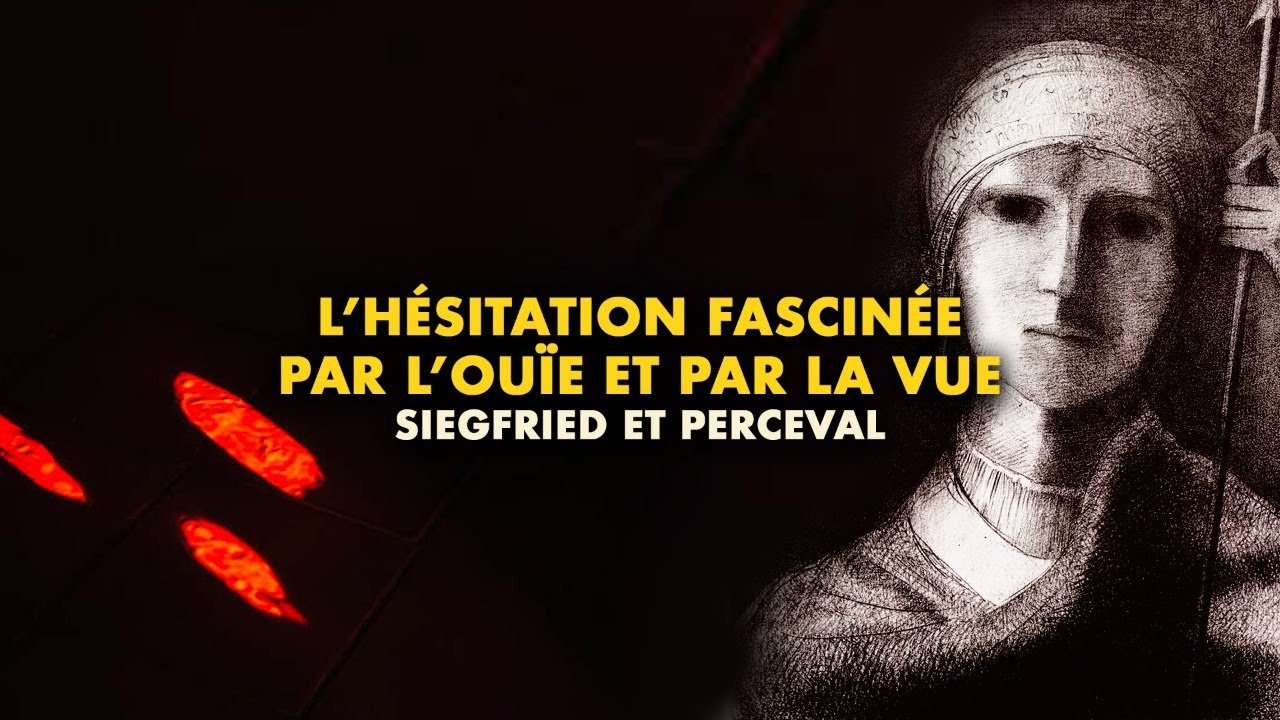
2:57 Well, let's get to the heart of the matter. Let me explain the title a bit and the image, the beautiful image. It's a painting by Odilon Redon, some of you no doubt recognized it, titled Parsifal. He is a contemporary of the period when Wagnerism began to spread across Europe, and in particular, somewhat belatedly, in Paris, where at first it caused scandals, and then suddenly everything that mattered in culture, from Baudelaire's era to Proust's, you see, that's not quite the same period.
3:36 I mean, it's the avant-gardes, of poetry, of prose, of the novel. The painters — Odilon Redon in this case, and not only him. In England there's also the painter Rackham, who made admirable paintings and engravings, inspired above all by the Ring, in fact. He makes particularly stylized figures, slender, almost like cartoon mermaids.
4:10 And the theme — well, why do I bring in two characters? First, why Wagner? We had reached Chrétien de Troyes, the character of Perceval the Welshman. Wagner is the resumption of this character under the Germanized title of Parsifal. Well, following on from this, I had shown you this — faithful in this respect, it's not out of some whim that Wagner Germanized it, pan-Germanist though he was, but because, in the time of Chrétien de Troyes, or a few years afterward at any rate, following the appearance of Perceval the Welshman, in the 13th century, Wolfram von Eschenbach, one of the most important of the Minnesinger — that's what troubadours are called, literally it means the singer-singers, plural, singen, sang, the Minnesinger, and Minne is a feminine personification of music, a bit like Erato or Mnemosyne, which we've also seen, or even Echo.
5:29 You know that the nymph Echo — the ancients said that the echo you hear when you speak in a mountain, in a natural amphitheater, was in fact a nymph answering us. And this is what is said in one of the most beautiful poems of our language, The Ballad of the Ladies of Times Past by François Villon, where he lists beautiful, mostly legendary women, down to real women like Joan of Arc. "And Joan, the good maid of Lorraine, whom the English burned at Rouen — where are they, sovereign Virgin? But where are the snows of yesteryear?"
6:02 There it is for Joan, but for Echo: "Echo speaking, when noise is made over river or over pond, who had beauty more than human — but where are the snows of yesteryear?" So there, the singers of love, Minnesinger, the most important in the German language — excuse me, I was fussing with my tie in a mirror, it was terrible at first. And so, how do we get there?
Red and white; from the epic to the courtly, then to the Grail 6:37 Because of the opposition I developed last time, which I'm taking up again here, the polarity of red and white. I had told you we would come back to it. Because there are those who think I say something and then move on to something else. I'm a stubborn obsessive. And that's why, taking a liberty with chronology, I should begin with the character of Siegfried and afterward with that of Perceval-Parsifal, since Parsifal is Wagner's testament, the work that comes last.
7:16 I'll begin by setting Parsifal and Siegfried side by side, but I start with a character who is not Wagnerian, who truly belongs to our matter of Brittany, with the immense Chrétien de Troyes, who — who knows why — suddenly, at the end of this last work, suddenly brings the Grail into his poems, "The Quest for the Grail." This isn't a preamble, one last little aside before we get into the text this time, because we're in the thick of the problem now — it's interesting to note that medieval poetry, if I stay, say, within the Hexagon — it didn't exist as such at the time, but if I stay within the French domain — begins with the epic. As almost always, cultures at the start are epic. Homer preceded Pindar the lyric poet and Sophocles the dramatist, for example.
8:23 Among the dramatists, Aeschylus, who is more epic than Sophocles, and both being less interiorized than Euripides — there's an order to it. Our poetry begins with the epic, the Song of Roland. Now there, there's no trifling with love — well, there is the fair Aude, who comes up from time to time, because she's waiting for Roland somewhere in her castle. But still, I mean, it's mostly fighting, it's magnificent, the versification, the great verse of laisses, of the author of the song, and the era of Charlemagne after all.
9:03 And then when we move to almost the antithesis, that is, to the courtly romance, that is, to the period when royal power had centralized the kingdom, war was no longer the main subject, since it had pacified the kingdom somewhat. It took time, from Philip Augustus to Louis XI, you see, there was a whole process of centralization and pacification that would later culminate in absolute monarchy, where Louis XIV could allow himself to say "I am the state."
9:39 There you have it, the little provincial feudal lords — well, a few great ones remained — I mean, you come to court, I'll give you Molière, Racine, Lully, but you stop scheming behind my back. There, it's no longer war. And it happens at court, right? Courtly love. What do you want to do at court when there's no more war? Love. And so the problems become interiorized. The Quest for the Grail is the final stage of this process. It's love too, but it's divine love.
10:12 There, I wanted to recall this progression, which is no accident. So when people say, "But what got into him all of a sudden?" — Chrétien de Troyes devoting himself to the Grail, when up to then he had sung the exploits of his knightly heroes who defended the widow and the orphan. Even if, in all his romances, there are plenty of wonders, miraculous, supernatural things, as befits especially the Celtic genre, with the marvelous imagination of this matter of Brittany, they are nonetheless secular loves — Lancelot's love for Guinevere, for the wife of King Mark, etc.
Perceval the idiot and muteness at the Grail castle 11:00 But for Erec, for Enide, etc. And here, it's a matter of divine love. The Grail, I don't know. So, let me remind you, I had already told you that our Perceval was raised like a wild child by his mother. So he's a bit of a simpleton, a bit of an idiot. I should note that at the time Wagner was writing Parsifal, where he stages an idiot — let me remind you again that Nietzsche was furious about this, as long as it was Siegfried who respected nothing, who broke the old values with his sword, who was the beautiful blond beast — no caricature, Nietzsche is no parody — who was beyond good and evil, so to speak — then suddenly to end with this hero who, when struck, turns the other cheek, who stammers, and that's why I chose him to illustrate hesitation, you'll see.
12:03 Because that's our theme, the hesitation between the two poles, red and white, we'll come back to it. It's starting to become clear. When Wagner stages this idiot who breaks with the Siegfrieds and even with the Tristans, etc. — then Flaubert writes Saint Julian the Hospitaller, one of the most disturbing of his heroes in the series of Three Tales. It's an admirable series, isn't it?
12:35 And Dostoevsky at the time simply writes The Idiot — something is happening at the end of the 19th century, in our modernity, at the heart of our modernity, before it shattered on the war of 1914, in this century that never stops ending. So I come back to this polarity and I get to the passage I summarized for you, but we hadn't read the text in detail — this passage where, in quest of adventure, so we're still a bit at the beginning, in the first third of the story, he has left his mother's castle for some time, he has already achieved exploits, people have learned to fear his strength, and above all he has had his first contact with Blanchefleur,
13:25 who will later become his wife, you see. The space of one night where they were body to body and skin to skin, to quote Chrétien de Troyes. And above all, above all, above all — you see that's human love — and above all, wandering from adventure to adventure, from forest to clearing, he came upon a mysterious castle where he witnessed the showing of the Grail. I've already told you about all this, so I'll go a bit quickly — at this ceremony where he saw a wounded king, the Fisher King wounded, depending on the version, in the kidney, the hip, the thigh, in any case unable to stand, almost always lying down, or in a boat where he fishes to pass the time.
14:10 So there's this play on the fisher king — the one who sinned (péché), for which he's wounded as an immanent punishment — and the king who fishes (pêche) at the same time, it's not like the cat that fishes. He witnessed all this. And everyone was waiting for him to ask the question: what is that? Whom does one serve with that? What are these maidens of supernatural beauty? This vessel that shines and puts out the candles even though they keep burning — one has the impression they're extinguished, so brightly does it radiate its light.
14:49 And he remained silent, stunned, wild boy that he was. He who had spoken so easily at first when he met knights, he remained silent. And so, the next morning, when he woke up in that castle, the portcullis was raised, the drawbridge was lowered, as if to say "you may leave, there's nothing more to do here." He saw no one, he left sadly. All that had happened before. So now, he's in quest of new adventures, after having witnessed that, and not having quite risen to the occasion through his silence, through his hesitation to ask the question.
Reading: the three drops of blood on the snow 15:32 He arrives on a moor covered in snow — it's the beginning of winter, covered in snow — with the tents of the Fisher King camping there with his court, as was often done at the time. There, I won't say more, the marvelous language of Chrétien de Troyes will happily take the place of mine. "He came straight to the meadow, frozen and snow-covered, where the king's army was encamped. But before he reached the tents, behold a flock of wild geese came flying."
16:10 I'll make a first stop here in Wagner's Parsifal. Parsifal appears on stage having splashed with blood, with an arrow, the sacred swan of the Grail, a white bird. "Behold a flock of wild geese came flying, whom the snow had dazzled. He saw and heard them, for they fled noisily before a falcon swooping down on them in a single stroke. He struck one at full speed, one that had separated from the others. He hit it and struck it so hard that he brought it down to the ground."
16:51 There, he's not hesitating as a hunter, making blood flow, like Ulysses who commits carnage with the Trojan horse at the beginning and with the massacre of the suitors at the end. You see, I'm going back to the very beginning. But it's not me artificially creating continuities. It's incredible how homogeneous the content is across more than two millennia. Let's not get ahead of ourselves. "He hit it, struck it so hard that he brought it down, but it was too early in the morning, too soon, and he went on without deigning to go pick it up or attend to it further."
17:28 "Perceval, however, spurred his horse toward where he had seen the flock. The goose had been wounded in the neck, it bled three drops of blood." And here we have our polarity, you see I'm not inventing it — three drops of blood on the immaculate meadow. "One would have said a natural color. The goose felt neither much pain nor much harm" — it wasn't seriously wounded — "but it had to remain on the ground."
17:58 Remain on the ground. By the time he reached it, it had already flown away. "When Perceval saw the snow that had been trampled where the goose had lain, and the blood that showed around it, he leaned on his lance to gaze at this resemblance." For the blood and the snow — I'll stop there on this white and this red, this red and this white — I stop because he interrupts his hunt, there's hesitation, he suddenly shifts his focus.
18:30 He had been entirely absorbed in his wild geese, and now he lets go of the prey, if not for the shadow, at least for a strange scene. One would say a bed where a wedding night had just taken place, wouldn't one? Look, look, I'm not interpreting. "When Perceval saw the snow that had been trampled where the goose had lain, and there was the blood, he leaned on his lance to gaze at this resemblance."
19:00 "For the blood and the snow together resembled the fresh color that is in the face of his beloved." So he thinks of his Blanchefleur — that's her name — utterly absorbed in this thought, he forgets even himself. Great poet, Chrétien de Troyes — he didn't just forget about the geese, he forgets himself. "Such, on the face of Blanchefleur, was this drop of vermilion" — and there, once again, set upon the white, as were these three drops of blood, with these triangular structures, heavy with symbolism, appearing on the white snow, "he was nothing but gaze."
19:48 When I spoke of fascination in this evening's title, I think it's clear to everyone now that I wasn't exaggerating. "He was nothing but gaze." And we'll see shortly, Siegfried likewise completely shifts his focus — he had come to kill the dragon and suddenly he hears the song of the birds, but there it's hearing. "He was nothing but audition" — he won't be anymore — "he was nothing but gaze," I never tire of sowing this.
20:22 "It seemed to him, so much pleasure did he take in it, that what he saw was" — and once again — "the wholly new color of his beloved's face, so beautiful." That's what you find, in what Chrétien de Troyes, in his Perceval the Welshman or The Quest for the Grail — sometimes also called The Story of the Grail — in its first twenty verses, addresses to the court, of course — it's a court in Champagne —
20:56 at the time, and thinking of the ladies present at his court who are delighted to have a new tale, they know there's going to be — it's courtly poetry, isn't it, it's the matter of Brittany — it's going to be about love, much more than the chanson de geste — he tells them he's going to tell them, I quote, "the finest tale ever told at a royal court, Ce est li contes del graal."
21:31 So much for Perceval. I told you I'm bending the chronology a bit, since I'll end this session with the end of the second act of Siegfried, even though Siegfried was composed a little before. This is Wagner already possessing all the resources of his final period — I mean his musical resources. I'll finish with the end of the second act — of Siegfried.
22:08 Let me tell you right away why I want to end with it, because there, you'll see we're going to see a lot of hesitation tonight. Moving from Perceval to Parsifal, the hesitations aren't going to let up. But there, it ends — the finale of Siegfried — I don't want to give it away, but it ends with a magnificent decision on which the curtain of the second act falls with a crash, on a kind of rather rare triumph, solar. We're not in the mists of Twilight of the Gods. So, I now move on to the character of Parsifal. For that, I need to give a fairly long — not preamble, but introduction, to summarize for you what happened before, the excerpts we're going to see.
Parsifal as filmed by Syberberg 22:57 I'll tell you right away that we'll see quite a few, some rather long, compared to the short video excerpts one usually shows just to illustrate one precise point of content, whereas here there are some dramatic sequences that can't be cut. And I think there will be things for everyone to enjoy, that some won't get over. All the more so since I chose the staging — or rather the direction, since it's a film — but a film that follows Wagner's score and text from beginning to end.
23:39 A bit like Joseph Losey did with the admirable Magic Flute — no, Bergman did the Magic Flute, it's not — Joseph Losey made an admirable Don Giovanni. That's a bit exceptional, it's not filmed opera, it's films, you see, made with opera singers who are actors — that's no small feat. And there, I of course took the staging for Siegfried that you know, with Boulez conducting and the admirable Chéreau directing.
24:17 And here, it's Hans-Jürgen Syberberg, a filmmaker that cinephiles no doubt know, who has made nothing but extremely strange, extremely baroque-modern films, if I may put it that way. Not baroque at all in the sense of the "baroqueux," but baroque in the literal sense, I mean, with collages. There are... you see busts of Marx and Nietzsche lying around somewhere in the Grail castle, in short, symbols borrowed from practically the whole of modern intellectual or artistic history, including psychoanalysis.
24:58 Well, I won't spoil it, but in any case it's exceptional in quality. And above all, it's one of the rare productions that gives us a Parsifal such as Wagner demanded he be staged, because most of the time we're served Parsifals who weigh 130 kilos and are 30 years too old. No, I'm not exaggerating, 30 years too old, it's a bit ridiculous. He's supposed to be a stammering young man, a kid, isn't he? A teenager.
25:29 He truly found the right person for the role, and above all there's a directing of the actor that you rarely see among opera directors. So there, for those interested, remember Hans-Jürgen, Jean-Georges, Syberberg, right? There was a mistake — they put "Sieberberg," I believe, on YouTube, but as I've always said, whatever it's called, at Apple, iTunes, YouTube, all of that — I'm full of admiration for the intelligence of the ergonomics, of everything you like. It's intelligent, but it's uncultured.
26:16 Well, it's a bit the American way. Even though, in my opinion, the finest and most refined people are also found in America, but they're so marginalized there that one barely has time to talk about them. But one must be honest, give them their due for that. So, as I often tell you, I don't gobble up the American, I gobble up Atlanticism. For now, it's they who hold power, it's a moment. Without further delay, I'd like us to begin with the scene where we'll see Parsifal burst onto the stage, because he does so late. The first act is long, don't worry, we won't watch it in full, but it's one of Wagner's longest.
The Grail domain, the lost spear, and Klingsor 26:54 Often the first act is long and laborious in Wagner, one notices — it's the act of exposition. The second is the act of action, where there's no turning back. And the third is the one with the healing, the redemption, the healing. And here, in this first act, let me tell you what happens before. We're in the domain of the Grail. Watch out, it's a strange space. Besides, when — a passage that comes after the one we're about to see, we'll cut before it, but I'll tell you anyway since I'm talking about space — when the knight who is the narrator of the whole first part, as often with Wagner, we don't see the action, it's as if caught in glue.
27:48 He's an old knight who is giving something of a catechism lesson, more like sacred history, to the young squires. He tells a bit about the state the domain of the Grail is in since the lance was lost there — since the villain within it, the sorcerer Klingsor, stole the lance. Because this domain of the Grail is a sacred domain, since it shelters the two most important relics of Christendom: the vessel that collected Christ's blood, that is the Grail, a vessel, a rather feminine symbol in the imagination, especially of that era, but also the lance, the lance that pierced Christ's side, and the lance without which the vessel would not be filled.
28:40 It's when these two relics are together at the Grail castle that the knights of the Grail are invincible — a kind of somewhat ghostly Templars — invincible. And by the way, they're dressed in red and white, well, white with a red cross. That's it, yes, Madame Fils, yes. And so he tells them how it happened, a rather tragic story, since ever since the lance is no longer there, the domain of the Grail is falling into ruin.
29:12 Every Friday, in principle, there's the ceremony of the Grail, during which the Grail king Amfortas, the famous Fisher King Chrétien de Troyes spoke of. You understand why he's wounded, why he committed a fault. Here's what happened. I'm going back to the origins. Amfortas's father, the Fisher King's father, Titurel — we see very little of him, so I'll go quickly — and he was the first, I'll pass over this quickly, to bring the Grail from the East, from the Crusade, to safety in this castle which, incidentally, Wagner situates very precisely, calling it Montsalvat.
29:54 Montsalvat — he places it in the Pyrenees, right at the border, especially at that time, between Christendom and Islam. And it's not so much the war between Christians and Muslims at that time, it's the war between Christians and pagans. You'll see how that's illustrated in this story. So, Christians and those who aren't Christian. The pagans, the pagans, whoever they may be. Which is very unjust, let's say in passing.
30:28 They're even stricter in their transcendence. It's not that Christians don't even have incarnation. So, ever since the Grail has been there, every Friday there's a dazzling showing of the Grail. King Amfortas officiated at that time without any problem, he wasn't wounded. And then one of the knights — this is where the problems begin — tried to silence within himself... guess what? Well yes, of course, libido. He doesn't call it that, does he. He doesn't call it that.
31:06 Temptation, you see, because to be a knight of the Grail you have to be of unassailable purity, of unassailable chastity. And not being able to, not managing it, he ended up — the text puts it in a rather labored way — he laid a criminal hand upon himself and castrated himself. There's a lot of blood in this story. There's Christ's blood in the Grail, there's the swan's blood splashed on its whiteness when Parsifal comes onto the scene, we'll see that shortly.
31:41 And there's the blood of that dreadful wound of the self-castration of — ah, I haven't told you his name — the magician Klingsor. So originally he's a knight of the Grail; it's a memory of the theology that says Satan is a fallen angel, cast down from heaven, a little lower. And even lower still. So to take revenge, of course — this crime got him driven out of the Grail castle, of course, because he had been tempted... it would be too easy, philosophically speaking, wouldn't it? What matters is having the desire and resisting it.
32:26 And to take revenge, of course, for being excluded, for being treated as a relapsed heretic, he wrought a profound transformation upon the desert. Let me introduce a new element here. What is the desert? It's a desert that separates the domain of the Grail from the rest of the world. Here too it's fairly easy to see what's implied: it means one can only get there by crossing a desert. And no one can find the way to the Grail unless he has been initiated or has received a grace. That's roughly it.
32:59 Now, this desert he doesn't leave sterile like that. He transforms it into a garden of enchantments, in which grow the famous flower maidens. And yes, Wagner is contemporary with Gustave Moreau, he's a contemporary of Baudelaire, it's quivering with eroticism. Whereas what characterizes this community is that one must renounce the pleasures of the flesh and pass from human love to divine love.
33:38 It's complicated. I'll come back to the flower maidens, whom we'll see in several excerpts from Parsifal, so as not to group them all into one excerpt that would be too long. For now, the knight is telling all this to the young squires, who are fascinated — among them there are women's voices, because they're all quite young. That's an opportunity for the composer, to have a tenor, an alto, a bass, and so on.
34:13 He's talking to them, and the first excerpt will begin right at the moment when he makes this sorrowful observation, that ever since the lance is gone, the knights no longer have the ardor for combat, the Grail no longer makes them invulnerable. So he doesn't move much anymore. It's a world in decline. You can guess where I'm going with this. I've arrived at our modernity. You can't say our world is doing well, whichever side you're on. Some people say it's because of immigrants. I think it's because of NATO — to each his own explanation. Everyone agrees things aren't going well. That's why sometimes you no longer know who's red and who's brown. Because there's a lot of discontent in our time.
35:05 Exploited by a minority that profits very nicely from it. So he makes this crushing observation, doesn't he? And I'll begin right when two squires exclaim, after a rather crushed silence from Gurnemanz — that's the old knight I've been telling you about, who's giving them a bit of sacred history — two young men who say, if someone could go get the lance back, what glory that would be for him! That's the moment when the excerpt I'm proposing will begin. I'm asking Pierre-Alain for a little more patience, a few more seconds, and the knight tells them there is nevertheless a note of hope, a vague touch of the supernatural.
35:54 One day, the Fisher King, in this pitiful situation, was praying, in confession, in guilty surrender before an altar — A-U-T-E-L, of course — and at that moment he had a vision. The Grail began to glow above the altar, and he heard a voice pronounce a promise which you're about to hear, live, in quotation marks so to speak.
36:37 The best acting direction, we have it — it's important for a play of such depth. With everything I've told you, that shouldn't pose too much of a problem. Let me just finish setting the context for all this. So he was praying, and this vision is also a pronouncement that says exactly this.
37:07 "Durch Mitleid wissend" — "Made wise through compassion" — "durch mit Leid," "mit" means "with," word for word it means compassion. "Made wise through compassion, the pure fool will come" — in the Middle Ages one said "the fol." The fol. "Know to wait for the one I have chosen." This begins to be said before the marveling squires, who take it up in chorus, very slowly, on the sustained note, and it continues, and suddenly, with violence — because after all this music, sticky and slow and dark, hopeless, suddenly there's action, and suddenly we're thrust into it.
The slain swan: projection of the interrogation 37:54 A dreadful thing — the swan of the Grail, for we are in a domain where it's forbidden to harm the slightest animal. Wagner was a vegetarian, we mustn't forget these things. The excerpt we're about to see will be a hit with vegans, if I may say so. And you'll see that this doesn't stop one from being antisemitic, which was the case with Wagner — militantly and obsessively so, and nationalist too. Well, we'll come back to that. It doesn't mean that because I'm vegan, I'm a fascist.
38:29 No, but I mean, it doesn't guarantee, it's not enough to guarantee, when one has compassion for animals, that one holds the right values. That can coexist with the very worst. That's just the point I'm making. Nor am I saying the reverse — that vegans are fascists. But I'm warning you: goodness is a quest. It's not enough to spare — like the Tibetan lamas who had excellent relations with the Third Reich. Yes, at the time, look it up, in the 1930s — it's not about sparing the lice that plague you. It's incredible, because one must respect life wherever it suffers. So, well, here it's not an animal that is killed or that suffers — it's worse than that.
39:23 It's in this domain that he chooses — well, he chooses, in Chrétien de Troyes, which I read to you, it was a wild goose, a white goose like that, on the snow, red spots on white. Here, he chooses the swan of the Grail, the most virginal thing there is, the very symbol of purity, you see, white, "the queen white as a lily who sang with a siren's voice," to quote Villon again. So I ask you to pay attention to the knight, who's a bit young for the role but who plays it admirably and who, above all, has a bass voice.
39:59 He's the one who sings the longest in Parsifal, for nearly four and a half hours. And you can see that our excerpts are short compared to the total length, but he should really have somewhat white hair and all that. He looks to be resonantly in his forties, fifty at most, but otherwise an excellent bass, good diction.
40:31 It's a bit complicated because it's in archaic English where "you" is replaced by "thee" and "thou," which is the German "du." And pay close attention to the sustained note on which the promise ends — the young squires take it up — and suddenly, the bloodied swan bursts onto the scene, and Parsifal is brought in as they say, "It is he who dared to kill the swan."
41:01 You're about to see the incredible interrogation that begins. Here I tell Pierre-Alain that he's been very kind and very patient and that we can begin this first excerpt.
44:52 ...and chastise the... Gondis, Leandre... the swan, how could you murder — here, in the holy forest, silent peace enfolded you...
46:01 ...we do not touch any animal here... they greeted you kindly and piously,
47:29 ...into... "What is he to you now?" "Here, look here, this is where you struck him!" ...The blood still stares out...
48:06 ...the wings hang... the snow-white plumage... darkly stained... the eye broken... do you see the gaze?
48:47 ...you are aware of your sinful deed... Tell me, boy, do you recognize your great guilt? ...How could you commit it? I didn't know, I didn't know.
49:31 I didn't know. Who sent you on this path? I don't know that either. Your name, then? I've had many. Kar meint, Joch, I don't have the poetry... Is that known?
51:11 "You know nothing of what I'm asking you; now tell what you do know, for you must know something."
"I do not know": absolute hesitation and the forgotten name 51:59 This is a strange sort of thing, still — what an interrogation! What almost sadistic work! I don't want to overstate it, but I don't know what you make of this guilt-tripping of the young man. He's told: "this isn't right, it's forbidden here, why do you make the animals suffer needlessly, not even to eat them — here they aren't eaten." Besides, how does Parsifal appear, with his horse beside him? Watch closely — I'm rewinding on purpose, a return to the text here.
52:34 You've seen the images, we won't forget them. For once they match Wagner's stage directions — thank you, Hans-Jürgen Syberberg. But as for the text, when he arrives with his horse, there's the chorus of squires who say "he must be punished, he's the one who shot." How could you do such a thing? The first words from Gurnemanz, the old knight — not old enough, did you notice? — and Parsifal's first words, with an indifferent smile: "I like shooting at anything that flies."
53:08 Now that's not hesitation. You're starting to understand where I'm going with this. But as soon as the interrogation begins, it's absolute hesitation. As soon as he's questioned — how could you do such a thing? I don't know. "Who is your father? I don't know." "Who showed you the way?" — because the old knight knows that no one can reach the domain of the Grail without having been initiated or having received a grace. So he is indeed intrigued. Parsifal says "I don't know." For him it's chance. He's questing for adventure. He ended up there.
54:02 And faced with these answers — and then wait, one more, the last in this first series of questions before a procession carries off the poor swan — and the final question, a very important one, when he asks him "but what is your name?" That's the least one should know, after all — one's own name. And this strange answer: "I've had many, but I don't remember any of them."
54:34 He even hesitates to say what he's called, stammering, unable to state his name. The name is what is nuclear — no need to borrow the term, it's obvious — psychoanalysis has a great deal to develop on this point, to the extent that it inspired Lacan's famous pun. The name of the father — it's often the father who gives the name — and the "names"/"no's" of the father, those who don't want to be fooled are often mistaken. Well, anyway, these are just puns. But the importance of the name, of naming, is always very solemn in Wagner.
55:10 Here it's downright mysterious. But you see, Siegfried's father, Siegmund in The Valkyrie, gives himself six names before arriving at "Siegmund." Well, they call me this because I was brave, that because I never had any luck, and so on, you see. Except here, he does know them. And here he says, I've had many, I don't remember any. In Chrétien de Troyes's text — and this is what inspired Wagner in this multiplicity of names, because he sticks very closely to his sources, he did enormous research work for the Ring, it's a Germanic realm and he went digging in the archives of the Eddas in Iceland, the Scandinavian Eddas, the oldest Scandinavian texts.
55:59 which is to stay very close to Chrétien de Troyes's text — Chrétien de Troyes has Perceval talking at the beginning, when he leaves his mother's castle and meets, for the first time, he sees knights dazzled by armor gleaming in the sun, the helmets, the pennants, the lances, and not this weapon of a wild boy, the bow, back then. Let me take this opportunity to point out that there's more than a class struggle, almost a racial one — well, they thought in terms of race at the time, even if they were really class matters — between the new occupants of Great Britain, the Germanic peoples, the Normans, the men of the North, that is the Vikings, so Scandinavians, of Germanic tongue, for whom the inhabitants of Great Britain, the Welsh, and everything — these are all races.
56:52 It's in Chrétien de Troyes's text that they're stupid and that nothing can be got out of them. So at one point a knight says "but what's your name?" and Perceval the Welshman answers, all the while fumbling with the helmets, the hauberks, the sword like that, without answering the knights' request for information. Instead, throwing questions back at them — what's this for, what's that for? He says, I don't know, my mother used to call me sometimes "my son," or sometimes "my dear friend," or "dear child," you see.
57:43 And what a work of guilt-tripping when he says to him "Look how long this goes on, it's unbearable — look at this swan, but we're given incredible details." And here we arrive, we plant our eyes, we the audience, and our minds, into the blood of the swan, the red at the heart of the whiteness. We're spared nothing as we watch. Look! The feathers stained, the feathers sticking together until they turn dark. Look! The glazed eyes! And each time he tries to look away, he's told "schau her! Look, look there, look here!" At this point, in this staging, he lets go of his bow.
58:38 In the stagings, in Wagner's stage directions, he takes his bow and breaks it over his knee. In this case, he realizes that the guilt-tripping has achieved its purpose. In the next excerpt — so much happens, I won't summarize it all, we'd lose too much time — we'll find ourselves in the magician's domain, with Perceval, whom we'll meet again — but what is he doing there? The magician's domain — remember the knights earlier who despaired, wondering if someone could go recover the lance — well, yes.
Kundry, the lyric drama, and the sacred festival stage play 59:17 I skipped that, because I told you the first act is already long, and I skipped a whole first part of the second act with the duet between the pimp and his prostituted victim. I'm not joking. We finally see the famous Klingsor, the terrible self-castrated magician. And we meet again the woman — I deliberately haven't told you about her yet, because there's a whole development to give to this character alone. Wagner spent over sixty years on her.
59:48 And from one female character to another, from Senta in The Flying Dutchman, to Elisabeth in Tannhäuser, to Elsa in Lohengrin, and Isolde of course, arriving at this composition, this fantastic hybrid that is the character of the woman you saw, this wild creature who is among the dead leaves, Kundry. At the beginning, we saw her — well, not us, here, in the clips, I can't show you everything — but I mean, at the very start of the play, we see her quite early, striving to soothe the Fisher King's wound.
1:00:21 We cannot cure her — she never cures her — but she runs across the whole world to find balms, things that at least relieve his pain for a moment. And she even says at one point that Amfortas, the Fisher King, wants to thank her by the lake, where the breeze from time to time relieves his pain a little. He says to her "Kundry is always faithful," because she always comes out of the bushes, she sleeps in bushes, worse than a homeless person — she is not even in town, isn't that so? A wild woman, you see — a symmetry with Perceval.
1:00:55 I'll come back to this because of the extract we just saw. She asks him where he found that balm, and he says all the perfumes of Arabia — if that is not enough, Arabia no longer contains enough perfume to soothe you. This is a memory of Shakespeare's Macbeth, which everyone knew by heart, where Macbeth's bloodstain after his crime will not go away. And she says "all the perfumes of Arabia will not wash out this spot." You see what guilt is the obsessive, lingering, recurring theme throughout.
1:01:35 Now, it is interesting to note that the character, the hero of this lyric drama — or rather, you know I am very sensitive to genre, so I will be precise — there is opera. The Italian majority, there is a magnificent French opera, Russian too of course, and within opera there are differences. Genres ranging from opera buffa, The Marriage of Figaro, the Singspiel — a kind of popular comedy in German-speaking countries, especially southern Austria for example, or Bavaria — to opera seria, which stages princesses, Titus and Berenice for example, La Clemenza di Tito, to speak of Mozart.
1:02:24 Wagner set aside opera as a whole in order to replace it with the music drama, which is a total fusion of text and music, as you see constantly here, with these strings that tear your soul apart every time there is a question, a silence — we heard it. A music that also opens up chasms of pain, this time the pain of the spiritual soul.
1:02:54 Look at the role of the strings in Parsifal — even though there are sumptuous brass passages, far fewer than in the Ring. Here it is the strings that stir the interior most. So, on the subject of genre, for Parsifal there is yet another genre that has only ever been applied to Parsifal. Wagner titled it "Bühnenweihfestspiel." "Bühne" is the stage, "Festspiel" is festival. In other words, it means "sacred scenic festival play."
1:03:26 It is an opera on an almost religious subject, even if it is not officially religious — because there are all sorts of things in it that are not in the dogma, I tell you that myself — but which has a connotation, a resonance, as you can clearly see, that is constantly mystical if not religious. And there is a name for this, even within operatic traditions, when a dramatic sung work is written on a religious subject, most often drawn from the Bible, like the admirable work — I recommend it to you — from the time of Monteverdi, between the sixteenth and seventeenth centuries, especially the early seventeenth, a magnificent composer but less well known than the immense Claudio Monteverdi. I'm thinking of Giacomo Carissimi, who wrote an oratorio, "Jephte" — it's in the Bible, there is Jephthah who, a bit like Agamemnon sacrificing his daughter Iphigenia among the Greeks, sacrifices his own life to win the battle, because that is what God asked of him to put him to the test, as he asked Abraham, who was about to immolate his son but was stopped at the last moment.
1:04:36 So there you have it — as a sung dramatic work on a sacred subject, that is an oratorio. Parsifal is almost an oratorio. It is not drawn from the Bible, it is drawn from Chrétien de Troyes. And I'll take the opportunity to mention in passing that the Christian connotation of the Grail — the vessel said to have collected Christ's blood — is a late medieval addition. Originally, in Chrétien de Troyes, there is no Christian appropriation at all.
1:05:08 We don't really know what the Grail is; we know it dazzles, that it is made of light, we know it is linked to food because it is a dish — that much is certain. Some say a vessel, some say a dish, isn't that so? We do say we're going to go "grailler" [to eat] — these are old roots, you know that. Or something "smells of graillon" [burnt fat] in slang. But in Chrétien de Troyes, there is not yet the Christian appropriation. That will come later with the monk Robert de Boron who, seeing the success — somewhat bound up with pagan magical tales — feared that the faithful might be led into pre-Christian superstitions, and so set about Christianizing the thing.
The flower maidens, Proust, and Herzeleide 1:05:52 Wagner unifies the two, the pre-Christian marvelous with magic, Klingsor. So, I haven't told you the best part yet, because now we're coming to the next extract, we do have to talk about it. We were in the religious realm, now we're moving a bit into the demonic, because the sequence we're about to see will begin with Parsifal wandering among the flower maidens. But what is this story of flower maidens? Good heavens!
1:06:27 It is obvious that a Proust who was mad about Wagner did not choose at random the title for which he finally won his Prix Goncourt, Within a Budding Grove [literally: In the Shadow of Young Girls in Flower]. Did I tell you I knew a woman with the agrégation in literature? There is a master's research paper on a parallel between the narrator's journey in the Search, which goes from the fixation on the mother — look at all the drama of bedtime, of his going to bed when his mother doesn't come to give him the final goodnight kiss because she has guests — and the pages among the most moving that Proust gives us there.
1:07:08 So from maternal fixation to the war of 1914 with the German zeppelins above the Place de la Concorde, from the white sonata to the red septet — "I'm not inventing anything, I'm not jumping from topic to topic." And this young woman had drawn this parallel with that very beautiful title, of fidelity — implied almost too faithful to the mother — of fidelity to grace. You saw that Perceval, who is somewhat overwhelmed, made to feel guilty, lights up again when the only positive response he gives to the questions asked of him — the only time he answers by giving us information — is when the old knight comes back to him after the... [corps-térent, unclear].
1:07:53 He says to him, "Well then, now, tell us something, so that we know at least something about you, it's not possible to know nothing." And he says, "I had a mother, she raised me in the forest," he gives her name, Herzeleide, which literally means "sorrowing heart," the lai, you know, the lament. Herz is heart, Herzeleid, sorrowing heart — good heavens, a memory of the Pietà, of the sorrowing Madonna before the corpse of her son, Mater Dolorosa.
1:08:26 And yes, all of this is very overdetermined. So, you're going to tell me, we're moving away from the flower maidens here. We're surely not going to put the Virgin Mary among the flower maidens? Oh no, certainly not, because these are not at all the same order of things. Judge for yourselves instead. What did he do with the desert? He transformed it into a garden of spells, a garden of temptations, in which he makes strange beings grow that are flowers from the waist down to the calyx, and are very beautiful girls from the waist up, whose function is to seduce the knights of the Grail when they go out to do battle.
1:09:02 We're not told exactly, but we're supposedly somewhere in the Pyrenees, at the border between two worlds, the faithful and the unfaithful. And that is where Wagner sets it. People have often thought of Montségur, since he calls it Montsalvat, a Cathar stronghold. Wagner drew a great deal on Cathar material too, on the age and on the Cathars, as well as on the lance — the story of the bleeding lance, with its drop of blood, that's in Chrétien de Troyes, welling from the tip toward the shaft. All of this is at once so mysterious and yet quite clear sometimes, madame. It produces so many different wounds and different bloods.
1:09:39 The blood of sin that mingles with the blood that saves mankind, the blood of Christ. Nietzsche, reading the libretto, said "too much blood, and besides I don't like hysterical women." I come back to Kundry, a character you saw among the fallen leaves. We will learn much later — well, we're going to discover at the start of the second act, with which we'll begin our next session. I want to give you the context for it. We will learn that this woman who runs across the whole world to soothe the Fisher King's wound is the very reason he is wounded.
1:10:19 Because when she is under the power of the magician Klingsor, under a kind of spell — you might call it, you see, a spell — she no longer belongs to herself, she no longer belongs to herself, she belongs solely to his will. And she becomes, under Klingsor's orders, who is castrated, the chief seductress. That's why I tell you there is a real dialogue that opens the second act, which we won't see, but which I recommend to you, with Schoenbergian overtones for connoisseurs. We are well beyond Romanticism here, we are in Expressionism, of a violence...
1:10:51 When he says to her "I am your master," she says to him "Oh really, with what...?" And he is terrified by this irony. And when I tell you that this is really a dialogue between a pimp and his chief prostitute, I am not inventing anything. "Go, get to work," because it's dangerous today. And I'll give you the exact quotation. "Now," he says, all the knights who have fallen, easily — they cannot resist your beauty — because she completely transforms herself.
1:11:24 When she turns into a seductress — Wagner took sixty years to forge the character of Kundry. The character of Kundry. We will learn later — she herself will tell Parsifal later, in the immense seduction scene that I'll spare you, we'll only see the very beginning — we'll learn that she is a reincarnation of women who have lived, one of whom witnessed the Calvary at Golgotha and laughed.
1:11:54 It's life that comes rushing in. Christ, they say, turned around at that moment, and ever since she has been condemned to laugh, to laugh, to laugh. An unhappy, cackling woman — hence this theme we often hear when she is present, a kind of chromatic descent, sometimes fast, sometimes slow, but most often fast, like a horse's whinny. So this Kundry, we'll see — Parsifal — we haven't answered the question, what is he doing there? He made the decision — I skipped ahead — and in fact we never see the moment when he decides.
Parsifal driven away, then among the flower maidens 1:12:36 By the start of the second act we've understood: that's it, pity has instructed him, as the promise required, hasn't it? He saw the Fisher King's suffering, he witnessed — I'll skip this, these are extraordinary scenes — he is dumbstruck in both eye and ear by the showing of the Grail in the Grail temple that closes the first act. Parsifal sees the infinite suffering — it's the music above all that expresses it, it's irresistible, up to a paroxysm.
1:13:06 And he does not ask the question. And so the old knight we saw, who was fond of him, who had thought after all, "This resembles the prophecy, this business, this must be the one who was promised to us, this idiot here, how convenient, he found the way, so he must have the grace" — is dreadfully disappointed, because he stands there open-mouthed before the suffering, just like that, caught in hesitation. To speak, not to speak. I told you that the same person who wrote her thesis on the parallel between Proust and Wagner, here, between Parsifal and — their respective professors — the same person had prepared the agrégation and had the fairy tale on the syllabus in comparative literature.
1:13:52 And their professors had told them that the figure of the ogre, so recurrent in children's tales, spares them nothing — it's dreadful. I'm not complaining, I was the first to love it when I read it, but it frightened me. Especially when it was said that there was so much blood on Bluebeard's walls that you could see yourself reflected in the wall. Worse than my own eyes. And so, the decision the character made, which we didn't see, and which the old knight expels him for — that we do see.
1:14:33 But we don't see Parsifal say, "That's how it is, I promise to go and fetch the lance." No, we're left to assume that this is what happens between the two acts, during the intermission, so to speak. We see him arrive there. But the old knight's last words as he drives him out at the end of the first act — these are the last words apart from the promise that falls from the dome, as we hear again the same phrase as though spoken by an angel — are "Get out of here, and in future leave the swans alone, go chase geese." I quote it exactly, it's strange — chase geese and leave the swans alone.
1:15:15 "Gosling that you are!" He closes the door in the immense hall that had been full of knights, the cult of the Grail, which is now empty, where nothing has happened, and which is sadder than ever — the curtain closes. And then we see Parsifal, all of a sudden surrounded — it's the first time he sees the female sex like this, all around him, flower maidens all saying to him "Komm, komm." It's an incredible collective vamping scene, absolutely incredible. I'll say no more, I'll leave it to... it's so densely packed, all these clarifications were really necessary.
1:15:55 So, let's look — ah yes, all the same, I'll tell you in advance that Parsifal is going to change. At first he is enchanted, he wants to play with them, then as they crowd around him more and more, he doesn't forget that he has his mission. You see how we come back to hesitation? His mission is to... He went to fetch the lance. He pushes them away, saying "give me space," "Raum," "Raum," "Raum," which gives "room" in English.
1:16:26 "Give me space," and at the moment when he pushes them away, when he frees himself, we hear for the first time since the beginning of the work — which lasts nearly five hours, four and a half hours — meaning that it's been two hours since it began. And for the first time, we hear his name spoken with a female voice. And we sense that Kundry has once again been unable to resist Klingsor's spell, that she is at work, and that she is about to carry out the most important seduction operation she has ever undertaken.
1:17:01 Carry on, and I come back to it. The old magician, in the scene, in their duet preceding the one we're about to see, says to her, "Bringing down the knights is easy, they're only men, but more dangerous is the one who presents himself today, protected by the shield of idiocy." And there she resists him. "I don't want to, he's a child." You see? You see? And it's then that, by magic, he casts his spell on her, she resists no longer, and I'll say no more.
1:17:40 So he is among the flower maidens; at first he will amuse himself, have fun, grow tired of it, push them away. At that moment, listen closely, the whole work turns on its axis. We are at the midpoint, as is often the case with Wagner, two hours from the beginning, two hours from the end. We hear Parsifal. And he repeats, and he says, "That is what my mother called me in a dream, when she was asleep." Sequence.
1:18:55 [transcription noise: repeated word "leon"] — the scene being long, I made a few cuts, one cannot show five hours all at once,
The primal scene: Kundry's account 1:20:08 But I pick it up again from the moment when she tells him, when she confronts him with his primal scene. Yes, it's a Freudian notion, but listen, I'm not saying anything more for now. You know, Freud comes not even half a generation after Wagner's death. All this was in the air already, you know, it was almost ripe. In any case, what is the primal scene? Somewhere there is a scene that caused the neurosis, the trauma, but which is not entirely constructed by the child.
1:20:46 There is a scene where he saw something. Sometimes it's called the parents' coitus, especially in households where there was overcrowding for economic reasons. Fantasized or real — I won't settle the debate, it's a debate internal to the analytic field, but an interesting one. That's what is called the primal scene, that is to say, she tells him how he was conceived.
1:21:20 She tells him what she experienced — she has lived for millennia, so she was there, she saw the baby. And that, the second part then. This second act begins with "Ich sah das Kind," I saw the child, I witnessed his first laughter, his first babbling, and above all, once again, a guilt-inducing moment very different from the one where Gurnemanz, the old knight, made him feel guilty with the swan's blood — here she tells him, "Ah, how she loved you, when you went off into the forest, how anxious she was, and when you came back, how she covered you with kisses — one cannot forget such a kiss."
1:21:58 As she brings him back, doesn't she, to the primal scenes of eros, to absolute fidelity — but a dangerous fidelity, isn't it. For at the end of all this, there is a corpse. Here I quote Nerval, yes, it all holds together, doesn't it. "The thirteenth returns, she is still the first, and she is always the only one, or is it the only moment — for are you king, oh you, pardon, for are you queen, oh you, the first or the last? Are you king, you, the only or the last lover, love him who loved you from cradle to coffin." That's what we're going to see now, from cradle to coffin.
1:22:44 Sequence.
1:25:52 ...that you turn me away, farther through myself, and farther I come again, to where I gained much.
1:28:23 It was her highest duty's command. From the weapons of men, and from raging, she wished quietly to shelter and protect him.
"Far from the clashes of wars"; Kundry's strategy 1:29:05 I think it happens almost as though reached — in any case, on this point, it's truly of incredible audacity to have gone back so far. He knows this character in a place where conscious memory can never go back to. And so she restores for him the very first moments of his existence as an infant. What does she mean by that, you see? Several remarks, all the same — once again, I return to the text, because sometimes one can hardly believe one's ears.
1:29:47 It's almost the second-to-last words, when she says "Elle t'a protégée" — "von Waffen fern, von Männerkampf und Wüten," far from the clash of wars. I told you that at the start of this cycle, my main hesitation — my own, because it was out of honesty that I spoke of hesitation — I myself am caught up by the situation we are living through. I had said that I hesitated between two poles: you talk every day about the danger of war, which only keeps growing.
1:30:25 Far from the clashes of wars and hatreds — she lost her husband on crusade, she doesn't want that to happen again for her son. So you talk every day about war, about the danger of war. I remind you that I have lived 75 years, and I have never seen such a danger of war. And yet I've seen crises, you know — at the time of the Cuban missile crisis and not only that. The Vietnam War, the Middle East, not so long ago, it's contemporary to you — when Obama put ships and nuclear missiles opposite Syria to fire on Russian bases — that was serious, what was happening then, and now it's in Europe.
1:31:07 As an African friend of mine used to say, war between white people — when there's war between white people, that's serious. That doesn't mean he was well placed, poor man, to know that his own brothers were being massacred in the villages of Mali and Burkina Faso, was he? For some years now, because of terrorism. But it does less damage — the machete is terrible, but I mean, it's not the same as missiles.
1:31:42 So, and the forces brought into play, that's not terrible enough. Hesitating between that and going back to one of our analytic reveries, doing textual commentary. We'll do more of that, because it also corresponds to a request from many of you, and I'll be happy to start again. But you can see clearly that one doesn't go without the other. You see? Parsifal has a mission. It's the opposite of fun, right there. He must recover the spear. And there, he's already in the process of forgetting it. He's spellbound, because Kundry has had a stroke of genius, she has an absolutely brilliant seduction strategy. Instead of showing her breasts, her hips and her figure like the flower maidens, and that was enough for the other knights of the Grail, she understood that, as Klingsor said, the most dangerous magician today is the one who protects the shield of idiocy.
1:32:44 She understood that with him a completely different strategy was needed, instead of making a display of her body like a saloon girl. It's not like a saloon dancer — I'm not saying that pejoratively toward the girl, the poor kid. But rather against many of those who ogle her. I don't say all of them, because I recently saw on Facebook Robert Mitchum with Marilyn Monroe, and I thought of that admirable film, River of No Return, where he goes to find her, to free her precisely from all those looks, to bring her back home, on the banks of the River of No Return.
1:33:32 Here, we won't see that, we're not going to see the whole lyric drama, the whole Bühnenweihfestspiel, the sacred stage festival play, to be precise about the genre — we won't see it, a mystery play, you could also say, in the Middle Ages they said a mystery play, performing the mystery of Notre-Dame, you see, plays on a sacred subject, let's say not religious, but sacred. At least sacred. And so, we won't see the moment when he's troubled. There, he says "I have never seen, even in a dream, what..." you'd say today, "what blows my mind today." You see? Well, that's how they'd put it in the housing projects. Not only there, though.
1:34:16 "Did you blossom in this rosebush?" Yes, he's all naive, he believes he emanated like the others. That's when she says "no, I come from very far away." That's when she says she comes from very far away in time, above all. Since she tells him about his birth, his conception, and his mother's love for the infant right up to his departure, which killed her. It's really interesting. It anticipates Siegfried — we'll see that the scene of Siegfried we're about to watch comes right after he has just learned that his mother died giving birth to him; he too knew nothing about his birth.
1:34:53 You see, I'm not inventing anything, it's recurrent. Afterward, one might say all this is arbitrary — well, we have psychoanalysis. I'll say, first of all, I don't attribute it only to psychoanalysis, but still, it must be admitted that before psychoanalysis these were things one didn't talk about. Infant sexuality wasn't spoken of... Whereas all the African mothers of village tradition know very well that to calm a child they fondle his little willy like that, right? In public, I mean — it's not very criminal for a mother toward her baby.
The spear theme recalls the mission 1:35:34 We won't see the scene where suddenly you see the hesitation live, that is, at the moment when he speaks — you know it's the music here, what he says is the essential thing. There are silences, there are enormous numbers of silences, you've noticed, like earlier when the other one was questioning him, "I don't know, I don't know," there were silences — but there were silences of speech, not silences of the instruments. I told you the strings stir the soul. You feel that there are terrible stakes. At the moment he begins to be overcome by Kundry's beauty, and above all his vigilance is lulled to sleep by the sadness that overwhelms him as she tells her story, because she's going to arrive — I won't dwell on it, but she's going to arrive, full of pain, at telling him that from having lost him she succumbed, she died.
1:36:22 And she's going to take him in her arms supposedly to console him and give him his first kiss. I won't tell you any more, how that kiss turns out — that's the whole stake of the piece, the whole great turning point of the piece. But look it up, it's worth it. Wikipedia, Wagner, Parsifal. You know that Wagner is the figure about whom — I don't know if I've already said this — more books have been written than about anyone else after Jesus Christ and before Napoleon.
1:36:54 So yes, there's no lack of documentation. You're a better navigator than I am. No, but what interests me regarding hesitation, that's my theme, which I can't lose amid all this. At the moment when Parsifal is in the process of forgetting his own quest for the spear. He has a mission. What is he doing with the flower maidens and with the other one telling him enchantments? He doesn't realize it's meant to soften him up. Suddenly, we hear it — that's why I tell you it's the music that reminds us of his mission. We hear the theme of the spear, those four ascending notes.
1:37:28 Like something coming, rising, that's going to pierce through. It's very clear. It comes to pierce, as it were, the sonic fabric of all the other intertwined themes in Kundry's narrative. At the moment he was sighing with tears, saying "My God, my mother, my mother, it's true, what I've done is terrible, it's terrible, I actually killed my mother, and my mother — I forgot her." And right then we hear the spear theme. And he says, "Ah, what else am I forgetting?"
1:38:05 As if he himself heard it in the orchestra, all of a sudden. I'm forgetting something else he had said. I can't find my bearings anymore. So we're at the height of hesitation. That's why I wanted this preliminary sequence. "Nur dumpfe Torheit" — it's hard to translate — "only dull foolishness weighs upon my brain." Well, so as not to remain on this castle of the Grail which no longer nourishes the knights, because the spear does not return, on this Parsifal who is on the verge of forgetting his mission right up to the fatal kiss — I won't say more.
Siegfried, Mime, and the mission to kill the dragon 1:38:47 To end on the antonym of hesitation, that is, decision, I had told you about Alexander cutting the Gordian knot during the first sequence on this theme — we're going to finish, first continue, with Siegfried, who is also on the verge of forgetting his mission. But his mission, what is it? Not at all... We're not in the matter of Brittany, in the sacred and in Christianity. Here, we're quite pagan, it's about going to do away with the dragon.
1:39:17 Siegfried was raised by an adoptive father, right? A blacksmith who came from Nibelheim, from the underground world, because forges are below ground, the metals, all that, right? The ores — Snow White and the Seven Dwarfs, when they go to work, it's in caves. They seem nice and all, but their origin is the Nibelungen, Walt Disney.
1:39:47 The blacksmith at the origin — those who remember, we saw it in The Rhinegold, whipped by Alberich, the master of Nibelheim, the chief dwarf, so to speak. The one who stole the gold from the Rhine maidens and made him work it, who through magic formulas turned it into a ring shape that gives power over the world to whoever possesses the ring. The ring he lost when the gods tore it from him, in order to pay the giants who had built the gods' fortress. So now he has neither the love he renounced to get the gold, nor the gold.
1:40:20 And so he pursues his curse, furious, stripped of everything. He makes his whole army of shadows work so that one day the world above, the world of the gods, will fall — that will be the twilight of the gods. But for now we're not there yet. Meanwhile, Mime, the blacksmith who was whipped by his half-brother — fortunately it's not a curious recurrence in mythology, Cain and Abel, Romulus and Remus, all that is strange. In Hindu mythology too, there are sibling relationships like that which turn out badly.
1:40:54 He escaped from Nibelheim, he lives in the forest, he has his forge, and he found a little wailing baby, like Parsifal with Herzeleide in the forest. It's striking, there's continuity from one work to the other despite all the differences, invariants. He found little Siegfried, he found his mother's corpse beside him — she died giving birth to him. The 'giving birth' comes afterward — she died of grief when she left the maternal manor.
1:41:28 She had to go live a life of chivalry, which she wanted to avoid at all costs. But I return to Siegfried. So he was found, raised by this blacksmith who has dark designs, who wants to raise him, who has trained him to have his unique strength. He's not in balance with him. I could perhaps use him to kill the dragon, the dragon that watches over the treasure. Fafner, with all the gold of the Rhine, the jewels, the fabulous treasure of the Nibelungen — it's now the dragon, the former giant who transformed into a dragon after killing his brother, again, and who can only be killed by a great hero, not by this blacksmith who is extremely cowardly.
1:42:11 And so, the scene we're about to see begins with a very short exchange, but I wanted to include it to underline the contrast between what and what? Between the bounding dwarf there, who spends his time exasperated, saying "I swaddled you, I raised you, you're still not patient with me, you should owe me more." And you'll see he has a little flask, as they say, a little metal flask at his neck, and he says "once you've killed the dragon, you'll be tired, I've prepared something to refresh you." In fact, he's prepared a poison to do away with Siegfried and seize the treasure once the dragon has been killed.
1:42:52 So I'll leave you with the last few seconds. His mission is that — to kill the dragon. Except as soon as he's about to chase him off, saying "go on, get away, I don't want to see you anymore" to Mime — especially since he has just learned, by forcing Mime to tell him the truth about his origins... He's not his real father, no one knows that it's Wotan somewhere down the line, well, actually Siegmund, descendant of Wotan, of the family of the gods, and that his mother died giving birth to him. All that he learns that very morning.
The forest murmurs: screening 1:43:22 And he tells him "Wait, I don't want to see you anymore." We see Mime walking off saying "Siegfried and Fafner" — those are his last words — "may they kill each other." And at that moment, for the first time, Siegfried is alone. He was raised by Mime from the very start. He's alone in the middle of the forest. And then something happens — it's the whole setting that wavers, the branches begin to rustle, instruments, winds, which best illustrate birdsong, flutes, oboes, clarinets, all over a bed of strings representing trees ceaselessly swaying in the wind, immense conifers we won't see there — that's the one reproach I'd make of the staging, maybe it was too complicated to do, I don't know.
1:44:22 They're somewhat plastic-looking trees, but never mind. Otherwise, it's admirable, especially the direction of the actors. Now, the one I'm about to explain to you right away — it's a catastrophe, the voice. But yes, I'm sorry, you can't have everything, but everything else is admirable, Boulez's conducting is of such transparency, with an exceptional sense of sonic balance. Even though there's still better. I once devoted a session to it, we'll come back to it — a listener had once asked me which recordings are the reference recordings of the Ring.
1:44:56 But this Siegfried plays admirably, he's directed by Chéreau, and he does it very well, except he has trouble singing. There it is, it's difficult. I'll leave you with the moment when he chases Mime from the clearing which is right next to the dragon's lair. But before the fight with the dragon, there is this intermezzo, this hesitation in the action, exactly as in Parsifal, the flower maidens scene, which happens in the second act.
1:45:30 With Wagner there are always three acts, two outer ones and a middle one. It's again the middle one each time. There it was the flower maidens, a kind of note of freshness somewhere in this whole terrible story. And here, in Siegfried, likewise, there are no more dragons, no more giants, there is this rustling, the murmur of the wind in the branches, and the magic of the great forest of the East. Because it stretches from the Vosges all the way to Vladivostok, passing through Poland. Extraordinary. Well, sequence.
1:46:26 You must not love me, I won't tell you, get out of my sight, leave me alone, otherwise I'll hold it against you for a long time, why do you keep pestering me about your love? That disgusting nodding and the goat's beard-shaking — when will I finally be rid of you? When will I be free of the dwarf? I'll leave you now by the spring, I'll settle down there. You just stay here, watch as the sun climbs high, and keep an eye on the worm.
1:47:53 Give me your counsel, or if you like, tell me what pleases you, father and Siegfried, Siegfried and father... that you are not my father — how strange it feels, and yet how glad I am.
The bird, the mother, the horn, and the dragon's blood 1:54:45 I'm sorry for all these cuts, but again, how do you want to interrupt a flow of lava lasting nearly five hours? One has to... I thank Pierre-Alain all the more because of his timing, right on the mark, I mean, thank you a thousand times. And again, I tell you what happens and what we won't see before the next sequence. So you've seen all this delight, the birdsong, and it's an idea of Chéreau's, the bird in the cage — it's Pagoyoux.
1:55:21 But anyway, I mean, it's not in the original stage directions, but never mind. We'll see, we can say it now, because it's not a policeman who's going to free him later, of course. It's interesting, the symmetry or the anti-symmetry between Parsifal, who later, with an arrow, will bring down the swan into death, into the lake, whose corpse will have to be fished out. And on the contrary, Siegfried, who makes the bird fly free from its cage. We'll see that later, we're about to see it.
1:55:56 But for now, after this delight of birdsong, we noticed that the bird is immediately linked to the mother. And it's precisely at the moment he was wondering, trying to imagine what his mother might have been like — it's lovely, because she must have been like the queen of the roe deer, that's all he knows, in the forest, he's never seen anything else. And he hasn't yet reached the kingdom of the Gibichungs, as in Twilight of the Gods, where he'll meet Gutrune and forget that he awakened the most beautiful of women, who sleeps on the rock and whom he freed from the flames.
1:56:33 Well, we're not there yet, for now he knows only the forest and his adoptive father's forge. So, everything that happens in the meantime is this: he has only positive thoughts, he says "if it sings something to me, it will tell me about my mother." We even hear the horn take over, because the bird is full of themes, you've noticed.
1:57:13 There's this one, and then there's often the answer, forgive me, because there are so many threads, or else in E, more often it's in E actually, or else — there, these themes answer each other, echo each other, but when it's reduced to the strict minimum, it's really the bird, when it has to be evoked in a split second, it's... there.
1:57:50 Now, when he says, maybe it's telling me about my mother, on flute or woodwind, suddenly the horn takes its place, making a kind of resonance, of amplification, like a whole chest swelling when one blows into the horn, right? I'll do something special. I think the horn is what is at once closest and farthest at the same time. It's strange, it makes you think of, far off, Roland losing his blood as he blows his horn, and at the same time it's the closest thing to breathing. It's a man's chest, the horn.
1:58:32 And then suddenly, I continue summarizing what happens up to the next sequence, silence falls in the forest. Why? Because Siegfried tries to imitate the birds. There's an almost comic sequence, with his sword he cuts himself a reed, wanting to make himself a little instrument and answer back the birdsong he hears. He only produces squawks. That's what gives it a comic side. So he gets fed up, he takes his horn, blows his fanfare, and he makes such a racket with his horn, he's in full form, it's a sunny passage.
1:59:12 And suddenly, that wakes the dragon, who comes out of his cave, there's a duel with the dragon, which I'll skip over of course, Siegfried gets the upper hand, and as he dies, the dragon, who is a former giant, gives him a historical anamnesis, he says to him, my poor fellow, all right, I die, I die beneath the blows of a bright-eyed hero. But the dragon dies nobly. And Siegfried is actually moved, but he says: you are but the plaything of an immense struggle that has been waged for a long time between the underground world and the world of the gods above.
1:59:43 Both are treacherous. And the dragon, just before dying, asks him, what is your name? He repeats "Siegfried" and the dragon dies. Afterward Mime arrives, believing that... No, I'm forgetting an important detail. Siegfried goes into the dragon's cave and sees the heap of treasure. For him, he doesn't know it has any value. He likes, like a child, to play with a topaz because it's big, and set aside a sapphire or a ruby.
2:00:21 In fact, he comes out and has the dragon's blood on his hands. He brings it to his lips, it burns him, it burns him, but the contact of having tasted the dragon's blood means that now he understands the language of the birds. There's a strange isolated fragment where Hegel — the dragon, companion of nature. An isolated fragment like that, don't ask me for more, there's nothing before it — he's ready to explain an isolated line of poetry, the dragon, companion of nature.
2:00:57 In short, he understands the voice of the birds and understands, generally speaking, the meaning of all messages. Even when people lie, he knows what the truth is. People, thinking they're lying to him, in fact tell him explicitly their true intentions. So, Mime arrives and takes up his fawning again — I raised you, I swaddled you, you must be tired, you're always violent with me, you have no gratitude. But at the same time he adds, but I could never stand you, and besides what I need is to cut off your little head and seize the treasure.
2:01:32 He tells him the truth, and Siegfried, of course, right then and there, strikes down his adoptive father. So, that's it, all that will go quickly. Well, Siegfried — Siegfried finds himself facing two corpses. What a day. That morning, he learned part of his genealogy, that his mother — at least he knows she died giving birth to him, that's not very cheerful — and as for his father, nothing is known. So he finds himself with two corpses, it's noon, he's hot, he has a bout of low spirits, it seems, not depression, not Siegfried, but a bout of low spirits, he's tired, he says "I..."
2:02:11 And then I'll finish by saying, the only likable being I've met in my life is this bird that was singing in the tree, you know, the one that's always in its cage. And suddenly, the bird comes fluttering back around him, and since he has tasted the dragon's blood, the flutes and oboes are replaced by a soprano in the extreme high register, in coloratura. It's one of the most beautiful passages, one of the freshest, one of the sunniest, in Wagnerian song.
2:02:43 I'll leave you with it. Now of course, the bird too — Wagnerian heroes are always thus disabused. The beings they encounter always know more than they do. The bird tells him "Ah, Siegfried has killed the dragon, the treasure belongs to him, he will be master of the world, and now he can go. I know who the most beautiful of women is, she sleeps on a rock surrounded by flames, Feuer umbrennt ihren Saal." And it leads him off... The act will end like that, Siegfried joyfully following it toward the back of the set as it opens, toward the light opening from the black forest, toward the rock where the Valkyrie sleeps.
The final decision and conclusion 2:03:28 It closes — no, without our having heard. Forgive this musical parenthesis, but it's the most important thing. When the theme of Wotan comes, there will always be, from the moment he wakes the Valkyrie, the theme we had heard in The Valkyrie, of the Valkyrie's sleep, like a peaceful breathing. And there, the theme of the bird and of the Valkyrie's sleep are coupled together, like a couple, look.
2:04:07 There, that's Wagner's method. Let's move on, that's the fabric, that's the learned music. And well, sequence.
2:08:30 Well, no one can say I left you feeling depressed. And seriously, we moved from a long sequence on hesitation to, at last, a decision. After dreaming along with the bird's song, which almost made him forget too that he was there for the dragon, it's the dragon that suddenly brought him back to reality. Well, he makes the decision, following the bird's words, to cross through the flames that can only be crossed by one who has never known fear. Incidentally, we'll learn afterward that he is going to experience, for the first time, in the third act of Siegfried, the waking of the Valkyrie — when for the first time he has a woman before him, though he thinks it's a man. At first he sees armor, a suit of armor, and he cries out "Das ist kein Mann" — but that's not a man! Because with his sword he cuts loose the laces of the breastplate — he must not breathe, he doesn't yet say "she" — he cuts loose the laces of her breastplate and suddenly he sees, of course, as you can imagine, a woman's breast.
2:09:29 He is terrified for the first time. In short, that's what comes next. That's the third act of Siegfried and the scene of the Valkyrie's awakening, of which Nietzsche said that the sphere of gods, of heroes, and even of the sublime itself had been surpassed. There you have it — the most solar scene, as it happens, in Siegfried. He doesn't much care for Wagnerian mists, and he says that Wotan was the god of bad weather. I'll leave you with that quip. Thank you for having become a little more familiar — less with the abstraction, since I had to start there, philosophically speaking — with hesitation, isn't that so?
2:10:06 Like a cursor moving, over time, from one extreme pole to the other, isn't that so? And so that you might become familiar, in a more incarnate way, with these more embodied figures, I took great pleasure in presenting to you these figures of hesitation — Perceval, Parsifal, Siegfried, and so many others we will see. Thank you for your loyalty. Once again, congratulations on the 5,000 subscribers. You are all part of that.
2:10:42 And until next time, which won't be too long from now. This time, I hope, in person, since we're going to resume the in-person sessions at Goscinny for those of you in the Paris region. There we are — and a big thank you to Pierre-Alain, who outdid himself this evening. It surely wasn't easy to space out all these sequences and deliver them to us with such clockwork precision. So, thank you very much to everyone.