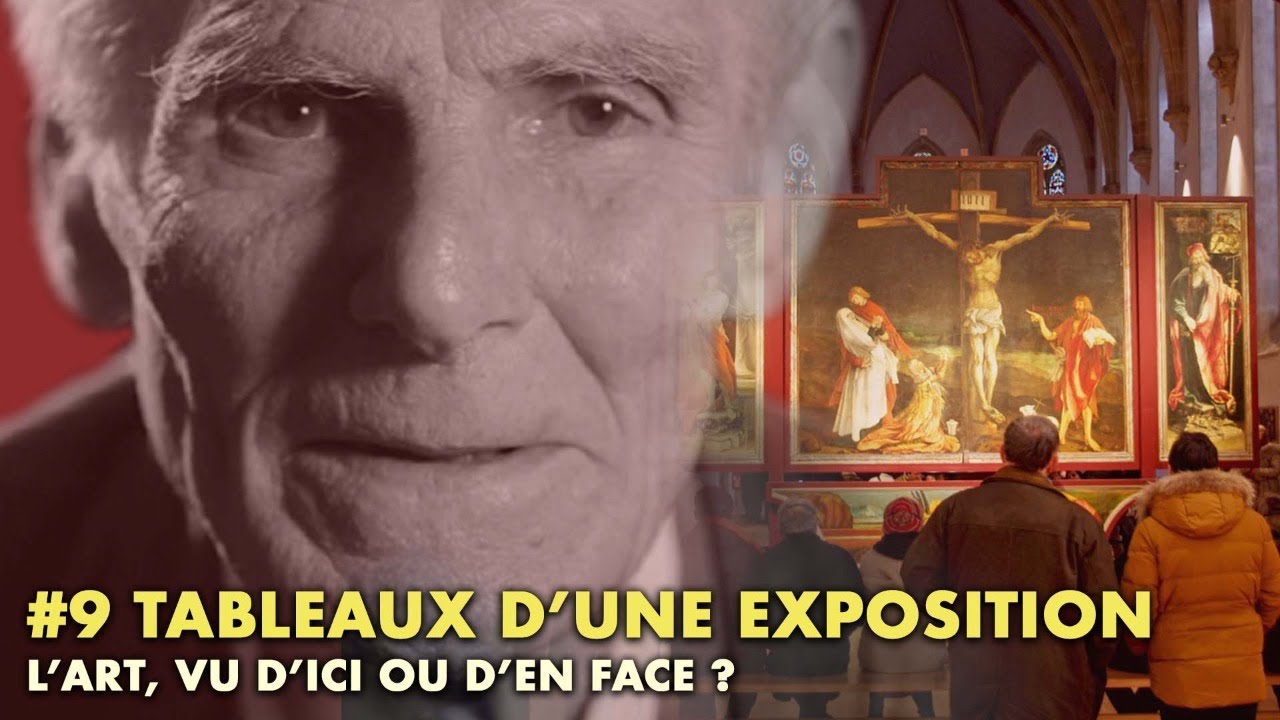
English translation of the French transcript, made with AI and not yet proofread — click a paragraph to jump to it. Show the French original
Opening credits: Hegel did not announce the end of art 0:13 Hegel never said that there would be no more art after him. On the contrary, he says that art will keep on perfecting and evolving itself. What is finished for him is the fact that it represents the absolute, as it did for previous generations. What is Egyptian art for us? It's the pyramid, it's the sphinx, isn't it? Ancient Egypt, of course. That is to say the way it represented the sacred, the gods and death. There is a fusion of art and religion.
0:43 What is Greek art? It's the Parthenon, it's a temple. It's the statue, the wonders of the world, it's the statue of Diana at Ephesus. So I mean, in every era, I'm thinking of Fra Angelico, jumping across centuries, who painted the Virgin and the Saints kneeling, knees together, out of devotion. I can't stand up while painting the Virgin, that's not possible.
1:16 It is this relation of art as the absolute and the sacred which for him has disappeared. The sacred no longer has that presence it had for the artists of the age when art was advancing toward its own revelation, but it has passed, as I said, into our representation. It is a fall in relation to the real.
1:49 What is represented has less ontological support than what is present. But on the other hand, as we'll see later, this is progress for Hegel, it's not reductive at all. We are museum visitors, we moderns. Look, look!
2:27 An African woman, a painting by Cranach, here a medieval golden rose, an African statuette. I'm indulging myself, it's an impersonal game, I am the citizen, the modern bourgeois, having the artistic representations of every era and every place parade before me. But that never existed! The Ancien Régime looks at Racine, and when he has his Greeks speak, he makes them speak like people of Versailles.
3:01 "Suffer, madam, that I may admire it, without limit." But that's not how the Greeks spoke.
Mussorgsky's Pictures at an Exhibition 4:14 Good evening everyone. Delighted not only to see you again, as usual, but more than ever, but also to pick up the continuity of our serial on femininity and community, even though I won't dwell on it again today, but it's to illustrate the title, the relation of aesthetics to politics in the system, of art to the city.
4:45 It could be varied in many ways. But first, let me comment a bit on this introductory video. I thank Pierre-Alain for making an editing job that wasn't obvious, between the piano interventions, but it's admirably done. He even manages to make the dramatization of the discourse coincide with the dramatization of the piece.
5:15 I don't know. Yes, because it's precisely a matter of connecting with this dialectic of the interior and the exterior that we're going to talk about tonight, it's a third way of putting it, I'm deliberately multiplying the different ways of posing a problem. Because there are some who say, oh my, now, a moment ago it was art and the city, now it's the interior and the exterior. It's deliberate, so that you associate clusters of opposition while reassuring yourselves.
5:50 There isn't a multiplication of problems. It's the same problem. It's a bit like an object that would have several facets, more than a cube for example, and that you can set down on any of its faces, it's always the same object, isn't it? And so I chose this piece by Mussorgsky, I don't know if that means anything very precise or very clever, but often the Russians themselves say that he's one of the most Russian of Russian musicians, as they also say about Gogol, isn't that so?
6:29 He's one of the most Russian of their writers. And he has a rough-hewn, raw side to him. Mussorgsky. I'm still commenting on what we just heard, after having specified the connection it has with our problem, Pictures at an Exhibition. I was finishing, in the credits, Pierre-Alain did well to include the moment when I say we are museum visitors, we moderns, our relation to art is mediated by a relation to representation.
7:06 A representation which apparently doesn't have the same ontological density, at first glance, that the divine presence had, of the divine or of God, depending on whether it's antiquity or Christianity, for the artists of the Old World. The Old World is a geographical notion. I don't know if it's tied to the discovery of America, but I'm playing on the historical Old World, that is, the Ancien Régime, isn't it?
7:36 That runs from prehistory up to the French Revolution, not included. Up to modernity, not included. So this piece, Pictures at an Exhibition, called that because there's a narrative behind it, is a series of very different, very varied pieces written for piano, but which Ravel, our Ravel, the French composer, with his marvelous sense of orchestration, which is what brings him close to the Russians—the Russians, it's often said, are the masters of orchestration, of orchestral color.
8:18 but Ravel adapted this piece for orchestra. I recommend that when you discover the piece, you first listen to the original piano version—there's a raw quality, or the primitive side of Mussorgsky, in the best sense of the term, which is expressed more clearly there than in the somewhat—not smoothed over, because Ravel is an immense musician, but in the somewhat more—well, there's a Cossack or muzhik quality in the piano version that translates poorly to the orchestra.
8:55 So I'd like us to listen to it, instead of being distracted by the pianist's bare feet. Yes, no, I'm sure some of you noticed furtively that the pianist is Alice Sara Ott, O-T-T, who has a German father and a Japanese mother, and who has this habit of walking to the piano in concert barefoot.
9:25 She likes to touch the pedals barefoot, maybe to feel them. There's another pianist, Friedrich Gulda, a great pianist, one of the rare ones who masters the jazz repertoire as well as the classical one, which is quite rare among classical pianists. An Austrian, Friedrich Gulda, who says he can only play Mozart at home if he's completely naked. Yes, let's not dwell on it, these are quirks. There you have it, there's the barefoot countess in cinema and there's the barefoot pianist you just saw. So, there are several pieces with a leitmotif that recurs, isn't there?
10:01 Which is called the Promenade because it's the leitmotif, one might say in Wagnerian terms, of the wanderer going from one picture to another. Afterward, at each picture, everything changes completely, of course. And it culminates at the end in that fantastic piece, very difficult to play, as is often the case with the Russian piano repertoire, called "The Great Gate of Kiev." And yes, I didn't do it on purpose, it's topical.
Recalling the problem: family against city 10:35 "The Great Gate of Kiev," emblematic of Russian music. So, why is it through this route that I come back to the serial on the book I wrote some years ago? Because we finished the introduction that centered on the figure of Antigone—that doesn't mean we've stopped talking about Antigone, but we've stopped, in an essay, one learns, the philosophy student learns, that an essay must close once a problem has been posed, and not merely a question, I recall that "What time is it?"
11:16 is a question, it's not a problem. A problem, I recall, is a question to which one cannot answer immediately, with a yes or a no. In the end, one does end up answering, one must commit, but one cannot answer immediately without taking a detour—through what? Through the essay itself, that is, after the introduction, the parts begin, don't they, to unfold. The problem that was posed, let me recall it by reading two pages that you won't see on screen, because they're two pages we've already seen—I might not say this well, since there are new arrivals too—two pages where I summarize the problem at the end of the introduction, right?
11:57 The introduction that was titled "the supreme ethical opposition." Let me recall that this title, the supreme ethical opposition, is how Hegel characterizes the opposition between the family and the state, at the center of which stands Antigone. So, not the opposition, as the anachronistic and modernizing distortions would have it—modernizing doesn't mean modern, far from it, it's precisely to defend modernity that I denounce the modernizing—those who want to see in Antigone, under I don't know what anti-totalitarian tisane, the heroic person who defends the rights of the individual against a totalitarian city.
12:45 No. Hegel recalls the text. The text is a community opposed to a community—one community, I won't go back over it, we've seen it, closer, which has a necessary bond to nature, the community of blood, the family, the whole group in which flows, wholly or partly, the same blood—against a broader community, the city, which is far less bound to the natural tie.
13:17 The bond of citizenship is not as natural as the bond from father to son or brother to sister. Which is what's at stake in Antigone, from sister to brother even more precisely. So there you have it, I recall that this is the opposition of which Hegel had said, rather mysteriously, well at first, when one doesn't develop these concepts of family and city, when one takes them in our immediate representations—why does he call it the supreme ethical opposition?
13:50 As if there weren't perhaps even more—it is the most highly tragic, he adds. This is in the Elements of the Philosophy of Right, his political testament, where he characterizes thus the opposition of the family community to the political community, to the city. I repeat: the supreme ethical opposition is the most highly tragic. One gets the impression of saying, aren't there more tragic problems than this opposition?
14:22 So, let me recall now that, through the family, another determination than the one proper to the unforgettable figure of Antigone—about whom there is nothing negative to say, except from Creon's point of view, the Greek point of view, for whom, and this held true for everyone, the ethos of the time, the Greek ethos, rising up against the law of the city is a hubris, a crime that must be expiated, of course. But we, we moderns, see rather her sublime side, the heroism of her uprising, all the more perilous since she knows she risks her life while still very young and not yet having known the marriage bed, as she says, that she will enter the tomb before even marrying.
15:15 You see, the one who defends the family is the one who will never have had the chance to found a household. That's the dialectic. And so there's nothing to say against this figure, but on the other hand, the community she defends is not free of everything, it has its shadows. This concerns the family, it has even more shadow than light. It is in public light that the laws are drawn up, on the agora, on the Pnyx, in the public square.
15:47 But within the walls of the house, things happen, don't they? So, and above all, here's where I'm getting to now, we've seen that one determination is that the family is the world of the private in relation to the city, which is the world of the public. And you see, today, a few weeks before the presidential election, the opposition between public and private carries connotations. No, I'm not drawing an amalgam, we're right in the heart of the problem. For Hegel says very precisely, I quoted you earlier so I'll go quickly now, when analyzing the tragic conflict in Sophocles, that the family is the place of acquisition and enjoyment for ends that are at first instance singular—I quote word for word—the opposite of the general will and the interests of the city, such as defending it against the Persian attack, for example.
16:38 Or else there, all the particularities of one and another, of individuals, of families, must disappear, and all be united before the enemy. So, and it's because of this ambivalence of the city, which is at times the moment of piety, of the cult owed to the dead, and especially on the women's side—I had put in the credits a magnificent excerpt from Eisenstein's film Alexander Nevsky, where we see the women after the battle against the Teutons, against the Teutonic knights, isn't that so, we see the Russian women on the battlefield searching for the corpse of their brother, their son, their husband, their father, and the women go to wash the bodies of the dead.
17:29 There you have it, it's all the more illegitimate that Creon forbids a sister from tending to her brother's corpse. I recall all this. So, we arrived at this ambiguity, this is where our introduction ends—there is an ambiguity that risks running counter to what is universal in artistic representation. So, let me read, if you like, the end of the introduction where we had arrived.
Engulfment in natural being-there 18:01 at Antigone's stage, subjectivity does not yet decide between a natural destiny, the family above all, and a spiritual destiny. Classical art culminates—classical art, tragedy, in this case Sophocles, Aeschylus, Euripides later—classical art culminates in this opposition without resolving it. Creon's repressive decision, who here represents the city, expresses the maintenance of the ethical order, the ethical order that was instituted by the law of the city.
18:39 But this happens within the representation, in the theater, so between us, within illusion. It is the ethical order that collapses—sorry—in reality it is rather the opposite that triumphs. It is the ethical order that collapses, it is the Greek city that collapses, I'll tell you right away, before the arrival of the Empire, first with Macedon, Philip of Macedon, his son Alexander of course, and then the Romans who will take over. That's another tragedy.
19:10 So in reality, it is rather the opposite that triumphs, it is the ethical order, the city, that collapses, and the individuality of the person—the person of Roman law—that replaces the ideal of the citizen. The person of the citizen is not the same thing. The person of Roman law is equal—there will always be some mediation, something intermediate, between the citizen of the Greek city and the Christian person. It's interesting. It is the ethical order that collapses and the individuality of the person that replaces the ideal of the citizen.
19:41 It is the Roman world or the Christian unhappy consciousness that results from the tragic conflict beyond the dramatist's exorcism. So now, here is what sums up the introduction, which we're going to finish with. A short page. The conflict between Antigone and Creon is thus not only still current. We haven't finished with the private in our own day. What do you think? The conflict between Antigone and Creon is thus not only still current in Hegel's time.
20:12 It is more so than ever for us. The historical content of this modern unhappiness alone is capable of grounding this recurring timelessness of the tragic conflict—to recall that we had posed the problem. How is it that Hegel, who usually relativizes every artistic figure a bit in relation to the world it corresponds to, to the historical or even geographical situation, or both, that it corresponds to, makes an exception, an incredible exception, for this tragedy of Antigone, saying that it holds for all the arts and in all times and for all eras?
20:48 And now, we just saw it. We'll see why the relation to the private, to private interest, to immediate interest, has something perilously unhistorical about it. That's it, I'm telling you in advance so it's clear. The historical content of this modern unhappiness alone is capable of grounding this recurring timelessness of the tragic conflict. Insofar as, at the threshold of its absolute spiritualization, the last danger threatening spirit is, I quote Hegel, being engulfed in natural existence.
21:22 The one who enjoys singular ends, libertarian ones, that's being engulfed in natural existence. Let me open a parenthesis—it's no accident, it's in Don Giovanni, I don't mean Don Giovanni by Molière, it's Mozart's setting to music of Molière's Don Juan, but in Mozart's Don Giovanni, the final scene which he borrows from Molière, that final scene where there's lightning outside, the storm, and where Don Giovanni sits all alone at his table, having alienated the whole world through his crimes, and he's only with his servant, there's nothing left but master and slave there, a servant who's almost terrified before the ferocious appetite—you see, engulfment in natural existence, yes, one must always be literal to understand the most profound passages, and the statements heaviest with meaning, the opposite of being abstract—he says at one point, as the other is devouring almost an entire chicken, Leporello remarks that he has an ogre's appetite, isn't that so, he's terrifying, just before the Commendatore knocks at the door and the final scene begins, so there, the last danger
22:33 threatening spirit is engulfment in natural existence—it becomes clear that for him, the philosopher Hegel, who from his youth at the time of Jena had known how to discern the actual bond in which such an engulfment operates, the supreme imperative must be of a political order. That's where we've arrived: what, at the time of the decline of the ethical order, was still limited in Greek times to a few systems in the process of isolating themselves—I quote Hegel—as soon as there's peace, as soon as each person tends to his own business, the general interest, the general will, to speak like Rousseau, gets a bit forgotten—so what was still limited to a few systems in the process of isolating themselves has become, with the unassignable, limitless power of the machine in the modern age—you see why I always associate modernity with the French political revolution, preceded by the English industrial revolution, and the conjunction of the two which gives rise to the world in which you, we, live.
The machine, wild beast, and the Kantian retreat toward morality 23:33 So, I repeat, it becomes clear that for the philosopher who, from the time of Jena, had known—I'm thinking of what he says about the tool, I'll quote it, we'll come back to it anyway—had known, from the time of Jena, how to discern the actual bond in which such an engulfment in natural existence operates—understood, the supreme imperative, what it is urgent to institute, must be of a political order—what, at the decline of the ethical order, was still limited to a few systems in the process of isolating themselves, has become, with the unassignable limitless power of the machine, which is what fascinates Hegel, before it fascinates Marx, a wild beast—that's the expression, yes, it would be Hegel's, to designate what happens in civil society when there is no general will to regulate it, even to tame it as he says, with severity—I quote word for word what Hegel says, in the Jena philosophy of spirit.
24:27 So, he sees in the unassignable limitless power of the machine a wild beast—that's what inspired our friend Michel Clouscard, isn't it, the title of his book—and just as little as nature bends to the categorical imperative, to Kantian morality, just as little is Kantian morality capable of ensuring the taming that Hegel demands with regard to the monster; one must leave morality behind to move onto political ground. I'm saying this for those it interests, I know there are a few who are starting to see where my interventions are heading—forgive me—by insisting here on what is supposed to be, a bit, the unity of my discourse, apparently disjointed at times, or often, but well, the more elements I attach to it, the more, I presume, some, I can see in the comments, are beginning to grasp the coherence.
25:19 What I mean by that is that in the... to those, to those who notice it, I add this piece of information which should confirm what they've understood, namely that one of the criticisms Hegel makes of Kant, beyond the admiration he has for him, doubtless the most illustrious of his predecessors in his eyes. I recall that when a student came to see Hegel saying, "I understand nothing, philosophy, everything gets muddled," Hegel would say, "Start again from Kant's Critique of Judgment, Kant's last great critique."
25:56 You see? Well, but one of the things he criticizes him for, aside also from the specter of the thing-in-itself, but that's another problem, even if there's a somewhat distant connection, is the fact of having transposed a problem that Rousseau had had the merit of finally bringing forth, after centuries of metaphysics, onto the political plane, back into a regression toward interiority. You see how we arrive at our problem for tonight, the interior and the exterior.
26:28 Making it regress toward moral interiority, from political exteriority to moral interiority. From the social contract to the critique of practical reason, there is a return from the political to the moral, from the objective to the subjective. I say this for those who are starting to see quite a few things. There. But I'm sure it will confirm what they've understood and make them want to go further.
26:59 So, and just as little as nature bends itself to the categorical imperative, just as little is Kantian morality capable of taming this civil society, this anarchy of the market, right? Is it capable of ensuring the taming Hegel demands with regard to the monster? The wild beast, that is, the monster. If the philosopher, from the Frankfurt period, this is the period when he had his depression, says in a letter, it was there that I, in unhappy Frankfurt, reached the nocturnal point of contradiction.
27:31 If the philosopher, from the Frankfurt period, by taking an interest in Steuart's principle of economy, the first, before Marx, the first philosopher who suddenly discovers this new discipline, entirely new, coming from England, the country that was the avant-garde of the era, right? And if the philosopher, from the Frankfurt period, taking an interest — Frankfurt is just before Jena, in the years 1801, 2, 3 — if the philosopher, from the Frankfurt period, by taking an interest in Steuart's principle of economy, or in the works of Adam Smith, thereby discovers the implacable machinery underlying the romantic unhappiness of his contemporaries — it had to be done, to see that behind it, it's not the misfortune proclaimed by the romantic poet, there is the English machinery behind German romanticism.
28:20 So, the break officially marked by the preface to the Phenomenology, Hegel's great break with his youthful romanticism, the one who saw the absolute in art, not in politics but in aesthetics, you see, our subject here. So, the break officially marked by the preface to the Phenomenology no longer appears as a discontinuity, as a break only with his youth, but rather as consistent with the meaning that emerges from such an experience.
28:50 And no doubt it is not by chance that it is in unhappy Frankfurt — that's how he names Frankfurt, where he went through his hell, so to speak, if it was his season in hell in Rimbaudian terms, his descent into hell in theological terms, however you like — it is not by chance that it is in unhappy Frankfurt that he finally reaches the bottom of his descent into hell. We can now venture a provisional conclusion, you see, to this introduction, to this moment of the tragedy centered on the figure of Antigone.
Art and the state, two means of the same end 29:24 In search — and here I'm summarizing our whole introduction, and we're going to arrive at an exteriority-interiority relation — in search of the hierarchy that governs the relation of aesthetics to politics in Hegelianism, is art more important, or is it politics? We had formulated the hypothesis that its variability — absolute aestheticism in the young Hegel, quasi-absolute politicization of consciousness in the Berlin Hegel — we had formulated the hypothesis that its variability, far from depending on psychological contingency, should rather be understood according to a syllogism — two extremes, a middle term — allowing us to necessarily connect these two extremes, namely the absolute aestheticism of Romanticism and the rationalism of the Berlin period.
30:10 This hypothesis — so for now I have two extremes, I don't yet have a complete syllogism — this hypothesis requires, as to its confirmation, the determination of a middle term, which we sought precisely on the side of what does not vary, from Tübingen, his youth, his studies, to Berlin, where he will die, right? Namely, what doesn't vary? The reference to the figure of Antigone in the tragic conflict. This latter, finally, the tragic conflict, or at least its analysis as set out in the Phenomenology of Spirit more than in the Lectures on Aesthetics — the Phenomenology, the mediating work par excellence, which we are seeking as a middle term — has revealed to us what gives an effective content to the supreme ethical opposition.
30:57 We understand the word better now. Why is it the most highly tragic? And it needs to be spelled out. And it has at the same time provided us with what can ground the possession of meaning that the philosopher seems to claim in the works following the experience of this split. Because afterward, after the Phenomenology, he will write the Logic, the Lectures on Aesthetics, the Philosophy of Right, the Philosophy of Religion, right, which are more synthetic, right, than the Phenomenology, which is a study that has somewhat the progression of consciousness, which is the becoming of the false, as we say elsewhere, right — this latter, then, the tragic conflict, or at least its analysis as set out in the Phenomenology of Spirit, has revealed to us what gives an effective content to the supreme ethical opposition, and has at the same time provided us with what can ground the possession of meaning that the philosopher seems to claim in his works following the experience of this split.
31:57 Two points: it's a matter of struggling — that is the imperative Hegel has, starting from unhappy Frankfurt, now that he has understood the link between the family, sensibility, mere feeling not yet raised to the concept, and private interests, including in their economic and social dimension — it's a matter of struggling against everything that could, I quote Hegel, let the whole disintegrate and the spirit evaporate, spirit as opposed to nature, that is, each for himself. As a middle term, this imperative, right, to struggle against everything that could let the whole disintegrate and the spirit evaporate, as a middle term this supreme spiritual imperative will in turn allow us to better regulate the hierarchy that governs the relation of aesthetics to politics in the system.
32:49 According to an apparent movement — I'm borrowing from astronomy the distinction of apparent movement, the sun that turns around us, that seems to travel across the sky or the starry vault of the sky, to speak like Kant, right, where all the stars except the fixed ones seem to turn around the Earth. As for the middle term — sorry, according to an apparent movement, this hierarchy between aesthetics and politics, as we have seen, seems to vary since it first benefits art in youth, then the State.
33:22 We can now restore the real movement, now that we have this mediation, by making art and the State the two successive means — first making use of art, then afterward making use of the general will — the two successive means of one and the same supreme end, which, in the last instance, as freedom, always has a political bearing. To preserve the community against the atomism of singularity — that's typical of capitalism, atomism and the singularity of force, force being the natural law par excellence — and of fortune, the contingency of force and fortune, because force is not only muscular force, we already saw with Plato that force is sometimes the strongest, but especially the cleverest, or the strongest in spirit.
34:16 So, the singularity of force and fortune — in this respect, the difference between art and the state lies in this. Whereas, up to a certain point, it is art that brings — you see, this is where we get to the process of interiorization — whereas up to a certain point it is art that brings the spirit back to itself, and I'll leave a phrase aside to see what we'll look at this evening, namely divine service in the glory of truth.
34:49 As Isis does for the disjointed limbs of the dismembered Osiris in Egyptian mythology — you know that Osiris's body is martyred; some have seen in it a prefiguration of Christ, but let's leave religious syncretism aside for now. So, Osiris's body is broken into fourteen, twice seven pieces, which fall into the Nile, that is, into the water — it's Isis, the Nile — into the water which gathers them, a bit like Moses was saved from the waters by Pharaoh's daughter, indeed, by the pharaonic princess; there are continuities.
35:24 The mother, the mother supports the child in distress, the wailing infant, the newborn. We've already seen this with Nerval, I won't dwell on it, we'll come back to it. The eminent role attributed to the State — sorry, divine service in the glory of truth, as Isis does for the disjointed limbs of dismembered Osiris — only the State, beyond this point, is capable of ensuring the security of this odyssey which goes from the particular toward the universal, from the exterior toward the interior, because unlike art, it is not unbeknownst to itself that the general will subscribes to this supreme imperative.
36:04 This seems a bit difficult and abstract, but you understand that art does this unconsciously — it's not the artist's aim, right, to ensure political freedom. The artist has other fish to fry, to make something beautiful, or that expresses the sacred, without knowing that this sacred, right, expresses a political interest. For example, even in the most primitive totemic religions — whether they're primitive in chronological terms is not a value judgment, right, on the contrary — religions in which we often find a magnificent art, I'm thinking of African mask art for example, especially since it involves the whole person, not just the face but the entire body down to the feet, with rattles on the ankles — in primitive things, the totem is the instance where suddenly all the families, all the individuals recognize their common ancestor, which is what unites them.
37:04 This is where the community becomes universal again. So, but it is unbeknownst to itself that art does the same thing, whereas when it's politics — post-revolutionary, understood, right — Hegel often says that what is incredible about the French Revolution is that for the first time, humanity walked on its head, that is, it is the citizen's political decisions that suddenly order the city. There's no longer the whim of an individual saying 'for such is my good pleasure.'
37:38 There is a logic to all this. The eminent role attributed to the State no longer appears in contradiction with the aestheticism of the beginning once we determine the exact measure by which art can, up to a certain point, accomplish what reason achieves through it. Without art suspecting it, of course. Insofar as it leads consciousness to its political truth, art constitutes, I quote Hegel, a divine service in the glory of truth.
38:08 I often repeat this against those who think Hegel assigns art a secondary role. It's not because he doesn't entrust it with the mission of embodying the absolute that he gives it a secondary role. It is divine service in the glory of truth. But from the moment aesthetic consciousness, on the threshold of its absolute politicization, you see, in the course of its journey, persists in representation and subjectivity, it draws the philosopher's wrath.
38:40 Art thus appears in Hegel as a phenomenology of spirit, since the Phenomenology is also the history of consciousness watching its certainties collapse one by one and thereby gradually drawing closer to its truth. At the expense of its certainties. Which presupposes a certain unhappiness at a given moment. It is this unhappiness that it recoils from, and that makes it persist in its particularity and subjectivity. We already saw this, we illustrated it with Nerval's dreams for example.
39:10 Art thus appears in Hegel as a phenomenology of spirit that would dread its end in the very measure that it draws near it. Remember when we did memory and anamnesis, I said it's perhaps not in consciousness's interest to go all the way through its memories, to have unlimited access to the past. The same force that pushes us to try to remember runs up against another force that locks memory away somewhere.
39:42 I had used as an example, among others, in the history of cinema — I know there are excellent film buffs here, more knowledgeable than me on this chapter, by the way. I love cinema a lot, but I don't have the systematicity and culture that some do. So I'm thinking of Suddenly, Last Summer by Mankiewicz, that extraordinary film with a very young Liz Taylor and Montgomery Clift, and especially Katharine Hepburn who gives an incredible performance, in which poor Liz Taylor, pressed by the doctor to try to remember the circumstances of her cousin's death which she witnessed on that island during the vacation, etc.
40:30 Every time she gets close to it, she suddenly breaks into a cold sweat, an anguish, and it ends in tears. Watch the film to find out how it resolves. Art thus appears in Hegel as a phenomenology of spirit that would dread its end in the very measure that it draws near it. In both cases, then, it is indeed in the name of politics that aesthetics distributes meaning. We must therefore now traverse this moment in the history of art during which the latter brings singular consciousness back to the universal.
41:05 This is what's called the ascending phase of art, up to the point from which we started, that of the tragic conflict, which is the crowning achievement of art in Hegel — so it's not the starting point, it's its crowning achievement, that of the tragic conflict — but in such a way that the passage from aesthetics to politics that it signifies is no longer only for us, or in itself — that's an expression Hegel uses in the Phenomenology — for us, phenomenologist readers, for us at the cinema, sitting in the theater, watching Charlie Chaplin open a door without seeing there's a bucket of water on top of it about to fall on him, which makes us laugh — for us, or in itself, there is a bucket, but not for Chaplin; consciousness doesn't know what's happening to it, it isn't yet at absolute knowledge, it's for us — we must therefore now traverse this moment in the history of art during which the latter brings singular consciousness back to the universal, up to the point from which we started, that of the tragic conflict, but in such a way that the passage from aesthetics to politics that it signifies, the tragic conflict, is no longer only for us, or in itself, but also for consciousness itself, so that it may pronounce it
42:16 itself, the way a psychoanalyst asks his patient — I'm using words everyone understands — asks his patient and demands that he formulate what up until now he had repressed and absolutely did not want formulated, right? This is even one of the reasons Freud very quickly abandoned the hypnosis method he had initially borrowed from the work of Charcot and his colleague Breuer, right, because precisely — it was spectacular — thanks to hypnosis there were supposedly paralyzed patients, thought to have a physiological problem, and then suddenly, 'rise and walk,' right, who, in the course of the recollection of a trauma under hypnosis, regained the use of their legs, and these were the famous sessions everyone came to see in Paris at the Pitié-Salpêtrière, at Professor Charcot's sessions — people couldn't believe it, not once but several times. Only the drawback with hypnosis — you'll see the connection that lets us pick up and continue —
43:26 is that upon waking, the patient no longer remembers anything, whereas what analysis wants is for it to become an acquisition, a piece of knowledge, and no longer something that depends on various altered states, for consciousness itself. There. So from there, I'm going to ask Pierre-Alain to present the text that follows in my little book, so we've finished the introduction, that is, the supreme ethical opposition and the figure of Antigone, and we move on to the history of art, to get quickly to divine service in the glory of truth. So I'll begin by reading — there are two pages — according to the famous schema of aesthetics, art can only be divinized during its ascending phase, so — and he's not even against the divinization of art, provided it's during its ascending phase — that's what we need to look at more closely, what exactly does that mean, namely the phase that starts from symbolism and ends in classicism — this makes us review all that, it's a work
Symbolism, classicism, romanticism 44:38 on aesthetics, in passing, on Hegel's Lectures on Aesthetics and their relation to his political work. Now in the Aesthetics, Hegel distinguishes three, three great moments — it's better than 'part,' 'part' makes you think of divisions in a space, the different parts of a house, the living room, the entrance, the room, the bedroom, the attic, the cellar — here it's a matter of moments in time, and yes, I always insist on this difference, which carries far more weight than one imagines, and which some of you have already grasped very well, how do you say, captured this movement — it can thus be defined — yes, sorry — this history, then, of art, for Hegel unfolds according to three moments which he names as follows: symbolism, classicism, romanticism. Symbolism is what characterizes the art of the oriental civilizations — I beg you to understand this properly, not among the Zemmours and others
45:48 in the historical sense and not the geographical sense, right — it concerns the oriental empires with which human history began. Human history did not begin in the smoky huts of the barbarians we were, when the great urban civilizations had already appeared on the banks of the Indus — I'm thinking of Mohenjo-daro, others have been found on the banks of the Yangtze — and of course on the Nile, the Euphrates, the Tigris, right — so this is that historical Orient — I recall there are, in Iraq, in Iran, right, so in the East, I'll say, nuclear engineers who are far more skilled than I am in that field, right — okay, anyway, so — now symbolism, I'll sum up very quickly what characterizes it, very quickly because we'll go into detail afterward — in fact these are three stages in the relation between content and form; in the first phase, symbolism, the absolute content
46:59 art, that is the absolute, that is the divine, seeks its form and, since it cannot find it, does violence to matter, right, into matter, and that's what produces the proliferation — it's the same thing — the quasi-infinite proliferation, in any case indefinite, for example, of Hindu sculpture where there's practically a deity every cubic centimeter, right, or Chinese painting, or gigantism, right — that's another way of doing violence to matter — Egyptian gigantism, the proliferation of the divine in Hindu or Far Eastern art, because the content seeks its form and never finds it quite adequate, and so it's very mobile and multiple. I'll move on to classicism, which is the Greek world — let's keep spinning the astronomical metaphors — the Orient is where the sun rises, the second moment, classicism, is where it reaches noon, that's classicism, right — I'm acting as though it stopped suddenly, it doesn't stop, the sun, right
48:09 but it's no longer in the East, and not yet in the West, and here I cannot help but quote a great classic, I'm thinking of La Bruyère, who speaks of art in the Characters at a certain point, and who says this: there is in art a point of perfection, as there is of goodness or maturity in nature — think of a fig, the ideal moment to pick it from the tree to eat it — there is in art a point of perfection, as of goodness or maturity in nature; whoever senses it has perfect taste; whoever senses something short of it or beyond it has defective taste — it's complicated because there's a point — so, I'll continue with La Bruyère — there is thus good and bad taste, and there are grounds for disputing tastes — that, to remind you of this Greek moment; it's brief, but it's the moment of noon when the shadow is shortest
49:19 right, to the point that sometimes it even disappears, right — so, and then there the content finds its form, the form of man; Greek sculpture is no longer an animal head, it's not the jackal, the Anubis — these aren't aesthetic value judgments, that's different, a beautiful Egyptian sculpture is better than a failed Greek one, but what matters is the stakes, you see, what is suddenly represented — the Apollo Belvedere, I'm exaggerating a bit, that's the Greek statue, it's no longer gigantic first of all, it's a man the same size as you or me, right, but what makes it not quite like you or me requires yet a third stage beyond the moment when content finally finds its form, that of man: there is the third moment where content realizes that no form can contain its infinity, and so where suddenly art surpasses the balance of content and form, because what is still missing
50:29 in the Greek world is the deepening of the negative, of evil, of suffering — there is a serenity, yes, that's what makes its quality, but that's also what makes its lack, in a way. Man, in his journey — when I say man, each individual, let's say — as Aragon says, nothing is ever certain for man, neither his strength nor his weakness nor his heart, and when he thinks to open his arms, his shadow is that of a cross, and when he wants to embrace his happiness, he crushes it, his life is a strange and painful divorce — one can say this of an individual, one can say it of a people, one can say it of human history, of which it is said in the Bible that it is a vale of tears, right — so this suffering, what I call the negative, cannot recognize itself in that serenity; it's no accident that it later recognized itself, for centuries and even millennia, in the symbol of an individual writhing in suffering on a cross — and that is the passage from the Greek citizen to the Christian person; we saw earlier that the juridical person of Roman law serves as an intermediary
51:39 there, I'll stick to art, so I won't dwell too much — now, it should be noted that this phase is the one that leads from oriental despotism — politically, we've so far seen an aesthetic division, right, symbolism, where the artist goes through all the symbols allowing the content to believe it has found its form, moving each time to another, a proliferation, there — then the classical Greek moment, content finds its form, it's the moment of the city and of a seed of democracy.
52:20 It should be noted that this phase, the one leading from the oriental system to the Greek city, this movement can thus be defined as a denaturalization of consciousness. It's no accident that in Greek statuary there is no longer, I repeat, the jackal head of Horus — sorry, of Anubis, the falcon head of Horus — or the reverse, a man's head on a lion's body, the sphinx — with the spirit seeking to free itself from its naturalness and its origins, it's magnificent.
52:53 That's also what is said, right? And besides, the figure of the sphinx, the now-Greek sphinx, the one in question in the tragedy of Oedipus, inspired by the Egyptian sphinx, who poses riddles, for the sphinx is the very figure of the riddle. Hegel says in the Aesthetics that among the Egyptians, the sphinx is the symbol of the symbol. It is the riddle par excellence. Let's not forget the riddle it poses: what animal walks on four legs in the morning, two legs at noon, and three legs in the evening? And of course we know the answer.
53:24 It's man, who crawls on four legs as a baby in the morning, not yet able to walk on his legs, man in his prime at noon — we find the same astronomical metaphor again — and in old age, leaning on a cane or a staff, on three legs in the evening. And by giving man as the answer, Oedipus kills the sphinx. That's the end of oriental antiquity. The riddle of the sphinx is man. My answer, right? So there is a political stake behind the aesthetic one.
53:58 And that's why I speak of a denaturalization of consciousness. Greek sculpture — the eagle is one of Zeus's attributes, it's still an animal presence. But the eagle, in Greek sculpture, is beside Zeus, down at his feet. It doesn't emerge from his body. Or his body doesn't emerge from the eagle's body. So, this movement can thus be defined — I'm looking at the text — as a denaturalization of consciousness, or what amounts to the same thing, as its politicization — not in the politician's sense, but in the sense where polis means the city.
Christianity, the unrepresentable, and final irony 54:35 Before basing such an interpretation — I say this first so it's clear — on the philosopher's own text, so that it will no longer just be an interpretation, let us recall beforehand that afterward, subsequent to the Greek city, the third moment, and from its decline onward, aesthetic representation and politicization can no longer sail together, insofar as the moment of Christianity, which is also that of the person, and no longer merely of the citizen, leads, you see, to the return of exteriority and interiority.
55:09 For the citizen, what matters is still the exterior — I meet the other there to vote, on the Pnyx, the Agora; in the person, there is a whole interior world in addition, right? As in the Gothic cathedral, the essential thing, even though it's magnificent on the outside — the gargoyles, whatever you like — is inside, where there's the rose window, the stained glass, and especially the most sacred places, the tabernacle, the Stations of the Cross, etc. And that's where the service takes place.
55:40 Not sailing together, art and politics, insofar as the moment of Christianity, which is also that of the person, leads to this concept of spirit — according to Hegel, God is spirit and wants to be worshipped in spirit. That's not Hegel, Hegel is quoting the Gospel here — God is spirit, we see he has kept the memory of his youthful theological studies — and wants you to worship him in spirit, meaning, and not in tin, in zinc, in wood — there, he can no longer be represented. And you'll notice that the Muslim religion, Islam, which also claims the Book, that is, transcendence — we know these are the religions of the Book, since we share the reference to Abraham — Abraham, Ibrahim, as they say in sub-Saharan Africa, Abraham, Mary, Mariam, Myriam, Mariamma, there are variations — Issa, for Jesus, right?
56:35 There are references we share, except that Jesus is not God incarnate, he's a prophet, right? In Islam there are also differences, at least noticeable ones. So, what's interesting here is to see that what they have in common — the Jewish religion, the Old Testament, the Christian religion, the New Testament, and Islam, which is the third to claim the Book — is that they share, right, the desire to represent the unrepresentable, to the point that Islam is quite consistent on this level, saying not to represent any living being at all, since that would be to strip it of what gives it a soul.
57:17 That's what gave us abstract art, that is to say Arabic writing, the arabesque. It's all quite coherent, isn't it? The sense of decoration, all that, and not figures, as in art—I don't know—in animism of course, it's the human figure, even with a deformation, as you like, or animal, or a mixture of the two, in Buddhist art, isn't it? It teems with anthropomorphic divinities, more or less, or monstrous ones.
57:49 So, God is spirit, and wants to be worshipped in spirit, and not in sheet metal, wood, or zinc. No sensible representation, that is, one that puts us in relation with the external world—we're coming more and more to this—can any longer be adequate to this ultimate enrichment of the idea. The idea isn't especially sensible, especially with a capital I, it's the intelligible, we've learned since Plato. This ultimate enrichment of the idea, and Romanticism thus appears as the sublime misfortune of art, in its final exasperation, subjective irony, Hegel, because there's a great movement to want to grant irony the supreme moment of art at the end of German Romanticism.
58:33 Hegel noticed that humor, irony, the Witz in German, wit in English—not W-I-T-Z, ennobling the Witz—irony always characterizes a final phase of an artistic period. Aristophanes's comedy closes the Greek tragic movement. Aristophanes's laughter resounds over the ruins of the city, the ruins brought by the Macedonian and thus imperial conquest of the city, for example.
59:08 Voltaire's laughter, or the comedies of Marivaux and especially Beaumarchais, and everything ends with songs. We lose India and Canada—that's in reality, unfortunately, well, unfortunately for France—we lose India and Canada but it's not serious, we play blind man's buff, it's not at the Trianon, and everything ends with songs, libertinage, it's frivolity. It's a symptom of the end of a world. And if I take Romanticism now, it's significant—look, for German Romanticism, for those who know it a little—that when someone like Heinrich Heine, whom Marx admired, no doubt his favorite among the Romantics, is precisely the one who partakes—this also relates to his Jewish culture, through his family—of an irony and a humor, isn't it, which certain rather narrow-minded Germans reproached him for, whereas that's what constitutes his superiority, isn't it?
1:00:07 When he speaks of his beloved weeping and her tears falling on her buttered toast—that wasn't done before, was it, there was only the sublime. Or else, with us, Alfred de Musset, who perhaps doesn't reach Heine's lyrical genius, even if there are peaks like the May Night and the October Night, but who chronologically is an end of Romanticism, the one you mentioned, that languorous undertaker, isn't it? Languorous, languorous—yet he has humor, for example when he speaks of that yellowed steeple where one sees the moon like a dot on an i.
1:00:42 No, the moon—that was a kind of ecstatic vision, wasn't it? Look at the score of Beethoven's sonatas—excuse me, I have them at hand here—they have as illustration the famous painting by Caspar David Friedrich, I think we can see it, wait, excuse me, two men gazing at the moon, a couple looking at the moon. There, it's not the moon as a dot on an i, we're not laughing, we're fascinated, it's transfigured night, to speak like Schoenberg, isn't it?
1:01:16 Well, like the poem that inspired Schoenberg, a Belgian poem, Belgian symbolist—well, actually more expressionist than symbolist. So that's why I'm alluding to... Romanticism thus appears as the sublime misfortune of art in its final exasperation—now you understand what that means—in its final exasperation, subjective irony closes its descending phase. So, you see, from cave art up to classicism, up to the Greek city, that's the ascending phase, and afterward there's a descending phase, but that's not pejorative on the aesthetic level.
Aesthetic religion in the Phenomenology 1:01:59 That is, all of a sudden, isn't it, a misfortune begins to appear. In this respect, the process which, in the chapter... So, let's come to the ascending phase. Let's return now to what goes from cave man, isn't it, up to tragedy, the tragedies of Sophocles—we said that its meaning, or its proper meaning, consisted in an increasing politicization of consciousness, or what amounts to the same thing, denaturalization.
1:02:34 I won't come back to it, isn't it—the passage from Egyptian gods, a mixture of man and animal, to the purely anthropomorphic Greek god is an illustration of this. In this respect, the process which, in chapter 7 of the Phenomenology, the chapter called 'Religion,' leads from natural religion to aesthetic religion—that's the Greek world—in Hegel, it's coded, we know it, the examples he takes in aesthetic religion is where he digs deepest into his reading, isn't it, of the great Greek tragedians.
1:03:04 prove particularly significant. His analysis is all the more necessary for us since, far from only containing in germ the future Lectures on Aesthetics—one might say, yes, but you just have to go later to Berlin, there are four volumes of lectures on aesthetics, we'll learn even more there about what he thinks of Greek tragedy—no, on the contrary we find, in the Phenomenology, a host of mediations and concrete determinations, such as the relation to private economic interest, which we find in the Phenomenology but which won't need to be repeated later—that's why Hegel always refers, in his Berlin lectures, back to the Phenomenology as the mediating work, for those who want demonstrations: go, refer to my Phenomenology. Because here we are still in the Phenomenology, at the level of consciousness—we're not in the element of science and absolute knowledge, but of consciousness—whereas the Lectures on Aesthetics presuppose the element, in the sense of the marine medium, the element of science, of knowledge—not science only in the sense of the hard sciences. That is why the respective starting points of this phenomenology of art constituted by chapter 7, aesthetic religion,
1:04:15 and on the other hand, the Lectures on Aesthetics, are inversely related. Indeed, from the very first volume of the lectures, from the very first volume of the Berlin lectures, the professor warns his students that his courses should not be followed with the more or less avowed intention of seeking in them a theory capable of founding the Romantic hope according to which, to take up Novalis's formula, poetry is the true absolute reality. There you have German Romanticism.
1:04:46 That's what Hegel's youth was—the absolute, which he recognizes at the end of his descent into hell, I won't repeat myself each time, as being of political essence, namely the general will, freedom. At the start, like every generation, he sought it in art, isn't it? As here Novalis, who is one of the most extreme of the German Romantics, formulates it very well: poetry is the true absolute reality, the more poetry there is, the more truth there is. It's that this fundamental limitation of art that Hegel performs, as the fruit of science, is one of the results of the process of becoming.
1:05:26 The point of view of consciousness, as developed in chapter 7 of the Phenomenology, where we examine what is not for us, isn't it—an achieved result—but what is for consciousness, is the reverse. Consciousness is to such a degree entitled to deify art that the becoming of the latter merges, at the time, with that of religion. Look at the great Greek tragedians, isn't it—each time, divinities intervene, as Athena intervenes in the trilogy of the Atreides, isn't it?
1:06:05 By putting—and that's the old expression for justice—by putting her sword on the scale, tipping the balance in Orestes's favor, that is, by judging that it's less criminal to kill the mother than to kill the father. You see what's at stake. Thus the division of chapter 7 into natural religion, aesthetic religion, and revealed religion—natural religion, think of totemism, which I alluded to earlier, it can be among the Papuans, it can be in sub-Saharan Africa, it can be in Amazonia.
1:06:36 You go into the Berry region, deep rural France, over there—I say that because there's a reputation of sorcerers in the Berry, isn't it, where cows are mysteriously afflicted with illnesses, it's more likely the neighbor's cow than mine, well, I don't want to get into that, isn't it? That region where people say 'Ouida,' isn't it? So natural religion, think of that—animism, totemism—natural because the element of the sacred can be a tree, can be an animal, can be...
1:07:14 There you go. Remember, in The Raw and the Cooked by Lévi-Strauss, that story, that myth, that mythical tale, which would be at the origin of fire—one of the myths recounting the origin of fire—where, after stealing fire from the jaguar who had saved his life, the young hero, who is an Indian, flees with the fire, but the jaguar had told him: 'You will be greeted by several trees in the forest, answer them!'
1:07:46 because you have to answer greetings. I learned to greet people in Africa. And it goes on for a while there, the greeting. But there's one you must not answer: the call of the rotten wood. Ah, I love this story, forgive me for lingering on it. As if this call were so... a bit like the song of the sirens. In the sense that it's a bit rotten, yet so tempting somehow. It's not that it was fatal. And of course the young hero answers the other trees. And the call of the rotten wood is so appealing to him that he ends up answering it.
1:08:19 And it's since then that human life, which used to be... that's what the myth says—as in the Bible, lasted for centuries and centuries, that human life was shortened ever since the one who stole the fire answered the call of the rotten wood. There you have it. Natural religion—it can be a tree, you see, that is a divinity. So you find here again this tripartite division.
Grünewald's Isenheim Altarpiece 1:08:49 Thus the division of chapter 7 into natural religion, aesthetic religion—natural religion, animism—aesthetic religion, the Greek moment, classicism—and revealed religion, Christian Romanticism—corresponds exactly to the famous triad of the Lectures on Aesthetics: symbolism, classicism, romanticism. So now I come to the painting, which may make the text disappear for a moment so we can see the painting, isn't it, by Grünewald, which is on the flyer given to you for this evening's session, isn't it.
1:09:30 There we go, this is the famous Isenheim Altarpiece. The altarpiece—yes, it's this kind of painting that closes like a cupboard, like a wardrobe, like that, it's typical of Rhenish art. People say 'German,' but Germany didn't exist yet—Rhenish art. I'm not giving a history of art, but this Matthias Grünewald probably never existed under that name. It's thought to actually be Matthias Nithart, according to the latest research, but anyway, we know he's from the region, and this altarpiece had been commissioned from him for a monastery where Antonine monks—called that because their patron was Saint Anthony—specialized, and they deserved credit, in caring for, or trying to help, patients afflicted with...
1:10:19 not the falling sickness—the falling sickness is epilepsy—what's it called? Saint Anthony's fire. Excuse me, Saint Anthony's fire, it involved psychiatric disorders, and for good reason, which was—they didn't know it at the time, we know it now—caused by having consumed, it was a time of famine, you know, rye that had sprouted, ergot of rye. It's not just today—it's what's at the base of LSD, lysergic acid, isn't it, which produces hallucinations, etc., but which also causes bodily suffering, not just serious psychic dysfunction, isn't it?
1:10:59 And so, to console them for their suffering, this painter had the idea of showing that our savior had himself endured suffering so terrible—and he thought, well, if our savior endured that... but look at the painting, there, one second, I'll try, there, thank you, thank you Pierre-Alain. It's frightening, in a way, to everyone who has seen it. So, for those who have read—or especially for those who haven't read—for those who want details, a commentary on this absolutely unique painting, there are pages and pages devoted to it in a novel by Huysmans, isn't it, the fin-de-siècle novelist, as one quickly says, isn't it, of the late 19th century, admirable in his novel that reeks of sulfur, in every sense, in many places, where he comments on this painting, this painting which you can see in Colmar, in Alsace, one of the most beautiful cities in Europe, Colmar, the Venice—the Venice of the Rhine plain, isn't it—and you see it at the Unterlinden Museum,
1:12:09 under the linden tree—that's what it means, it's also the name of Berlin's most famous avenue, the Champs-Élysées of Berlin, Unter den Linden—you see it, you can see it there, it's on this black and shadowy background—we don't see it here, but I advise you to type in 'Isenheim Altarpiece,' I-S-S-E-N-H-E-I-M, it will be left on our YouTube page, of course, and you type in images—you absolutely must see the details, because this whole painting is so famous that it's viewed detail by detail in images, and you'll see the fingers, the Christ's hands are spread wide, you feel a terrible suffering, a terrible pain—first the Christ is immense, isn't it, and you see how the onlookers are dumbstruck, everyone who has seen it has received a shock, Mary collapses in grief in John's arms, Christ, before his agony, which we see, had time to say 'Mother, behold your son; son, behold your mother,' and on the right, the figure of John the Baptist, who is supposed to be dead at that point, since Salome, Herodias's daughter,
1:13:23 when Herod had the misfortune of telling her—she must have danced very well—imagine a girl of 15 or 16 at the time, who must have danced so well that Herod said, 'I'll give you whatever you want,' always an imprudent phrase—and she said, 'I want the head of John the Baptist,' the one who preaches in the deserts, denouncing the court, which perpetuates itself in its abominations, which wallows in lust. So John the Baptist is dead, and his head is brought on a platter, the Baptist's head, and, as Hölderlin says in a poem, on a platter.
1:14:01 And there, we see him as if he were resurrected, pointing his finger, with a serenity, of course, that Christ's corpse doesn't have—we see him with a bubble, which you can't make out, but which is very visible up close, where it's written in Latin 'Illum oportet crescere' and 'me autem minui'—he must increase, he, the Messiah, and I must decrease. Isn't that so? As if the prophecy were being fulfilled. There, against a black sky, and what you can't see, that's why I recommend—I refer you to the images, we don't have too much time—the body of Christ, seen up close, is covered with bruises, with pustules, truly, he didn't hold back, did he,
1:14:41 in the representation of suffering. We are quite far here, aren't we, from the Venus de Milo. This is not the glorification of the body, is it? A bit like, at the time, we see the recumbent tomb effigies, isn't it, emaciated and eaten by worms, sculpted on the tombs of kings in our cathedrals, isn't it? I'm thinking especially of the effigies at Saint-Denis. Yes, there are many things to see there. At the time, Saint-Denis was practically as important as Paris, especially theologically.
1:15:12 So, before moving on, I'm going to ask Pierre-Alain to play the little video I'm borrowing from the series of very short videos that Philippe Moreau, at the time, and Hugo Chiesse, were kind enough to film each Saturday at my place, asking me what I'm doing—asking me now with you to expand a little on my book, because it was a bit allusive, a bit too fast, a bit elliptical.
1:15:43 And so they decided to film the answers to the questions they asked me about my book, and one of them deals precisely with what we've just seen, that is, the moment when there is a limit to art's claim to want to express the absolute. A limit which some, mistakenly, misread—that's why I'd like the little video to be played where I clarify it, I'll leave it to myself—the misreading of saying, well, Hegel says art is finished, that there's no more art—that's a misreading.
1:16:22 It has lost its function of representing the absolute, of embodying the absolute. It's politics that will take over, but that doesn't mean art is finished, far from it, as you'll see, far from it. We'll even see that this limitation is an enrichment. So I'm going to ask Pierre-Alain now to play us this little video where it's much clearer, you'll see. So, allow me to step into the live broadcast, but it's the video we played at the beginning, Dominique, and I've only cut it with the...
1:16:57 I didn't think you wanted to put it back on during the live broadcast, so it's not at all... I don't think I can put it on for you right away, or I'll launch it from YouTube, but since my internet connection isn't great, I think it's going to be complicated. Ah, you don't have it as a link then? I have it, but since my internet connection isn't great, I'll try to play it, but... No, I'd say, I'd say that technically, it's on my end, there's no problem. Everyone can hear us, so don't worry, they'll only know if... it's not a problem. It's a matter of... For me it worked very well.
1:17:28 I'm going to try to play it from YouTube. No, but let me take the opportunity, let me take the opportunity to clarify something, because it should be clear. Pierre-Alain, the great merit of doing all this work from Italy, where he's just settled, and where all the technical setups aren't yet in place, isn't it, that would be suitable, especially for... and also, you're in a place where the internet connection isn't as reliable as in the Paris region. There you go. And otherwise, we wouldn't have this little technical problem.
1:17:59 Shall we try anyway, or not? It's up to you, Pierre-Alain. And me, can't I play it now? That's it. Hegel never said that there would be no more art to come. On the contrary, he says art will never cease to perfect itself and evolve.
1:18:31 What is finished, for him, is the fact that it represents the absolute the way it did for previous generations. What is Egyptian art for us? It's the pyramid. It's the sphinx, yes or no? Ancient Egypt, of course. That is to say, the way it represented the sacred, the gods, and death. There's a fusion of art and religion. What is Greek art? It's the Parthenon? It's a temple. It's the statue among the wonders of the world, it's the statue of Diana at Ephesus. There you go. So, I mean, in every era—I'm thinking of Fra Angelico, I'm skipping centuries—who painted the Virgin and the Saints kneeling, knees together, out of devotion.
1:19:10 I can't stand up while painting the Virgin, it's not possible. It's this relationship of art to the absolute and the sacred which, for him, has disappeared. The sacred no longer has this presence. It had it for the artists of the era when art was advancing toward its own revelation, but that has passed, as I said, into our representation. It's a fall compared to the present. The representation has less ontological support than the present. But on the other hand—we'll see this later—it's progress for Hegel, it's not at all reductive.
1:19:43 we are museum visitors, we moderns. Our relation to art, that's the relation we have once we've visited museums. Look, look, all right? An African woman, a painting by Cranach, all right? Here, a medieval golden rose, an African statuette. I'm treating myself to the luxury—it's an impersonal game, I'm the modern citizen, the bourgeois—of scrolling through the gallery of artistic representations from every era and every place.
1:20:17 But that never actually existed. The Ancien Régime looks at Racine, and when he has his Greeks speak, he makes them speak like Versailles courtiers. 'Suffer, madam, that I go and admire the limit point.' Well, that's not how the Greeks spoke. Well, that's not bad at all. Bravo, Pierre-Alain. Yes, the image was a little slowed down, but the sound was excellent, it seemed to me, for me. So there, I think I've been clear, and now we can start the properly philosophical discussion.
Presence and representation: three moments of the work 1:20:52 Because I've just contrasted here the relation to the artwork of the ancients, of the ancients in the ancient world, the Ancien Régime, as I said earlier, where art ensures the presence of the sacred. Don't forget that, especially for the believer moreover, don't forget that in the tabernacle, in the cathedral, there really is the corpus christi inside it, which I consume at communion.
1:21:26 It's not a symbol, it's not a representation, it is present. You see, there, that's the pair that emerges. That's why I wanted this little video. This dichotomy of presence and representation, of the German category of Vorstellung. The same term used for going to the theater—we went to see a performance [représentation] of Les Précieuses ridicules, or Le Malade imaginaire, or Le Misanthrope, or La Cantatrice chauve.
1:21:59 There you go. Representation. Vorstellung. It must be carefully distinguished from Darstellung. We'll come back to that. It's another set of issues that Althusser didn't miss—to be fair, he saw that there was something at stake there. So Vorstellung, representation, as you might guess, we're now right in the middle of our dichotomy that governs this whole talk this evening, between the exterior and the interior. Representation is by definition more interiorized than presence itself.
1:22:34 Well, without holding on, I'll remove its spear, which could hurt me, and I'll take my Rasta. I call it Rasta because look, look, it's fantastic, you saw, it has the dreadlocks there. Well, it's Ghanaian, it's Ghanaian art. It's very rare to have a leg raised like that, isn't it? And, but on the other hand, what you find throughout African sculpture is that it's very rare for the legs to be straight, as with the Egyptians for example, the ancients—it's always bent, that is, it's a snapshot of the dance we're seeing there.
1:23:10 Well, in short, that's not my subject. What we recognize is these Ghanaians and Ashanti art, the powerful Ashanti tribe who are remarkable goldsmiths. Don't forget that Ghana was called, when it was an English colony, the Gold Coast. Well, it's just east of Côte d'Ivoire. Of course, the English took the gold and we were left with the Ivory. So, I see it there, you see? I see it in front of me, here. You see it there.
1:23:41 He does have a presence, my Rasta figure. Now I close my eyes and I think of him. I have a purely inner representation of him. My eyes are closed, so I'm no longer in exteriority. We move from painting or sculpture to music. Music has a duration in time. There, for now, when I picture him to myself, it's a duration in time, it's no longer a portion of space.
1:24:12 It's a quantity of duration. That's what we're looking at. As art evolves through its history, the represented part increasingly wins out over the initial presence. Is what art evolves toward seeing the exterior? And this dichotomy, I state it first in a simple way, the exterior, the interior.
1:24:44 Now I'm correcting, refining, if you will. But don't think I'm complicating things. On the contrary, it's in order to get to the real issues. In fact, the real opposition is not exterior and interior, it's the movement of interiorization that I perform when I dig into my memories, for example, and the movement of exteriorization performed by Fra Angelico when he paints, or by the Ashanti who sculpted this marvel, isn't that so?
1:25:17 You saw the modeling of the muscles like that, didn't you? Good. That is a movement that starts from what I feel, from my representation, and that returns to the exterior. Look at this triple, these three moments. The exterior that I interiorize — well, I'm no longer speaking in terms of parts in space, but of moments in time. First moment, I interiorize the exterior.
1:25:47 Out of the multiplicity of the world around me, I unify it in the totem, for example, isn't that so? Which is the common ancestor to everyone and which means we're all kin to the city, even those who aren't kin by blood. A parenthesis: there was once a driver who almost got us killed, it was in Côte d'Ivoire, his totem was the python. And so that implies an alliance, I'll tell you quickly, the python is somewhat their patron, so the python protects them and they, in return, must not kill the python.
1:26:28 Now, once, with the car, he swerved enormously to avoid a python crossing the road, he almost got us killed. It's serious. So the sacred is present, it's not a representation. He could have told himself, "it doesn't matter, it's a representation of the divine, the python." No, no, no. So let's be clear: first moment, the exterior is interiorized; second moment, this interiorization turns back toward the exterior, but in the form of the work of art.
The surface, Parthenon and cathedral 1:27:06 And here I'm segueing into another video whose reference I'll leave, which I had already touched on when I dealt with the logic of the subject, that cycle of videos you'll see on our site, where I examine the notion of surface. Most of you remember this, don't you? I had taken as an example the sun shining on the sea, to quote Baudelaire, what I called liquid gold.
1:27:44 There are moments at sunset when the sea reflects the sun, you'd say it was liquid gold, wouldn't you? You never tire of looking at it, but I said, forgive me, forgive me for going beyond the representation of the surface, but if all of a sudden I take a glass from where the gold looks most sumptuous and I lift up the glass, what a disappointment! Colorless, isn't it?
1:28:14 Almost odorless, perhaps not without flavor, it's quite salty, it's sodium chloride, it's seawater. It could be the water of the Seine, at sunset. Look at Recueillement, another poem by Baudelaire, set in Paris, he speaks to his Sorrow, seeing smiling Regret rise from the depths of the waters, the dying sun falling asleep beneath an arch — the arch of the Pont Marie, no doubt, since the Pont Neuf is a bit far from where Baudelaire lived on the Île Saint-Louis.
1:28:46 So there, I return to the sun shining on the sea, I borrow it from "Chant d'automne," a poem by Baudelaire, isn't that so? "I love the greenish light in your long eyes, sweet beauty, but today everything is bitter to me, and nothing" — it's a bit boorish — "neither your love, nor the boudoir, nor the hearth, is worth as much to me as the sun shining on the sea." Superb. "And yet, love me, tender heart, be a mother, even to an ingrate, even to a wicked man."
1:29:20 You stay there for a "Chant d'automne" which has two parts, moreover. The second, beginning with "Soon we shall plunge into the cold darkness," but since it's more the season for that now — we're in the cold darkness now, even though it was nice today, yesterday rather — I come back to the sun shining on the sea. But what a deceptive experience! It's liquid gold, I thought I was taking hold of gold, a bit like children made to believe that by running, by going to the foot of the rainbow, there's a treasure.
1:29:50 It's not that they never see it — I take a glass of the liquid gold, there's no more liquid gold in it. And I had said, if you take a pin — this is a thought experiment — I take a pin and stick it in, even just a millimeter, into the surface of the sea, into that golden sheet, in that millimeter there is no more gold.
1:30:21 That's where we see that we were dealing not with the real in its depth — it's the case to say so, depth — but in its surface. Which in no way diminishes the symbolic depth of this surface, for it is the page on which I suddenly see everything that interests me appear. This decline, this sublime death, isn't it? Like the death of a hero, like the end of a tragedy, because red and gold, the colors of twilight, are at the same time the colors of the tragic, aren't they?
1:30:53 Sangre y oro, the colors of the Spanish flag, isn't that so? A country that knows about the tragic! There you go. But it's on a surface. So you see, the interior, the true, the concrete — the wood that the Ashanti had to work in order to make my Rasta figure, the part of a tree he had to work — it's not just any tree — in order to bring it to form, isn't that so?
1:31:23 But the form that the Ashanti imposes on the wood comes to him from within. It was first interiorized through the sense of the sacred, of that which has a soul. Of course, in our civilization of the Book, only human beings have a soul, but never mind, that's not the debate here. Here we're in animism, that is to say almost everything can have a soul, isn't that so? It's Nerval who says somewhere, he who liked to accumulate all religions at once, "Fear, in the blind wall, a watching eye."
1:31:58 "A pure spirit grows beneath the bark of stones." Beneath the bark, sorry. "A pure spirit grows beneath the bark of stones." That's not a poem you'll find among Les Chimères. There you go. So I wanted to draw your attention to this double movement which involves three moments, isn't that so? Exteriority, interiorization, and re-exteriorization, but not at all in order to return to the empirical real, to the real that the sensible world puts us in contact with.
1:32:32 But we return to the sensible with something we can see in painting, sculpture, architecture, that we can hear in music, in theater, in cinema, where we both see and hear a total work of art — cinema, like opera or lyric drama in general. There you go. But it's not the real, is it? The real of the physicist and the chemist and the biologist.
1:33:04 Fortunately these aren't the same approaches, are they? But it's a real of which only the surface is retained, like the page, a bit like on snow, where you see the slightest scratch inscribed, the slightest trace of a snow partridge that passed by there. You see these traces with such clarity — the equivalent, in the body, is the skin. An emotion, a thing. Those who have psoriasis, those who have a flare-up of hives, isn't that so? Or eczema, that's what I mean, isn't it? They often complain that back-to-school time is coming, "I feel my psoriasis is going to come back."
1:33:36 Doctors know very well, dermatologists — even if there's a predisposition, I'm not neglecting any of the factors, even if there seems to be a hereditary component — it's not only that. There's also a factor, forgive me, that isn't just somatic, there's a psychic factor as well and not just a somatic one. You see? In everything concerning the skin — hence the allergies, which are so numerous. The skin is the writing page of interiority. It's where interiority surfaces.
1:34:06 To the exterior. It's on the cheeks of the woman to whom medieval poems are dedicated, especially those titled "Aube," because it's a genre, the dawn song, isn't it? It's always the same story: the sun rises and then suddenly pales because the beloved woman appears, she makes the sun itself pale, not through her own radiance. There you go, it's a genre called the alba, "Alba." Well, this woman with white skin — here we get into Marx — if I have dark skin, it's because I'm a peasant woman who works in the fields, so my body is already deformed by labor, by pregnancies.
1:34:50 Whereas the woman who protects herself from the sun, with a parasol, etc., the one with white skin — on her skin, when she feels emotion, pink rises to the surface, red rises to the surface, out of that compromise which is pink between the extremes of white and red, isn't it? And this gives us one of the most beautiful passages in Perceval le Gallois: the three drops of blood on the snow that stop Perceval, that so fascinate him — he's not even paying attention to anything else — he's fascinated by the three drops of blood from the bird he wounded and which flew off, only wounded, on the snow, the three like that.
1:35:31 And he says indeed, it reminded him of his beloved's cheeks, didn't it? There you go, I've lingered over the notion of surface, because the term "superficial," the adjective from the noun "surface," misleads us — but yes, it does happen to me to be Nietzschean, at any rate to borrow from Nietzsche his most defensible sides, isn't that so? He's a bit better in aesthetics than in politics.
1:36:02 One is forced to reject slavery and eugenics, while admiring on the other hand what he says, namely that the surface is often deeper than the depths. Because after all, at the bottom of the water — let's go back to the literal sense — the water into which swans dip their heads, isn't it? — they break this mirror in which they spend their time admiring themselves — for us, in fact, they're doing something else, they're locating where there are worms. And when they dip their head, it's to go to the bottom — the bottom of what? There's mud that they rummage through to pull out worms, or mollusks, and other mollusks — storks, wading birds, and swans.
1:36:41 There you go. But that's the real depth. It is not more profound, quite the contrary, than that surface of the waters. "But soon these light impressions themselves faded away, in the continuous motion that rocked me," said Rousseau, in the Fifth Walk. There you go. I was insisting on these different pages in the symbolic sense that are the skin, in the human body, that are the surfaces of water, more or less mobile — the more mobile, the more this surface can reflect everything, "in the silent expanses of the reflected sky," to quote Proust.
1:37:20 There you go. I believe that's what I wanted to insist on within the general movement of the history of art, from exterior to interior. Let me recall one last time everything that stands in opposition, still without this being an aesthetic value judgment. I am not saying that the cathedral is more beautiful than the Parthenon or the reverse. On what grounds would neo-pagans have the right to decide that — none.
1:37:52 No. What interests me is not "I like it, I don't like it," because then we're talking about ourselves, not about the work. Let's get back to the work. In the Parthenon, what's most important is not what one sees inside. Inside, there's a sacrificer — the crowd did not go in. There's a sacrificer, a victim, a tragos, a goat, which gives rise to tragedy — the sacrifice of the goat is at the origin of tragedy. There you go. But outside, what a marvel!
1:38:22 There's the golden ratio for the proportions, the columns, the sculptures, the friezes of the Parthenon, whatever remains of them, isn't that so? Whereas in the cathedral — and then it's limited in verticality, the tympanum, the triangle, the tympanum comes to limit the columns' aspiration to rise, which would be hubris in the Greek spirit if they were left unchecked — comes to temper the vertical with the horizontal, the capital allowing for the mediation that softens the impact, isn't that so?
1:38:55 Of this radical opposition between the vertical and the horizontal. But there, in the cathedral, there are beauties on the outside too, it's magnificent. Walk around a great cathedral, there's so much to see, it's almost inexhaustible. I recommend at Notre-Dame — because you always look upward when you're at the foot of Notre-Dame — look there in front, in the left portal, there's a little Adam and Eve sculpted there, but they're a bit naive, they're adorable.
1:39:27 There you go, with a serpent coiled around, with a woman's head, around the tree. It's marvelous. Well, there are things to see on the outside of the cathedral, but of course everyone knows you have to go inside to suddenly realize, yes, this is indeed the dwelling place of the sacred. Oh yes, yes. And then there's the light of Apollo, the one that lit up the Parthenon, but here it arrives filtered through the stained-glass windows, because it's the light of the soul, of inner fervor. There you go, I'm not the one who invented this analysis, you'll find it in Hegel's Aesthetics. I'll hand it over to you.
1:39:58 And in any case, I'm grateful to you for having stayed with me through this serial, without growing too impatient over the long parenthesis that the geopolitical tensions — which are far from over — obliged us to take for a while; I had to, had to devote, exceptionally, time to which I judged it useful and preferable. So, what is Geoffrey saying? It seems incomprehensible to me. "Come now, according to your conception of aesthetic feeling, don't moderns lack Don Quixote's theory in their chaotic, even anarchic era."
The emancipation of women and technical progress 1:40:35 I don't know if I understand, because he says that I'm incomprehensible, but here it's me who doesn't understand what he means. I'm not sure, but I'm sure that Geoffrey, in a moment, will phrase that perhaps in a less elliptical way. I'm not saying it's poorly put, it seems very well expressed, but first of all, I'm getting old, I need a bit more time to grasp it, to "get it," as you say. So we'll come back to it.
1:41:05 I'll move on to Tannes. Good evening everyone. Good evening. "Have you read Emmanuel Todd's latest book, Où en sont-elles, which offers a sketch of the history of women?" Listen, I'll come back to that — it's a question to which, as you know, I've just devoted an entire video. I'm not going to start over, and we'll get back to it. And besides, especially given the role Antigone plays in the book we're currently discussing — but that's not the center of my reflection here, is it? "What do you make of the idea that the rise of women has been a driving force in the liberalization of Western societies, in the dissolution of ideologies — communism, Christianity — and in individual withdrawal, anomie?"
1:41:43 I'll answer right away on one precise point, not on everything, that's not my subject, but there is one point I can't let pass: the emancipation of women supposedly having brought about anomie. No, no, no — I am for the emancipation of women, aren't I? But not the emancipation dreamed of by the privileged feminists I spoke about last time. Isn't that so? They claim, on the contrary, that it's not just about class relations, that there's something else, that there's really an opposition between the masculine and the feminine.
1:42:15 I say no — there are men and women, a minority, but there are just as many men as women who exploit millions of exploited men and women. It's not men who exploit women, it's women and men who exploit millions of women and men. And I always add, to be quite clear, that all else being equal, it's still always the woman who bears the greater suffering, that's clear. And all the more so the less economically developed the society is — which is precisely why women's emancipation is not due to the bourgeoisie, it's due to technical progress, which is not the same thing, which frees them from the tasks that had been assigned to them since, I might say, the dawn of time.
1:43:01 And on which Daniel Arias made a very fine remark on my last video, with his usual acuity, where he rightly says that pregnancy is a fundamental factor that played a much more important role, isn't that so, in assigning women to certain tasks — you can guess which ones, always the same — cooking, education, care of the infant, the children, in short, the interior of the cave, of the hut, later overseen from the house in Athens or in Memphis or in Babylon.
1:43:39 And as opposed to the man, who is more often outside the space where the family is, because he's out hunting or at war, isn't that so, or at the plow, in the field, campus, the countryside. And so he had seen very clearly that it's pregnancy that is normally the determining factor, because a woman — I don't know — in her eighth month, for instance, being unable to help with the hunt, though that doesn't mean that when she's fit she can hunt perfectly well.
1:44:14 There are women who hunt and women who fish. I've seen women fishing with baskets like that, small fish in rivers and backwaters in Africa, with great skill. But still, I mean, it's the mothering woman who cannot carry out all the tasks that might make her, forgive me, the equal of man in everyday technique, and who has therefore been assigned to, and has therefore become bound to, cooking, clothing, keeping the house, the hearth, and so on — more to matters of the interior than to matters of the exterior, let it be said in passing.
1:45:05 So, to come back — thanks to technical progress, she can spend less time cooking, especially if there's a slow cooker. I have friends — I won't say their names because they're known and they're almost neighbors of ours, actually — who really revealed to me this marvel that is the slow cooker. Forgive me, that's a little dig at the degrowthers. The slow cooker is extraordinary, it's real progress — but it was delicious, vegetables cooked to a degree I'd never had, a point of doneness, as La Bruyère would say, a point of perfection — short of it, it's not that; beyond it, it's no longer that.
1:45:41 Like goodness or ripeness in nature. Well, yes, that's what has brought emancipation. For that kind of emancipation, I'm all for it. It allows a woman, if she wants, isn't that so, to devote herself to her children, or else to put them with a nanny depending on the era or the milieu, or to entrust them to relatives, and to carry on with her research work on the origins of Covid.
1:46:12 There. So, I'm just picking up on that theme in the question, because that's not my subject today, feminism, that I am for the emancipation of women with equal work, equal pay, which we're still far from. Because there are some who say, oh, that's not it, real feminism is something else, it's more... let's already start by satisfying that and we'll see many problems disappear, and so-called differences, I don't know, that would come from patriarchy.
1:46:43 A woman who works and earns two grand a month, there are some, she's not going to let herself be led by the nose, and not by her husband. Personally, maybe, if she's in love, but that's her right. Men, they do worse, or better. I don't know from which point of view we place ourselves. There. Is there a cross-reading, always Todd, to be made on the themes you're currently addressing? The state against the family, femininity and community? Yes, but on condition, precisely, that we don't link women to the old society and men to modern society, above all not, on the contrary.
1:47:20 I am for emancipated women and men, aren't I, men emancipated from this programme... from this horrible condition where one must lose one's life to earn it. Where I speak, there are boys, there are also girls, but there are especially boys who work in brickyards in India to pay off their parents' debts. They're five years old and you don't see them at school, they're not there — they're in the brickyards. You can imagine the level of hygiene in those brickyards, with the kilns and the smoke.
1:47:54 to pay off, well, lose one's life earning it. There, I am for the emancipation of both sexes, of course. And it's not about forgetting that. In that sense, I am a feminist because there is much to be done. But I refer you to a very fine book published by Delga, "Les femmes de la CGT," in which a woman who worked a great deal, enormously, to emancipate the women of the factory where she worked, said that she ran up against not only the boss, who liked having female employees he could underpay compared to the men, who weren't paid much either.
1:48:38 No, but also against the bourgeois feminists of Simone de Beauvoir's time, etc., who didn't have quite the same problems and who were often in opposition. But on the other hand, it's true that there is a cross-reading between the relation of inside and outside, of the feminine and the masculine, women having long been — I won't repeat myself — assigned to the inside, unable to accompany the husband on the hunt, spending a certain number of months pregnant.
Antigone and the ambivalence of the private 1:49:13 There. So, Geoffrey coming back. So, Antigone, thank you Geoffrey for persisting. Antigone as a symbol of revolt of the personal that we moderns have acquired, against the political which we repress — I hope I haven't misunderstood. No, no, no, that's it, I understand better now. Yes, yes, of course, good, there, Geoffrey, we're getting there, but precisely, we see the ambivalence, no doubt what was most poorly grasped, because it's difficult at first, isn't it? She fights for the private.
1:49:43 The family is the sphere of the private. Good, what happens within the walls of my family doesn't concern, after all, the family next door. Here too, one must admire modern societies, mustn't one? Not all the curtains rise across Paris when I walk, to see who's walking in the street. It's not like — whereas in an African village, or where I'm from still, there are places where it's, who's that? Where does he come from? We don't know him. You see, less so now, but still, we have more freedom of anonymity in the modern city than in the traditional village.
1:50:16 Here I'm contrasting eras, not places. Marvelous, this village. Especially since television, it stops those watching it from having only spying on the neighbors to pass the time at a certain age. But there is an ambivalence. That is to say, this private sphere, I have nothing against the private as a general category. I'm even for the private, in a certain sense.
1:50:48 I am for the public-private divide, on condition that privatization not concern the great means of production and exchange. The great ones. My toothbrush, I'm not for it being nationalized. My wife — that's an impersonal word. Not that either. I say this because Plato is for the community of women. It was said that the Cathars, I don't know, all those whose religious heresies were massacred where there was community — well, it began with the community of women, and the anti-communism, I don't want to be misunderstood.
1:51:22 So, I am for the private. Everyone has a right to a private sphere. First, because there's a singularity to each person. The angle from which I see my window here, I'm the only one who sees it. I'm even alone with myself, because if I do this, it's already a different angle. I'll never again find exactly the same position, down to a thousandth of a millimeter, that I had when I started talking about it. You see, that's the singular, that's my business. There are trivial things in it, there are things I hold dear. Each person has their own path.
1:51:52 There are trivial objects — each of us could say the same thing — that I keep because they remind me of a memory, something, a loyalty, a gift. Not for their intrinsic value. There, that's the private. But no one has to poke their nose into it. But the private must not interfere — which is the case under capitalism, more than ever — since there's much less to oppose it than in the days when there was a powerfully organized working class — the private must not decide what is vital for billions of people, the great means of production and exchange.
1:52:36 it's monstrous that the complexity of modern life, the complexity that technology allows, the fabulous technology we've achieved, isn't it — it's incredible that these means of production, I lump it all together, it could be an excavator, it could also be an electron microscope, that they should serve private interests. It's not the pandemic we're living through that will contradict what I'm saying — the price at which we pay for Pfizer, I'm not deciding whether we should get vaccinated or not, that's another debate, but the price at which we pay for Pfizer is a scandal.
1:53:16 And you know there were difficulties that were quickly glossed over at the European Commission over the famous von der Leyen text messages, the chief of Europe, weren't there? Who refused to hand them over to the parliamentarians. But the parliamentarians, they're not exactly... They're not Bolsheviks with knives between their teeth, the members of the European Parliament. She refused to hand over the text messages from those negotiations with Pfizer and AstraZeneca. And I'm only talking here about pharmaceutical matters.
1:53:48 I'm not talking about the means of production and exchange of energy, of food. But it's monstrous, somehow, that all of that depends on private interests that can sell this, buy that, merge, split, sell off, close shop and go do worse elsewhere — that is, better for them. There. So, once again, there is private and private.
1:54:19 But the family doesn't decide the matter. It's on this ambivalence that I'll leave the character of Antigone. So, I tell Geoffrey his question is excellent. I understand it better now. No, he didn't misunderstand, but he hadn't been quite so clear. Antigone is the symbol of the revolt of the family member against the hubris of Creon when the city itself oversteps its prerogatives, because let me recall here, that's indeed the foundation, the mainspring of this tragedy, and what makes it the most supremely tragic.
1:54:55 It's that as long as the citizen is alive, he belongs to the city. That is, he's under the command of the city, which can even send him to make the supreme sacrifice in war. When the Persians approach Salamis, Marathon, whatever, and threaten Athens, of course, and even the whole of the Greek cities, but once he's dead, he becomes a family matter. His corpse — the city has no more right to legislate over him. Creon is wrong to say he shouldn't be buried, that he should be left to wild birds and beasts of prey and to public putrefaction.
1:55:33 No, no, I will not leave my brother's body. That's where Antigone is unforgettable. That's the private in an almost timeless sense of the term, isn't it? The city has no business meddling in it. So Antigone's hubris — that is, disobeying the city, which for the Greeks is pure hubris — comes here to counterbalance Creon's hubris.
1:56:07 And that's why — tragedy is an algebra, I was talking about balance, wasn't I — you know that in the end it always has to equal zero, like a second-degree trinomial. Of course, Antigone is walled up and kills herself in the very place where she should have been walled in. She dies before even having known the wedding hymn and the glorification of marriage and motherhood.
1:56:39 But Creon — his son kills himself, and his wife too, because his son was in love with the Antigone whom Creon condemned. Everyone loses feathers over it. That's why it makes some say there can be no Christian tragedy. Tragedy is typically Greek, because what defines this genre is that it ends badly. Agreed? At worst there can only be a tragic comedy, like the Easter triduum, Good Friday, Holy Saturday.
1:57:09 You see, the painting is atrocious, one might say. The worst of the tragic is Christ on the cross. Yes, but it ends well. Look, I told you to look at the images section, the Isenheim Altarpiece, look after the crucifixion, the resurrection — you won't believe your eyes. This Christ, covered in pustules, greenish, like a putrefying body, with brown or russet-brown hair, isn't it, suddenly becomes a solar blondness, with a loincloth — I was going to say a toga — that changes color, that is literally transfigured, going from white to red, it's prodigious.
1:57:48 There. So I'm answering there very precisely, and I thank Geoffrey, his question, that no one — there's no one — the person must be free for society to be free, mustn't they, but their freedom must not serve to gangrene the city, which is not the same thing. So, Redrom, whom I greet, and I'm glad to see both Geoffrey and Redrom again — so then, capital, private property revolting against the Republic, the state, would be a perversion of the noble figure of Antigone.
All mechanical, all organic, freedom 1:58:27 Well, there, an answer to Geoffrey, quicker than the one I just gave, but which sums it up very well, which proves I haven't been entirely incomprehensible — I'm afraid I sometimes get muddled — I thank him. Thanks. Yes, I said yes, Redrom, that's right, I answer yes to the question. Hubris, so hubris, spelled Y-B-R-I-S, but never mind, that is, there's a hubris of the liberal against the hubris of the mechanical state — that's a bit how the modern world functions, but yes, yes, it's interesting, it's good to talk about mechanics, it's interesting to oppose the wholly mechanical — a pile of pebbles — to the wholly organic — a flower, a tree, a fish, living, that's an organic whole, alive; as soon as it's dead, it decomposes, it becomes mechanical again, it's the physico-chemical laws doing their work of decomposition, precisely.
1:59:18 But, let's leave anatomy aside, let's come back to this opposition between the wholly mechanical — a pile of pebbles, I add a pebble, I remove one, it remains a pile of pebbles — you remove a person's heart and the person is finished. There, all the parts are interdependent in the organic whole, all the parts conspire — one must use a Leibnizian term, mustn't one — each part is pars totalis, a total part, which is why, starting with Buffon, when you find an animal's tooth, you can reconstruct, from the shape of that tooth, whether it was carnivorous or herbivorous, whether it ground grass or tore flesh, and from there, what its stomach was like, because a herbivore's stomach, every farmer knows, is not the same as that of a wolf or a panther, elsewhere too — so you see, from one part, you can read the whole, which is not the case with a pile of pebbles: I can't, from one pebble, guess the shape of the pile it was taken from, know whether it was a pile neatly arranged by someone, a mason, in a cubic shape, or whether it was
2:00:28 a pile left to chance at the bottom of a scree slope, as they say in the mountains, a tumble of pebbles — there, yes, that's it, hubris of the liberal against hubris of the mechanical state, and the intersubjective bond, the bond among subjects in civil society, is a bond more mechanical than organic, but one must pass through civil society, not skip over it, because the family and the state, taken separately, would be totalitarian if there had not been the mediation of civil society — you see, philosophy seems complicated, no, it's not complicated, it's demanding — the true is the whole, as Hegel says — and within the whole, one cannot skip over that moment when there appeared — and I come back to Geoffrey's question — the possibility for the individual to play it solo, as they say in companies, to suddenly play the free agent, even in archaic societies where there's very little room for individual freedom — I've already told you about those African societies, but there are others elsewhere than Africa that are even older in terms of mode of production, where a woman doesn't even have the right
2:01:38 to think her husband's name when she has her period, because it could spoil the hunt he's carrying out, mightn't it, it could jeopardize the hunt he's carrying out. So, there's very little individual freedom in societies where people are stuck to one another to face the hostility of their surroundings, the natural elements and other men, other tribes and other villages, in short, internal wars. So, and as the city becomes more powerful — I mentioned earlier — I can walk down the street without curtains rising, who's that, etc.
2:02:14 Good. But, even in the most archaic societies, there's a moment when civil society pokes its nose in, and that can be, as you've understood, like everything in the middle, for better and for worse. There, I'm answering both your questions at once, Geoffrey and — I'll say — Erwan, Redrom, sorry — I answer both questions at once by saying that, from the stage of a small village in the Amazon, for example, a small village perhaps of 150 Indian people lost deep in the forest in a clearing, there's a moment when they move away from families, from huts, where it's the family model, where the essential community is that of the family.
2:03:07 Of course, men's huts, women's huts, or the children moving from one to the other according to age. It's when — well, stocks must be replenished, there must be hunters who venture away from the village. And when they're roaming, the two of them, far from watching eyes, then the individual — yes, they can joke with each other, say things they'd never say where the eyes and ears of the village regulate them.
2:03:37 So, one must pass through this moment of freedom, even if — I'll end on this — freedom is not in itself the good. I told you about Plato's myth of the cave. The sun is the idea and represents — for alas it is not present, otherwise there would be no need for Plato to write the Republic and want to refound the city. The good is not present in our world. But it has its offspring, the sun, which gives a bit of an image of it.
2:04:07 It ought to be like that, something that allows the eye to see and the object to be seen, and that ensures beings growth and nourishment. But that's an ancient vision, which is profound but not complete, as we saw earlier that the Greek statue didn't go far enough into evil, into suffering, as the crucifixion does, for example. That's why I chose that painting. I'm not wandering off, we always end up around the same center. In place of the sun, if you put freedom, one must recall that it can be a black sun.
2:04:43 For freedom is not only the good, it's the possibility — which the animal doesn't have, and even less the pebble — of doing good or evil. The animal never does evil, but it never does good either, it does what it can. It can do itself good by eating when it's hungry, and it can do harm to another animal, but not out of malice, thinking of the wicked in intention. Evil — that's why the devil, you see, religion is serious, Rimbaud said, theology is serious.
2:05:16 And Rimbaud is no choirboy — when religion says that the devil, the tempter in the Garden of Eden, what does he say to Eve? "If you taste this fruit, eritis sicut deus, scientes bonum et malum" — oh, he doesn't want to speak Latin, or Hebrew, or some Semitic language — "If you taste this fruit, you will be like God, knowing good and evil." For once he's not lying, the liar, whose essence is a lie, as it's also said in the Gospel.
2:05:48 For once, he's not lying, there, that's the liar's paradox. He who always lies — is he telling the truth or lying? When he says "I always lie" — well, let's not get lost, those are problems mathematicians and logicians have been trying to solve for millennia. So, back to the devil, there, he's not lying. That means, it's a passage from animal to man. You will have knowledge, "eritis sicut deus, scientes," knowing — you see, that, again, means to know — good and evil. And then you'll finally be able to do good, for example, charity in the developed sense, not almsgiving, not just almsgiving, not patronage, not just alms, but the good — but you can also do evil.
2:06:40 And there, and especially, one can hesitate between the two, not know where the good is, where the evil is, and what suffering. And so, it's indeed a pain that begins when one is driven out of the earthly paradise, this pain of never knowing, I don't know, what end one should pursue, where my true good lies. Yes, let's put it more simply. There. Thank you for these excellent questions. Good evening Guillaume. I was thinking of Guillaume earlier, who is a fine connoisseur of music, isn't he?
Poetry, the most interiorized art: Rilke 2:07:12 when I was saying, I was speaking, giving some details about this work by Mussorgsky, "Pictures at an Exhibition," and since I'm addressing Guillaume, I'll take the opportunity to recommend — I don't know if he knows this version, maybe he does, but I recommend it to everyone, I don't know. But if I put on this version by Alice Sara Ott, our Japanese-German pianist earlier, was it because you were looking at her bare feet?
2:07:43 No, seriously, it's mainly because it's much better recorded than the version I'm going to recommend now, which musically, well, is beyond compare, if I may say so. It's the version performed by the Soviet Sviatoslav Richter. But careful, he did several. "Pictures at an Exhibition" is a must that every great pianist tackles. It's the version he did — remember this — in the 1950s, I don't recall exactly, '53 or '56, in Sofia. That's what to remember. "Pictures at an Exhibition"
2:08:13 by Sviatoslav Richter, the Sofia version. Sofia, in Bulgaria. There. You can hear a bit of the audience coughing, the sound recording isn't as good since it's older, but still, it's incomparable. You won't believe — especially your ears at the end — the pecked notes of the Hut on Hen's Legs, and above all the majesty and the octaves of the Great Gate of Kiev. There, it's almost as if we pass from representation to presence, you get the feeling those bronze doors are going to open before us.
2:08:47 It's not... There. So, let's look at this question anyway. How is it that Hegel, in the Lectures, always places poetry at the summit of the arts, if he comes back to Romanticism and thus to poetry as truth, as Novalis said, whom you were quoting? How is it that Hegel always places poetry at the summit of the arts in the Lectures? It's the most interiorized art. I'm going to quote a text I kept precisely for answering questions.
2:09:19 And I may look at it first and come back to this question afterward. So, I'll ask Pierre-Alain if he'd be so kind as to pass me excerpts from a text I already used when I did "Nature and Landscape," but which is drawn from the Duino Elegies, the great collection of elegies by Rainer Maria Rilke, and an excerpt from his ninth elegy, out of ten, isn't it. But I recommend you read each of the ten, each is two or three pages.
2:09:50 It's, well, one of his works, and above all I'll quote afterward the Sonnets to Orpheus, which are perhaps his testament. "Are we here, perhaps," says Rilke, "here in this world to say — to say what?" So look at the outer world, house, bridge or fountain, gate, orchard, jug, window. Perhaps still, at most, column, tower. You see, there are natural objects, it's not just orchard, spring, but also column, tower, these objects of art.
2:10:26 "But we are here to say, understand it — oh, to say it so much that the things themselves, in their most intimate depths, never imagined they could be." A banana has never been so interiorized as when it is named as banana. It's a breath, banana, it passes quickly, speech is a breath. Isn't it? That's what he's going to develop, what a miracle, but what dialectic.
2:10:56 isn't that so? The time of the expressible, it's here. It's here. Here is its homeland. Speak here, where there is the animal that speaks. Humanity speaks and confesses, faithfully. Listen closely to this magnificent passage. Sing the world to the angel. How? But the angel is superior to us. In fact, he'll laugh at our music, he who has the music of angels. Sing the world to the angel. And not the ineffable. Don't speak of eternity, of God, of angels in your songs.
2:11:27 Speak of the banana, of the tree, of the jug, of the threshold, of the house, of the threshold worn down each time one comes home. So sing the world to the angel and not the ineffable. Sing the world down here below. You cannot boast before him of the splendors of your mere feeling. Stop with your mush of feeling. In the universe he experiences a more sensitive feeling. You are a novice when it comes to eternity, angels, divinity, etc. You are a novice. So show him, simply, the thing.
2:12:00 You see, exteriority, we come back to it, you see this lowly thing, it comes. This thing at which he'll be quite astonished, the angel, just as the rope-maker of Rome was. Or the potter of the Nile, the one who makes pots, isn't that so? You once were that. Like you, the traveler Rilke, you who were astonished to see his craftsmen accomplish miracles, isn't that so? Like my Rasta. How, even to the point of moaning? Show him how happy a thing can be, perhaps, how happy a thing can be, and ours, and yet restrain oneself?
2:12:36 How, even to the moaning of suffering, comes to take form and in its purity serves as a thing or dies within a thing and beyond, in beatitude, escapes from the violin? You realize what goes into building a violin. You also have to work on a tree, carve, shape the form of the violin, which is so complex. You know that the violins of the great violinists are worth fortunes, in short.
"I say a flower": Mallarmé and sublimation 2:13:07 And beyond—but why? Take a violin, it's horrible. For 3-4 years, beginners make horrible sounds. They do a mad amount of work to draw all at once from this wooden box, isn't that so, the very idea, sweet, as Mallarmé says. In fact, I'll come back to Mallarmé for the same problem, you'll see. So, where a thing dies and beyond, in the beatitude of the violin, escapes.
2:13:37 I come back to Mallarmé. I wanted to finish this beautiful passage of Rilke, which isn't finished, but which I'm suspending. For now. Namely, when Mallarmé says in a famous passage called 'Variation on a Subject, Crisis of Verse'—Crisis of Verse being a part, a chapter of Variation on a Subject, I'm telling you because it's all on Wikisource. Variation on a Subject, Mallarmé, Complete Works, Variation on a Subject, Crisis of Verse.
2:14:09 Where he says this: 'What good is it? What good is it to speak, to say, as Rilke asks? What good is the marvel, the miracle, of transposing a fact of nature?' You see, we come back to it, tree, banana, orange, pebble. What good is the marvel of transposing, through the act of speaking, of naming it, a fact of nature, in its near vibratory disappearance, through the play of speech?
2:14:39 However, one has the impression that one loses something in the process. Like a pebble—it's more substantial. When I say 'the pebble,' it vanishes like a breath in the air. What good is the marvel, I take it up again and continue, what good is the marvel of transposing a fact of nature in its near vibratory disappearance, through the play of speech? Except that it may allow to emanate, without the bother of a close and concrete reminder. Here, I leave empirical exteriority, non-artistic exteriority, the exteriority that was given at the start, moment 1 of my triptych from earlier, the exteriority that I must interiorize by speaking or by expressing, precisely.
2:15:19 Except that it may allow, without the bother of a close or concrete reminder, the pure notion to emanate. And if you don't understand, he immediately gives an example that is one of the most famous passages in Mallarmé. I say a flower. I did not say a tulip, a rose—those are the close or concrete reminders, they bother me. I'm thinking, when I said a flower, for now, I haven't specified. I say to you: a flower. The idea of flower in general—this is where we see that the general is not the abstract, it's the universal that is the abstract.
2:15:54 I say a flower. Come, now I continue with Mallarmé. And outside, out of the oblivion into which my voice relegates no outline, tulip, gentian, lilac, and outside the oblivion into which my voice relegates no outline, as something of known chalices—known, from the verb to know—that's Mallarmé. I take it up again, because with Mallarmé you have to go over it several times. I say a flower. And outside the oblivion into which my voice relegates no outline, as something of known chalices, musically there rises, when I say a flower, musically there rises, musically—there's nothing left to see, look, I close my eyes—musically there rises, the very idea, sweet.
2:16:35 Have you ever seen an idea that gives off fragrance—the very idea, sweet? What rises? The one absent from every bouquet. And yes, there's a Platonic side to it, but it becomes concrete, doesn't it? And it's true that the words of everyday language—this is where we see why the hard sciences were right not to use them for the knowledge of the external world, of raw exteriority that has not been interiorized. The oscillations, the light that comes to us from the stars—they did well to set that aside, because these words have a relation to our desires.
2:17:13 One must not mix up the subjective and scientific objectivity. Because a flower—just look at all the links there are between roses and flowers going back millennia, and not only the orchid as a representation of femininity. How many women's names are distributed among daisies, roses, isn't that so? Gretchen is the diminutive of Margaret, isn't that so?
2:17:45 Buttercup was the wife of Bud Powell, that is, Bouton d'or [buttercup]. And so on. When women aren't given bird names, but that's to insult them. When they are glorified, it's with flower names. You know, in Children of Paradise, right at the beginning, when—what's your name?—My name is Garance, which is the name of a flower. I say a flower, and outside the oblivion, into which my voice relegates no outline, as something of known chalices, musically there rises, the very idea, sweet, the one absent from every bouquet.
2:18:23 Real flowers, those that are the object not of poetry but of the botanist—and that matters too, that's something else, because it may also serve pharmacy, and often does. Real flowers, which I can also see, touch, smell, evoke for me by analogy something other than the biological and botanical reality of flowers. The relation to femininity, to eros, the sublimation of scent.
2:18:54 Yes, I'm sorry, but listen, this is galactic stuff too, just as an excellent friend who played a great role in founding our association, whom I salute here, is Caroline Champion, of course, who wrote this essay 'In Praise of the Rotten.' Because she deals with cooking and flavor, that's her specialty. Flavor, scent, you see?
2:19:24 Often one announces the other, appetite, isn't that so? Awakened by smell. The aroma of a dish, as they say—she shows well that often what we find tastiest is often what is closest to the edge of, not yet rotten, but giving off signs of it. What is wine, even the best, if not fermentation? And so a process which, if left to develop without being interrupted, at the point that La Bruyère spoke of—you see, you think I'm wandering off, but I keep telling him the same thing, the same as all along.
2:20:01 There is, in art, a point of perfection, as there is of goodness or ripeness in nature, which whoever senses it has the perfect taste, which is this side of it or beyond it—a fig, before it is perfectly ripe, still lacks a few molecules of sugar. And if it's past that, it risks, I don't know, stinging, being fermented, stinging the mucous membranes and having a sour taste. So, between the two, there is a point of perfection. There is, within that, a point that goes a little beyond that perfection, toward the beginning of its decline, which is why wines that age are well preserved so they aren't spoiled and rotted by oxygen, well corked—sorry, well sealed, one says corked—are excellent, to the point that the best thing in cheese is the aging, the holes of Roquefort, the molds.
2:20:59 It's rotting. That's good. You see? For scents, it's the same. Since the subject is a bit risqué, I'll dwell on it less than for flavors. But there are passages where Freud, brilliantly—and here it's the physician speaking—shows that it is no accident that the sense of smell is atrophied in man. No, not from birth. It's not that the human species has less of a sense of smell. It's because it's repressed on account of the role it plays in eros.
2:21:34 Just as good manners consist of not putting one's hands in front of one's mouth, of not opening it too wide when eating, of not showing that we are dependent, desiring beings, all that—that's good manners. It's about not showing our organic dependency. The same goes for smells. But look at the role smell plays in the sexuality of mammals, good heavens! I don't need to talk to you about dogs, and they're not the only ones. Deer, likewise, etc.
2:22:04 So it's precisely because of the decisive role it plays in the sexuality of the mammals to which we belong—as a family, not as a species, and not as a genus, but as a family—that this is why smell is repressed somewhere in man, or is sublimated into essence, into perfume. And that's the whole history of cosmetics since Antiquity, because they had aromatics, the Egyptian women of Antiquity.
2:22:37 But yes, it's interesting, yes, it's what's called in psychoanalytic terms sublimation—sublimation of a drive that, in its raw state as such, is not tolerated. So there, we've talked about flowers, thanks to Mallarmé, I close this important parenthesis, and I take up again this magnificent crescendo: show the angel how a thing can be happy, can be without sin, how, even to the moaning of suffering, it comes to take form and in its purity, the throes of artistic creation, serves as a thing or dies within a thing and beyond, in the beatitude of the violin, escapes.
2:23:25 'The violin trembles like a heart that is afflicted,' Baudelaire, in a very beautiful poem. And that you celebrate these things which have the life—I don't like this translation, but anyway it's a bit precious, sorry to the translator—these things which have the life of decay, these things which are precarious, real bananas, real flowers, etc., they are perishable, they understand it, they, the perishable ones, charge us, we the more perishable, to save them, by naming them in a poem.
2:23:55 we immortalize a sunset, we immortalize a fountain, we immortalize a tree that has perhaps since died. It's not... But so, the poetic interest, that is, the interest, the relation it has to our desire symbolically, as I said earlier about flowers, is transposed into speech, spoken or written. It's not... So it's translated, it's already profound as an idea, but on top of that, it's a bit complicated by the translation.
2:24:27 They, real things, number 1, before interiorization in my triptych, they, the perishable ones, make us capable, we, when we interiorize them, moment number 2, of saluting, we, the more perishable ones. They want that in our body, our heart, sorry, wholly invisible, it become for us a duty to accomplish their metamorphosis. And there, the third moment arrives, we return to the exterior, but as a work of art. Infinite, metamorphosed into what? To become what? Into us, whatever we too must be in the end.
2:24:59 'O earth, is this not what you want? Invisible, to rise in us, is not your dream to exist invisible?' Once, o earth, invisible—not inaudible—in speech. Any beautiful text about the earth, about landscape, about scenery, about the countryside, all that is heard, isn't that so? But it's no longer a found exteriority, is it? As it was before creation, before the work of art, isn't that so?
2:25:30 'O earth, is this not what you want? Invisible, to rise in us, is not your dream to exist invisible? Once, o earth, invisible. Otherwise, this metamorphosis, what is your pressing mission? O beloved earth, I have this will. Believe that there is no more need of your springtimes to win me over.' You see the springs? What's more beautiful than a spring? And there he says, Rilke, a single, unique spring is already too much for the blood. Well, once you've lived through two or three of them—it's metaphorical too, isn't it? It's hard to die in spring, as Jacques Brel says, all the same.
2:26:04 'Even a single spring is already too much for the blood, immensely, I am yours, earth, and from very far, by choice, and no longer by necessity, this time. You were always in your right, and it is your holy discovery that death, the confidante. Here, this is what I live on. Neither childhood nor future are diminishing. There's no more reduction, an overabundant existence from the edges of my heart.'
2:26:36 There you have the revelation, isn't that so, of this interiorization through the passage into speech and thus into expression. You see that the prefix ex- means we come back to the exterior. Artistic expression consists in placing on the outside what was not on the outside at the start, but which, though ultimately the same, had to be mixed with interiority first, before being restored again to the exterior, onto the surface that allows it to be unfolded.
2:27:10 the surface of the page, the surface of the eardrum, if it's a song, like the song of the sirens, or of the washerwomen when they wash the linen at the fountain, the laughing women at the fountains, as Aragon says in a very beautiful poem, and in short, on the surface of the skin, as I said earlier, of the snow, where Perceval sees the three drops of blood, which allow the two extremes, red and white, to be reconciled, to make the pink of eros, isn't that so?
2:27:44 There you have it, then, an overabundant existence from the edges of my heart, within the symbolic order. There, and I'll finish, unless there are still other questions—I can certainly take more, because I'm sure they're going to... Yes, we've answered the questions that were pending, through this double process, isn't that so, which involves three moments, I never tire of repeating it: raw, sensible interiority, the fruits as they are for a botanist, or for a pharmacist, or for a farmer, plus what the fruit is in speech, when I say a fruit, I say orange, when Rimbaud says 'the girl with orange lips, knees crossed in the clear flood that wells up from the meadows'—you see, 'wells up,' that's water rising from below, from underneath, isn't that so—'the girl with orange lips, knees crossed in the clear flood, in the luminous water that wells up from the meadows, nakedness shaded, crossed and clothed by rainbows, flora, the sea.'
2:28:49 Art is a copy—nature is a copy of art, one might even say. And yes, that's scandalous today, can you imagine, there's nothing more heterodox today in dominant ideology than the idea that nature is a copy of art. If we were not mortal, we would not be so sensitive to the beauty of the twilight over the sea. And that beauty would not overwhelm us with a certain voluptuous—not deathly—melancholy, which is the opposite of what one feels in the morning, at dawn, on the dawn of a fine day, just as autumn does not give quite the same feelings as spring.
Lukács and aesthetic decadence 2:29:30 And you can guess that I'm going to repeat the admirable phrase of Senancour, Rousseau's immediate successor, isn't that so? Spring is more beautiful in nature, but man has done so much that autumn is sweeter. There. I'm glancing at... Ah, Armin, I don't know him, Armin Chardoli, very happy to welcome him. Hello, Mr. Pagani. In your opinion, is Lukács's thesis, isn't that so...
2:30:00 the one who thought a great deal about aesthetics, the Hungarian Marxist, considering bourgeois art to have been in decline since 1848—is it still valid? Put that way, in a general manner, it's difficult. It's difficult to say that things which came after 1848—I'm thinking of Brahms's music, or at least the essential part of it, which comes after 1848, he wasn't composing at age 5—or Stravinsky, one can't say that's inferior to music contemporary with Beethoven, that they don't equal, that they don't have the genius of Beethoven.
2:30:40 Even though it's true, as I've often said, that Beethoven's last quartets allow us to anticipate what twentieth-century music would become. Well, what is most successful in twentieth-century music, I'm thinking of the massive, super-massive body of quartets, Bartók's quartets. We come back to Hungary. As you know better than I do—though I'm not sure—Lukács is no doubt the first Hegelian thinker to have taken up this theme, traditionally tied to conservative political theories, in favor of a Marxist reading.
2:31:15 Now, I don't quite understand what it means to say that the Marxist is conservative. The Marxist is absolutely not conservative, as far as I know. Hegel, as I said earlier—yes, I see the two questions, that's very good—says quite clearly in the Aesthetics that art will not cease to develop and to perfect itself. What is finished is its claim to give presence to the absolute. It is in another domain that the absolute must be represented.
2:31:45 I'm going to shock you, but when I see, especially at a time when—I don't know, about global warming—especially since it's been warming for 10,000 years, we've been coming out of the Ice Age for 10,000 years. One could want to go back, against warming, to the Ice Age, but at that time, it's true, the Sahara wasn't a desert, it was a marsh, but it wasn't the forest of Fontainebleau either.
2:32:16 But one has to accept that, in that case, the glaciers reached almost to Nice, exaggerating a bit, not far off. So why am I talking about this? Because it happens, yes, fossil fuels warm the planet, promote climate warming, even if, in my opinion, it's a proportion that has nothing to do with the work of solar energy.
2:32:50 In any case, that's another debate. We all agree there's climate warming. But otherwise, look at the cave paintings in the Sahara, you see elephants, hippopotamuses right in the middle of the desert, on the rocks, which proves there was grass, and so on, so it's not from today that the earth has been warming. And it's drying up. Which I deplore. But nonetheless, from the aesthetic point of view, from the surface of vision, that doesn't mean they should be eliminated—an oil refinery at night, I find it's almost the equivalent of cathedrals, when you look at it.
2:33:25 Yes, that happened to me, arriving near Lyon at night, like that. And I'm not the only one, don't think I'm raving. Rimbaud—Rimbaud is not an apologist for industry, but nonetheless he says 'I hailed the marvels' when he sees the factories at night, when he wandered as a vagabond between the Ardennes and, I don't know where, there was industry over there, he speaks of marvels blazing like a billion thunders. You see? There. So, I mean, one shouldn't speak too ill of artistic modernity, no doubt, even if there's a lot of waste, but even with Romanticism, there is waste.
2:34:03 But before '48, the thing itself... People thought I was being harsh on baroque music. No, I'm harsh toward the discourse of the baroque enthusiasts, who are incapable of appreciating a Tchaikovsky concerto—for them it's vulgar and bad taste. Obviously, there's such a charge of libido in it that they can't bear it. That's another debate. Yes, I understood, but as for decadence, I'm getting to it. But in baroque music, what must be acknowledged is that there are no completely failed works.
2:34:36 A Vivaldi concerto resembles another Vivaldi concerto like two peas in a pod. It's a bit the same with Telemann, that's true. But they are always impeccably organized. There isn't much waste. Although there is some. I'm not even taking Bach's work. Whereas in the Romantics, there are risks taken which mean there is waste. There are works. There are poems, especially among the French Romantics, which don't have—how does one put it—which are a bit strangled by the old form, Rimbaud, because in France we were so marked by the great classical century that we struggled to move to the new sensibility.
2:35:10 And there is too much thought set to verse passing itself off as poetry. It's reflection. That produces a lot of waste. It no longer gets through. So, from Romanticism on, there is this waste which is also characterized, you see, in the pretension, in an art that wants to look modern. At the FIAC, you know, the avant-garde art fair, I take an egg, I throw it onto a board covered in flour, and I say I've made a masterpiece. But I'm not going to use this example to condemn the avant-gardes in general and modern art in general.
2:35:42 There we are. Lukács, the first Hegelian thinker who took up this theme traditionally linked... So then, Meclaircisse will have to clarify—forgive me, we'll need clarification—whether he means that Marxists are conservative. Yes, decadence. But decadence is not pejorative in aesthetic matters. Mahler is a musician of decadence, isn't he? Has anything as beautiful ever been made as the extraordinary finale of Mahler's Second Symphony? Or his lieder with orchestra?
2:36:12 For example. I spoke about this in another series of interviews which will soon appear as a podcast. I can't say more, but this is a little preview I'm letting slip. And thanks to a director whom I salute and whom you know, since he's the one who made La Fausse Note, isn't he? And with whom we already had, at one point, some interviews which will soon be published.
2:36:46 I can't say more in the current interest of things, but where I give examples of these summits of musicality reached by certain passages in Mahler. But there is also waste. There are also longueurs. There are no longueurs in Bach's Art of Fugue, of course. It is long for those who struggle to enter into this learned music. But once it becomes intelligible, on the contrary, one is surprised at the end that it's already over. There you go.
2:37:19 So, decadent. Nietzsche has interesting things to say about this. He often attacks decadence when it is a threat to health, because the real Nietzschean pair, in Nietzschean thought—I don't say philosophy, in Nietzschean thought, he himself mocks philosophy, so I'm not speaking behind his back—is not the true and the false. That's not his problem. There are those who absolutely want to be strippers—those who strip away the false to reveal the true—that's not his problem. Nietzsche prefers masks to faces.
2:37:49 He spends his time saying so. Look at the aphorisms of the wanderer in Beyond Good and Evil. You'll see literally what I've just said. The problem is always to find a new mask. No, no, but let me come back to it. I alluded earlier to the fact that he said the surface can be deeper than the depth. You see? And decadence often delights in the shimmerings of these surfaces. So decadence can be severe for the strength of a people that is in its decline.
2:38:24 When the Roman Empire no longer had the strength to resist the so-called barbarian invasions, it didn't happen just like that. Well, now we know it was very gradual. But still, aesthetically, this is not at all pejorative. Just as it is often the case, and I said this earlier, when things go somewhat beyond a certain point of perfection in the classical sense aimed at by La Bruyère, that perhaps for a brief moment they give the best of themselves. It's no accident that Nietzsche, speaking of the overture to the Mastersingers—he's talking about Wagner's Meistersinger, a work for which he had a particular tenderness—says that this music has the flabby skin of fruits that have ripened too late.
2:39:06 You see that I'm not speaking entirely at random. And it's a tribute. I'd like to know the time, if possible, because I wonder if I haven't gone over the time allotted to me. And I know you are loyal, but I wouldn't want to abuse your loyalty. So let me check.
2:39:37 Ah well, wait, I have the time here. There we are. Yes, it may be time for us to bring this first installment of our series on the relations between aesthetics and politics to a close. I can see from your questions that it hasn't lost any of its interest. And I thank you especially for that. And I'll see you Thursday, in two weeks. But in the meantime, you know you'll have more than just crumbs, in the form of answers to questions and other short formats.
2:40:07 There we are. And I thank Pierre-Alain in advance for kindly helping me pass them on to you. There we are. Thank you.